Does Earthing Reduce EMF? The Science for Australian Homes (2026)
Drafted with AI assistance and checked against published specifications and certifications. First-hand measurements appear only where stated. How we make content
Quick Verdict
Grounding Lowers Body Voltage — It Doesn’t Block Incoming EMF
A grounded sheet drains the electric field differential from your body to earth. It does not stop Wi-Fi, mobile, or power-line EMF reaching you — shielding fabric is a different product entirely.
Earthing does not block or shield environmental EMF from WiFi, 5G, or power lines — but it does reduce your body’s electrical voltage when you are exposed to AC electric fields, which is a measurable and distinct mechanism. These are two separate questions that most articles conflate, and getting them confused leads to real protection gaps in your home.
The Two Questions Everyone Conflates
When someone asks “does earthing reduce EMF,” they are usually asking one question but actually need two separate answers. The first is whether earthing reduces the EMF fields in your environment — the radio frequencies from your WiFi router, the 5G signal from the street, the magnetic field from your power box. The second is whether earthing reduces your body’s biological response to those fields. The answer to the first question is no. The answer to the second, specifically for AC electric fields, is yes — and the mechanism is measurable with a standard voltmeter.
This distinction matters because the marketing around earthing products often implies broad EMF protection without being technically specific. You deserve to know exactly what you are buying and what problem it solves. If you have a high-RF bedroom from a nearby mobile tower or a WiFi router running overnight, a grounding sheet will not reduce that RF exposure by a single microwatt. If you have AC electric fields from your bedroom wiring creating induced body voltage — which is common in Australian homes with standard 230V wiring — earthing addresses that directly.
What Earthing Actually Does — The Electrical Mechanism
Your body is electrically conductive. When you are inside a building surrounded by 230V AC wiring, your body acts as an antenna and accumulates an induced electrical charge — measurable as body voltage. The typical ungrounded person sleeping in a standard Australian bedroom registers body voltage of 1-3 volts AC, sometimes higher if the bed is close to wiring in the walls or if there is a powered device nearby. This is AC electric field induction, operating at 50 Hz (Australian mains frequency).

When you make contact with the earth — or with a conductive surface connected to a grounded earth point — your body voltage drops toward zero because you are now connected to the earth’s electrical ground potential. This is the same principle that makes the earth wire in your power point essential for safety. The earth provides an electron reservoir at stable potential, and your body equalises with it. Clint Ober’s original grounding research, published in the Journal of Environmental and Public Health in 2012, measured this effect directly using standard AC voltmeter readings. Grounded subjects showed a reduction in body voltage of over 90% compared to ungrounded controls.
ARPANSA — Australia’s peak radiation protection authority — acknowledges that ELF (extremely low frequency) electric and magnetic fields from electricity infrastructure may cause health effects, citing evidence for childhood leukaemia as the strongest association. Their position is that while the evidence does not establish causation at typical residential exposures, reducing unnecessary ELF exposure where practical is reasonable. Earthing, by reducing induced body voltage during sleep, addresses the electric field component of this exposure category.
What a Body Voltage Measurement Shows
Take a basic voltmeter, set it to AC millivolts, connect one lead to a ground reference (your earth point in a power point), and hold the other probe. In an ungrounded state in a typical bedroom, you will read somewhere between 500 mV and 3,000 mV. Clip a grounding cord to your wrist connected to the same earth point, and that reading collapses — often to under 100 mV. That is a real, reproducible, instrumentally verified reduction in the electrical potential your body carries.
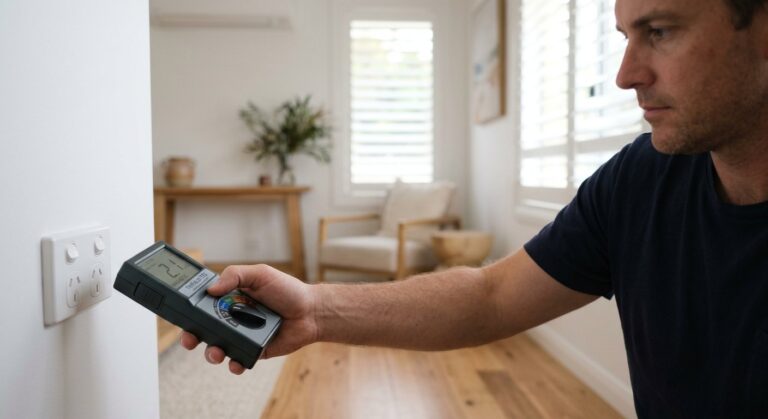
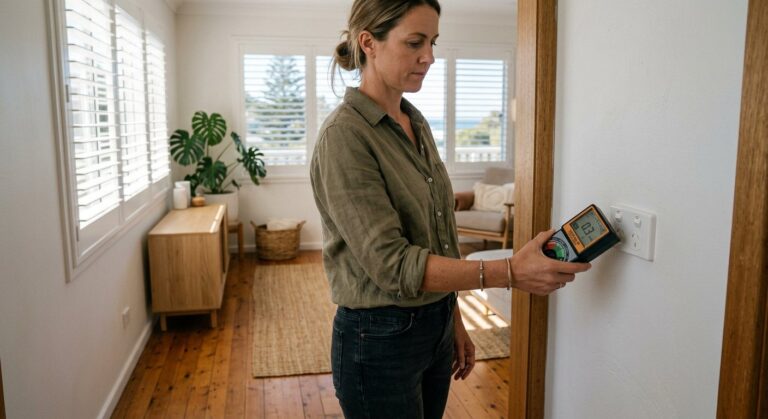
The TriField TF2 can measure AC electric fields in V/m, which gives you a room-level field reading rather than a body voltage reading — these are related but not identical measurements. For body voltage specifically, you need an AC voltmeter or a purpose-built body voltage meter. But the TF2 is what you want first, because it tells you what fields are present in the room and whether they originate from wiring (AC electric, low frequency), appliances (AC magnetic, low frequency), or wireless devices (RF/microwave). That diagnostic step determines which strategy applies.
What Earthing Cannot Do — The RF Problem
WiFi operates at 2.4 GHz and 5 GHz. 5G mobile networks operate at 700 MHz through to 26 GHz depending on band. Smart meters in Australia transmit on 900 MHz. These are radio frequency fields, and they behave completely differently from the 50 Hz AC electric fields that earthing addresses. The physics is distinct. You cannot ground away a 2.4 GHz signal any more than you can ground away the light coming through your window.
ARPANSA sets the Australian RF exposure limit at 1,000 microwatts per square centimetre at 2.4 GHz — a thermal safety limit, not a precautionary one. The Building Biology evaluation guidelines used by independent assessors set a sleeping area target of less than 0.1 milliwatts per square metre, which is 10,000 times more conservative. Most inner-city Australian bedrooms register somewhere between these two figures, and the question of whether to be concerned is a personal risk tolerance decision. What is not a personal decision is whether earthing helps: it does not, for RF.
RF reduction requires one or more of these approaches in order of priority. First, remove or disable the sources inside your room — a router on airplane mode, a phone in flight mode, a smart meter screen. Second, if external RF sources are the problem (a mobile tower 200 metres away, a neighbour’s WiFi through a shared wall), then shielding with conductive fabric or RF-blocking paint can reduce penetrating RF. Third — and this is a critical warning — if you deploy any form of Faraday enclosure (a bed canopy, a grounding sheet that claims RF blocking) while leaving active RF sources inside the enclosure, you will increase your exposure because the signal reflects rather than escapes. Measure first. Remove internal sources first. Shield external residual only.
Australian Smart Meters and the Burst Transmission Problem
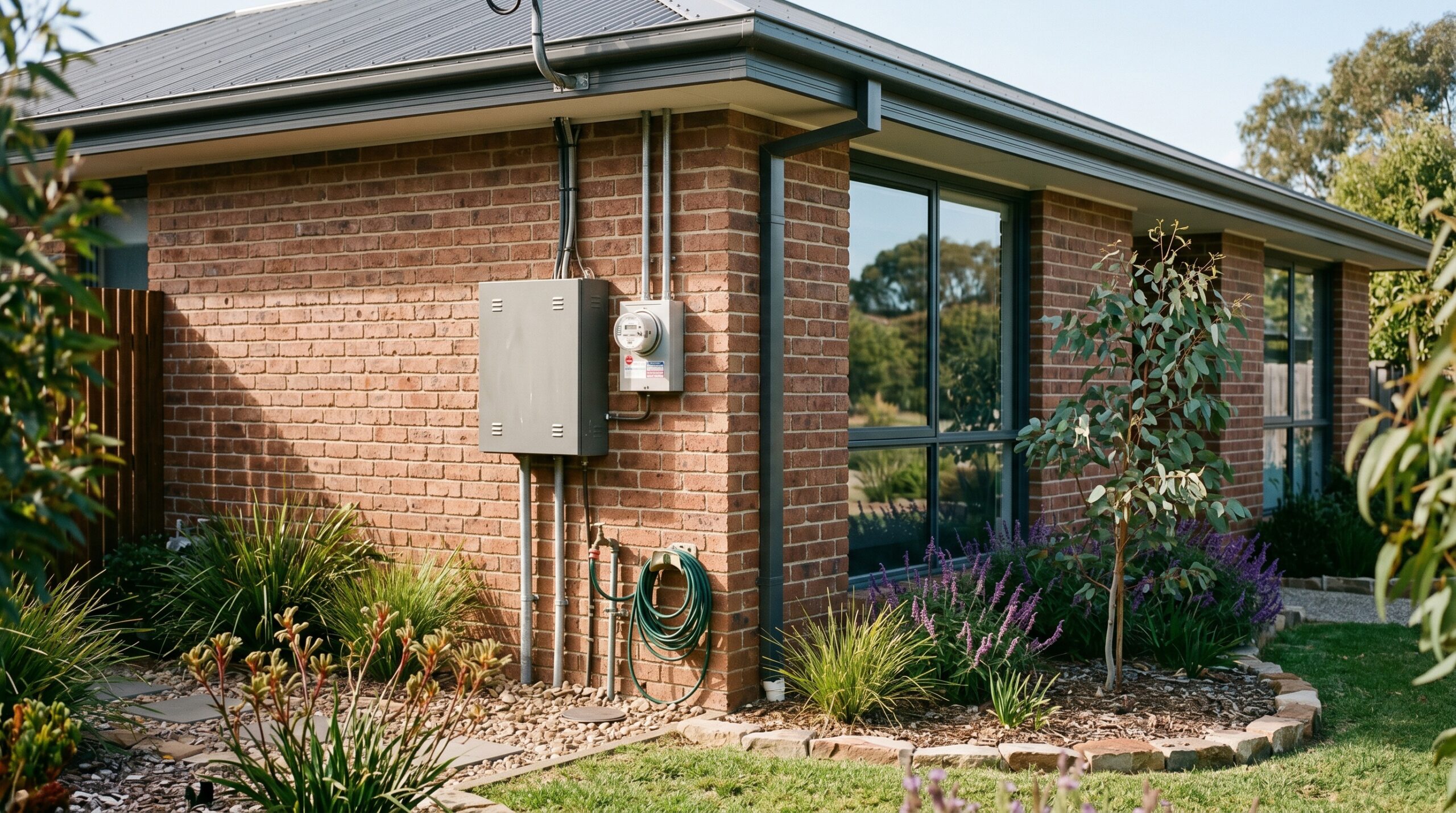
Australian smart meters transmit on 900 MHz in short bursts — typically every 30 seconds to a few minutes depending on the network and tariff. The time-averaged reading from a standard meter can look low and unremarkable. The peak reading during a transmission burst can be 100 to 1,000 times higher than the time average. If your bedroom shares a wall with your electricity meter box, those peaks are relevant. Earthing does not reduce them. A TriField TF2 on RF mode will show you the bursts if you hold it near the meter panel. Distance is your primary tool — 3 to 4 metres of separation reduces the signal to negligible levels by the inverse square law.
The Case for Using Both Strategies in an Australian Bedroom
The honest answer is that an EMF-conscious Australian bedroom needs a layered approach, and earthing is one layer — not the whole solution. Here is how the layers stack in practical terms.
The highest-impact, zero-cost intervention is putting your phone on airplane mode and switching off your WiFi router at the wall before sleep. A Jackson 24-hour mechanical timer (available on Amazon AU for around $20, ASIN B0DCGPPK5H) automates the router shutdown so you do not have to remember. These two steps alone eliminate the two largest RF sources in most Australian bedrooms.
The second layer is addressing AC electric fields from bedroom wiring. A licensed electrician can install a demand switch on your bedroom circuit — typically $100 to $150 — which cuts AC voltage to the wiring during sleep while leaving the circuit live when you need it. This eliminates the 50 Hz electric field from the wiring entirely, and body voltage drops accordingly. A grounding sheet achieves a similar outcome for your body voltage specifically, even without a demand switch, because it shorts your body to earth potential directly.
The third layer is dealing with any external RF that persists after sources are eliminated. If you live within 500 metres of a 5G base station or in a high-density urban area in inner Sydney, Melbourne, or Brisbane, there will be ambient RF you cannot eliminate at source. This is where an RF shielding canopy or grounding sheet with conductive threads can legitimately help — but only for that external residual, and only after you have measured to confirm the primary source is external, not internal.
Grounding Sheets — What the Product Does and Does Not Claim to Do
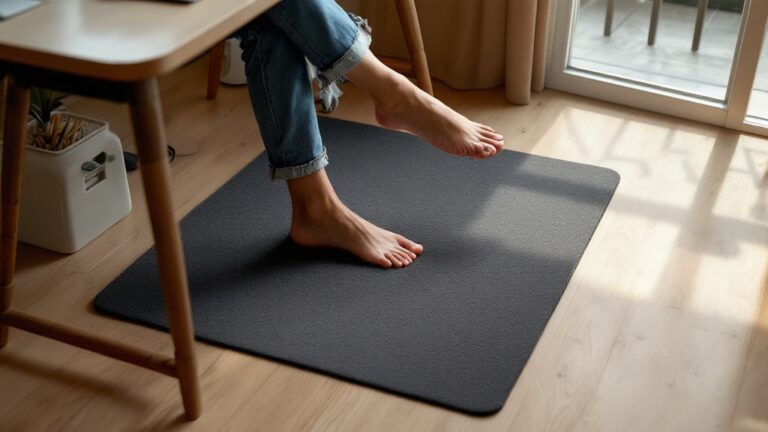
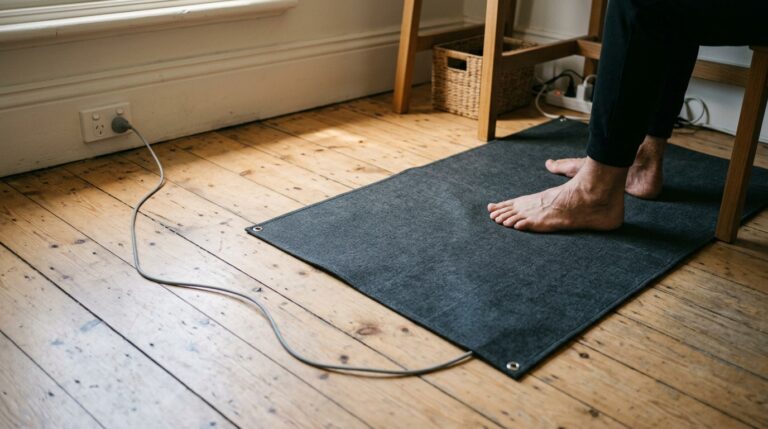
A grounding sheet contains conductive fibres (typically silver thread woven through cotton) connected via a cord to the earth pin of a power point. The earth pin is not connected to the live or neutral circuits — it is purely a ground reference. When you sleep on the sheet, your body makes contact with the conductive fibres and your body voltage equalises with earth potential. This is functional earthing through a textile, and it works for the purpose it addresses: reducing induced body voltage from AC electric fields during sleep.
Premium Grounding‘s sheets are among the better-specified options available in Australia, using silver-thread conductive fabric with a verified earth connection cord and continuity tester. The continuity tester is worth noting — it lets you confirm the earth pin in your power point is actually connected to ground, which is not guaranteed in older Australian homes with original wiring. If your earth connection reads open on the tester, the sheet will not function and you need an electrician before proceeding.

✓ Pros
- Measurably reduces induced body voltage from 50 Hz AC electric fields
- Silver-thread conductive fabric with verified continuity
- Includes earth connection tester — essential for Australian homes
- Passive operation — no power required, no RF emitted
✗ Cons
- Does not block or reduce RF radiation (WiFi, 5G, smart meters)
- Requires a functional earth connection — older Australian homes may need electrical work first
- Silver thread requires gentle washing to preserve conductivity

✓ Pros
- Measures all three EMF types in one device — AC magnetic, AC electric, and RF
- Calibrated to NIST-traceable standards
- Identifies whether ELF or RF is dominant in your room — determines which intervention applies
- Used by building biologists and independent assessors across Australia
✗ Cons
- RF mode shows power density average — misses smart meter transmission bursts without patient monitoring
- Does not measure body voltage directly (requires separate AC voltmeter for that)
A Practical Protocol for Australian Homes in 2026
The sequence matters here. Every step has a specific reason for the order it sits in.
Step one: measure. Pick up a TriField TF2 and take readings in your bedroom with everything running as normal — router on, phone on the bedside table, all devices as they usually are. Note the RF reading in milliwatts per square metre, the AC magnetic reading in milligauss, and the AC electric reading in V/m. Take a second set of readings with the router turned off and the phone in another room. The difference between those two readings tells you what your controllable sources are contributing.
Step two: eliminate controllable sources. Phone on airplane mode. Router on a mechanical timer to cut power at 10 pm and restore it at 6 am. Any other wireless devices in the bedroom — Bluetooth speakers, smart bulbs, a WiFi-connected TV — either disabled at night or moved out of the room. These interventions cost nothing except habit change, and they have the largest individual impact on your RF exposure.
Step three: address your bedroom wiring. If the TF2 AC electric reading stays elevated even after all devices are removed, the field is coming from the wiring in the walls. A demand switch eliminates this. A grounding sheet addresses it from the body side — not by reducing the field, but by preventing your body from accumulating voltage from it. Both are valid; the demand switch is more complete because it eliminates the field, while the grounding sheet equalises your body potential within it.
Step four: if external RF remains after source elimination, consider targeted shielding. For Sydney households in dense inner suburbs like Surry Hills or Newtown with multiple overlapping WiFi signals and 5G infrastructure, or for Brisbane residents near Telstra and Optus base stations in areas like South Brisbane or Fortitude Valley, ambient RF can be significant even with internal sources removed. Shielding at the window or using a bed canopy addresses incoming external RF. Do not deploy a canopy while any active RF device remains inside it.
The Role of Outdoor Earthing
Direct contact with the earth — walking barefoot on grass, sand, or soil — achieves the same electrical grounding effect as a sheet, and more completely. Bare soil and wet grass are highly conductive. A 20-minute barefoot walk on a lawn in your backyard in Palm Beach, Mount Tamborine, or anywhere else in coastal Queensland achieves measurable body voltage reduction. The research published in the Journal of Inflammation Research (Oschman et al., 2015) documented reductions in blood viscosity markers and cortisol normalisation in chronically grounded subjects. Whether these effects are clinically significant for most people remains an open research question, but the electrical mechanism — body voltage equalisation — is not in question.
The practical limitation for most urban Australians is opportunity. You are not walking barefoot on grass for 8 hours while you sleep. A grounding sheet extends the earthing window through the night, which is why it occupies a different product category from “go outside more.” Both approaches share the same physics.
Recommended Products — EMF Measurement + Grounding
See full EMF meter guide →Summary — Earthing in Context
Earthing is a legitimate intervention for one specific part of the EMF problem: induced body voltage from AC electric fields. It is not a broad-spectrum EMF protection strategy, and presenting it as one does a disservice to people who need real protection from RF-dominant environments.
For Australian homes, the priority order is clear. Eliminate controllable RF sources first — router off at night, phone on airplane mode. This is free and takes two minutes. If AC electric fields from wiring are your dominant issue, a grounding sheet or demand switch addresses that directly. If you live in a high-density urban area of Sydney, Melbourne, or Brisbane with significant ambient RF from external infrastructure, measure that residual with a TF2 and consider targeted shielding for external signals only.
Earthing earns its place in that protocol as one evidence-based tool among several. It does what it does. Know what that is, and you will not be disappointed by what it is not. For the broader protocol — measuring your home before choosing products — see our Complete EMF Guide for Australian Homes.
Last reviewed: June 2026 — Clean and Native
Measure your bedroom first. Every other decision follows from that.
The TriField TF2 shows you whether your room is ELF-dominated (wiring) or RF-dominated (wireless). That single measurement determines whether earthing is relevant for your specific situation or whether source reduction and shielding need to come first.
Frequently Asked Questions
Earthing reduces induced body voltage from 50 Hz AC electric fields by connecting your body to the earth’s ground potential. It does not reduce, block, or shield RF radiation from WiFi, 5G, mobile networks, or smart meters. These are two entirely separate mechanisms requiring different interventions.
No. A standard grounding sheet connects your body to earth potential, which addresses AC electric field induction at 50 Hz. 5G signals operate at 700 MHz to 26 GHz — these are radio frequency fields that require shielding material (conductive fabric or RF-blocking paint) for any reduction. A grounding sheet does not provide meaningful 5G shielding.
ARPANSA does not have a specific position on earthing as an EMF intervention. ARPANSA does acknowledge that ELF electric and magnetic fields from electricity may cause health effects, with childhood leukaemia cited as the association with the strongest evidence base. Their general guidance supports reducing unnecessary ELF exposure where practical, which earthing is consistent with for the AC electric field component.
Use a TriField TF2 or equivalent calibrated meter. In RF mode, take a reading with all wireless devices on, then repeat with everything switched off. In AC electric mode, take a reading with devices on, then repeat. If the dominant reading drops significantly when you turn off wireless devices, RF is your primary issue. If the AC electric reading stays high regardless of wireless devices, your wiring is the dominant source — and earthing is directly relevant to that.
The electrical mechanism — body voltage reduction through connection to earth ground potential — is instrumentally verified and not disputed. Research published in the Journal of Environmental and Public Health (Chevalier et al., 2012) and Journal of Inflammation Research (Oschman et al., 2015) documents physiological correlates in grounded subjects. Whether these translate into clinically meaningful health outcomes remains an active research area without definitive consensus.
Not necessarily, but you need to verify your earth connection first. Use the continuity tester included with quality grounding sheets like the Premium Grounding range to confirm the earth pin in your power point is actually connected to ground. If the tester shows an open circuit, stop and call a licensed electrician. Older Australian homes — particularly those built before the 1980s — sometimes have inadequate earthing that needs remediation regardless of any grounding sheet use.
Body voltage is the AC electrical potential your body accumulates when surrounded by 230V mains wiring. An ungrounded person in a typical Australian bedroom typically measures 500 mV to 3,000 mV AC. Building Biology guidelines (SBM-2015) recommend less than 10 mV in sleeping areas. Grounding reduces this to under 100 mV in most cases, and often below 10 mV with direct skin contact on a conductive sheet.
Put your phone on airplane mode and switch your WiFi router off at the wall before sleep. These two steps are free, take under two minutes, and eliminate the two largest controllable RF sources in most Australian bedrooms. A Jackson 24-hour mechanical timer on the router automates the nightly shutdown. Do this before spending money on any grounding or shielding product.
Yes, and the combination is appropriate if your room has both AC electric field issues (from wiring) and persistent external RF (from a mobile tower or neighbour’s WiFi that you cannot eliminate at source). The grounding sheet addresses ELF body voltage. RF shielding addresses incoming radio frequency from outside. They target different parts of the spectrum and do not interfere with each other. Confirm all internal RF sources are off before deploying any shielding enclosure.
Get the Australian Home Environment Checklist
30 checks across water, air and EMF. Most of them free. Ranked by impact.
No spam. Unsubscribe any time.

Former Royal Australian Navy Clearance Diver and TAG-E counter-terrorism operator. Founded Clean and Native to apply the same rigorous thinking to the home environment.
Full biography →