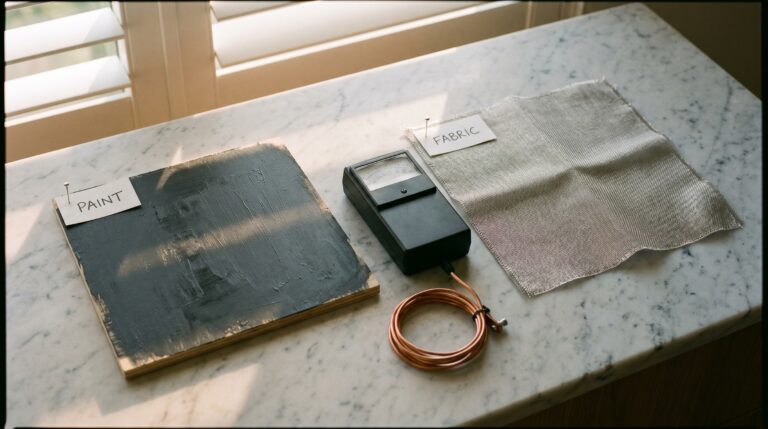
How to Ground Yourself in an Apartment or Rental: The Australian Renter’s Earthing Guide (2026)
Quick Verdict
Apartment Renters Can Earth Indoors — Three Methods That Work
Australian 3-pin sockets include an earth pin you can use safely with any earthing mat, band, or sheet. No drilling, no landlord sign-off required — just a grounded outlet, which every AU home has.
The Apartment Earthing Problem
Walk barefoot on grass for twenty minutes and you are grounded — electrons from the earth’s surface transfer into your body through direct skin contact. That is the entire mechanism. No device required. But if you live on the fourth floor of a concrete apartment block in Brisbane or Sydney, grass is not outside your bedroom door.
The standard solution is a grounding mat or sheet connected via a 3-pin plug to your building’s earth — the third pin in an Australian power point that is physically wired back to a ground rod buried outside the building. When it works, it is a genuine electrical connection to the earth. Your body’s voltage drops to match ground potential. That is measurable with a body voltage meter. The problem is that “works” is doing a lot of heavy lifting in that sentence.
Australian apartment buildings constructed before the 1966 adoption of mandatory earthing requirements under AS/NZS 3000 (the Wiring Rules) may have been retrofitted with 3-pin socket faces without re-wiring the earth conductor behind the wall. The socket looks earthed. The indicator light on a cheap power board may not catch it. But the earth pin connects to nothing. Plug a grounding mat in and you are not grounded — you are just sitting on a mat.
Older Queenslanders in Brisbane and Ipswich subdivided into rental flats, 1950s cream-brick walk-ups in Melbourne’s inner suburbs, and concrete towers built in the 1960s and 1970s across Sydney, Perth, and Adelaide are the highest-risk categories. Even newer buildings are not immune — a single improperly terminated earth at one outlet does not mean the rest of the building is fine. You have to check your specific outlet.
There is a second issue specific to apartments that almost nobody discusses. Multi-unit buildings concentrate electrical infrastructure. A high-rise in Sydney or Melbourne may have a central switchboard, multiple sub-boards per floor, dozens of smart meters transmitting at 900 MHz in burst mode (per ARPANSA documentation on smart meter radiofrequency emissions), and shared WiFi infrastructure in common areas. You are closer to more electrical sources than you would be in a detached house. A grounding mat addresses body voltage from the electrical field component of exposure — it does not reduce radiofrequency from a smart meter in the hallway. Grounding is one tool. It does one thing. Know what that thing is.
Step 1 — Verify Your Outlet Is Earthed
Before buying a single grounding product, spend ~$15 on a 3-indicator outlet tester on Amazon AU. These are small plug-in devices with three LED lights. The light pattern tells you the outlet’s wiring configuration. The combination you want is: right light on, middle light on, left light off — this indicates correct wiring with active live, neutral, and earth. If all three lights show a different pattern, your outlet has a wiring fault.
The specific patterns vary slightly between tester brands, but the units come with a legend on the face plate. The most common fault you will find in older Australian rentals is “open earth” — live and neutral are connected, earth is not. The outlet works fine for powering a lamp. It cannot ground you.
What to do if the outlet is not earthed
Document it. Photograph the tester readout with the outlet in frame. Then report it in writing to your property manager. Under AS/NZS 3000:2018 (the Australian and New Zealand Wiring Rules), an open earth is an electrical fault. It is not a cosmetic issue. Landlords have a legal obligation to maintain the property in a safe, habitable condition — an unearthed outlet is a legitimate electrical safety failure, not a preference-based request.
Most property managers will arrange a licensed electrician within a reasonable timeframe once the fault is documented in writing. A single outlet re-earth takes an electrician less than an hour. If your property manager refuses to act, your state’s tenancy authority is the next step — Fair Trading NSW, RTA Queensland, Consumer Affairs Victoria, Consumer Protection WA, and CBS South Australia all have formal dispute processes for maintenance failures.
Testing your body voltage directly
If you want a more precise measure, a body voltage test tells you exactly what the electrical field exposure is at your sleep location and whether a grounding connection reduces it. You hold one probe, the other touches ground, and you read the AC millivolt figure on a multimeter. Grounded body voltage below 100 mV is the Building Biology SBM-2015 guideline target for a sleeping area. Ungrounded, many people in apartments read between 500 mV and 2,000 mV depending on proximity to wiring in walls and ceiling.
Grounding Products — Verified for Australian Rentals
If Your Earth Works: Best Grounding Products for Renters
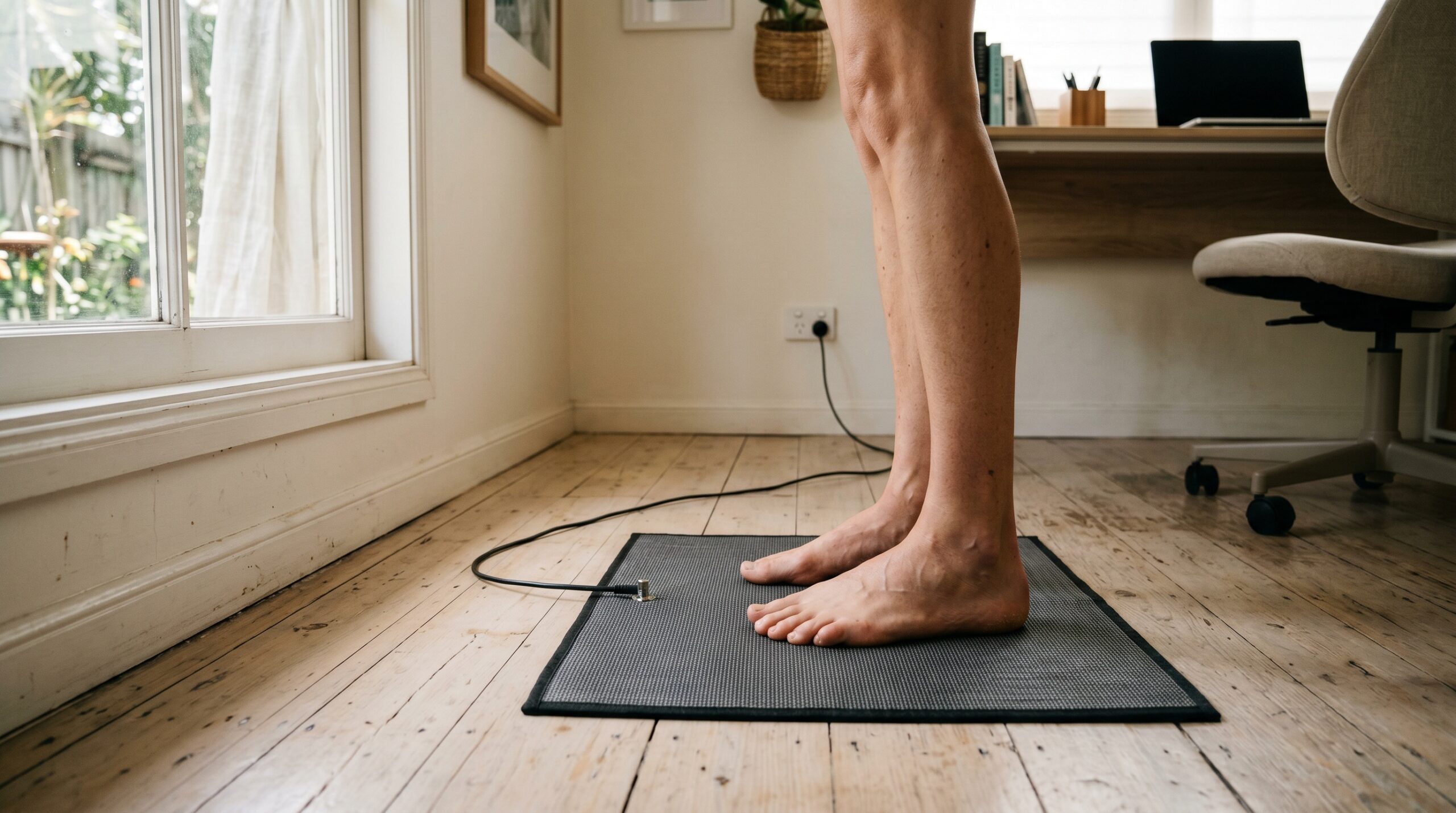
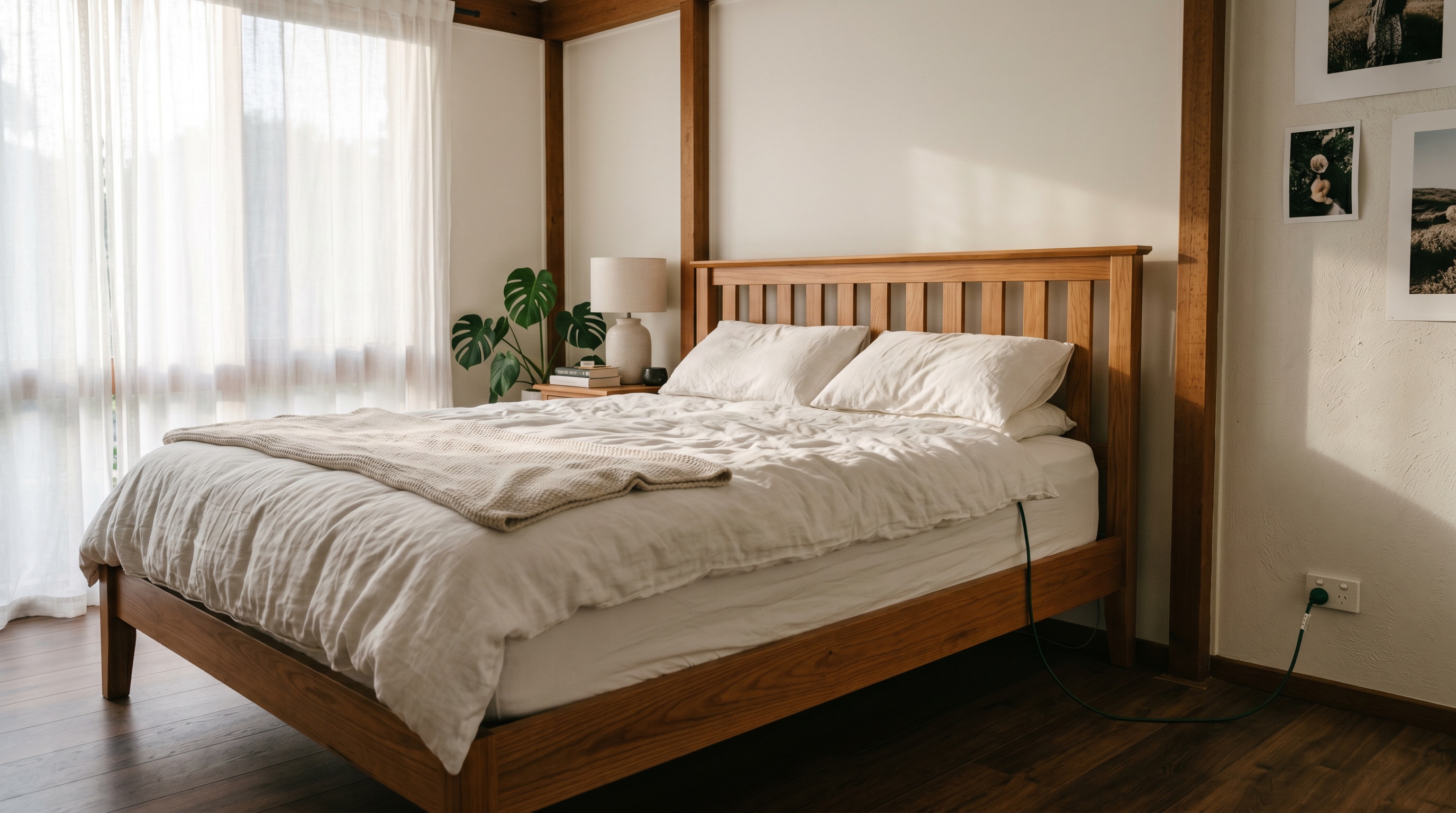
Once you have a confirmed, working earth in your outlet, two products cover the main grounding scenarios for a rental: a grounding mat for daytime use and a grounding sheet for sleep. Neither requires drilling, adhesive, or any modification to the property. Both are completely compatible with standard rental agreements.

✓ Pros
- Stainless-steel surface — conductive, durable, no fabric degradation
- Ships with an Australian-standard 3-pin earthing cord (no adaptor needed)
- No permanent installation — no lease risk
- Works under a standing desk, on the floor, or on a bed surface
✗ Cons
- Requires verified, functioning earth in outlet — does not work without it
- Hard surface not suitable for overnight sleep contact on its own
- Does not reduce RF from smart meters or WiFi — grounding addresses body voltage only

✓ Pros
- Up to 8 hours continuous grounding during sleep — the longest daily window
- Conductive silver-thread weave maintains conductivity through fabric
- No property modification — lies over existing linen
- Compatible with standard Australian bedding sizes
✗ Cons
- Silver threads degrade with harsh detergents — requires gentle machine wash
- Requires confirmed working outlet earth — non-negotiable prerequisite
- Cord runs from bed to outlet — minor trip-hazard management needed
Does it work through carpet?
The grounding mat’s cord bypasses the carpet entirely — it is electrically connected via the cord to the outlet earth, not through the floor material. Whether you place the mat on carpet, tiles, timber, or concrete does not affect the earth connection. The mat works the same on carpet as on bare tiles. What matters is the skin-to-mat contact surface, not what is underneath the mat.
Outlet placement and cord length
In most apartments, the bedroom outlet is within 3-4 metres of the bed. Standard Premium Grounding cords are 4.6 metres. If your outlet is further away, an extension lead connected to the earth cord is fine electrically, provided the extension lead itself is connected to an earthed outlet. Do not use a double adaptor that bypasses the earth pin.
If Your Earth Doesn’t Work: Outdoor Grounding Options
An open earth in your outlet does not mean you cannot ground. It means you cannot use the building’s electrical infrastructure to do it. You need to go around the building wiring entirely.
The outdoor ground rod method
This is the same method used in standalone grounding kits sold for off-grid use. A copper-coated steel ground rod (typically 600 mm to 900 mm long) is pushed into the earth outside the building. A lead wire runs from the rod, through a window or door gap, to the grounding mat or sheet inside. No electrical connection to the building whatsoever.
The ground rod needs to be in direct soil contact. Concrete paving, tiling, or sealed surfaces do not conduct well enough. A garden bed beside the building, a lawn area, or exposed soil behind a fence line all work. Moisture improves conductivity significantly — a rod sunk into moist clay soil reads a far lower ground impedance than one in dry sandy soil. If you are in Perth or another dry-climate city, water the rod location periodically.
Ground floor and low-rise tenants
If you have outdoor access — a courtyard, a small garden area, or even a patch of soil beside a ground-floor door — the rod method is simple and costs under $40 in materials from any hardware store. A copper-coated rod, a length of 1.5mm stranded copper wire, and a banana-to-snap connector to interface with the grounding mat cord. No electrician needed because there is no electrical connection involved — it is a direct earth connection, not a live circuit.
High-rise with a concrete balcony
Concrete is not an insulator in the way most people assume, but the conductivity of a typical residential concrete slab is inconsistent and depends on moisture content, rebar density, and the slab’s connection to the building’s earthing system. Standing barefoot on a concrete balcony may provide some electron transfer, but it is not reliable or measurable in the way a direct soil or verified outlet-earth connection is.
If you are above the third floor with no soil access, your realistic options are: request the landlord repair the outlet earth (see the next section on your rights), or accept that direct grounding is not currently achievable and focus on the other components of low-EMF sleep — removing wireless devices from the bedroom, using a mechanical timer to cut the router overnight, and keeping the phone in aeroplane mode. These are meaningful reductions in their own right, even without a grounding connection.
Your Rights as a Tenant Under AS/NZS 3000
An unearthed outlet is not a grey area. Under AS/NZS 3000:2018 — the Australian and New Zealand Wiring Rules, which are the enforceable electrical standard referenced in every Australian state’s electrical safety legislation — an open earth conductor in a socket outlet is a wiring fault. It is not a feature of older construction that landlords are permitted to maintain indefinitely.
Every Australian state and territory has enacted residential tenancy legislation that requires landlords to maintain the property in a safe and habitable condition. The specific Acts are: the Residential Tenancies Act 2010 (NSW), the Residential Tenancies and Rooming Accommodation Act 2008 (QLD), the Residential Tenancies Act 1997 (VIC), the Residential Tenancies Act 1995 (SA), the Residential Tenancies Act 1987 (WA), the Residential Tenancies Act 1997 (ACT), and the Residential Tenancies Act 1999 (NT). All of them, without exception, place electrical safety maintenance on the landlord.
How to frame the request
Do not send a message saying “I want to ground myself and need an earthed outlet.” Property managers do not know what grounding is and will dismiss the request. Send a message saying: “I have identified an electrical fault at the power point in the bedroom — the outlet tester shows an open earth condition. This is a wiring fault under AS/NZS 3000. Please arrange a licensed electrician to rectify it at the landlord’s cost.”
That framing is accurate, legally grounded (no pun intended), and difficult to refuse. Document the request in writing via email or the property management portal. Keep the outlet tester photograph. If the fault is not rectified within a reasonable timeframe — typically 14 days for a non-emergency fault, 24-48 hours for something classified as a safety hazard — you have grounds to escalate to your state tenancy authority.
Costs and who pays
Re-earthing a single outlet typically costs $80 to $150 in labour for a licensed electrician. If the entire switchboard lacks an earth bus bar or the main earth conductor is missing — which can occur in pre-1960s buildings — the cost rises significantly and the fault is even more clearly the landlord’s responsibility. You are not asking for a renovation. You are asking for compliance with a mandatory electrical standard.
Decision Guide: Which Approach Is Right for You
Three questions narrow this down quickly.
Question 1: Is your outlet earthed?
Buy an outlet tester and check before anything else. If the outlet is confirmed earthed: go straight to the product section above. If it is not earthed: move to question 2.
Question 2: Do you have outdoor soil access?
Ground floor or low-rise with a courtyard, garden bed, or lawn area: use an outdoor rod setup while simultaneously requesting the landlord repair the electrical fault. High-rise with no soil access: request the landlord repair the fault as the primary path, and avoid spending on grounding products until the earth is confirmed working.
Question 3: What is your primary goal — daytime or overnight grounding?
If you work from home and spend significant time at a desk: the grounding mat under the desk is your highest-use product. Feet rest on the mat, hands occasionally touch the surface, and you accumulate grounding contact during productive hours without any deliberate routine change. If sleep quality or overnight body voltage is your focus: the grounding sheet is the better tool. Eight hours is eight hours. Nothing during the day competes with that duration.
You can use both. Many people do — mat under the desk during the day, sheet on the bed at night. Both can be connected to the same verified earthed outlet. There is no conflict in running two earthing connections simultaneously from the same ground reference.
Decision Guide Summary
| Your Situation | First Action | Product |
|---|---|---|
| Earthed outlet + desk work | Verify earth, buy mat | Premium Grounding Mat |
| Earthed outlet + sleep focus | Verify earth, buy sheet | Premium Grounding Sheet |
| Open earth + ground floor | Outdoor rod + request repair | Rod kit + mat |
| Open earth + high-rise | Formal landlord repair request | Hold off until earth confirmed |
Last reviewed: June 2026 — Clean and Native
Our Verdict
For Australian renters with a verified earthed outlet, the Premium Grounding Sheet is the better starting point — it delivers the longest daily grounding window (seven to eight hours during sleep) with zero property modification and zero lease risk. If you primarily work from home, pair it with the Premium Grounding Mat under your desk for continuous daytime contact. If your outlet tests as open earth, do not spend a dollar on products until you have sent a written fault report to your property manager citing AS/NZS 3000:2018 — the repair is the landlord’s responsibility and typically costs less than $150 for a single outlet.
Grounding is not complicated once the earth question is answered. It is a direct electrical connection to the earth through your building’s existing infrastructure. That is either working or it is not. Find out which one you have, then act accordingly.
Final Verdict
If your Australian rental has properly earthed power outlets — most properties built after 1970 do — an indoor grounding mat or sheet connected via a standard 3-pin cord gives you full electrical earthing without modifying anything or requiring landlord approval. For older rentals with uncertain earthing, a $15 outlet tester confirms before you buy: if your outlets fail, an outdoor earthing rod driven into garden soil is the only reliable alternative.
Frequently Asked Questions
Yes, if the building’s electrical earth is functioning correctly. A grounding mat or sheet connected via a 3-pin cord to a verified earthed outlet works identically on the 15th floor as it does on the ground floor — the earth path runs through the building’s wiring back to the main earthing system. The floor you are on is irrelevant. What matters is whether the outlet’s earth conductor is actually connected, which you verify with a $15 outlet tester.
Yes. The grounding connection runs through the cord to the outlet’s earth terminal, not through the floor. The mat sitting on carpet versus tiles versus concrete makes no difference to the electrical connection. What matters is skin contact with the mat surface itself.
Concrete provides inconsistent and unreliable grounding. It depends on moisture content, the presence of reinforcing steel, and whether the slab is connected to the building’s earthing system. Barefoot contact with a concrete balcony may provide partial electron transfer but is not a measurable or consistent ground connection. A verified outlet earth or a direct soil rod connection is more reliable.
Buy a 3-indicator outlet tester from Bunnings or Jaycar for around $15. Plug it into the outlet. The LED pattern tells you the wiring status. The correct reading for a properly wired Australian outlet is right light on, middle light on, left light off. Any other pattern indicates a fault. Photograph the readout for your records.
Yes — and it is not a request, it is a maintenance obligation. An open earth is an electrical fault under AS/NZS 3000:2018, the Australian Wiring Rules. Australian tenancy legislation in every state requires landlords to maintain the property’s electrical safety. Frame your written request as a safety rectification, not a lifestyle preference. Include the outlet tester photograph and cite AS/NZS 3000 by name.
No. A grounding sheet reduces AC body voltage — the electrical field component of EMF from wiring in walls and ceilings. It does not reduce radiofrequency radiation from smart meters, WiFi routers, or mobile base stations. Those require separate measures: router timers, aeroplane mode on phones, or RF shielding. Grounding is one tool that does one specific thing.
Yes, for ground-floor and low-rise tenants with soil access. The rod setup involves no connection to the building’s electrical system — it is a direct earth path to soil, not a live circuit. The cord runs from the rod through a window gap or door seal to the mat inside. No electrician required because there is no electrical installation involved. The rod must be in direct moist soil contact for reliable conductivity.
Yes. Both can be connected to the same earthed outlet simultaneously. There is no electrical conflict in running two earth connections from the same ground reference. Many people use a mat during the day under their desk and a sheet overnight — the two products serve different contact windows and are fully compatible.
No. Grounding requires direct skin-to-conductive-surface contact. Thick wool, synthetic fibres, and rubber all insulate. Thin cotton socks are also insufficient. For the mat, bare feet or bare skin contact is required. The grounding sheet works through direct skin contact with the sheet surface — sleeping with a separate thick synthetic blanket between you and the sheet breaks the connection.
Best Earthing Products Australia 2026: Mats, Sheets, Pillowcases & Bands
Compare every earthing product category tested in Australia →Get the Australian Home Environment Checklist
30 checks across water, air and EMF. Most of them free. Ranked by impact.
No spam. Unsubscribe any time.

Former Royal Australian Navy Clearance Diver and TAG-E counter-terrorism operator. Founded Clean and Native to apply the same rigorous thinking to the home environment.
Full biography →