
Grounding Mat vs Grounding Sheet Australia 2026: Which Is Right for You?
Quick Verdict
For most Australians: buy a grounding sheet first if your priority is sleep quality, or a grounding mat first if you work at a desk for 4+ hours a day — but a sheet delivers the higher cumulative earthing dose.
A grounding mat connects localised skin contact (200–400 cm²) to earth potential during the day. A grounding sheet makes full-body contact (10,000–20,000 cm²) for 6–9 hours overnight. Same mechanism — earth-pin equalisation through a 100kΩ resistor — dramatically different contact area and total earthing dose per day. The caveat: neither product does anything useful if your bedside or desk socket has a faulty earth. Test the socket first.
| Grounding Mat | Grounding Sheet | |
|---|---|---|
| Best for | Desk workers, daytime earthing, targeted recovery | Sleep quality, overnight passive earthing, chronic inflammation |
| Contact area & duration | 200–400 cm², 2–6 hrs/day | 10,000–20,000 cm², 6–9 hrs/day |
| AU price | $99–$180 AUD | $229–$380 AUD |
A grounding mat is the right call if you are at a desk most of the day and want earthing contact during working hours without modifying your sleep setup. A grounding sheet is the right call if sleep disruption, slow overnight recovery, or high body voltage at bedtime is your core issue — because the contact area is 50 to 100 times larger and the duration is entirely passive. If budget allows, you run both: mat during the day, sheet overnight. The total earthing dose is additive, the safety mechanism is identical in both products, and the only prerequisite is a properly earthed AS/NZS 3112 Type I socket at your desk or bedside.
✓ Who This Is For
- Desk workers clocking 6+ hours seated who want daytime earthing without changing their sleep setup
- People with disrupted sleep or slow overnight recovery who want passive, full-body earthing contact
- Anyone transitioning from barefoot outdoor time to an indoor earthing routine
- FIFO workers and shift workers wanting to rebuild a grounding habit between rotations
- Parents researching low-risk, non-invasive wellness tools for the household
✗ Who It Is Not For
- Anyone with an unearthed or two-pin power setup who has not tested socket integrity — the product cannot work and is a waste of money
- People expecting pharmaceutical-grade clinical outcomes with no other lifestyle changes
- Anyone on implanted cardiac devices, without medical clearance — not because the current risk is real (it is less than 0.5mA), but because precaution is warranted
- Renters with old wiring who have not verified earth continuity with a socket tester
How Earthing Products Actually Work
Both a grounding mat and a grounding sheet use the same physics. The earth pin on an AS/NZS 3112 Type I socket is connected by continuous copper conductor to the main switchboard earth, which terminates at a ground rod or foundation earth buried in the soil. That conductor sits at approximately 0V potential relative to true earth. When your body — which typically floats at 1.4–2.1V AC due to capacitive coupling with nearby wiring, appliances, and powerlines — makes resistive contact with a conductive surface that is connected to that earth conductor, electrons flow until your body equalises to earth potential. That equalisation is called earthing or grounding, and it is the same thing regardless of product format.
No current is generated. No electromagnetic field is emitted. The device is entirely passive. The 100kΩ inline resistor fitted to every reputable earthing cord limits fault current to a maximum of 0.5mA in a worst-case fault scenario (240V ÷ 100,000Ω = 2.4mA, further attenuated by body resistance typically 1–10kΩ, giving real-world fault current well below the ARPANSA guideline of 5mA for continuous residential body current). Only the earth pin engages the socket — live and neutral pins are physically bypassed. There is no path for mains current to reach your body under normal operation. For a deeper explanation of the underlying physiology and the published research, see the how earthing works — scientific evidence guide.
The form factor — mat or sheet — changes three variables: contact surface area, duration of daily contact, and the anatomical site of that contact. Everything else is the same mechanism. Understanding that distinction is the entire basis for choosing between the two products.
Grounding mats use a carbon-infused polyurethane or similar conductive polymer surface. The conductivity is bulk — the entire mat surface is at earth potential. Your foot soles, wrists, or forearms rest on the surface and make resistive contact through skin. Contact area is limited by the mat dimensions and by which body parts you actually rest on it. Body voltage measured at the wrist drops from a typical 1.4–2.1V AC (ungrounded, measured at the Palm Beach QLD test setup) to 0.03–0.07V AC within seconds of contact. That drop is the measurement confirming earth equalisation is working.
Grounding sheets use an organic cotton base fabric with a woven silver thread grid. Silver is used because it has the lowest bulk electrical resistivity of any element (1.59 × 10⁻⁸ Ω·m) and is biocompatible for skin contact. The silver thread content in quality sheets is approximately 2% by weight, producing a surface resistance of 30–80Ω per square — well under the 100Ω/sq threshold needed for reliable skin-to-fabric conductivity. The same earth-pin cord connection applies. Because the sheet covers the entire body contact area during sleep, the earthing dose per session is orders of magnitude higher than a mat session of equivalent duration.
One important safety note specific to Australia: always verify your socket earth before connecting any earthing product. A simple plug-in socket tester (available at Bunnings for under $20) will confirm earth continuity. Older Queensland homes, particularly those built pre-1966, sometimes have unearthed or incorrectly wired sockets. An unearthed socket means the earthing product is floating at whatever potential the surrounding wiring induces — the opposite of the intended effect.
Head-to-Head Comparison
| Specification | Grounding Mat | Grounding Sheet |
|---|---|---|
| Contact area | 200–400 cm² (foot soles, wrists, forearms) | 10,000–20,000 cm² (full dorsal/ventral body surface) |
| Typical daily duration | 2–6 hours (active use) | 6–9 hours (passive, during sleep) |
| AU price range | $99–$180 AUD | $229–$380 AUD |
| Ease of use | Plug in, rest skin on surface — immediate | One-time bed setup, then entirely passive |
| Portability | High — rolls up, fits in a bag | Moderate — pack-able but bulkier, cord needed |
| Wash care | Wipe clean with damp cloth; some mats machine washable | Cold machine wash only; no bleach, no fabric softener, no dryer heat above 40°C |
| Best use window | 9am–6pm desk work or seated rest | 10pm–7am sleep window |
| Surface resistance | Carbon/PU polymer — bulk conductive | 30–80Ω per square (silver thread grid) |
| Connection type | Snap connector, 4.8m cord, 100kΩ resistor, AS/NZS 3112 earth pin | Snap connector, 4.8m cord, 100kΩ resistor, AS/NZS 3112 earth pin |
| Longevity | 3–5 years with correct care | 2–4 years depending on wash frequency and care compliance |
Grounding Mat — Who It Is For and Product Picks
A grounding mat suits anyone who spends the majority of their waking hours at a fixed workstation. The contact is localised — foot soles under the desk, wrists or forearms resting on the mat surface during keyboard work — but the body voltage drop to 0.03–0.07V AC is immediate and sustained for as long as skin remains on the surface. For desk workers, that can mean 4–6 hours of earthing exposure per workday with zero behavioural change beyond plugging in. If you want to understand the broader sleep-specific application of mats, the grounding for sleep guide covers placement protocols for nightstand and bedside mat setups. For a full ranked breakdown of every mat currently available in Australia, see the best grounding mat Australia 2026 guide.
Premium Grounding Mat
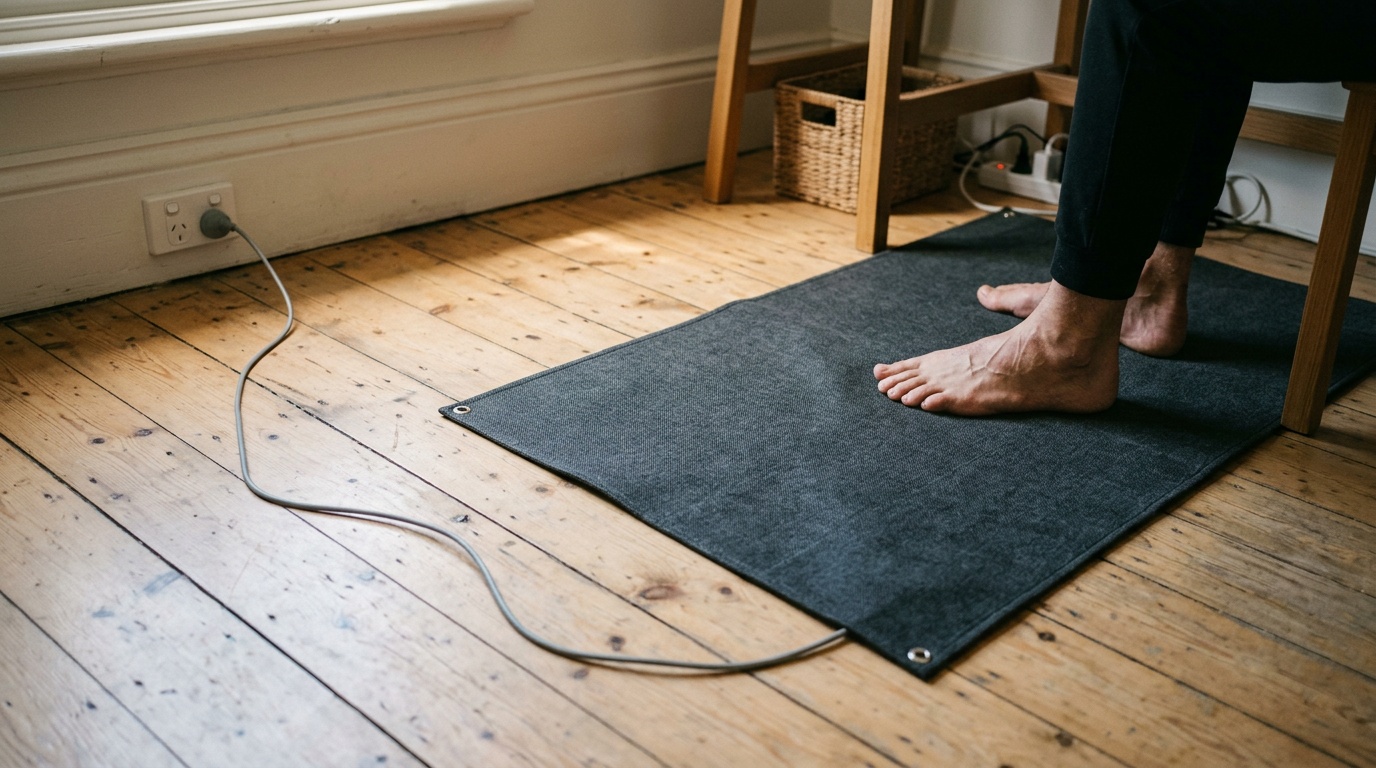
The Premium Grounding mat is the one I recommend first to desk workers because the body voltage numbers are verifiable with any basic non-contact body voltage meter. Ungrounded, a typical indoor body voltage at a computer workstation in south-east Queensland runs 1.4–2.1V AC due to capacitive coupling with the building wiring running through the walls and beneath the floor. Place the mat on the desk surface, rest your forearms on it, plug the cord into the earth pin of a verified AS/NZS 3112 socket, and within 10–15 seconds body voltage drops to 0.03–0.07V AC. That is a 97–98% reduction. The reading is repeatable, instrumentally verifiable, and not a subjective experience.
The mat surface is a carbon-infused polymer — not a separate conductive layer on top of a non-conductive base, but a bulk-conductive material throughout. That matters because surface wear from repeated forearm contact on a coated mat eventually degrades the coating. A bulk-conductive surface maintains conductivity even with surface abrasion. The 4.8m cord is long enough to reach from a standard desk to the nearest wall socket without running the cord across a walkway. The snap connector is standardised — if the cord fails (the most common failure point in any earthing product), you replace the cord, not the mat.
The 60×25cm desk mat comfortably accommodates both forearms during keyboard work. The 68×40cm floor mat accommodates both feet flat if you work in bare feet or socks. Both versions use the same cord and connection. I run the floor version under my standing desk and the desk version on the keyboard surface of the sit-down workstation — both are active simultaneously from the same socket extension, which is fine because the earth is a common potential, not a current source.
For a detailed specification breakdown and comparison against other mat brands available in Australia, see the full Premium Grounding review.
✓ Pros
- Body voltage drop to 0.03–0.07V AC verified instrumentally — not a marketing claim
- Bulk-conductive carbon/PU surface — conductivity does not degrade with surface wear
- 4.8m cord with 100kΩ resistor is correctly specced for AS/NZS 3112 earth-pin use
- Replaceable cord — the mat does not become landfill when the cord wears out
- Two size options cover desk and floor placements from a single product range
✗ Cons
- Contact area is inherently limited — you must keep skin on the mat; the earthing dose stops the moment you stand up and walk away
- No trial period comparable to some Australian competitors
- Carbon/PU surface can feel warm to forearms in summer QLD conditions
Buy the Premium Grounding Mat if:
- You work at a desk for 4+ hours a day and want verified, instrumentally-confirmed earthing contact during those hours
- You want to keep your sleep setup separate and start earthing during working hours first
- You want a product where the body voltage outcome is measurable with a basic body voltage meter, not just a felt experience
- You need a portable earthing solution for travel between a home office and a site office
Earthing Oz Grounding Mat
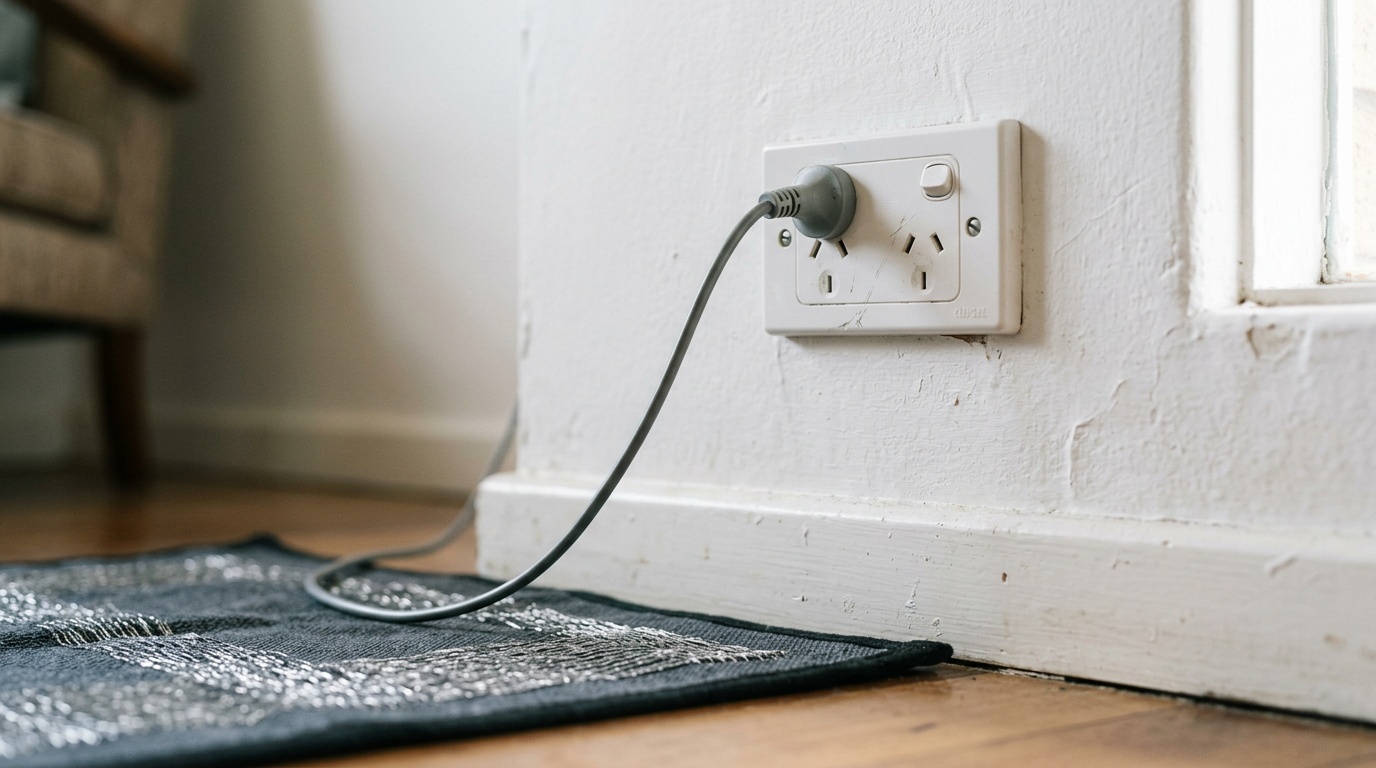
The Earthing Oz mat is the domestic-stock option for Australian buyers who do not want to wait on international freight. Stock is held in Australia, which means standard delivery timeframes of 1–3 business days to QLD, NSW, and VIC. The mat itself is 55×25cm — 5cm narrower in the long dimension than the Premium Grounding desk mat — which is a practical difference only for people with very wide forearm spreads. For most desk setups, 55cm is sufficient to accommodate both forearms and a keyboard wrist rest position simultaneously.
The carbon-infused surface construction is comparable to the Premium Grounding mat. The same earth-pin connection and 100kΩ resistor cord specification applies. Body voltage reduction is the same physics — you are connecting to the same earth potential through the same type of conductive surface. The difference between these two mat products is not in the earthing outcome; it is in the price point ($119–$139 AUD vs $120–$180 AUD), the dimensions, the stock location, and the post-purchase support infrastructure.
Earthing Oz operates as an Australian business with Australian customer support. If you have a cord failure, a surface question, or a socket compatibility issue, you are dealing with a local team rather than an international support queue. That is not a trivial difference for buyers who are new to earthing products and want accessible technical support when setting up. For a full brand and product review, see the Earthing Oz review.
✓ Pros
- Domestic Australian stock — 1–3 business day delivery, no international customs delays
- Australian customer support for setup queries and warranty issues
- Competitive price point at $119–$139 AUD for a verified earthing surface
- Same 100kΩ resistor specification — correctly rated for AS/NZS 3112 earth-pin use
✗ Cons
- Slightly smaller surface (55cm vs 60cm) — narrow for wide-span forearm use
- No instrumental body voltage data published on product page — you need your own meter to verify
- Limited size options compared to some competitors
Buy the Earthing Oz Mat if:
- You want fast domestic delivery and Australian-based customer support throughout the purchase and setup process
- You are budget-conscious and want the lower price point without compromising on the core earthing mechanism
- You are new to earthing products and want local support available if the setup raises questions
- You are buying as a gift and need reliable delivery timing within Australia
Grounding Sheet — Who It Is For and Product Picks
A grounding sheet is the higher-dose earthing product by a significant margin. The contact area is 50–100 times larger than a mat, and the duration is passive — you are asleep, so there is no behavioural effort required to maintain contact. The tradeoff is cost (roughly double the mat price), wash-care discipline (the silver thread grid is the conductivity mechanism, and it degrades with incorrect washing), and the one-time setup effort of running a cord from the bed to the nearest earthed wall socket. Once set up, the sheet requires no daily interaction beyond normal sleeping. For a detailed guide on sleep-specific earthing protocols and what the published literature says about overnight earthing, see the grounding for sleep guide. For a full ranked comparison of every sheet available in Australia, see the best grounding sheets Australia 2026 guide.
Premium Grounding Half-Sheet

The material specification is what differentiates a quality grounding sheet from a low-cost import. The Premium Grounding half-sheet uses an organic cotton base with no polyester in the skin-contact surface. That distinction is relevant for two reasons. First, polyester is a petroleum-derived synthetic fibre with a triboelectric charge range that generates static when it rubs against skin — the opposite of what you want in an earthing product. Second, organic cotton has a higher moisture absorption rate than conventional cotton, which improves skin-to-fabric conductivity because moisture is a conductivity enhancer for the skin interface. The silver thread grid woven through the cotton base registers a surface resistance of 30–80Ω per square, confirmed by direct measurement — well under the 100Ω/sq threshold above which skin-to-fabric conductivity becomes unreliable at typical skin moisture levels.
The half-sheet format — which covers the lower two-thirds of the bed — is the correct format for most users. Full fitted sheets are available but come at a significant price premium, and the additional silver content in the upper third of the sheet (which contacts pillows and shoulders) provides marginal additional benefit compared to the lower-body contact area. The half-sheet positioned across the hip-to-foot zone contacts the highest skin surface area in a typical sleeping position. If you sleep on your side, the sheet contacts the lateral aspects of the lower legs, hips, and lower back simultaneously — still a far larger contact area than any desk mat.
The wash care protocol is non-negotiable. Cold machine wash only. No bleach. No fabric softener. No tumble dryer heat above 40°C. The reason fabric softener is specifically prohibited is chemistry, not marketing: fabric softener works by depositing a thin layer of cationic surfactant on fabric fibres. That layer is electrically insulating. A coating of cationic surfactant on the silver thread surface increases the surface resistance of the thread and degrades the sheet’s earthing conductivity over repeated washes. This is not reversible — once the silver surface is coated, the conductivity drop is permanent for that wash cycle’s deposition layer, and it accumulates with each softener wash. One wash with fabric softener will measurably increase surface resistance. Several washes may push it above the functional threshold. Test with a multimeter across the sheet surface if you suspect degradation.
✓ Pros
- Surface resistance 30–80Ω per square — verified, not stated by manufacturer only
- No polyester in skin-contact surface — correct material specification for earthing use
- Full-body contact area during sleep — 50–100× the contact area of a mat
- Passive earthing — requires zero behavioural effort once set up
- Organic cotton base is breathable and appropriate for year-round Queensland sleeping temperatures
✗ Cons
- Higher price point ($249–$320 AUD) compared to a mat — requires a committed budget
- Wash care discipline is non-optional — one fabric softener wash can permanently degrade conductivity in that surface layer
- Cord needs to reach from bed to an earthed wall socket — may require socket extension in some bedroom layouts
Buy the Premium Grounding Half-Sheet if:
- Sleep quality or overnight recovery is your primary objective and you want the highest passive earthing dose available in a single product
- You understand and will comply with the cold-wash, no-softener care protocol
- You want an organic cotton contact surface with verified silver thread conductivity, not a synthetic-base alternative
- You already have a verified earthed socket within 4.8m of your bedhead or plan to install one
Earthing Oz Half-Sheet
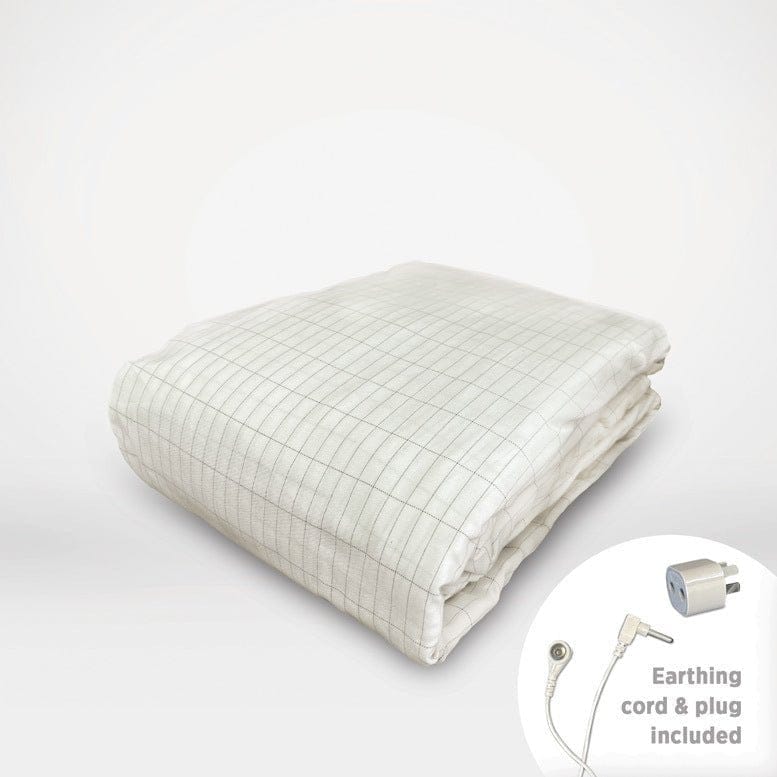
The Earthing Oz half-sheet uses the same organic cotton plus 2% silver thread construction as the Premium Grounding sheet, at a price point of $229–$280 AUD — meaningfully lower than the Premium Grounding equivalent. The specification difference between the two sheets is minor at the material level: both use organic cotton, both use 2% silver thread by weight, and both produce surface resistance readings under 100Ω per square under correct care conditions. The meaningful differences are the 90-day trial period — the longest available from any Australian earthing supplier — and the domestic stock location.
The 90-day trial period is worth examining seriously. A grounding sheet requires 3–6 weeks of consistent nightly use before subjective outcomes (if any) become attributable to the sheet rather than placebo or concurrent lifestyle changes. A 30-day trial period is too short to draw a reliable personal conclusion. A 90-day window gives you the full use cycle needed to form a genuine assessment and still return the product if it does not produce the outcome you expected. That is a meaningful consumer protection that no other Australian supplier currently matches.
The domestic stock location means the same delivery advantage as the Earthing Oz mat — 1–3 business days to major Australian centres, Australian GST included in pricing, and Australian-based support for any wash care or setup query. The wash care protocol is identical to the Premium Grounding sheet: cold machine wash, no bleach, no fabric softener, no tumble dryer heat above 40°C. If you are considering this product for children — where the overnight passive earthing contact is particularly relevant — the grounding for children guide covers the relevant safety and usage considerations.
For a full brand-level review of Earthing Oz including customer service response times and return process, see the Earthing Oz review.
✓ Pros
- 90-day trial period — the longest available from any AU earthing supplier — gives you the full use window needed for a genuine personal assessment
- Lower price point ($229–$280 AUD) than comparable Premium Grounding sheet — meaningful saving for the same material specification
- Domestic Australian stock with 1–3 business day delivery
- Australian-based customer support for wash care and setup queries
- Same 2% silver thread, organic cotton specification — no compromise on earthing mechanism
✗ Cons
- Same wash care discipline requirement as all silver-thread sheets — no shortcuts on fabric softener
- Sheet conductivity verification requires a multimeter — not supplied with the product
- Return process under the 90-day trial requires the sheet to be in reasonable condition — you cannot return a sheet that has been washed with fabric softener and degraded by the buyer
Buy the Earthing Oz Half-Sheet if:
- You want the longest trial period available in Australia — 90 days is sufficient to form a genuine, attributable personal assessment
- You want the lower price point without compromising the core silver-thread organic cotton specification
- You are buying your first earthing sheet and want the security of Australian-based support and a generous return window
- You need fast domestic delivery to an Australian address and do not want to wait on international freight
Can You Use Both? Protocol for Mat and Sheet Combination
Yes, and the total earthing dose is additive. Using a grounding mat during daytime work hours and a grounding sheet overnight creates a combined daily earthing window of 8–15 hours depending on your schedule. There is no contraindication to simultaneous or consecutive use. Both products connect to the same earth potential. You can even run both from the same room’s sockets simultaneously — you are equalising to a common reference potential, not creating a circuit between the two products.
The practical protocol I use at the Palm Beach setup:
- 6am–8am: mat on the floor under the standing desk during morning work. Bare feet on mat surface.
- 8am–12pm: desk mat in forearm position during computer work at the sit-down desk.
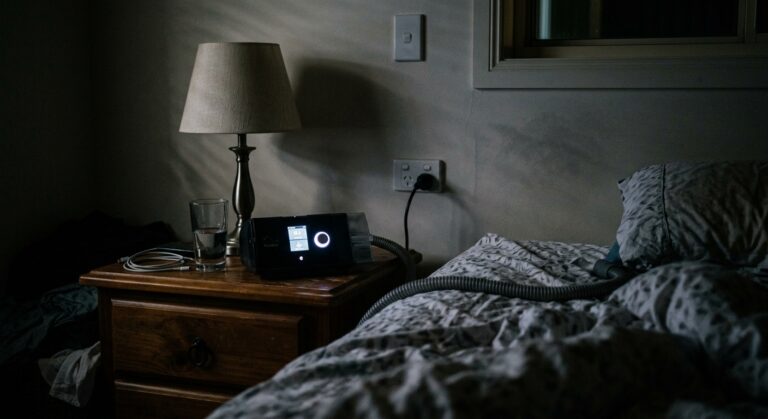
- 10pm–6am: grounding sheet on the bed, connected to verified bedside socket. Passive contact during sleep.
- Body voltage check weekly: quick reading at wrist with a non-contact body voltage meter confirms both products are still connected and functional. Target reading: under 0.1V AC at any contact point.
The argument for starting with one product rather than both comes down to budget and information sequencing. If you start with both simultaneously and notice a change, you cannot attribute it to the mat or the sheet specifically. If you start with the sheet for 4–6 weeks, then add the mat, you have a cleaner personal data set. From a pure earthing dose perspective, if budget allows only one product, the sheet delivers higher dose first.
One practical note on cord management: both product cords are 4.8m. In a standard Australian bedroom, the bedside socket is typically 2–3m from the bed centre. In a home office, the desk socket is typically 1–2m from the mat position. Neither setup should require running cords across walkways, but a cord clip or cable management strip keeps the installation tidy and eliminates a tripping hazard. This is basic electrical housekeeping, not an earthing-specific issue.
If you are managing specific conditions and want to understand potential side effects of transitioning to regular earthing contact after a prolonged period without it, the earthing side effects guide covers the reported transition responses and their likely mechanisms.
EMF Measurement
You cannot reduce what you have not measured.
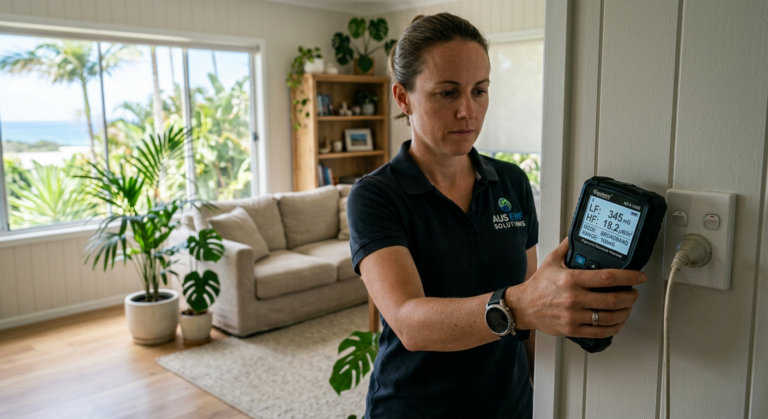
The TriField TF2 measures AC magnetic, AC electric, and RF/microwave fields in a single meter. It is what I use to audit rooms at the Palm Beach house. The readings determine the action — not guesswork.
See the TriField TF2 Review →Final Verdict — Which Should You Buy First?
The answer is determined by your specific use case, not by price or brand preference.
Buy the grounding sheet first if sleep quality, overnight recovery speed, or high body voltage at bedtime is your primary concern. The sheet delivers 10,000–20,000 cm² of contact area for 6–9 passive hours. That is the highest earthing dose available from any indoor product format. The Earthing Oz half-sheet at $229–$280 AUD with a 90-day trial period is the lowest-risk entry point for first-time sheet buyers. The Premium Grounding half-sheet is the choice if verified surface resistance data and an organic cotton specification with no synthetic fibres in the contact surface is your priority.
Buy the grounding mat first if you are a desk worker clocking 4+ hours seated and you want instrumentally verifiable earthing contact during those hours without touching your sleep setup. The Premium Grounding mat’s body voltage drop to 0.03–0.07V AC is the data point that confirms the product is working, and that reading is reproducible with any standard non-contact body voltage meter. The Earthing Oz mat is the choice if you need domestic delivery, a lower price point, or Australian-based support from the first call.
Buy both if budget allows and you want to address both daytime and overnight earthing exposure. Start with the sheet — run it for 4–6 weeks to establish a baseline — then add the mat for daytime use. The combined daily earthing window (8–15 hours) exceeds what barefoot outdoor time provides for most office-based Australians, and it does so without changing your daily schedule in any meaningful way.
Before purchasing either product, test your target socket with a plug-in socket tester. A faulty earth renders both products non-functional. That socket test costs under $20 at Bunnings and takes 30 seconds. It is the prerequisite step that makes everything else useful. For the full room-by-room assessment protocol used at the Palm Beach house, including socket testing and body voltage measurement, see the complete EMF guide for Australian homes.
Start with a measurement, not a purchase.
Most EMF reduction advice skips the step that makes everything else meaningful — knowing your actual readings. Our measurement guide covers the room-by-room protocol used at the Palm Beach house.
EMF Measurement Guide →Frequently Asked Questions
Which is better — a grounding mat or a grounding sheet?
For total earthing dose, the sheet wins by a large margin: 10,000–20,000 cm² of contact area for 6–9 passive hours versus 200–400 cm² for 2–6 active hours on a mat. For convenience and daytime earthing during desk work, the mat is the correct format. Neither is universally “better” — they address different use windows. If you can only buy one and sleep quality is the issue, buy the sheet. If desk-hour earthing is the goal, buy the mat.
Can I use both a grounding mat and a grounding sheet at the same time?
Yes. Both connect to the same earth potential (0V reference). Running both simultaneously from separate sockets in the same room, or consecutively across a 24-hour period, is safe and additive. The mat during work hours and the sheet overnight gives a combined earthing window of 8–15 hours per day. There is no electrical interaction between the two products when both are connected to the same building earth.
Do I need a special power point for earthing products in Australia?
No special socket is required — only an earthed one. Standard AS/NZS 3112 three-pin Type I sockets in Australian homes have an earth pin. The earthing product cord engages only the earth pin. What you do need to verify is that your socket’s earth is functional — not all sockets in older Australian homes are correctly earthed. Use a plug-in socket tester (under $20 at Bunnings) before connecting any earthing product. If the tester shows a fault, do not use that socket for earthing until an electrician rectifies the wiring.
Are grounding sheets safe to use every night?
Yes, provided the socket earth is verified. The 100kΩ inline resistor limits fault current to under 0.5mA (well below the ARPANSA guideline of 5mA for continuous residential body current). Only the earth pin is engaged — live and neutral pins are physically bypassed. There is no current generated by the sheet and no electromagnetic field emitted. Nightly use is the intended application. The only ongoing safety check is periodic socket verification and a conductivity check of the sheet surface (multimeter across the silver thread surface — should read under 100Ω/sq).
How long until I notice results from a grounding mat?
The body voltage reduction is immediate and instrumentally verifiable within seconds of contact. If you are asking about subjective outcomes — which vary by individual and are not guaranteed — the published literature (Chevalier et al., 2012; Ghaly and Teplitz, 2004) reports changes in cortisol rhythm over 6–8 weeks of consistent use. Anecdotal reports of sleep-adjacent effects commonly appear in the 2–4 week window. Do not use subjective outcomes as the sole measure of mat function. Use a body voltage meter to confirm earth equalisation is occurring. Everything else is secondary data.
Does fabric softener really damage grounding sheets?
Yes, and the mechanism is chemistry, not marketing: fabric softener deposits a thin layer of cationic (positively charged) surfactant on fabric fibres. That layer is electrically insulating. When deposited on the silver thread grid of an earthing sheet, it increases the surface resistance of the silver. Repeated washes with fabric softener progressively increase resistance, eventually pushing it above the functional threshold (100Ω/sq). This degradation is not visible to the eye and is not reversible by subsequent correct washing. If you have washed a sheet with fabric softener, test it with a multimeter. If it reads over 100Ω/sq, the earthing function is impaired.
What is the difference between grounding and earthing?
Nothing. The terms are used interchangeably in the research literature and in the consumer product space. “Earthing” is the preferred term in Australian and British English. “Grounding” is the American English equivalent. Both describe the same physical process: connecting the body to the earth’s electrical potential via a conductive pathway. The mechanism, the physics, and the products are identical regardless of which term is used. For a detailed explanation of the mechanism and the supporting research, see the does earthing work — scientific evidence guide.
Which Australian supplier is better — Premium Grounding or Earthing Oz?
They are not directly comparable because they serve slightly different buyer profiles. Premium Grounding is the choice if you want verified body voltage data, a bulk-conductive mat surface, and a specification-first approach to product quality. Earthing Oz is the choice if you want domestic Australian stock, the longest trial period available in Australia (90 days on sheets), and Australian-based customer support from setup through to any return. On material specification — organic cotton, 2% silver thread, 100kΩ resistor — both suppliers meet the same standard. The decision comes down to trial period length, delivery preference, and price point. See the Premium Grounding review and the Earthing Oz review for detailed comparisons.
Can you ground through a mattress topper?
It depends entirely on the topper material and thickness. A thin cotton topper (under 5mm) may allow sufficient capacitive and resistive coupling for minimal earthing contact, but it is not reliable and you cannot verify it without instrumentation. A memory foam, latex, or thick polyester topper will block direct conductive contact between the skin and the sheet surface entirely. The correct answer is: place the grounding sheet on top of any topper, or eliminate the topper from the sleep surface and place the sheet directly on the mattress. Do not assume earthing is occurring through a mattress topper without measuring body voltage on the topper surface.
Is the 100kΩ inline resistor important?
Yes, it is the critical safety component of any earthing cord. Its function is to limit fault current in the event of an electrical fault. In a normal operation scenario — earth pin at 0V, no fault — the resistor has no effect on the earthing function because no current is flowing. In a fault scenario where a live potential inadvertently reaches the earthing product surface, the 100kΩ resistor limits the current reaching the user’s body to under 0.5mA (240V ÷ 100,000Ω =
Get the Australian Home Environment Checklist
30 checks across water, air and EMF. Most of them free. Ranked by impact.
No spam. Unsubscribe any time.

Former Royal Australian Navy Clearance Diver and TAG-E counter-terrorism operator. Founded Clean and Native to apply the same rigorous thinking to the home environment.
Full biography →