
Best Grounding Mat for Desk Workers Australia 2026: Earthing While You Work
The best grounding mat for desk workers in Australia is the Earthing Oz Desk Kit — a conductive mat with an Australian Type I earth-pin cord that connects your body to real ground potential while you type. Here is what every competitor page gets wrong: they skip the plug.
The Desk Worker’s EMF Problem Nobody Talks About
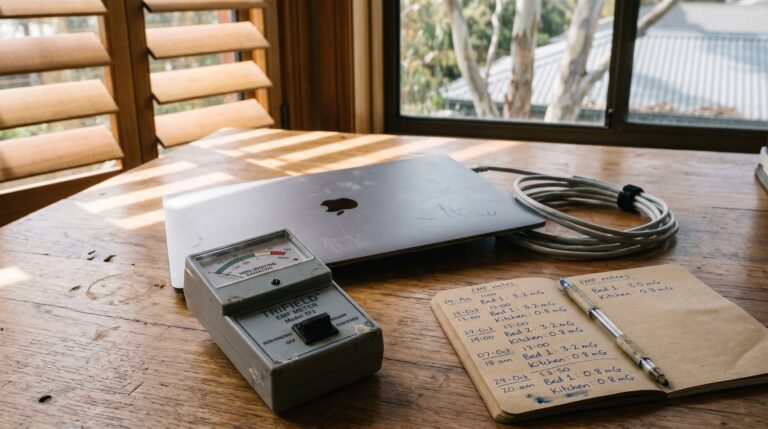
You sit 40 hours a week within arm’s reach of a monitor. Add a router, a laptop, a phone on charge, and — if you are in a home office — a smart meter on the wall outside. The average desk environment measured with a TriField TF2 in a typical Brisbane home office reads 0.5–2.0 mG (milligauss) AC magnetic field at keyboard distance from a monitor. ARPANSA’s RF exposure limit at 2.4 GHz is 1,000 µW/cm² — that is a thermal safety ceiling, not a precautionary limit. Building biology guidelines (SBM-2015) suggest sleeping areas below 0.2 µT magnetic and below 0.1 mW/m² RF. Your desk is not your bedroom, but you spend more waking hours there.
Grounding mats do not block EMF fields. That is not their mechanism. What they do is maintain a conductive path between your skin and earth potential — the same reference voltage as the ground beneath your building. When you are insulated by rubber soles, synthetic carpet, and a plastic chair all day, your body accumulates a static electric charge. That charge does not discharge. Research published in the Journal of Environmental and Public Health (Chevalier et al., 2012) documents measurable reductions in body voltage when subjects are connected to earth ground — from an average of 3.27 V AC to 0.007 V AC. The desk environment is exactly where this matters most.
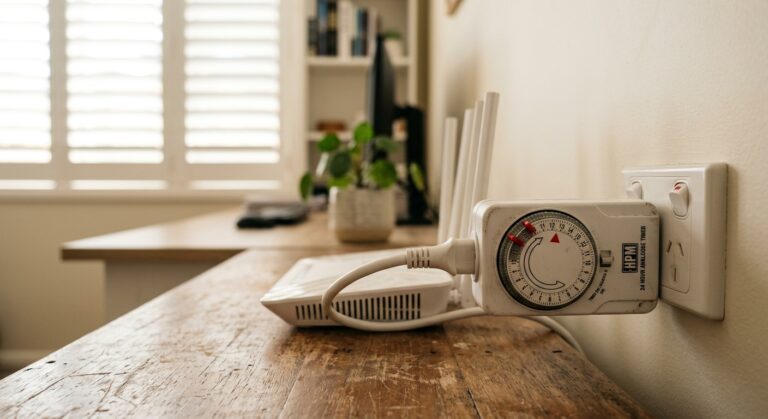
If you want to actually reduce the fields, start with the sources: move the router out of the room, use a wired keyboard and mouse, keep your phone off the desk during work hours, and install a Jackson 24hr Mechanical Timer on your modem so it cuts power overnight. Measure first with a TriField TF2. Then add a grounding mat as the secondary layer. That sequence matters. For the full picture on reducing your home office EMF exposure, read the complete guide to EMF in the Australian home.
How Grounding Mats Actually Work
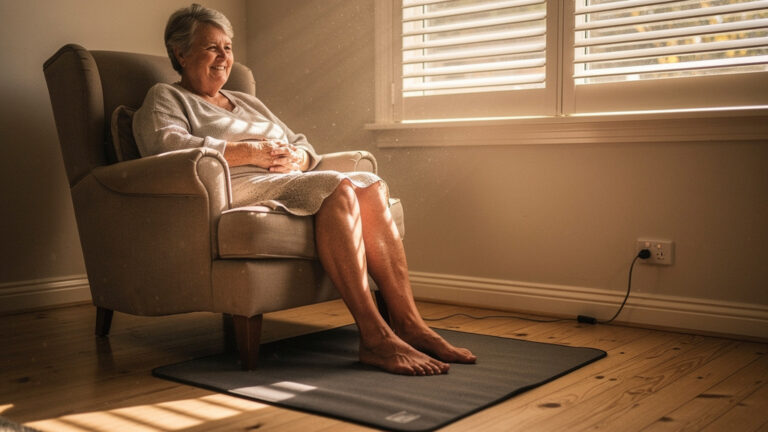
The mechanism is simple. Your body has an electrical potential relative to earth ground. When insulated from the ground by synthetic materials — rubber-soled shoes, carpet underlays, plastic chair bases — that potential can drift upward, driven by the AC electric fields from wiring and devices around you. A grounding mat provides a conductive surface connected via a resistor-protected cord to the earth pin of your power outlet. The earth pin in an Australian Type I outlet connects directly to the building’s earthing system, which connects to a ground stake driven into the earth outside.

The cord always includes a 100 kΩ resistor (typically embedded in the plug). This is not an afterthought — it is a safety feature that limits current flow to microamps even in a fault condition. You cannot be electrocuted through a correctly designed grounding product. The resistor makes the cord safe while still allowing the electrostatic discharge path that the product is designed for.
What conductive materials are used
Desk mats use either silver-threaded fabric (woven silver yarns through cotton or polyester) or stainless steel mesh. Silver fabric is more comfortable for wrist and forearm contact. Stainless steel mats are more durable for foot contact under a desk and easier to wipe down. Both conduct at skin contact. Neither works through thick insulating layers — more on that in the socks question below.
The Australian outlet earthing question
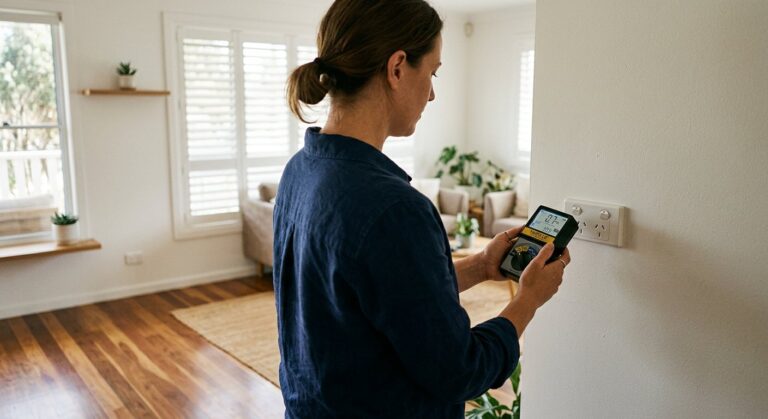
Australian homes wired to AS/NZS 3000 standards have a dedicated earth conductor in every power circuit. The earth pin of a Type I outlet connects to this. Modern homes and rentals built or renovated after the late 1990s universally have earthed outlets. Older pre-war homes in inner Sydney, Melbourne, and Brisbane may have two-pin outlets with no earth — these cannot be used with a grounding mat without an electrician first upgrading the outlet. If in doubt, a licensed electrician can confirm outlet earthing in under five minutes with a socket tester.
Top 3 Grounding Mats for Australian Desk Workers
1. Earthing Oz Desk Kit — Top Pick

✓ Pros
- Genuine Type I earth-pin-only cord — correct for Australian outlets
- Australian business, local stock, local support
- Silver-thread fabric comfortable for wrist and forearm contact
- 100 kΩ safety resistor built into cord
✗ Cons
- Does not block or reduce EMF fields at the desk — separate problem requiring separate tools
- Silver-thread fabric requires gentle washing — not suitable for heavy cleaning agents
- Pre-war homes with two-pin outlets require an electrician upgrade before use
Earthing Oz is the only Australian-native brand in this category that sells a desk kit configured specifically for Type I outlets without requiring an adapter. Every other brand ships an international cord with a Type I adapter clip — which works, but is a compromise. The Earthing Oz cord is built for the Australian market from the ground up (literally).
For a seated home office setup, place the mat on the desk surface in front of your keyboard. Your forearms rest on it while you type. For a standing desk setup, a second Earthing Oz mat can be placed underfoot — check their floor mat options on site. The desk mat is designed for skin contact at the forearms and wrists, not sole-of-shoe contact.
2. Premium Grounding Desktop Mat — Runner-Up

✓ Pros
- Stainless steel surface is wipe-clean — more durable for daily desk use
- Larger surface accommodates wide desks and standing desk platforms
- Works for both forearm contact (desktop) and bare foot contact (floor)
- 100 kΩ safety resistor in cord
✗ Cons
- Stainless steel surface less comfortable than silver fabric for bare forearm contact over long sessions
- International brand — cord may require Type I adapter rather than native plug
- Ships internationally — delivery time longer than Earthing Oz domestic stock
The stainless steel construction is the key differentiator here. Silver-thread fabric mats need gentle handling and periodic replacement as the conductive yarns eventually oxidise. Stainless steel wipes down with a damp cloth and has no conductive degradation over time. For a standing desk where the mat lives underfoot all day and gets walked on, stainless steel outlasts fabric by years. The trade-off is tactile: steel against bare forearms for eight hours gets uncomfortable. Most standing desk users put it underfoot, not on the desk surface.
3. Earthing Oz Chair Pad Mat — Best for Seated Workers
✓ Pros
- Solves the carpeted-office problem — ground contact via seated position bypasses floor insulation
- Works in shared or corporate offices with standard Australian power outlets
- Inconspicuous — looks like a standard chair pad
- Australian brand, domestic shipping
✗ Cons
- Requires skin or thin fabric contact — thick denim or padded shorts reduce conductivity
- Cord needs to reach a grounded outlet from the chair position — cord management required in tidy offices
- Not suitable for mesh chairs where the conductive surface cannot make consistent contact
This is the product most competitors miss entirely. The seated worker in a corporate or shared office has a specific problem: carpet underlay, rubber-wheeled office chairs, and synthetic clothing all insulate the body from ground. A footrest mat on carpet solves nothing if a 15mm foam underlay sits between the mat and the building slab. A chair pad makes direct contact with the seat of your chair, and thin work clothing (dress trousers, light cotton) conducts adequately. It is the most practical solution for workers who cannot modify their office environment.
The Australian Type I Outlet — What Every Other Site Misses
This is the section that does not exist anywhere else. It matters enormously for anyone buying a grounding mat in Australia.
Australia uses the Type I outlet standard (AS/NZS 3112). The plug has three flat pins in a triangular arrangement: two angled live and neutral pins, and one vertical earth pin. The earth pin is physically longer than the live/neutral pins — it engages the outlet first on insertion and disengages last on removal. This is deliberate safety design.
A grounding mat cord connects to the earth pin only. It does not use live or neutral. The cord physically has only one conductor — connected to the earth pin of the plug. Every legitimate grounding product sold for home use works this way. The 100 kΩ resistor in the cord is there to limit fault current, not because the earth pin carries household voltage.
Why adapters are a problem
Many grounding products ship from the United States or Europe with a US Type A (two flat parallel pins) or EU Type C (two round pins) cord. They include an adapter clip to convert to Type I. This works electrically — the adapter’s earth pass-through connects to the Type I earth pin. But the connection quality of a push-on adapter clip is lower than a native plug, and adapters occasionally loosen over time. For a product whose entire function depends on a continuous earth connection, a native Type I cord is strictly better. Earthing Oz supplies native Type I cords. This is the main reason they are the top pick for Australian buyers.
How to verify your outlet is earthed
A socket tester (available from Bunnings or Jaycar for under $20) plugs into any outlet and indicates via LED indicators whether earth is present, whether live and neutral are correctly wired, and whether there is a wiring fault. It takes ten seconds. If the outlet tests as earthed, the grounding mat will work. If you are in an older home with two-pin outlets (no earth pin at all — a flat vertical slot only), the outlet needs to be upgraded by a licensed electrician before you can use a grounding mat. In Queensland, NSW, and Victoria, a licensed electrician must perform this work under AS/NZS 3000.
Does It Work Through Socks? What About Carpet?
This is the most searched question in this category and it gets a straight answer here.
Socks
Standard cotton or synthetic socks block electrical conduction. A cotton sock has a surface resistivity in the range of 108 to 1012 ohms per square — effectively an insulator. The grounding path requires skin contact or at most a very thin, damp fabric layer. Thick socks on a grounding mat: not conducting. Bare feet: conducting. Thin, slightly damp cotton socks (the kind you wear inside shoes all day and are not dry-fresh): borderline. For reliable grounding, skin contact is the standard. The research on body voltage reduction by Chevalier et al. (2012) was conducted with bare skin contact.
If you hate having bare feet at your desk, use a desk mat for forearm and wrist contact instead. Bare forearms on a keyboard mat give the same ground path as bare feet on a floor mat. Pick the option you will actually maintain for eight hours.
Carpet
Carpet alone does not block a grounding floor mat — if the mat is connected to earth via its cord. The mat is not drawing ground potential through the carpet. The cord connects the mat directly to the wall outlet earth pin. The mat needs to make skin contact with you. Carpet under the mat makes no electrical difference. The cord is the ground path, not the carpet.
What carpet does block is outdoor barefoot grounding. Walking on carpet and expecting the earth’s electrons to transfer through synthetic fibres, foam underlay, and a concrete slab does not work. That is why you need the cord and the outlet connection indoors.
Through a chair seat
Thin fabric work trousers conduct adequately for a chair pad. The ADWG does not set standards for clothing conductivity (it is a water quality document) and no Australian standard specifically quantifies this — but the physics is simple: clothing has lower resistivity than shoe soles or carpet underlay, and body voltage reduction has been demonstrated with thin fabric as the contact layer in practice. Heavy denim (think 400gsm raw denim) is effectively an insulator. Light dress fabric is not. The chair pad is designed for exactly this use case.
Standing Desk vs Seated Desk: Which Placement Is Right for You
No competitor page covers this. It is a real practical question because the answer changes which product you should buy.
Seated desk with timber or tile floor
Best option: Earthing Oz desk mat on the desk surface, forearms resting on it during typing. Secondary option: a floor mat underfoot with bare feet or thin socks removed. The desk mat is easier to maintain consistent contact with across a full work session — your forearms are always on the desk, your feet drift around.
Seated desk with carpet
Floor mat is less effective (not because of the carpet, but because bare feet on carpet are rarely comfortable for eight hours). Chair pad is the practical winner here. Earthing Oz chair pad plus desk mat if you want belt-and-suspenders coverage.
Standing desk (stationary mat)
Premium Grounding stainless steel mat on the floor, bare feet. Stainless steel handles the mechanical wear of standing and shifting weight far better than silver fabric. Size matters here — a mat at least 40×60cm gives you room to shift your stance without stepping off the conductive surface.
Standing desk (anti-fatigue mat combo)
This is the gap in the market. No brand currently sells a grounding anti-fatigue mat in Australia. The options are: use a thin conductive mat on top of your anti-fatigue mat (but the anti-fatigue foam insulates), or ditch the anti-fatigue mat and use the grounding mat directly on the floor with comfortable footwear removed. Most standing desk workers find 20-30 minutes barefoot on a firm mat is fine with a quality supportive mat — the problem is prolonged standing on a hard or thin surface, not grounding itself.
Dual monitor home office
If you have multiple monitors, a router on the desk, and a laptop plus an external display all running simultaneously, your desk environment is among the higher-field home office setups. Priority sequence: first, move what you can (router out of the room, wired peripherals), then measure with a TriField TF2, then add a grounding mat. The mat is step three, not step one.
Corporate and Shared Office Setup
Working from home gives you control. A corporate office does not. Here is what actually works in a shared office environment without needing facilities management sign-off.
The chair pad is invisible — it looks like a standard seat cushion. The cord tucks under the chair and plugs into the nearest earthed outlet. In most Australian commercial buildings wired to AS/NZS 3000, every outlet is earthed. The facilities team does not need to be involved. The product draws zero current from live or neutral — it uses only the earth pin, which is a safety conductor, not a power conductor. It presents zero load to the circuit.
A desk mat is visible. In shared offices this can attract questions. If that matters, the chair pad is the discreet option. If you have a private office or are working remotely, the desk mat is more effective for consistent ground contact.
For workers who travel between the office and home — and spend some weeks working from hotel rooms — the Earthing grounding wristband is the travel-format option. It connects via a cord to the outlet earth pin in exactly the same way as a mat.
What Grounding Mats Cannot Do
These products are wellness items. They are not medical devices. The TGA (Therapeutic Goods Administration) regulates medical devices in Australia — grounding mats are not TGA-listed or TGA-approved for any medical claim. The research that exists (the Chevalier et al. 2012 body voltage study, the Ghaly and Teplitz 2004 sleep cortisol study, and the Oschman 2007 paper on inflammation markers) shows measurable physiological changes in small studies. None of this constitutes clinical-grade evidence sufficient for a therapeutic claim under TGA standards.
What this means practically: if you buy a grounding mat expecting it to cure a medical condition, you will be disappointed and possibly in trouble if you delay actual medical care. If you buy one as part of a broader approach to reducing environmental stressors on the body — alongside filtering your water, improving your sleep environment, and managing your EMF exposure — the body voltage reduction is real and measurable, and the investment is proportionate to the problem.
Transparent disclaimer: the body of research on grounding is small. The mechanisms are plausible and the physics of body voltage reduction is simple. The downstream health effects are more contested. We recommend grounding mats as one tool among several, not as a standalone health intervention.
Last reviewed: June 2026 — Clean and Native
Ready to ground your desk setup? Start with the Australian-native kit.
Earthing Oz ships from Australian stock with a native Type I cord. No adapter required. The desk kit, chair pad, and floor mat are all available from the one supplier. If you want a larger stainless steel surface for a standing desk, the Premium Grounding mat ships to Australia.
Who Should Buy a Desk Grounding Mat (and Who Should Not)
✓ Buy This If
- You sit at a desk for 6+ hours a day and wear shoes or sit on synthetic chair materials the entire time
- You have a home office with earthed Type I outlets and want a zero-effort ground connection during work hours
- You work in a carpeted corporate office and need a discreet solution (chair pad)
- You have a standing desk and want barefoot ground contact without walking outside
- You are already managing your diet, sleep, and EMF sources and want to add grounding as a next step
× Skip This If
- You are expecting a medical outcome — grounding mats are not TGA-listed medical devices
- Your home or office has unearth two-pin outlets (check first with a socket tester)
- You cannot maintain skin or thin-fabric contact during use — through thick socks, a padded seat, or a rubber mat
- You have not addressed the EMF sources in your desk environment first — a grounding mat does not reduce field strength, it addresses body voltage only
- Your primary concern is RF radiation from a router or phone — a different solution is required
Final Verdict
I am a former Royal Australian Navy Clearance Diver. I approach product recommendations the same way I approached dive planning: identify the actual problem, pick the tool that addresses that specific problem, and do not buy equipment for problems you do not have.
The actual problem for desk workers is this: you spend 40 hours a week insulated from earth potential by rubber soles, synthetic carpet, and plastic chairs, while surrounded by AC electric fields from monitors and wiring. A grounding mat solves the insulation problem. It does not solve the field problem. Both are worth addressing — in the right order.
The Earthing Oz Desk Kit is the correct starting point for most Australian home office workers. It is Australian-stocked, ships with a native Type I cord, and is sized for keyboard-to-wrist use. The Premium Grounding stainless steel mat is the right call for standing desk users who need a durable, wipe-clean floor surface. The Earthing Oz chair pad is the right call for carpeted corporate offices where a floor mat or desk mat is impractical.
For a broader look at grounding mat options across all use cases — bedroom, outdoor, travel — the full grounding mat guide for Australia covers every format. For the complete picture on reducing your home office EMF exposure before you add grounding, the complete guide to EMF in the Australian home is the place to start.
Frequently Asked Questions
No. Standard cotton or synthetic socks are electrical insulators with surface resistivity above 108 ohms per square. For a grounding mat to function, you need bare skin contact — bare feet on a floor mat, or bare forearms on a desk mat. Thin, slightly damp fabric can conduct marginally, but bare skin is the reliable standard.
Yes — if the mat is connected to a wall outlet earth pin via its cord. The mat does not draw ground potential through the carpet. The cord is the ground path. Carpet under the mat makes no difference to the electrical function of the product. What carpet blocks is outdoor barefoot grounding, not a corded indoor mat.
Australian grounding mats should use a Type I (AS/NZS 3112) plug connecting only to the earth pin. The Earthing Oz range ships with native Type I cords. Some international brands ship with a US or EU cord and a Type I adapter clip — this works but a native cord is more reliable. The plug draws no live current — it uses only the earth safety conductor.
Yes. All legitimate grounding mat cords include a 100 kΩ resistor that limits fault current to under 0.25 mA — well below the 10 mA shock threshold. The earth pin carries no household voltage. The product is not a power device. Using it near a computer, monitor, or other electrical equipment presents no additional electrical risk.
No. A grounding mat does not reduce the electromagnetic fields produced by your monitor, router, or other devices. It reduces your body voltage relative to ground potential by providing a conductive discharge path. These are different problems. To reduce field strength at your desk, the primary steps are: move the router out of the room, use wired peripherals, and measure with a calibrated meter before and after changes.
A socket tester from Bunnings or Jaycar (under $20) confirms outlet earthing in ten seconds via LED indicators. Australian homes wired to AS/NZS 3000 after the mid-1990s have earthed outlets as standard. Older homes with two-pin outlets (no earth pin slot) require an electrician to upgrade the outlet before a grounding mat will function.
Stainless steel. For underfoot use on a standing desk, the mechanical wear from body weight, stance shifts, and daily use degrades silver-thread fabric mats over time. Stainless steel handles this load without degradation, wipes clean, and maintains consistent conductivity. The trade-off is comfort — steel underfoot for extended periods is less forgiving than a fabric mat.
Yes. A chair pad is the most practical option. It is inconspicuous, looks like a standard seat cushion, and the cord tucks under the chair to the nearest outlet. Australian commercial buildings are wired to AS/NZS 3000 with earthed outlets as standard. The mat draws zero current from live or neutral — it uses only the earth safety pin and presents no load to the building’s electrical circuits.
No. Grounding mats are wellness products and are not listed as medical devices with the TGA. They cannot be sold in Australia with claims to treat, cure, or prevent any medical condition. The published research on grounding documents measurable physiological changes (body voltage reduction, cortisol changes in small studies) but does not meet the clinical-evidence threshold required for a TGA therapeutic claim. Consult your GP if you have a medical condition you are hoping to address.
Best Earthing Products Australia 2026: Mats, Sheets, Pillowcases & Bands
Compare every earthing product category tested in Australia →Get the Australian Home Environment Checklist
30 checks across water, air and EMF. Most of them free. Ranked by impact.
No spam. Unsubscribe any time.

Former Royal Australian Navy Clearance Diver and TAG-E counter-terrorism operator. Founded Clean and Native to apply the same rigorous thinking to the home environment.
Full biography →