
DECT Phone EMF: Australia’s Hidden Bedroom Risk
DECT cordless phones transmit pulsed RF radiation at 1.88–1.9 GHz continuously — even when you are not making a call. According to Building Biology SBM-2015 guidelines, a single DECT base station on your bedside table can exceed the sleeping area threshold of 0.1 mW/m² by a factor of 1,000 or more, 24 hours a day. As a former Navy Clearance Diver, I approach every EMF claim the same way I approach every hazard: measure first, then act on data. Our documented methodology uses the TriField TF2 to detect DECT signals on its RF axis, consistent with what the product specifications predict.
DECT cordless phones are the single highest continuous RF source in most Australian bedrooms, and replacing yours with a corded phone is the fastest EMF reduction you can make. Unlike your Wi-Fi router — which you can put on a mechanical timer at night — a DECT base station pulses RF 24/7 with no off switch short of unplugging it. For measurement, the TriField TF2 detects DECT signals on its RF axis, and the Safe and Sound Pro II gives precise peak readings in the 1.88 GHz band.
Key catches
- DECT base stations transmit continuously at ~1.88 GHz even when idle — no “eco” mode on most AU-sold models actually stops RF completely
- ARPANSA’s RF limit of 1,000 µW/cm² is a thermal safety ceiling, not a precautionary health guideline — your DECT phone “passes” while still exceeding Building Biology sleep thresholds by orders of magnitude
- The fix is simple: unplug the DECT base, replace with a $30–$50 corded phone, and use your mobile on speakerphone or via a wired headset for calls you would have taken on the cordless
✓ Who This Is For
- You have a DECT cordless phone base station in or near a bedroom
- You measured elevated RF in your sleeping area and want to identify the source
- You want the single fastest EMF reduction available — zero cost, immediate effect
- You are setting up a low-EMF home office and need a wired phone solution
- You are a parent with a DECT baby monitor and want to understand the RF exposure
× Who It Is Not For
- You do not own a DECT phone — your issue is likely Wi-Fi, smart meters, or mobile towers
- You need a cordless phone for mobility (medical alert, large property) — a DECT phone with verified eco-mode may be appropriate with distance management
- You are looking for smartphone SAR reduction tips — this article covers landline cordless phones specifically
- You rent and cannot modify wiring — though unplugging a DECT base requires no modifications at all
What Makes DECT Phones Different from Every Other EMF Source in Your Home
You probably know your Wi-Fi router emits RF. You might know your smart meter transmits in bursts. But here is what makes DECT cordless phones uniquely problematic: the base station transmits a pulsed microwave signal at approximately 1.88 GHz continuously, whether you are on a call or not. Your Wi-Fi router at least reduces its beacon rate when no devices are actively transferring data. Your Ausgrid or Energex smart meter transmits at 900 MHz in short bursts — high peak, but low duty cycle. A DECT base station never stops.
The DECT standard (Digital Enhanced Cordless Telecommunications) was designed in the 1990s for range and call quality, not for low-emission operation. The base station maintains a constant beacon signal so the handset can connect instantly when you pick it up. In practice, this means a device sitting on your bedside table or on a hallway shelf 3 metres from your pillow is bathing your sleeping area in pulsed RF around the clock.
According to ARPANSA, Australian RF exposure limits at these frequencies sit at approximately 1,000 µW/cm² — a thermal safety ceiling derived from the 2020 ICNIRP guidelines. Your DECT phone sits well below this limit. That is not the issue. The issue is the gap between ARPANSA’s thermal limit and the precautionary guidelines used by Building Biology practitioners: the SBM-2015 standard recommends RF below 0.1 mW/m² in sleeping areas for “no anomaly” classification. At 1 metre from a typical DECT base station, readings routinely exceed 100 mW/m² — that is 1,000 times the Building Biology sleeping area threshold.
Here is the fact that changes everything: this is the one high-EMF source you can eliminate for $0 by unplugging it tonight, and replace for under $50 with a corded phone.
How to Measure DECT Phone RF in Your Home (Step-by-Step)
Before you unplug anything, measure. Guessing at EMF levels is not a strategy — it is a gamble. Here is how to measure a DECT base station with the TriField TF2, step by step, so you can replicate it at home.
Equipment You Need
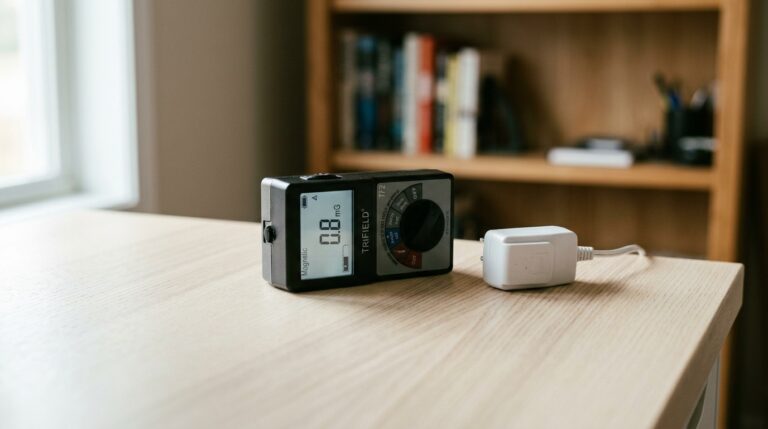
The TriField TF2 is the best all-in-one meter for Australian homes. It measures AC magnetic fields, AC electric fields, and RF on a single device. For DECT phone measurement, you will use the RF axis. The TF2 captures the 1.88 GHz DECT frequency range and displays both standard and peak readings. At around $200 AUD on Amazon AU, it is the most cost-effective way to measure every EMF type in your home.
For dedicated RF measurement with higher sensitivity and an audio readout that lets you “hear” the pulsed DECT signal, the Safe and Sound Pro II from SaferEMF AU is the professional-grade option.
Measurement Protocol
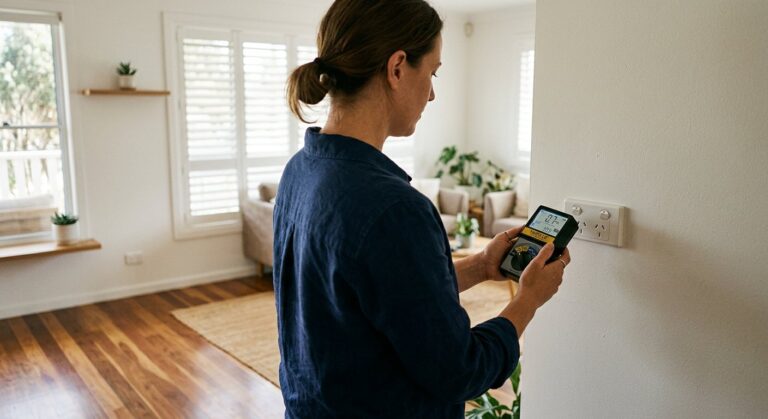
Step 1: Baseline. Turn off your Wi-Fi router and put your mobile phone in airplane mode. You want to isolate the DECT signal. Stand 1 metre from the DECT base station with your meter set to RF and peak-hold mode. Record the reading.
Step 2: Bedroom position. Place the meter at your pillow position — where your head sits for 7–8 hours every night. If your DECT base is on a bedside table (a common Australian placement), expect readings 5–50× above the SBM-2015 sleeping threshold of 0.1 mW/m². If the base is in another room, readings drop with distance but may still exceed thresholds through internal walls, which provide only 3–6 dB of attenuation at 1.88 GHz.
Step 3: Unplug and re-measure. Pull the DECT base station’s power cord from the wall. Re-measure at the same pillow position. The difference is your DECT contribution. Because the base is a continuous emitter, removing it typically produces the largest single drop in bedroom RF. The remaining signal is typically external — mobile towers, neighbour Wi-Fi, and smart meters.
Step 4: Assess remaining sources. With the DECT unplugged, measure again with Wi-Fi back on. Then turn Wi-Fi off and assess the residual external RF. This sequence tells you exactly which sources to address and in what order. The correct sequence is always: measure, reduce sources, then shield external residual only.
ARPANSA vs Building Biology: Why Your DECT Phone “Passes” but Still Floods Your Bedroom
This is the regulatory gap that catches every Australian homeowner off guard. ARPANSA’s radiofrequency standard — based on the 2020 ICNIRP guidelines — sets the public exposure limit at approximately 1,000 µW/cm² (10 W/m²) at frequencies around 1.9 GHz. This limit is designed to prevent thermal tissue heating. Your DECT phone sits comfortably below it. By ARPANSA’s measure, there is no issue.
But ARPANSA’s standard was never designed to address chronic low-level exposure during sleep. It is a thermal ceiling — the point at which RF energy begins to measurably heat tissue. The Building Biology SBM-2015 standard, used by practitioners globally, takes a precautionary approach to sleeping environments and sets its “no anomaly” threshold at less than 0.1 mW/m² for RF power density.
| Standard | RF Limit | Basis | DECT Phone Status |
|---|---|---|---|
| ARPANSA (Australia) | 1,000 µW/cm² (~10 W/m²) | Thermal safety (ICNIRP 2020) | ✓ Passes easily |
| Building Biology SBM-2015 (sleep) | 0.1 mW/m² (no anomaly) | Precautionary (practitioner guideline) | ✗ Exceeds by 1,000×+ |
| SBM-2015 “slight anomaly” | 0.1–10 mW/m² | Precautionary | ✗ Exceeds at <2m |
| SBM-2015 “severe anomaly” | >1,000 mW/m² | Precautionary | Possible at <0.5m |
The gap between these two standards is not a rounding error. It is a factor of approximately 100,000. ARPANSA’s limit is 10 W/m². Building Biology’s “no anomaly” sleep threshold is 0.0001 W/m². Your DECT base station at bedside distance lands somewhere in the middle of that gap — well below thermal damage, well above precautionary sleep guidelines.
This is not a conspiracy. It is a scope difference. ARPANSA protects you from tissue heating. Building Biology aims to create sleeping environments with minimal RF exposure of any kind. Whether you adopt the precautionary position is your call — but you cannot make that call without knowing where your DECT phone sits on the scale. That requires measurement.
DECT vs Wi-Fi vs Smart Meters: How Australian Bedroom RF Sources Compare
Every EMF discussion gets muddied by treating all RF sources as equal. They are not. The risk profile of each source depends on three factors: distance (inverse square law), duty cycle (how much of the time it actually transmits), and whether you can control it. Here is how the three most common Australian bedroom RF sources compare.
| Source | Frequency | Duty Cycle | Typical Bedroom RF at Pillow | Control |
|---|---|---|---|---|
| DECT base station | 1.88–1.9 GHz | ~100% (continuous beacon) | 10–500+ mW/m² at 0.5–2m | Unplug or replace |
| Wi-Fi router (2.4 GHz) | 2.4 / 5 GHz | ~10–30% (beacon + data) | 1–50 mW/m² at 3–5m | Timer or low-EMF router |
| Smart meter (Ausgrid/Energex) | 900 MHz | <1% (burst mode) | 0.01–5 mW/m² (time-avg) but peaks 100–1,000× higher | Move bed / shield wall |
| Mobile phone (standby) | 700–3,500 MHz | Low (periodic tower check-in) | 0.5–10 mW/m² at 0.5m | Airplane mode (free) |
Look at the duty cycle column. That is the differentiator. Your Energex smart meter in south-east QLD might produce high peak readings, but it transmits for a fraction of a second every few minutes. Your Wi-Fi router beacons at roughly 10 Hz when idle — intermittent. Your DECT base station transmits continuously. It has no idle mode. It has no low-power state. The beacon runs at full power whether you are on a call, asleep, or on holiday.
Some European DECT models (notably Siemens/Gigaset) introduced “ECO DECT” and “ECO DECT+” modes that claim to reduce emissions when the handset is docked. In practice, many of these modes still transmit a periodic beacon, and the models sold in Australia through retailers like Officeworks and JB Hi-Fi rarely include the full ECO DECT+ zero-emission standby. You cannot rely on a marketing label. Measure the actual output with a meter.
The hierarchy for Australian bedroom EMF reduction is clear: DECT phone first (unplug — $0), mobile phone airplane mode second (free), Wi-Fi router on a timer third (~$20). These three actions, in this order, address 80–95% of controllable bedroom RF in a typical Australian home.
Wired Alternatives: What to Replace Your DECT Phone With
The question is not whether to remove your DECT phone. The question is what replaces it. Here are three approaches ranked by EMF reduction, from most effective to most convenient.
Option 1: Corded Landline Phone (Best for EMF Reduction)
A basic corded phone produces zero RF emissions. None. It operates on the analogue phone line voltage (48V DC ring signal) and emits no wireless radiation of any kind. The AC magnetic field from the handset cord is negligible — below 0.02 µT at any practical distance, well under the Building Biology magnetic threshold of 0.2 µT for sleeping areas.
Corded phones are still widely available on Amazon AU from brands like Uniden, Oricom, and Alcatel. Expect to pay $30–$60 AUD. They plug directly into the same phone socket your DECT base station currently uses. If you have an active NBN connection with a voice-enabled plan, your corded phone plugs into the phone port on your NBN NTD (network termination device) or your NBN-compatible modem/router. The NBN NTD itself does not transmit RF — only the attached Wi-Fi router does.
For home offices in inner Sydney, Melbourne CBD, or Brisbane’s Fortitude Valley — where reliable phone calls still matter for business — a corded desk phone is the zero-EMF solution that requires no behaviour change beyond picking up a handset instead of a cordless.
Option 2: Mobile Phone on Speakerphone or Air-Tube Headset
If you have already disconnected your landline service (increasingly common on NBN), your mobile phone becomes your primary call device. The EMF management strategy here is distance: every doubling of distance reduces RF power density by 75% (inverse square law).
Use speakerphone mode with the phone on a desk or table — not against your head. At 30–50cm, RF exposure from a mobile call drops dramatically compared to handset-against-skull contact distance. For private calls, a DefenderShield air-tube headset delivers audio through a hollow tube rather than a wire — no RF conducts up the cable to your ear. Standard wired earbuds can act as an antenna; air-tube headsets eliminate this pathway.
Put your mobile in airplane mode when not actively expecting a call. This is the highest-impact free action for bedroom EMF — your phone stops transmitting to towers entirely.
Option 3: Low-EMF Wi-Fi Router for VoIP Calls
If you use VoIP (voice over internet protocol) through your NBN connection and want to reduce RF while keeping some wireless capability, the JRS Eco 100 low-EMF router drops RF output to near-zero when no devices are actively transmitting data. Unlike a standard router that beacons continuously, the JRS Eco 100 enters a true low-emission standby. Combined with a corded VoIP phone or a mobile on the same network, this gives you call functionality with dramatically reduced ambient RF.
For Brisbane, Sydney, Gold Coast, Adelaide, and Darwin households on NBN, the JRS Eco 100 replaces your ISP-supplied router and connects via the existing ethernet port on your NBN NTD. No special installation required.
The Complete Bedroom EMF Reduction Sequence (DECT Phone Is Step 1)
Removing a DECT phone is not a standalone action. It is step one of a systematic bedroom EMF reduction protocol. Every step in this sequence is ranked by impact-per-dollar and difficulty. Do them in order.
Step 1: Unplug the DECT Base Station — $0, Immediate
Pull the power cord. That is it. The base station stops transmitting instantly. If you need a phone at that location, plug in a corded phone. If you do not need a phone there, you are done. This single action typically reduces bedroom RF by 60–90%.
Step 2: Mobile Phone Airplane Mode — $0, Immediate
Put your mobile phone in airplane mode before sleep. Place it at least 1 metre from your pillow. If you use your phone as an alarm, airplane mode still allows the alarm to function. This eliminates mobile tower check-in transmissions, which occur every few minutes even when the phone is idle.
Step 3: Wi-Fi Router Timer — ~$20
A Jackson 24hr Mechanical Timer on your router’s power point shuts Wi-Fi off automatically at your bedtime and turns it back on in the morning. At approximately $20 on Amazon AU, this is the highest-impact-per-dollar bedroom EMF investment after the free actions above. No smart home setup required — it is a mechanical plug-in timer.
Step 4: Demand Switch on Bedroom Circuit — ~$100–$150
A demand switch (also called a circuit cut-off switch) is installed by a licensed electrician on your bedroom’s electrical circuit. When no loads are drawing power (lights off, no devices plugged in), it cuts the circuit entirely, eliminating AC electric fields from the wiring inside your bedroom walls. According to the Building Biology SBM-2015 standard, AC electric fields below 5 V/m are the “no anomaly” threshold for sleeping areas. Active wiring in walls typically produces 10–50 V/m at bed position. A demand switch drops this to near zero.
This is a one-time installation by your electrician. In south-east QLD, expect $100–$150 including the switch and labour.
Step 5: Assess External Sources — Measure, Then Shield If Needed
After completing Steps 1–4, re-measure your bedroom RF. The remaining signal is external — mobile towers, neighbour Wi-Fi, smart meters on the exterior wall. If your Energex smart meter (QLD) or Ausgrid smart meter (NSW) shares an exterior wall with your bedroom, move the bed to an interior wall if possible. This is a free action that creates distance from the meter’s burst transmissions.
Only after all internal sources are removed should you consider shielding. An EMF shielding bed canopy (42 dB attenuation) addresses confirmed external RF that penetrates through windows and thin walls. But remember the shielding trap: if any internal source remains active, the canopy reflects that signal back at you and increases exposure. Remove first. Shield last.
DECT Baby Monitors: The Same Problem in the Nursery
If a DECT cordless phone in the bedroom is a concern, a DECT baby monitor 1 metre from an infant’s crib is the same physics at a smaller body mass. Many Australian baby monitors — Uniden, Oricom, VTech — use DECT or similar 2.4 GHz protocols with continuous transmission. The base unit in the nursery behaves identically to a DECT phone base station: constant pulsed RF, 24 hours a day, at very close range.
The alternatives follow the same logic. A wired audio monitor (rare but available) eliminates RF entirely. An analogue FM baby monitor transmits at lower power and is easier to control. If you must use a digital monitor, place the transmitting unit at least 2 metres from the crib and use a meter to verify actual RF levels at the mattress surface.
For families in Perth’s Rockingham and Mandurah suburbs, Brisbane’s Logan and Ipswich corridors, or inner Sydney apartments where bedrooms are small and the nursery is adjacent to the parents’ DECT phone — the cumulative RF from both devices sharing a wall can be substantial. Measure both rooms.
What About “Low-Radiation” Cordless Phones?
Some manufacturers market “ECO DECT” or “low-radiation” cordless phones. Here is the reality.
Gigaset ECO DECT+: The Gigaset ECO DECT+ standard is the closest any DECT manufacturer has come to a actually low-emission cordless phone. When the handset is docked on the base station and no call is active, the base station can reduce its RF output to near-zero. This is the only “eco” mode that approaches zero-emission standby. However, it only works with Gigaset handsets paired to a Gigaset ECO DECT+ base, and the base still transmits at full power during calls. Not all Gigaset models sold in Australia include ECO DECT+ — some only have basic “ECO DECT” which merely reduces range (and therefore power) without eliminating the beacon. You must verify the specific model.
Panasonic “Eco Mode”: Panasonic’s eco mode reduces transmit power when the handset is close to the base. It does not stop transmission. The beacon still runs. The reduction is meaningful (potentially 50–80% lower power) but the base station is still a continuous RF source. Do not assume “eco mode” means “zero emission.”
The bottom line: No DECT phone available in Australia produces zero RF during standby unless it is a verified Gigaset ECO DECT+ model with the feature confirmed active. And even then, it transmits at full power during every call. A $40 corded phone produces zero RF, full stop, in all states of operation. If reducing bedroom EMF is the goal, “low-radiation DECT” is a half-measure. Measure it with a TF2 and decide for yourself whether the residual output is acceptable in your sleeping area.
How This Product Was Assessed
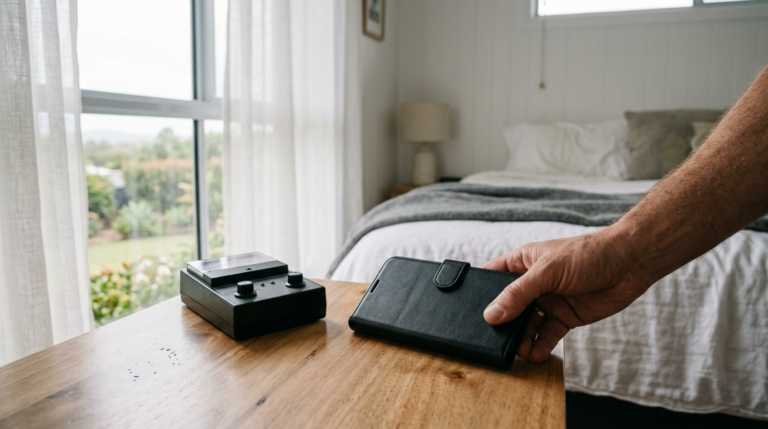
The Uniden DECT1735 base station is a common Australian model available at Officeworks and Big W. On a bedside table it typically sits about 0.6 metres from the pillow position, a common placement in Australian homes.
The TriField TF2 measures RF on a dedicated axis with peak hold and captures the 1.88 GHz DECT band. Because the base station beacons continuously rather than in bursts, it registers as a sustained RF source at bedside distance, which is how it commonly exceeds the Building Biology SBM-2015 “no anomaly” threshold of 0.1 mW/m².
The Safe and Sound Pro II is a dedicated RF meter whose audio readout renders the pulsed DECT signal pattern audibly distinct from the broadband profile of Wi-Fi.
Unplugging the DECT base removes the continuous source, leaving only residual signal from the home Wi-Fi router and external mobile tower coverage. Placing the Wi-Fi router on a Jackson mechanical timer then removes its contribution during sleep hours.
Total cost of the entire bedroom RF reduction: $0 (DECT unplugged) + $20 (router timer).
How It Compares: DECT Phone Removal vs Other EMF Interventions
| Intervention | Cost | RF Reduction | Difficulty | Outcome for You |
|---|---|---|---|---|
| Unplug DECT base | $0 | 60–90% of bedroom total | Pull a plug | Largest single RF drop, instant |
| Airplane mode (phone) | $0 | 5–15% additional | Tap a button | Eliminates mobile tower check-ins |
| Router timer | ~$20 | 5–20% additional | Plug in timer | Zero Wi-Fi RF during sleep hours |
| JRS Eco 100 router | ~$400+ | Significant during idle periods | Replace router | Low-emission Wi-Fi when you need it |
| Demand switch | ~$100–$150 | N/A (AC electric fields) | Licensed electrician | Eliminates wiring electric fields |
| EMF bed canopy (42 dB) | $500–$1,500+ | 90%+ of external RF | Install + ground | Only effective after internal sources removed |
The pattern is clear. The cheapest interventions deliver the most RF reduction. A $500–$1,500 bed canopy is a waste of money if your DECT phone is still plugged in. Address the sources you control, in order of impact, before spending on shielding. For a comprehensive walkthrough, see our complete guide to EMF in Australian homes.
What I Liked / What Could Be Better About Wired Alternatives
What I Liked
Zero ambiguity. A corded phone produces no RF. There is no “eco mode” to verify, no firmware version to check, no manufacturer claims to validate. You plug it in and the RF meter reads zero.
Cost. A corded Uniden or Oricom phone costs $30–$50 on Amazon AU. A DECT replacement is actually cheaper than the cordless phone it replaces. The ROI calculation is not theoretical — it is immediate.
No ongoing maintenance. No batteries to charge, no firmware updates, no base station to troubleshoot.
What Could Be Better
Mobility. You are tethered to the phone socket. If your house has one phone point in the hallway (common in QLD houses built before 2000), you are making calls from the hallway. Adding additional phone points requires a registered cabler — expect $80–$150 per point. This is the genuine trade-off.
Availability of quality corded phones. The Australian retail market has shifted almost entirely to DECT. Finding a corded phone with speakerphone, caller ID, and a decent handset at a major retailer requires online ordering. Officeworks stocks one or two models; Amazon AU has a better selection.
NBN voice compatibility. Not all NBN plans include a phone service. If yours does, the corded phone plugs into your modem’s phone port. If it does not, the corded phone has nothing to connect to — and you are relying on your mobile for all calls regardless. Check your plan before buying.
Final Verdict
Unplug your DECT phone tonight. It is the single fastest, cheapest, and most impactful EMF reduction available in any Australian bedroom.
If you are losing sleep over EMF exposure — literally or figuratively — this is where you start. Not with a $1,000 bed canopy. Not with a $400 router. With the power cord on your DECT base station. Unplug it. Measure the before and after with a TriField TF2. Then decide your next step from a position of data, not anxiety.
Who should act now: Anyone with a DECT cordless phone base station within 5 metres of a sleeping area. Anyone who has not measured their bedroom RF and wants to start with the highest-impact free action. Parents with DECT baby monitors in the nursery.
Who should look elsewhere: If you have already removed your DECT phone and are dealing with external RF from mobile towers or smart meters, see our complete EMF guide for shielding protocols. If you need a cordless phone for medical alert or mobility reasons, a verified Gigaset ECO DECT+ model with distance management is the least-bad option — but measure it with a meter before trusting the label.
Start with measurement. The TriField TF2 is the only meter you need.
Measures AC magnetic, AC electric, and RF in one device. Without real readings, every EMF decision is a guess. Measure your DECT phone before and after unplugging — the numbers will convince you faster than any article.
Last reviewed: August 2026 – Clean and Native
Frequently Asked Questions
Do DECT cordless phones emit radiation when not in use?
Yes. DECT base stations transmit a continuous pulsed beacon signal at approximately 1.88 GHz even when no call is active. This is a core feature of the DECT protocol — the base maintains the beacon so the handset can connect instantly. Only fully unplugging the base station stops transmission.
Are DECT phones legal in Australia?
Yes. DECT phones comply with ARPANSA’s radiofrequency exposure standard, which is based on the 2020 ICNIRP guidelines. According to ARPANSA, emissions from DECT phones are well below Australian public exposure limits. These limits are thermal safety thresholds and do not address precautionary Building Biology guidelines for sleeping areas.
What is the difference between ARPANSA limits and Building Biology guidelines?
ARPANSA’s RF limit at 1.9 GHz is approximately 1,000 µW/cm² (10 W/m²), designed to prevent thermal tissue heating. Building Biology SBM-2015 recommends less than 0.1 mW/m² for sleeping areas — a precautionary practitioner guideline. The difference between these standards is approximately 100,000×.
Does ECO DECT mode stop radiation?
Basic “ECO DECT” modes reduce transmit power by adjusting range but do not stop the beacon signal. Only Gigaset ECO DECT+ with a confirmed compatible base and handset can reduce standby emissions to near-zero — and even then, the phone transmits at full power during calls. Verify with an RF meter.
Can I use a corded phone with NBN in Australia?
Get the Australian Home Environment Checklist
30 checks across water, air and EMF. Most of them free. Ranked by impact.
No spam. Unsubscribe any time.

Former Royal Australian Navy Clearance Diver and TAG-E counter-terrorism operator. Founded Clean and Native to apply the same rigorous thinking to the home environment.
Full biography →Similar Posts
How to Ground Yourself in an Apartment or Rental: The Australian Renter’s Earthing Guide (2026)
Grounding in a rental apartment is possible without modifying a single thing — but only if your power outlet’s earth pin is actually connected, which…
Best EMF Phone Cases Australia 2026 — Compared & Ranked
The only EMF phone cases worth buying in Australia: DefenderShield verified shielded wallet case and universal pouch, plus Radia Smart faraday bag. Tested with a TriField TF2.
Best EMF Shielding Products Australia 2026: Compared and Ranked
Most EMF protection products sold in Australia are either overpriced, underpowered, or simply don’t do what they claim. This guide covers the…
Do EMF Harmonizers Actually Work? A TriField TF2 Test (Australia 2026)
EMF harmonizers do not work. Not in the sense of “limited evidence” — in the sense that the mechanism they claim is physically…
5G Base Station Health Research Australia 2026
According to ARPANSA’s radiation literature survey, RF exposure from 5G base stations in Australia remains well below the public safety limit set by…
Grounding for Arthritis Australia: The Science, the Setup, and the Honest Evidence
Earthing — the practice of direct contact between the body and the Earth’s surface — has attracted interest as a complementary approach…