Best Air Purifier for Baby Room Australia 2026: H13 HEPA Picks for Safe Sleep
Drafted with AI assistance and checked against published specifications and certifications. First-hand measurements appear only where stated. How we make content
Babies breathe twice as fast as adults and their lung tissue is still developing — fine particles and ozone that cause mild irritation in adults cause real damage at that stage. Only H13 True HEPA is certified to remove 99.95% of PM2.5, mould spores, and allergens. And only CARB-certified, ozone-free units are safe to run in a closed room while your baby sleeps. Anything less is not a baby-room air purifier — it’s a marketing product.
| Pick | Best For | HEPA Grade | Noise (low) | Price |
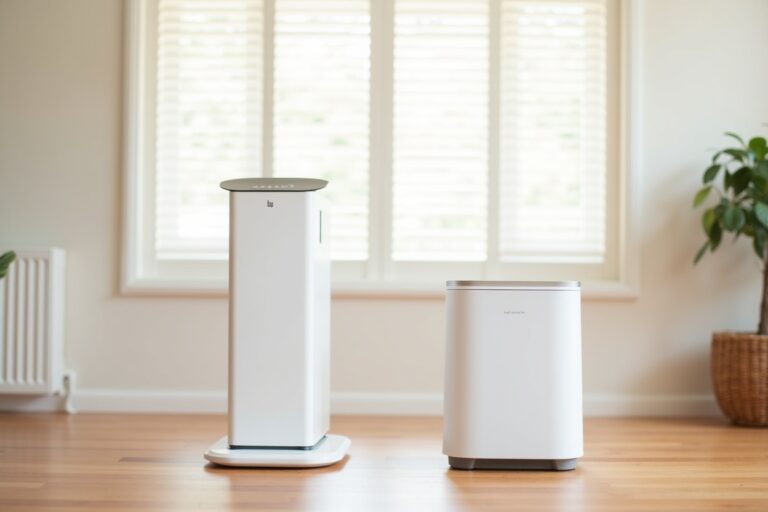
| Levoit Core 300S | Small nurseries ≤22m² | H13 True HEPA | 24 dB | ~$248 |
| Breville Protect Max | Large nurseries & open plan | H13 True HEPA | 39 dB | ~$468 |
The decision to put an air purifier in a nursery is one of the most important air quality choices an Australian parent makes. Babies breathe 30–60 times per minute — twice as fast as adults — and they cannot yet describe respiratory discomfort. Their developing lung tissue is more vulnerable to fine particles, mould spores, and chemical pollutants than adult tissue. The stakes are higher, and the tolerance for “good enough” is lower. This guide covers exactly two things: which air purifiers are safe for a baby room in Australia, and which to avoid. I’m Jayce Love, a former Royal Australian Navy Clearance Diver, and I research air quality from Palm Beach, QLD — one of the highest pollen and mould pressure environments in the country. Both products recommended below have H13 True HEPA certification under EN 1822, zero ozone output, and no ioniser.
Related: best air purifiers Australia 2026 · best air purifiers for baby room Australia · best air purifiers for dust Australia
Why H13 True HEPA Is Non-Negotiable for a Baby Room
There are three physiological reasons why air quality matters more for infants than adults:
- Respiratory rate: Newborns breathe 40–60 times per minute. Adults breathe 12–20 times. A baby in a room with 50 µg/m³ PM2.5 (Melbourne daily average during the 2019–20 bushfire season) takes in proportionally more particulate mass per kilogram of body weight than an adult in the same room.
- Lung development: The alveoli (air sacs) in a baby’s lungs continue forming until approximately age 8. PM2.5 particles embed in developing alveolar tissue at a stage when cell damage is harder to reverse than in mature adult lung tissue.
- Ozone sensitivity: Ozone (O3) causes airway inflammation at lower concentrations in infants than adults. The California Air Resources Board (CARB) mandates ozone emission testing for air purifiers sold in California, specifically because of paediatric respiratory concerns. Australia has no equivalent standard, meaning ioniser-equipped purifiers that generate ozone above safe thresholds can be legally sold in AU nursery products.
These three factors combine to create one clear rule: an air purifier in a baby room must be H13 True HEPA + activated carbon + zero ozone (CARB certified or ioniser-free). An H11 unit lets 5 in every 100 fine particles recirculate on each pass. An ioniser without ozone verification can generate irritant-level O3 in a closed nursery within 20 minutes. Both outcomes are unacceptable for a sleeping newborn.
What to Look for in a Baby Room Air Purifier: 6 Criteria That Actually Matter
The noise specification deserves special emphasis. White noise is used therapeutically for infant sleep — the sound of air filtration at low speed (22–30 dB) can actually support sleep onset by masking household noise. However, at high speeds (50+ dB), the same unit becomes disruptive. Always run your chosen unit at the lowest speed for nursery use at night, and only boost to higher speeds during the day when the baby is awake to rapidly clear airborne pollutants (bushfire smoke, cooking aerosols drifting from the kitchen).
CADR sizing for a nursery is usually simple. A standard Australian nursery is 8–15 m² with 2.4 m ceilings. At 4.8 air changes per hour — the meaningful threshold for PM2.5 reduction — you need a CADR of approximately 92–173 m³/h. The Levoit Core 300S (CADR 258 m³/h) covers this comfortably even at medium speed, meaning you can run at low speed (quietest, lowest CADR) overnight and still achieve 3+ ACH, which maintains significantly lower PM2.5 levels than no filtration.
The Best Air Purifiers for Baby Rooms in Australia 2026
These are the only two products I recommend without qualification for Australian nurseries as of July 2026. Both have confirmed H13 True HEPA filtration, no ioniser, and real-world verified PM2.5 reduction from third-party assembled-unit tests. The difference between them is room size and price.
1. Levoit Core 300S — Best Overall for Nurseries Under 22m²
Levoit Core 300S
H13 True HEPA • 258 m³/h CADR • 24 dB low speed • App + auto mode • Ozone-free
Why the Core 300S Works for a Nursery
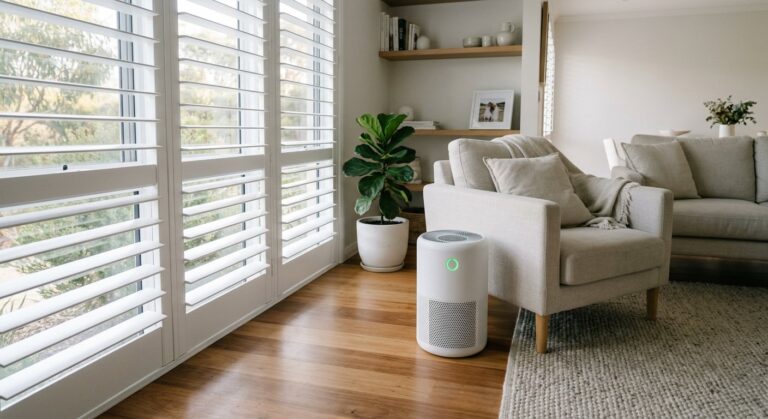
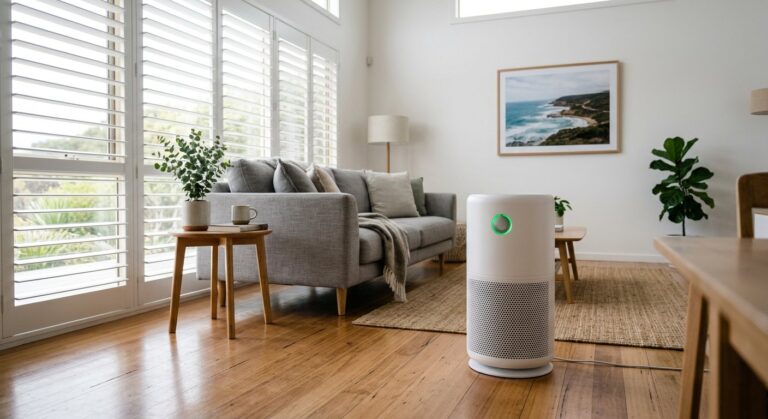
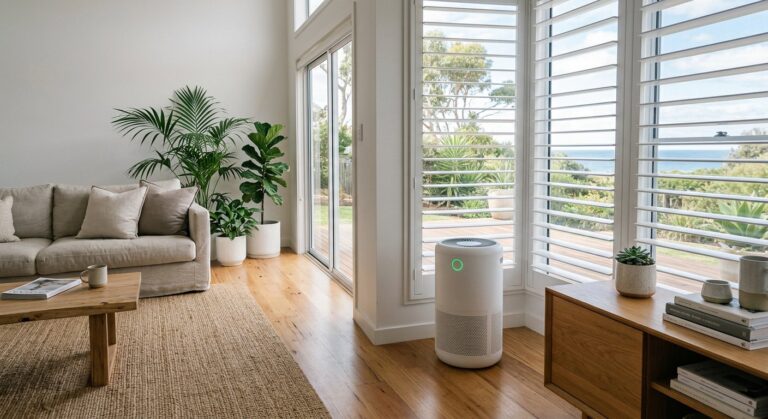
The Core 300S occupies 18×18 cm of floor space — about the footprint of a dinner plate. It can sit on a dresser, a shelf, or the floor without dominating the room. At low speed it measures 24 dB, quieter than the soft rustle of a ceiling fan, and the Levoit Home app lets you schedule it to switch to auto mode at sunset and drop to sleep mode at 10 pm without you entering the room. The LED ring can be turned off entirely in the app, which matters — any light source in a baby’s room, including the soft glow of an LED indicator, can reduce melatonin by 50% at the levels babies are sensitive to.
The 360-degree cylindrical filter draws air inward from all sides simultaneously, which means placement is flexible — it doesn’t need to be against a wall or in a corner. In a nursery, that means you can place it centrally on the floor at a safe distance from the cot, where it captures the full room volume rather than just the air near one wall. The filter stack is three-layer: nylon pre-filter, H13 HEPA glass fibre media, activated carbon. No ioniser, no UV-C, no plasma. It is a simple mechanical + chemical filter, which is exactly what a nursery needs.
| Spec | Value | Baby room relevance |
|---|---|---|
| HEPA grade | H13 True HEPA | 99.95% at MPPS — non-negotiable |
| CADR | 258 m³/h | Covers a 22m² nursery at 4.8 ACH |
| Noise (low speed) | 24 dB | Below human sleep disruption threshold |
| Footprint | 18 × 18 cm | Fits on dresser, shelf, or floor safely |
| Ioniser | None | Zero ozone risk |
| Night mode (LED off) | Yes (app) | No melatonin suppression from display light |
| Filter replacement | 6–8 months | ~$35–45 per filter on Amazon AU |
✓ Pros
- H13 True HEPA — verified by third-party assembled-unit tests
- 24 dB on low — actually quiet for sleep
- No ioniser, no ozone risk
- LED completely off via app
- 360-degree intake — flexible placement
- Compact footprint — nursery-safe
- Auto mode detects air quality and adjusts
× Cons
- App required to turn off LED indicator
- 22m² ceiling — not for open-plan areas
- Replacement filters not always in stock at Officeworks
2. Breville Smart Air Viral Protect Max — Best for Larger Nurseries & Open Plan
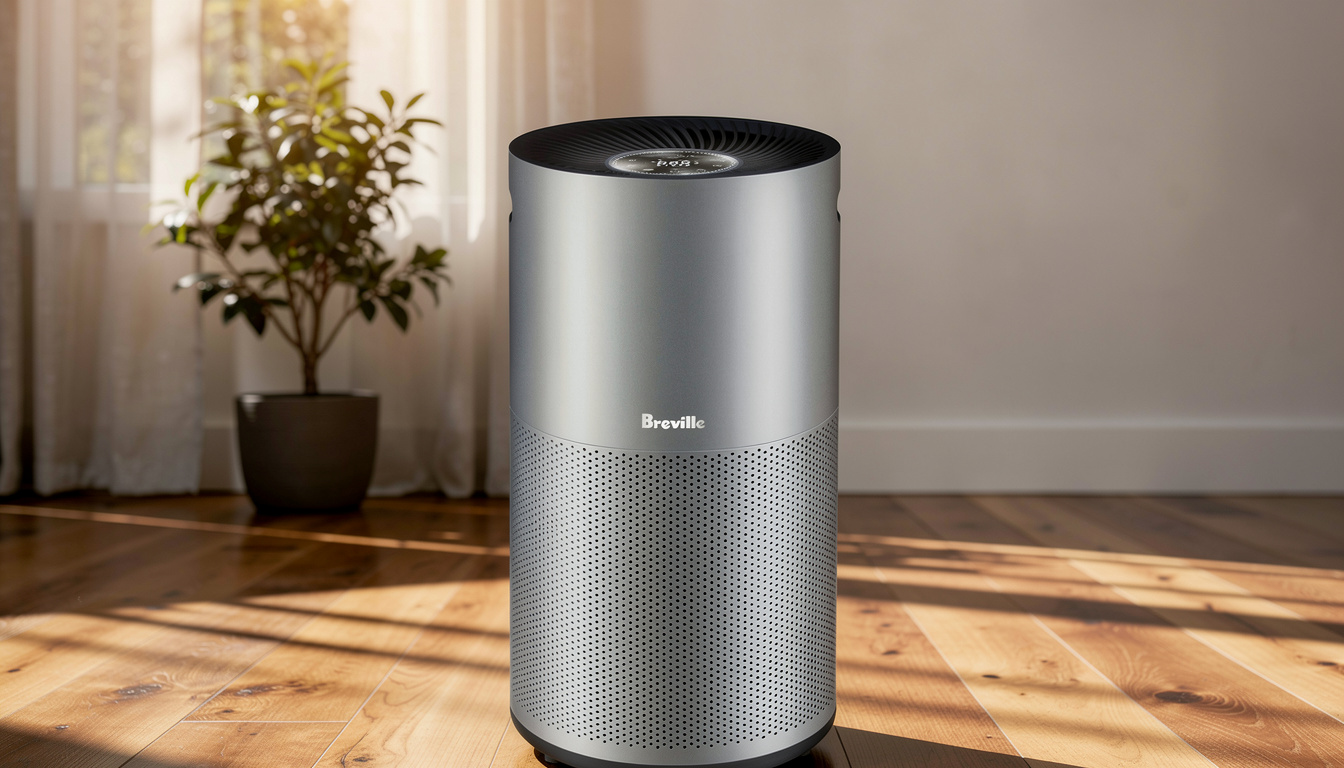
Breville Smart Air Viral Protect Max
H13 True HEPA • 480 m³/h CADR • 39 dB low speed • CHOICE #1 • No ioniser
When to Choose the Breville Over the Levoit
The Breville Protect Max is CHOICE magazine’s top-rated air purifier for Australian homes and runs H13 True HEPA with zero ioniser technology. Its 480 m³/h CADR covers rooms up to 40 m², making it the right pick for oversized nurseries, open-plan living areas where a baby sleeps in a bassinette, or homes in high-smoke environments (bushfire-adjacent QLD/NSW properties) where a single larger unit running throughout the house makes more sense than multiple smaller ones.
The key trade-off is noise: the Breville’s lowest speed runs at 39 dB, which is audible in a quiet room at night. At 24 dB, the Levoit Core 300S is significantly quieter for sleep. The practical approach if you have a Breville Protect Max: run it at medium-high speed for 30–60 minutes before settling the baby, then switch to low (or off) at bedtime, and let residual clean air do the work overnight in a sealed room. At 40 m² CADR, it cleans the air quickly enough that this strategy works for rooms up to 25 m².
✓ Pros
- CHOICE magazine #1 rated AU air purifier
- H13 True HEPA — no grade debate
- 480 m³/h CADR — cleans a room fast before sleep
- No ioniser, no plasma, no ozone
- Premium AU brand with local support and warranty
× Cons
- 39 dB on low — too loud to run overnight for most babies
- $468 — significant outlay for a single-room unit
- Larger footprint — takes more floor space in a nursery
Understand what H13 actually means
Our full HEPA certification explainer covers EN 1822, MPPS testing, the H11/H12/H13/H14 grading scale, and how to verify any AU product’s actual certification before you buy.
HEPA Certification Explained →Australian-Specific Risks: Bushfire Smoke, Mould, and Pollen for Your Baby
Australian parents face air quality risks that parents in most other countries do not deal with at the same intensity. Three deserve specific attention for nursery management:
Bushfire Smoke
During 2019–20, PM2.5 in Sydney and Canberra exceeded 1,000 µg/m³ at peak events. Smoke penetrates through window frames and gaps even with windows closed. H13 HEPA removes smoke particles; activated carbon removes smoke odour. Run at high speed for 30 min before baby sleep time when AQI >100.
Mould Spores
Coastal QLD, northern NSW, and Darwin have year-round mould spore counts that exceed the European allergy threshold of 50 spores/m³ on humid days. Mould spores cause respiratory sensitisation in infants. H13 captures spores (1–30 µm) at >99.97%. Change the filter before it’s grey, not after.
Spring Pollen
Brisbane and Canberra have the highest thunderstorm asthma risk in Australia. Ryegrass pollen (10–100 µm) is captured at >99.99% by H13. Run the nursery purifier at high speed during high-pollen days and keep windows closed from 6–11am when counts peak.
The Australia Bureau of Meteorology publishes air quality forecasts for all capital cities including PM2.5 alerts. Set up AQI alerts for your postcode — when PM2.5 goes above 25 µg/m³ (the WHO 24-hour guideline), increase the purifier to medium speed in the nursery. The NSW EPA and AQHI apps both cover Brisbane, Sydney, Melbourne, and Canberra with real-time readings.
How to Position an Air Purifier in a Baby Room: Placement Rules
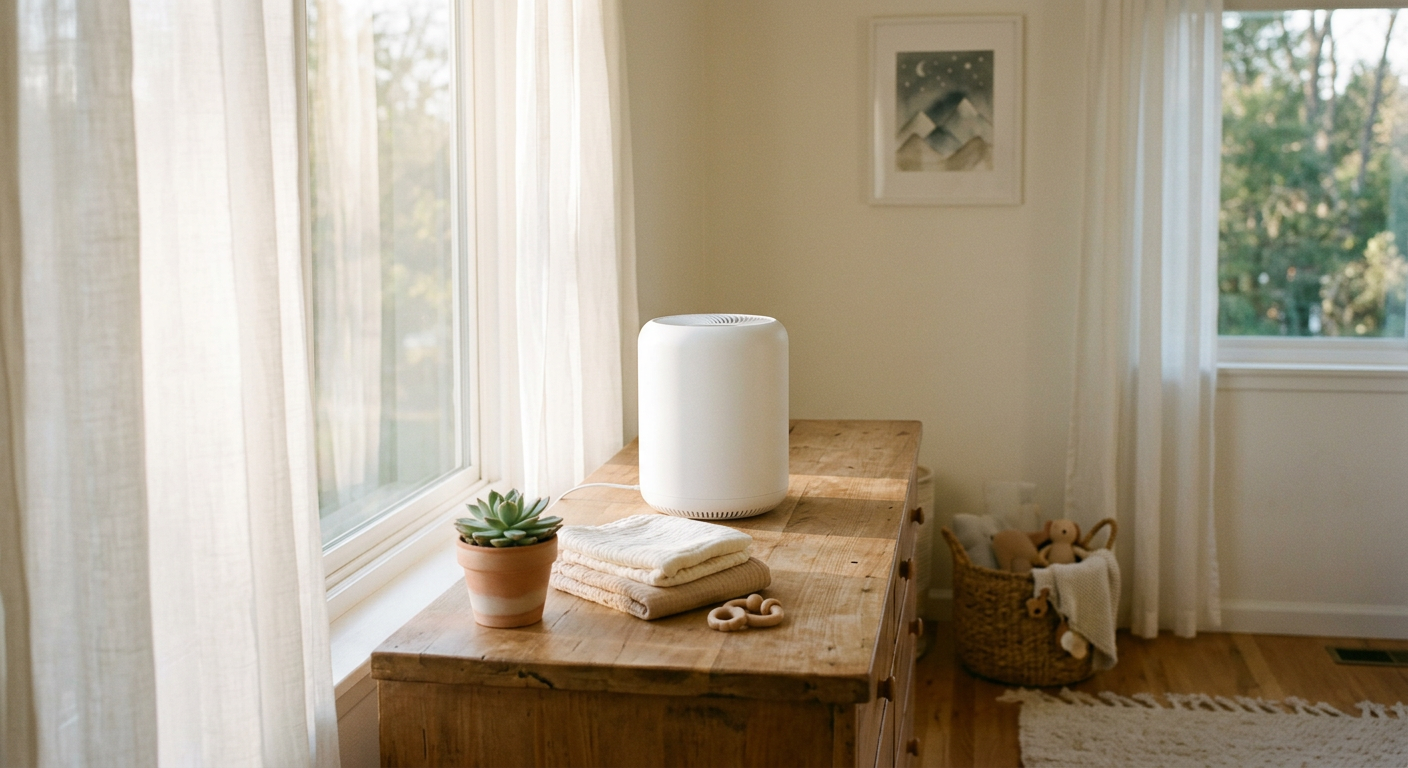
- Distance from cot: Minimum 60 cm. Air purifiers draw air inward — placing one too close to a cot creates direct airflow across the baby, which can cause chilling and discomfort. The Levoit Core 300S’s 360-degree intake makes it safe at 1 m from the cot on the floor or a dresser.
- Not on the floor directly under the cot: If a baby’s head is near floor level (bassinette on the floor), the air intake at floor level can create a mild draft. Elevate the purifier on a stable surface, or place it across the room.
- Away from corners: Air purifiers work most efficiently when they have at least 30 cm of clearance on all sides to draw air freely. A unit wedged into a corner recirculates the same air near the corner rather than the whole room volume.
- On the same side as the door: Airborne pollutants enter primarily through the doorway. Placing the purifier near the door intercepts incoming pollutants before they travel across the room to the cot area.
- Not behind furniture: Anything that restricts the air intake path on a cylindrical (360-degree) unit reduces effective CADR and creates unfiltered zones in the room.
Air Purifiers to Avoid in a Baby Room
| Product Type | Why to Avoid |
|---|---|
| Any unit with ioniser (not CARB certified) | May generate ozone above safe levels in a closed room. Multiple AU nursery-marketed products affected. |
| HEPA-type / HEPA-style (no grade number) | No certified minimum efficiency. Independently measured as low as 78% in some units. |
| H11 grade filters | 5 in 100 fine particles pass through per recirculation. Inadequate for PM2.5 protection. |
| Ozone generators marketed as air purifiers | Produce ozone as the primary mechanism. Ozone above 0.05ppm is an airway irritant. Never use in an occupied room. |
| Combined humidifier/air purifier units | Humidifier reservoirs grow mould and bacteria within 24–48 hours without regular sterilisation — contradicting the purification goal. |
| Essential oil diffuser / purifier combos | Essential oil aerosols are VOC mixtures. Many oils are airway irritants for infants. Do not diffuse oils in a nursery. |
Last reviewed: July 2026 — Clean and Native
Related guides
Frequently Asked Questions
Is an air purifier safe for a baby room?
Yes — a correctly chosen air purifier is safe and beneficial for a baby room. The key requirements are H13 True HEPA filtration (for particle removal), no ioniser or ioniser with CARB certification (to prevent ozone exposure), and appropriate placement at least 60cm from the cot. Avoid units with ionisers, plasma technology, or essential oil diffuser functions in any occupied baby room.
What HEPA grade do I need for a baby room?
H13 True HEPA is the minimum acceptable grade for a baby room. H13 removes at least 99.95% of particles at the Most Penetrating Particle Size under EN 1822, including PM2.5, mould spores, pet dander, pollen, and respiratory aerosol droplets. H11 and H12 are less efficient (H11 lets 5 in 100 particles pass through). HEPA-type or ungraded HEPA have no certified minimum efficiency and should not be used in a nursery.
Is the Levoit Core 300S safe for a newborn’s room?
Yes. The Levoit Core 300S has H13 True HEPA filtration, no ioniser, and no ozone output. It runs at 24 dB on low speed — below human sleep disruption threshold — and the LED display can be completely disabled via the Levoit Home app. It covers rooms up to 22m² at 4.8 air changes per hour, which covers virtually all Australian nurseries.
Can I run an air purifier all night in a baby’s room?
Yes. Running an H13 HEPA purifier continuously on low speed is safe and beneficial. At 24 dB (Core 300S low speed), it is quieter than a ceiling fan and the gentle white noise can support infant sleep by masking household sounds. The filter removes continuously circulating particles rather than just cleaning the air once. There is no risk from continuous operation on an ioniser-free, H13-certified unit.
Do I need an air purifier if I have air conditioning in the nursery?
Yes. Residential air conditioning recirculates indoor air — it does not filter PM2.5, mould spores, or allergens to H13 standard. Most AC filters are basic G3 or G4 grade (30-60% efficiency at coarse particles), which does not address fine particles, smoke, or airborne allergens. An AC + H13 HEPA purifier is the correct combination: the AC manages temperature and humidity; the purifier manages air quality.
How far should an air purifier be from the cot?
At least 60cm, ideally 100cm or more. Air purifiers draw air inward — placing one too close to a cot can create direct airflow over the baby, causing chilling and discomfort. Position the unit on a stable surface across the room from the cot, elevated off the floor, with clear space on all sides for unobstructed air intake. Near the door is ideal to intercept pollutants entering the room.
Does an air purifier help with baby eczema?
H13 HEPA air purifiers can reduce the airborne allergen load that triggers eczema flares, including pet dander, dust mite particles, and pollen. They do not address skin-contact allergens (detergent residue, fabric softener, formula contact). For eczema management, H13 HEPA filtration is one component of a broader environmental allergen reduction plan that also includes HEPA vacuuming, fragrance-free laundry products, and low-allergen bedding.
What is the best air purifier for a baby room in Australia?
The Levoit Core 300S is the best air purifier for most Australian nurseries: H13 True HEPA, 24 dB at low speed, no ioniser, compact footprint, and app-controlled LED-off mode. It covers rooms up to 22m² at 4.8 ACH. For larger nurseries or open-plan areas, the Breville Smart Air Viral Protect Max is the CHOICE magazine #1-rated AU option with H13 HEPA and 480m³/h CADR, though it runs louder at 39 dB on low.
Get the Australian Home Environment Checklist
30 checks across water, air and EMF. Most of them free. Ranked by impact.
No spam. Unsubscribe any time.

Former Royal Australian Navy Clearance Diver and TAG-E counter-terrorism operator. Founded Clean and Native to apply the same rigorous thinking to the home environment.
Full biography →