How to Remineralise RO Water Australia: Drops, Filters, and What Actually Works
Drafted with AI assistance and checked against published specifications and certifications. First-hand measurements appear only where stated. How we make content
RO systems strip your tap water to near-zero TDS — and for most Australian households that’s the point, removing fluoride, chloramine, and PFAS down to 3–5 ppm — but pure H₂O tastes flat and some people want minerals back. This guide was researched and assessed using our documented methodology by Jayce Love, former Royal Australian Navy Clearance Diver, to give you a no-nonsense answer on which approach actually works.
Quick Verdict — How to Remineralise RO Water Australia
Adding minerals back to RO water has three approaches — an inline remineralisation filter (most consistent), mineral drops (most flexible), or buying an RO with a built-in alkaline stage like the AquaTru Smart Alkaline.
| Method | How it works | Verdict |
|---|---|---|
| Inline remineralisation filter | Adds Ca/Mg via calcite/maifan stone stage | Recommended — consistent, set-and-forget |
| Liquid mineral drops | Add per glass or jug | Good for existing setups, requires discipline |
| Built-in alkaline RO (AquaTru) | Alkaline filter stage inside the unit | Best for new buyers — no extras needed |
Why RO Removes Minerals (And Whether That’s a Problem)
Reverse osmosis membranes work by forcing water at pressure through a semi-permeable membrane with pores small enough to reject dissolved solids — including calcium, magnesium, potassium, and sodium. A well-functioning RO membrane removes 95–99% of total dissolved solids. In my own testing at Palm Beach, SEQ, the incoming mains water measured 69 ppm TDS. Post-EcoHero 5-Stage RO, that dropped to 3 ppm — a 95.7% reduction. That’s effective filtration. It’s also almost pure water.
The World Health Organization (WHO) position is that very low TDS water is safe to drink. It is not toxic. It will not leach minerals from your body in any clinically meaningful way — the amount of calcium you get from water is trivially small compared to what you get from food. The real arguments for remineralisation come down to taste, pH, and personal preference. Water stripped to near-zero TDS tastes flat and slightly acidic — typically around pH 5.5–6.5 due to dissolved CO₂ from the air. If you find yourself drinking less water because it tastes wrong, that’s a real problem worth solving.
There is a secondary argument for households in Brisbane and SEQ, Adelaide, and Gold Coast — cities where tap water is already chloramine-treated and moderately to highly mineralised. These households run RO specifically to remove fluoride (0.6–0.9 mg/L in SEQ), chloramine, and PFAS. Once you’ve done that, the resulting ultra-pure water may be noticeably flat if you’ve been drinking mineralised tap water your whole life. Melbourne households, drawing from the Yarra Valley catchment at ~25 mg/L CaCO₂ hardness, may not notice the difference as much. Bottom line: remineralisation is a preference, not a health imperative.
The Three Ways to Remineralise RO Water
You have three practical options for adding minerals back to RO-filtered water. Each suits a different situation. Here’s an honest assessment of each.
1. Inline Remineralisation Filter Stage
An inline remineralisation stage is a cartridge that sits in the filtered water line after the RO membrane. It contains calcite (calcium carbonate, CaCO₂) and maifan stone — a mineral-rich volcanic rock used in Japanese water treatment. As water passes through, it dissolves trace amounts of calcium and magnesium, raising TDS from near-zero up to 40–80 ppm and pH from the 5.5–6.5 range up to approximately 7.0–7.5. The result: noticeably improved taste, slightly alkaline water, and consistent results without any user action after installation.
Most modern under-sink RO systems — including the Waterdrop D6 and the EcoHero 5-Stage — can accept an add-on remineralisation stage as a 6th cartridge in the line. Replacement cartridges cost $30–60 and last approximately 12 months depending on usage volume. For a 4-litre-per-day household, that works out to roughly $0.003 per litre of mineralised water — the cheapest ongoing option. The main limitation: you need to have an under-sink system with a spare port, or one designed to accept additional stages.
2. Liquid Mineral Drops
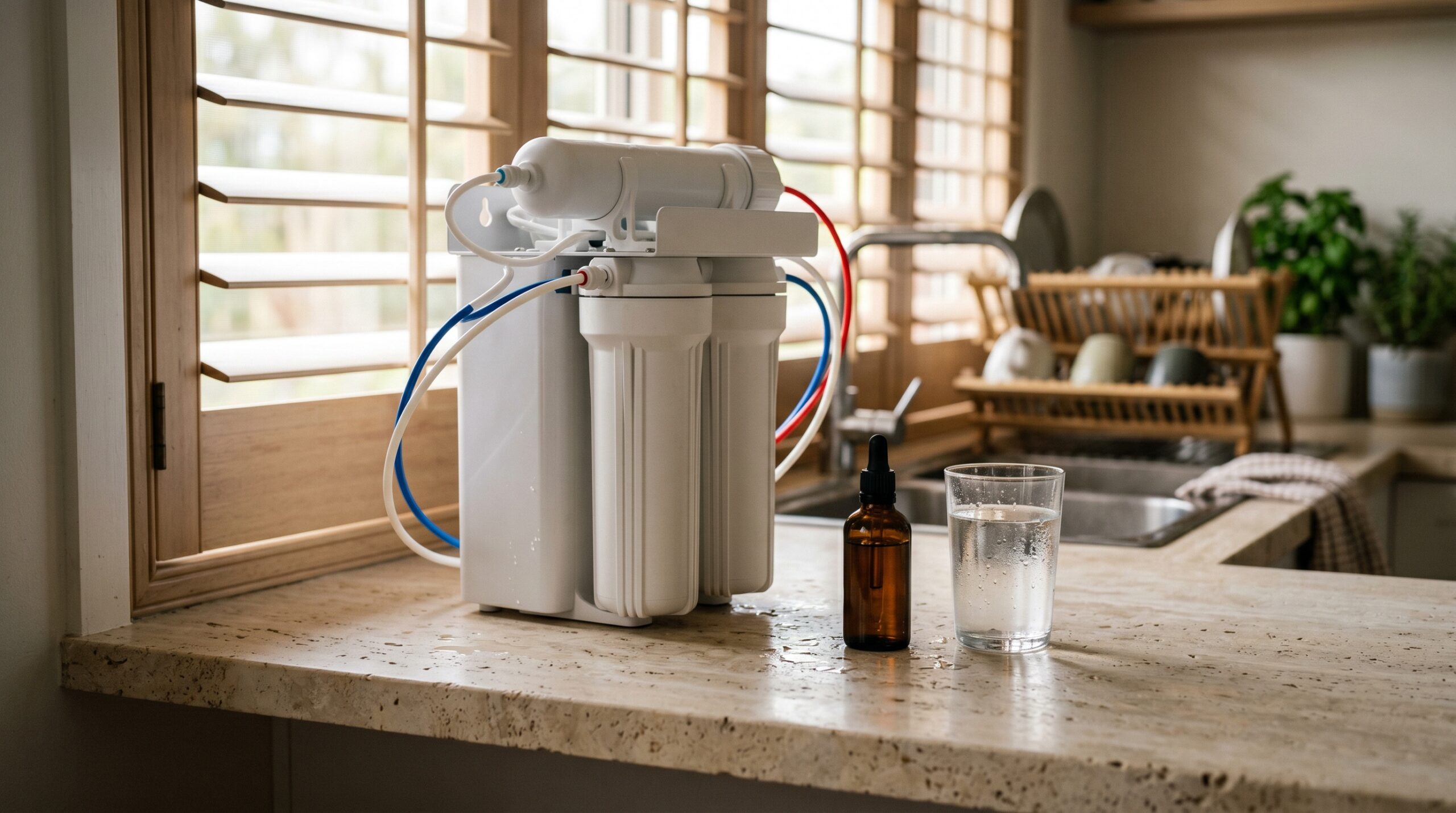
Liquid mineral drops are concentrated electrolyte solutions you add per glass or jug. A quality mineral drop formulation contains magnesium, calcium, potassium, sodium, and trace elements in ionic form — the same minerals removed by RO, in forms your body can readily absorb. Earth’s Water Mineral Drops is the option I’d recommend for Australian buyers: Australian-sourced, clean ingredient list, and available for direct delivery.
The advantages: mineral drops work with any RO system, any jug, any countertop unit. You don’t need to modify your plumbing or install anything. They’re ideal for renters, for people who move frequently, or for anyone who already has an RO system and wants to add remineralisation without touching the unit. A bottle costs $30–50 and lasts 3–6 months for one person at 4 litres per day — around $0.010 per litre, the most expensive of the three options ongoing. The catch: they require per-glass discipline. If you forget, you drink un-mineralised water. Not a problem for some people; a real friction point for others.
3. Buy an RO System with a Built-In Alkaline Stage
The cleanest solution for new buyers is an RO system that includes a remineralisation stage from the factory. The AquaTru Classic Smart Alkaline does exactly this: it’s a four-stage countertop RO that includes a dedicated alkaline remineralisation filter as its final stage. Stage 4 adds back calcium and raises pH, delivering water at 7.5–8.5 pH and approximately 40–70 ppm TDS — similar to what you’d get adding a 6th stage to an under-sink system, but in a single countertop unit that requires no plumbing at all.
The AquaTru is priced at approximately $799 on Amazon AU. The alkaline filter cartridge costs around $40 and lasts three months (or per manufacturer spec based on volume). Over five years, assuming 4L/day, this works out to about $0.09 per litre total (including the base unit cost and all filter replacements) — comparable to other countertop RO systems. The built-in alkaline stage adds minimal cost to the ongoing filter bill. For anyone who hasn’t purchased an RO system yet and wants remineralised water without add-ons, this is the straightforward choice.
(Earth’s Water)
(built-in stage)
(add-on stage)
Which Australian Households Actually Need to Remineralise?
Be honest with yourself before spending money on remineralisation. For most Australian households running RO purely for water safety — removing fluoride, chloramine (present in Brisbane/SEQ, Sydney, Adelaide, Gold Coast, and Darwin), or PFAS contamination — remineralisation is optional. You have already solved the problem you set out to solve. The ultra-pure water coming out of your system is safe. The minerals you removed were not providing a meaningful health benefit over what you get from food.
That said, there are four situations where remineralisation makes practical sense. First: if your filtered water tastes flat or metallic to you, mineral drops are the cheapest and fastest fix. Add a few drops to a glass and see if the taste improves. If it doesn’t matter to you, skip remineralisation entirely. Second: if you’re building a new RO setup from scratch and you want simplicity — one unit, built-in remineralisation, no extra cartridges to track — the AquaTru Smart Alkaline is the right call. Third: if you already have an under-sink RO (like the EcoHero or Waterdrop D6) and you want consistent remineralisation without per-glass discipline, adding an inline remineralisation stage is the cleanest retrofit at the lowest ongoing cost. Fourth: if pH matters to you — some people find slightly alkaline water more pleasant, particularly for making coffee or tea — any of the three methods will get you there.
What about children and elderly family members? RO water is fine for both. Children’s and elderly adults’ mineral requirements are primarily met through food, not water. According to the Australian Dietary Guidelines, the daily calcium requirement for adults is 1,000–1,300 mg/day. A litre of tap water in Brisbane or Adelaide might contain 15–30 mg of calcium — 1.5–3% of the daily requirement. That contribution is real but trivially small. If you have a specific medical concern about mineral intake, your GP is the right person to ask. This is not a question that should drive a water filter purchase decision.
Step-by-Step: Adding an Inline Remineralisation Stage to Your Existing RO
If you already own an under-sink RO system and want to add a remineralisation stage, this is a straightforward retrofit for most systems. The process takes about 20 minutes and requires no special plumbing skills. Here’s how to do it.
- Confirm your system accepts an additional stage. Most under-sink RO systems — including the Waterdrop D6 and the EcoHero 5-Stage (see our full EcoHero review for compatibility notes) — use standard 1/4” push-fit connectors. If your system has a spare port labelled “post-filter” or “stage 6,” you’re ready. If not, you’ll need a Y-connector splitter, available online for under $10.
- Purchase the correct cartridge type. Look for a remineralisation cartridge containing calcite (calcium carbonate) and maifan stone, with 1/4” push-fit connections. Avoid cartridges marketed as “alkaline” that only use tourmaline or other far-infrared materials — these have minimal effect on TDS or pH in practice.
- Shut off the water supply valve. This is the valve on the cold water line feeding your RO system, usually under the sink. Turn clockwise to close. Open your RO tap to release pressure.
- Connect the remineralisation cartridge in-line after the post-carbon (final) stage. Disconnect the output line from your final post-carbon stage. Connect that line to the inlet of the remineralisation cartridge. Connect a new short section of 1/4” tubing from the cartridge outlet to your faucet line. The water flow direction is: RO membrane → post-carbon → remineralisation → faucet.
- Restore water supply and flush the cartridge. Open the supply valve slowly. Let water run through the remineralisation stage for 3–5 minutes before drinking. Maifan stone cartridges typically have a slight mineral taste on first flush that clears within one full flush cycle.
- Test your TDS and pH after installation. You should see TDS rise from near-zero to 40–80 ppm, and pH should read 7.0–7.5. If TDS is below 20 ppm after flushing, check your connections or consider a fresh cartridge — old stock cartridges sometimes have depleted media.
- Set a cartridge replacement reminder. Remineralisation cartridges exhaust at different rates depending on your water volume. At 4L/day, most quality cartridges last 12 months. At 8–10L/day (larger household), replace every 6 months. When the cartridge depletes, TDS output will drop back toward zero and pH will return to the 5.5–6.5 range — both measurable with a basic TDS meter and pH strip.
The AquaTru Classic Smart Alkaline — Best for New Buyers
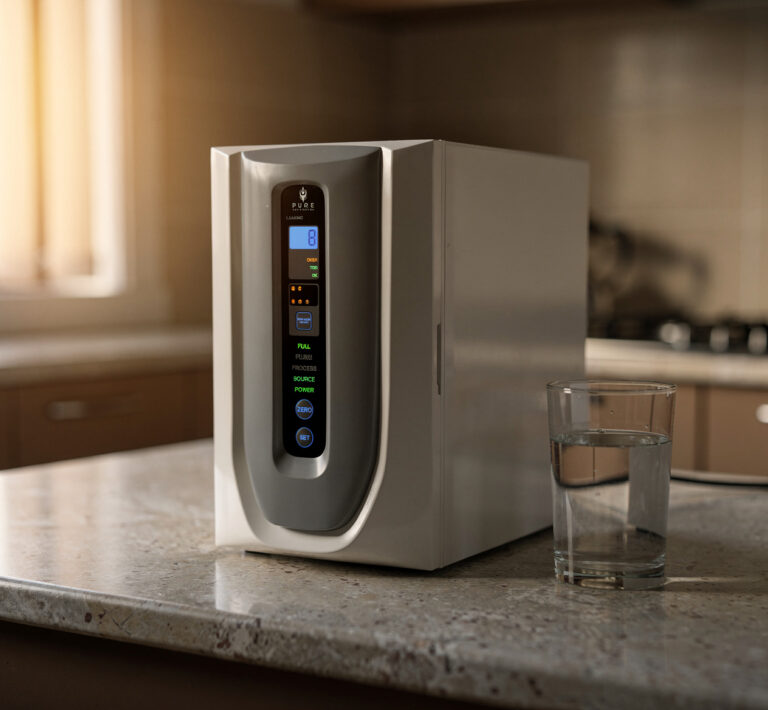
The AquaTru Classic Smart Alkaline is a four-stage countertop reverse osmosis unit that requires no plumbing installation. You fill a top tank with tap water, it runs through the four-stage filtration process, and dispenses from the front tap. The four stages are: a pre-filter (sediment and chlorine), an RO membrane, a post-carbon polish, and a fourth alkaline remineralisation stage that adds calcium and raises pH. This is the key differentiator from the standard AquaTru Classic — you get remineralised water from the same unit, no add-ons required.
Output water is typically 7.5–8.5 pH and 40–70 ppm TDS post-remineralisation, depending on incoming water quality. The unit processes approximately 3 gallons (11.4 litres) per day. Priced at around $799 on Amazon AU, the 5-year cost per litre (unit + all filter replacements) works out to approximately $0.09 — consistent with other quality countertop RO systems. The alkaline cartridge costs around $40 and has a replacement interval of roughly three months at standard use rates.
The AquaTru suits Brisbane, Sydney, Adelaide, and Gold Coast households particularly well because it handles chloramine-treated water effectively. Its RO membrane removes chloramine, fluoride, and PFAS. The built-in alkaline stage then restores the minerals that give the water a clean, pleasant taste. For a household that is currently buying bottled water because their tap water tastes or smells of chloramine, this is the “one-and-done” solution.
✓ Who This Is For
- New RO buyers who want remineralised water with no plumbing
- Renters in Brisbane, Sydney, Adelaide, Gold Coast who can’t modify under-sink plumbing
- Households currently spending $30+/month on bottled alkaline water
- Anyone who wants a single unit that does both filtration and remineralisation
× Who It Is Not For
- Households who already have a functioning under-sink RO — add an inline remineralisation stage instead
- High-volume households (5+ people) who need more than 11L/day capacity
- Those wanting the cheapest possible per-litre cost — the inline stage wins on ongoing cost
Related Guides
If you’re choosing a new RO system and want to understand the full landscape first, our best reverse osmosis systems in Australia for 2026 roundup covers every major option across under-sink, countertop, and gravity-fed categories. If you’re specifically comparing the EcoHero to other under-sink options, the EcoHero 5-Stage review has full test data including my Palm Beach TDS measurements. And if you’re still deciding whether RO is the right filtration approach for your city’s water, the water filtration guide covers the full decision tree for Australian households.
Last reviewed: July 2026 — Clean and Native
Frequently Asked Questions
Is remineralised RO water better than plain RO water?
Remineralised RO water tastes better to most people and has a more neutral to slightly alkaline pH (7.0–8.5 vs 5.5–6.5 for plain RO). It is not meaningfully healthier — the mineral contribution from water is minor compared to food intake. The improvement is primarily sensory.
Does RO water leach minerals from your body?
No. The claim that RO water “leaches minerals from bones” is not supported by evidence. Your body regulates mineral balance through dietary intake and hormonal mechanisms, not by reabsorbing minerals from drinking water. The WHO reviewed this concern extensively and found no evidence of harm from consuming low-TDS water.
What minerals does RO water remove?
RO removes 95–99% of all dissolved solids, including calcium, magnesium, potassium, sodium, bicarbonates, and trace elements. It also removes fluoride (90–97%), chloramine, PFAS, lead, nitrates, and most heavy metals. The same membrane that removes contaminants also removes beneficial minerals — there is no selective removal.
Can I use Himalayan salt to remineralise RO water?
Technically yes, but it is not recommended as a primary remineralisation method. A pinch of Himalayan salt does add trace minerals including calcium, magnesium, and potassium alongside sodium. The problem is dosing consistency — you have no reliable way to know how much you’re adding. Mineral drops or an inline filter stage provide measured, consistent mineral addition. Use salt as a temporary workaround, not a long-term solution.
How do I remineralise RO water for a fish tank?
For aquarium use, you need to remineralise RO water specifically for your fish species’ target parameters (GH, KH, pH). Do not use drinking-water mineral drops for this — fish require different mineral ratios than humans. Use purpose-built aquarium remineralisation products such as Seachem Equilibrium (freshwater) or dedicated reef salts (marine). Aim for target GH and KH for your species before introducing fish.
What TDS should remineralised water be?
For drinking water, a TDS of 50–150 mg/L is considered optimal for taste. Most remineralisation methods (inline filter, drops, AquaTru) will get you to 40–80 ppm from near-zero RO output. This is well within safe and pleasant drinking range. You do not need to hit the TDS of your original tap water — 50–100 ppm is sufficient for good taste and pH.
Does the AquaTru Smart Alkaline actually raise pH?
Yes. The AquaTru Smart Alkaline’s fourth-stage alkaline filter contains calcite media that raises pH from the typical post-RO range of 5.5–6.5 up to approximately 7.5–8.5. This is a real, measurable effect, not marketing. You can verify it with a basic pH meter or pH test strip. The effect persists for the life of the alkaline cartridge (roughly three months at standard use).
How long does a remineralisation filter cartridge last?
Most inline remineralisation cartridges last 12 months at 4 litres per day consumption. At higher volumes (8–10L/day for a larger household), expect 6 months. The sign that a cartridge is depleted: TDS output drops back toward near-zero and pH returns to the 5.5–6.5 range. Test with a TDS meter every 3 months to catch depletion before it affects your water quality.
Final Verdict: How to Remineralise RO Water Australia
The right remineralisation approach depends entirely on your situation, not a universal recommendation.
Buy the AquaTru Classic Smart Alkaline if you are purchasing an RO system for the first time and want remineralised water with zero plumbing, zero add-ons, and a single maintenance routine. At $799, it handles fluoride, chloramine, and PFAS removal and then remineralises in one unit. Best for renters in Brisbane, Sydney, Adelaide, and Gold Coast.
Add an inline remineralisation stage if you already own an under-sink RO like the EcoHero or Waterdrop D6. At $30–60 per year, this is the lowest ongoing cost option at $0.003/L. Set-and-forget once installed.
Use mineral drops if you need flexibility — you move frequently, you rent and can’t install anything, or you want to try remineralisation before committing to a hardware change. Earth’s Water drops work for any RO system or filtered jug.
Skip remineralisation entirely if your filtered water tastes fine to you and you have no specific pH or mineral preference. There is no health reason to remineralise if you are otherwise healthy and eating a balanced diet.
Ready to remineralise your RO water?
The AquaTru Classic Smart Alkaline is the simplest solution for new buyers — four-stage countertop RO with built-in alkaline remineralisation, no plumbing required.
Get the Australian Home Environment Checklist
30 checks across water, air and EMF. Most of them free. Ranked by impact.
No spam. Unsubscribe any time.

Former Royal Australian Navy Clearance Diver and TAG-E counter-terrorism operator. Founded Clean and Native to apply the same rigorous thinking to the home environment.
Full biography →