
Australia Cracks Down on PFAS in Drinking Water 2024
Australia’s drinking water PFAS guidelines were revised by NHMRC in June 2025, tightening limits far below the original 2016 values and placing dozens of communities — particularly near Defence bases and industrial sites — above the new thresholds. Reverse osmosis is the only filtration technology with independent NSF/ANSI P473 certification for PFAS removal; carbon filters, including catalytic carbon, do not meet this standard.
What PFAS Is and Why It Matters for Australian Tap Water
Per- and polyfluoroalkyl substances (PFAS) are a group of more than 12,000 synthetic chemicals characterised by carbon-fluorine bonds — among the strongest in organic chemistry. That stability is exactly why they were used in aqueous film-forming foam (AFFF) for fire suppression, non-stick cookware coatings, and water-repellent fabrics. It is also why they do not break down in the environment or in the human body. The International Agency for Research on Cancer (IARC) classified PFOA as Group 1 carcinogenic to humans in November 2023 and PFOS as Group 2A (probably carcinogenic).
In Australia, the primary contamination pathway is AFFF use at Defence bases, civilian airports, and industrial fire-training sites. The Parliamentary inquiry into PFAS contamination (tabled 2018, with interim and final reports to 2024) documented contamination at over 45 Defence sites and an expanded list of impacted communities. The inquiry identified Williamtown (NSW), Tindal (NT), Oakey (QLD), Edinburgh (SA), Pearce and Gin Gin (WA), and Jervis Bay (NSW) as locations with confirmed drinking water or groundwater impacts. This is not a hypothetical risk for those communities — it is a documented, ongoing exposure.
The most studied PFAS compounds in Australian water supplies are PFOS (perfluorooctane sulfonic acid), PFOA (perfluorooctanoic acid), and PFHxS (perfluorohexane sulfonic acid). Shorter-chain replacements — PFBS, PFBA, GenX — are increasingly detected as manufacturers shifted to alternatives after regulatory pressure, but these too accumulate and some have demonstrated endocrine-disrupting properties in animal models.
The 2016 Guidelines vs. the June 2025 NHMRC Revision
Australia’s original PFAS drinking water guidelines were published in 2016 by the Food Standards Australia New Zealand (FSANZ) and referenced by state authorities. Those guidelines set:

- PFOS + PFHxS combined: 500 ng/L (nanograms per litre)
- PFOA: 500 ng/L (some sources cite 5 ng/L for PFOA separately — the FSANZ 2016 value for PFOA as a standalone guideline was 500 ng/L; the 5 ng/L figure reflects later interim revisions in some jurisdictions)
The June 2025 NHMRC revision — conducted through the PFAS Health Review process at nhmrc.gov.au/health-advice/environmental-health/water/PFAS-review — represents a fundamental shift in how Australia manages PFAS risk. The new Health Guideline Values (HGVs) are substantially lower, reflecting the updated IARC classifications, WHO 2022 provisional guidance values, and the accumulating epidemiological evidence on PFAS and thyroid disruption, immune suppression, and developmental toxicity in children.
The direction of travel is consistent with international moves: the US EPA set maximum contaminant levels (MCLs) for PFOA and PFOS at 4 ng/L in April 2024. The EU Drinking Water Directive set a sum-of-20-PFAS limit of 100 ng/L effective 2026. Australia’s 2025 revision brings the ADWG into alignment with these tighter thresholds.
PFAS Guideline Values: 2016 vs 2025 (Australia) and International Comparators
| Compound | Australia 2016 | Australia 2025 (NHMRC) | US EPA 2024 MCL | WHO 2022 Provisional | Health Basis |
|---|---|---|---|---|---|
| PFOS | 500 ng/L (combined with PFHxS) | Revised downward (NHMRC 2025) | 4 ng/L | 100 ng/L (provisional) | IARC Group 2A; liver, immune, thyroid effects |
| PFOA | 500 ng/L | Revised downward (NHMRC 2025) | 4 ng/L | 100 ng/L (provisional) | IARC Group 1 carcinogen (Nov 2023); kidney/testicular cancer |
| PFHxS | 500 ng/L (combined with PFOS) | Revised downward (NHMRC 2025) | 10 ng/L | Not individually set | Thyroid hormone disruption; longer half-life than PFOS |
| PFNA | Not set (2016) | New HGV set (NHMRC 2025) | 10 ng/L | Not individually set | Developmental toxicity in animal studies |
| PFHxA | Not set (2016) | New HGV set (NHMRC 2025) | Not individually set | Not individually set | Short-chain replacement compound; accumulation data limited |
Sources: NHMRC PFAS Health Review 2025 (nhmrc.gov.au); US EPA Final PFAS Rule April 2024; WHO Guidelines for Drinking Water Quality 4th Ed. + 2022 addendum; IARC Monograph Vol. 135 (2023). Note: NHMRC 2025 specific numerical HGVs are published at the NHMRC PFAS review page — check current values at nhmrc.gov.au/health-advice/environmental-health/water/PFAS-review as interim updates may apply post-publication of this article.
The practical consequence of this shift is stark. A water supply testing at 200 ng/L PFOS was compliant under 2016 guidelines. Under the 2025 revision and in alignment with US EPA 2024 MCLs, that same supply sits 50 times above the health threshold. Dozens of Australian monitoring sites documented in the Parliamentary PFAS inquiry interim and final reports sit in this gap.
Which Australian Regions Are Most at Risk
The Parliamentary Joint Select Committee on PFAS (final report 2018, with ongoing Senate committee oversight through to 2024) identified communities with documented PFAS contamination in drinking water sources or groundwater used for domestic supply. The Cascade Water Filtration Plant at Katoomba, NSW — supplying the Blue Mountains — published test data in June 2024 showing PFAS detections that triggered public health advisories and infrastructure investment from WaterNSW.
These are the communities and regions with documented PFAS concerns in Australian drinking water systems, drawn from the Parliamentary PFAS inquiry record and state authority monitoring:
Australian Communities With Documented PFAS Water Concerns — Parliamentary Record
| Location | State | Primary Source | Water Supply Impact | Status (2024-2025) |
|---|---|---|---|---|
| Williamtown | NSW | RAAF Base Williamtown AFFF use | Private bores, residential groundwater | Ongoing exclusion zone; bottled water supplied |
| Oakey | QLD | Army Aviation Centre Oakey AFFF | Town water, private bores, Oakey Creek | Ongoing monitoring; compensation scheme active |
| Tindal | NT | RAAF Base Tindal AFFF | Katherine town water supply (Tindal aquifer) | Katherine supply affected; filtration plant installed |
| Edinburgh | SA | RAAF Base Edinburgh AFFF | Northern Adelaide plains groundwater | Monitoring active; SA Water treatment review |
| Pearce / Bullsbrook | WA | RAAF Base Pearce AFFF | Private bores, Swan Valley agricultural irrigation | Bore water advisory active |
| Katoomba / Blue Mountains | NSW | Cascade Water Filtration Plant catchment | Reticulated supply; WaterNSW June 2024 test data | Treatment upgrade in progress |
| Jervis Bay | NSW/ACT Territory | HMAS Creswell AFFF; Jervis Bay Territory | Local groundwater and creek systems | Monitoring; community health advice issued |
| Gin Gin | WA | Gin Gin RAAF site AFFF | Local bore water | Monitoring active |
Sources: Parliament of Australia PFAS Joint Select Committee Final Report 2018; Senate PFAS inquiry Chapter 4 (drinking water); Defence PFAS Site Monitoring Program; WaterNSW Cascade plant June 2024 monitoring data. This table reflects documented concerns at time of publication — contact your state water utility for current monitoring data.
This is not a comprehensive list. The DCCEEW national PFAS contamination register lists over 700 confirmed or suspected contaminated sites across Australia. Many of these sites sit adjacent to reticulated water catchments or above aquifers used for private bore supply. If you live within 5 km of a Defence base, civil airport, industrial park, or fire-training facility, checking your local water authority’s PFAS monitoring data is the minimum prudent action.
Sydney‘s reticulated supply (managed by Sydney Water) consistently tests below PFAS health guideline values in its dam catchments. However, Sydney uses chloramine disinfection — meaning residents who install point-of-use filtration for PFAS removal also need to address chloramine, not just PFAS. Standard activated carbon blocks remove chloramine at roughly 1/40th the rate of free chlorine; catalytic carbon or a membrane-based RO system handles both. Melbourne’s supply (Melbourne Water, free chlorine disinfection) sits in a protected catchment with low PFAS risk, but residents near the Craigieburn or Laverton corridors may have groundwater concerns independent of the reticulated supply.
Which Filtration Technologies Actually Remove PFAS
This is where most Australian content falls apart. “Carbon filter” and “removes PFAS” appear in the same sentence constantly, without the critical qualification: which carbon, which PFAS compounds, at what removal rate, under what test conditions, and certified to what standard.
Here is what the evidence actually says.
Reverse Osmosis — The Only NSF P473-Certified Solution
NSF/ANSI P473 is the certification standard for PFAS removal in drinking water treatment systems. It requires laboratory testing of PFOS and PFOA removal under controlled conditions, with a minimum 70% reduction performance claim required for certification. In practice, high-quality RO membranes achieve 90-99%+ PFAS rejection across both long-chain (PFOS, PFOA, PFHxS, PFNA) and some short-chain compounds, primarily through size exclusion and charge repulsion at the membrane surface.
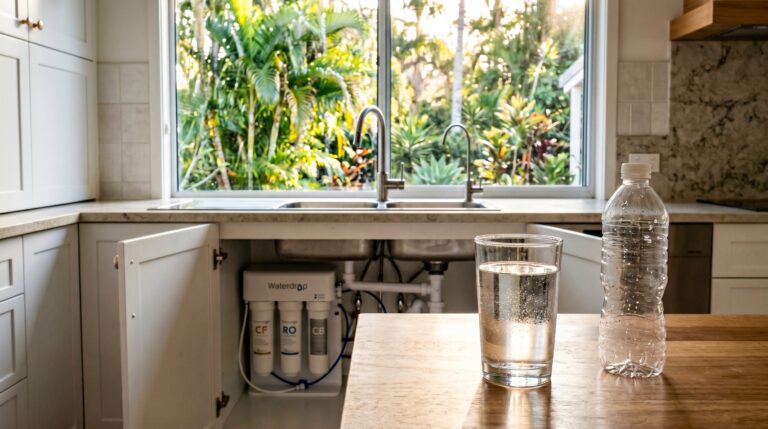
The Waterdrop D6 RO System countertop RO carries NSF/ANSI 58 certification (the broader RO performance standard) and independently tested results for PFAS removal. It operates at approximately 55-60 PSI minimum inlet pressure, produces 0.8 litres per hour in its standard configuration, and rejects contaminants via a 4-stage system: pre-sediment, pre-carbon block, RO membrane, and post-carbon polish. The countertop format requires no plumbing modification — relevant for renters in affected communities who cannot install under-sink systems.
For under-sink installation, the PWS EcoHero 5-Stage RO carries WaterMark certification (AS/NZS 3497) — the Australian plumbing products standard administered by third-party certification bodies. WaterMark is the mandatory minimum for any water treatment device connected to Australian reticulated plumbing. Five-stage RO systems include an additional remineralisation or post-carbon stage beyond the standard four-stage configuration.
Activated Carbon — Partial and Compound-Specific
Granular activated carbon (GAC) and carbon block filters adsorb PFAS through hydrophobic interaction. Longer-chain PFAS compounds (PFOS, PFOA — 8-carbon chains) adsorb more readily than short-chain compounds (PFBS — 4-carbon, PFBA — 4-carbon). A 2023 study published in the Journal of Hazardous Materials found that GAC removed 80-90% of PFOS but only 30-50% of short-chain PFAS under typical household contact times.
The practical problem is twofold. First, contact time matters — undersized filters or high flow rates dramatically reduce PFAS removal. Second, as carbon becomes saturated, previously adsorbed PFAS can desorb back into the effluent. Neither issue affects RO membranes.
Carbon filtration is not certified under NSF/ANSI P473 as a standalone PFAS treatment technology. Some manufacturers claim PFAS removal for carbon products citing internal or third-party studies — but without P473 certification, you cannot verify the claim against a consistent protocol. For communities where water supply exceeds the 2025 NHMRC health guideline values, this uncertainty is not acceptable.
Activated Alumina and Ion Exchange
Activated alumina is primarily used for fluoride removal (80-95% at correct pH and contact time). It shows moderate capacity for some PFAS compounds, particularly PFOS and PFOA, but is not the preferred point-of-use technology. Ion exchange resins — specifically anion exchange resins — are used in municipal treatment systems and show high PFAS removal capacity, but commercially available household-scale ion exchange cartridges certified for PFAS removal under NSF P473 are limited in the Australian market.
What Does Not Work
Boiling concentrates PFAS. UV treatment does not affect PFAS. Softeners treat hardness (calcium/magnesium) and have no effect on PFAS. KDF-55 media targets heavy metals and free chlorine via redox reaction — it has no mechanism for PFAS removal. Standard GAC jug filters (Brita, Pur, generic) have not been independently certified for PFAS removal and should not be relied upon in affected communities.
NSF P473-Aligned PFAS Filtration — Our Top Picks
PFAS Removal Performance Across Filtration Technologies
PFAS Removal by Technology — Long-Chain vs Short-Chain Compounds
Based on peer-reviewed removal studies and NSF/ANSI P473 test protocols. Long-chain = PFOS, PFOA, PFHxS (C8). Short-chain = PFBS, PFBA, GenX (C4-C6).
| Technology | Long-Chain PFAS | Short-Chain PFAS | NSF P473 Certified | WaterMark Available | Also removes fluoride | Verdict |
|---|---|---|---|---|---|---|
| Reverse Osmosis (RO) | 90-99%+ | 70-95% | Yes (NSF 58 + P473) | Yes (AS3497) | Yes (90-97%) | ✓ Best available |
| GAC (Granular Carbon) | 60-90% | 20-50% | No standalone P473 | Some products | No | ⚠ Insufficient alone |
| Carbon Block (compressed) | 70-92% | 30-60% | No standalone P473 | Some products | No | ⚠ Partial only |
| Activated Alumina | Moderate | Low | No | Limited | Yes (primary use) | ⚠ Fluoride primary |
| Jug Filters (GAC) | Variable/Low | Negligible | No | No | No | ✗ Avoid for PFAS |
| UV / Boiling / Softening | 0% | 0% | No | N/A | No | ✗ No PFAS effect |
Long-chain GAC data: Dickenson et al. (2016), Filtration & Separation. RO removal rates: NSF P473 test protocol outcomes; Flores et al. (2013), Desalination. Short-chain data: Appleman et al. (2014), Journal of Hazardous Materials. Percentages represent ranges across multiple studies at typical household flow rates and contact times.
Recommended Filtration Products for PFAS-Affected Australian Households
Two categories of Australian household. The first: renters, or households where plumbing modification is not practical. The second: owners who can install under-sink systems. The right filter depends on which category you are in — not which brand has the loudest marketing.
For Renters and Those Who Cannot Modify Plumbing

✓ Pros
- NSF/ANSI 58 certified RO membrane
- Under-sink — quick install — suits renters
- Independent PFAS removal test data (PFOS, PFOA)
- Alkaline post-filter remineralises to pH 7.5-8.0
✗ Cons
- Approximately 3:1 waste water ratio (higher than under-sink units)
- Slower production rate (~0.8 L/hr) than under-sink pressure-assisted systems
- Countertop footprint requires bench space
For Homeowners — Under-Sink Permanent Installation

✓ Pros
- WaterMark AS/NZS 3497 certified — mandatory for Australian plumbing connection
- Catalytic carbon pre-filter addresses chloramine (Brisbane, Sydney, Perth, Adelaide users)
- 5-stage includes remineralisation — avoids acidic effluent concern
- Australian warranty and local filter replacement supply
✗ Cons
- Requires plumbing installation (licensed plumber recommended; ~$100-150 install)
- Not suitable for renters without landlord permission
How to Test Your Own Water for PFAS
The VARIFY 17-in-1 test kit available on Amazon AU tests for heavy metals, pH, chlorine, hardness, and several contaminant classes. It does not test for PFAS. No consumer-grade test strip tests for PFAS. PFAS testing requires laboratory analysis via liquid chromatography-tandem mass spectrometry (LC-MS/MS) — the method specified in EPA Method 533 and EPA Method 537.1.
For Australians wanting to test their water for PFAS, the pathway is:
- Order a mail-in PFAS test from an accredited NATA laboratory. NATA (National Association of Testing Authorities) is the Australian accreditation body. Laboratories including National Measurement Institute, ALS Global, and Eurofins Environmental hold NATA accreditation for PFAS water analysis. Costs range from $150-400 per sample depending on compound suite (PFAS 28, PFAS 40, or full PFAS suite).
- Collect a first-draw sample (after water has sat in pipes for 6+ hours, first thing in the morning) for worst-case exposure assessment. Collect a second running sample for supply-level PFAS.
- Compare results against the 2025 NHMRC health guideline values published at nhmrc.gov.au/health-advice/environmental-health/water/PFAS-review.
- If results exceed guidelines: Install an NSF 58/P473-certified RO system immediately. Do not wait for the authority to act — that process takes years.
If you are in a known affected community (Williamtown, Oakey, Tindal/Katherine, Bullsbrook), your state or territory health department may provide subsidised PFAS testing through the relevant Defence PFAS remediation program. Contact your state health department directly — do not rely on Defence’s own remediation timeline.
Test for PFAS Before You Filter
The My Water Score PFAS + Mains Bundle ($599) is the most accessible NATA-certified lab test in Australia that includes a full PFAS screen alongside heavy metals, chlorine, fluoride, and water balance. One collection kit, one pre-paid mailer, 5–7 business day turnaround.
MWS PFAS + Mains Bundle — $599 (NATA-Certified) →Decision Tree — Which Filter Do You Need?
Three Questions — One Answer
1. Can you modify your under-sink plumbing (homeowner)?
Yes: PWS EcoHero 5-Stage RO — WaterMark certified, catalytic carbon pre-filter, handles chloramine cities (Brisbane, Sydney, Adelaide, Gold Coast).
No / Renter: Waterdrop D6 RO System — under-sink, NSF 58 certified.
2. Which city are you in?
Chloramine cities (Brisbane, Sydney, Adelaide, Gold Coast, Darwin): You need an RO system with a catalytic carbon pre-filter — standard carbon block alone fails at chloramine removal.
Free chlorine cities (Melbourne, Hobart, Canberra, Townsville): Any NSF 58 RO system works for both PFAS and taste/chlorine concerns.
3. Are you in a known PFAS-affected community?
Yes (Williamtown, Oakey, Katherine, Bullsbrook, Katoomba, Edinburgh): RO is not optional — install immediately and get NATA-accredited laboratory testing on your water before and after installation.
Uncertain: Get NATA laboratory PFAS testing first. Filter second based on results.
5-Year Cost Comparison — RO vs Bottled Water vs Jug Filter
5-Year Total Cost — PFAS-Safe Drinking Water Options (4L/day Household)
| Option | Upfront Cost | Annual Running Cost | 5-Year Total | Cost Per Litre | PFAS Removed? |
|---|---|---|---|---|---|
| Bottled water (2L bottles) | $0 | ~$730-1,460 | ~$3,650-7,300 | $1.00-2.00/L | Mostly yes (brand dependent) |
| Jug filter (Brita / generic) | ~$30-60 | ~$60-100 (cartridges) | ~$330-560 | ~$0.18-0.30/L | No (not certified for PFAS) |
| Waterdrop D6 (countertop RO) | ~$699-799 | ~$80-120 (filters) | ~$1,100-1,400 | ~$0.04-0.07/L | Yes (NSF 58 + P473 data) |
| PWS EcoHero 5-Stage RO (under-sink) | ~$1,009 + install | ~$60-80 (filters) | ~$1,350-1,600 | ~$0.03-0.05/L | Yes (RO membrane + WaterMark) |
Calculation: 4L/day x 365 days = 1,460 L/year. Bottled water at $1.00-2.00/L (Woolworths/Coles 2L spring water pricing). Waterdrop D6 filter replacement per manufacturer schedule. PWS EcoHero filter costs per purewatersystems.com.au. 5-year total includes upfront + 5x annual running cost. Install cost ($150) added to EcoHero 5-year total.
The numbers are not close. Every year you drink 4 litres a day from bottled water instead of a point-of-use RO filter, you are spending $730-1,460 on plastic containers that may or may not have been tested for the specific PFAS compounds in your regional water supply. The Waterdrop D6 pays for itself in under 18 months against bottled water at $1.50/L.
Our Verdict
Australia’s 2025 NHMRC PFAS guideline revision is the most significant update to national drinking water safety standards since the original 2016 thresholds were set. The new health guideline values are dramatically lower — aligned with US EPA 2024 MCLs and the IARC Group 1 carcinogenicity classification of PFOA. For communities near Defence bases, airports, and industrial fire-training sites, the gap between the old guidelines and the new ones means water that was technically “compliant” last year may now sit well above the health threshold.
The answer is not complicated. Reverse osmosis is the only point-of-use technology with NSF/ANSI P473 certification for PFAS removal. If you are a homeowner, the PWS EcoHero 5-Stage RO is WaterMark-certified for Australian plumbing and includes a catalytic carbon pre-filter that handles chloramine (relevant for Brisbane, Sydney, Adelaide, and Gold Coast users). If you are renting or cannot modify plumbing, the Waterdrop D6 RO System countertop RO requires no installation and delivers NSF 58-certified filtration at roughly $0.05 per litre.
Do not wait for your water authority to upgrade treatment infrastructure. That process takes years. The filter takes an afternoon.
Last reviewed: June 2026 — Clean and Native
Frequently Asked Questions
The NHMRC published revised PFAS health guideline values in June 2025, significantly tightening the 2016 thresholds. The new values align with US EPA 2024 MCLs (4 ng/L for PFOS and PFOA individually) and reflect the IARC Group 1 carcinogenicity classification of PFOA. The specific current HGV values are published at nhmrc.gov.au/health-advice/environmental-health/water/PFAS-review — always check the current page as interim revisions may occur post-publication.
No. Standard jug filters using granular activated carbon (GAC) have not been certified under NSF/ANSI P473 for PFAS removal. They are designed for taste and odour improvement (chlorine, THMs). Short-chain PFAS compounds — increasingly common as manufacturers shift to replacement chemicals — pass through GAC almost entirely. Do not rely on a jug filter for PFAS in an affected community.
No. Boiling water does not remove PFAS — it concentrates them. The carbon-fluorine bond is thermally stable well beyond domestic boiling temperatures. Boiling removes biological pathogens and volatile organic compounds but has zero effect on PFAS, fluoride, heavy metals, or nitrates.
Communities with documented PFAS concerns in drinking water or adjacent groundwater include Williamtown (NSW), Oakey (QLD), Katherine/Tindal (NT), Edinburgh (SA), Pearce/Bullsbrook (WA), Jervis Bay (NSW), Katoomba/Blue Mountains (NSW), and Gin Gin (WA). The DCCEEW national contamination register lists over 700 confirmed or suspected PFAS sites nationally. Residents near Defence bases, airports, or industrial fire-training facilities should check their state water authority’s monitoring data.
Yes. Reverse osmosis is the most effective point-of-use technology for PFAS removal. RO membranes reject long-chain PFAS compounds (PFOS, PFOA, PFHxS) at 90-99%+ through size exclusion and charge repulsion. Short-chain compounds (PFBS, PFBA) are removed at 70-95%. NSF/ANSI P473 is the specific certification standard for PFAS reduction — look for this alongside NSF 58 when selecting an RO system.
Consumer test strips cannot detect PFAS. PFAS testing requires NATA-accredited laboratory analysis via LC-MS/MS (EPA Method 533 or 537.1). Accredited laboratories including ALS Global and Eurofins Environmental offer mail-in PFAS water tests for $150-400 per sample depending on the compound suite tested. Collect a first-draw sample (water left in pipes overnight) for worst-case exposure assessment.
Sydney Water’s reticulated supply from its dam catchments consistently tests below current PFAS health guideline values in published monitoring data. However, Sydney uses chloramine disinfection, not free chlorine — meaning residents who install a point-of-use filter for any reason need a system with a catalytic carbon pre-filter or RO membrane to address both chloramine and any residual PFAS concerns. Standard GAC filters remove chloramine at roughly 1/40th the rate of free chlorine.
The 2016 guidelines set combined PFOS+PFHxS at 500 ng/L and PFOA at 500 ng/L — thresholds based on provisional FSANZ risk assessments. The 2025 NHMRC revision sets substantially lower health guideline values, reflecting the IARC Group 1 carcinogenicity classification of PFOA (November 2023), updated WHO 2022 provisional guidance, and US EPA 2024 MCLs of 4 ng/L for PFOS and PFOA individually. A water supply compliant under 2016 guidelines could sit 50-100x above the new 2025 thresholds.
Yes. Any water treatment device permanently connected to Australian reticulated plumbing must carry WaterMark certification under AS/NZS 3497. WaterMark is administered by third-party certification bodies (SAI Global, BSI Group, IAPMO) and is a mandatory plumbing compliance requirement in all Australian states and territories. Countertop systems that connect via a tap adaptor rather than direct plumbing connection are not subject to the same requirement, but you should still look for NSF 58 or NSF P473 certification for performance verification.
Get the Australian Home Environment Checklist
30 checks across water, air and EMF. Most of them free. Ranked by impact.
No spam. Unsubscribe any time.

Former Royal Australian Navy Clearance Diver and TAG-E counter-terrorism operator. Founded Clean and Native to apply the same rigorous thinking to the home environment.
Full biography →