Air Purifier for Pet Hair: Australian Guide 2026
Drafted with AI assistance and checked against published specifications and certifications. First-hand measurements appear only where stated. How we make content
How this assessment was made. I have not personally tested these four air purifiers in a pet household. I do run Coway’s smaller Airmega 150 in my bedroom in Palm Beach with my dog in the house, and the photos in the filter care section show what its pre-filter caught in a month. This guide is based on manufacturer specifications and Amazon Australia listings, independent reviews where they exist, Australian health and allergy guidance (ASCIA, Asthma Australia, the ABS) and peer-reviewed research on pet allergens. Prices were checked on Amazon AU on 19 October 2026. Where a figure is the manufacturer’s claim, the article says so. Clean and Native may earn a commission on some links; that does not change which products are assessed or what the evidence says.
The best air purifier for pet hair in an Australian home is a HEPA purifier with enough airflow for the room you and your pet share, a pre-filter you can keep clean, and a carbon stage for odour. For most pet owners that is the Coway Airmega Mighty (about $319, 421 m³/h listed CADR, Sensitive Choice approved) or the Levoit Core 400S (about $399, 433 m³/h listed, with app control). If allergies are the main problem, the Philips 2200 carries ECARF certification for allergy sufferers. For big open-plan rooms, the Breville Smart Air Viral Protect Max lists up to 530 m³/h.
One honest point first: an air purifier captures the allergen floating in the air. It does not stop your dog shedding on the couch. ASCIA, the national allergy body, says the most effective way to reduce exposure for people allergic to animals is to avoid the animal, and that keeping pets out of bedrooms and living areas may help people with mild reactions. A purifier is part of the plan, not the whole plan.
Match the purifier to the room, not the box. Work out your room’s volume, multiply by five, and buy a purifier whose CADR at least matches that number in m³/h. Then pick on the features that matter for your household: Sensitive Choice approval, app control, quiet running, or raw airflow for a big space.
| Pick | Best for | Price (19 Oct 2026) |
|---|---|---|
| Coway Airmega Mighty | Most pet homes: strong airflow, Sensitive Choice approved, simple to run | ~$319 |
| Levoit Core 400S | Bedrooms and living rooms with app control and auto mode | ~$399 |
| Philips 2200 Series | Allergy sufferers and quiet bedrooms (ECARF certified) | ~$312 |
| Breville Smart Air Viral Protect Max | Large open-plan rooms up to 138 m² | ~$498 |
✓ A HEPA purifier will help if
- Someone in the house sneezes, wheezes or wakes up congested around the pets
- Your cat or dog spends time in the bedroom or main living area
- The house smells of pets even after cleaning
- You also want protection from bushfire smoke, pollen or dust
× It will not fix
- Hair already on the floor, couch and bed: that needs a vacuum
- Severe pet allergy on its own: speak to your GP or an allergist
- Odour from a source that needs cleaning, such as a litter tray or bedding
- A room far bigger than the purifier’s rated size
Why pet dander needs a different approach
You can see pet hair. The particles that trigger allergy symptoms are much smaller. Cat and dog allergens, mainly the proteins Fel d 1 from cats and Can f 1 from dogs, come from skin, saliva and other secretions and travel on dander and dust. They are carried on a wide range of particle sizes. A 1998 study of British homes published in Thorax found airborne cat allergen was mostly on larger particles, with about 23% on particles smaller than 4.7 microns. An international consensus document on cat and dog allergy reports that Fel d 1 is carried on particles under 5 microns, and dog allergen particles stay airborne for long periods.
Those small particles are what a HEPA filter is built to catch, and they are the reason a purifier can help where a vacuum alone cannot. Vacuuming removes what has settled. A purifier removes what is floating in the air you breathe, including overnight if your pet sleeps in or near the bedroom.
This is a common problem. Animal Medicines Australia’s 2025 survey found that 73% of Australian households own a pet, and that 48% of pet cats are now kept indoors only, up from 36% in 2019. More indoor pets means more allergen indoors. At the same time, the ABS 2022 National Health Survey found that almost one in four Australians (23.9%) report hay fever or allergic rhinitis.
What makes an air purifier work for pets
I approach this the way I was trained to approach any equipment decision in the Navy: identify the hazard, then specify the gear against it. For pets there are four specifications that matter, and most “pet edition” marketing skips at least one of them.
1. A genuine high-efficiency filter. Look for a HEPA filter with a stated efficiency and particle size, such as 99.97% at 0.3 microns. Asthma Australia says the HEPA filter is the best filter to look for in an air purifier. Labels such as “HEPA-type” with no numbers tell you nothing. For the detail on labels, see True HEPA vs H13 vs HEPASilent.
2. A pre-filter you can clean. Pet hair and fluff clog the main filter quickly. A pre-filter in front of the HEPA catches the coarse material and is the part you clean most often. It is the single biggest factor in how long the expensive filter lasts in a pet home.
3. A carbon stage for odour. HEPA filters capture particles, not smells. Pet odour is largely gases, which activated carbon adsorbs. Manufacturers rarely publish how much carbon is in the filter, so be wary of any review that quotes exact carbon weights without a source. Treat carbon as a useful extra, and deal with the source of the smell as well.
4. Enough airflow for the room. This is where most purchases go wrong. A purifier that is too small for the room cannot keep up with an animal that sheds allergen all day. That is what the next section is for.
How to size a purifier for your room
The number to compare is CADR, the clean air delivery rate, which tells you how much filtered air the purifier delivers per hour. The US Environmental Protection Agency’s sizing guidance works out to a CADR (in cubic feet per minute) of about two-thirds of the room’s floor area in square feet, which corresponds to roughly 4.8 air changes an hour. Asthma Australia does not set an air-change target, but notes that most purifiers have a room rating size.
In metric terms, multiply your room’s volume in cubic metres by five, and look for at least that CADR in m³/h:
| Room | Volume (2.4 m ceiling) | Target CADR |
|---|---|---|
| Bedroom, 3 m × 4 m | 29 m³ | about 145 m³/h |
| Large bedroom, 4 m × 5 m | 48 m³ | about 240 m³/h |
| Living room, 5 m × 6 m | 72 m³ | about 360 m³/h |
| Open-plan, 7 m × 8 m | 134 m³ | about 670 m³/h |
If your ceilings are higher than 2.4 m, use the real height. Undersizing is the most common mistake pet owners make: a small purifier in a big open-plan room will run flat out and still lose to a shedding Labrador. Our CADR calculator does the maths for your exact room.
The best air purifiers for pet hair in Australia
All four are sold on Amazon Australia. I have not tested them with my own animals, so the figures below are manufacturer and listing claims unless stated otherwise.
1. Coway Airmega Mighty: best for most pet homes
 HEPA + carbon421 m³/hCADR (Coway)
CADR 421 m³/h | Up to 109 m² | Pre-filter, deodorisation and HEPA filter | Auto and eco modes | Optional ioniser (switchable) | Sensitive Choice approved | ~$319 (19 Oct 2026)
Check the Coway Price on Amazon →The Mighty is a long-running Coway design and one of the most widely recommended purifiers for pet homes. The Amazon AU listing, sold by Coway Australia, gives a CADR of 421 m³/h and rooms up to 109 m², which is more airflow than most purifiers at this price. It runs a pre-filter, a deodorisation filter and a HEPA filter, with an air quality sensor that adjusts the fan and an eco mode that pauses the fan when the air stays clean.
It is approved under the National Asthma Council Australia’s Sensitive Choice program, which is a useful local signal for allergic households. It also includes an optional ioniser with its own on/off button; I would leave it off and let the filters do the work. Coway rates the filter for up to 12 months. At $319 with more than 300 ratings averaging 4.7 out of 5, it is the best value here.
✓ Pros
- High listed CADR (421 m³/h) for the price
- Sensitive Choice approval from the National Asthma Council Australia
- Sold and supported by Coway Australia
× Cons
- No app control
- Optional ioniser should be switched off if you want filter-only cleaning
- Coway’s efficiency claim does not cite a named filter standard
Buy this if…
you want the most clean air for the money in a living area or large bedroom.
2. Levoit Core 400S: best with app control
 HEPA + carbon433 m³/hCADR (listing)
CADR 433 m³/h (listing) | 24 dB listed sleep mode | 38 W | VeSync app, Alexa | Particle sensor and auto mode | ~$399 (19 Oct 2026)
Check the Levoit Price on Amazon →The Core 400S suits pet owners who want to see what the air is doing. Its particle sensor drives an auto mode, and the VeSync app shows air quality history, sets schedules and tracks filter life. The Amazon AU listing, sold by Levoit’s Australian distributor VeSync, gives a CADR of 433 m³/h, and it has more than 16,000 ratings averaging 4.6 out of 5.
Two cautions. Levoit claims 24 dB in sleep mode, but independent testers at HouseFresh measured its lowest setting at about 35.5 dBA, so expect a soft hum rather than silence. And Levoit no longer describes the filter as H13; Australian listings call it True HEPA. Neither is a reason not to buy it, but both are reasons to read specifications carefully.
One more check before you buy: the Amazon AU listing for this unit is titled “with Plasma”. Levoit’s PlasmaPro version adds an ion function with its own on/off button, and Levoit publishes no ozone data for it. If your unit has a Plasma button, leave it off.
✓ Pros
- Strong listed CADR with an app, schedules and filter tracking
- Auto mode reacts to grooming sessions and shedding
- Huge base of owner ratings
× Cons
- Quieter on paper than in independent testing
- No H13 claim from Levoit
- Genuine replacement filters can be harder to find than third-party copies
Buy this if…
you want app control, scheduling and real-time air quality for a bedroom or living room.
3. Philips 2200 Series: best for allergy sufferers
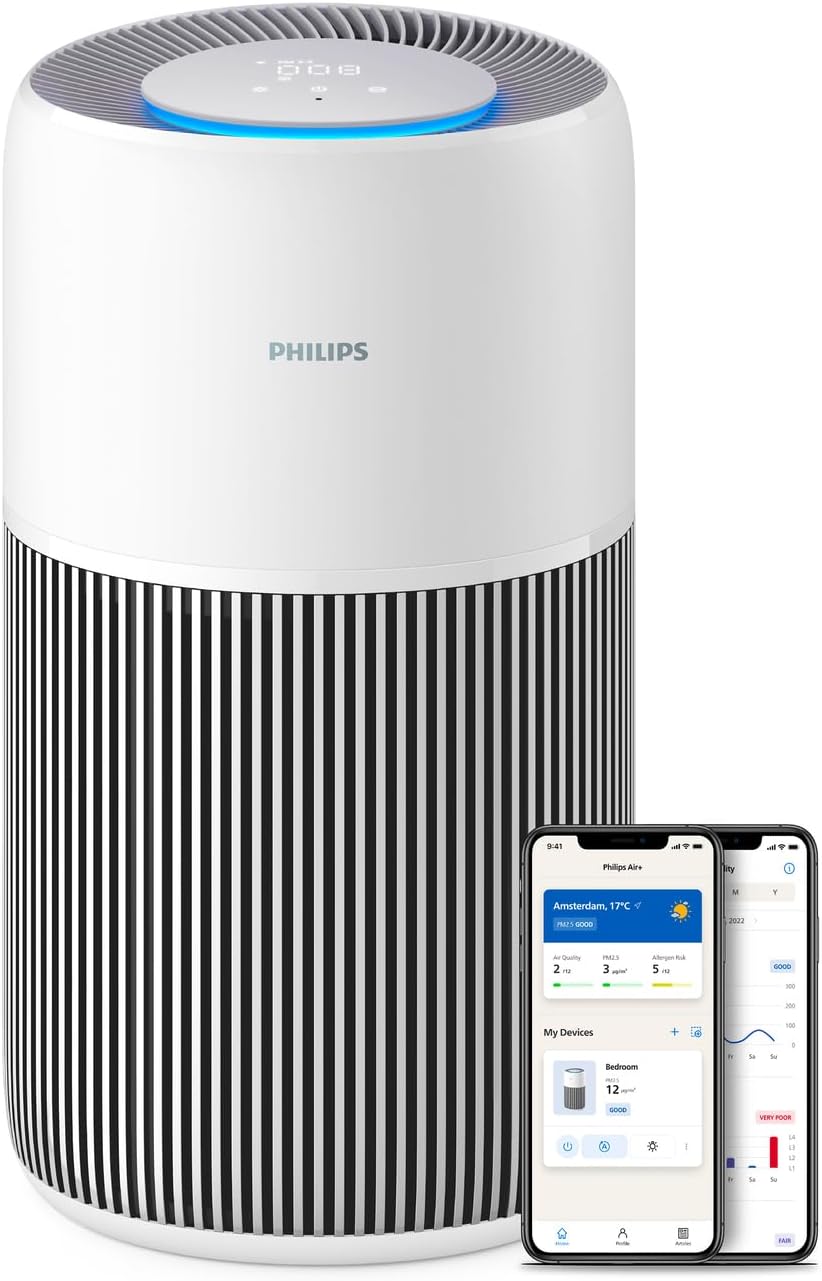 HEPA + carbon400 m³/hCADR (Philips)
CADR 400 m³/h | Up to 104 m² | As low as 13 dB(A) | 28 W | ECARF certified | Filter FY2200, up to 3 years | ~$312 (19 Oct 2026)
Check the Philips 2200 Price on Amazon →If the person with the allergy is the reason you are buying, the Philips 2200 is the pick. Philips states it is certified by ECARF, the European Centre for Allergy Research Foundation, for allergy sufferers, and claims it removes 99.99% of pollen, dust mite and pet allergens. It lists a CADR of 400 m³/h, runs as low as 13 dB(A), draws 28 W at most, and Philips rates the FY2200 filter for up to three years.
Philips tests its NanoProtect filter to a German automotive filter standard rather than the European HEPA standard, so do not read its claims as an H13 rating. It is sold and shipped by Amazon AU at $312.
✓ Pros
- ECARF certification for allergy sufferers
- Very quiet on its lowest setting (Philips claim)
- Filter rated for up to three years
× Cons
- No app on this model
- Philips’s efficiency claims use its own test basis
- Fewer Amazon AU ratings than the Coway or Levoit
Buy this if…
someone in the house is allergic and you want a quiet purifier for the bedroom.
4. Breville Smart Air Viral Protect Max: for large open-plan rooms
 HEPA-13 + carbon530 m³/hCADR (Breville)
CADR up to 530 m³/h | Rooms up to 138 m² | Pre-filter, carbon, AntiViral HEPA-13 | Microbe Shield light | Wi-Fi app | ~$498 (19 Oct 2026)
Check the Breville Price on Amazon →For a big open-plan living area, airflow is everything, and the Breville lists the most of the four: a CADR of up to 530 m³/h for rooms up to 138 m². It runs a pre-filter, an activated carbon filter for smoke and odours, and what Breville calls an AntiViral HEPA-13 filter, which Breville says reduces 99.97% of particles and allergens down to 0.3 microns. Breville does not cite a named filter standard for the HEPA-13 label.
Breville’s virus claims refer to the filter material, which it says was tested under ISO 18184, a laboratory test for antiviral textiles. They are not a measure of how the purifier cleans room air. The Microbe Shield light, which Breville describes as a shortwave light designed to target bacteria and viruses, can be switched off. The replacement filter (part LAP065BLU0ZAN1) was $99 at JB Hi-Fi, and CHOICE estimates two filters a year. On Amazon AU it is sold by Amazon at $498, but with only a handful of ratings so far.
✓ Pros
- Highest listed CADR here, for large open-plan rooms
- Australian brand with Wi-Fi app control
- Pre-filter, carbon and HEPA-13 stages
× Cons
- Most expensive to buy and to run (about $99 per filter)
- Virus claims are about the filter fabric, not room air
- Very few Amazon AU ratings so far
Buy this if…
your pets live in a big open-plan space and you need the extra airflow.
Specification comparison
| Spec | Coway Mighty | Levoit Core 400S | Philips 2200 | Breville Protect Max |
|---|---|---|---|---|
| CADR (claimed) | 421 m³/h | 433 m³/h (listing) | 400 m³/h | Up to 530 m³/h |
| Rated room size | Up to 109 m² | Up to 83 m² twice an hour (listing) | Up to 104 m² | Up to 138 m² |
| Filters | Pre-filter, deodorisation, HEPA | Pre-filter, HEPA, carbon | HEPA NanoProtect, carbon | Pre-filter, carbon, HEPA-13 |
| Extra stage | Optional ioniser | None | None | Microbe Shield light |
| App | No | Yes | No | Yes |
| Australian signal | Sensitive Choice | AHAM certified (listing) | ECARF certified | Australian brand |
| Max power (listed) | 82 W | 38 W | 28 W | Not stated |
| Price (19 Oct 2026) | ~$319 | ~$399 | ~$312 | ~$498 |
Manufacturers measure CADR and room size on different bases, so treat small differences as noise. The gaps that matter are the big ones: the Breville’s extra airflow for big rooms, and the Philips’s certification for allergy sufferers.
Running costs
I am not going to give you a five-year cost table built on guessed filter prices. Here is what is actually published. The Breville’s replacement filter was $99 at JB Hi-Fi, and CHOICE estimates about $200 a year in filters. Philips rates the 2200’s filter for up to three years and Coway rates the Mighty’s for up to 12 months. Check the current filter price before you buy any purifier, because that is where the long-term cost sits.
Electricity is the smaller cost. A purifier drawing 38 W running flat out around the clock would use about 333 kWh a year, roughly $110 at 33 cents per kWh. On low or auto, which is how most people run them, the real figure is a fraction of that. Pet homes run purifiers longer than most, so it is worth choosing one with a genuine low-power setting. Our running costs calculator works it out for your rates.
Filter care in a pet household
Here is why that matters. These photos are the pre-filter from my own Coway Airmega 150 after one month in my bedroom, with my dog in the house: a grey mat of dust and hair across the whole surface. That is the pre-filter doing its job. Left in place, it chokes the airflow the HEPA filter depends on, and the purifier’s real CADR drops with it. If your pet sleeps in the bedroom, see the best bedroom air purifiers.
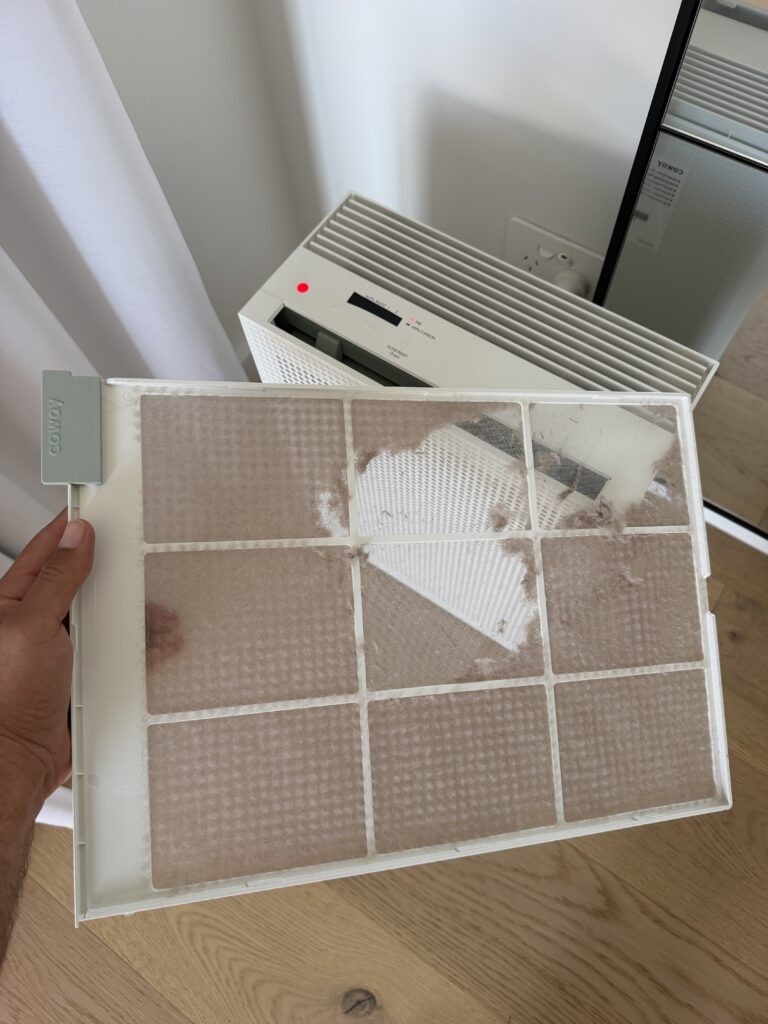
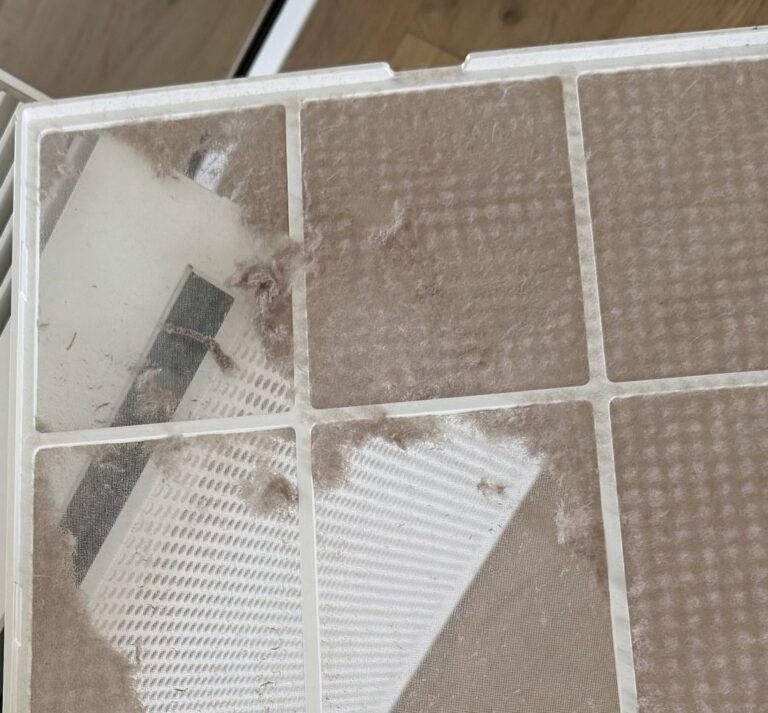
Clean the pre-filter often. In a multi-pet home, check it weekly and clean it every one to two weeks. A clogged pre-filter pushes the load onto the HEPA filter and cuts airflow, which cuts the purifier’s real CADR. In humid coastal areas, let a rinsed pre-filter dry completely before refitting it.
Replace on the indicator, but watch the signs. Most of these purifiers track filter life. In a home with heavy shedding, expect to replace sooner than the maker’s estimate. A fan that sounds louder at the same speed, or a sensor that reads poor air more often, both suggest a loaded filter.
Do not forget the smell. Carbon stops working once it is saturated, and there is no indicator for that. If pet odour returns while the particle reading looks fine, the carbon is probably spent. See our filter replacement guide.
Vacuum with a sealed HEPA vacuum. A purifier handles what is airborne. What has settled on floors and furniture needs a vacuum that does not blow fine dust back out the exhaust. See the best HEPA vacuums in Australia.
What to avoid
Ozone generators. The US EPA warns that ozone generators sold as air cleaners can produce ozone above health standards, and that ozone is generally ineffective at controlling indoor air pollution at safe levels. No US federal agency has approved them for occupied spaces. Avoid them entirely, especially if you keep birds.
Ion-only purifiers. Ionisers charge particles so they stick to surfaces rather than removing them through a filter, and the EPA notes some ionising devices can emit ozone. If a purifier has an ioniser as an extra, as the Coway does, you can switch it off. If ions are the only cleaning method, skip it. More in ionisers vs HEPA.
Tiny desk purifiers for big rooms. A small unit can be useful on a desk or bedside table, but it cannot keep a living room clear of a shedding dog. Size to the room.
Unsupported numbers. Be wary of reviews quoting exact carbon weights, dB figures or certifications that the manufacturer does not publish. Plenty of purifier reviews repeat figures the manufacturer never published. If the brand does not state it, it is not a specification.
Your climate and your pet allergens
Pets are rarely the only allergen in an Australian home. In humid coastal areas such as south-east Queensland and northern New South Wales, dust mites thrive, so pet owners there often face dander and dust mite allergen together. In Melbourne, spring grass pollen is the big seasonal load, and the thunderstorm asthma event of November 2016, which the Victorian health department linked to at least nine deaths, is a reminder of how serious pollen exposure can be for people with asthma. Inland and in Perth and Adelaide, fine dust loads clog pre-filters faster in summer.
Across the south-east, bushfire smoke can arrive in any summer. A purifier sized properly for your pets will also help with smoke, because smoke particles are captured by the same HEPA filter. The practical effect is that your purifier will run harder and need its pre-filter cleaned more often in your worst season, so plan for it. For smoke specifically, see our bushfire smoke guide.
Which one should you buy?
1. How big is the room your pet uses most? Work out the CADR you need (room volume × 5). Up to about 400 m³/h: any of the four. Well above that, in a big open-plan space: the Breville, or two smaller purifiers in separate zones.
2. Is allergy the main problem? If a family member reacts to the pets, the Philips 2200’s ECARF certification and quiet running make it the bedroom pick. Pair it with a pets-out-of-the-bedroom rule, as ASCIA suggests.
3. Do you want app control? If yes, the Levoit Core 400S. If you would rather switch it on and forget it, the Coway Mighty.
Still unsure? The Coway Airmega Mighty at about $319 suits most Australian pet homes: strong airflow, Sensitive Choice approval and local support.
Final verdict
For most Australian pet owners, the Coway Airmega Mighty is the best place to start: it lists 421 m³/h of clean air, is approved under the National Asthma Council’s Sensitive Choice program, and costs about $319. Choose the Levoit Core 400S if you want app control and auto mode, the Philips 2200 if allergies are the driver, and the Breville Smart Air Viral Protect Max if you are clearing a big open-plan space.
Whichever you choose, size it to the room, keep the pre-filter clean, vacuum with a sealed HEPA vacuum, and keep pets out of the bedroom if someone is allergic. That combination does more than any single gadget. For the wider field, see the best air purifiers in Australia.
Prices change. Check Amazon AU before buying.
Frequently asked questions
Do air purifiers actually help with pet allergies?
They can reduce airborne pet allergen, which is carried on particles a HEPA filter is designed to catch. But ASCIA says the most effective way to reduce exposure for people allergic to animals is to avoid the animal, and that keeping pets out of bedrooms and living areas may help those with mild reactions. Use a purifier as one part of the plan.
What is the best air purifier for pet hair in Australia?
For most homes, the Coway Airmega Mighty (421 m³/h listed CADR, Sensitive Choice approved, about $319). The Levoit Core 400S suits people who want app control, the Philips 2200 suits allergy sufferers, and the Breville Smart Air Viral Protect Max suits large open-plan rooms.
Can an air purifier remove pet odour?
Partly. HEPA filters capture particles, not smells. A carbon stage adsorbs some odour gases, but it saturates over time. Purifiers work best on pet smell when you also clean the source, such as bedding and litter trays.
What CADR do I need for a room with pets?
Multiply the room’s volume in cubic metres by five and look for at least that CADR in m³/h. A 4 m by 5 m room with a 2.4 m ceiling is 48 m³, so aim for about 240 m³/h or more. This follows US EPA sizing guidance of about 4.8 air changes an hour.
How often should I clean or replace filters in a pet household?
Check the pre-filter weekly and clean it every one to two weeks in a multi-pet home. Replace the main filter when the indicator says so, or sooner if airflow drops or odour returns. Coway rates the Mighty’s filter for up to 12 months and Philips rates the 2200’s for up to three years.
Are air purifiers safe for cats, dogs and birds?
Filter-only purifiers add nothing to the air. Avoid ozone generators entirely, which the US EPA warns can exceed ozone health standards; birds are especially sensitive. If a purifier has an optional ioniser, you can switch it off.
Should I run my air purifier all the time with pets?
Running it continuously on a low or auto setting keeps airborne allergen down, because pets shed all day. Pet homes run purifiers longer than most, so choose one with a quiet, low-power setting.
Does an air purifier help with bushfire smoke as well as pets?
Yes. Smoke particles are captured by the same HEPA filter. A purifier sized for your pets will also help during smoke events, though it will work harder and need its pre-filter cleaned more often.
Do I still need to vacuum if I have an air purifier?
Yes. A purifier only captures what is airborne. Hair and dander on floors and furniture need vacuuming, ideally with a sealed HEPA vacuum so fine dust is not blown back into the air.
Is the Breville Smart Air Viral Protect Max good for pets?
It suits large open-plan rooms, with a listed CADR of up to 530 m³/h for rooms up to 138 m², and has pre-filter, carbon and HEPA-13 stages. Its virus claims relate to lab tests of the filter fabric, not room air, and its filters are the most expensive of the four here at about $99 each.
- ASCIA: Allergen minimisation
- Asthma Australia: Air purifiers
- Custovic et al. 1998, Thorax: airborne cat allergen Fel d 1 in British homes
- Thermo Fisher allergen encyclopedia: cat allergen (citing the Dávila et al. 2018 consensus)
- Animal Medicines Australia: Pets in Australia 2025
- ABS: Health conditions prevalence (National Health Survey 2022)
- AIDR: Thunderstorm asthma, Victoria 2016
- US EPA: Guide to air cleaners in the home
- US EPA: Ozone generators sold as air cleaners
- Breville: the Smart Air Viral Protect Max specifications
- JB Hi-Fi: Breville AntiViral HEPA-13 replacement filter
- CHOICE: Breville Smart Air Viral Protect Max listing
- HouseFresh: Levoit Core 400S review (independent noise measurements)
- Amazon AU: Coway Airmega Mighty listing
- Amazon AU: Levoit Core 400S listing
- Amazon AU: Philips 2200 Series listing
- Amazon AU: Breville Smart Air Viral Protect Max listing
Get the Australian Home Environment Checklist
30 checks across water, air and EMF. Most of them free. Ranked by impact.
No spam. Unsubscribe any time.

Former Royal Australian Navy Clearance Diver and TAG-E counter-terrorism operator. Founded Clean and Native to apply the same rigorous thinking to the home environment.
Full biography →