Sharp Plasmacluster Air Purifier Review 2026
Sharp’s Plasmacluster ion technology is marketed as a step beyond standard HEPA filtration — active ions released into the air to neutralise airborne pathogens, allergens, and odours. The question for Australian buyers is whether that ion technology delivers measurable benefits over a conventional H13 HEPA filter, and whether Sharp’s limited Australian model availability and pricing make it a competitive choice against proven local options like the Breville Protect Max.
The Sharp Plasmacluster series uses genuine HEPA filtration paired with proprietary ion technology — but the ion claims rely heavily on Sharp’s own laboratory testing, and the Australian model range is limited with poor retail availability and opaque pricing. The HEPA and activated carbon stages do real, measurable work removing PM2.5 and VOCs. However, the Plasmacluster ion technology lacks the breadth of independent, peer-reviewed verification that would justify paying a premium over a simple H13 HEPA unit. For most Australian households — especially those dealing with bushfire smoke season (October-March) across NSW, VIC, and QLD — the Breville Protect Max at $468 with 550 CADR delivers more verifiable filtration performance per dollar.
Key catches
- Plasmacluster ion efficacy data comes primarily from Sharp-funded lab testing — independent replication in real-world Australian home conditions is sparse
- Australian retail availability is severely limited — most models require grey import or purchasing through US/Japanese channels with no local warranty
- CADR ratings on available models (FP-J80A-W: ~306 m³/h) lag behind the Breville Protect Max (550 CADR) at a comparable or higher price point
- Replacement HEPA and carbon filters are harder to source in Australia, pushing ongoing costs above locally-stocked competitors
✓ Who This Is For
- You specifically want Plasmacluster ion technology for odour neutralisation and are comfortable with manufacturer-sourced efficacy data
- You already own a Sharp Plasmacluster and want an honest assessment of what the ion stage actually does vs the HEPA stage
- You have access to a reliable import channel (Amazon US, Japanese retailer) and accept no local warranty
- You prioritise quiet operation — Sharp units run notably quiet on lower fan speeds
× Who It Is Not For
- You want the highest CADR per dollar available in Australia — the Breville Protect Max (550 CADR, $468) wins outright
- You need guaranteed Australian warranty, local filter supply, and support — Sharp AU has minimal air purifier presence
- You want independently certified particulate removal data (NSF, AHAM Verifide) rather than proprietary claims
- You are buying primarily for bushfire smoke protection and need maximum CADR for rapid room clearance
- You want smart home integration (HomeKit, Google Home, Alexa) — Sharp’s AU-available models lack this
What Plasmacluster Ion Technology Claims to Do — and What the Evidence Actually Shows
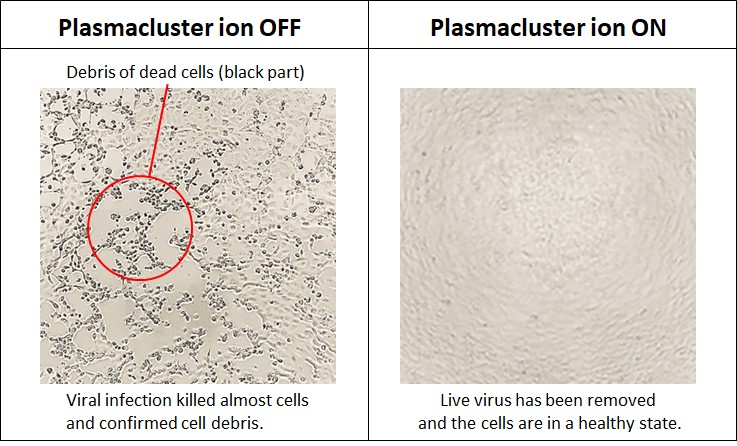
Sharp’s marketing positions Plasmacluster as a fundamentally different approach to air purification. Rather than just pulling air through a filter, the system releases positive and negative ions into the room. According to Sharp’s global technology page, these ions surround airborne pathogens, allergens, and odour molecules, forming hydroxyl (OH) radicals on their surfaces that chemically inactivate them. Sharp claims Plasmacluster Ion 25000 (their highest-density output, at 25,000 ions/cm³) removes 99% of airborne viruses within 9 minutes and suppresses mould spores within 20 minutes in laboratory testing.
Here is where you need to read carefully. Those claims come from Sharp’s own testing laboratories, primarily in Japan. The test conditions — sealed chambers, controlled humidity, specific pathogen concentrations — bear limited resemblance to a bedroom in Brisbane during a humid February or a living room in western Sydney during bushfire smoke season. In a sealed 1m³ test chamber, ion density is maximised because nothing dilutes or disperses the ions. In your 40m² living room with doors opening, air conditioning cycling, and people moving, that ion density drops substantially.
Independent verification is thin. A ChannelNews review of the Sharp FP-J50A noted “odour elimination within seconds” in a 40m² office, which is a real-world observation but not a controlled measurement. Some Japanese studies published in journals like the Journal of Hospital Infection have found statistically significant pathogen reduction with Plasmacluster ions, but these are typically co-authored by Sharp-affiliated researchers, conducted under laboratory conditions, and funded by Sharp Corporation. That does not make them fabricated — but it does mean the evidence base lacks the independent replication you would want before paying a premium.
Contrast this with simple H13 HEPA filtration, which has decades of independent verification. An H13 HEPA filter captures 99.95% of particles at 0.3 micrometres according to EN 1822 testing standards — no manufacturer funding required to verify this, because it is a physical filtration mechanism with well-understood physics. When bushfire smoke pushes PM2.5 above 200 µg/m³ in Penrith and western Sydney suburbs, you need a filter with a high CADR and proven particle capture. Ions are a secondary consideration at best.
Plasmacluster Ion 25000 vs 7000: What the Numbers Mean
Sharp sells two tiers of Plasmacluster technology. Understanding the difference matters if you are comparing models.
| Specification | Plasmacluster 7000 | Plasmacluster Ion 25000 |
|---|---|---|
| Ion density output | 7,000 ions/cm³ | 25,000 ions/cm³ |
| Manufacturer virus claim | Airborne pathogen reduction (no specific time stated) | 99% airborne virus in 9 min (lab chamber) |
| Mould suppression claim | Not specified | Suppresses mould spores in 20 min (lab chamber) |
| Skin moisture claim | Not claimed | Maintains skin moisture (Sharp lab data) |
| Typical model examples | FP-J30A, FP-F30A | FP-J80A-W, KC-860U, FXJ80UW |
| Independent verification | Minimal | Sharp-funded studies only |
The 25000 series outputs roughly 3.6x the ion density of the 7000 series. Sharp’s own testing shows faster pathogen inactivation at the higher density, which is logical — more reactive ions means more surface contact per unit time. But neither tier has been independently verified in conditions resembling an Australian home with normal ventilation, door openings, and variable humidity.
For context, Brisbane and coastal QLD homes regularly experience 70-85% relative humidity during summer. High humidity can affect ion dispersion and lifespan in ambient air. Sharp does not publish ion performance curves at varying humidity levels, which is a notable omission for the Australian market. If you live in Cairns, Townsville, or the Gold Coast, this gap in the data should concern you.
HEPA and Carbon Filtration Specs — the Part That Actually Matters
Strip away the ion marketing and every Sharp Plasmacluster air purifier is also a conventional multi-stage filter. This is the part that does the heavy lifting for particulate removal, and it is the part you should evaluate when deciding whether to buy.
The FP-J80A-W (Plasmacluster Ion 25000, the highest-spec model commonly found via import channels) uses a True HEPA filter rated to capture 99.97% of particles at 0.3 micrometres. That is the same standard as an H13 HEPA filter under EN 1822. Behind it sits an activated carbon pre-filter for VOC and odour adsorption, plus a washable pre-filter for larger particles like pet hair and dust.
| Specification | Sharp FP-J80A-W | Breville Protect Max | Levoit Core 400S |
|---|---|---|---|
| CADR (m³/h) | ~306 | 550 | 350 |
| HEPA grade | True HEPA (99.97% @ 0.3µm) | H13 HEPA (99.95% @ 0.3µm) | H13 HEPA (99.97% @ 0.3µm) |
| Coverage area (manufacturer) | ~62 m² | ~40 m² (CADR/m² = 13.75) | ~40 m² (CADR/m² = 8.75) |
| Activated carbon stage | Yes (integrated) | Yes (dedicated stage) | Yes (integrated) |
| Ion/plasma technology | Plasmacluster Ion 25000 | None | None |
| Smart connectivity | No | No | Yes (VeSync app, Alexa) |
| AHAM Verifide | No | No | No |
The critical number here is CADR — Clean Air Delivery Rate. It tells you how many cubic metres of filtered air the unit delivers per hour. At ~306 m³/h, the Sharp FP-J80A-W is adequate for a medium room but falls well short of the Breville Protect Max’s 550 m³/h. During the 2019-20 Black Summer, AQI readings exceeded 2,000 in parts of NSW. At those concentrations, every additional cubic metre per hour of filtered air matters. The Breville clears a 40m² room roughly 1.8x faster than the Sharp.
Sharp’s manufacturer-stated coverage of ~62m² for the FP-J80A-W likely assumes 2 air changes per hour. The AHAM recommendation for effective air purification is 4.8 air changes per hour. At that standard, the Sharp realistically covers approximately 25-26m² — a standard Australian bedroom, not an open-plan living area. The Breville covers ~38m² at 4.8 ACH. That difference is the gap between protecting one room and protecting your main living space.
Australian Pricing and Retail Availability — the Real Problem
This is where the Sharp Plasmacluster story falls apart for Australian buyers. As of August 2026, Sharp Electronics Australia (sharp-electronics.com.au) does not list dedicated air purifier models for the Australian market. The Sharp Australia product range focuses on TVs, kitchen appliances, and commercial display equipment. Air purifiers are absent from the local catalogue.
What does this mean in practice? If you want a Sharp Plasmacluster air purifier in Australia, you have three options — none of them good:
1. Grey import from Amazon US or Japanese retailers. The KC-860U and FXJ80UW are available on amazon.com (US). Expect to pay USD $350-500 plus international shipping ($50-100), import duties (5% customs + 10% GST on CIF value), and accept a US power plug requiring an adapter. Total landed cost: approximately AUD $650-850. No Australian warranty.
2. Occasional stock on Amazon AU from third-party sellers. Availability is sporadic. Pricing is typically 30-50% above the US retail price. Warranty support is non-existent or handled by the third-party seller, not Sharp Australia.
3. JB Hi-Fi, Bing Lee, The Good Guys. As of August 2026, none of these Australian retailers stock Sharp air purifiers. Harvey Norman does not list them either. Sharp Australia’s authorised dealer network does not include air purification products.
| Cost Factor | Sharp FP-J80A-W (Grey Import) | Breville Protect Max (AU Stock) |
|---|---|---|
| Unit price (AUD) | ~$650-850 landed | ~$468 |
| Australian warranty | None | 2 years (Breville AU) |
| Local filter availability | Import only (~$80-120 + shipping) | Amazon AU, Breville direct (~$70-90) |
| Power plug | US Type A (adapter needed) | Australian Type I (native) |
| Est. annual filter cost | ~$120 (import + shipping) | ~$80 |
| 5-year total cost (AUD) | ~$1,250-1,450 | ~$868 |
The maths is stark. Over five years, the Sharp Plasmacluster costs approximately $380-580 more than the Breville Protect Max — and delivers 44% less CADR, no local warranty, and filter sourcing headaches. At $468, the Breville is not just cheaper. It is better supported, easier to maintain, and more powerful. That is a hard combination to argue against.
Noise and Energy Consumption
Sharp does deserve credit on noise. The FP-J80A-W operates at approximately 21 dB on its lowest fan setting — quieter than a whisper (typically measured at 25-30 dB). On maximum, it reaches around 52 dB, which is roughly the level of a quiet conversation. For a bedroom unit running overnight, that low-speed noise floor is actually excellent.
Energy consumption runs at approximately 5.3W on low and up to 64W on maximum. At Australian electricity rates (~$0.30/kWh national average, higher in SA at ~$0.40/kWh), running the Sharp on low 24/7 costs approximately $14/year. On medium (~25W), that climbs to around $66/year. These are comparable to the Breville Protect Max, which draws approximately 6W on sleep mode and 55W on maximum.
| Metric | Sharp FP-J80A-W | Breville Protect Max | Levoit Core 400S |
|---|---|---|---|
| Low/sleep noise (dB) | ~21 dB | ~24 dB | ~24 dB |
| Max noise (dB) | ~52 dB | ~55 dB | ~52 dB |
| Low power (W) | ~5.3W | ~6W | ~5W |
| Max power (W) | ~64W | ~55W | ~38W |
| Annual energy cost (low, 24/7) | ~$14 | ~$16 | ~$13 |
All three units are efficient enough that electricity cost is a rounding error in the total ownership equation. The real cost differentiator is upfront price plus filter replacement — and on both counts, the Australian-stocked units win decisively. Noise is a non-issue for all three on sleep mode — any of them can run in a bedroom without disturbing sleep.
What the Sharp Does Well — Honest Assessment
Despite the availability and pricing problems, the Sharp Plasmacluster line has genuine strengths worth acknowledging.
Build quality is excellent. Sharp has manufactured air purifiers for the Japanese domestic market since the early 2000s, and Japanese consumer electronics standards are demanding. The FP-J80A-W uses quality materials, precise assembly, and durable components. Long-term YouTube reviews (2+ years of continuous use) report no mechanical degradation, no motor noise increase, and consistent performance. The Plasmacluster ion generator uses a discharge electrode system rated for approximately 17,500 hours — roughly 2 years of 24/7 operation before the ion generator unit needs replacement (~$50-70 imported).
Odour control is a genuine strength. Multiple reviews — ChannelNews, PCMag AU, and user reports — consistently note rapid odour elimination. Whether this is the ions, the activated carbon, or both working in combination is difficult to isolate. But if your primary concern is cooking odours, pet smell, or smoke odour (distinct from smoke particulates), Sharp units perform well in this area.
The humidification models are unique. Some Sharp Plasmacluster models (KC series, like the KC-860U) integrate a humidification function. For dry climates — Canberra in winter, Adelaide year-round, Perth’s dry summers — a combined purifier-humidifier has genuine utility. No Australian-stocked competitor offers this integration at a comparable level. The Breville and Levoit are purifiers only.
These are real advantages. The problem is not that the Sharp is a bad product. The problem is that you cannot buy it through normal channels in Australia, you cannot get it serviced locally, and the CADR deficit versus locally-available alternatives means you are paying more for less filtration capacity. If Sharp Electronics Australia ever brings the air purifier range to the local market with proper pricing, warranty, and filter supply, this calculus changes. Until then, it remains a niche import option.
How It Compares — Sharp vs the Australian Market
The comparison that matters for Australian buyers is not Sharp vs Dyson or Sharp vs some US-only brand. It is Sharp vs what you can actually walk into a store (or click on Amazon AU) and buy today, with a local warranty and accessible filter replacements.
| Criterion | Sharp FP-J80A-W | Breville Protect Max | Levoit Core 400S | Winix 5500-2 |
|---|---|---|---|---|
| CADR (m³/h) | ~306 | 550 | 350 | ~300 |
| AU price (AUD) | ~$650-850 (import) | ~$468 | ~$349 | ~$399 |
| CADR per $ (m³/h per AUD) | ~0.36-0.47 | 1.18 | 1.00 | ~0.75 |
| AU warranty | None | 2 years | 2 years | 2 years |
| Filter sourcing | Import only | Amazon AU / Breville | Amazon AU | Amazon AU |
| Ion/plasma tech | Plasmacluster 25000 | None | None | PlasmaWave |
| Smart app | No | No | Yes | No |
| 5-year total (unit + filters) | ~$1,250-1,450 | ~$868 | ~$749 | ~$799 |
| Verdict | Niche import only | Best overall for AU | Best value | Strong mid-range |
The Breville Protect Max delivers 1.18 m³/h per dollar spent. The Sharp delivers 0.36-0.47 m³/h per dollar. That is a 2.5-3.3x efficiency gap in favour of the Breville. The Levoit Core 400S at $349 is even more cost-effective at 1.00 m³/h per dollar, with the added benefit of app control and Amazon Alexa integration.
The Winix 5500-2 is worth noting because it includes PlasmaWave technology — Winix’s own ion-based technology that functions similarly to Plasmacluster (generating positive and negative ions to decompose pollutants). If you specifically want ion technology alongside HEPA filtration and prefer to buy from Australian stock, the Winix 5500-2 at ~$399 with local availability is a more practical choice than a grey-imported Sharp.
For the full ranked comparison of every air purifier worth buying in Australia, see our best air purifier Australia 2026 rankings.
Ozone and Safety Considerations
Any air purifier that generates ions, plasma, or reactive species needs to be evaluated for ozone production. Ozone (O₃) is a respiratory irritant — the NEPM ambient air quality standard sets the 8-hour average limit at 0.065 ppm, and Asthma Australia identifies ozone as a trigger for asthma symptoms.
Sharp states that Plasmacluster technology does not generate ozone, because the ion generation process (splitting water molecules in air into positive H⁺ and negative O₂⁻ ions) does not produce O₃ as a byproduct. This claim appears supported by the technology’s mechanism — the discharge voltage used is below the ozone generation threshold. However, Sharp does not publish specific ozone emission test results against the CARB (California Air Resources Board) standard, which limits air purifier ozone emission to 0.050 ppm.
By contrast, the Winix 5500-2 PlasmaWave technology has been specifically tested and certified by CARB as ozone-safe. If ozone sensitivity is a concern for you — particularly relevant if you have asthma or respiratory conditions, which affect approximately 2.7 million Australians according to AIHW data — the absence of a specific CARB ozone test result from Sharp is a data gap you should note.
Australian Air Quality Context — Why This Purchase Decision Matters
On a clear August day in Brisbane, AQICN monitoring stations at The Gap and Woolloongabba report AQI in the “Good” range (0-50). You might question whether you need an air purifier at all. That thinking changes fast.
During the 2019-20 Black Summer bushfire season, AQI readings in Penrith and western Sydney suburbs exceeded 2,000 — roughly 40x the “Hazardous” threshold. Canberra recorded the worst air quality of any capital city on Earth for multiple days. Melbourne saw PM2.5 concentrations that made outdoor exercise dangerous for weeks. These are not hypothetical risks — they are recent, documented events that repeat with increasing frequency according to the CSIRO State of the Climate 2024 report.
In Queensland, land-clearing burns between June and September create localised PM2.5 spikes across Logan, Ipswich, and the Gold Coast hinterland. Pollen season peaks September-November across south-east QLD. Brisbane’s humidity (regularly 70-85% in summer) drives indoor mould growth, which releases spores into household air at concentrations that a HEPA filter captures but that standard air conditioning systems recirculate.
When you are buying an air purifier for these conditions, CADR is the specification that determines whether it protects you during the worst events. A unit with 306 m³/h CADR will take roughly 1.8x longer to clear a 40m² room than a 550 CADR unit. During a bushfire smoke event, that difference translates directly into how many hours your family breathes hazardous air. This is not abstract. It is arithmetic.
Final Verdict
The Sharp Plasmacluster is a well-engineered air purifier with genuine HEPA filtration and an ion technology that may offer incremental benefits for odour and pathogen control. But for Australian buyers in 2026, it fails on the fundamentals that matter: you cannot buy it from a local retailer, you get no Australian warranty, replacement filters require international shipping, and the CADR is 44% lower than the locally-available Breville Protect Max at a significantly lower price.
Buy the Sharp Plasmacluster if: You specifically want Plasmacluster ion technology for a defined reason (e.g., Japanese market familiarity, prior positive experience, specific odour problem), you have a reliable import channel, and you accept the total cost and warranty tradeoffs.
Buy the Breville Protect Max instead if: You want the most CADR per dollar from an Australian-stocked, locally-warranted air purifier — which is what the majority of Australian households actually need, especially for bushfire smoke protection.
The Breville Protect Max is the benchmark air purifier for Australian homes.
550 CADR, H13 HEPA, activated carbon stage, and CADR/m² ratio that outperforms the Sharp Plasmacluster at roughly half the landed cost. Available on Amazon AU with full Australian warranty.
Last reviewed: August 2026 – Clean and Native
The Breville Protect Max is the benchmark air purifier for Australian homes.
550 CADR, H13 HEPA, activated carbon stage, and CADR/m² ratio that outperforms Dyson at the same price. Available on Amazon AU.
Frequently Asked Questions
Is the Sharp Plasmacluster air purifier available in Australia?
Not through standard Australian retail channels as of August 2026. Sharp Electronics Australia does not list air purifiers in its local product range. You would need to grey-import from the US or Japan, which adds $200-400 to the cost and eliminates local warranty coverage.
Does Plasmacluster ion technology actually work?
Sharp’s laboratory testing shows measurable virus and mould reduction in sealed test chambers. However, this data comes primarily from Sharp-funded studies. Independent replication in real-world home conditions — with normal ventilation, door openings, and variable humidity — is limited. The HEPA filter stage does the verifiable heavy lifting for particulate removal.
Does the Sharp Plasmacluster produce ozone?
Sharp states the Plasmacluster ion generation process does not produce ozone, and the discharge mechanism supports this claim. However, Sharp has not published CARB (California Air Resources Board) ozone emission certification data for its consumer models, unlike Winix which has CARB-certified its PlasmaWave technology.
What is the difference between Plasmacluster 7000 and 25000?
Plasmacluster 7000 outputs approximately 7,000 ions per cm³. Plasmacluster Ion 25000 outputs approximately 25,000 ions per cm³ — roughly 3.6x higher density. Sharp claims faster pathogen inactivation at the higher density, but neither tier has been independently verified in typical Australian home conditions.
How does the Sharp Plasmacluster compare to the Breville Protect Max for bushfire smoke?
Get the Australian Home Environment Checklist
30 checks across water, air and EMF. Most of them free. Ranked by impact.
No spam. Unsubscribe any time.

Former Royal Australian Navy Clearance Diver and TAG-E counter-terrorism operator. Founded Clean and Native to apply the same rigorous thinking to the home environment.
Full biography →Similar Posts
Dyson Purifier Big Quiet vs IQAir HealthPro Plus Australia 2026: Which Is Worth Your Money?
The Dyson Big Quiet BP04 delivers 711 m³/h clean air delivery at 24 dB minimum noise, making it the better choice for most Australian homes that need…
Best Air Purifier for Pets Australia 2026: Dog Hair, Cat Dander and Odour
The Breville Protect Max (LAP500) is the single best air purifier for Australian pet owners in 2026, with a proven 99.97% HEPA capture rate for cat dander…
Best Air Purifier for Dust Australia 2026
The four best air purifiers for dust in Australia in 2026, compared for HEPA performance in Australian conditions. Breville Protect Max, Coway Mighty, Winix Zero+ PRO, Coway Airmega 400.
Air Purifiers to Avoid Australia 2026: Poor Performers and Misleading Claims
The air purifiers you should avoid in Australia in 2026 are ozone-generating ionisers, filterless “plasma” devices, unverified imports without CADR…
Winix 5500-2 Review Australia 2026
The Winix 5500-2 is a solid mid-range True HEPA purifier that earned its Wirecutter recommendation for a reason: reliable particulate filtration, a…
Find My Air Purifier – Which One Is Right for You?
Answer 3 questions and get a personalised air purifier recommendation for your Australian home — matched to your concern, room size, and budget.