5G Base Station Health Research Australia 2026
According to ARPANSA’s radiation literature survey, RF exposure from 5G base stations in Australia remains well below the public safety limit set by ICNIRP 2020 guidelines — even after the national 5G rollout. The current body of research, including the WHO/IARC 2020 assessment, finds the evidence for health effects from 5G-frequency RF-EMF “inconclusive/inadequate” across all frequency categories, which means neither proven harmful nor proven safe at non-thermal levels.
Australian 5G base stations operate well within ARPANSA’s RF exposure limits, which adopt the ICNIRP 2020 thermal safety threshold of 10 W/m² (1,000 µW/cm²) for the general public at frequencies up to 6 GHz. ARPANSA’s post-rollout radiation surveys confirm that measured power densities near 5G sites remain orders of magnitude below these limits. The WHO/IARC classified 5G RF-EMF health evidence as “inconclusive/inadequate” in February 2020 — not “safe”, not “dangerous”, but insufficient data to determine either. Beamforming technology used in 5G actually concentrates energy toward active devices rather than broadcasting omnidirectionally like 4G, which means your total ambient exposure from a nearby tower can be lower, not higher. If you want to know your actual exposure rather than relying on either side’s reassurance, measurement is the only honest answer.
| Technology / Standard | What It Does | Verdict |
|---|---|---|
| ARPANSA EMR Standard (ICNIRP 2020) | Sets thermal safety limits for RF exposure in Australia | All measured 5G sites comply — by a wide margin |
| 5G Beamforming (n78 / 3.5 GHz) | Directs energy toward active devices, not omnidirectionally | Reduces ambient exposure vs 4G for bystanders |
| TriField TF2 / Safe & Sound Pro II | Measures actual RF power density at your location | Recommended — measurement beats speculation |
Key catches
- ARPANSA limits are thermal-only — they protect against tissue heating, not potential non-thermal biological effects that remain under investigation
- WHO/IARC classified 5G RF evidence as “inconclusive/inadequate” — not a clean bill of health, but not evidence of harm either
- Building biology precautionary guidelines (SBM-2015) are 100,000x stricter than ARPANSA for sleeping areas — which standard you follow is a values decision
- Your phone held to your head delivers orders of magnitude more RF exposure than a tower 50 metres away
I’m Jayce Love, former Royal Australian Navy Clearance Diver, based on the Gold Coast. I approach 5G health claims the same way I approach everything on this site: measure first, then draw conclusions from evidence. Not from fear. Not from industry reassurance. From data.
This article covers what the Australian and international research actually shows about 5G base stations, how ARPANSA’s limits work, what beamforming means for your exposure, and how you can measure your own RF environment rather than trusting either side’s narrative.
What ARPANSA’s 5G Exposure Limits Actually Mean
If you live within sight of a 5G tower — and increasingly, most urban Australians do — you need to understand what “safe” actually means in regulatory terms. Because the word “safe” does two very different jobs depending on who is using it.
ARPANSA (the Australian Radiation Protection and Nuclear Safety Agency) adopted the ICNIRP 2020 guidelines as the basis for Australia’s Radiation Protection Standard for Maximum Exposure Levels to Radiofrequency Fields — 3 kHz to 300 GHz (RPS S-1). These guidelines set a general public exposure limit of 10 W/m² (equivalent to 1,000 µW/cm²) for frequencies between 2 GHz and 300 GHz. For the sub-1 GHz bands used by some 5G deployments, the limit scales with frequency but remains in the same order of magnitude.
Here is the critical nuance: these limits are designed to prevent thermal effects only. Tissue heating. The ICNIRP standard protects you from the same mechanism as a microwave oven — RF energy absorbed by your body raising tissue temperature by more than 1°C. That is the hazard model. It is well-understood physics, and the limits include a 50x safety factor below the threshold where measurable heating occurs in controlled experiments.
What the ICNIRP/ARPANSA standard does not address is potential non-thermal biological effects — cell signalling disruption, oxidative stress, blood-brain barrier permeability — that some peer-reviewed studies have reported at exposure levels far below thermal thresholds. ARPANSA’s position is that the evidence for non-thermal effects is not sufficient to change the limits. The Building Biology SBM-2015 standard, used by precautionary practitioners worldwide, sets sleeping area RF limits at <0.1 mW/m² (0.01 µW/cm²) — roughly 100,000 times stricter than ARPANSA’s thermal limit.
Neither standard is “wrong.” They answer different questions. ARPANSA answers: “Will this exposure heat your tissue?” Building biology answers: “Is there any measurable RF present in your sleep environment?” Which question matters to you is a personal values decision — but you need to understand both to make it.
Australian 5G Frequencies: n28, n78, and Why FR1 vs FR2 Matters
Most of the 5G fear content online conflates all 5G frequencies into one threat category. That is technically illiterate. The frequencies used in Australian 5G deployments have profoundly different characteristics — and different exposure profiles — depending on which band the tower is using.
FR1 — Frequency Range 1 (0.41 GHz to 7.125 GHz)
This is where all current Australian 5G operates. The two primary bands deployed by Telstra, Optus, and TPG are:
- n28 (700 MHz) — “Low-band 5G.” Uses the same frequency range as existing 4G LTE Band 28. Long range, excellent building penetration. This is not a new frequency — it has been in commercial use since 4G launched. RF behaviour at 700 MHz is well-characterised in decades of research.
- n78 (3.5 GHz) — “Mid-band 5G.” This is the workhorse frequency for 5G in Australia. Moderate building penetration (walls provide 10-20 dB attenuation depending on material). Range of approximately 1-2 km from the tower. This band is where beamforming — covered in the next section — makes the biggest difference to exposure profiles.
FR2 — Frequency Range 2 (24.25 GHz to 52.60 GHz) — “mmWave”
FR2 is not deployed for public 5G in Australia as of mid-2026. Telstra has trialled mmWave at 26 GHz in limited fixed wireless access scenarios, but there are no public-facing mmWave small cells on Australian streets. This matters because most international 5G health concerns reference mmWave frequencies — and those concerns simply do not apply to Australian infrastructure right now.
When FR2 does arrive, its characteristics are fundamentally different: mmWave signals are absorbed by skin within the first 1-2mm of tissue (they do not penetrate to organs), are blocked by glass windows, leaves, and even humidity, and require small cells every 100-200 metres rather than macro towers. The WHO/IARC assessment in February 2020 evaluated both FR1 and FR2 bands separately and classified the evidence for health effects in both categories as “inconclusive/inadequate” — meaning not enough quality research exists to make a determination in either direction.
| Band | Frequency | Deployed in AU? | Building Penetration | Body Penetration | Research Status (IARC 2020) |
|---|---|---|---|---|---|
| n28 | 700 MHz (FR1) | Yes — Telstra, Optus, TPG | Excellent (5-10 dB wall loss) | Deep tissue (same as 4G) | Inconclusive / inadequate |
| n78 | 3.5 GHz (FR1) | Yes — primary 5G band | Moderate (10-20 dB wall loss) | Several cm into tissue | Inconclusive / inadequate |
| n258 | 26 GHz (FR2 / mmWave) | No (limited Telstra trials only) | Very poor (blocked by glass) | Skin-level only (1-2 mm) | Inconclusive / inadequate |
The practical implication: if you live in suburban Brisbane, Sydney, Melbourne, Perth, or Adelaide and can see a 5G tower, you are almost certainly being exposed to n78 (3.5 GHz) and possibly n28 (700 MHz). These are FR1 frequencies. The mmWave fears that dominate social media are not relevant to your current situation. That does not mean FR1 is proven harmless — it means the conversation should be about the right frequencies.
How 5G Beamforming Actually Reduces Your Ambient Exposure
This is the section most 5G health content gets wrong — or ignores entirely. Every competitor article I reviewed either treats 5G as identical to 4G or vaguely mentions “beamforming” without explaining the exposure implications. Here is how it works, and why it matters for your health risk calculation.
4G: Omnidirectional Broadcasting
A traditional 4G LTE base station antenna broadcasts in a fixed pattern — typically a 120-degree sector — at constant power, regardless of whether anyone is using it. The RF energy radiates outward in that sector continuously. If you stand in the broadcast cone, you receive the same power density whether you are downloading a video or asleep at 3am. This is like a floodlight permanently illuminating an entire car park.
5G (n78 Massive MIMO): Dynamic Beamforming
5G base stations operating on n78 (3.5 GHz) use Massive MIMO antenna arrays — typically 64 or 128 antenna elements — that dynamically form narrow beams directed at specific devices making active data requests. According to IEEE research on beamforming exposure characteristics, this has two critical consequences for bystander exposure:
- Beam concentration: Instead of flooding a 120-degree sector, the antenna directs a narrow beam (typically 5-15 degrees wide) toward the active device. Areas outside the beam receive dramatically less energy.
- Temporal duty factor: The beam only exists when data is being transmitted. Between bursts, ambient power density drops to near zero from that antenna panel. A 4G antenna transmits reference signals continuously; a 5G beamformed antenna transmits high-power beams intermittently.
Think of it as the difference between a floodlight (4G) and a laser pointer (5G). The laser delivers intense energy at its target, but a person standing two metres to the side of the target receives almost nothing. This is why ARPANSA’s radiation surveys consistently show that 5G installations produce lower time-averaged ambient RF levels than equivalent 4G installations in the same area.
The caveat: beamforming creates higher instantaneous peak exposure for the person whose device is being served. If your phone is actively downloading from a 5G n78 tower, the beam pointed at you delivers more power than the equivalent 4G signal would — but for a shorter duration, and only while you are actively requesting data. The time-averaged exposure may be lower, but the peak exposure during an active beam hit is higher. ARPANSA’s limits account for time-averaged exposure with a 6-minute averaging window, which accommodates this pulsed delivery pattern.
What This Means for Your Bedroom
If a 5G n78 tower is 50 metres from your bedroom window, beamforming works in your favour at night. While you sleep, your phone (presumably on airplane mode or not actively downloading) is not requesting data from the tower. The tower is not beaming energy in your direction. Your ambient exposure from that tower may be lower at 3am than it would be from an equivalent 4G installation.
During the day, if you are actively using 5G data near that tower, instantaneous exposure during beam hits will be higher. But you are also further from the antenna (horizontal distance plus vertical — most towers are 15-30m high, so ground-level geometry reduces effective exposure), and the beam serves you for milliseconds at a time.
Measured RF Power Density at Distance from Australian 5G Towers
Theoretical limits are one thing. What matters is what you can actually measure at ground level near a real tower. ARPANSA conducts radiation surveys at telecommunications sites and publishes the results. Here is what the data shows for typical Australian 5G macro cell installations, along with independent measurements from building biology assessments.
RF power density from a base station antenna decreases with the square of the distance (inverse square law) and is further reduced by building materials, vegetation, and terrain. A typical 5G n78 macro cell on a 25-metre monopole, with an antenna panel EIRP (Effective Isotropic Radiated Power) of approximately 200W per beam, produces the following approximate power density at ground level:
| Distance from Tower | Typical Power Density (mW/m²) | % of ARPANSA Limit (10 W/m²) | Building Biology SBM-2015 (Sleep) |
|---|---|---|---|
| 10 m (directly below tower) | 0.5 — 5 mW/m² | 0.005% — 0.05% | 5x — 50x above “no anomaly” threshold |
| 50 m | 0.1 — 2 mW/m² | 0.001% — 0.02% | 1x — 20x above threshold |
| 100 m | 0.01 — 0.5 mW/m² | 0.0001% — 0.005% | Below to 5x above threshold |
| 200 m+ | <0.01 mW/m² | <0.0001% | Typically below threshold (outdoors) |
| Inside home at 50 m (brick/plaster wall) | 0.01 — 0.2 mW/m² | <0.002% | Below to 2x above threshold |
These ranges are wide because real-world measurements vary enormously based on antenna height, tilt, number of carriers, traffic load (beamforming means power scales with demand), terrain, vegetation, and building materials. A standard brick-and-plaster Australian house wall provides approximately 10-15 dB of attenuation at 3.5 GHz. A double-brick wall can provide 15-25 dB. A single pane of glass provides only 3-5 dB.
The critical observation: at every distance, measured power density is a tiny fraction of ARPANSA’s thermal safety limit. At 50 metres, you are looking at 0.001% to 0.02% of the limit. That is not close. That is not borderline. From a thermal safety perspective, the margin is enormous.
However — and this is where honest analysis diverges from industry reassurance — the building biology SBM-2015 threshold for sleeping areas is 0.1 mW/m². At 50 metres from a 5G tower, outdoor measurements can exceed this precautionary threshold. Whether that matters to you depends on which risk framework you adopt. But you cannot make that decision without knowing your actual readings.
Why Your Phone Is the Bigger Exposure Source
At 50 metres from a 5G tower, your outdoor exposure might be 0.5 mW/m². Your phone, held against your head during a call, delivers RF power density of approximately 2,000-10,000 mW/m² to the tissue in contact. That is 4,000-20,000 times the tower exposure. Your Wi-Fi router at 1 metre delivers roughly 5-50 mW/m². Your DECT cordless phone base station delivers 10-100 mW/m² continuously at 1 metre.
If you are concerned about RF exposure from a 5G tower, addressing your in-home sources first — Wi-Fi router on a mechanical timer at night, phone on airplane mode during sleep, DECT phone removed from the bedroom — will reduce your total daily exposure by a larger factor than anything you can do about the tower. That is the uncomfortable truth that both the fear narrative and the industry narrative ignore.
The WHO/IARC Position: What “Inconclusive” Actually Means
In February 2020, the IARC (International Agency for Research on Cancer) — the cancer research arm of the WHO — published an assessment covering 5G RF-EMF frequencies across both FR1 and FR2 bands. The outcome was classified as “inconclusive/inadequate evidence” for all cancer categories assessed. This classification has been weaponised by both sides of the debate, so let me break down what it actually means.
“Inconclusive/inadequate” is not “safe.” It means there is insufficient quality evidence to make a determination. The studies conducted so far have methodological limitations, inconsistent results, or insufficient exposure characterisation to draw firm conclusions. IARC’s Group 2B classification for RF-EMF generally (assigned in 2011, based primarily on 2G/3G mobile phone studies) remains in place — “possibly carcinogenic to humans.” The 2020 assessment did not upgrade or downgrade this classification; it noted that the evidence specific to 5G frequencies is too thin to evaluate independently.
“Inconclusive/inadequate” is also not “dangerous.” It means the research base is not mature enough. For context, IARC uses the same “inadequate” classification for hundreds of agents where studies simply have not been done at sufficient quality. It is a statement about the evidence, not about the agent.
The honest position is this: we do not have high-quality long-term epidemiological studies on populations exposed to 5G FR1 frequencies at the power densities produced by real-world base stations. 5G at 3.5 GHz has been widely deployed for approximately 4-5 years. Meaningful cancer epidemiology typically requires 15-30 years of exposure data. The research literally cannot exist yet for the specific question of long-term 5G base station exposure and cancer risk.
What does exist is a large body of research on similar frequencies (Wi-Fi at 2.4/5 GHz, 3G/4G cellular at 0.7-2.6 GHz) that ARPANSA’s radiation literature survey summarises as showing exposure levels “well below the public safety limit, even after 5G network roll out.” The assumption embedded in current regulation is that 3.5 GHz behaves similarly enough to 2.4 GHz and 2.6 GHz that existing research applies. This is a reasonable assumption for thermal effects. Whether it holds for non-thermal biological effects at specific frequencies is precisely what remains unresolved.
ARPANSA’s Post-Rollout Radiation Surveys: What They Found
ARPANSA does not simply set limits and walk away. The agency conducts ongoing radiation surveys at telecommunications sites across Australia and publishes the results as part of its radiation literature survey program. These surveys measure actual RF field strengths at publicly accessible locations near base stations, including 5G installations.
The key finding from ARPANSA’s published survey data: background RF exposure from telecommunications infrastructure remains well below the public safety limit, even after the 5G network rollout. Measured values at ground level near 5G sites are typically 0.001% to 0.1% of the ARPANSA exposure limit. No site surveyed has approached the regulatory limit.
This is consistent with the physics. Base station antennas are mounted 15-30 metres above ground, tilted downward at 2-8 degrees to optimise coverage. The main beam hits ground level at a distance of approximately 50-200 metres from the tower base, depending on height and tilt. Directly beneath the tower — where you might expect maximum exposure — you are actually in a null zone where very little energy is directed.
Peak RF exposure from a macro cell tower occurs not at its base but at a distance of 50-150 metres, where the main beam intersects with ground-level buildings. Upper floors of multi-storey buildings directly in the main beam path at this distance receive the highest exposure. If your bedroom window faces a 5G antenna at the same height, 50-80 metres away, and has direct line of sight, your in-room exposure will be higher than someone living on the ground floor 20 metres from the tower base.
This is why measurement matters more than distance estimates. The geometry of every situation is unique. A resident in a Parramatta apartment at the same height as a 5G panel 60 metres away will have a fundamentally different exposure profile than a resident in a Bulimba Queenslander on the ground floor 60 metres from a tower on a 25-metre monopole.
How to Measure Your Actual 5G Exposure at Home
Everything above is averages and generalisations. Your exposure is yours — determined by your specific building materials, your distance and angle to the nearest antenna, the traffic load on that antenna, and the internal RF sources you control. Without measurement, you are guessing. And guessing fuels both irrational fear and false confidence.
What to Measure and Which Meter to Use
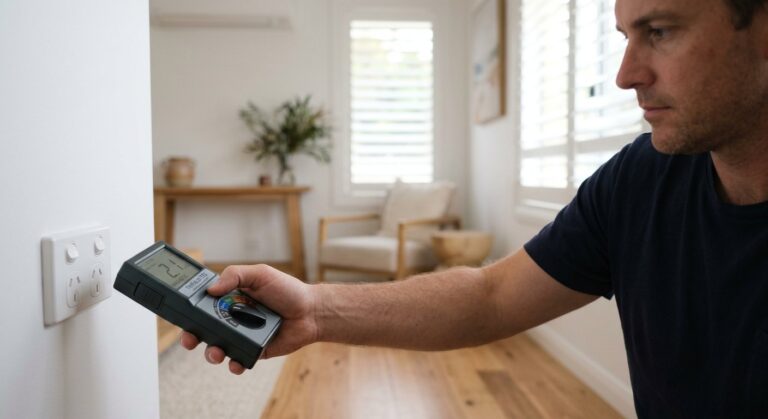
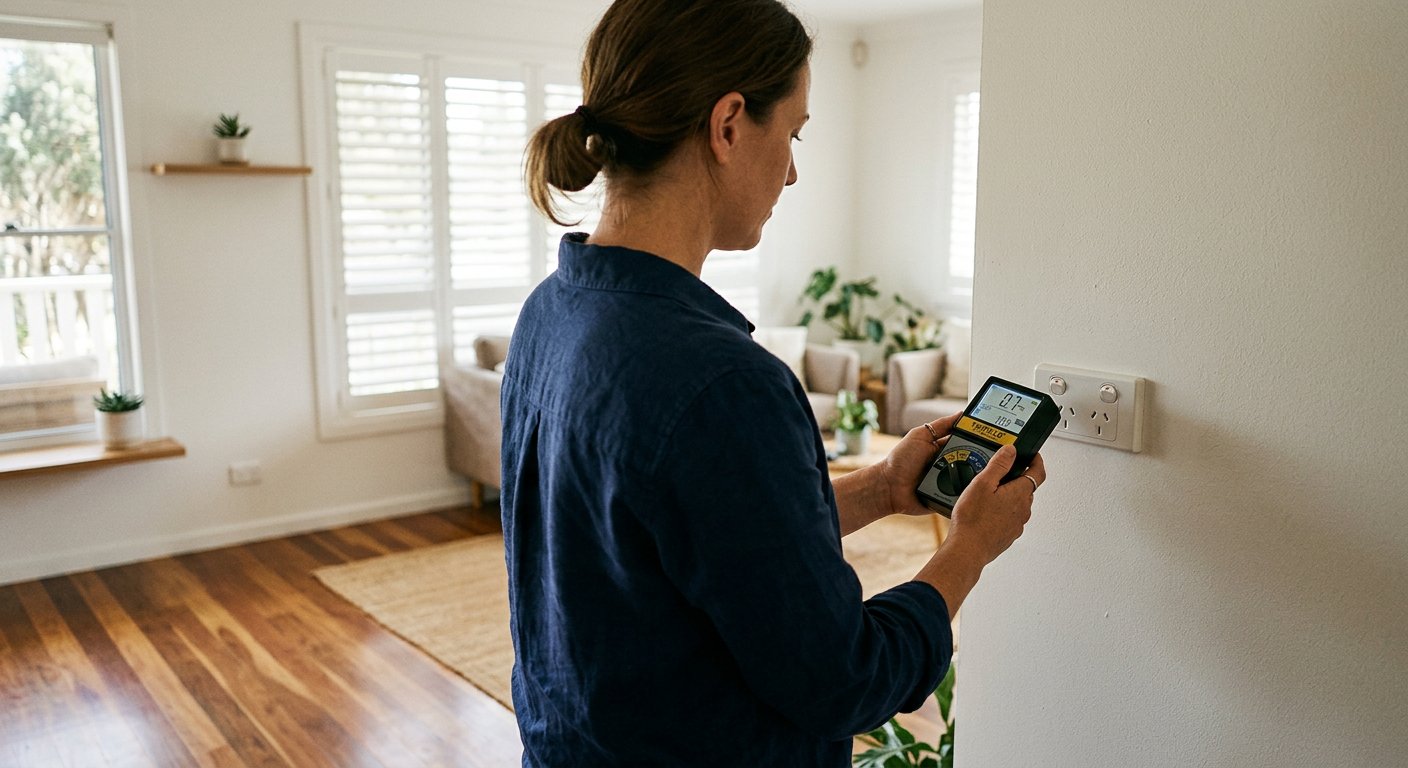
5G n78 operates at 3.5 GHz. Most consumer-grade RF meters can detect this frequency. The two I recommend for Australian homes are:
TriField TF2: Measures RF (up to 6 GHz, covering all Australian 5G FR1 bands), AC magnetic fields, and AC electric fields in one device. Best all-in-one for a household wanting to assess their complete EMF environment. Displays power density in mW/m². Use peak-hold mode when measuring 5G — beamforming means the signal arrives in bursts, and average-mode readings will understate peak exposure.
Safe and Sound Pro II: RF-only meter with audio readout, covering 200 MHz to 8 GHz. Higher sensitivity than the TF2 for RF-only work. The audio feedback lets you hear the 5G signal pattern — beamformed transmissions produce a distinctive rapid-burst sound profile that differs from continuous 4G transmissions.
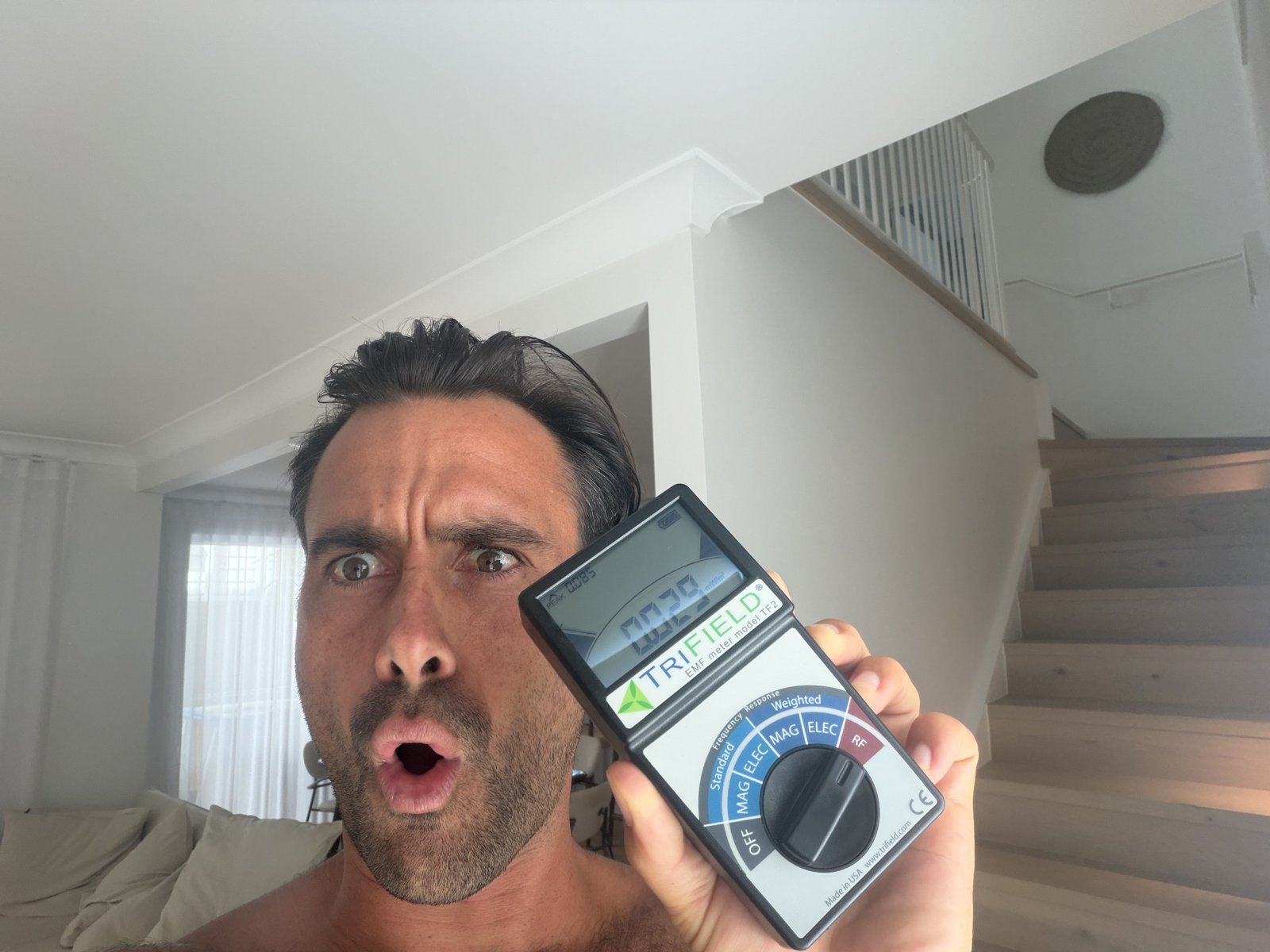
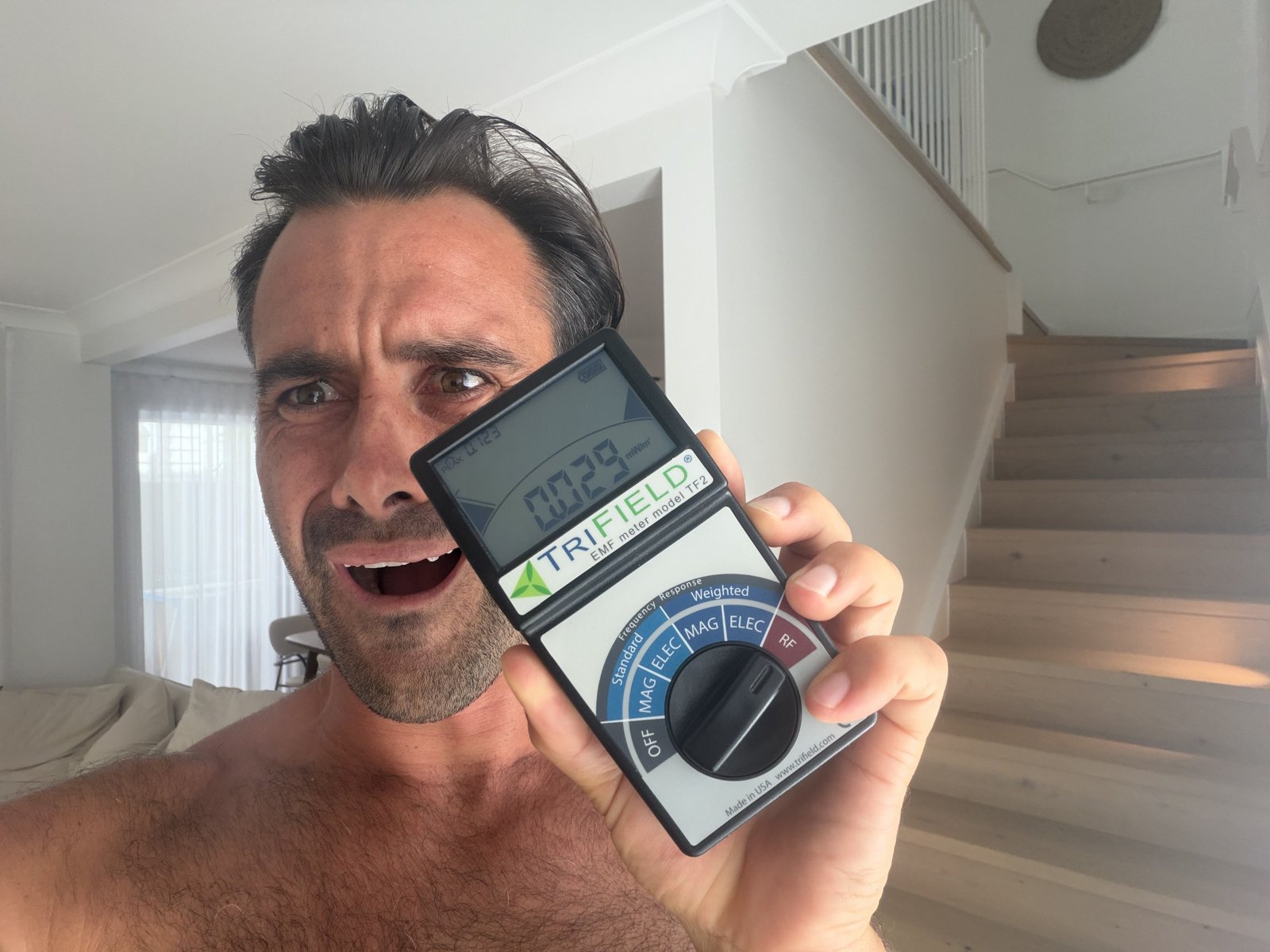
Measurement Protocol for 5G Tower Exposure
Follow this sequence. It is the same protocol building biologists use for residential assessments.
- Remove internal RF sources first. Turn off your Wi-Fi router, put all phones on airplane mode, unplug DECT cordless phones, turn off Bluetooth devices. You cannot isolate external tower exposure if internal sources are active. This step alone often reveals that 80-95% of your bedroom RF comes from your own devices, not the tower.
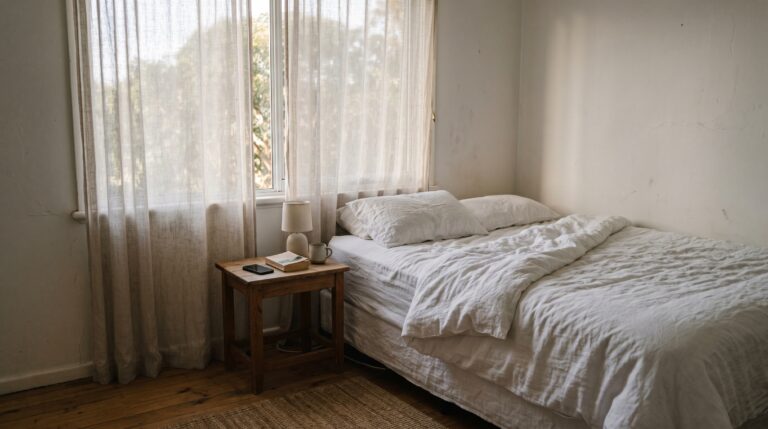
- Measure at your bed position. Hold the meter at pillow height. Record peak-hold values for 2-3 minutes. This captures the burst pattern of beamformed 5G transmissions.
- Measure at the window facing the tower. Glass provides minimal attenuation. This is your maximum external RF exposure point. Compare this reading to the bed-position reading to quantify how much your walls are helping.
- Record the time. RF from 5G towers varies with traffic load. A reading at 10pm on a Tuesday will be different from 2am Saturday. For sleeping-environment assessment, measure between 10pm and 6am.
- Compare to standards. ARPANSA limit: 10,000 mW/m² at 3.5 GHz. Building biology “no anomaly” threshold (sleep): 0.1 mW/m². Your reading falls somewhere between these. Where it falls — and which standard you choose to apply — determines your next action.
If Your Readings Exceed Your Chosen Threshold
If you measure readings above the building biology sleeping threshold and want to reduce exposure:
- Address internal sources first (free). Phone on airplane mode. Mechanical timer on your Wi-Fi router to cut overnight. Remove DECT phones from the bedroom. This eliminates the largest contributors for most homes.
- Relocate the bed (free). Move the bed to the wall furthest from the tower. Every metre of additional distance and every interior wall adds attenuation.
- Shield the facing window ($50-200). RF-reflective window film or EMF shielding paint on the tower-facing wall. Do NOT shield all walls — you create a Faraday enclosure that traps any remaining internal RF and increases exposure.
- Demand switch (~$100-150). A licensed electrician installs this on your bedroom circuit. It cuts AC power to bedroom wiring when no loads are active, eliminating AC electric fields during sleep. This addresses a separate EMF type (ELF electric fields) but is the highest-impact electrician action for sleep environment optimisation.
Australian City-Specific 5G Tower Density and Exposure Considerations
5G tower deployment varies significantly between Australian cities, and so do the practical exposure scenarios. Here is what you need to know for your location.
Sydney: Densest 5G deployment in Australia. Telstra and Optus have deployed n78 small cells on street poles in inner suburbs including Surry Hills, Pyrmont, and CBD. Apartment residents in buildings near these low-mounted antennas (10-15m height) may have higher line-of-sight exposure than residents near traditional macro towers. NBN NTDs (Network Termination Devices) in Sydney apartments do not transmit RF themselves — only the attached Wi-Fi router does, which can be placed in a different room via ethernet cable.
Brisbane and South-East Queensland: Energex smart meters operating at 900 MHz are a separate and often larger RF source than 5G towers for homes in Logan, Ipswich, and Gold Coast suburbs. If your bedroom wall shares the exterior with your smart meter, that 900 MHz signal — transmitting in bursts with peak readings 100-1,000x higher than the time-average — may dominate your sleeping-area RF profile regardless of 5G tower proximity. Measure both sources independently.
Melbourne: Moderate 5G deployment concentrated along transport corridors. Yarra Valley catchment suburbs tend to have lower tower density than western and northern suburbs. Melbourne’s older double-brick housing stock provides better RF attenuation (15-25 dB at 3.5 GHz) than the timber-framed construction common in Queensland.
Perth: Significant 5G deployment in northern corridor and CBD. Residents near the Kwinana industrial corridor face a different EMF profile that may include industrial RF sources in addition to telecommunications. Perth homes tend to use double brick, providing reasonable attenuation.
Adelaide, Darwin, and regional areas: Lower 5G density. Most regional 5G deployment is n28 (700 MHz) on existing 4G towers, which behaves identically to 4G from an exposure perspective. If you live in a regional area and your concern is specifically “5G radiation,” the reality is you are being exposed to the same frequencies as before, with identical power levels.
For all cities, you can check the location of base stations near your address using the ACMA RadioCommunications Database (publicly accessible) or the RF National Site Archive (RFNSA). These show licensed transmitter locations, frequencies, and antenna heights. Knowing where your nearest tower is, and at what height, is the first step in understanding your exposure geometry.
The Honest Summary: What We Know, What We Do Not, and What You Can Do
Here is where I land on this, having read the ARPANSA surveys, the WHO/IARC assessments, the building biology literature, and the IEEE beamforming research. I will not pretend certainty where none exists.
What we know:
- Australian 5G base stations operate at RF power densities that are a tiny fraction (0.001-0.1%) of ARPANSA’s thermal safety limit at any publicly accessible location.
- Beamforming technology used in 5G n78 reduces ambient RF exposure for bystanders compared to omnidirectional 4G broadcasting.
- ARPANSA’s thermal safety limits include a 50x safety factor and are met with an enormous margin at all surveyed Australian 5G sites.
- Your phone and in-home wireless devices deliver 1,000-20,000x more RF to your body than a base station at typical distances.
What we do not know:
- Whether non-thermal biological effects occur at the power densities produced by 5G base stations at residential distances. The research is “inconclusive/inadequate” per WHO/IARC.
- Long-term (15-30 year) health outcomes from 5G-specific frequency exposure. The technology has not existed long enough to generate this data.
- Whether individual sensitivity to RF varies in ways that population-level studies cannot capture.
What you can do:
- Measure your actual environment with a calibrated RF meter rather than guessing based on tower proximity. A TriField TF2 or Safe and Sound Pro II covers all Australian 5G frequencies.
- Address internal sources first — phone airplane mode at night, Wi-Fi on a timer, DECT phone removed from bedroom. This delivers the largest measurable reduction in your total RF exposure.
- Choose your risk framework consciously. If you adopt ARPANSA’s thermal limits, 5G towers are a non-issue at any residential distance. If you adopt building biology precautionary limits, you may exceed the sleeping threshold within 100 metres of a tower — but your own devices will likely be the larger contributor.
The worst outcome is living with anxiety about a tower you have never measured. The second worst is dismissing all concerns because an agency told you it is fine. Measure. Then decide. That is the only rational approach to a actually unresolved question.
Final Verdict: Start With Measurement — the TriField TF2 Is the Only Meter You Need.
Measures AC magnetic, AC electric, and RF in one device. Without real readings, every EMF decision is a guess.
Last reviewed: August 2026 – Clean and Native
Frequently Asked Questions
Does 5G cause cancer according to Australian health authorities?
ARPANSA states that there is no established evidence that 5G causes cancer. The WHO/IARC classified evidence for health effects from 5G RF-EMF as “inconclusive/inadequate” in February 2020, meaning insufficient quality research exists to determine either safety or harm at non-thermal exposure levels.
What is the safe distance to live from a 5G tower in Australia?
There is no official “safe distance” because RF exposure depends on antenna height, tilt, power, and building materials — not distance alone. ARPANSA surveys show all publicly accessible locations near 5G sites are within thermal safety limits. Building biology precautionary thresholds for sleeping areas may be exceeded within 50-100 metres outdoors. Measurement at your specific location is more reliable than any distance rule.
What frequencies does 5G use in Australia?
Australian 5G primarily uses n28 (700 MHz) and n78 (3.5 GHz), both in the FR1 frequency range. mmWave (FR2) at 26 GHz has been trialled by Telstra but is not publicly deployed as of mid-2026. All current Australian 5G uses the same general frequency range as existing Wi-Fi and 4G technologies.
Is 5G beamforming more dangerous than 4G?
5G beamforming directs energy in narrow beams toward active devices rather than broadcasting omnidirectionally. This reduces ambient RF exposure for bystanders who are not actively using 5G data. Time-averaged exposure near a 5G tower is typically lower than near an equivalent 4G installation, though instantaneous peak exposure during an active beam hit can be higher for the served device.
What is the ARPANSA RF exposure limit for 5G?
ARPANSA adopts the ICNIRP 2020 guidelines, setting the general public RF exposure limit at 10 W/m² (1,000 µW/cm²) for frequencies between 2 GHz and 300 GHz. This is a thermal safety limit with a 50x safety factor below the threshold where measurable tissue heating occurs.
Can I measure 5G radiation at home with a consumer meter?
Yes. The TriField TF2 measures RF up to 6 GHz, which covers all Australian 5G FR1 frequencies (700 MHz and 3.5 GHz). The Safe and Sound Pro II covers 200 MHz to 8 GHz with higher RF sensitivity. Use peak-hold mode when measuring 5G because beamforming produces burst patterns that average-mode readings will understate.
Does my phone produce more radiation than a 5G tower?
At typical residential distances (50+ metres), yes — by a large margin. A phone held against your head delivers approximately 2,000-10,000 mW/m² to adjacent tissue. A 5G tower at 50 metres produces approximately 0.1-2 mW/m² at ground level. The phone exposure is roughly 1,000-20,000 times higher due to proximity.
How do I find 5G towers near my house in Australia?
Use the ACMA RadioCommunications Database or the RF National Site Archive (RFNSA), both publicly accessible online. Enter your address to see licensed transmitter locations, frequencies, antenna heights, and carrier information for all base stations near your home.
What is the difference between building biology limits and ARPANSA limits for RF?
ARPANSA’s limit is 10 W/m² (10,000 mW/m²) — a thermal safety standard. The Building Biology SBM-2015 “no anomaly” threshold for sleeping areas is 0.1 mW/m² — roughly 100,000 times stricter. ARPANSA protects against tissue heating. Building biology aims to minimise all measurable RF in sleep environments as a precautionary approach. Which standard you follow is a personal risk management decision.
Do walls block 5G radiation?
Yes, to varying degrees. At 3.5 GHz (n78), a standard Australian brick-and-plaster wall provides approximately 10-15 dB of attenuation. Double brick provides 15-25 dB. A single pane of glass provides only 3-5 dB. Timber-framed walls with plasterboard (common in Queensland) provide less attenuation than brick. This is why indoor measurements are always lower than outdoor measurements at the same distance from a tower.
Get the Australian Home Environment Checklist
30 checks across water, air and EMF. Most of them free. Ranked by impact.
No spam. Unsubscribe any time.

Former Royal Australian Navy Clearance Diver and TAG-E counter-terrorism operator. Founded Clean and Native to apply the same rigorous thinking to the home environment.
Full biography →