ARPANSA SAR Limits Explained: Mobile Phone Radiation Safety Standards in Australia
Drafted with AI assistance and checked against published specifications and certifications. First-hand measurements appear only where stated. How we make content
ARPANSA SAR Limits Explained: Mobile Phone Radiation Safety Standards in Australia
Australia’s SAR (Specific Absorption Rate) limit for mobile phones is 2.0 W/kg averaged over 10 grams of tissue, set by ARPANSA under the Radiation Protection Standard for Maximum Exposure Levels to Radiofrequency Fields (RPS 3), which adopts the ICNIRP 1998/2020 guidelines. The whole-body SAR limit for the general public is 0.08 W/kg, while the localised head and trunk limit of 2.0 W/kg is the number most relevant to your phone — and according to ARPANSA’s own exposure surveys, a typical phone in use produces approximately 15 mW/kg at the head, roughly 0.75% of that public limit.
What SAR Actually Measures and Why ARPANSA Uses It
SAR stands for Specific Absorption Rate. It quantifies the rate at which your body absorbs radiofrequency electromagnetic energy, measured in watts per kilogram of tissue. When you hold a phone to your head, the antenna emits RF energy. Some of that energy is absorbed by your skull, brain tissue, and skin. SAR measures how much energy per unit of tissue mass gets absorbed over a defined period.
The measurement process is standardised internationally. A phone is placed against a phantom head (a physical model filled with liquid that mimics the electrical properties of human tissue) at maximum transmit power. An automated probe scans through the liquid, mapping the electric field strength at thousands of points. From those measurements, the SAR is calculated and averaged over either 1 gram or 10 grams of tissue, depending on which regulatory framework applies.
ARPANSA adopted the 10-gram averaging standard because it aligns with the International Commission on Non-Ionizing Radiation Protection (ICNIRP) guidelines. The 10-gram average produces a lower peak number than the 1-gram average used by the US Federal Communications Commission (FCC), which is why direct SAR number comparisons between Australian and American listings are misleading. A phone rated 1.4 W/kg under FCC’s 1-gram standard might rate 0.9 W/kg under ICNIRP’s 10-gram standard. Same phone, same radiation, different measurement protocol.
The critical thing to understand: SAR is tested at maximum transmit power with the phone pressed directly against the head. In real-world use, your phone almost never operates at maximum power. According to ARPANSA’s own radiation literature survey, a typical phone in active call mode produces approximately 15 mW/kg at the head — that is 0.015 W/kg, or roughly 0.75% of the 2.0 W/kg public limit. The phone dynamically adjusts its power output depending on signal strength, distance from the tower, and network load. Closer to a tower means less power required means lower actual exposure.
Australia’s ARPANSA Limits vs International Standards: A Direct Comparison
No competitor article currently provides a clear, side-by-side table of how Australia‘s SAR limits compare to every major international standard. Here it is.
| Regulatory Body | Countries | Localised SAR Limit | Averaging Mass | Whole-Body Limit | Basis |
|---|---|---|---|---|---|
| ARPANSA (RPS 3) | Australia | 2.0 W/kg | 10 g | 0.08 W/kg | Thermal (ICNIRP) |
| ICNIRP (2020) | EU, UK, Japan, 40+ nations | 2.0 W/kg | 10 g | 0.08 W/kg | Thermal |
| FCC | USA, Canada | 1.6 W/kg | 1 g | 0.08 W/kg | Thermal (IEEE C95.1) |
| SBM-2015 (Building Biology) | Precautionary guideline | N/A (power density based) | N/A | N/A | Non-thermal / precautionary |
| India (DoT) | India | 1.6 W/kg | 1 g | 0.08 W/kg | Thermal (adopted FCC) |
| China (MIIT) | China | 2.0 W/kg | 10 g | 0.08 W/kg | Thermal (ICNIRP) |
Notice the pattern. Every national regulatory limit is based on preventing thermal effects — tissue heating. The 2.0 W/kg ICNIRP limit (used by ARPANSA) and the 1.6 W/kg FCC limit are not as different as the numbers suggest. The FCC averages over 1 gram of tissue, which captures a higher peak in a smaller volume. ICNIRP averages over 10 grams, smoothing that peak across a larger volume. Independent researchers have shown that a phone producing 1.6 W/kg over 1 g typically produces around 0.8-1.2 W/kg over 10 g. The safety margins are functionally similar.
What neither ARPANSA nor the FCC addresses is non-thermal biological effects — the concern that RF radiation below tissue-heating thresholds might still affect cell signalling, oxidative stress markers, or sleep architecture. This is where the gap between regulatory science and precautionary science sits. ARPANSA’s position, stated on its website, is that “there is no established scientific evidence” that low-level RF exposure from phones causes health effects. The International Agency for Research on Cancer (IARC), a WHO body, classified RF electromagnetic fields as “possibly carcinogenic to humans” (Group 2B) in 2011 based on limited evidence from epidemiological studies of glioma in heavy phone users.
You do not need to pick a side in that debate to make practical decisions. The approach I use — as a former Navy Clearance Diver who was trained to manage actual environmental hazards, not theoretical ones — is simple: reduce exposure where the cost of reduction is trivially low, and measure your environment rather than relying on lab numbers from a test jig.
Why SAR Ratings on Your Phone Box Are Almost Useless for Real-World Safety Decisions
Here is the problem nobody in the regulatory space will say plainly: the SAR number printed on your phone’s packaging tells you almost nothing about your actual daily RF exposure. It is a compliance checkbox, not a health metric you can act on.
There are five reasons why.
1. SAR is measured at maximum transmit power. Your phone only hits max power when the signal is extremely weak — one bar, edge of coverage, inside a concrete building. According to ARPANSA’s radiation literature survey data, real-world exposure during a call is typically around 15 mW/kg at the head. That is 0.015 W/kg — roughly 133 times below the 2.0 W/kg limit. In strong signal conditions (four or five bars), the phone may transmit at 1/1,000th of its maximum power.
2. SAR does not account for cumulative daily exposure from multiple sources. Your phone is one RF source. Your Wi-Fi router runs 24 hours a day. Your smart meter transmits in bursts at 900 MHz. Your neighbour’s router bleeds through the wall. Your Bluetooth earbuds sit inside your ear canal. The SAR rating on your phone says nothing about the combined RF environment you live in.
3. SAR testing uses a standardised phantom head, not your head. The SAM (Specific Anthropomorphic Mannequin) phantom was designed to represent the top 10% of military recruits by head size — a large adult male. Children have thinner skulls and higher tissue conductivity. The World Health Organization noted this concern in their research agenda, yet the standard has not been updated to reflect paediatric exposure modelling.
4. Modern phones have multiple antennas and variable power management. A 5G phone may operate across Sub-6 GHz bands (600 MHz to 6 GHz) and millimetre wave (mmWave above 24 GHz) simultaneously. SAR testing is conducted per band, per antenna configuration. The maximum reported value does not describe the combined exposure from multiple antennas active at once during real-world use.
5. Body position matters enormously. SAR is tested at two positions: against the head and against the body (typically in a trouser pocket, 5-15 mm separation). But you carry your phone in different positions throughout the day — breast pocket, back pocket, hand while scrolling, in bed next to your pillow. The SAR value does not apply to the position that may matter most to you.
This is why I tell every person who asks me about phone radiation the same thing: stop looking at SAR numbers and start measuring your actual environment. A TriField TF2 or Safe and Sound Pro II will show you the real RF power density in your bedroom, at your desk, and in your child’s room. That data is actionable. A SAR number on a spec sheet is not.
EMF Meters & Protection
See full EMF guide →The Thermal vs Non-Thermal Debate: What ARPANSA Will and Will Not Tell You
ARPANSA’s position is clearly stated: their SAR limits protect against established thermal effects of RF radiation. Tissue heating. If your SAR exposure stays below 2.0 W/kg localised, your tissue temperature increase stays well below 1°C, and no established adverse health effect occurs. This is the scientific consensus position held by ARPANSA, ICNIRP, the WHO’s International EMF Project, and the vast majority of national regulators.
What ARPANSA’s limit does not address — and is not designed to address — is the possibility of biological effects below the thermal threshold. These are sometimes called “non-thermal” or “sub-thermal” effects. They include changes in oxidative stress markers, altered blood-brain barrier permeability, effects on melatonin production, and changes in sleep EEG architecture reported in some peer-reviewed studies.
The evidence base here is contested. The IARC Group 2B classification (“possibly carcinogenic”) from 2011 was based largely on the Interphone study and the Hardell group studies, which found elevated odds ratios for glioma in the heaviest phone users (top decile by cumulative call hours). The US National Toxicology Program (NTP) study, completed in 2018, found “clear evidence” of heart schwannomas in male rats exposed to whole-body RF at SAR levels of 1.5, 3.0, and 6.0 W/kg — above typical human phone exposure but below or near the occupational limit. The Ramazzini Institute replicated similar findings at lower exposure levels.
On the other side, large cohort studies — particularly the Danish Cohort Study and the Million Women Study in the UK — have not found statistically significant increases in brain tumour incidence among phone users over follow-up periods of 10-20+ years. ARPANSA cites these null-result studies when maintaining that no revision to thermal-only limits is warranted.
Where does this leave you as an Australian household? In a position where the regulatory standard protects against heating, real-world exposure is far below even the heating threshold, but the question of whether chronic low-level exposure at non-thermal levels carries any biological cost remains open. The precautionary approach — reducing exposure where the cost is near-zero — loses you nothing and may gain you something. That is the operating principle behind Building Biology guidelines.
Building Biology SBM-2015 vs ARPANSA: The Numbers Are Worlds Apart
| Parameter | ARPANSA Limit | SBM-2015 Sleeping Area (No Concern) | Ratio |
|---|---|---|---|
| RF Power Density (at 2.4 GHz) | 1,000 μW/cm² (10 W/m²) | < 0.1 μW/cm² (< 0.001 W/m²) | 10,000x |
| AC Magnetic Field (50 Hz) | 100 μT (general public) | < 0.02 μT (no concern) / < 0.1 μT (slight concern) | 500-5,000x |
| AC Electric Field (50 Hz) | 5,000 V/m (general public) | < 1 V/m (no concern) / < 5 V/m (slight concern) | 1,000-5,000x |
That 10,000x gap between the ARPANSA RF limit and the Building Biology sleeping area guideline is not a typo. It reflects fundamentally different assumptions. ARPANSA protects against established tissue heating. Building Biology SBM-2015 seeks to minimise chronic low-level exposure during the 7-8 hours your body is in its deepest repair and regeneration state. Neither is “wrong” — they are answering different questions.
For your bedroom, the Building Biology targets are achievable. Airplane mode on your phone, Wi-Fi router on a timer, and a demand switch on your bedroom circuit will get most homes below SBM-2015 “slight concern” thresholds. You do not need to rewire your house or live in a Faraday cage. You need to measure, then make a few cheap changes.
How to Look Up SAR Values for Any Phone Sold in Australia
ARPANSA does not maintain a searchable database of SAR values by phone model. This is one of the biggest gaps in Australian EMF consumer information. Here is how to find the number for your specific handset.
Method 1: Your phone’s built-in SAR display. On iPhone, go to Settings > General > Legal & Regulatory > RF Exposure. On Android, the location varies by manufacturer, but dialling *#07# on many Samsung and Xiaomi devices will display the SAR certification data. This shows both head and body SAR values under the relevant standard (ICNIRP 10 g for Australian models).
Method 2: Manufacturer’s website. Apple publishes SAR data for every iPhone model in the “RF Exposure Information” section of its legal documentation. Samsung publishes it in the “Health and Safety” section of the user manual PDF, downloadable from the Australian support page.
Method 3: The German Federal Office for Radiation Protection (BfS) database. This is the most comprehensive searchable SAR database in the world. Available at bfs.de, it lists SAR values for thousands of phone models. Filter by brand, sort by SAR value. While these are tested under European (ICNIRP) standards identical to Australia’s, models sold in Australia may have different firmware power management. Use it as a reference, not a guarantee.
Method 4: EU SAR certification documents. Under EU regulations, SAR test reports are publicly accessible. The ISED (Canada) and FCC (US) databases also publish detailed SAR test reports, but remember — FCC values use 1 g averaging and will appear higher than the equivalent ICNIRP 10 g value for the same phone.
SAR Values for Popular Phones in Australia (ICNIRP 10 g Standard)
| Phone Model | Head SAR (W/kg, 10 g) | Body SAR (W/kg, 10 g) | Notes |
|---|---|---|---|
| iPhone 15 Pro Max | 0.98 | 0.98 | Well under limit |
| iPhone 16 Pro | 0.98 | 0.98 | Apple’s published max |
| Samsung Galaxy S24 Ultra | 0.89 | 1.52 | Higher body SAR — pocket carry |
| Google Pixel 9 Pro | 0.96 | 0.99 | Mid-range values |
| Samsung Galaxy A55 | 0.64 | 1.34 | Budget model, lower head SAR |
Every phone sold in Australia must comply with ARPANSA’s 2.0 W/kg limit to receive ACMA’s Radiocommunications (Electromagnetic Radiation — Human Exposure) Standard compliance label. If it is on the shelf at JB Hi-Fi, Officeworks, or any Australian retailer, it has passed. The question is not “does it comply?” — it does. The question is whether compliance with thermal-only limits is sufficient for your personal risk tolerance, particularly for bedroom exposure while sleeping.
Practical RF Reduction Strategies for Australian Households
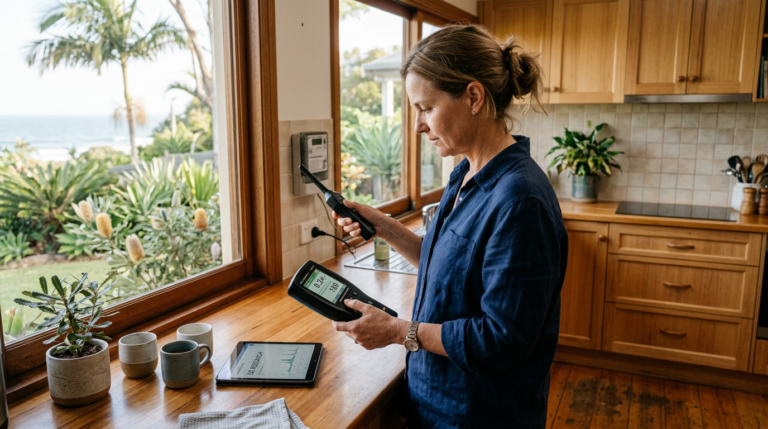
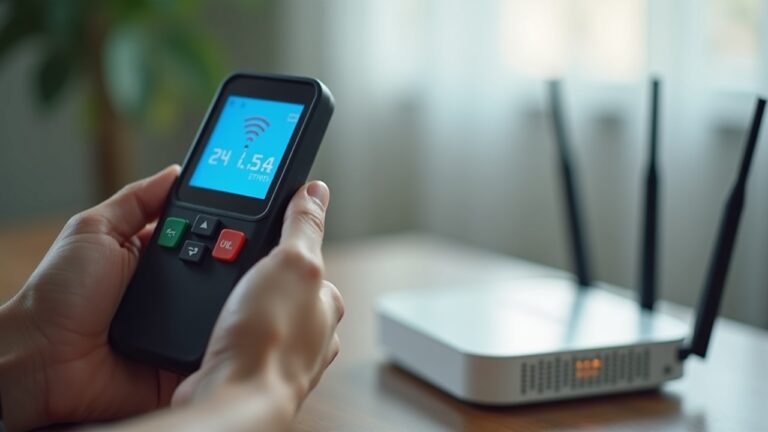
You cannot reduce what you have not measured. That is the first principle. Before buying any shielding product, before switching off any device, take a baseline reading. A TriField TF2 on its RF setting will show you power density in your bedroom, living room, and office in milliwatts per square metre (mW/m²). The Safe and Sound Pro II gives you peak and average RF readings with higher sensitivity and frequency range.
Once you have baseline readings, here is the priority sequence that delivers the most exposure reduction for the least cost. I use this exact protocol at the Palm Beach house and recommend it to every household I consult with.
Step 1: Remove Internal Sources from the Bedroom (Free – $20)
Phone on airplane mode during sleep. This is the single highest-impact action and it costs nothing. A smartphone on a bedside table in active mode broadcasts RF continuously — Wi-Fi polling, cellular keep-alive pings, Bluetooth scanning. On airplane mode, RF output drops to effectively zero. If you use your phone as an alarm, airplane mode still allows the alarm to function.
Wi-Fi router on a mechanical timer. The Jackson 24hr Mechanical Timer (Amazon AU ASIN B0DCGPPK5H, approximately $20) plugs in between your router and the wall socket. Set it to turn off at 10 PM and on at 6 AM. Eight hours of zero Wi-Fi RF in your home every night. This eliminates the single largest continuous RF source in most Australian households.
Your smart meter is a different story. Australian smart meters operate at 900 MHz and transmit in short bursts. Peak readings near the meter can be 100 to 1,000 times higher than the time-averaged value. If your bedroom shares a wall with the meter box — common in Queensland and Victorian homes built from the 1990s onward — consider rearranging the bed to maximise distance. RF power drops with the square of distance. Moving the bed 2 metres further from the meter reduces power density by 75%.
Step 2: Increase Distance During Daytime Use ($0 – $30)
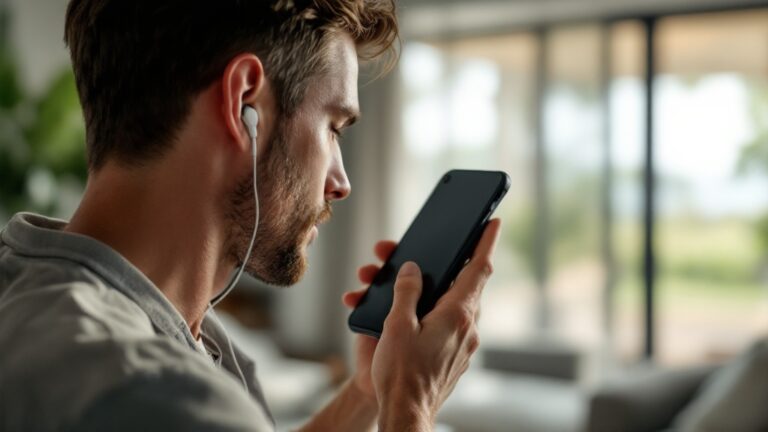
Use speakerphone or air-tube headsets for calls. Standard wired earbuds conduct a small amount of RF along the wire. Air-tube headsets, such as the DefenderShield model available through SaferEMF AU, use a hollow tube for the last section before the earpiece — no wire near your head. This is not about fear. It is about a $40 product that reduces head exposure to near zero during calls with no change to call quality.
Never carry your phone in a pocket against your body while transmitting. Body SAR values on many phones approach 1.5 W/kg in the pocket test position. Put it in a bag, on a desk, or in an outer jacket pocket. The difference between 0 mm separation and 15 mm separation is substantial in terms of absorbed power.
Use wired Ethernet for desks and workstations. If your desktop computer or laptop can connect via Ethernet, do so and disable Wi-Fi on that device. One fewer transmitter in your environment. Most NBN routers have four Ethernet ports — use them.
Step 3: Address Specific Hotspots (If Meter Shows Elevated Readings)
Demand switch on the bedroom circuit. A licensed electrician installs this on the circuit breaker feeding your bedroom (approximately $100-150 installed). When the last light or appliance in the room is switched off, the demand switch cuts voltage to the wiring. This eliminates AC electric fields from the 240V cables running through your bedroom walls and ceiling — typically 20-80 V/m reduced to near zero. It does not affect other circuits.
Low-EMF router for the house. The JRS Eco 100 (available from SaferEMF AU) replaces your standard Wi-Fi router. It reduces beacon transmission power by up to 90% and supports full beacon shutdown when no devices are actively connected. This is a genuine low-emission router, not a marketing gimmick — it has been independently tested by building biologists in Europe and Australia.
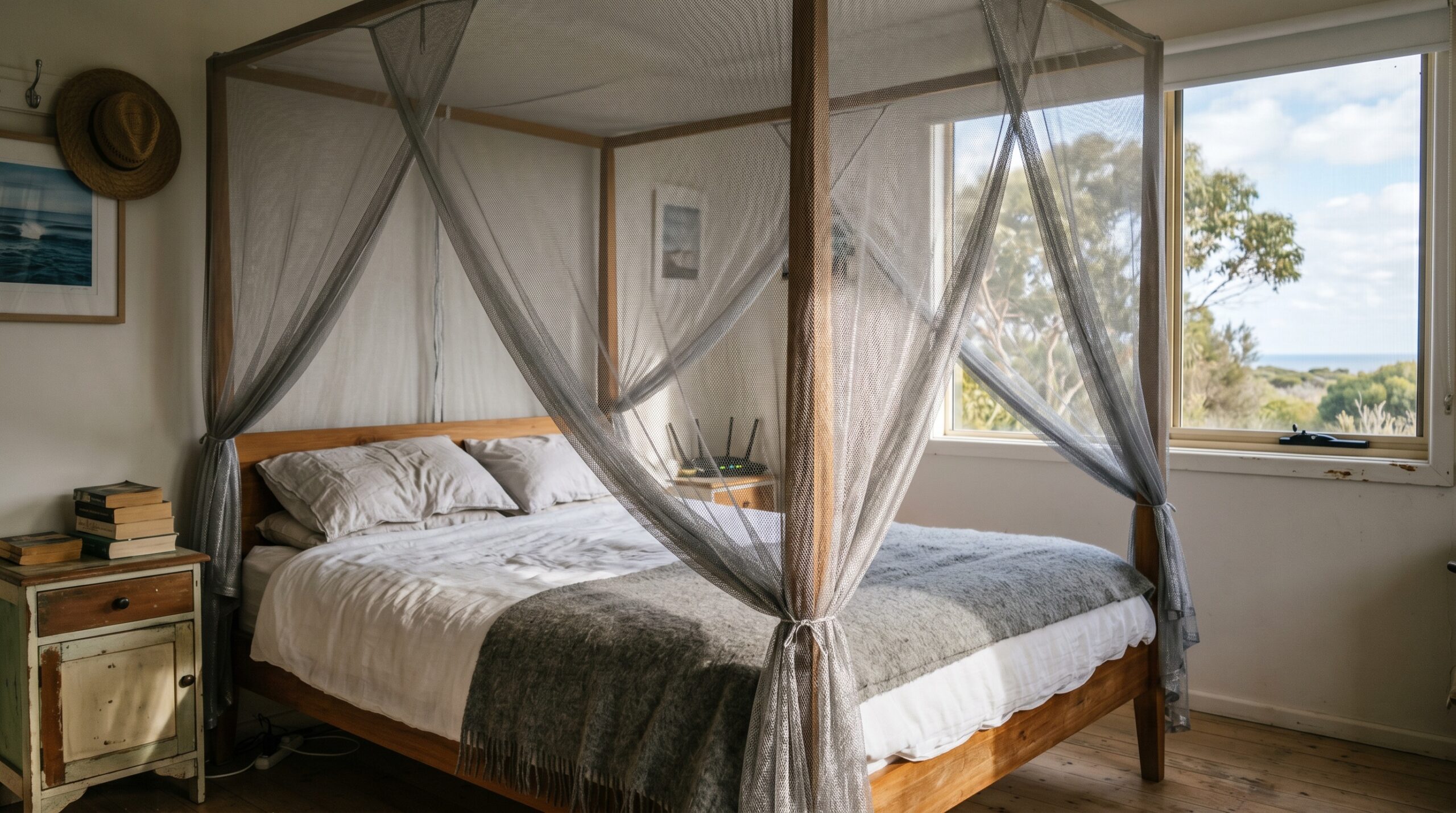
Shielding — only after internal sources are removed. This is critical and most people get it backwards. An EMF shielding bed canopy (such as the silver cotton 42 dB model from SaferEMF AU) reflects RF. If your phone is inside the canopy and actively transmitting, the canopy reflects that radiation back at you — increasing your exposure. A canopy works only when all internal sources have been removed and you are shielding against external residual RF from neighbours’ routers, nearby towers, or smart meters. Measure, reduce, then shield. Never shield first.
What ARPANSA’s SAR Standard Does Not Cover: Smart Meters, Wi-Fi, and 5G
ARPANSA’s SAR limit applies to devices held against the body — primarily mobile phones. But the RF environment in a 2026 Australian home involves far more than your handset.
Smart meters. Every new and replacement electricity meter in Queensland, Victoria, NSW, and South Australia is a smart meter. These transmit usage data via 900 MHz radio in short bursts — typically 50-100 millisecond transmissions, multiple times per day. ARPANSA’s general public RF limit of 1,000 μW/cm² (the same thermal limit used for all RF sources at that frequency) applies. Smart meters comply easily in terms of time-averaged exposure. But peak burst power at 1 metre from the meter can reach 5-50 μW/cm², and if your bed is on the other side of that wall, nightly exposure is not trivial compared to Building Biology sleeping area targets of less than 0.1 μW/cm².
Wi-Fi routers. A standard 802.11ac or Wi-Fi 6 router operates at 2.4 GHz and 5 GHz. ARPANSA’s limit at 2.4 GHz is 1,000 μW/cm². A typical router at 1 metre produces 1-10 μW/cm² when actively transmitting. At 3 metres — the distance in many bedrooms — that drops to 0.1-1 μW/cm². Still above Building Biology “no concern” levels, but well within ARPANSA compliance. The router timer eliminates this entirely during sleep.
5G infrastructure. Sub-6 GHz 5G (the dominant deployment in Australia via Telstra, Optus, and TPG) operates in similar frequency bands to 4G LTE and is covered by existing ARPANSA limits. Millimetre wave (mmWave) 5G, operating above 24 GHz, is limited to very small cells in dense urban areas — parts of Sydney CBD, Melbourne CBD, and select venues. ARPANSA’s RPS 3 covers these frequencies with power density limits rather than SAR (because mmWave does not penetrate deeply into tissue). For the vast majority of Australian homes in suburban Brisbane, Perth, Adelaide, Melbourne, or regional areas, mmWave 5G exposure is currently zero.
Bluetooth and wearables. Bluetooth Classic and Bluetooth Low Energy (BLE) operate at 2.4 GHz at very low power — typically 1-10 mW transmit power. SAR contribution is minimal. However, devices worn directly on the body (smartwatches, fitness trackers, wireless earbuds in the ear canal) deliver their RF directly into tissue with zero distance buffer. The precautionary approach is simple: use airplane mode on your smartwatch at night, remove earbuds when not on a call, and prefer wired connections where practical.
ARPANSA’s Regulatory Status: RPS 3 and the ICNIRP 2020 Update
ARPANSA’s current mandatory standard is the Radiation Protection Standard for Maximum Exposure Levels to Radiofrequency Fields — 3 kHz to 300 GHz (RPS 3), which references the ICNIRP 1998 guidelines as its technical basis. In 2020, ICNIRP published updated guidelines with refined dosimetric quantities, including absorbed power density for frequencies above 6 GHz (relevant to mmWave 5G). ARPANSA signalled its intention to harmonise with these updated guidelines.
As of mid-2026, the formal update to RPS 3 incorporating ICNIRP 2020 has not been completed. Vodafone Australia and other carriers referenced an anticipated harmonisation date of late 2020-2021, but the process has been slower than expected. In practical terms, the core SAR limits for phones (2.0 W/kg localised, 0.08 W/kg whole-body) are unchanged between ICNIRP 1998 and ICNIRP 2020 for frequencies below 6 GHz — which covers all current phone frequencies in Australia.
The meaningful change in ICNIRP 2020 is the introduction of absorbed power density as the dosimetric quantity above 6 GHz, replacing SAR. This matters for future mmWave devices but does not change the SAR limit for any phone currently sold in Australia. If you are buying a phone today, the 2.0 W/kg ICNIRP limit is the applicable standard, and ARPANSA’s enforcement reflects this.
Decision Tree: What Should You Actually Do About Phone RF Exposure?
Three questions. That is all you need.
1. Are you willing to spend $0-20 on the easiest wins?
Yes → Phone on airplane mode every night (free). Jackson mechanical timer on Wi-Fi router ($20). You have just eliminated the two largest continuous RF sources in your bedroom for under $20. Stop here if you are satisfied with a basic precautionary approach.
2. Do you want to know your actual RF exposure levels?
Yes → Get a TriField TF2 (approximately $250, Amazon AU) for all-in-one measurement (RF + AC magnetic + AC electric). Or the Safe and Sound Pro II (approximately $550, SaferEMF AU) if you want dedicated RF precision with peak hold capability. Walk every room. Take readings at bed height, desk height, and near smart meters. Now you have data, not guesses.
3. Are your meter readings above Building Biology SBM-2015 thresholds after removing internal sources?
Yes → External sources (towers, neighbours’ routers, smart meters through walls) need shielding. Consider a demand switch for AC electric fields ($100-150 installed by a licensed electrician). For RF, a JRS Eco 100 low-EMF router replaces your standard router. For sleeping areas with external RF above 0.1 mW/m², a shielding bed canopy is warranted — but only after all internal sources are confirmed off. The silver cotton 42 dB canopy from SaferEMF AU provides excellent broadband RF attenuation.
No → You are done. Your bedroom is within precautionary guidelines. Maintain the habits (airplane mode, timer) and re-measure annually or if you add new wireless devices.
Final Verdict
ARPANSA’s 2.0 W/kg SAR limit is a thermal safety standard, not a precautionary health guideline. Every phone on sale in Australia complies with it. Real-world exposure is typically 0.75% of the limit. The SAR number on your phone tells you almost nothing about your actual daily RF environment.
If you are reading this because you are concerned about phone radiation and your family’s health, here is what I would do in your position — because it is exactly what I do in mine. Airplane mode on the phones at night. Router on a $20 timer. And if you want to go further, invest in a meter so every decision you make is based on real numbers from your home, not spec-sheet values from a test laboratory in Shenzhen.
Without real readings, every EMF decision is a guess. With a $250 meter and 30 minutes, you know exactly where you stand. That is the difference between worry and action.
Start with measurement. The TriField TF2 is the only meter you need.
Measures AC magnetic, AC electric, and RF in one device. I use it for every room audit at the Palm Beach house. Without real readings, every EMF decision is a guess.
Last reviewed: May 2026 — Clean and Native
Frequently Asked Questions
ARPANSA sets the localised SAR limit at 2.0 W/kg averaged over 10 grams of tissue, in line with ICNIRP guidelines. The whole-body SAR limit for the general public is 0.08 W/kg. Every phone sold through Australian retailers must comply with this standard.
The numbers differ (2.0 W/kg vs 1.6 W/kg) but the actual safety margin is similar. Australia uses 10-gram tissue averaging (ICNIRP), while the US FCC uses 1-gram averaging. The same phone tested under both standards will show a higher number under the FCC method. The real-world protective effect is comparable.
On iPhone, go to Settings > General > Legal & Regulatory > RF Exposure. On many Android phones, dial *#07# to display SAR certification data. You can also check the manufacturer’s website or the German BfS radiation protection database, which lists SAR values for thousands of phone models under the ICNIRP 10 g standard used in Australia.
Airplane mode disables cellular, Wi-Fi, and Bluetooth transmitters, reducing RF emissions to effectively zero. The phone still emits negligible levels from the processor and screen backlight, but RF output — the relevant concern — is eliminated. Your alarm, offline apps, and downloaded content still work normally.
Sub-6 GHz 5G phones sold in Australia must comply with the same 2.0 W/kg SAR limit as 4G phones. The frequency bands are similar and the safety standard applies equally. Millimetre wave 5G uses a different dosimetric measure (absorbed power density) but is currently deployed only in limited urban locations in Sydney and Melbourne, not in typical residential areas.
No. ARPANSA’s limit is designed to prevent tissue heating above 1°C. It does not address potential non-thermal biological effects such as oxidative stress or altered sleep architecture reported in some peer-reviewed studies. The IARC classified RF as “possibly carcinogenic” (Group 2B) in 2011, but ARPANSA maintains there is no established evidence warranting lower limits.
Yes. Smart meters transmit at 900 MHz in short bursts and comply with ARPANSA’s general public RF exposure limit. However, peak burst readings at 1 metre can reach 5-50 μW/cm², which exceeds Building Biology SBM-2015 sleeping area guidelines of less than 0.1 μW/cm². If your bedroom shares a wall with the meter box, consider measuring and increasing distance.
Airplane mode on your phone (free) and a Jackson 24hr Mechanical Timer on your Wi-Fi router (approximately $20 from Amazon AU). These two actions eliminate the two largest continuous RF sources in most Australian bedrooms and require zero technical skill to implement.
Yes, if RF-emitting devices are inside the canopy. A shielding canopy reflects RF. If your phone is transmitting inside it, the canopy bounces that radiation back toward you, increasing exposure. Always remove all internal RF sources (phone on airplane mode, no active Bluetooth devices) before using any shielding enclosure.
ARPANSA does not mandate SAR display at point of sale in the same way France does. However, ACMA requires all phones to comply with the Radiocommunications (Electromagnetic Radiation — Human Exposure) Standard before they can be sold. Manufacturers must make SAR data available in the phone’s documentation and settings, but it is not typically displayed on shelf labels in Australian retailers.
Get the Australian Home Environment Checklist
30 checks across water, air and EMF. Most of them free. Ranked by impact.
No spam. Unsubscribe any time.
Former Royal Australian Navy Clearance Diver and TAG-E counter-terrorism operator. Founded Clean and Native to apply the same rigorous thinking to the home environment.
Full biography →