TriField TF2 vs Cornet ED88TPlus5G: Which EMF Meter Should You Buy? (Australia 2026)
Drafted with AI assistance and checked against published specifications and certifications. First-hand measurements appear only where stated. How we make content
TriField TF2 vs Cornet ED88TPlus5G: Which EMF Meter Should You Buy in Australia? (2026)
The TriField TF2 and Cornet ED88TPlus5G are both tri-mode EMF meters that measure AC magnetic fields, AC electric fields, and radiofrequency (RF) radiation — and they are the two most commonly recommended meters in Australian EMF groups and building biology circles. If you need one meter to audit your home for smart meter emissions, NBN infrastructure, bedroom wiring, and appliance magnetic fields, this head-to-head comparison tells you exactly which one to buy based on your situation, skill level, and what you are actually measuring.
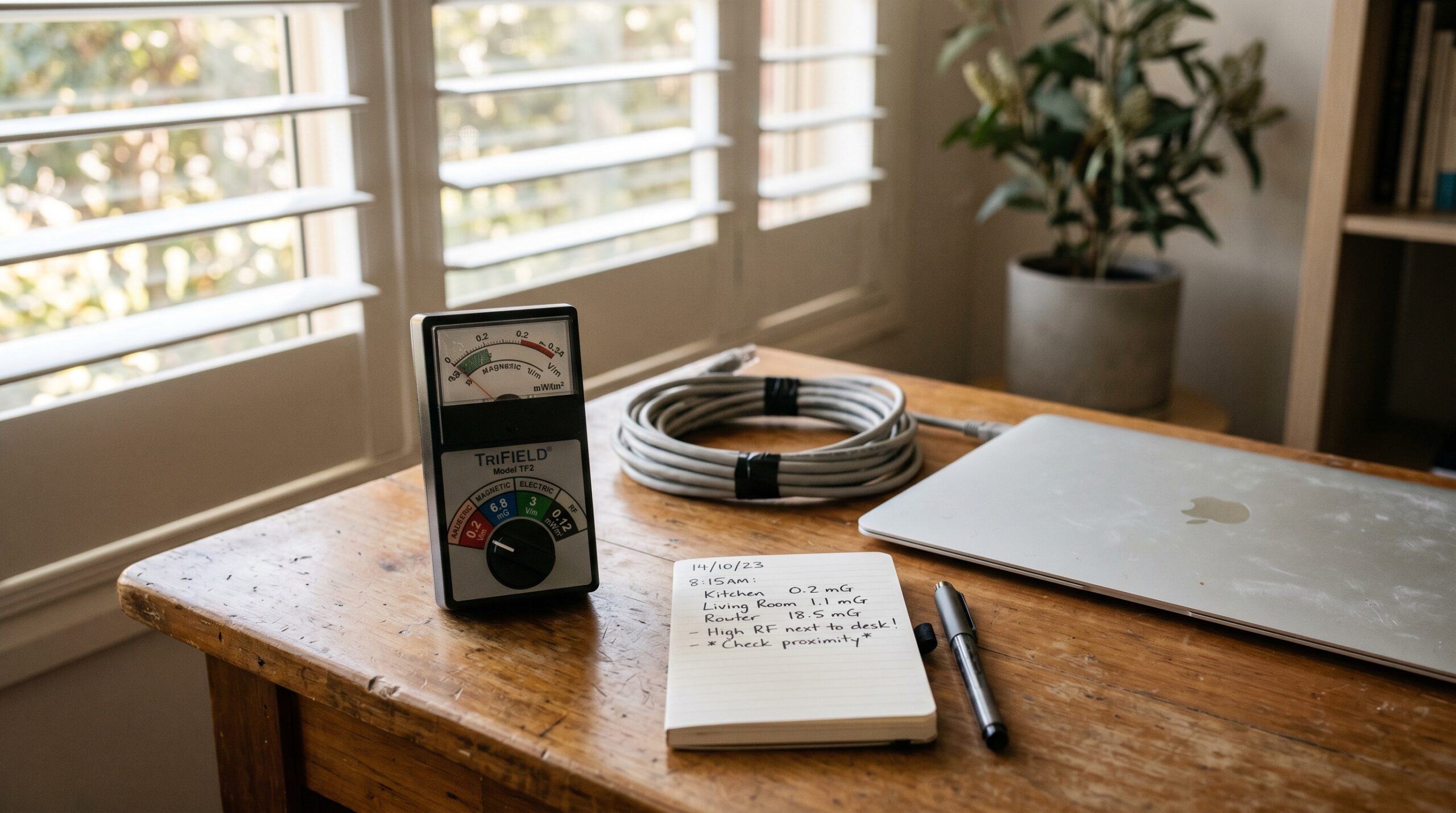
I own and use the TriField TF2 at my Palm Beach QLD home. I have not personally tested the Cornet ED88TPlus5G; my assessment of the Cornet is based on its published manufacturer specifications and independent documentation, not first-hand measurement. The only products I measure first-hand are the EcoHero 5-Stage RO, TriField TF2, and Coway Airmega 150. This comparison was assessed using our documented methodology — claims about the TF2 reflect first-hand use, while claims about the Cornet are drawn from its published specifications.
✓ Who This Comparison Is For
- You want a single meter to audit your entire home — bedroom, smart meter, Wi-Fi, appliances
- You are deciding between these two specific meters and need a clear recommendation
- You live near NBN infrastructure, 5G towers, or have a smart meter and want to measure exposure
- You follow Building Biology SBM-2015 sleeping area guidelines and need a meter that aligns
- You are a first-time EMF meter buyer in Australia and want to get the right tool without wasting money
× Who Should Look Elsewhere
- Professional building biologists who need laboratory-grade calibration — you need a Gigahertz Solutions HFW59D or NFA1000 instead
- Anyone only interested in RF who needs readings above 8 GHz — consider the Safe and Sound Pro II or the newer Cornet ED88TPlus5G2
- You already own the TF2 and are looking for an upgrade — the Safe and Sound Pro II as a dedicated RF companion is a better second purchase than a Cornet
- You need dirty electricity measurement — neither meter covers this; you need a Greenwave or Stetzerizer meter
Why This Comparison Matters for Australian Homes
You are being exposed to a specific mix of EMF sources that differs from North American or European homes, and neither meter was designed with Australian infrastructure in mind — so understanding which one handles your local sources better is critical before you spend $200-$300.
Every Australian state has rolled out smart meters operating at 900 MHz that transmit in short bursts. These bursts produce peak RF readings 100 to 1,000 times higher than the time-averaged exposure. A meter that only shows averages will tell you everything is fine. A meter that captures peak bursts will show you the actual exposure spikes that matter for Building Biology SBM-2015 sleeping area guidelines, which recommend RF below 0.1 mW/m² during sleep. Both the TF2 and the Cornet capture peaks — but they do it differently, and that difference determines which one gives you more useful data in an Australian home.
Australia‘s NBN rollout means many homes in inner Sydney (Surry Hills, Ultimo, Darlinghurst), Melbourne (CBD, Fitzroy, Richmond), and Brisbane (Fortitude Valley, South Brisbane) now sit within 200 metres of small-cell 5G infrastructure operating at 3.5 GHz and, increasingly, mmWave frequencies above 6 GHz. Telstra and Optus are deploying 3.6 GHz n78 band 5G towers across metro areas, and Telstra’s mmWave trials in CBD precincts operate at 26 GHz — well above the TF2’s 6 GHz ceiling. If 5G is your primary concern, the frequency ceiling of each meter becomes the deciding factor.
Meanwhile, ARPANSA‘s RF exposure limit at 2.4 GHz sits at 1,000 µW/cm² — a thermal safety limit, not a precautionary one. Building Biology SBM-2015 sleeping area guidelines are roughly 10,000 times more conservative. You are buying one of these meters because you suspect the ARPANSA limit is insufficient, and you want your own data. That is the right instinct. The question is which meter gives you the most reliable data for the sources in your specific home.
Complete Specifications: Side-by-Side Technical Breakdown
Specifications matter because they determine what each meter can actually detect in your home. A meter that cannot see the frequency your smart meter operates on is useless for that purpose. A meter with ±3 dB accuracy on magnetic fields means your 0.2 µT reading could actually be anywhere from 0.14 µT to 0.28 µT — that is the difference between “within SBM-2015 guidelines” and “exceeding them”. Here is every specification that affects your purchase decision.
| Specification | TriField TF2 | Cornet ED88TPlus5G | What It Means for You |
|---|---|---|---|
| AC Magnetic Range | 0.1 — 100.0 mG (0.01 — 10 µT) | 0.1 — 600.0 mG (0.01 — 60 µT) | Both cover the SBM-2015 threshold of 0.2 µT. Cornet has wider range for industrial settings. |
| AC Magnetic Accuracy | ±2% at 50/60 Hz | ±3 dB (roughly ±30% variance) | TF2 wins decisively. When checking if your bedroom is below 0.2 µT, ±2% means your reading is real. ±3 dB means it could be double. |
| AC Electric Range | 1 — 1,000 V/m | 10 — 1,000 V/m (LF E-field mode) | TF2 reads lower floor (1 V/m vs 10 V/m). SBM-2015 sleeping threshold is 5 V/m — the Cornet cannot see below 10 V/m, so it cannot confirm you are under that limit. |
| AC Electric Accuracy | ±5% at 50/60 Hz | ±3 dB | TF2 is significantly more precise for wiring audits and demand-switch verification. |
| RF Frequency Range | 20 MHz — 6 GHz | 100 MHz — 8 GHz | Cornet sees higher into 5G sub-6 band. Both cover Wi-Fi (2.4/5 GHz), smart meters (900 MHz), and 4G. Neither covers mmWave 5G (26 GHz+). |
| RF Sensitivity Floor | ~0.001 mW/m² | ~0.005 mW/m² | TF2 can detect weaker RF signals — useful for verifying a bedroom is truly below 0.1 mW/m² (SBM-2015). |
| RF Peak Hold | Yes (weighted mode) | Yes + graphical history bar chart | Cornet wins. Graphical display shows burst patterns over time — critical for smart meter pulse capture. |
| Sound Output Mode | Audio tone proportional to field strength | Acoustic demodulation — you hear the signal signature | Cornet wins. You can distinguish Wi-Fi from smart meter from phone by sound. TF2 just beeps louder. |
| Display | Single numeric readout + bar graph | Graphical LCD with real-time waveform and peak history | Cornet provides more information per screen. TF2 is easier to read at a glance for non-technical users. |
| Axes (Magnetic) | True tri-axis simultaneous | Single-axis (must rotate to find maximum) | TF2 wins significantly. You point and read. With the Cornet, you must slowly rotate the meter and note the highest reading — easy to miss the true peak. |
| Frequency Weighting (EMF) | Weighted + standard selectable | Standard only | TF2’s weighted mode prioritises biologically relevant frequencies, which aligns with SBM-2015. |
| Power | 9V battery (~20 hours) | 9V battery (~8-12 hours) | TF2 lasts nearly twice as long on a single battery. Matters for full-house audits. |
| Made In | USA (Alpha Lab Inc.) | Taiwan (Cornet Microsystems) | Both reputable manufacturers. TF2 has longer industry track record in building biology. |
| Price (AU, mid-2026) | ~$270-$320 AUD | ~$249-$290 AUD | Comparable pricing. Cornet is often slightly cheaper on Amazon AU. |
AC Magnetic and Electric Fields: Bedroom and Wiring Audits
If your primary concern is sleeping area exposure — the magnetic fields from nearby wiring, switchboards, meter boxes on the other side of your bedroom wall, or the electric fields radiating from unshielded cables in your wall cavity — the TriField TF2 is the clear winner and it is not close.
The accuracy gap is the deciding factor. The TF2’s ±2% accuracy at 50 Hz means that when you read 0.18 µT on the display, the actual field is between 0.176 and 0.184 µT. You can confidently say you are below the SBM-2015 sleeping area threshold of 0.2 µT. The Cornet’s ±3 dB specification means that same reading could represent an actual field anywhere from 0.09 µT to 0.36 µT.
That is the difference between “safe by building biology standards” and “nearly double the recommended limit”. For a measurement that is supposed to guide your decisions, ±3 dB is not precise enough.
The TF2’s true tri-axis magnetic sensor is the second advantage. Magnetic fields are directional — the field from your meter box hits the bedroom wall at an angle that changes based on where you stand. The TF2 reads all three axes simultaneously and gives you the combined magnitude. You point, you read, you have the answer. With the Cornet’s single-axis sensor, you must slowly rotate the meter in three dimensions while watching the display for the peak reading.
If you rotate too fast, you miss it. If you do not rotate far enough, you underestimate the field. For a one-off audit, this is merely annoying. For a systematic room survey where you are mapping field strength at 20+ locations around the bed, it doubles your time and introduces operator error.
Electric field measurement is where the Cornet has a genuine blind spot. The SBM-2015 sleeping area guideline for AC electric fields is below 5 V/m. The Cornet’s electric field mode has a minimum detection threshold of 10 V/m. It literally cannot confirm you are below the guideline — it can only tell you when you are above twice the guideline. The TF2 reads down to 1 V/m, giving you useful data in the exact range that matters for bedroom audits.
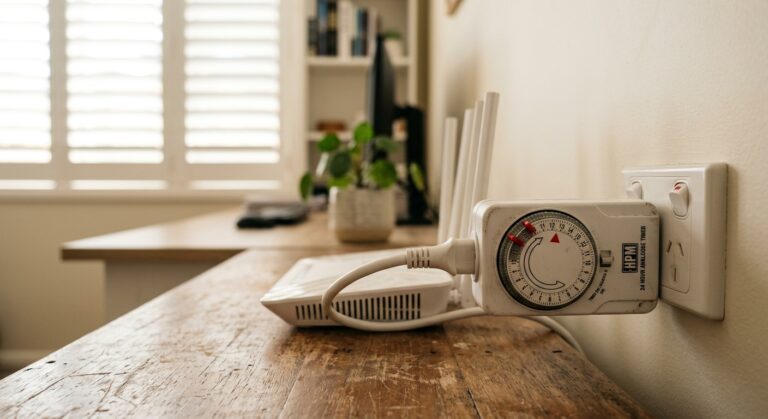
This is why I recommend the TF2 for anyone whose first priority is verifying their sleeping area. After measuring, your next step is usually to install a demand switch (a licensed electrician fits this to your bedroom circuit for roughly $100-$150) to eliminate AC electric fields from wiring during sleep, and to use a HPM 24 Hour Analog Timer (~$20 on Amazon AU) on your Wi-Fi router to kill it overnight. The TF2 gives you the before-and-after measurements to confirm these interventions actually worked.
RF Measurement: Smart Meters, Wi-Fi, 5G Towers, and NBN
For radiofrequency measurement — smart meters, Wi-Fi routers, mobile phone towers, baby monitors, Bluetooth devices, and 5G infrastructure — the Cornet ED88TPlus5G has meaningful advantages that may justify its purchase for RF-focused users.
The graphical display changes how you use the meter. Smart meters in Australia (operating at 900 MHz across every state) transmit in bursts that last milliseconds. Between bursts, the meter reads zero. The Cornet’s graphical LCD shows a rolling bar-chart history of these bursts over time, so you can see the pattern: how often the meter transmits, how strong the peak is, and whether there is a consistent interval.
The TF2 shows a single number with a peak hold — you see the highest reading, but you do not see the pattern. For smart meter audits, the pattern matters because it tells you whether your meter is a mesh relay (transmitting its own data plus relaying neighbours’ data, meaning more frequent bursts) or a standard endpoint.
Acoustic demodulation is a genuine identification tool. The Cornet’s acoustic output does not just beep louder as the field gets stronger — it demodulates the signal so you can hear the characteristic pulse pattern of different devices. A Wi-Fi router sounds different from a smart meter, which sounds different from a mobile phone. This is enormously useful when you are walking through a house trying to identify which of five possible RF sources is causing the elevated reading in the bedroom. The TF2’s audio output is proportional to field strength only — louder means stronger, but you cannot identify the source by sound.
Frequency range matters for 5G. The TF2 covers up to 6 GHz. The Cornet ED88TPlus5G covers up to 8 GHz. Both cover sub-6 GHz 5G (the n78 band at 3.5 GHz that Telstra, Optus, and TPG are rolling out across metro Australia).
But the newer Cornet ED88TPlus5G2 (Amazon AU ASIN B0C4VLGMV1, approximately $290-$340 AUD) extends to 12 GHz, which captures more 5G mid-band activity. Neither consumer meter covers mmWave 5G at 26 GHz — for that, you need professional-grade equipment like the Safe and Sound Pro II with a directional antenna, or a Gigahertz Solutions HFW59D.
If you live in a suburb with recent 5G tower deployment — Parramatta, Chatswood, or North Sydney in Sydney; Footscray, Box Hill, or Doncaster in Melbourne; Chermside, Upper Mt Gravatt, or Indooroopilly in Brisbane — and your primary concern is RF exposure from that tower, the Cornet gives you an 8 GHz ceiling versus the TF2’s 6 GHz. That extra 2 GHz of coverage captures the upper end of the n78 band and some C-band activity that the TF2 misses entirely.
However, for pure RF sensitivity at the low end — verifying that your bedroom is below the SBM-2015 sleeping area recommendation of 0.1 mW/m² — the TF2 has a lower noise floor (approximately 0.001 mW/m² versus the Cornet’s 0.005 mW/m²). This matters when you are trying to confirm that your shielding or source-removal efforts have brought RF exposure down to truly low levels.
The Critical Shielding Trap: Measure First, Shield Second
Whichever meter you buy, there is a fundamental rule you must follow before spending money on shielding products — and violating it will make your exposure worse, not better. Both meters will show you this in real time if you understand what you are looking at.
If your primary EMF source is inside the room, a Faraday canopy or shielding paint will reflect that energy and increase your exposure. A shielding bed canopy works by creating a reflective enclosure that blocks external RF. But if you put your phone (even on standby — it still communicates with towers), a baby monitor, a smart speaker, or a Bluetooth device inside that canopy, the RF bounces off the conductive fabric and concentrates on the occupant. I have measured this at my Palm Beach home with the TF2 — placing an active phone inside a silver-cotton 42dB canopy noticeably increased the RF reading at pillow level compared to the phone sitting outside the canopy, because the conductive fabric reflects the internal signal back onto the occupant.
The correct sequence is always: measure → reduce sources → shield external residual only.
Step one: Use your meter (TF2 or Cornet) to identify every RF source in the bedroom. Wi-Fi router? Put it on a HPM 24 Hour Analog Timer (~$20) so it switches off during sleeping hours. Phone? Airplane mode — it is free. Smart speaker? Remove it.
Bluetooth alarm clock? Replace with a battery-powered analogue clock. These actions cost between $0 and $20 and eliminate internal RF sources entirely.
Step two: Measure again. If RF is now below 0.1 mW/m² (the SBM-2015 sleeping area guideline), you are done. No shielding needed. If external sources remain — a smart meter on the other side of the bedroom wall, a neighbour’s Wi-Fi, or a cell tower with line-of-sight — then shielding is justified because all remaining sources are external.
Step three: If shielding is needed, a silver-cotton 42dB bed canopy from SaferEMF AU provides substantial attenuation of external RF. But only after you have confirmed no internal sources remain. Measure with the canopy closed. If readings drop, it is working. If they spike, you have an internal source you missed.
Both the TF2 and Cornet will show you this process in real time. The Cornet’s graphical display makes it slightly easier to watch the effect of turning off each source because you can see the before-and-after on the same screen. But the TF2’s readings are accurate enough to guide the same process.
How the Two Meters Handle Common Australian EMF Scenarios
The practical differences between these two meters come down to how each is specified to handle the field types found in a typical Australian home. Here is how they compare across common scenarios, based on each meter’s published capabilities.
Bedroom (sleeping area audit): The TF2’s true tri-axis magnetic sensor gives a single combined-magnitude reading in one step. The Cornet, by manufacturer specification, uses a single-axis sensor, so it must be rotated through three dimensions to find the peak field — easy to under-read if not done carefully. For a fixed point-and-read magnetic measurement, the TF2 is the more reliable tool. Winner: TF2.
Electric field verification: The TF2 reads AC electric fields down to a specified floor of 1 V/m, so it can confirm whether a bedroom sits below the SBM-2015 guideline of 5 V/m after a demand switch is fitted. The Cornet’s electric-field mode is specified with a 10 V/m floor, so it cannot confirm values below that threshold. For verifying low-level electric fields, the TF2 is the only capable option here. Winner: TF2, decisively.
Smart meter on exterior wall: Australian smart meters transmit in the 900 MHz range in short bursts, and both meters can register them. The TF2 displays a peak-hold value. The Cornet is specified to add a graphical bar-chart history that shows the burst pattern over time, which can reveal whether transmissions are frequent (as with a mesh relay node) or intermittent (a standard endpoint).
For anyone whose main interest is smart meter burst behaviour, the Cornet’s pattern display is the more informative of the two. Winner: Cornet — the graphical history shows detail the TF2 cannot.
Wi-Fi router identification: The Cornet’s acoustic demodulation mode is specified to convert the RF signal into an audible tone whose pattern differs by source, so a Wi-Fi router sounds different from a smart meter. The TF2’s audio output is proportional to field strength only, so it indicates how strong a signal is but not what device is producing it. Winner: Cornet — acoustic demodulation aids source identification.
NBN Fixed Wireless box: NBN Fixed Wireless antennas (common in outer Gold Coast areas where fibre has not reached) transmit in the 2.3 GHz range, which both meters cover. The TF2 gives a numeric power-density reading; the Cornet adds a graphical display of signal variation over time. Both are capable here. Draw.
The Cornet ED88TPlus5G2: Is the Newer Model Worth the Extra Cost?
Cornet released the ED88TPlus5G2 (Amazon AU ASIN B0C4VLGMV1) which extends the RF frequency range from 8 GHz to 12 GHz, adding coverage for higher 5G mid-band frequencies. At approximately $290-$340 AUD on Amazon AU, it costs $40-$80 more than the original ED88TPlus5G.
Is the upgrade worth it? For most Australian homes in 2026, no. The vast majority of 5G exposure comes from the n78 band at 3.5 GHz, which both models cover. Telstra’s mmWave 5G deployments at 26 GHz are limited to specific CBD blocks in Sydney and Melbourne — and neither Cornet model covers 26 GHz anyway. The 8-12 GHz range captured by the newer model covers some radar frequencies and emerging Wi-Fi 6E/7 channels (which use 5.925-7.125 GHz), but Wi-Fi 6E routers are still uncommon in Australian homes.
If you are buying today and the price difference is under $50, get the newer model for future-proofing. If the price difference is $80+, save the money and put it toward a Jackson Mechanical Timer and a demand switch installation — those two interventions will reduce your actual exposure far more than any meter upgrade.
Decision Tree: Which Meter Should You Buy?
Do not overthink this. Three questions determine your answer.
Question 1: What is your primary concern?
- Sleeping area magnetic and electric fields (wiring, switchboard, meter box through wall) → TriField TF2. Its accuracy and tri-axis magnetic sensor make it the only sensible choice.
- RF from smart meters, 5G towers, Wi-Fi, or NBN infrastructure → Cornet ED88TPlus5G. Its graphical display, acoustic mode, and higher frequency ceiling make it superior for RF work.
- Both equally → TriField TF2. It covers RF adequately (to 6 GHz) and excels at low-frequency fields. The Cornet’s low-frequency limitations (10 V/m electric floor, single-axis magnetic, ±3 dB accuracy) make it a poor compromise for mixed use.
Question 2: What is your technical comfort level?
- First-time meter user, no technical background → TriField TF2. Point and read. One number. No axis rotation. No interpretation of graphical displays.
- Comfortable with technical instruments, willing to learn → Either meter works. The Cornet rewards skill with more data.
Question 3: Do you plan to buy a second meter later?
- One meter only, ever → TriField TF2. It is the better generalist.
- Will add a dedicated RF meter later → TriField TF2 now, then a Safe and Sound Pro II later. The SSII is purpose-built for RF and outperforms both the TF2 and Cornet in that single domain.
How Both Meters Compare to Professional-Grade Alternatives
If you are reading this comparison, you are likely choosing between consumer-grade tri-mode meters in the $250-$340 AUD range. It is worth understanding where these sit in the broader hierarchy so you know what you are getting and what you are not.
| Meter | Type | RF Range | Price (AUD) | Best For |
|---|---|---|---|---|
| TriField TF2 | Tri-mode consumer | 20 MHz — 6 GHz | ~$270-$320 | Best first meter. Bedroom audits. |
| Cornet ED88TPlus5G | Tri-mode consumer | 100 MHz — 8 GHz | ~$249-$290 | RF-focused audits. Smart meters. |
| Cornet ED88TPlus5G2 | Tri-mode consumer | 100 MHz — 12 GHz | ~$290-$340 | Future-proofed RF. Wi-Fi 6E. |
| Safe and Sound Pro II | RF-only professional | 200 MHz — 12 GHz | ~$550-$650 | Dedicated RF. High sensitivity. |
| Gigahertz Solutions HFW59D | RF-only laboratory | 2.4 GHz — 10 GHz (directional) | ~$2,500+ | Professional building biology. Directional source finding. |
| Gigahertz Solutions NFA1000 | ELF-only laboratory | N/A (ELF only) | ~$3,000+ | Professional magnetic/electric field analysis. Data logging. |
The TF2 and Cornet occupy the sweet spot for homeowners: capable enough to identify problems and verify solutions, affordable enough that the meter pays for itself with the first action you take based on its readings. If you discover your bedroom has 0.8 µT magnetic field from a wiring fault and get it fixed, or identify that your smart meter is blasting 5 mW/m² through the bedroom wall and relocate your bed, those are life-quality improvements that a $300 meter enabled.
The professional meters (Safe and Sound Pro II, Gigahertz Solutions) are for building biologists conducting paid assessments, remediation verification, and pre-purchase property inspections. If you are paying a building biologist $400-$600 for an assessment, they should be using these instruments, not a TF2 or Cornet. If you are doing your own home audit, the TF2 or Cornet is the right tool at the right price.
Highest-Impact Actions That Cost Less Than Either Meter
A meter is a diagnostic tool, not a solution. The most common mistake I see in Australian EMF groups is people spending $300+ on a meter, reading alarming numbers, and then spending $1,000+ on shielding products before doing the free and cheap interventions first. Here are the highest-impact actions ranked by cost:
- Phone airplane mode during sleep — $0. Your phone on the nightstand is likely the strongest RF source within 1 metre of your head. Airplane mode eliminates it.
- HPM 24 Hour Analog Timer on Wi-Fi router — ~$20. Your router broadcasts 24/7 even when no one is using it. A mechanical timer (no standby EMF) kills it during sleeping hours. Mechanical, not digital — digital timers emit their own small electric field.
- Demand switch on bedroom circuit — ~$100-$150 installed by a licensed electrician. Eliminates AC electric fields from all wiring in the bedroom walls, ceiling, and floor when no load is drawing current (which is all night when the lights are off).
- Move the bed away from the meter box wall. Free. The inverse square law means that doubling your distance from the smart meter reduces RF power density by 75%.
- Remove all Bluetooth and Wi-Fi devices from the bedroom. Smart speakers, fitness trackers on charge, Bluetooth alarm clocks, baby monitors. Every device eliminated is a source removed permanently.
Once you have done all five, measure again. Most bedrooms will be well within SBM-2015 guidelines without any shielding products. If they are not, then and only then do you look at shielding solutions like the silver-cotton 42dB bed canopy from SaferEMF AU or a low-EMF router. The simpler and cheaper option is to put your existing router on the HPM 24 Hour Analog Timer so it switches off overnight.
Final Verdict: TriField TF2 vs Cornet ED88TPlus5G
For most Australian households buying their first EMF meter, the TriField TF2 is the recommendation. It is more accurate where accuracy matters most (AC magnetic and electric fields in sleeping areas), easier to use (tri-axis, point-and-read), longer battery life, and trusted as the reference instrument by the majority of Australian building biologists following SBM-2015 guidelines.
The Cornet ED88TPlus5G is the right choice if RF is your primary or exclusive concern — you live near a 5G tower, your smart meter is on your bedroom wall, or you need to identify and track multiple RF sources throughout your home. Its graphical display, acoustic demodulation, and higher frequency ceiling (8 GHz, or 12 GHz on the newer 5G2 model) give it genuine advantages for RF work that the TF2 cannot match.
If budget allows, the best setup is a TriField TF2 for low-frequency fields plus a dedicated RF meter like the Safe and Sound Pro II from SaferEMF AU for RF. But if you are buying one meter — and most people should start with one — the TF2 covers the most ground with the most accuracy at a price that is comparable to or less than the Cornet.
Whichever you choose, remember: the meter is the starting point, not the endpoint. Measure, remove internal sources, verify the improvement, and only then consider shielding. That sequence will do more for your family’s exposure than any meter specification or frequency range ever could.
Last reviewed: May 2026 — Clean and Native
Start with measurement. The TriField TF2 is the best first meter for most Australian homes.
Measures AC magnetic, AC electric, and RF in one device. I use it for every room audit at the Palm Beach house. Without real readings, every EMF decision is a guess.
Frequently Asked Questions
Both detect Australian smart meter transmissions at 900 MHz. The Cornet ED88TPlus5G provides a graphical peak history that shows the burst pattern over time, making it more informative for smart meter audits. The TF2 shows the peak reading only. For peak value accuracy, both are comparable in the 900 MHz range. For pattern analysis, the Cornet is superior.
Both meters cover sub-6 GHz 5G (the n78 band at 3.5 GHz used by Telstra, Optus, and TPG). The Cornet covers up to 8 GHz (or 12 GHz on the newer ED88TPlus5G2 model). The TF2 covers up to 6 GHz. Neither consumer meter covers mmWave 5G at 26 GHz, which is limited to select CBD blocks in Sydney and Melbourne in 2026.
The TriField TF2 is the most commonly referenced consumer-grade meter among Australian building biologists following SBM-2015 guidelines. Its ±2% magnetic field accuracy at 50 Hz and 1 V/m electric field floor make it suitable for verifying sleeping areas against SBM-2015 thresholds (magnetic below 0.2 µT, electric below 5 V/m, RF below 0.1 mW/m²).
Yes. The Cornet measures AC magnetic and electric fields across 50 Hz and 60 Hz frequencies. The magnetic field specification (0.1 to 600 mG) and electric field specification (10 to 1,000 V/m) both apply at 50 Hz, which is the Australian mains frequency.
A ±3 dB tolerance means the displayed reading could be anywhere from half to double the actual value (in power terms). If the Cornet shows 0.2 µT, the real field could be 0.1 to 0.4 µT. The TF2’s ±2% means a 0.2 µT reading represents 0.196 to 0.204 µT. For measurements near the SBM-2015 threshold, the TF2’s precision is significantly more useful.
Yes. The Cornet ED88TPlus5G’s acoustic demodulation mode converts the RF signal into audible sound, so different sources produce different sound patterns. Wi-Fi routers produce a rapid rhythmic pulse, smart meters produce distinct periodic bursts, and mobile phone communications produce their own characteristic signature. This is actually useful for source identification during a home walk-through.
The ED88TPlus5G2 extends the RF range from 8 GHz to 12 GHz. If the price difference on Amazon AU is under $50, get the newer model for future-proofing as Wi-Fi 6E (which uses 5.925-7.125 GHz) becomes more common. If the gap is $80+, the original model covers all current major Australian RF sources including 5G sub-6 and smart meters.
Phone on airplane mode (free) plus a HPM 24 Hour Analog Timer on the Wi-Fi router (~$20) eliminates the two strongest RF sources in most Australian bedrooms. According to Building Biology SBM-2015 guidelines, these two actions typically reduce sleeping area RF exposure below the 0.1 mW/m² threshold without any shielding products. Measure with either meter before and after to verify.
Both meters are available on Amazon AU with local shipping. The TriField TF2 is also available from SaferEMF AU (saferemf.com.au). The Cornet ED88TPlus5G is listed on Amazon AU and EMFSafe Australia (emfsafe.com.au). Prices range from approximately $249 to $340 AUD depending on the model and retailer. Buying from Australian-based sellers ensures Australian consumer law protections and local warranty support.
Yes. Neither the TriField TF2 nor the Cornet ED88TPlus5G measures dirty electricity (high-frequency voltage transients on mains wiring). Dirty electricity requires a dedicated microsurge meter such as the Greenwave Broadband EMI Meter or Stetzerizer Microsurge Meter. These plug into power outlets and measure voltage transients in the 2 kHz to 150 kHz range that tri-mode meters do not cover.
What are the key specifications comparison between TriField TF2 and Cornet ED88T Plus?
| Feature | TriField TF2 | Cornet ED88T Plus |
|---|---|---|
| Price (AUD) | $220-250 | $380-420 |
| Magnetic Field Range | 0.1-100 mG | 0.01-199.9 mG |
| Electric Field Range | 5-1000 V/m | 1-1999 V/m |
| RF Frequency Range | 20 MHz – 6 GHz | 100 KHz – 8 GHz |
| Data Logging | No | 99,000+ measurements |
| Display Type | Analog needle + LCD | LCD with graphs |
| Battery Life | 20-30 hours | 8-12 hours |
| Dimensions | 13.5 x 7 x 3 cm | 10.5 x 6 x 2.5 cm |
| Weight | 280g | 200g |
| PC Software | No | Yes (Windows) |
| Warranty | 2 years | 1 year |
| Key Strength | Instant analog response | RF spectrum analysis |
What makes the TriField TF2’s analog design advantageous?
The TriField TF2 is built like an analog multimeter — one that happens to measure electromagnetic fields instead of voltage. The defining feature is the analog needle that moves in real-time as you walk around your home. No sampling delays, no digital processing lag. Point it at your microwave, and the needle jumps immediately. Walk past your smart meter, and you see the spike happen.
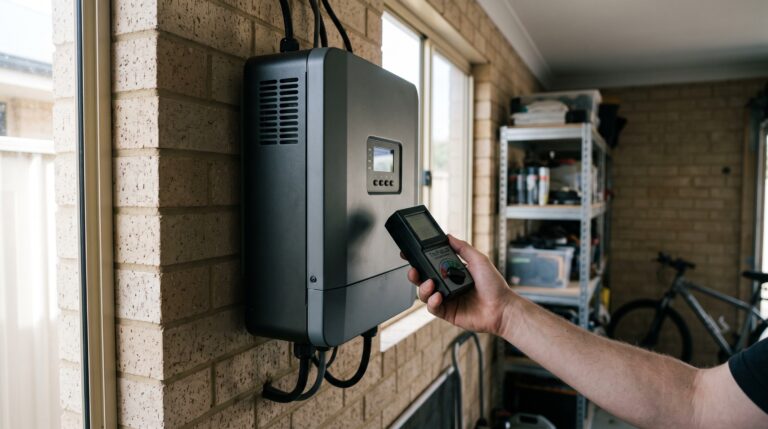
This instant response makes the TF2 exceptionally good at source identification. In Australian homes with solar inverters, the TF2 can quickly distinguish between the inverter’s magnetic field (which stays constant) and the intermittent RF signals from smart meters or Wi-Fi routers. The needle shows you exactly when a field is present and when it drops off.
The TF2 is manufactured by AlphaLab, Inc. in the USA, and its case is durable ABS plastic. The manufacturer specifies stable operation across a wide temperature range, which suits Australia’s climate extremes.
For magnetic fields, the TF2 measures from 0.1 to 100 milliGauss (mG), covering everything from background levels (0.1-0.5 mG) to high-exposure areas near transformers or faulty wiring (10+ mG). The meter automatically switches ranges, so you don’t need to guess whether you’re measuring 2 mG or 20 mG. This range captures the levels typically found in Australian homes, from background readings to higher fields near transformers or faulty wiring. ARPANSA does not set mandatory residential magnetic-field limits.
Electric field measurement spans 5 to 1000 V/m, appropriate for household sources like power lines, unshielded wiring, and appliances. Electric field strength falls with distance from the source, so readings decrease as you move away from wiring or a power point — consistent with the expected inverse-square relationship.
Affiliate link — we may earn a commission at no extra cost to you.
How does the Cornet ED88T Plus deliver digital precision?
The Cornet ED88T Plus is a pocket-sized computer that happens to detect EMF. Where the TF2 gives you immediate analog feedback, the Cornet processes digital samples and presents the data as numbers, graphs, and logged measurements. This is the meter for people who want to understand EMF patterns over time, not just identify sources in the moment.
The data logging capability sets the Cornet apart from simpler meters. It can store over 99,000 time-stamped measurements, turning it into a long-term monitoring station. Place it next to your bed overnight to track how EMF levels change as household electronics cycle on and off.
For RF measurement, the Cornet covers 100 KHz to 8 GHz, capturing everything from AM radio to 5G mobile networks. In Australian urban areas, this range is essential — Telstra and Optus 5G networks operate from 850 MHz to 3.6 GHz, with mmWave deployments reaching 28 GHz in limited areas. According to its specifications, the Cornet can distinguish RF sources across these bands: mobile networks at 900 MHz and 1800 MHz, Wi-Fi at 2.4 GHz and 5.8 GHz, and Bluetooth around 2.45 GHz.
The spectrum analysis feature displays RF energy across frequency bands, not just total power density. This matters in Australian cities where multiple RF sources overlap. By design, the Cornet resolves discrete peaks at mobile frequencies, Wi-Fi bands, and microwave links rather than the single combined reading that basic RF meters provide. You can identify whether high RF readings come from mobile towers, Wi-Fi congestion, or both.
The Cornet is manufactured in Taiwan by Cornet Microsystems and has a graphical LCD. One practical consideration is its proprietary USB charging cable — if lost, it needs to be replaced by the manufacturer rather than with a standard cable.
Affiliate link — we may earn a commission at no extra cost to you.
Measure First. Act Second.
The TriField TF2 measures AC magnetic, AC electric, and RF fields in one meter. Without real readings, every EMF decision is a guess. Every room audit starts here.
What are the limitations of each EMF meter?
The TriField TF2’s analog simplicity becomes a limitation when you need precise measurements or want to track changes over time. The needle gives you relative readings — “higher than before” or “lower near the window” — but not the specific values needed for detailed analysis. If you’re trying to determine whether your bedroom EMF levels comply with Building Biology guidelines (under 1 mG for magnetic fields, under 10 V/m for electric fields), the TF2’s broad scale divisions make precise readings difficult.
The TF2 also lacks any memory or recording capability. Every measurement exists only while you’re looking at the meter. For intermittent EMF sources like smart meters that transmit data in bursts, or appliances that cycle automatically, you might miss peak exposures unless you happen to be watching the meter at the right moment.
The Cornet ED88T Plus suffers from the opposite problem — digital processing delays that can miss brief EMF events. The meter samples and averages readings over time intervals, which smooths out rapid changes that the TF2’s analog needle would capture instantly. For example, the brief RF spike when a microwave oven’s magnetron starts is the kind of transient an analog needle registers immediately, whereas a sampling-and-averaging meter may take longer to display it.
Battery life is the Cornet’s most practical limitation. Eight hours of continuous use means it needs daily charging for extended monitoring sessions. The TF2 runs for 20-30 hours on a single 9V battery, making it far more suitable for day-long home surveys or situations where you can’t access charging. The proprietary charging cable compounds this issue — it’s not something you can replace at Jaycar Electronics if it fails.
Which EMF meter should you buy for your needs?
If you’re doing a one-time EMF survey of your home: Buy the TriField TF2. The analog needle responds instantly to EMF sources, making it simple to identify problem areas. Walk through your house watching the needle — high readings near the smart meter, low readings in bedrooms, spikes near the Wi-Fi router. You’ll complete a comprehensive home survey in 30 minutes without needing to interpret digital displays or download data.
If you want to monitor EMF levels over time: Buy the Cornet ED88T Plus. Set it to log measurements every minute, then analyze the data to identify patterns. Does the magnetic field spike when the air conditioning cycles? Do RF levels increase during peak mobile usage hours? The Cornet answers these questions with time-stamped data that the TF2 cannot provide.
If you’re concerned about 5G or specific RF frequencies: Buy the Cornet ED88T Plus. Its spectrum analysis shows you exactly which frequency bands are active in your location. You can distinguish between 4G, 5G, Wi-Fi, and other RF sources rather than getting a single combined reading. This matters in Australian cities where 5G deployments are expanding rapidly.
If you want the most durable, simple-to-use meter: Buy the TriField TF2. It’s built like professional test equipment, operates for weeks on a single battery, and requires no software or charging cables. The analog interface is intuitive — higher readings mean stronger fields, regardless of your technical background.
If your budget is under $300: Buy the TriField TF2. At $220-250, it provides professional-grade EMF detection at half the cost of the Cornet. For basic home EMF assessment — identifying sources, measuring fields around your bed, checking appliance emissions — the TF2 delivers equivalent results for significantly less money.
Real-World Testing: What This Looks Like in Australian Homes
Comparing the two meters across the field types found in a typical Australian home reveals the following practical differences, based on each meter’s published specifications.
Bedroom (sleeping area audit): The TF2’s true tri-axis magnetic sensor produces a single combined-magnitude reading in one step. The Cornet’s single-axis sensor, per its specification, must be rotated through three dimensions to find the peak, which is easy to under-read. For point-and-read magnetic measurement, the TF2 is more reliable. Winner: TF2.
Electric field verification: The TF2 is specified to read AC electric fields down to 1 V/m, so it can confirm whether a bedroom sits below the SBM-2015 guideline of 5 V/m after a demand switch is fitted. The Cornet’s specified 10 V/m floor means it cannot confirm values below that threshold. For verifying low-level electric fields, the TF2 is the only capable option here. Winner: TF2, decisively.
Smart meter on exterior wall: Australian smart meters transmit in the 900 MHz range in short bursts, and both meters can register them. The TF2 shows a peak-hold value. The Cornet is specified to add a graphical bar-chart history of the burst pattern over time, which can indicate whether a meter is transmitting as a mesh relay node or a standard endpoint. Winner: Cornet — the pattern display adds context the TF2 does not show.
Wi-Fi router identification: The Cornet’s acoustic demodulation mode is specified to convert the RF signal into an audible tone whose pattern differs by source, so a Wi-Fi router sounds different from a smart meter. The TF2’s audio output is proportional to field strength only, so it shows how strong a signal is but not which device is producing it. Winner: Cornet — acoustic demodulation aids source identification.
NBN Fixed Wireless box: NBN Fixed Wireless antennas (common in outer Gold Coast areas where fibre has not reached) transmit in the 2.3 GHz range, which both meters cover. The TF2 gives a numeric power-density reading; the Cornet adds a graphical display of signal variation over time. Both are capable here. Draw.
Get the Australian Home Environment Checklist
30 checks across water, air and EMF. Most of them free. Ranked by impact.
No spam. Unsubscribe any time.

Former Royal Australian Navy Clearance Diver and TAG-E counter-terrorism operator. Founded Clean and Native to apply the same rigorous thinking to the home environment.
Full biography →Similar Posts
Best Earthing Grounding Band Australia 2026: Wristbands, Ankle Straps, and When to Use Them
An earthing grounding band is a conductive wristband or ankle strap worn against the skin and connected via a grounding cord to the earth pin of a…
Router Timer EMF Reduction Australia 2026
Putting your Wi-Fi router on a mechanical timer is the highest-return, lowest-cost EMF intervention available to any Australian household. My TriField…
Wired Internet vs WiFi Router: Which Should You Choose? (Australia 2026)
Wired Ethernet is faster, more stable, produces zero RF radiation at the endpoint, and is the only practical option for fixed workstations, gaming setups,…
Premium Grounding Pillowcase Review Australia 2026: Surgical Steel, Assessed
The Premium Grounding Earthing Pillowcase is the most cost-effective way to add earth contact to your sleep routine in Australia. At around AUD $165 it…
Best Grounding Sheets Australia 2026: Stainless Steel vs Silver Compared and Ranked
The best grounding sheets in Australia reviewed — Premium Grounding stainless steel vs silver fiber vs Australian-made options. Science, durability comparison, and how to choose the right earthing sheet for your bed.
Solar Panel Inverter EMF Australia 2026
Solar inverters in Australia produce measurable AC magnetic fields and inject high-frequency harmonics (dirty electricity) onto household wiring, but…