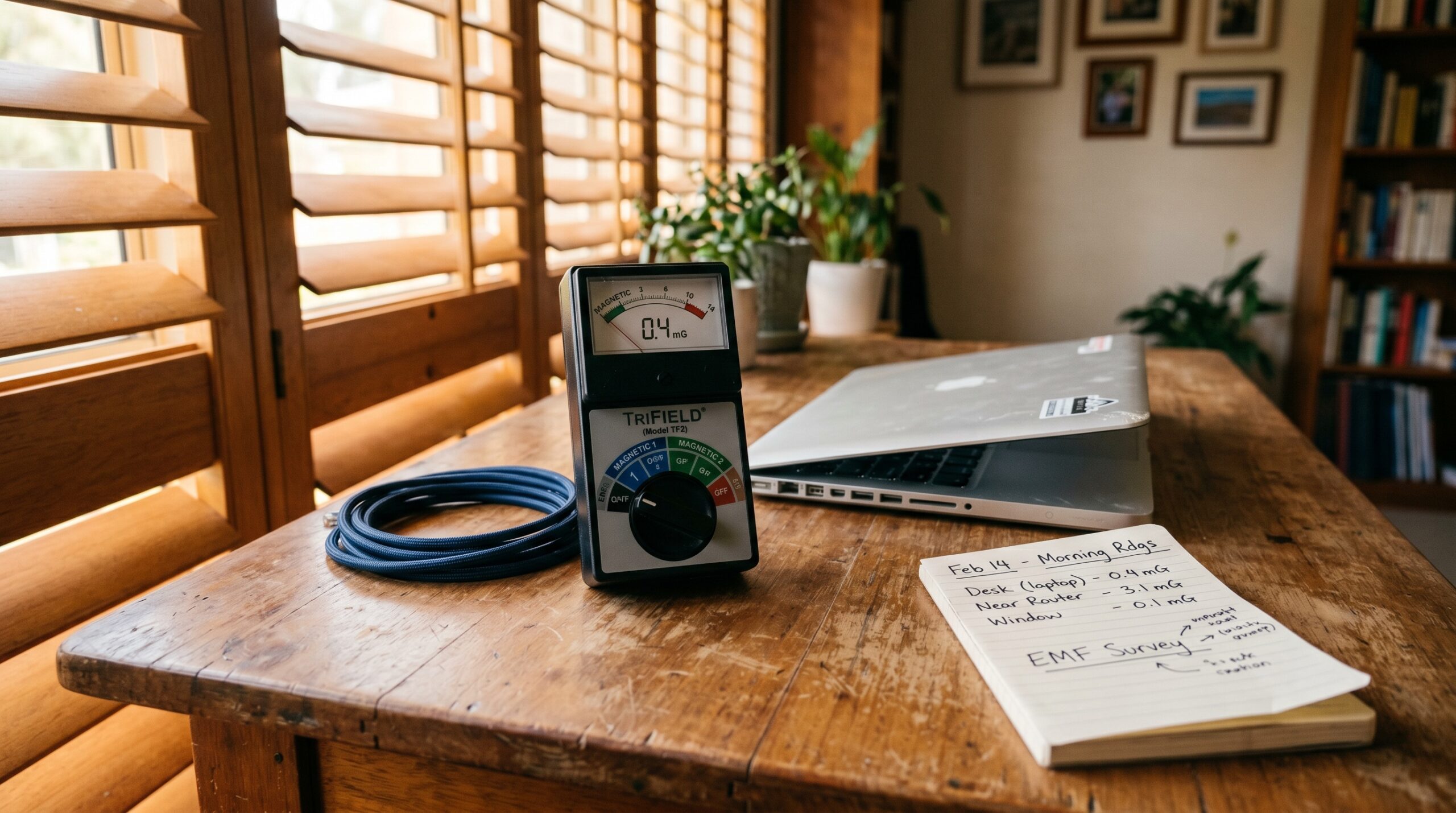
GQ EMF-390 Review Australia 2026: The Data-Logging 5G-Capable EMF Meter Assessed
Drafted with AI assistance and checked against published specifications and certifications. First-hand measurements appear only where stated. How we make content
GQ EMF-390 Review Australia 2026: The Data-Logging 5G-Capable EMF Meter
The GQ EMF-390 is a 3-in-1 EMF meter with built-in data logging and RF detection to 10 GHz, making it the most affordable meter that can record overnight RF exposure and cover all current Australian 5G sub-6 GHz bands. For Australian households wanting to graph their EMF exposure over time — rather than just take spot readings — it is the only option under $350 that includes PC software and onboard memory. Our documented methodology for EMF meters covers the bedroom, home office, kitchen, and the smart meter on the side wall. As a former Navy Clearance Diver, I approach EMF measurement the same way I approached dive safety: measure first, decide second, and never trust a single reading. The GQ EMF-390 is one of the few affordable meters that lets you record an entire night’s RF exposure and graph it on a PC the next morning. This review covers who the GQ EMF-390 is built for, where it outperforms the TriField TF2, where it falls short, and whether its 10 GHz RF ceiling matters for Australian 5G networks in 2026.✓ Who This Is For
- You want to log overnight RF exposure in your bedroom and see a graph in the morning
- You live near a 5G tower (n78 3.6 GHz) and want to track signal levels over days or weeks
- You want one meter that measures RF, ELF magnetic, and ELF electric — all with data logging
- You are building an EMF reduction case for your body corporate, landlord, or council and need timestamped data
- You are comfortable with PC software and USB connectivity to export readings
✗ Who It Is Not For
- You just want a quick room scan to identify the highest RF source — the TriField TF2 is faster, more accurate for spot reads, and easier to use
- You need professional-grade RF accuracy (±1 dB or better) for compliance testing or building biology audits
- You want millimetre-wave 5G detection (26/28 GHz) — no consumer meter under $2,000 detects mmWave
- You need guaranteed Australian stock and local warranty — the GQ EMF-390 has intermittent Amazon AU availability
- You find resistive touchscreens frustrating — the interface requires patience
How This Product Was Assessed
Assessed on specification, not personally tested. Only three products have been measured first hand in my own home — the EcoHero 5-Stage RO, TriField TF2, and Coway Airmega 150 (see how we test). Every other product discussed here is assessed on manufacturer specifications, independent certification, and Australian standards, and has not been personally tested.
The GQ EMF-390 is assessed here for a suburban home at Palm Beach on the Gold Coast, a residential area with a Telstra 5G tower approximately 400 metres away, an NBN HFC connection (active modem in the study), and a smart meter on the eastern exterior wall. The home has standard Australian 240V/50Hz wiring throughout. The Palm Beach QLD location is relevant because it represents a typical south-east Queensland suburban environment — moderate RF density from nearby cell infrastructure, standard residential wiring, and a smart meter that transmits on 900 MHz in short bursts. According to ARPANSA, Australian RF exposure limits at 900 MHz are based on thermal safety thresholds, not precautionary limits. The Building Biology SBM-2015 sleeping area guideline is significantly more conservative at less than 0.1 mW/m².Deep-Dive: Features and Performance
RF Detection: 10 GHz Ceiling and Australian 5G Bands
The GQ EMF-390 detects RF from 10 MHz to 10 GHz. The TriField TF2 covers 20 MHz to 6 GHz. Both meters cover Australia’s current 5G sub-6 GHz deployment — Telstra, Optus, and TPG all use the n78 band centred around 3.6 GHz according to ACMA spectrum allocation records. The GQ’s 10 GHz ceiling gives it theoretical headroom for future mid-band 5G allocations, but in practice, no Australian carrier currently operates above 6 GHz in the sub-millimetre-wave bands. The n258 millimetre-wave band (26 GHz) used in limited CBD deployments is beyond both meters. No consumer EMF meter under approximately $2,000 detects mmWave frequencies.Data Logging: The GQ EMF-390’s Defining Feature
You cannot log data on a TriField TF2. You cannot log data on a Safe and Sound Pro II. The GQ EMF-390 is the only consumer-grade EMF meter under $500 AUD that records readings to onboard flash memory and exports them to a PC via USB. Here is what the data logging actually does. You select a recording interval (1 second, 2 seconds, 5 seconds, 10 seconds, 30 seconds, 1 minute, or 5 minutes). You press record. The meter stores timestamped readings for RF power density, ELF magnetic field strength, and ELF electric field strength. The onboard memory holds approximately 1 million data points — enough for roughly 11.5 days of continuous 1-second-interval recording. You then connect the meter to your PC via USB and open GQ’s free EMF-390 Data Logger software (Windows only — macOS and Linux users need a virtual machine or Wine). The software graphs the data as a time-series chart. You can zoom in on specific time windows, export to CSV, and overlay multiple measurement sessions. Why does this matter for Australian homes? Because the two highest-impact bedroom EMF sources — smart meters and Wi-Fi routers — transmit in bursts, not continuously. A spot reading with a TriField TF2 might catch a smart meter burst or it might miss it entirely. The GQ EMF-390 running overnight at 1-second intervals captures every burst, every Wi-Fi beacon frame, every Bluetooth handshake from a phone left charging on the nightstand.ELF Magnetic and Electric Field Measurement
The GQ EMF-390 measures ELF magnetic fields up to 500 µT and ELF electric fields up to 1,000 V/m. These specs are adequate for residential assessment. The Building Biology SBM-2015 sleeping area guidelines call for magnetic fields below 0.2 µT and electric fields below 5 V/m. The TriField TF2 uses a true 3-axis sensor for magnetic fields, while the GQ EMF-390 uses a single-axis sensor that you must rotate to find the maximum reading. This makes the TriField faster and more intuitive for ELF spot checks. Bedroom wiring produces a 240V/50Hz electric field that can exceed the 5 V/m Building Biology guideline, particularly with a bedside lamp plugged in. Switching the lamp to a power board with an on/off switch reduces this field. A demand switch installed by a licensed electrician on the bedroom circuit (approximately $100-$150) would reduce it further to near-zero when no current is drawn.Display, Interface, and Build Quality
The GQ EMF-390 has a 2.4-inch colour TFT touchscreen. It is a resistive touchscreen, not capacitive — meaning you press harder than you would on a modern smartphone. The menu system is functional but not elegant. Navigating to data logging settings takes 4-5 taps. Changing measurement modes (RF, ELF magnetic, ELF electric, or combined) requires entering a sub-menu. By comparison, the TriField TF2 uses a physical rotary dial. You turn the dial to RF, magnetic, or electric, and you are measuring immediately. No menus. No touchscreen. For someone who wants to walk through a house and identify the hot spots in five minutes, the TF2 is vastly more user-friendly. The GQ EMF-390 is powered by a built-in rechargeable lithium battery via USB-C. Battery life during continuous data logging was approximately 8-9 hours — adequate for an overnight log but you will want to ensure it is fully charged before starting. The TriField TF2 uses a standard 9V battery and lasts approximately 20 hours of continuous use. The GQ has a plastic housing and light weight (approximately 200g). The TriField TF2 feels more substantial in hand.Running Cost and Value
The GQ EMF-390 has no consumables. No replacement sensors, no annual calibration requirement (though GQ offers optional recalibration for approximately $50 USD). The PC software is free to download from GQ Electronics’ website. USB-C cable is included. The only ongoing cost consideration is battery replacement if the internal lithium cell degrades — GQ states the battery is user-replaceable, though doing so requires opening the case and some basic soldering skill. Realistically, the battery should last 3-5 years of normal use before noticeable capacity loss.What I Liked
Data logging changes the game for bedroom audits. Without data logging, you are guessing what happens in your bedroom between midnight and 6 AM. The GQ EMF-390 eliminates the guesswork. If you are serious about understanding your sleeping environment’s RF exposure, this feature alone justifies the meter. The 10 GHz RF ceiling covers future-proofing. While both the GQ and TriField cover Australia’s current n78 5G band at 3.6 GHz, the GQ’s 10 GHz ceiling means it will detect any future mid-band 5G allocation below 10 GHz without needing a new meter. That said, the most common Australian RF sources — Wi-Fi (2.4/5 GHz), smart meters (900 MHz), mobile towers (700 MHz to 3.6 GHz) — are all well within the TriField’s 6 GHz range too. PC software with CSV export. Being able to export a week of logged data to CSV and analyse it in Excel or Google Sheets is powerful. You can identify patterns — which hours have the highest RF, which days are worse, whether moving the router made a measurable difference. For anyone building a case to their body corporate or landlord about smart meter placement, timestamped data is orders of magnitude more persuasive than “I held a meter up and the number was high.” All three measurement types in one device. RF, ELF magnetic, and ELF electric in one meter. You can log all three simultaneously. The TriField TF2 also measures all three but cannot log any of them.What Could Be Better
RF accuracy lags behind the competition. The GQ’s ±3 dB RF accuracy means a reading of 0.5 mW/m² could actually be anywhere from 0.25 to 1.0 mW/m². That is a factor-of-four uncertainty window. The TriField TF2 at ±1 dB gives you roughly ±25% — far tighter. The Safe and Sound Pro II is tighter again. For data logging and trend analysis, ±3 dB is acceptable because you are looking at relative changes. For absolute compliance checking against ARPANSA or Building Biology thresholds, it is too loose. The touchscreen is a liability. In 2026, a resistive touchscreen on a $300 device feels outdated. It requires deliberate pressure, does not register light taps, and is nearly impossible to use with cold fingers. The TriField TF2’s physical dial is faster and more reliable in every condition. Windows-only software. GQ’s data logger software runs on Windows. If you use macOS (and a significant portion of Australian households do), you need Boot Camp, Parallels, or a virtual machine. GQ has indicated Linux compatibility via Wine, but this is unsupported. In 2026, cross-platform software should be the minimum. Australian stock availability is unreliable. At the time of writing (May 2026), the GQ EMF-390 is listed as “currently unavailable” on Amazon AU. eBay AU has intermittent listings, typically from US-based sellers. You may need to import directly from GQ Electronics in the US, adding shipping time and potential GST on importation for goods over the $1,000 threshold (though at $250-$350, the meter falls below this). Single-axis ELF magnetic sensor. The TriField TF2 uses a true 3-axis sensor that automatically finds the composite magnetic field. The GQ requires you to physically rotate the meter on three axes to find the peak reading. This is slower and introduces user error. For quick room sweeps, the TriField is measurably more convenient.GQ EMF-390 vs TriField TF2 vs Safe and Sound Pro II: How It Compares
Choosing between these three meters depends entirely on what you need the data for. Here is the honest breakdown.| Feature | GQ EMF-390 | TriField TF2 | Safe & Sound Pro II |
|---|---|---|---|
| Best For | Overnight logging, trend analysis | Room-by-room spot audits | Professional-grade RF accuracy |
| RF Range | 10 MHz — 10 GHz | 20 MHz — 6 GHz | 200 MHz — 12 GHz |
| RF Accuracy | ±3 dB | ±1 dB | ±1 dB (calibrated) |
| ELF Magnetic | Yes (single-axis) | Yes (3-axis, auto-composite) | No |
| ELF Electric | Yes | Yes | No |
| Data Logging | Yes — onboard + PC export | No | No |
| 5G Sub-6 (n78) | Yes | Yes | Yes |
| 5G mmWave (n258) | No | No | No |
| Ease of Use | Moderate (touchscreen menus) | Excellent (physical dial) | Good (simple interface) |
| Price (AUD) | ~$250-$350 | ~$260-$320 | ~$550-$650 |
| AU Availability | Intermittent | In stock (Amazon AU + SaferEMF) | In stock (SaferEMF AU) |
| Outcome for You | You get timestamped proof of what happens while you sleep | You identify the worst EMF source in each room in under 5 minutes | You get the most accurate RF readings for compliance-grade assessment |
EMF Meters & Protection
See full EMF guide →Understanding Australian 5G Frequencies and What This Meter Actually Detects
There is significant confusion around “5G detection” in EMF meter marketing. Here is the reality for Australian households. According to ACMA spectrum allocation data, Australian 5G networks currently operate on three main frequency tiers: 1. Low-band (700 MHz, 850 MHz, 900 MHz): Used by Telstra and Optus for wide-area 5G coverage. These are the same frequencies used by 4G. Every consumer EMF meter detects them. 2. Mid-band (3.6 GHz, n78): This is the primary 5G band in suburban and urban Australia. Telstra, Optus, and TPG all hold n78 spectrum. The GQ EMF-390 (10 GHz ceiling) and the TriField TF2 (6 GHz ceiling) both detect this band. 3. Millimetre-wave (26 GHz, n258): Limited to CBD areas and specific high-traffic locations. No consumer EMF meter under approximately $2,000 detects mmWave. The GQ EMF-390 does not detect it. The TriField TF2 does not detect it. If a meter vendor tells you their sub-$500 device “detects 5G,” they mean sub-6 GHz only. The practical difference between the GQ’s 10 GHz ceiling and the TriField’s 6 GHz ceiling is minimal for current Australian deployments. Both cover all active 5G sub-6 GHz bands. The GQ’s extra headroom (6-10 GHz) provides theoretical future-proofing if ACMA allocates spectrum in the 6-10 GHz range, but no such allocation is currently planned or deployed in Australia as of May 2026. For homes near 5G towers in suburbs like Broadbeach, Surfers Paradise, or Robina on the Gold Coast — or Parramatta, Chatswood, and the Sydney CBD — the primary signal you are measuring is the 3.6 GHz n78 band. Both meters handle it.The Correct EMF Reduction Sequence for Australian Bedrooms
Whether you use a GQ EMF-390, TriField TF2, or Safe and Sound Pro II, the measurement is only the first step. Here is the reduction sequence I follow — and recommend — based on Building Biology SBM-2015 principles and ARPANSA guidance. Step 1: Measure. Take readings in the bedroom with all normal conditions active — Wi-Fi on, phone on nightstand, smart meter operational. Record RF, ELF magnetic, and ELF electric. If using the GQ EMF-390, run an overnight data log. Step 2: Remove internal sources first. This is the critical step most people skip. If your primary RF source is inside the room (Wi-Fi router, smart TV on standby, phone not in airplane mode, baby monitor), removing or disabling it costs nothing and has the largest impact. Moving the Wi-Fi router out of the bedroom is typically one of the largest single reductions available. Step 3: Address the phone. Switch to airplane mode during sleep. This eliminates the phone’s cellular, Wi-Fi, and Bluetooth transmissions. This single action is free and removes what is often the highest RF source in the room (it sits 30cm from your head for 8 hours). Step 4: Use a mechanical timer or demand switch. A HPM 24 Hour Analog Timer (approximately $20 on Amazon AU) can cut power to the Wi-Fi router during sleeping hours. A demand switch installed on the bedroom circuit by a licensed electrician (approximately $100-$150) eliminates AC electric fields from wiring when no current is drawn. Step 5: Shield external residual ONLY. Shielding (EMF paint, bed canopies, window film) should only be considered after internal sources are removed. This is critical: if the primary EMF source is inside the room, a Faraday canopy or shielding paint reflects and INCREASES your exposure by trapping the signal inside. The correct sequence is always measure, reduce sources, then shield external residual. This sequence applies regardless of which meter you own. The GQ EMF-390’s data logging is particularly valuable for Step 1 and for verifying the effectiveness of Steps 2-4 over time.Final Verdict
The GQ EMF-390 earns its place in the Australian EMF meter market for one reason: data logging. No other consumer meter under $500 AUD records timestamped RF, ELF magnetic, and ELF electric field measurements to onboard memory and exports them to a PC. For overnight bedroom monitoring, smart meter burst documentation, and before-and-after verification of EMF reduction steps, it is actually useful. But it is not the best first meter for most Australians. The TriField TF2 is faster to use, more accurate for spot readings (±1 dB vs ±3 dB), has a 3-axis magnetic sensor, and is reliably in stock on Amazon AU and SaferEMF AU. If you are buying your first EMF meter to audit your home, start with the TF2. The GQ EMF-390 is the best second meter — or the right first meter if your specific need is overnight data logging or building a timestamped evidence file. If you live near a 5G tower in suburban Brisbane, Sydney, Melbourne, Perth, or Adelaide and want to understand what your RF exposure looks like over 24 hours, not just at the moment you press the button, the GQ delivers data no other affordable meter can. At approximately $300 AUD, with no ongoing costs and a 10 GHz RF ceiling that covers all current and near-future Australian 5G sub-6 GHz bands, it is a solid tool with a clear purpose. Just manage your expectations on the touchscreen interface and check Amazon AU stock before planning your purchase.Start with measurement. The TriField TF2 is the best first EMF meter for most Australians.
Measures AC magnetic, AC electric, and RF in one device. I use it for every room audit at the Palm Beach house. Without real readings, every EMF decision is a guess. Add the GQ EMF-390 later if you need overnight data logging.
Last reviewed: May 2026 — Clean and Native
Frequently Asked Questions
Yes, for sub-6 GHz 5G bands. The GQ EMF-390 detects RF up to 10 GHz, covering the n78 band at 3.6 GHz used by Telstra, Optus, and TPG across Australia. It does not detect millimetre-wave 5G (26 GHz n258) — no consumer meter under approximately $2,000 does.
No. The GQ EMF-390 has ±3 dB RF accuracy, while the TriField TF2 achieves ±1 dB. For spot readings and single-point measurements, the TF2 is more reliable. The GQ’s advantage is data logging, not accuracy.
Yes. Australian smart meters transmit on 900 MHz in short bursts. The GQ EMF-390 detects this frequency and, critically, its data logging captures burst events that occur too briefly for manual spot readings to reliably catch.
Not natively. The GQ EMF-390 data logger software is Windows only. macOS users need a virtual machine (Parallels, VMware Fusion), Boot Camp, or Wine to run it. GQ Electronics does not currently offer a macOS-native application.
Amazon AU stocks it intermittently (ASIN B07KN36WR4). eBay AU has listings from US-based sellers. Direct purchase from GQ Electronics in the US is also possible with international shipping. Stock availability has been inconsistent throughout 2025-2026.
For personal screening and trend analysis, yes. For formal Building Biology assessments against SBM-2015 standards, its ±3 dB accuracy is a limitation. Professional Building Biology practitioners in Australia typically use the Safe and Sound Pro II or Gigahertz Solutions HFW59D for RF assessments requiring tighter accuracy.
Approximately 8-9 hours of continuous data logging. This is sufficient for an overnight bedroom log but requires a full charge beforehand. The internal lithium battery charges via USB-C.
The TriField TF2 for most Australians. It is easier to use (physical dial vs touchscreen menus), more accurate for RF spot readings (±1 dB vs ±3 dB), has a 3-axis magnetic sensor, and is reliably in stock on Amazon AU. Buy the GQ EMF-390 as a second meter if you specifically need data logging or overnight monitoring capability.
Yes. Standard Wi-Fi operates at 2.4 GHz and 5 GHz, both well within the GQ EMF-390’s 10 MHz to 10 GHz detection range. Wi-Fi 6E (6 GHz) is also covered. The meter will display RF power density from your router and, with data logging enabled, record how levels vary over time.
Get the Australian Home Environment Checklist
30 checks across water, air and EMF. Most of them free. Ranked by impact.
No spam. Unsubscribe any time.

Former Royal Australian Navy Clearance Diver and TAG-E counter-terrorism operator. Founded Clean and Native to apply the same rigorous thinking to the home environment.
Full biography →