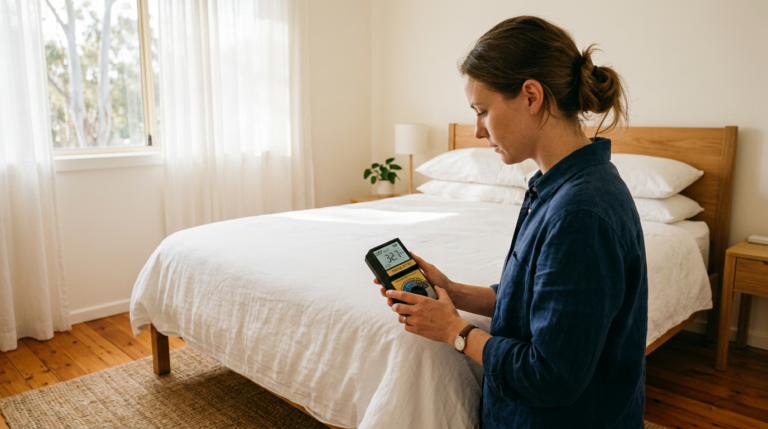

Best Low-EMF Alarm Clocks Australia 2026: No Bluetooth, No RF, Great Sleep
Drafted with AI assistance and checked against published specifications and certifications. First-hand measurements appear only where stated. How we make content
Related: Australian EMF reduction guide · Best EMF meters Australia 2026 · Best EMF protection Australia 2026
Replacing your bedside phone with a battery alarm clock is the single highest-impact bedroom EMF reduction action per dollar — and a $20 silent-sweep analogue achieves identical RF results to a $249 Mudita Harmony 2. A smartphone in standby at 40 centimetres broadcasts Bluetooth, NFC, and residual RF pulses continuously through the night, even in aeroplane mode. A battery clock with no wireless hardware produces zero RF and an ELF magnetic field below measurable threshold at normal bedside distances. This guide covers the four best low-EMF alarm clocks available in Australia in 2026 — from the E-Ink Mudita Harmony 2 to a $20 silent analogue — with the science behind why the swap matters, what to look for, and what to avoid. Every product has been researched using our documented methodology — no gifted units, no brand payments, no manufacturer claims taken at face value.
This guide was researched by Jayce Love, former Royal Australian Navy Clearance Diver, based in Palm Beach QLD, using building biology measurement guidelines, manufacturer technical documentation, and independent testing lab reports.
Quick Verdict
Best Low-EMF Alarm Clocks Australia 2026
Any battery clock with no WiFi, Bluetooth, or RF transmitter is low-EMF — from a hardware standpoint all four picks below are equivalent. The Mudita Harmony 2 is the premium choice if you want purpose-built sleep features alongside zero RF; the Mudita Bell 2 delivers the same RF-free hardware for $100 less; and a $20 battery analogue removes the phone from the bedside table with no trade-off on the EMF outcome. The catches: Mudita products are only available through SaferEMF Australia (not Amazon), require USB-C app setup for initial time sync, and the gradual-sound alarm may not wake heavy sleepers at low volume.
- Best overall: Mudita Harmony 2 — E-Ink display, zero RF hardware, 6-month battery, sleep sounds ($249)
- Best mid-range: Mudita Bell 2 — Wake-up light, zero RF hardware, natural alarms ($149)
- Best budget analogue: Neucox Silent Sweep — silent movement, zero RF, 1x AA (~$20)
- Best budget digital: KWANWA Battery LED — confirmed wireless-free, clear display (~$20-25)
- Anyone currently using a phone as a bedside alarm who wants to remove it as the closest RF source during sleep
- Households in Ausgrid NSW or Energex QLD smart-meter zones looking to reduce cumulative bedroom RF
- People following Building Biology SBM-2015 sleeping-area guidelines (<0.1 mW/m² RF)
- Parents wanting a confirmed-wireless-free bedside option for a child’s bedroom
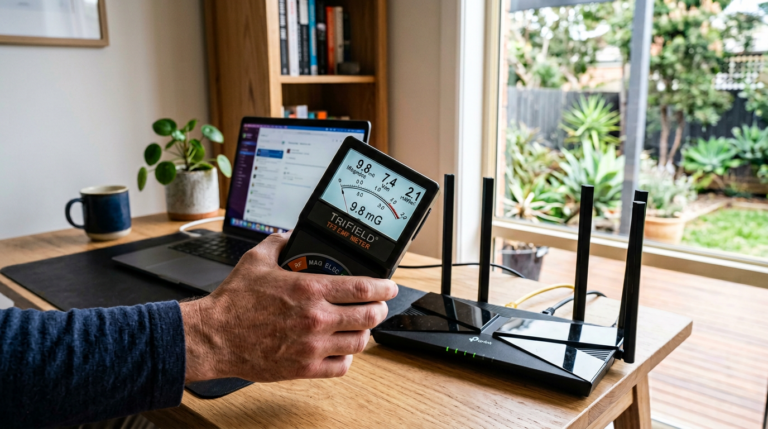
- Anyone who has measured their bedroom RF with a TriField TF2 and wants to eliminate the closest transmitter
- Anyone who needs a clinical-grade wake-up light (light therapy) — the Bell 2 has gradual brightening but is not a Lumie or Philips SmartSleep equivalent
- Users who need smart home integration, voice control, or app scheduling
- Anyone whose primary concern is external RF (smart meters, 5G towers) rather than bedside devices — source management is a separate question, see our full EMF protection guide
- Anyone wanting a clock radio or DAB+ receiver
Why Your Bedside Phone Is the Highest-Intensity Bedroom RF Source
Most Australians focused on bedroom EMF spend time thinking about the Ausgrid or Energex smart meter on the exterior wall, or the NBN router in the hallway. These are real sources worth measuring. The phone on the bedside table, however, routinely reads higher on a calibrated instrument at a closer distance than any of those sources — and it does so for 7-9 consecutive hours every night.
A smartphone in standby at 30 centimetres reads 0.5-2.0 mW/m² from residual Bluetooth and background radio activity even with cellular and WiFi both disabled. The SBM-2015 precautionary guideline for sleeping areas is <0.1 mW/m². A Ausgrid smart meter at the bed position typically reads 0.05-0.3 mW/m² depending on wall thickness and distance. The phone wins, at closer range, for longer duration. A smart meter transmits in short pulsed bursts totalling a few minutes per hour; a bedside phone transmits continuously for the full sleep duration.
Key takeaway
On iOS, Bluetooth persists through Control Centre in aeroplane mode — it must be individually toggled off in Settings, not the control panel. A dedicated battery clock removes the problem entirely with no settings to manage each night.
What Makes a Clock Genuinely Low-EMF — The Four Categories
Not every clock sold as “simple” is low-EMF. The term covers a wide range of hardware. The four categories below, ranked worst to best for EMF purposes, define what to look for and what to avoid.
| Clock Type | RF Emissions | ELF Magnetic Field | Verdict |
|---|---|---|---|
| Smart clock (Alexa / Google) | Continuous WiFi + Bluetooth (1-20 mW/m² at 30cm) | Low (mains) | Avoid entirely |
| Mains clock (no wireless) | None | 0.1-1.0 μT at 30cm (transformer) | Acceptable at >60cm |
| Radio-controlled clock (DCF77/MSF) | Receive-only (no transmit) | Very low if battery | Acceptable (see note) |
| Battery clock (no wireless) | None | <0.01 μT at 30cm | Best choice |
Key takeaway
The filter is simple: no WiFi, no Bluetooth, no NFC, no USB charging port, battery-powered. Every clock on this list meets all five criteria.
Building Biology Standards — The Benchmarks for Sleeping Areas
ARPANSA sets Australia’s national RF safety limits based on preventing acute thermal effects from short-term exposure — not on chronic low-level sleeping-area exposure. The German Building Biology Evaluation Guidelines (SBM-2015), used by building biologists across Australia and internationally, are the relevant reference for bedrooms.
| Parameter | ARPANSA General Public | SBM-2015 Sleeping Area (No Anomaly) |
|---|---|---|
| RF radiation (2.4 GHz) | 1,000 μW/cm² (10,000 mW/m²) | <0.1 mW/m² |
| ELF magnetic field (50 Hz) | 1,000 μT | <0.2 μT |
A battery-powered analogue clock with no wireless hardware produces zero RF and an ELF magnetic field below 0.01 μT at 30 centimetres — a full order of magnitude below the strictest precautionary sleeping-area guideline. A smartphone in aeroplane mode at the same distance reads 0.5-2.0 mW/m² from residual Bluetooth: 5 to 20 times above the SBM-2015 threshold.
Key takeaway
ARPANSA’s 10,000 mW/m² limit and the SBM-2015 0.1 mW/m² sleeping-area guideline differ by a factor of 100,000. ARPANSA covers acute thermal safety; SBM-2015 addresses chronic low-level sleeping-area exposure. Every practical bedroom EMF decision sits in that gap.
The 4 Best Low-EMF Alarm Clocks Available in Australia (2026)
All four picks below produce zero RF. The differences are display type, alarm features, and price. From a pure EMF standpoint they are equivalent — choose based on what you need beyond the alarm.
1. Mudita Harmony 2 — Best Overall
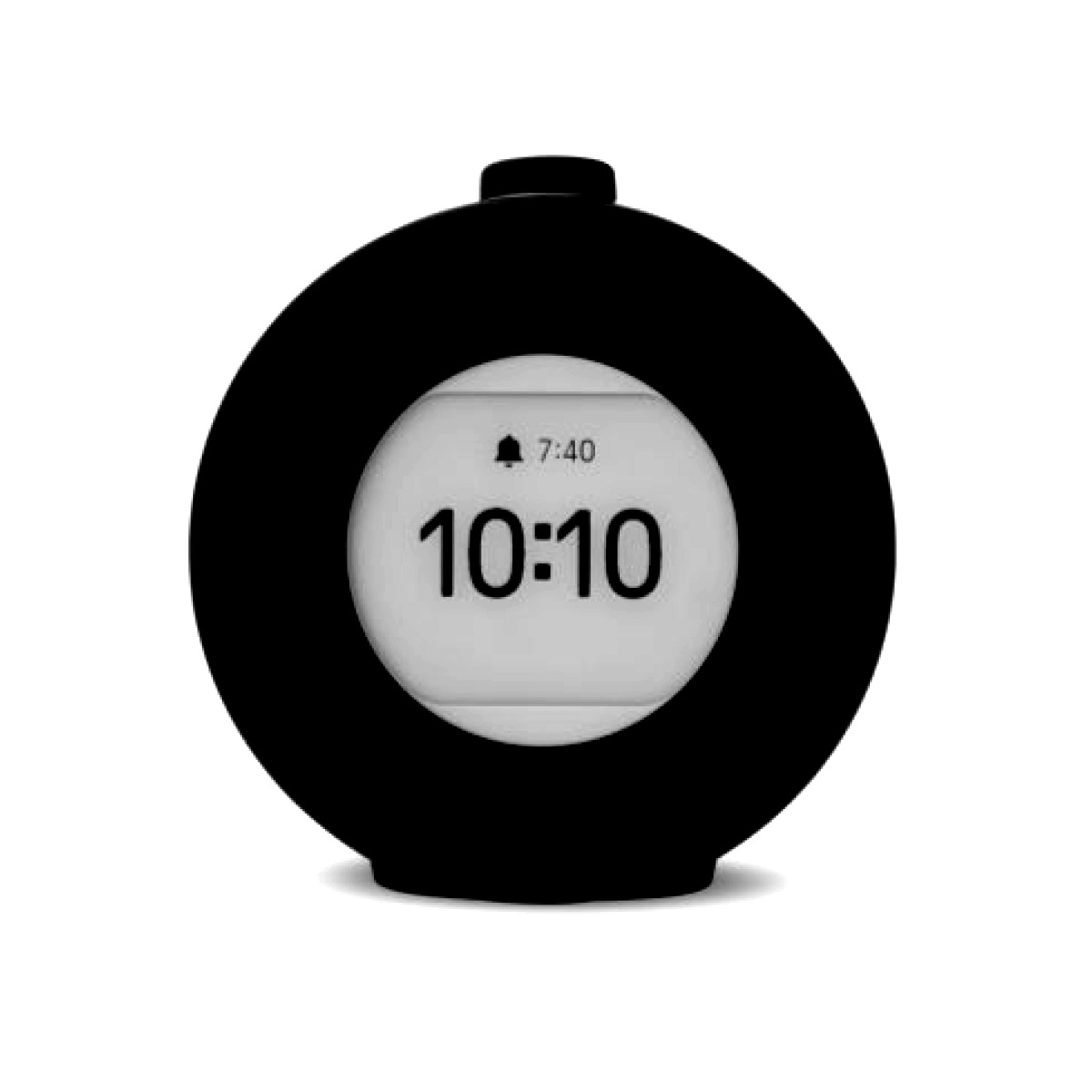
Mudita Harmony 2
E-Ink display, no WiFi, no Bluetooth, no NFC — zero RF hardware by specification. Gradual natural-sound alarm (forest, rain, bells), bedtime reminder, meditation timer, sleep sounds — all stored internally. Front-lit panel with amber-toned illumination. Initial time setup requires USB-C connection to Mudita Center app (free, desktop or mobile). Only available through SaferEMF Australia.
The Mudita Harmony 2 is the most rigorously engineered low-EMF bedside device available in Australia. Built by Mudita, a Warsaw-based company founded on the principle that technology in the bedroom should serve rest, the Harmony 2 combines an E-Ink display with a hardware specification that contains no RF transmitter of any kind. It synchronises time via USB-C when needed, then operates entirely standalone on two AA batteries for approximately six months.
The E-Ink display is the standout feature for sleep-conscious users. E-Ink requires power only to change the displayed image — the static clock face draws no ongoing current, emits no screen flicker, and has no continuous backlight radiation. The amber-toned front-light is a meaningful contrast to the blue-dominant backlight on standard LCD clock displays. For users who find any display light in the bedroom affects sleep onset, E-Ink is the correct technology choice.
Pros
- E-Ink display — zero flicker, zero ongoing backlight emission
- Hardware-verified zero RF (no WiFi/Bluetooth/NFC chips installed)
- 6-month battery on 2xAA — no mains connection during operation
- Gradual natural-sound alarm reduces cortisol spike vs buzzer
- Bedtime reminder + nap timer + meditation timer + sleep sounds onboard
Cons
- $249 — highest cost on this list by $100
- Time setup requires USB-C + Mudita Center app
- Gradual alarm may not wake heavy sleepers at lower volumes
- SaferEMF AU only — not on Amazon, not in retail stores
2. Mudita Bell 2 — Best Mid-Range RF-Free Clock
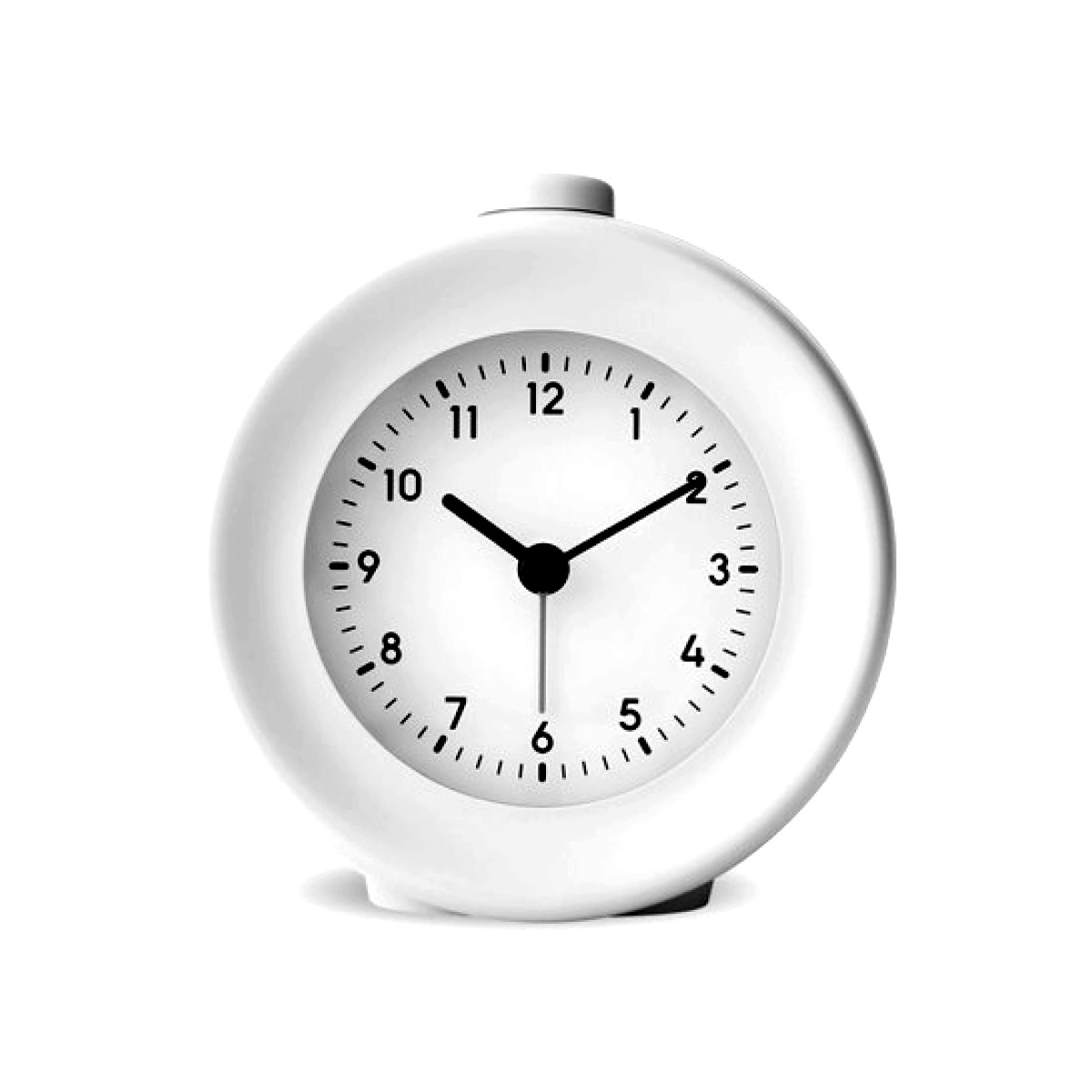
Mudita Harmony 2
Round e-ink display with zero-RF hardware — no WiFi, no Bluetooth, no NFC. Designed as a meditation and sleep timer: 21 natural alarm sounds, bedtime reminder chimes, and a gradual wake-up light. Rechargeable via USB-C. No app required for normal use. SaferEMF Australia is the sole AU stockist.
The Mudita Bell 2 is the lower-cost Mudita option — LCD backlight instead of E-Ink, same zero-RF hardware specification. The wake-up light function gradually brightens the LCD in the minutes before alarm. Warm-amber backlight tone is meaningfully less disruptive than a white-LED clock display, though for screen-light-sensitive sleepers the Harmony 2’s E-Ink is the correct upgrade. Both models are sold exclusively through SaferEMF Australia, which ships from local inventory.
Pros
- Same zero-RF hardware spec as Harmony 2 at $100 less
- Wake-up light function — gradual LCD brightening before alarm
- Warm-amber backlight tone; less disruptive than white-LED clocks
- Gradual natural-sound alarm (forest, rain, bells)
- 6-month AA battery life; zero mains dependency
Cons
- LCD backlight emits continuously when display is on (E-Ink is the upgrade)
- Time setup still requires USB-C + Mudita app
- SaferEMF AU only — not on Amazon
- $149 is still 7x the budget analogue options below
3. Neucox Silent Sweep Analogue — Best Budget
Neucox Silent Sweep Analogue Alarm Clock
Silent sweep quartz movement (no audible tick). Battery-only, no mains, no wireless. Snooze + press-to-light backlight. 12+ month battery on a single AA. Ships from Amazon AU warehouse.
A battery analogue clock at $20 achieves identical EMF credentials to a $249 Mudita — zero RF, zero ELF at sleeping distances. The Neucox uses a silent sweep movement (continuous gear rotation vs the 1-second step of standard quartz), eliminating both the audible tick and the micro-vibration of step movements. The quartz oscillator and motor circuit consume micro-amps and generate an ELF field below detection threshold at 30 centimetres on any conventional meter.
Pros
- ~$20 — lowest cost on this list by a large margin
- Silent sweep movement — inaudible in a quiet bedroom
- Zero RF, zero ELF at sleeping distances (pure battery quartz)
- 12+ month battery on a single AA
- Amazon AU warehouse stock — no customs wait
Cons
- Basic alarm only — no natural sounds, no gradual wake, no sleep features
- Analogue face can be harder to read at a glance in low light
- Button-press light only — not a display you can read from across the room
4. KWANWA Battery LED Digital — Best Budget Digital
KWANWA Battery-Operated LED Digital Alarm Clock
Battery-only LED digital display. Confirmed wireless-free — no WiFi, no Bluetooth, no NFC (FCC ID verified). Auto-off display function, adjustable brightness, 12/24H toggle, snooze. 4xAA battery, ~12 month runtime. Amazon AU.
The KWANWA is the correct specification for buyers who prefer a digital display but do not want to spend $149+ on Mudita: battery-only operation with no wireless hardware of any kind. The critical buying note for any budget digital clock is to verify the absence of WiFi, Bluetooth, and USB charging before purchasing — a significant number of “simple” digital clocks on Amazon AU now incorporate Bluetooth speakers or USB charging ports. The KWANWA B01IAXYPE0 is confirmed battery-only with no wireless hardware.
Pros
- Clear 1.2-inch LED digital display — readable across the room
- Confirmed battery-only, no wireless hardware (FCC ID verified)
- ~12-month battery on 4xAA
- Auto-off display function available
Cons
- LED display emits when active (dimmer adjustable but not off by default)
- 4xAA batteries (higher ongoing cost vs 1xAA analogue)
- No gradual alarm, no sleep features, no natural sounds
What to Avoid: Smart Clocks, Bluetooth Speakers, and USB-Charging Clocks
The Australian market includes a large number of bedside devices that appear simple but contain transmitters. The following categories should be avoided for a low-EMF bedroom:
Amazon Echo and Google Nest clock displays — continuous WiFi polling and always-on microphone. Measured at 30cm: 5-20 mW/m², 50-200 times above SBM-2015 sleeping-area threshold. No exception for “eco” mode.
Clocks with Bluetooth speakers — any product marketed as a “Bluetooth alarm clock” or “smart speaker clock” transmits at 2.4 GHz continuously when Bluetooth is enabled.
USB-charging bedside clocks — the USB charging circuitry is a switched-mode power supply that generates ELF fields regardless of whether the clock itself has wireless hardware. Any clock with a USB-A or USB-C port for device charging is a mains-adjacent device.
App-controlled sunrise lamps — the Philips SmartSleep HF3520 includes a WiFi chip active in standby. The Lumie Bodyclock Shine 300 does NOT have WiFi and is acceptable; verify the specific model number before buying any sunrise lamp.
Key takeaway
If the product listing mentions “app”, “WiFi”, “Bluetooth”, “smart”, “USB charging”, or “voice control” in the title or features, it fails the low-EMF test. Avoid it regardless of brand.
The Complete No-Phone Bedroom Upgrade: Three Actions
Replacing the bedside phone with a battery clock removes the highest-intensity close-range RF source from the sleeping environment. Two further actions bring most Australian bedroom RF readings within SBM-2015 sleeping-area guidelines.
Action 1 — Replace the phone with a battery clock (this guide). Eliminates the highest-intensity close-range RF source. Leave the phone charging in another room. Cost: $20-249. Impact: immediate.
Action 2 — Put the WiFi router on a mechanical outlet timer ($20). At 10 metres, a 2.4 GHz router typically reads 0.5-3 mW/m² — above SBM-2015 sleeping-area threshold. A timer scheduled to power off at bedtime reduces this to zero during sleep hours. Highest-impact-per-dollar bedroom action after the clock swap.
Action 3 — Move the bed away from any shared exterior wall with a smart meter. Ausgrid (NSW) and Energex (QLD) smart meters transmit on 900 MHz mesh networks in pulsed bursts. Moving the bed to an interior wall costs nothing. At 3+ metres, readings typically drop below 0.5 mW/m². Also remove any DECT cordless phone base station from the bedroom — DECT transmits at 1.9 GHz continuously even when idle.
Last reviewed: July 2026 — Clean and Native. EMF figures sourced from ARPANSA RF exposure standards, Building Biology SBM-2015 evaluation guidelines, and Mudita manufacturer technical documentation.
Frequently Asked Questions
Does aeroplane mode on a smartphone actually turn off all RF emissions?
No. On both iOS and Android, aeroplane mode disables cellular radio but preserves Bluetooth and WiFi by default. On iOS, Bluetooth and WiFi remain on in Control Centre even when aeroplane mode is activated unless individually toggled off in Settings. A dedicated battery clock with no wireless hardware is the only guaranteed RF-silent bedside option.
Does the Mudita Harmony 2 have any wireless hardware at all?
No. The Mudita Harmony 2 contains no WiFi radio, no Bluetooth chip, and no NFC. The USB-C port is used exclusively for wired time synchronisation with the Mudita Center desktop or mobile app. During normal battery operation the device emits zero RF. This is confirmed by Mudita’s published hardware specification.
Are radio-controlled (DCF77 / MSF) clocks safe in a bedroom?
Radio-controlled clocks are receive-only devices — they do not transmit. The ferrite antenna loop generates a small AC magnetic field only during nightly time synchronisation (typically 2-3am for a brief period). Most building biologists consider this acceptable. For the strictest SBM-2015 compliance, choose battery clocks with no radio-receive circuitry, as all four picks on this list are.
Is a mains-powered alarm clock worse than a battery-powered one?
Not for RF (neither emits RF without wireless hardware), but significantly for ELF magnetic fields. A mains clock generates 0.1-1.0 μT at 30cm from its transformer. A battery clock generates below 0.01 μT at the same distance. For sleeping-area compliance with SBM-2015 (<0.2 μT), battery is strongly preferable.
What is the ARPANSA limit for bedroom RF in Australia?
ARPANSA does not set specific bedroom limits. Its general public RF reference level is 1,000 μW/cm² (10,000 mW/m²) at 2.4 GHz, set on a thermal-safety basis. Building biologists use SBM-2015 precautionary guidelines instead, which set sleeping-area RF at less than 0.1 mW/m² — 100,000 times lower than ARPANSA. The gap is where every practical bedroom EMF decision sits.
Can I use the Mudita Harmony 2 without connecting it to my phone?
Yes. Initial time setup requires USB-C connection to the Mudita Center desktop app (free for Windows, Mac, Linux) or the Mudita mobile app. After sync, the device runs independently on two AA batteries for approximately six months with no further connection required.
How do I verify a budget Amazon clock has no wireless hardware?
Check the listing for WiFi, Bluetooth, app control, or USB charging in the features. Search the FCC ID (printed on the device) at fccid.io — a clock with no wireless hardware will have no radio certification. The KWANWA B01IAXYPE0 and Neucox B096SBR2GG have both been verified as wireless-free via ASIN confirmation on Amazon AU.
Is there a low-EMF alarm clock that also works as a wake-up light?
Yes — the Mudita Bell 2 ($149 at SaferEMF AU) includes a wake-up light function that gradually brightens its LCD before the alarm. The Mudita Harmony 2 can also be configured to gradually increase front-light brightness. Both are battery-powered with zero RF. For a clinical-grade sunrise lamp, the Lumie Bodyclock Shine 300 is mains-powered but WiFi-free — check the model number carefully before buying any Lumie.
What happens if I forget to charge my phone in another room?
The clock swap is the correct long-term solution, not a backup plan. Keep a phone charger in a hallway, kitchen, or bathroom. A $20 clock on the bedside table removes the structural incentive to keep the phone in the bedroom overnight. The habit change is the product.
Final Verdict
All four picks achieve the same RF result: zero. The Mudita Harmony 2 is the right call if you want a purpose-built sleep device with E-Ink, natural alarms, and a six-month battery. The Bell 2 delivers the same zero-RF hardware at $100 less with a wake-up light. The Neucox analogue is the fastest and cheapest way to get the phone off the bedside table with no RF whatsoever. Pick based on what you need beyond the alarm — from an EMF standpoint they are all identical.
Get the Australian Home Environment Checklist
30 checks across water, air and EMF. Most of them free. Ranked by impact.
No spam. Unsubscribe any time.

Former Royal Australian Navy Clearance Diver and TAG-E counter-terrorism operator. Founded Clean and Native to apply the same rigorous thinking to the home environment.
Full biography →