Earthing for Chronic Fatigue in Australia
Earthing — direct skin contact with the earth’s surface — is proposed as a low-exertion intervention for ME/CFS symptoms including unrefreshing sleep, morning fatigue, and chronic pain. For the estimated 200,000+ Australians living with ME/CFS, according to a 2021 economic burden study published in the International Journal of Environmental Research and Public Health, any intervention that does not trigger post-exertional malaise (PEM) deserves serious examination.
Earthing shows preliminary signals for improved sleep and reduced inflammation in small pilot studies, but no randomised controlled trial has specifically enrolled ME/CFS patients. The Chevalier 2012 review identified cortisol normalisation and subjective pain reduction across multiple small studies. For Australians with ME/CFS, indoor grounding sheets and mats offer a way to access these potential benefits without outdoor heat stress, UV exposure, or bushfire smoke — and critically, without triggering PEM. However, the evidence base remains early-stage: small sample sizes, lack of blinding controls, and no replication in ME/CFS-specific populations. This is not a cure. It is a low-risk, low-exertion addition worth trialling alongside established pacing strategies.
Key catches
- No RCT has specifically studied earthing in ME/CFS patients — existing studies cover general populations
- Australian mains earth may carry stray voltage in older homes — test with a multimeter before grounding via wall socket
- Indoor grounding requires a properly earthed Australian power point (3-pin AS/NZS 3112 with verified earth continuity)
- Earthing does not replace pacing, medical management, or mitochondrial support — it is complementary at best
ME/CFS in Australia: The Scale of the Problem You Are Navigating
If you have ME/CFS, you already know how isolating it is. What you may not know is how many Australians share your situation. According to a 2021 study by Close et al. published in the International Journal of Environmental Research and Public Health, an estimated 200,000+ Australians live with ME/CFS, generating an annual economic burden of approximately $14.5 billion AUD when accounting for direct healthcare costs, lost productivity, and informal care.
The World Health Organisation classifies ME/CFS as a neurological condition (ICD-11 code 8E49). The hallmark symptom — post-exertional malaise (PEM) — means that even minor physical or cognitive exertion can trigger a disproportionate crash lasting days or weeks. This single feature eliminates most conventional interventions. Exercise therapy, once recommended, has been largely abandoned in updated NICE guidelines (2021) due to evidence it worsens outcomes for many patients. Cognitive behavioural therapy addresses coping, not the underlying pathology.
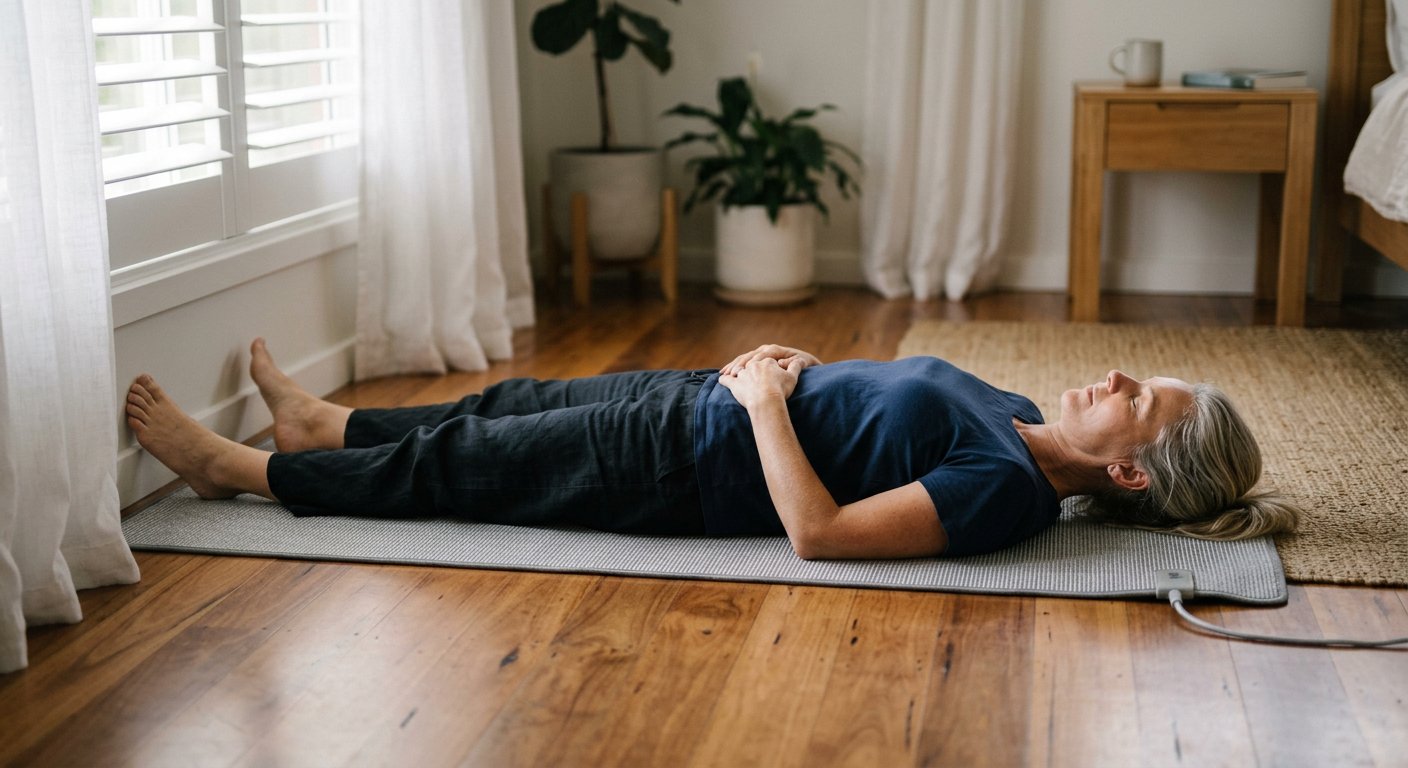
That leaves a gap. You need interventions that are actually passive — things that work while you rest. This is the specific appeal of earthing for the ME/CFS population: it requires no exertion beyond lying in bed or sitting with your feet on a grounding mat. If it delivers even modest improvements in sleep quality, pain, or inflammatory markers, the risk-benefit ratio is compelling because the risk side is essentially zero exertion cost.
But compelling rationale is not evidence. Let me walk you through what the research actually shows, where it falls short, and how Australian-specific barriers shape your decision.
The Earthing Hypothesis: How Grounding Is Proposed to Work
The earth’s surface carries a mild negative electrical charge, maintained by approximately 5,000 lightning strikes per minute globally. The earthing hypothesis, as outlined in the Chevalier et al. 2012 review published in the Journal of Environmental and Public Health, proposes that direct skin contact with the earth allows free electrons to transfer into the body, where they may neutralise reactive oxygen species (free radicals) and influence systemic inflammation.
The Mitochondrial Electron Hypothesis
This is where the ME/CFS connection becomes specific. Mitochondrial dysfunction is increasingly recognised as a feature of ME/CFS. A 2017 study by Tomas et al. (Molecular BioSystems) demonstrated impaired mitochondrial complex activity in peripheral blood mononuclear cells from ME/CFS patients compared to healthy controls. If mitochondria are struggling to efficiently transfer electrons through the respiratory chain, the theoretical question becomes: can an external source of electrons — from the earth’s surface — influence this process?
I need to be direct here. This is a hypothesis, not a proven mechanism. No study has measured electron transfer from ground contact into mitochondrial respiratory chain complexes. The gap between “the earth has free electrons” and “those electrons reach your mitochondria and improve ATP production” is enormous and unverified. What we do have is indirect evidence that grounding appears to affect measurable physiological parameters. Let me detail what those studies actually found.
The Chevalier 2012 Review: What It Actually Shows
The Chevalier, Sinatra, Oschman, Sokal and Sokal 2012 review paper aggregated findings from multiple small studies. The key results:
| Study | Sample Size | Intervention | Key Finding | Limitations |
|---|---|---|---|---|
| Ghaly & Teplitz 2004 | 12 | Grounded sleep (8 weeks) | Cortisol profiles normalised; subjective sleep and pain improved | No blinding, n=12 |
| Chevalier et al. 2013 | 28 | Grounded patches (1 hour) | Reduced blood viscosity (zeta potential improvement) | Single session, no long-term follow-up |
| Oschman 2009 (pilot) | Varies | Grounded sleep pads | Reduced inflammation markers (thermal imaging) | Thermal imaging is indirect; no blinded controls |
| Sokal & Sokal 2011 | Multiple cohorts | Grounded copper plates | Changes in blood urea, electrolytes, thyroid function | Varied protocols, no ME/CFS patients enrolled |
The pattern across these studies is consistent: small sample sizes, limited or no blinding, and no ME/CFS-specific populations. The Ghaly 2004 cortisol study is the most relevant to fatigue — it showed cortisol profiles during grounded sleep shifted toward a more normal diurnal pattern, with the nadir aligning closer to midnight and the morning rise becoming steeper. For ME/CFS patients with characteristically flat cortisol curves and unrefreshing sleep, this is an interesting signal. But n=12 with no blinding means the placebo effect cannot be excluded.
I am not dismissing this research. I am telling you exactly what it shows and what it does not. The signal is there. The proof is not.
Why Outdoor Grounding Fails for Most Australians with ME/CFS
Every earthing article tells you to walk barefoot on grass for 30 minutes. If you have ME/CFS, this advice ranges from impractical to dangerous. Here is why Australia’s specific environmental conditions make outdoor grounding particularly difficult for this population.
Heat Stress and Thermoregulation
The Bureau of Meteorology (BoM) records average maximum temperatures above 30°C for 4-6 months per year across Brisbane, Sydney’s western suburbs (Penrith, Blacktown, Richmond), Perth, Darwin, and most of Queensland. ME/CFS patients frequently report heat intolerance as a symptom — this is consistent with autonomic dysfunction (dysautonomia), which is now recognised as a common ME/CFS comorbidity. Standing or sitting outside in 32°C heat while barefoot is not a low-exertion activity for someone with impaired thermoregulation. It is a crash trigger.
UV Exposure
According to ARPANSA, Australia receives some of the highest UV radiation levels globally. The UV Index regularly exceeds 11 (extreme) across most of the country from October to March. For ME/CFS patients who are photosensitive — a reported symptom in a subset of patients — outdoor grounding during daylight hours requires sun protection that adds complexity and physical burden to what should be a simple intervention.
Bushfire Smoke and Air Quality
During the 2019-2020 Black Summer, PM2.5 levels in Canberra exceeded 5,000 µg/m³ — over 200 times the NEPM standard of 25 µg/m³ (24-hour average). Sydney, Melbourne, and regional NSW and Victorian communities experienced weeks of hazardous air quality. According to NEPM air quality standards, outdoor activity during these periods is contraindicated for anyone with a chronic health condition. Bushfire smoke season (October-March in NSW, VIC, and QLD) eliminates outdoor grounding as a reliable strategy for roughly half the year in affected regions.
Physical Accessibility
Many ME/CFS patients are housebound or bedbound during severe phases. According to Emerge Australia (the national ME/CFS support organisation), an estimated 25% of ME/CFS patients are housebound at any given time. For this group, outdoor grounding is not just inconvenient — it is physically impossible. Indoor grounding products exist specifically to bridge this gap.
Indoor Grounding for ME/CFS: Products, Safety, and Australian Electrical Considerations
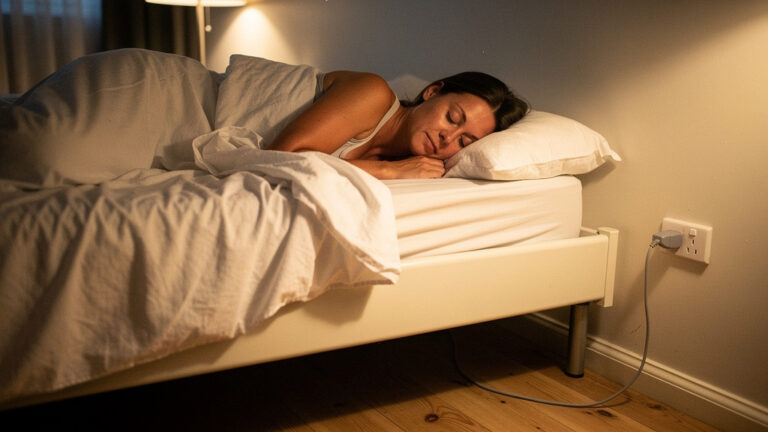
Indoor grounding products connect your body to the earth pin of a standard Australian 3-pin power outlet (AS/NZS 3112). They do not use the active or neutral conductors — only the earth conductor, which connects to your home’s earth stake or the street’s Multiple Earth Neutral (MEN) system. This is the same grounding system that protects you from electrical faults.
How Indoor Grounding Products Work
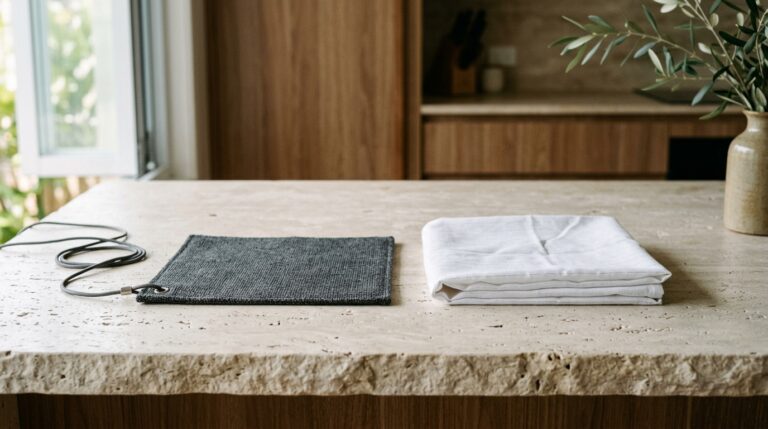
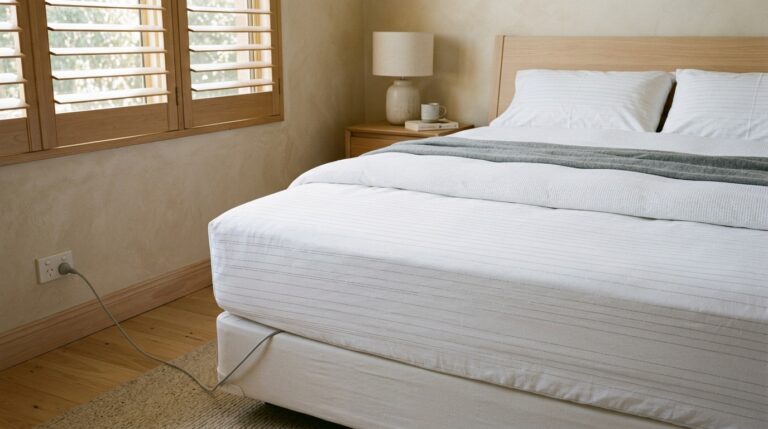
A grounding sheet or mat contains conductive material — typically silver-threaded fabric or carbon-infused polyurethane — connected via a cord to an adapter plug that only contacts the earth pin of your wall socket. When your skin touches the conductive surface, you are electrically connected to the earth through your home’s earthing system.
The two Australian-accessible brands worth considering are Premium Grounding and Earthing Oz. Both ship domestically and use AU-compatible earthing adapters.
Critical Safety Step: Verify Your Earth Before You Ground
This is the step every earthing product website glosses over. In older Australian homes — particularly pre-1990 builds in Sydney’s inner west, Melbourne’s inner suburbs, Brisbane’s older Queenslanders, and Perth’s pre-war housing stock — the earth conductor may not be properly connected, may have high resistance, or may carry stray voltage from nearby equipment or wiring faults.
Before you use any indoor grounding product, you need to verify your earth. Here is how:
- Buy a socket tester. A basic Australian power point tester (available on Amazon AU for $15-25) will confirm correct wiring — active, neutral, and earth all in the right positions. If the tester shows a fault, stop. Do not use grounding products on that circuit until a licensed electrician has inspected the wiring.
- Measure earth-to-neutral voltage. Using a multimeter set to AC voltage, measure between the earth pin and neutral pin of the socket. Ideally this reads under 0.5V AC. If it reads above 2V AC, your earth is carrying stray voltage — potentially from a neighbour’s load on a shared MEN system or from internal wiring issues. A licensed electrician can install a dedicated earth stake for your grounding products if the mains earth is noisy.
- Test continuity. A multimeter continuity test between your grounding product’s conductive surface and the earth pin of the plug adapter should show near-zero resistance. If it shows open circuit, the cord or adapter is faulty.
Grounding Product Comparison for ME/CFS Patients
| Product Type | Price Range (AUD) | Best for ME/CFS Use | Skin Contact Needed | Exertion Level |
|---|---|---|---|---|
| Grounding sheet (fitted) | $199–$599 | Overnight sleep grounding — highest total contact hours | Yes — bare skin on sheet surface | Zero (you sleep on it) |
| Grounding mat (desk/floor) | $49–$129 | Daytime grounding while seated or resting | Yes — bare feet on mat | Zero (feet rest on it) |
| Grounding patches | $29–$59 (pack) | Targeted areas (feet, wrists) for bedbound patients | Adhesive on skin | Zero |
| Outdoor barefoot | Free | Unreliable — heat, UV, smoke, PEM risk from activity | Bare feet on ground | Low-moderate (standing/walking) |
For ME/CFS patients, the grounding sheet is the clear first choice. You get 7-9 hours of continuous contact per night with zero exertion. A 120-night trial from Premium Grounding means you can assess whether it makes any subjective difference to your sleep quality before committing. At $199 for a single sheet, that works out to $1.66 per night over the trial period — less than a daily coffee, and you will know within 4-6 weeks whether you notice a difference.
EMF Exposure as a Potential ME/CFS Factor: The Australian Home Context
This is the intersection that no other earthing resource covers. ME/CFS patients frequently report electromagnetic hypersensitivity (EHS) symptoms — though the relationship between EHS and ME/CFS remains contested in the literature. What is not contested is that Australian homes expose occupants to a range of EMF sources that did not exist 20 years ago, and that reducing these exposures follows the same precautionary logic as grounding.
Your Bedroom EMF Environment
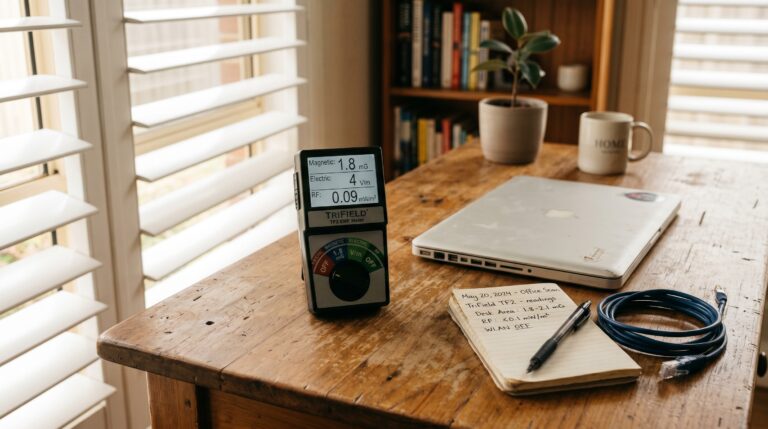
ARPANSA sets RF exposure limits at 1,000 µW/cm² at 2.4 GHz — a thermal safety limit, not a precautionary one. Building Biology guidelines (SBM-2015) recommend sleeping area RF below 0.1 mW/m², AC magnetic fields below 0.2 µT, and AC electric fields below 5 V/m. The gap between the ARPANSA limit and the Building Biology recommendation is approximately four orders of magnitude. If you are investigating earthing because you suspect environmental factors are contributing to your ME/CFS symptoms, measuring your actual bedroom EMF levels is a logical first step.
Common Australian bedroom EMF sources include:
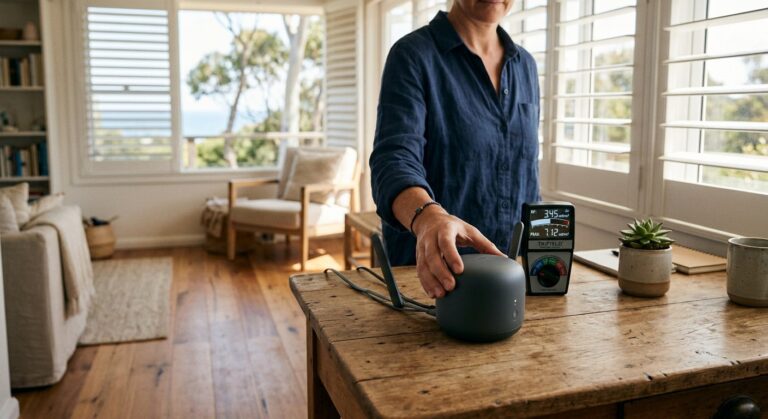
- Wi-Fi router — often left on 24/7, transmitting at 2.4 GHz and 5 GHz continuously. A Jackson 24hr Mechanical Timer (~$20) on the router eliminates overnight RF exposure for free.
- Smart meters — Ausgrid (NSW) and Energex (QLD) smart meters transmit at 900 MHz in bursts. Peak readings can be 100-1,000x higher than time-averaged readings. If your bedroom wall shares an exterior with the smart meter, move your bed to an interior wall first.
- Phone on bedside table — smartphone in active mode generates significant RF. Airplane mode is free and immediate.
- AC wiring in walls — generates electric fields even when no appliance is switched on. A demand switch (~$100-150 installed by a licensed electrician) eliminates these on your bedroom circuit during sleep.
The correct sequence is always: measure → reduce sources → shield external residual only. If you ground yourself via a sheet while your bedroom is filled with Wi-Fi and smart meter RF, you have addressed one variable while ignoring others. For ME/CFS patients who suspect environmental sensitivity, a systematic approach matters.
A Safe Earthing Protocol for ME/CFS: Pacing-Compatible Steps
If you have ME/CFS, you know that even well-intentioned interventions can trigger PEM if they are introduced too aggressively. Here is a pacing-compatible approach to trialling earthing, structured to minimise crash risk.
Week 1-2: Baseline and Earth Verification
Before you change anything, establish a baseline. Rate your sleep quality, morning fatigue, and pain on a simple 0-10 scale each morning for 14 days. Use a single notebook by your bed — do not use a phone app (the phone should be on airplane mode or out of the room). Simultaneously, verify your home’s earth connection using the steps described above. If you need an electrician, book the appointment now so you are not waiting when the product arrives.
Week 3-4: Introduce Grounding Mat (Daytime Only)
Start with a grounding mat under your feet during seated rest — reading, watching television, or simply resting. This limits contact to 1-2 hours per day during waking hours, when you can monitor how you feel. Some earthing practitioners report a “detox” response (headache, increased fatigue) in the first few days. Whether this is a real physiological response or placebo/nocebo effect is unclear. Either way, starting small lets you assess your individual response without committing to overnight use.
Week 5-8: Add Grounding Sheet (Overnight)
If the daytime mat produced no adverse reaction, add the grounding sheet to your bed. Continue tracking sleep quality, morning fatigue, and pain daily. The Ghaly 2004 study protocol used 8 weeks of grounded sleep — this is a reasonable trial period. You are looking for trends over weeks, not day-to-day changes.
Week 9-12: Assess and Decide
Compare your weeks 9-12 averages against your baseline (weeks 1-2). If sleep quality has improved by 2+ points on your 0-10 scale, morning fatigue has decreased, or pain has reduced, the grounding sheet is likely providing subjective benefit and is worth continuing. If you see no change, you have the 120-night trial period from Premium Grounding to return the product.
Cost-Benefit: How Earthing Compares to Other Low-Exertion ME/CFS Interventions
No other earthing resource puts grounding in context against the alternatives. Here is an honest comparison of low-exertion interventions accessible to Australian ME/CFS patients, ranked by evidence quality and cost.
| Intervention | Exertion Level | Annual Cost (AUD) | Evidence Quality | ME/CFS-Specific Studies |
|---|---|---|---|---|
| Sleep hygiene optimisation | Zero | $0–$50 | Strong (general population) | Limited but recommended by NICE |
| Bedroom EMF reduction | Zero-Low | $20–$170 | Building Biology precautionary | None (ME/CFS-specific) |
| Grounding sheet (earthing) | Zero | $199–$599 (year 1) | Preliminary (small pilot studies) | None (ME/CFS-specific) |
| Magnesium supplementation | Zero | $50–$120 | Moderate (sleep/muscle) | Limited observational |
| CoQ10 supplementation | Zero | $180–$360 | Moderate (mitochondrial) | One small RCT (Castro-Marrero 2015) |
| LDN (Low-dose naltrexone) | Zero | $300–$600 (compounding) | Preliminary (small trials) | Observational + one pilot RCT |
The honest position: sleep hygiene optimisation and bedroom EMF reduction are the lowest-cost, lowest-risk starting points. A Jackson mechanical timer on your Wi-Fi router ($20) and putting your phone on airplane mode (free) may improve your sleep quality more than a $400 grounding sheet — and cost 95% less. Start there. If you have already optimised your sleep environment and are looking for additional interventions, earthing is a reasonable next step given the 120-night trial period that removes your financial risk.
How Indoor Grounding Is Assessed
A grounding sheet can be assessed on two levels: its electrical connection to earth, which is measurable with basic tools, and its effect on ME/CFS symptoms, which the current evidence base cannot yet answer. The steps below describe the electrical checks that confirm whether a grounding product is functioning as claimed.
Earth verification: A socket tester confirms correct wiring (active, neutral, and earth all present and correctly positioned), and earth-to-neutral voltage measured with a multimeter should sit well within the acceptable range (ideally under 0.5V AC).
Continuity test: A multimeter continuity test between the conductive surface and the earth pin of the adapter plug should show near-zero resistance, confirming the conductive pathway is intact and functional.
Body voltage measurement: AC body voltage (relative to earth) can be measured with a multimeter while lying on a standard cotton sheet and again on a connected grounding sheet. When the adapter is plugged into a verified earthed socket, a functioning grounding sheet equalises your body’s electrical potential with earth ground, which shows as a marked drop in measured body voltage.
EMF context: A grounding sheet does not shield against RF (Wi-Fi, smart meter), as an RF meter such as the TriField TF2 will show. It only addresses the AC electric field component by providing a conductive path to earth. If your Wi-Fi router is still broadcasting from the next room, the sheet does nothing about that. This is why the measure-reduce-shield sequence matters before adding grounding products.
Premium Grounding lists silver-threaded conductive fabric and an AU-compatible adapter that fits standard 3-pin sockets without modification. Whether the electrical connection to earth translates into measurable health benefits for ME/CFS patients is the question that the current evidence base cannot definitively answer.
The Honest Limitations: What the Evidence Does Not Support
I will not leave you with an incomplete picture. Here are the claims that the evidence does not support:
Earthing does not cure ME/CFS. No study has demonstrated remission or cure of ME/CFS from grounding. Any website or product page that implies this is misleading you.
The mitochondrial electron transfer hypothesis is unproven. No study has demonstrated that electrons from the earth’s surface reach mitochondrial respiratory chain complexes or influence ATP production. The hypothesis is biologically plausible at a surface level but has no direct experimental evidence.
Cortisol normalisation ≠ ME/CFS improvement. The Ghaly 2004 study showed cortisol pattern changes in 12 healthy adults. ME/CFS patients may have fundamentally different HPA axis dysfunction that does not respond the same way. Extrapolating from healthy subjects to ME/CFS patients is a logical leap, not a certainty.
No blinded trials exist for grounding sheets. Every grounding study has the same problem: participants know whether they are sleeping on a grounded or ungrounded surface. True blinding would require a sham grounding cord with a broken internal connection — some studies have attempted this, but participant guessing accuracy is untested. Placebo effects in sleep and pain studies are notoriously large (30-40% improvement in placebo arms is common).
Grounding is not a substitute for medical management. If you are taking prescribed medications (low-dose naltrexone, antivirals, immune modulators, or sleep medications), grounding does not replace them. Discuss any new intervention with your treating physician — particularly if you are under the care of an ME/CFS specialist.
Australian ME/CFS Resources
If you are reading this article because you or a family member has ME/CFS, here are the Australian-specific resources that matter:
- Emerge Australia (emerge.org.au) — National support, education, and advocacy. Maintains a directory of ME/CFS-informed GPs and specialists.
- ME/CFS Australia (mecfs.org.au) — Research advocacy and patient information.
- CFS Discovery (Griffith University, QLD) — Leading Australian ME/CFS research group, based on the Gold Coast. Their work on the NCNED (National Centre for Neuroimmunology and Emerging Diseases) includes research into immune, neurological, and metabolic dysfunction in ME/CFS.
- NDIS — ME/CFS is an eligible condition for NDIS support. If you are severely affected, NDIS funding may cover equipment, home modifications, and support workers. Application requires a treating physician’s report documenting functional impairment.
Final Verdict
Who should trial earthing for ME/CFS:
- You have already optimised sleep hygiene and bedroom EMF environment
- You are looking for additional low-exertion, zero-PEM-risk interventions
- You are comfortable with preliminary evidence (not proven, but plausible)
- You can verify your home’s earth connection or pay an electrician $80-150 to do so
- You will track symptoms systematically over 8-12 weeks, not rely on subjective impressions
Who should look elsewhere:
- You are expecting a cure or significant remission — the evidence does not support this
- You have not yet addressed basic sleep hygiene (dark room, cool temperature, consistent schedule)
- You live in an older home with unverified electrical earthing and cannot afford an electrician
- You are spending limited financial resources and would benefit more from a specialist consultation or EMF meter to measure your actual bedroom environment first
Earthing is a low-risk addition to a systematically optimised sleep environment — not a standalone solution. For the 200,000+ Australians with ME/CFS, the absence of exertion cost is its strongest selling point. The 120-night trial from Premium Grounding removes financial risk. Start with a $20 router timer and airplane mode. Then measure your bedroom EMF with a TriField TF2. Then, if you want to go further, trial a grounding sheet. That sequence — cheap to expensive, proven to preliminary — is how a systematic person approaches an evidence gap.
Last reviewed: August 2026 – Clean and Native
Start with measurement. Then ground with confidence.
Verify your home’s earth, measure your bedroom EMF, then trial a grounding sheet with a 120-night money-back guarantee. Without real readings, every decision is a guess.
Frequently Asked Questions
Does earthing cure chronic fatigue syndrome?
No. No study has demonstrated that earthing cures or produces remission of ME/CFS. Preliminary studies show potential improvements in sleep quality and cortisol patterns in general populations, but no randomised controlled trial has enrolled ME/CFS patients specifically.
Is earthing safe for people with ME/CFS who experience post-exertional malaise?
Earthing via a grounding sheet requires zero physical exertion — you sleep on it. This makes it one of the lowest-PEM-risk interventions available. However, any physiological change can theoretically trigger PEM in severely affected patients. Start with short daytime sessions and monitor for any adverse response before overnight use.
How do I know if my Australian power point is properly earthed?
Use a power point socket tester ($15-25 on Amazon AU) to confirm correct wiring. Then measure earth-to-neutral voltage with a multimeter — it should read below 0.5V AC. If your home was built before 1990, have a licensed electrician verify earth continuity and impedance before using grounding products.
Get the Australian Home Environment Checklist
30 checks across water, air and EMF. Most of them free. Ranked by impact.
No spam. Unsubscribe any time.

Former Royal Australian Navy Clearance Diver and TAG-E counter-terrorism operator. Founded Clean and Native to apply the same rigorous thinking to the home environment.
Full biography →