EMF During Pregnancy Australia 2026
No confirmed adverse health effects from EMF exposure during pregnancy have been established at levels below Australian safety limits, according to both ARPANSA and the WHO International EMF Project (2024 update). However, the precautionary approach — measuring your actual home exposure and reducing it where practical — costs almost nothing and addresses the acknowledged gaps in long-term research on fetal development windows.
| Room | Primary EMF Sources | Verdict |
|---|---|---|
| Bedroom | Phone, WiFi router, smart meter, wiring | Highest priority — 8 hrs continuous exposure |
| Home Office | Laptop, WiFi, monitor, power board | Second priority — direct body contact |
| Kitchen | Microwave, induction cooktop, smart meter | Short-duration — distance is sufficient |
Current evidence does not confirm harm from household EMF levels during pregnancy, but the research has acknowledged gaps — particularly for chronic low-level RF exposure during fetal development. ARPANSA’s own review of animal studies (2023) noted that experiments used SAR levels “far above” Australian Standard RPS-S1 limits, limiting their applicability to real home conditions. The practical response is not anxiety — it is measurement and low-cost source reduction, starting with the bedroom where you spend 8 consecutive hours.
Key catches
- ARPANSA thermal safety limits (1,000 µW/cm² at 2.4 GHz) are not precautionary — they protect against tissue heating only, not chronic low-level biological effects
- Smart meters in QLD (Energex) and NSW (Ausgrid) transmit at 900 MHz in bursts — peak readings run 100–1,000× higher than time-averaged values. Always measure with peak hold
- Shielding an internal source (phone, router inside the room) with a canopy or shield INCREASES exposure via reflection. Remove internal sources first, then shield external residual only
What the Science Actually Says: ARPANSA, WHO, and the BioInitiative Report
You have probably read alarming claims about EMF and pregnancy online. You may have also read dismissive statements that there is “no evidence of harm.” Both positions oversimplify the picture. As a former Navy Clearance Diver, I am trained to assess risk based on what the data supports — not what sounds reassuring or alarming. Here is where the major bodies stand.
ARPANSA (Australia’s radiation safety authority) sets exposure limits based on the ICNIRP guidelines. For radiofrequency (RF) fields at 2.4 GHz (your WiFi router frequency), the Australian limit under Radiation Protection Standard RPS-S1 is 1,000 µW/cm² (equivalent to 10 W/m²). This is a thermal safety limit — it protects against measurable tissue heating. It does not account for chronic low-level biological effects, because ARPANSA’s position is that these have not been established with sufficient certainty. ARPANSA’s 2023 systematic review of animal reproductive studies acknowledged that experimental SAR levels were “far above” the Australian standard, making direct human extrapolation difficult.
The WHO International EMF Project (updated 2024) states that “no adverse health consequences have been established as being caused by mobile phone use” but explicitly notes knowledge gaps in long-term and developmental exposure. WHO Environmental Health Criteria 238 (2007) — the most comprehensive ELF assessment — concluded that childhood leukaemia showed a “consistent statistical association” with magnetic field exposures above 0.3-0.4 µT, while noting this may not represent a causal relationship. For pregnant women, WHO EHC 238 found the epidemiological evidence for adverse birth outcomes “inadequate” — meaning not enough quality data exists to draw a conclusion either way.
The BioInitiative Report (2012, updated 2014) compiled by independent researchers reviewed over 1,800 studies and concluded that existing public safety limits are inadequate. Section 18 specifically addressed fetal and neonatal effects, citing Aldad et al. (2012) — a Yale study that found mice exposed to mobile phone radiation in utero showed behavioural changes and altered neuronal development. The Falcioni et al. (2018) study by the Ramazzini Institute found increased incidence of Schwannomas in rats exposed to far-field RF at 50 V/m — a level below many environmental exposures near base stations. These are animal studies. They cannot be directly applied to human pregnancy. But they represent the reason the precautionary approach exists: the absence of confirmed harm is not the same as confirmed safety.
German and Australian occupational studies reviewed by the IET found no increased leukaemia or lymphoma risk from parental power-frequency (50 Hz) EMF exposure at occupational levels. This is reassuring for women who work near electrical equipment, but it does not address RF from WiFi, phones, and smart devices — a different exposure category that the occupational studies did not examine.
Understanding the Standards Gap: Why ARPANSA Limits May Not Be Enough for a Nursery
If ARPANSA says everything is fine below 1,000 µW/cm², why would you bother reducing exposure? Because that limit protects against one specific mechanism: tissue heating. It does not claim to protect against non-thermal biological effects. And the gap between Australia’s thermal safety limit and precautionary Building Biology guidelines is enormous.
According to the Building Biology SBM-2015 standard — used by building biologists worldwide to assess sleeping area safety — the thresholds for a sleeping area are dramatically lower than ARPANSA limits:
| EMF Type | ARPANSA / ICNIRP Limit | Building Biology (No Anomaly) | Difference |
|---|---|---|---|
| RF (2.4 GHz) | 10 W/m² (1,000 µW/cm²) | <0.1 mW/m² | 100,000× |
| AC Magnetic (50 Hz) | 1,000 µT | <0.2 µT | 5,000× |
| AC Electric (50 Hz) | 5,000 V/m | <5 V/m | 1,000× |
That is not a 10% or 20% disagreement. The Building Biology precautionary guideline for RF in a sleeping area is one hundred thousand times lower than ARPANSA’s thermal limit. This does not mean ARPANSA is wrong. It means the two standards are measuring different things. ARPANSA asks: “Will this heat tissue?” Building Biology asks: “What level of chronic exposure shows no biological anomaly in sensitive populations?”
For a pregnant woman — or anyone sharing a bedroom with a developing fetus — the question is which standard you want to apply to the room where you spend a third of your life. The good news: getting below Building Biology thresholds in a bedroom typically costs under $50 and takes an afternoon. No shielding paint, no Faraday cages. Just source removal.
Before you shield anything, understand the critical sequence: measure, then reduce sources, then shield external residual only. If your primary EMF source is inside the room (phone, WiFi router, baby monitor), a shielding canopy or Faraday-style enclosure will reflect that energy back into the room and increase your exposure. This is the most common — and most expensive — mistake in EMF reduction.
Room-by-Room EMF Reduction: Bedroom, Home Office, Kitchen
Every room in your home has a different EMF profile. The mistake most people make is treating the whole house as one problem. It is not. Your bedroom is where you spend 8 uninterrupted hours — and during pregnancy, often more. Your home office matters because a laptop on your abdomen is direct-contact exposure. Your kitchen matters least because exposure duration is short and distance is your best tool. Here is how to address each one, in priority order.
Room 1: The Bedroom (Highest Priority — 8+ Hours Continuous Exposure)
If you do nothing else, fix the bedroom. During pregnancy, you spend more time in bed than anywhere else. Every EMF source running overnight delivers cumulative exposure across 8-10 continuous hours. And the fixes are either free or cost less than a baby onesie.
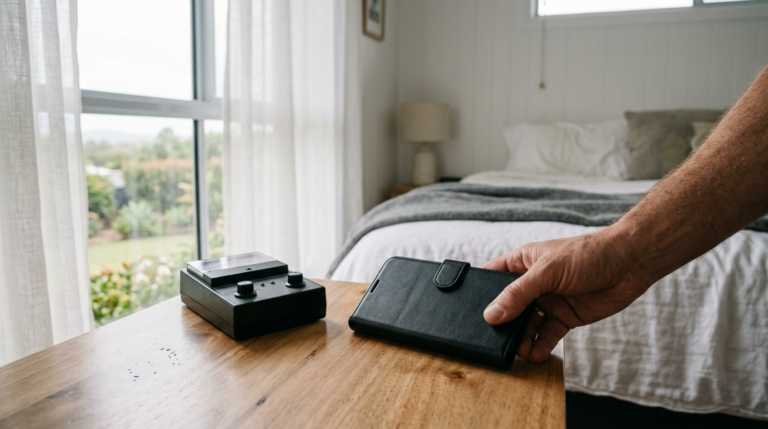
Step 1: Phone on airplane mode (cost: $0). Your phone is the single highest-RF source in the bedroom. When connected to a cell tower, it transmits at 700 MHz to 2.6 GHz, with power output scaling up as signal quality drops. In a Cairns or Darwin home with poor indoor reception, your phone may transmit at peak power on the bedside table all night. Airplane mode eliminates all RF transmission instantly. If you need an alarm, airplane mode preserves clock and alarm functions.
Step 2: Remove or relocate the WiFi router (cost: $0). If your WiFi router sits in the bedroom or in an adjoining room with a thin wall, move it. WiFi routers transmit at 2.4 GHz and 5 GHz continuously — even when no device is actively using the network. A router 1 metre from your pillow delivers measurably different exposure than one 8 metres away in the lounge. For homes in inner Sydney, Brisbane, or Perth apartments where relocation is not practical, put the router on a Jackson 24hr mechanical timer (~$20) that kills power from 10 PM to 6 AM. No WiFi signal, no RF.
Step 3: Remove DECT cordless phones from the bedroom (cost: $0). DECT cordless phone base stations transmit at approximately 1.9 GHz continuously — even when no call is in progress. Many Australian homes still have these on bedside tables. Remove the base station from the bedroom entirely. If you need a phone beside the bed, a corded phone produces zero RF.
Step 4: Check smart meter location. If your bedroom shares an exterior wall with your electricity smart meter (common in QLD homes on Energex meters and NSW homes on Ausgrid meters), the meter transmits mesh network data at 900 MHz in bursts. Time-averaged readings may look low, but peak readings — measured with a meter in peak hold mode — can be 100 to 1,000 times higher. The simplest fix: move the bed to an interior wall. This is free and immediately effective. If that is not possible, measure first before purchasing any shielding.
Step 5: Demand switch installation (~$100-150). A licensed electrician installs a demand switch on your bedroom circuit. When all active loads are off (lights, chargers unplugged), the demand switch cuts voltage to the bedroom wiring, eliminating AC electric fields from the walls and ceiling. This is the single most effective fix for overnight AC electric field exposure and is fully compliant with Australian wiring standards.
Step 6 (optional): Grounding mat for sleep. A grounding mat connects to the earth pin of your power outlet and provides a conductive surface for body contact during sleep. Some users report improved sleep quality, though clinical evidence for pregnancy-specific benefits is limited. If you are interested, we have reviewed the options in our best grounding mat Australia 2026 guide. Only use a grounding mat after confirming low AC electric fields in the bedroom — grounding in a high-electric-field environment can increase current flow through the body.
Room 2: The Home Office (Second Priority — Direct Body Contact)
Working from home during pregnancy introduces a specific exposure pattern: a laptop on or near your abdomen for hours at a time. This is not a general “room exposure” problem. It is a direct-contact, near-field exposure problem. The difference matters enormously.
Laptop on a desk, not on your lap. A laptop running on your thighs or abdomen places the WiFi antenna, processor (AC magnetic fields), and power supply transformer within 0-15 cm of the fetus. At that distance, magnetic field intensity can exceed 1-2 µT — well above the Building Biology 0.2 µT sleeping area threshold. The fix is simple: use the laptop on a desk or table, at arm’s length. If you must work from a couch or bed, a DefenderPad laptop EMF shield provides a physical barrier between the laptop’s underside and your body.
Wired ethernet instead of WiFi. Every device using WiFi contributes RF to the room. A Cat6 ethernet cable from your router to a USB-C ethernet adapter eliminates the laptop’s WiFi transmission entirely. Once connected via ethernet, disable WiFi and Bluetooth in your laptop’s settings. The reduction in room-level RF is immediate and measurable.
Monitor distance. Desktop monitors and laptop screens generate AC electric fields. At 30-50 cm distance (normal working position), these typically fall below 5 V/m. At 15 cm (leaning into the screen), they may exceed it. A simple rule: keep your screen at arm’s length. This is also better for your posture during pregnancy.
Power board and charger placement. Power boards with multiple transformers (phone charger, laptop charger, monitor power supply) generate localised AC magnetic fields. Keep them 1 metre from your seated position if possible — on the floor beside the desk, not on the desk surface beside your keyboard.
Room 3: The Kitchen (Lowest Priority — Short Duration, Distance Works)
Kitchen EMF exposure during pregnancy concerns many women, especially around microwave ovens and induction cooktops. The critical difference: kitchen exposure is short-duration (minutes, not hours) and you are typically standing at arm’s length or further. Distance is your most powerful tool here, and it is free.
Microwave ovens. Australian microwaves must comply with AS/NZS 60335.2.25, which limits RF leakage to 50 W/m² at 5 cm from the door surface. At 1 metre distance, the inverse square law reduces this to a fraction of a percent of the ARPANSA limit. The practical fix: stand 1-2 metres back while the microwave runs. Do not press your abdomen against the door to watch food heat. That is it.
Induction cooktops. Induction cooktops generate intermediate-frequency magnetic fields (20-100 kHz) at the cooking surface. According to measurements published in the Journal of Exposure Science & Environmental Epidemiology (Viellard et al., 2014), fields at 30 cm from the cooktop edge were well below ICNIRP reference levels. The practical concern is standing directly against the cooktop edge during long cooking sessions. During pregnancy, stand 30-50 cm back when possible. If you are using a large stockpot on the front burner, use a rear burner instead to increase abdominal distance.
Smart meter (kitchen wall). In many Australian homes — particularly in QLD and NSW — the smart meter is mounted on the exterior kitchen wall. The same advice applies as with the bedroom: if your dining table or a seating area is directly against the smart meter wall, move seating 1-2 metres away. Measure with a TriField TF2 in peak hold mode to confirm actual RF burst levels before making any other changes.
The Low-EMF Router Option: JRS Eco 100
If you cannot — or do not want to — turn WiFi off completely overnight, the JRS Eco 100 is a purpose-built low-EMF router available through SaferEMF Australia. It uses modified firmware on an Asus hardware platform to reduce RF output in two specific ways:
Full Eco mode reduces beacon interval transmissions by approximately 90% when no device is actively transferring data. A standard router broadcasts beacon frames 10 times per second, every second, whether or not any device is online. The JRS Eco 100 extends this interval or suppresses beacons entirely when the network is idle. The result: measurable RF in a sleeping area drops to near-zero during overnight idle periods without manually disabling WiFi.
Eco standby mode disables WiFi entirely when no clients are connected, then re-enables when a device sends a probe request. This is functionally equivalent to a router timer, but automatic.
The JRS Eco 100 does not reduce RF during active data transfer. If someone is streaming video on the network, the router transmits at normal power. Its advantage is the 90%+ reduction during the idle hours — which, during pregnancy, are the sleeping hours when cumulative exposure matters most.
For Brisbane, Sydney, Adelaide, and Gold Coast homes where multiple WiFi networks from neighbours also contribute RF (apartments and terraces in inner suburbs like Paddington, Newtown, Kingsford, or Subiaco), the JRS Eco 100 controls only your router’s output. Neighbouring networks require measurement first, then potentially shielding specific windows or walls — but only after confirming internal sources are addressed.
How to Measure EMF in Your Home Before Making Changes
Every recommendation in this guide assumes you know what your actual exposure levels are. Without measurement, every EMF decision is a guess — and guesses lead to either unnecessary spending on shielding products or false confidence that your bedroom is fine when it is not.
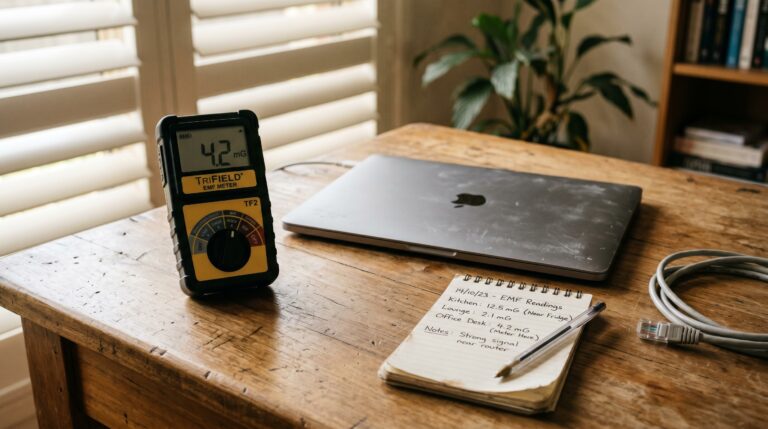
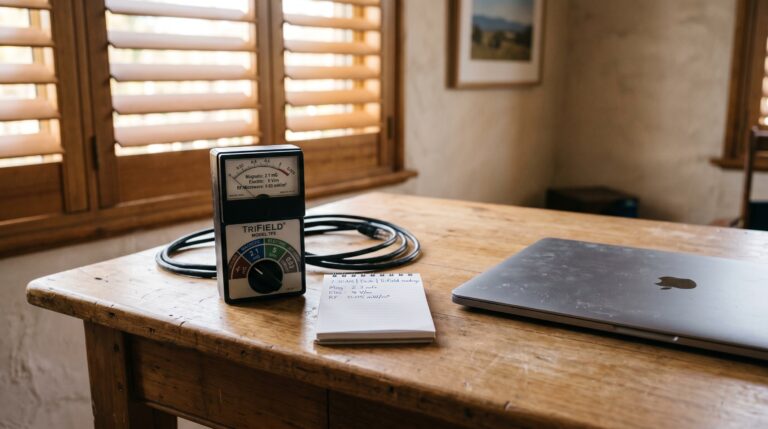
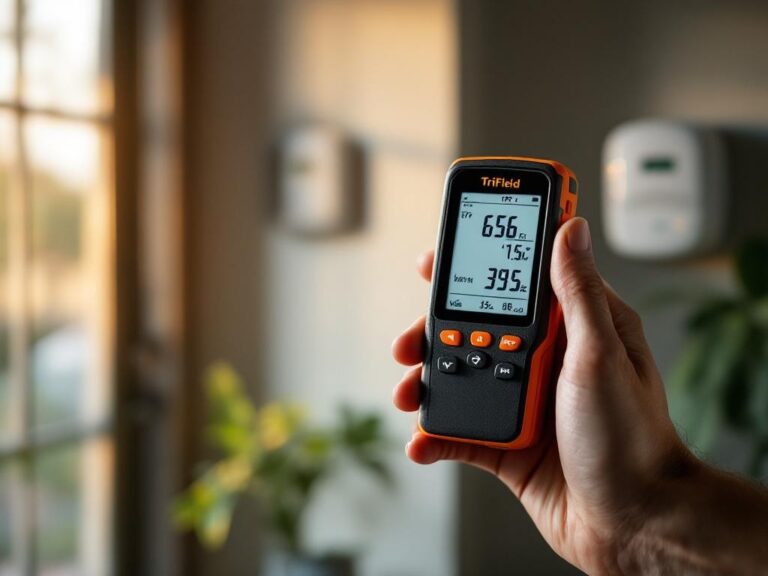
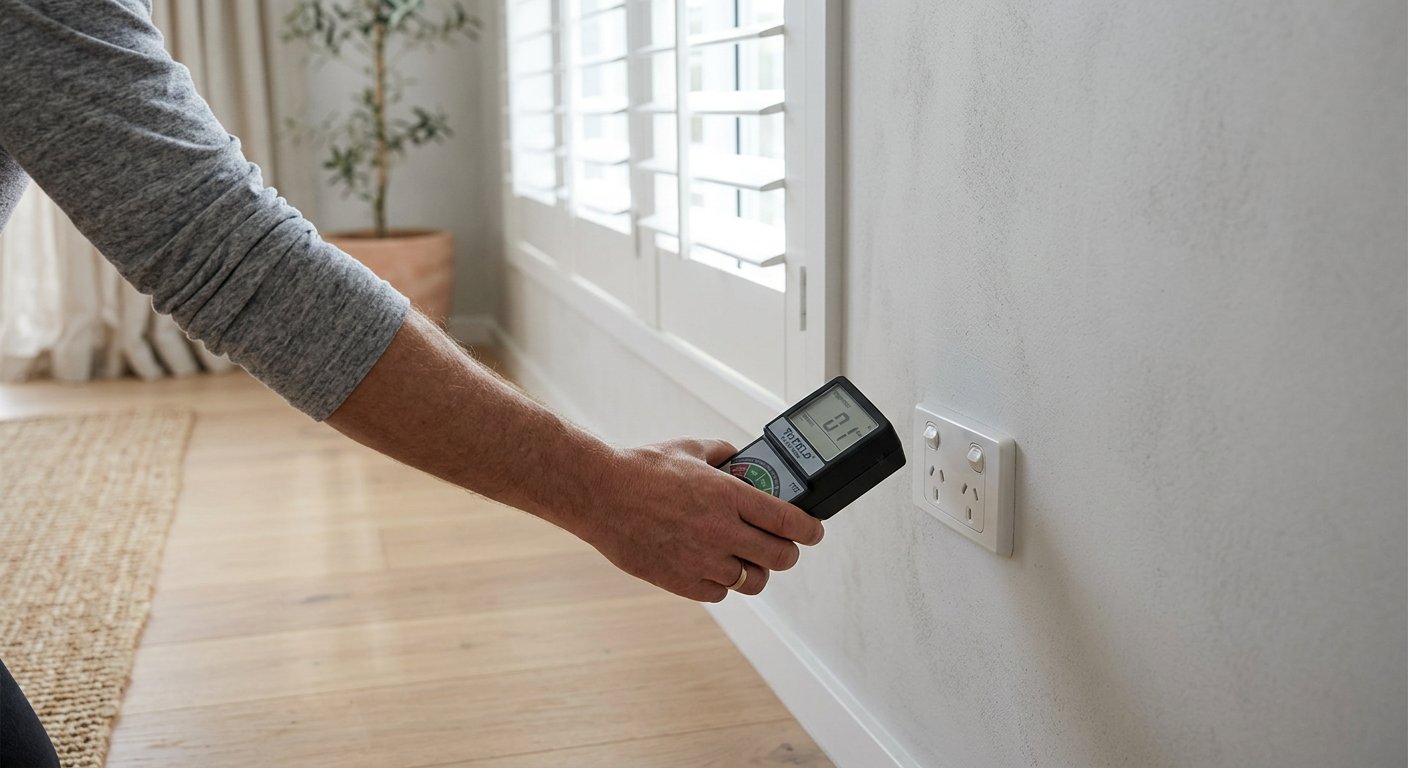
The TriField TF2 is the only all-in-one meter that measures AC magnetic, AC electric, and RF fields in a single device. For pregnancy-related assessments, you need all three types measured at the pillow position, the mattress surface, and key spots around the nursery.
What to measure and where:
- Pillow position (AC magnetic): Set the TF2 to magnetic mode (mG or µT). Place it where your head rests. Readings above 2 mG (0.2 µT) indicate a wiring issue or nearby appliance. Common culprits: bedside lamp transformers, clock radios, and wiring in the wall or floor below.
- Pillow position (AC electric): Switch to AC electric mode. Readings above 5 V/m suggest wiring in the adjacent wall is energised. A demand switch on the bedroom circuit resolves this.
- Pillow position (RF): Switch to RF mode with peak hold engaged. Walk around the room slowly. Note peaks near windows (neighbouring routers, 5G small cells from Telstra/Optus/TPG at 3.5 GHz on street poles), near exterior walls (smart meters), and near any device left on (baby monitor, phone). Building Biology target: below 0.1 mW/m².
- Nursery (same three measurements): Measure at cot height. Baby monitors are a significant RF source — particularly those with video. Consider a wired baby monitor or an audio-only unit with lower transmission power.
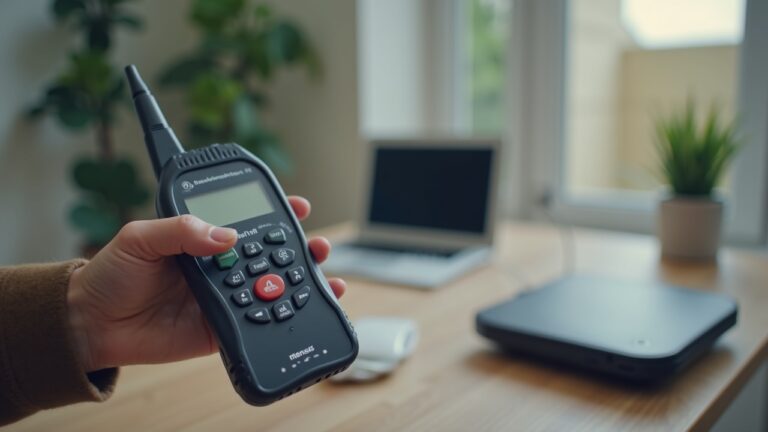
If you want dedicated RF sensitivity beyond what the TF2 provides, the Safe and Sound Pro II from SaferEMF Australia is the most sensitive consumer-grade RF meter available in Australia. It provides audio feedback that lets you “hear” RF sources as you scan — useful for identifying which device is the dominant contributor.
For a full walkthrough of the measurement process, see our EMF measurement guide for Australian homes.
The Complete Pregnancy EMF Reduction Checklist
Here is the full sequence, ordered by impact-per-dollar. Every item includes its cost and the EMF type it addresses. Print this, work through it in order, and measure after each step to confirm the reduction.
| Priority | Action | EMF Type | Cost | Room |
|---|---|---|---|---|
| 1 | Phone on airplane mode overnight | RF | $0 | Bedroom |
| 2 | Remove WiFi router from bedroom | RF | $0 | Bedroom |
| 3 | Remove DECT cordless phone base | RF | $0 | Bedroom |
| 4 | Laptop on desk, not lap | ELF-MF + RF | $0 | Office |
| 5 | Move bed away from smart meter wall | RF | $0 | Bedroom |
| 6 | Mechanical timer on WiFi router | RF | ~$20 | Bedroom |
| 7 | Wired ethernet + disable WiFi on laptop | RF | ~$30 | Office |
| 8 | Buy TriField TF2 and measure | All | ~$250 | All rooms |
| 9 | Demand switch on bedroom circuit | AC Electric | ~$100-150 | Bedroom |
| 10 | JRS Eco 100 low-EMF router | RF | ~$450 | Whole home |
Steps 1 through 5 cost nothing. Steps 6 and 7 cost under $50 combined. The first $0-50 of effort eliminates the majority of controllable EMF exposure in a typical Australian home. The TriField TF2, demand switch, and low-EMF router are worthwhile investments but are secondary to source removal.
If you live in an apartment — particularly in inner-city Brisbane (West End, Fortitude Valley), Sydney (Newtown, Surry Hills, Redfern), or Melbourne (Southbank, South Yarra, Fitzroy) — your neighbour’s WiFi may be the dominant RF source in your bedroom. Measure first. If external RF is confirmed, window shielding film or an EMF shielding bed canopy (42 dB attenuation) can address external residual — but only after you have confirmed all internal sources are removed or disabled. Shielding without source removal traps internal RF and makes things worse.
What About Baby Monitors and Nursery Equipment?
This deserves its own section because it is the question most expecting parents ask after the bedroom is sorted. You have reduced your own sleeping area, and now you need to monitor the baby. Every wireless baby monitor adds RF to the nursery.
Video baby monitors are the highest RF nursery source. They transmit continuously at 2.4 GHz (same frequency as WiFi) with sufficient power to stream video through walls. Placing one 50 cm from a cot creates a constant RF source at the closest point to your newborn’s head. If you need video monitoring, position the camera at maximum distance (2+ metres from the cot) and avoid models that also connect to WiFi/cloud services (double transmission).
Audio-only monitors transmit at lower power and only when sound is detected (VOX mode). They are a lower-RF alternative. Some models use DECT frequency (1.9 GHz) — confirm the monitor does not transmit continuously in standby.
Wired monitors produce zero RF. They are rare in Australia but available. If the nursery is adjacent to your bedroom, a wired audio monitor is the lowest-EMF option.
Do not place any wireless baby monitor, WiFi camera, or smart speaker inside the cot or within arm’s reach of the sleeping position. At 2+ metres distance, RF intensity drops dramatically per the inverse square law. This single placement change is more effective than any shielding product.
Final Verdict
The evidence does not confirm harm. The gaps in evidence justify low-cost precaution.
ARPANSA, WHO, and mainstream science have not established adverse effects from household EMF levels during pregnancy. The BioInitiative Report, Falcioni et al. (2018), and Aldad et al. (2012) raise legitimate questions that existing thermal safety limits do not address. The practical middle ground is not fear — it is a systematic $0-170 reduction of controllable sources in the bedroom and home office, confirmed by measurement.
Start with airplane mode tonight. Measure with a TriField TF2 this weekend. Work through the checklist in priority order. The worst outcome is you spend $20 on a timer and sleep better knowing your exposure is documented and minimised. The more likely outcome is you reduce your bedroom RF to below Building Biology thresholds before the baby arrives — without spending anything on shielding products you may not need.
Start with measurement. The TriField TF2 is the only meter you need.
Measures AC magnetic, AC electric, and RF in one device. Without real readings, every EMF decision is a guess.
Last reviewed: August 2026 — Clean and Native
Frequently Asked Questions
Is EMF harmful during pregnancy in Australia?
No adverse health effects from EMF during pregnancy have been confirmed below ARPANSA safety limits, according to both ARPANSA and the WHO International EMF Project. However, both bodies acknowledge gaps in long-term research on fetal development, which is why low-cost precautionary steps — such as phone airplane mode and router relocation — are reasonable.
What does ARPANSA say about WiFi and pregnancy?
ARPANSA states that WiFi routers operate well below the Australian Radiation Protection Standard RPS-S1 limit of 1,000 µW/cm² at 2.4 GHz. Their position is that no health effects have been established at these levels. ARPANSA’s 2023 animal study review noted experimental exposures were “far above” the Australian standard, limiting extrapolation to real-world conditions.
Should I turn off WiFi at night while pregnant?
Turning off WiFi overnight eliminates the dominant RF source in most homes during the 8-10 hours of sleep. A Jackson mechanical timer (~$20) automates this. If you need overnight WiFi for a baby camera or partner, a JRS Eco 100 low-EMF router reduces beacon transmissions by approximately 90% during idle periods.
Can I use a laptop on my lap while pregnant?
Laptop processors and WiFi antennas generate AC magnetic fields and RF at close range. At direct contact (0-15 cm), magnetic fields can exceed 1-2 µT — above the Building Biology 0.2 µT sleeping area threshold. Use the laptop on a desk at arm’s length. If lap use is unavoidable, a DefenderPad EMF shield provides a physical barrier between the device and your body.
Are smart meters safe during pregnancy?
Australian smart meters (Energex QLD, Ausgrid NSW) transmit at 900 MHz in short bursts. Time-averaged emissions are well below ARPANSA limits, but peak readings can be 100 to 1,000 times higher than the time average. If your bed or nursery cot shares a wall with the smart meter, move the sleeping position to an interior wall. Measure with a meter in peak hold mode to confirm actual exposure.
Does an EMF shielding canopy help during pregnancy?
An EMF bed canopy (such as a silver cotton 42 dB model) is effective against external RF sources — neighbour WiFi, smart meters, and 5G small cells. However, if any RF source remains inside the canopy (phone, baby monitor, WiFi router), the canopy reflects that energy inward and increases exposure. Always remove internal sources before installing any shielding enclosure.
What is the BioInitiative Report and should I trust it?
The BioInitiative Report (2012, updated 2014) is an independent review of over 1,800 studies on EMF health effects, compiled by researchers from multiple universities. It concludes that current safety limits are inadequate and recommends significantly lower exposure thresholds. Mainstream bodies (WHO, ARPANSA) have not adopted its recommendations, citing methodological concerns with some included studies. It is a legitimate compilation of peer-reviewed research, but its conclusions are more precautionary than current regulatory positions.
How do I measure EMF levels in my nursery?
Use a TriField TF2 meter to measure AC magnetic, AC electric, and RF fields at cot height. For AC magnetic, readings should be below 0.2 µT (Building Biology SBM-2015 “no anomaly” threshold). For RF, use peak hold mode and target below 0.1 mW/m². Measure with all nursery devices turned on (baby monitor, night light, humidifier), then re-measure with each device off to identify the dominant source. Our EMF measurement guide provides a full step-by-step walkthrough.
Is it safe to use a microwave oven while pregnant?
Yes. Australian microwaves must comply with AS/NZS 60335.2.25, which limits RF leakage to 50 W/m² at 5 cm from the door surface. At 1 metre distance, leakage drops to a fraction of ARPANSA’s safety limit. Stand 1-2 metres back during operation rather than pressing against the door.
What is a demand switch and do I need one for pregnancy?
A demand switch is a device installed by a licensed electrician on your bedroom circuit breaker (~$100-150). It automatically cuts voltage to bedroom wiring when no active loads are drawing power, eliminating AC electric fields from walls and ceiling during sleep. It is fully compliant with Australian wiring standards and is the most effective fix for overnight AC electric field exposure. It is not essential but is a worthwhile investment if your TF2 readings show elevated electric fields at the pillow position (above 5 V/m).
Get the Australian Home Environment Checklist
30 checks across water, air and EMF. Most of them free. Ranked by impact.
No spam. Unsubscribe any time.

Former Royal Australian Navy Clearance Diver and TAG-E counter-terrorism operator. Founded Clean and Native to apply the same rigorous thinking to the home environment.
Full biography →