PFAS in Sydney Tap Water — Which Filter Actually Works (2026)
A 2025 study from the University of New South Wales identified 21 previously unknown PFAS chemicals in Sydney tap water, raising the total confirmed count to 31 distinct compounds — including one detected in tap water globally for the first time. Standard pitcher filters and basic benchtop carbon units do not remove PFAS; only reverse osmosis filtration and NSF/ANSI 58-certified activated carbon block filters provide verified removal.
Quick Verdict — Best PFAS Filters for Sydney Tap Water
Sydney tap water contains at least 31 PFAS types, including unregulated compounds with no Australian guideline value. Only RO or NSF 58-certified carbon block filters remove them as a class.
The AquaTru Classic is the top pick for Sydney renters — no plumbing required, NSF/ANSI 58 certified with documented 97% PFAS removal. For permanent installs, the PWS EcoHero 5 Stage carries Australian WaterMark certification alongside NSF 42/58. The one category to avoid: standard pitcher filters (Brita, TAPP, ZeroWater) — none are certified for PFAS removal across the 31 types now identified in Sydney.
| Filter | Type | PFAS Removal | Best For |
|---|---|---|---|
| AquaTru Classic Countertop RO | Countertop RO | 97% (NSF/ANSI 58) | Best Renters |
| Waterdrop D6 Under-Sink RO | Under-Sink RO | >98% (NSF certified) | Best Permanent |
| PWS EcoHero 5 Stage RO | Under-Sink RO | ~95% (WaterMark) | Best AU Certified |
| Standard Carbon Pitcher (Brita etc.) | Carbon Pitcher | Not certified for PFAS | Avoid for PFAS |
✓ Who This Is For
- Sydney households wanting to filter the newly identified PFAS compounds, including unregulated types
- Renters who cannot modify plumbing but want certified PFAS removal (AquaTru countertop RO)
- Families with infants or pregnant women, who are most vulnerable to PFAS accumulation
- Homeowners wanting a permanent under-sink RO with Australian certification
- Anyone near a former RAAF base, firefighting training area, or industrial site in NSW
✗ Who This Is Not For
- Regional NSW households in unaffected catchments — check your local water quality report first
- Budget buyers under $500 — certified PFAS removal via RO has a higher upfront cost
- Renters who cannot accept ~35cm × 35cm bench space usage (AquaTru footprint)
- Anyone expecting a Brita-style pitcher to solve this problem — it won’t
What the 2025 UNSW Study Found in Sydney Tap Water
In August 2025, researchers from the University of New South Wales published findings from a non-target screening analysis of Sydney’s municipal water supply. Using high-resolution mass spectrometry (HRMS) — a technique capable of detecting trace organic contaminants well below the threshold of standard compliance monitoring — the team sampled water from four catchment sites feeding the Sydney distribution network.
The results identified 21 PFAS compounds not previously recorded in Sydney water testing, raising the total known count from roughly 10 to 31 distinct types. Among these, one compound had never been documented in tap water from any global source — a genuinely novel environmental detection with no existing toxicological assessment.
The critical point is regulatory coverage. Sydney Water’s existing compliance reporting covers only the small subset of PFAS for which the Australian Drinking Water Guidelines (ADWG 2024) provide a threshold value. The 21 newly identified compounds are, by definition, outside current regulatory coverage. This means Sydney tap water can be reported as “within guidelines” while simultaneously containing dozens of unregulated PFAS types — because those compounds are not being tested against any standard.
The UNSW researchers also noted that the PFAS detected were not primarily the result of direct industrial discharge into Sydney’s drinking water catchments. The contamination profile suggests a combination of: legacy PFAS from historical firefighting foam (AFFF) use in the Sydney basin, breakdown products from PFAS precursor compounds used in manufacturing and food packaging, and short-chain PFAS transformation products. This is significant because it means the contamination cannot be resolved by switching off a single pollution source — the compounds are distributed throughout the catchment system.
The findings are consistent with a broader global pattern. Non-target HRMS studies conducted in the United States, Germany, and the Netherlands have revealed similarly expanded PFAS profiles in treated municipal tap water — typically detecting 3–5 times as many PFAS types as routine compliance testing. Sydney is not uniquely contaminated. What the UNSW study does is close the gap between what the monitoring framework measures and what is actually present in the water supply.
What PFAS Are — And Why “Forever Chemicals” Is Literally True
PFAS stands for per- and polyfluoroalkyl substances — a family of more than 15,000 synthetic chemicals built around the carbon-fluorine (C-F) bond. The C-F bond is the strongest bond in organic chemistry. It resists thermal breakdown, UV degradation, biological metabolism, and chemical oxidation. A PFAS molecule introduced into an environment or organism does not meaningfully degrade on any human timescale. “Forever chemicals” is not an exaggeration.
PFAS entered widespread industrial use from the 1950s onwards: in non-stick cookware (PTFE production used PFOA), water-resistant textiles (Scotchgard’s original formula used PFOS), food packaging films, firefighting foam (AFFF), semiconductor manufacturing, medical device coatings, and dental floss. More than 600 PFAS compounds are in active commercial use in Australia. The vast majority have never undergone human health assessment.
How PFAS accumulate in the body: PFAS bind to serum proteins, liver tissue, and kidney tissue. The serum half-life of PFOA in adult humans is approximately 3.8 years; PFOS approximately 5.4 years. This means that even if you stopped all PFAS exposure today, the compounds already in your bloodstream would take over a decade to reduce by 90%. Children have slightly faster clearance rates but are more vulnerable to the same dose — lower body weight, developing organ systems, and a blood-brain barrier that matures into early childhood all amplify exposure effects relative to adults.
Drinking water is one of several PFAS exposure pathways that accumulate simultaneously. Diet (PFAS-coated packaging, microwave popcorn bags, greaseproof food wraps, processed foods cooked in PFAS-containing cookware), inhalation (indoor house dust from treated textiles and furniture), and dermal absorption all contribute. The European Food Safety Authority estimated in 2020 that a significant share of EU adults already exceed precautionary tolerable weekly intake estimates from diet alone — before accounting for water. Australian dietary PFAS exposure data is limited, but the food exposure pathways are equivalent.
| PFAS Type | IARC Classification | Established Health Associations |
|---|---|---|
| PFOA | Group 1 Carcinogen (IARC, 2023) | Kidney cancer, testicular cancer, thyroid disease, ulcerative colitis |
| PFOS | Group 2B (Possible carcinogen) | Immunotoxicity, thyroid disruption, reduced fertility, liver effects |
| PFHxS | Under review | Thyroid hormone disruption; reproductive and developmental effects in children |
| PFNA, PFDA (long-chain) | Under review | Immunotoxicity in children; reduced vaccine response; reproductive harm |
| 21 new UNSW types (2025) | No assessment | No toxicological data available. Structurally related to above categories. |
The 21 newly identified PFAS in Sydney water are structurally related to the types above — many are chain-length variants or transformation products. Their individual health effects are unstudied. The precautionary approach is to treat PFAS as a class: a filter certified for the regulated subset (PFOA, PFOS, PFHxS) using RO technology provides the broadest protection against the full spectrum of PFAS types, including novel and short-chain variants.
Australian PFAS Standards vs the Rest of the World
The Australian Drinking Water Guidelines (ADWG) 2024 revision set guideline values for a small number of PFAS compounds: PFOS combined with PFHxS at 0.07 μg/L (70 ng/L), and PFOA at 0.56 μg/L (560 ng/L). These are health-based guideline values, not legally enforceable Maximum Contaminant Levels (MCLs). Compliance is voluntary for state water authorities.
In April 2024, the US Environmental Protection Agency set binding MCLs at 4 parts per trillion (4 ng/L) for PFOA and PFOS individually — the first legally enforceable PFAS drinking water standards in US history. The EPA’s rationale: PFOA is a Group 1 carcinogen and PFOS a probable carcinogen, and no dose is sufficiently safe to justify a permissive threshold. Australia’s PFOA guideline of 560 ng/L is 140 times higher than the US EPA MCL.
Sydney Water’s annual water quality reports confirm compliance with ADWG guideline values for regulated PFAS. This is accurate. What the compliance statement does not cover:
- The 21 newly identified PFAS types from the UNSW study, which have no guideline value in any Australian or international jurisdiction
- Whether measured concentrations would meet the US EPA’s significantly more stringent 4 ng/L standard for PFOA and PFOS
- Cumulative PFAS exposure from drinking water in addition to dietary and inhalation pathways
- Long-term accumulation effects, which are the primary concern rather than short-term acute toxicity
The position is not that Sydney tap water is acutely dangerous — it is not. The concern is chronic low-level cumulative accumulation over years, compounded by simultaneous dietary exposure. The regulatory gap is that 21 of the 31 PFAS types now identified in Sydney’s tap water exist in a complete information vacuum: no toxicological assessment, no guideline value, no monitoring requirement. A water authority can truthfully report “within guidelines” while this 21-compound gap remains unaddressed.
Which Filter Technologies Remove PFAS — and Which Don’t
Filtration performance for PFAS is not uniform across technologies. The mechanism matters significantly, particularly for the shorter-chain PFAS variants now known to be present in Sydney water.
| Filter Technology | PFAS Removal | Notes |
|---|---|---|
| Reverse Osmosis (RO) | 94–99% | Physical size exclusion at ~0.0001 μm. Best broad-class removal including short-chain variants. NSF/ANSI 58 certification available. |
| NSF 58-Certified Carbon Block | 73–97% | Adsorption-based. Effective for long-chain PFAS; less reliable for short-chain variants (C4–C6). Must carry NSF/ANSI 58 certification. |
| Standard Carbon Pitcher (Brita, ZeroWater) | Not certified | No NSF 58 certification. Inconsistent partial adsorption only. Cannot be relied upon for PFAS removal. |
| KDF / Ceramic Filters | Ineffective | Targets heavy metals and bacteria. No mechanism for PFAS removal. |
| UV / UV-C Treatment | Ineffective | Inactivates microorganisms only. Does not degrade or remove PFAS molecules. |
| Boiling | Makes it worse | PFAS are thermally stable at 100°C. Evaporation reduces water volume while PFAS mass stays constant — increasing concentration. |
| Distillation | Partial (80–90%) | Removes most PFAS but short-chain volatile variants may co-distil. Slow and energy-intensive. Not practical for household use. |
Why boiling concentrates PFAS: This is the most common misconception in online discussions about PFAS. The C-F bond does not break at 100°C — it is thermally stable to over 400°C. As water converts to steam and volume decreases, PFAS remain in the liquid phase and their concentration per litre increases proportionally. A kettle boiled from 500mL to 400mL leaves PFAS approximately 25% more concentrated. Do not boil water as a PFAS mitigation strategy.
The short-chain PFAS problem: The newer PFAS compounds identified by the UNSW study — and many of the 21 novel types — are shorter carbon-chain variants (C4–C6). These were developed as substitutes for regulated long-chain compounds (C8+ PFOA, PFOS) after those were phased out under the Stockholm Convention. Short-chain PFAS have fundamentally different adsorption behaviour on activated carbon — weaker Van der Waals binding means less effective carbon-block capture. Reverse osmosis, which works by physical size exclusion through a semi-permeable membrane rather than adsorption, performs more consistently across chain lengths. This is the key reason RO is the preferred technology for addressing the full-spectrum PFAS profile now identified in Sydney.
For more context on water filter options beyond PFAS, see our guide to the best water filters in Australia and our comparison of countertop water filters.
The 5 Best PFAS-Removing Filters for Sydney Households
1. AquaTru Classic Countertop RO — Best for Sydney Renters

AquaTru Classic Countertop Reverse Osmosis
NSF/ANSI 58 certified with 97% PFAS removal — the only countertop RO with this standard available in Australia. No plumbing required; plugs in on any bench and moves between rentals.
$749 from Amazon AU →The AquaTru Classic is the most independently verified PFAS filter available in Australia without any plumbing. NSF/ANSI 58 certification covers 83 contaminants including PFOA, PFOS, and a range of PFAS compounds, with a documented 97% PFAS removal rate. No installation required — fills from any tap into its 1.9L holding tank, then processes through a 4-stage system: sediment → carbon pre-filter → reverse osmosis membrane → carbon polishing filter. Ideal for Sydney renters in apartments, houses, or share accommodation. The primary trade-offs are upfront cost (~$749) and filter replacement costs (~$140/year).
AquaTru Classic — Pros and Cons
Pros
- NSF/ANSI 58 certified — 97% PFAS removal documented
- Zero plumbing — works in any rental property
- Removes 83 contaminants including chloramine, lead, fluoride
- Compact footprint (~35cm × 35cm bench space)
- On-demand filtered water from 1.9L holding tank
Cons
- ~$749 upfront
- ~$140/yr filter replacements
- Slow fill rate (~1.8L/hr)
- Wastes ~3L per 1L filtered
Buy if: You rent in Sydney, are pregnant or have young children, and need the highest independently verified PFAS certification available without any plumbing modifications. Check price on Amazon AU →
2. Waterdrop D6 Under-Sink RO — Best Permanent High-Output Solution

Waterdrop D6 Under-Sink Reverse Osmosis
Tankless under-sink RO with NSF-certified membrane removing >98% of PFAS. On-demand filtered water with no holding-tank stagnation risk; 6-stage system includes a UV stage for additional pathogen protection.
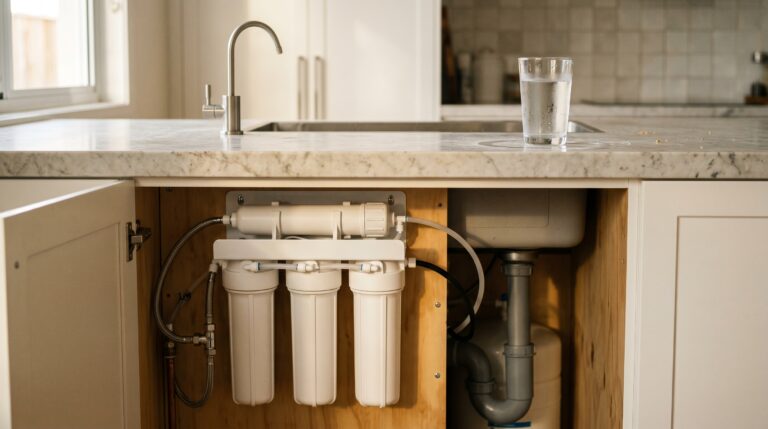
Check price on Amazon AU →The Waterdrop D6 is a tankless under-sink RO system with an NSF-certified RO membrane removing >98% of PFAS, heavy metals, chloramine, and microplastics. Tankless architecture means filtered water is produced on demand without being stored — eliminating the potential for secondary contamination or stagnation common to tank-based units. A dedicated filtered-water tap mounts alongside your existing kitchen fixture. 6-stage filtration: pre-sediment → pre-carbon → RO membrane → post-carbon → UV stage → post-filter. Requires a licensed plumber for installation (budget $200–300).
Waterdrop D6 — Pros and Cons
Pros
- >98% PFAS removal with NSF-certified RO membrane
- Tankless — no stagnant stored water, instant on-demand output
- 6-stage includes UV for additional microbial protection
- No bench space used; compact under-sink footprint
- Smart LED filter-change indicator
Cons
- ~$899 unit + ~$250 licensed plumber installation
- Not suitable for renters
- RO removes minerals — may want remineralisation
- Annual filter cost ~$200–250
Buy if: You own your Sydney home, want a permanent zero-bench-footprint PFAS solution with the highest output flow rate and tankless on-demand delivery. Check price on Amazon AU →
3. PWS EcoHero 5 Stage Under-Sink RO — Best Australian Certified
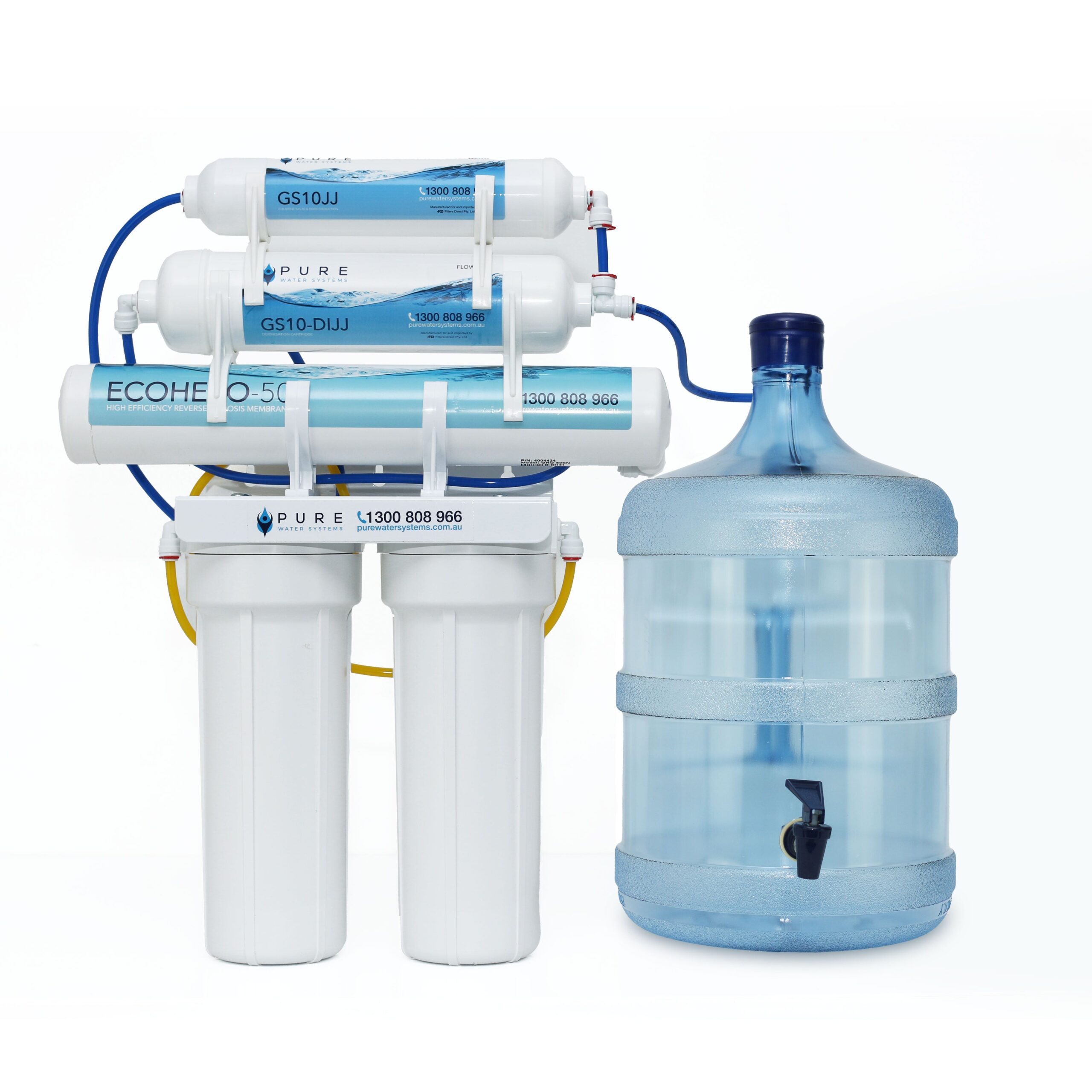
PWS EcoHero 5 Stage Under-Sink RO
The only under-sink RO in this list with WaterMark AS3497 certification — the Australian standard for permanently plumbed water filtration. Five stages including pH remineralisation.
See at Pure Water Systems →The Pure Water Systems EcoHero carries WaterMark AS3497 certification — the Australian standard legally required for permanently plumbed water filtration systems. Five-stage filtration (sediment → activated carbon block → RO membrane → deionising → pH remineralisation) delivers ~95% PFAS reduction while adding minerals back post-RO, solving the flat-taste problem common to unmineralised RO output. Australian brand with domestic customer support and locally stocked filter cartridges — no international shipping delays when filters need replacing. at checkout.
PWS EcoHero 5 Stage — Pros and Cons
Pros
- WaterMark AS3497 + NSF 42 & 58 component-level certification
- pH remineralisation stage — pleasant neutral-alkaline taste
- Australian brand, local warranty, domestically stocked filters
- Removes chloramine, fluoride, PFAS, lead, and nitrates
- 10% off with code at checkout
Cons
- ~$695 upfront + ~$250 licensed plumber installation
- Not suitable for renters
- Requires under-sink space and bench hole for filter tap
- Annual filter cost ~$150
Buy if: You own your Sydney home and want the most comprehensively Australian-certified under-sink RO with local warranty support and pleasant mineralised RO water. See at Pure Water Systems →
4. PWS RO-5U Reverse Osmosis Purifier — WaterMark Certified

Pure Water Systems RO-5U Reverse Osmosis
WaterMark-certified (licence 022780) 5-stage under-sink RO from Pure Water Systems. Digital TDS monitor, auto leak detection, twist-click NSF-certified cartridges. Removes 96% TDS including fluoride, PFAS, and heavy metals. 8L pressurised tank, dedicated standalone faucet.
$2,049 from Pure Water Systems →The PWS RO-5U is a tankless under-sink system with a dedicated filtered-water tap, claiming 99% contaminant removal including fluoride, bacteria, and PFAS. Its distinguishing feature is a mineralisation stage post-filtration — unusual for under-sink RO systems at this price point, which typically strip all minerals along with contaminants. The 2:1 filtered-to-drain water ratio is better than most entry-level RO systems. Important caveat: WaterMark AS3497 certification is listed as pending — if this is a hard requirement for your installation, Installation by a licensed plumber is recommended; Pure Water Systems can arrange a local plumber in most metro areas. Allow $150–250 for installation on top of the unit price.
PWS RO-5U — Pros and Cons
Pros
- Tankless design — no stagnant water, instant delivery
- Mineral addition post-filtration — better taste than plain RO
- Claims 99% contaminant removal including fluoride & bacteria
- 2:1 filtered water ratio — efficient vs competitors
- 12-month filter cartridge lifespan
Cons
- WaterMark certification pending — confirm before buying for rental compliance
- $2,049 upfront — most expensive unit in this list
- Requires DIY or handyman install (not self-install for most)
- Fewer independent third-party test results vs NSF 58 certified units
Buy if: You own your home, want a tankless RO with mineral addition for better-tasting filtered water, and are comfortable confirming WaterMark status before installation. View PWS RO-5U →
5. Waters Co BIO 500 MAX — Best Benchtop Gravity Option

Waters Co BIO 500 MAX 7L Bench Top Water Filter
7L gravity-fed benchtop filter using multi-stage mineral media. Claims to reduce chloramine, heavy metals, and improve pH. Good general water quality upgrade; note this is NOT reverse osmosis and does not carry NSF/ANSI 58 PFAS certification.
$649 from Waters Co Australia →The Waters Co BIO 500 MAX is a 7-litre gravity-fed benchtop filter using a multi-stage mineral media system developed over 40 years of research. It reduces chloramine, heavy metals, and organic contaminants while adding alkaline minerals to raise pH. This is not a reverse osmosis system — it does not use a semi-permeable membrane and has not been independently certified for PFAS removal under NSF/ANSI 58 or NSF P473. If PFAS removal is your primary concern, the AquaTru Classic or a plumbed under-sink RO is the appropriate choice. The BIO 500 MAX is best suited for households wanting improved water taste, chloramine reduction, and mineralisation without plumbing — particularly where full PFAS certification is a secondary priority to convenience and cost.
Waters Co BIO 500 MAX — Pros and Cons
Pros
- No plumbing or electricity required — works anywhere
- 7L capacity — large enough for a family
- Adds alkaline minerals, raises pH naturally
- 40+ years of company research behind filter media
- No installation cost; self-contained benchtop unit
Cons
- NOT reverse osmosis — no membrane PFAS removal
- No NSF/ANSI 58 certification for PFAS
- $649 — premium price for a gravity filter
- Slow gravity flow rate vs pressure-fed RO systems
Buy if: You want a benchtop water quality improvement (chloramine, taste, mineralisation) without any plumbing, and PFAS certification is secondary to convenience. For primary PFAS protection, use the AquaTru or a plumbed RO above. See at Waters Co Australia →
5-Year Cost Comparison
PFAS filtration is a long-term household investment. The realistic 5-year cost — including filter replacements and where applicable professional installation — changes the relative economics considerably compared to upfront sticker price alone.
| Option | Upfront | Annual Ongoing | 5-Year Total | PFAS Removal |
|---|---|---|---|---|
| AquaTru Classic Countertop RO | $749 | ~$140 | ~$1,449 | 97% (NSF/ANSI 58) |
| Waterdrop D6 Under-Sink RO | $899 + $250 install | ~$225 | ~$2,274 | >98% (NSF) |
| PWS EcoHero 5 Stage RO | $695 + $250 install | ~$150 | ~$1,695 | ~95% (WaterMark) |
| Bottled water (2L/day @ $3.50/wk) | $0 | ~$182 | ~$910 | Unknown — PFAS detected in many brands |
| Standard carbon pitcher (Brita) | ~$60 | ~$80 | ~$460 | Not certified for PFAS |
The bottled water comparison requires a critical caveat: PFAS have been detected in some Australian and international bottled water brands. International studies including US Consumer Reports testing have found PFAS in approximately 1-in-4 bottled water products tested. PFAS can enter bottled water through the source water, treatment process, or production line equipment. Switching to bottled water is not a reliable PFAS mitigation strategy — it replaces one exposure source with an unverified alternative while adding significant plastic waste and ongoing cost.
For a Sydney household consuming 3L of filtered water per day (drinking and cooking), the AquaTru Classic at ~$1,449 over 5 years works out to approximately $0.27 per litre — one-third the cost of bottled water, with documented NSF/ANSI 58 PFAS removal certification that bottled water does not carry.
Also filtering your shower water? See our full Best Shower Filter Australia 2026 guide — including the only catalytic carbon option proven effective for chloramine cities.
Frequently Asked Questions
Get the Australian Home Environment Checklist
30 checks across water, air and EMF. Most of them free. Ranked by impact.
No spam. Unsubscribe any time.

Former Royal Australian Navy Clearance Diver and TAG-E counter-terrorism operator. Founded Clean and Native to apply the same rigorous thinking to the home environment.
Full biography →