
Perth Tap Water Quality 2026: Chloramine, Hard Water, and the Alcoa Monitoring Problem
Perth tap water meets the Australian Drinking Water Guidelines (ADWG) but carries three characteristics relevant to filter selection: free chlorine disinfection, high hardness (~180 mg/L CaCO₃), and fluoride at 1.0 mg/L. Recent reporting has added a fourth concern — Water Corporation has confirmed that Alcoa’s restricted access to mine sites in Perth’s drinking water catchment area has “significantly diminished” their ability to monitor potential contamination near the Yarragadee aquifer.
For Perth households wanting comprehensive protection, only reverse osmosis removes all four simultaneously.
Perth water is fluoridated, hard, and disinfected with free chlorine — reverse osmosis addresses all three at once.
| Filter | Best For | Chlorine | Fluoride | Price |
|---|---|---|---|---|
| Waterdrop D6 RO | Perth homeowners | ✓ Removes | ✓ Removes | ~$899 |
| AquaTru Classic | Perth renters | ✓ Removes | ✓ Removes | ~$749 |
| PWS EcoHero 5-Stage | AU certified | ✓ Removes | ✓ Removes | ~$695 |
✓ Who This Is For
- Perth homeowners on the metropolitan grid
- Renters in northern suburbs (Joondalup, Wanneroo)
- Families with infants or immunocompromised members
- Southern Perth households near Kwinana or Rockingham
- Anyone who noticed a chemical smell in Perth tap water
✕ Who It Is Not For
- Households on tank rainwater (different contaminant profile)
- Those wanting soft water for appliances only — a water softener is a separate system
- Readers looking for a shower filter — see our Perth shower filter guide
What’s Actually in Perth Tap Water (2026)
Perth water looks clean from the tap. The 2024 Water Corporation annual quality report confirms it meets all ADWG targets. But “meets guidelines” means something different to a regulator than to a family making filtered-water decisions. Here is what the guidelines confirm is present.
Free chlorine disinfection. Perth uses free chlorine as its primary disinfectant — the same method used in Melbourne, Canberra, and Darwin, and unlike Brisbane, Sydney, and Adelaide which use chloramine (monochloramine). This is confirmed by both the Water Corporation and the WA Department of Health. (Note: WA’s Goldfields and Agricultural Water Supply Scheme — serving remote rural WA, not Perth metro — does use chloramine for long-distance distribution.) From a filtration standpoint, free chlorine is good news: standard activated carbon removes free chlorine efficiently and at normal filter lifespans. Standard carbon filters that work reliably in Melbourne will work equally well in Perth for chlorine removal.
Fluoride at 1.0 mg/L. The Water Corporation adds fluoride to Perth’s reticulated supply at a target of 0.7–1.0 mg/L in line with the Australian Health Ministers’ Advisory Council guidance. Whether or not you consider this a concern is a personal decision — but if you want it removed, that is only achievable with reverse osmosis (90–97% removal) or activated alumina (80–95%). Carbon filters of any type cannot remove fluoride.
Hard water (TDS ~170 mg/L, hardness ~180 mg/L CaCO₃). Perth’s groundwater sources — the Yarragadee, Leederville, and superficial aquifers — carry significant mineral content. The result is scale buildup in kettles and appliances, a flat or slightly metallic taste, and reduced efficiency of soaps and detergents. Reverse osmosis reduces TDS by 90–98%, producing noticeably softer, neutral-tasting water.
PFAS (per- and polyfluoroalkyl substances) — elevated risk in southern suburbs. PFAS contamination from historical AFFF firefighting foam use has been documented around RAAF Base Pearce (Bullsbrook), Jandakot Airport, and the Kwinana industrial corridor. Households in Rockingham, Kwinana, Mandurah, and areas adjacent to these sites face elevated risk of PFAS in groundwater. The Water Corporation’s scheme water is blended and treated, but private bores in affected suburbs carry a measurably higher risk. Reverse osmosis removes 90–99% of PFAS.
The Alcoa Monitoring Gap: What It Means for Perth Households
In March 2026, ABC News reported that the Water Corporation had raised concerns about Alcoa’s restricted access to bauxite mine sites in Perth’s drinking water catchment. The Water Corporation stated that Alcoa’s lack of cooperation had “significantly diminished” their capacity to monitor potential contamination near critical supply infrastructure — specifically in areas proximate to the Yarragadee aquifer, a major source of Perth’s groundwater supply.
The framing from Water Corporation was careful. No contamination event has been confirmed. The concern is about monitoring capacity — the ability to detect problems before they enter the supply. Mining operations introduce a range of potential contaminants: sediment, heavy metals (arsenic, lead, manganese, aluminium — the ore itself), and process chemicals. The Darling Range bauxite operations have been running since the 1960s and Water Corporation has long relied on site access for catchment monitoring.
What does a monitoring gap mean in practical terms? It means the time between a potential contamination event occurring and Water Corporation detecting it is longer than it should be. Perth residents cannot directly observe that gap. The Water Corporation’s annual quality reports test finished water — water that has already been treated — not raw catchment water upstream of treatment. A monitoring restriction at the source creates a blind spot that post-treatment testing may not catch quickly.
This is not a call to panic. Perth’s treated water supply has a strong safety record and multiple treatment barriers. It is, however, a clear argument for point-of-use filtration as an independent household safeguard. A reverse osmosis system installed under your kitchen sink removes contaminants at the final step — after whatever happened upstream, after whatever the treatment plant did or did not catch.
Why Standard Pitcher Filters Fail Perth Households
Walk into any Perth Woolworths or Chemist Warehouse and you will find Brita, BRITA Maxtra+, and similar pitcher-style filters. These products are designed primarily for free-chlorine water systems, and that is not what comes out of a Perth tap.
The fluoride problem. Standard activated carbon granules (GAC) — the type in virtually every pitcher filter — remove free chlorine through a rapid adsorption reaction, and Perth’s free chlorine disinfection means standard carbon pitchers do work for chlorine. However, carbon filtration has zero mechanism to remove fluoride ions. This is a chemistry limit: the adsorption sites on activated carbon bind chlorine and some heavy metals but simply do not interact with fluoride. If fluoride removal is your goal — and the Water Corporation adds fluoride to Perth supply at 0.7–1.0 mg/L — no carbon-based pitcher filter of any type can help you. Only reverse osmosis (90–97% removal) or activated alumina (80–95%) are effective.
Fluoride is untouched. Not a single carbon-based pitcher filter removes fluoride. This includes the premium models with added minerals or ion-exchange media. The chemistry that removes chlorine and some heavy metals does not interact with fluoride ions. If fluoride removal is your goal, carbon filtration of any kind — pitcher, countertop carbon, under-sink carbon block — is not the answer. Only RO and activated alumina work.
Hard water persists. Carbon filtration has no mechanism to reduce total dissolved solids or mineral hardness. If your kettle is scaling up and your coffee tastes flat because of Perth’s 170 mg/L TDS water, a pitcher filter will not change that. You need either an RO system (which reduces TDS by 90–98%) or a dedicated water softener (which exchanges calcium and magnesium for sodium — different mechanism, separate system, does not remove fluoride or PFAS).
The conclusion is not that pitcher filters are worthless — they do improve taste in some scenarios and can reduce some heavy metals. The point is that Perth’s specific water chemistry (chloramine + fluoride + hardness) demands a more capable technology, and reverse osmosis is the one that addresses all three simultaneously.
The 3 Best Water Filters for Perth Homes (2026)
All three recommendations use reverse osmosis membranes. That is not brand loyalty — it is the chemistry of Perth water. Only RO simultaneously removes fluoride (90–97%), PFAS (>95%), heavy metals, and hard water minerals — along with chlorine and disinfection byproducts.
1. Waterdrop D6 Under-Sink RO — Best for Perth Homeowners

Waterdrop D6 Under-Sink Reverse Osmosis
Tankless 6-stage RO with NSF-certified membrane. Removes chloramine, fluoride, heavy metals, and PFAS from Perth’s hard water supply. On-demand filtered water — no holding tank, no stagnation risk.
Check price on Amazon AU →The Waterdrop D6 is a tankless under-sink RO with a 6-stage system: pre-sediment filter → pre-carbon block (targets chloramine at source) → NSF-certified RO membrane (>98% PFAS removal, 90–97% fluoride removal) → post-carbon → UV stage → final polish. The pre-carbon block is a compressed carbon block — not GAC — which removes chloramine effectively (unlike pitcher filters). By the time water reaches the RO membrane, chloramine has already been reduced; the membrane then handles fluoride, PFAS, and the dissolved minerals causing Perth’s hardness. Tankless architecture means filtered water is produced on demand without being stored — eliminating the holding-tank stagnation risk common to older under-sink units. Perth tap water at ~170 mg/L TDS typically leaves the D6 membrane at 5–15 mg/L. Installation requires a licensed plumber and a dedicated filtered-water tap (budget $200–300).
Waterdrop D6 — Pros and Cons
Pros
- NSF-certified RO membrane (>98% PFAS removal)
- Compressed carbon pre-filter removes chloramine effectively
- 90–97% fluoride removal
- Tankless — on-demand, no stagnation
- UV stage adds microbial protection
- No bench space used
Cons
- ~$899 + ~$250 licensed plumber install
- Not suitable for renters
- Annual filter cost ~$200–250
- RO removes all minerals (water tastes flat without remineralisation)
Buy if: You own your Perth home and want a permanent zero-bench-footprint solution that removes fluoride, PFAS, hard water minerals, and chlorine disinfection byproducts in one unit. Check price on Amazon AU →
2. AquaTru Classic Countertop RO — Best for Perth Renters

AquaTru Classic Countertop Reverse Osmosis
NSF/ANSI 58 certified with documented 97% PFAS removal and 93% fluoride removal. No plumbing required — fills from tap, processes through a 4-stage RO system. The only countertop RO with this certification available in Australia.
$749 from Amazon AU →The AquaTru Classic carries NSF/ANSI 58 certification — the most comprehensive independent certification available for RO systems, covering 83 contaminants including PFOA, PFOS, and a broad panel of PFAS, along with fluoride (93%), lead, arsenic, and 78 other compounds. Its four-stage system (sediment → carbon pre-filter → reverse osmosis membrane → carbon polishing filter) processes Perth tap water at ~170 mg/L TDS into filtered water at 5–20 mg/L. The critical advantage for Perth renters is the complete absence of plumbing requirements: the unit fills from any tap into its 1.9L holding tank, then processes at ~1.8L/hour. A Perth renter in a Fremantle apartment or Northbridge share house can run this without any landlord approval.
AquaTru Classic — Pros and Cons
Pros
- NSF/ANSI 58 certified — 97% PFAS, 93% fluoride removal
- Zero plumbing — works in any Perth rental
- Removes 83 contaminants independently verified
- Compact bench footprint (~35 × 35cm)
- No landlord approval needed
Cons
- ~$749 upfront
- ~$140/yr filter replacements
- Slow 1.8L/hr fill rate
- 1.9L tank capacity — fill before need
- Wastes ~3L per 1L filtered (typical RO ratio)
Buy if: You rent in Perth and need NSF-certified fluoride and PFAS removal without any plumbing modifications or landlord involvement. Check price on Amazon AU →
3. PWS EcoHero 5-Stage Under-Sink RO — Best Australian Certified
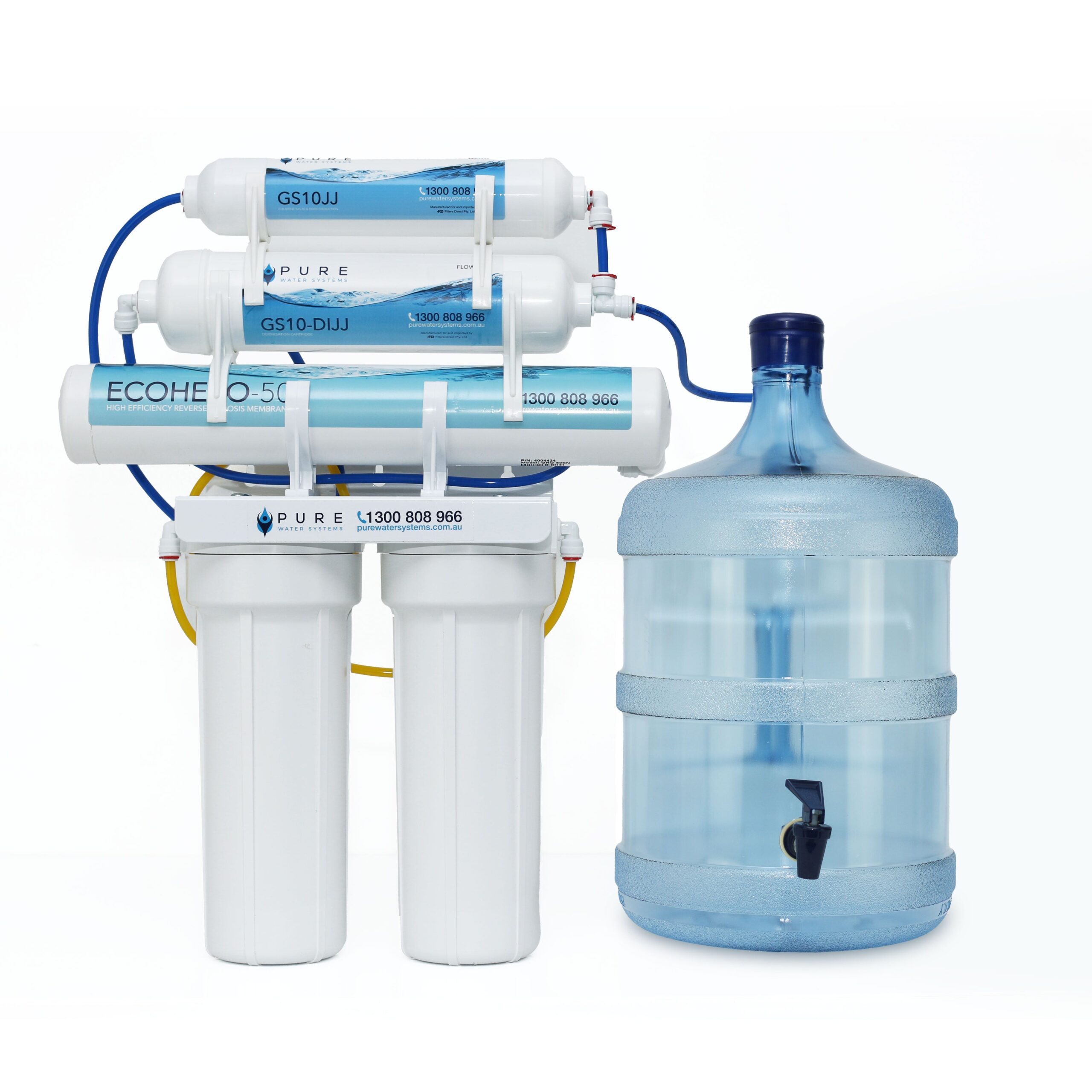
PWS EcoHero 5-Stage Under-Sink Reverse Osmosis
WaterMark AS3497 certified — the Australian standard for permanently plumbed filtration. Five stages including pH remineralisation, which offsets the flat taste of demineralised Perth RO water. Local warranty and AU-stocked filters.
See at Pure Water Systems →The Pure Water Systems EcoHero is the only under-sink RO in this list carrying WaterMark AS3497 certification — the Australian standard legally required in most states for permanently plumbed water filtration. For Perth homeowners installing an under-sink system, this is the compliance-clean choice. Five stages: sediment → activated carbon block → RO membrane → deionising stage → pH remineralisation. The remineralisation stage is particularly relevant for Perth. Perth’s source water is already high in dissolved minerals, but after the RO membrane strips it to near-zero TDS, remineralised water (slightly alkaline, neutral taste) is noticeably more pleasant to drink than flat post-RO water. Australian brand with Perth-accessible customer support and locally stocked replacement filters — no 6-week international shipping delays when a filter needs replacing. at checkout.
PWS EcoHero — Pros and Cons
Pros
- WaterMark AS3497 certified — Australian compliance standard
- pH remineralisation — solves flat-taste problem
- ~95% PFAS and fluoride removal
- Australian brand, locally stocked filters, local warranty
- 10% off with code
Cons
- ~$695 + ~$250 licensed plumber installation
- Not suitable for renters
- Annual filter cost ~$150
- Requires bench hole for dedicated filter tap
Buy if: You own your Perth home and want the most comprehensively Australian-certified RO system with local support, WaterMark compliance, and pleasant mineralised water output. See at Pure Water Systems →
5-Year Cost Comparison: RO vs Bottled Water in Perth
Perth bottled water typically costs $0.80–$1.50 per litre at a supermarket. Against that benchmark, RO filtration at home is dramatically cheaper over any multi-year period. Assumes a 4-litre-per-day filtered water household.
| Option | Upfront | Annual cost | 5-yr total | Cost/litre |
|---|---|---|---|---|
| Bottled water (1L/day @ $1.00/L) | $0 | $365 | $1,825 | $1.00/L |
| Bottled water (2L/day @ $1.00/L) | $0 | $730 | $3,650 | $1.00/L |
| AquaTru Classic (renters) | $749 | $140 | $1,449 | $0.11/L |
| PWS EcoHero 5-Stage | $945* | $150 | $1,695 | $0.13/L |
| Waterdrop D6 Under-Sink | $1,149* | $225 | $2,274 | $0.17/L |
* Includes estimated $250 Perth plumber installation. 4L/day household. Filter costs are annual averages from manufacturer pricing. Bottled water at $1.00/L is a conservative Perth supermarket estimate.
What Perth Households Near Kwinana and Rockingham Should Know
The southern Perth suburbs — Kwinana, Rockingham, Waikiki, Safety Bay, and Mandurah — sit adjacent to the Kwinana industrial strip, one of Australia’s most concentrated heavy industrial zones, as well as the former Pearce RAAF base (now Pearce Air Force Base) in Bullsbrook and Jandakot Airport. All three sites have documented histories of AFFF (aqueous film-forming foam) use, which contains long-chain PFAS compounds.
Western Australia’s Department of Water and Environmental Regulation (DWER) has conducted PFAS investigations in these areas. The Water Corporation’s IWSS scheme water drawn from surface and deep groundwater sources is tested and treated, but the groundwater beneath some private properties in these suburbs has returned elevated PFAS readings in past investigations. If you are on a private bore (not scheme water), the risk is different — bore water quality in these suburbs should be tested independently.
For scheme water users in these suburbs, the Water Corporation’s standard supply is regularly tested. However, the monitoring gap highlighted in the 2026 Alcoa reporting is relevant here too: the Yarragadee aquifer — which supplies Perth including southern suburbs — runs close to Alcoa’s Huntly and Willowdale mine operations. If you are in Rockingham, Kwinana, or Mandurah and want certainty, an RO system at the tap is the most practical household-level solution, regardless of what any utility report says.
Last reviewed: June 2026 — Clean and Native
Also filtering your shower water? See our full Best Shower Filter Australia 2026 guide — including the only catalytic carbon option proven effective for chloramine cities.
Frequently Asked Questions About Perth Tap Water
Is Perth tap water safe to drink?
Yes — Perth tap water meets the Australian Drinking Water Guidelines (ADWG) and is safe to drink under the regulatory definition. The ADWG sets health-based guideline values for over 100 contaminants. However, “safe to drink” under the ADWG means contaminant levels are below health-risk thresholds, not that the water is contaminant-free. Perth tap water contains free chlorine, fluoride, and hardness minerals that some households prefer to filter out.
Does Perth tap water have chlorine or chloramine?
Perth uses free chlorine, not chloramine, as its primary disinfectant. This is confirmed by the Water Corporation and WA Department of Health — chloramine is only used in WA’s Goldfields and Agricultural Water Supply Scheme (remote rural WA), not Perth metro. Standard activated carbon pitcher filters remove free chlorine effectively — so unlike Brisbane or Sydney households, Perth residents do not need catalytic carbon filters specifically for disinfectant removal. If you want fluoride removed, only reverse osmosis or activated alumina work; standard carbon cannot remove fluoride regardless of city.
Why does my Perth tap water smell like chemicals?
The chemical smell in Perth tap water is almost always free chlorine — the disinfectant added by the Water Corporation. A standard activated carbon pitcher filter or under-sink carbon block will remove it effectively. Perth uses free chlorine (not chloramine), so standard carbon filters are fully effective here. A reverse osmosis system will also remove chlorine along with fluoride and hardness if you want comprehensive filtration.
Does Perth tap water have fluoride?
Yes — the Water Corporation adds fluoride to Perth’s reticulated water supply at a target concentration of 0.7–1.0 mg/L. Only reverse osmosis (90–97% removal) or activated alumina (80–95%) can remove fluoride. Carbon filters of any type cannot remove fluoride.
What is the TDS of Perth tap water?
Perth tap water has a TDS of approximately 170 mg/L and a hardness of approximately 180 mg/L calcium carbonate. This is classified as hard water and is noticeably higher than Melbourne (~60 mg/L TDS) or Sydney (~80–100 mg/L TDS). A reverse osmosis system will reduce Perth tap water to approximately 5–20 mg/L TDS at the membrane outlet.
Does Perth water have PFAS?
The Water Corporation’s IWSS scheme water is tested for PFAS and is currently within ADWG guideline values. However, elevated PFAS has been detected in groundwater near Kwinana, Rockingham, RAAF Base Pearce (Bullsbrook), and Jandakot Airport. Households in these suburbs on private bores should have their water tested. For scheme water users concerned about PFAS as a precautionary measure, reverse osmosis removes >95% of known PFAS compounds.
Can I use a Brita filter for Perth tap water?
A standard Brita pitcher filter will remove free chlorine from Perth water effectively — Perth uses free chlorine (not chloramine), so standard GAC-based carbon filters work as intended. However, Brita filters cannot remove fluoride, PFAS, or hard water minerals regardless of city. If you want fluoride removal, you need reverse osmosis. If you only want to improve the taste and smell of Perth tap water, a standard carbon pitcher filter is an adequate and cost-effective choice.
What is the Alcoa water monitoring issue in Perth?
In March 2026, ABC News reported that the Water Corporation had raised concerns about Alcoa restricting access to bauxite mine sites in Perth’s drinking water catchment. The Water Corporation stated that restricted access had “significantly diminished” their ability to monitor potential contamination near the Yarragadee aquifer, a major Perth groundwater supply source. No contamination event has been confirmed — the issue relates to monitoring capacity. The Water Corporation is continuing to press Alcoa for access.
How hard is Perth water compared to other Australian cities?
Perth has some of the hardest tap water of Australia’s major cities, with hardness of approximately 180 mg/L CaCO₃ and TDS around 170 mg/L. For comparison: Melbourne is ~25 mg/L CaCO₃ (very soft), Brisbane is ~80–120 mg/L (moderate), and Adelaide is ~140 mg/L (hard). Perth water will visibly scale kettles, appliances, and shower screens faster than in most other Australian capitals. Reverse osmosis reduces hardness by 90–98%; a dedicated water softener addresses hardness but does not remove fluoride, PFAS, or chlorine disinfection byproducts.
Get the Australian Home Environment Checklist
30 checks across water, air and EMF. Most of them free. Ranked by impact.
No spam. Unsubscribe any time.

Former Royal Australian Navy Clearance Diver and TAG-E counter-terrorism operator. Founded Clean and Native to apply the same rigorous thinking to the home environment.
Full biography →