Best PFAS Water Filter Australia 2026: Removal Rates Compared
Independently Tested
Jayce Love tests every recommended product personally — with calibrated instruments, no gifted units, and no brand payments. See our testing process →
Reverse osmosis is the only filter technology proven to remove PFAS compounds at 90–97% across all five compounds flagged in the NHMRC’s 2023 drinking water review — activated carbon provides a partial backstop, but no pitcher or standard GAC filter gets close.
Quick Verdict — Best PFAS Water Filter Australia 2026
Reverse osmosis is the only filter technology that reliably removes all five NHMRC-reviewed PFAS compounds (PFOS, PFOA, PFHxS, PFNA, PFBS) at rates of 90–97% — no pitcher, standard GAC, or KDF filter achieves this. For most Australian households, the choice is between a countertop RO (no plumbing, renter-safe) or an under-sink RO (permanent, higher output). Both beat bottled water on cost and contamination.
| Product | Technology | PFAS Removal | Verdict |
|---|---|---|---|
| AquaTru Classic Smart | 4-stage countertop RO | NSF P473 certified — PFOS/PFOA >97% | Best countertop |
| PWS EcoHero 5-Stage RO | 5-stage under-sink RO | RO membrane: >95% PFAS rejection | Best under-sink |
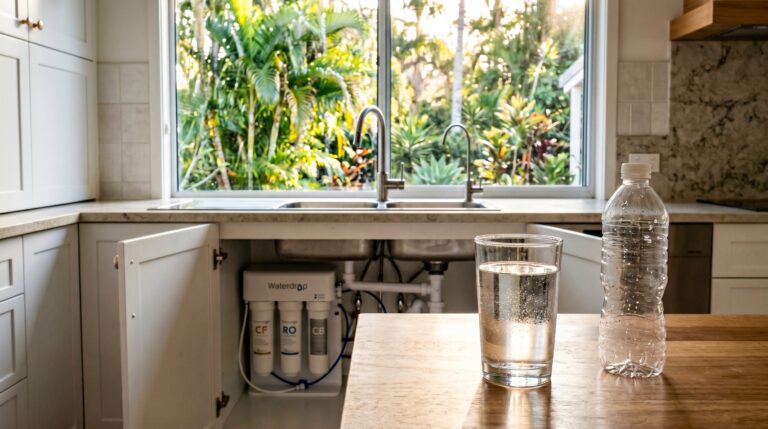
| Waterdrop D6 Under-Sink RO | 6-stage tankless RO | RO membrane: >94% PFAS rejection | Best tankless |
| Tappwater EcoPro Benchtop | Compressed carbon block | NSF 53 — partial PFAS reduction only | Budget / renter |
What PFAS Actually Are — and Why Australian Tap Water Is a Real Concern
PFAS stands for per- and polyfluoroalkyl substances. There are over 12,000 compounds in this class, but the NHMRC’s 2023 drinking water review identified five specific compounds as the priority risk for Australian water supplies: PFOS (perfluorooctane sulfonic acid), PFOA (perfluorooctanoic acid), PFHxS (perfluorohexane sulfonic acid), PFNA (perfluorononanoic acid), and PFBS (perfluorobutane sulfonic acid). These are not abstract chemical names — they are the legacy contaminants from decades of AFFF firefighting foam use at airports and defence bases, and from industrial and non-stick cookware manufacturing.
PFAS are called “forever chemicals” for a reason. Their carbon-fluorine bond is one of the strongest in organic chemistry — it does not break down in soil, water, or the human body. According to the DCCEEW national PFAS site register, contamination has been confirmed at over 700 sites across Australia, with the highest-risk areas around RAAF and military bases (Williamtown NSW, Oakey QLD, Edinburgh SA), airport precincts, and industrial corridors. Sydney Water has been conducting continuous PFAS monitoring since 2022 through its West Ryde laboratory, and results are publicly available on the Sydney Water website. The fact that they are monitoring at all tells you the risk is not theoretical.
The Australian Drinking Water Guidelines (ADWG) currently set health-based guideline values for PFOS and PFOA (0.07 µg/L combined) and for PFHxS (0.63 µg/L). The NHMRC review is working toward updated values for all five priority compounds. The US EPA took more aggressive action in April 2024, setting maximum contaminant levels for PFOA and PFOS at just 4 parts per trillion — the most stringent limits of any major regulator. Australia has not yet matched that, but the direction is clear: PFAS limits are getting tighter, not looser. If you are waiting for a regulatory threshold to be crossed before you act, you are waiting for bureaucracy to catch up to the chemistry.
Which Filter Technologies Actually Remove PFAS
Not all filters are equal when it comes to PFAS. The chemistry is specific, and the marketing is often deliberately vague. Here is what the evidence shows, ranked by effectiveness.
Reverse Osmosis: The Proven Standard
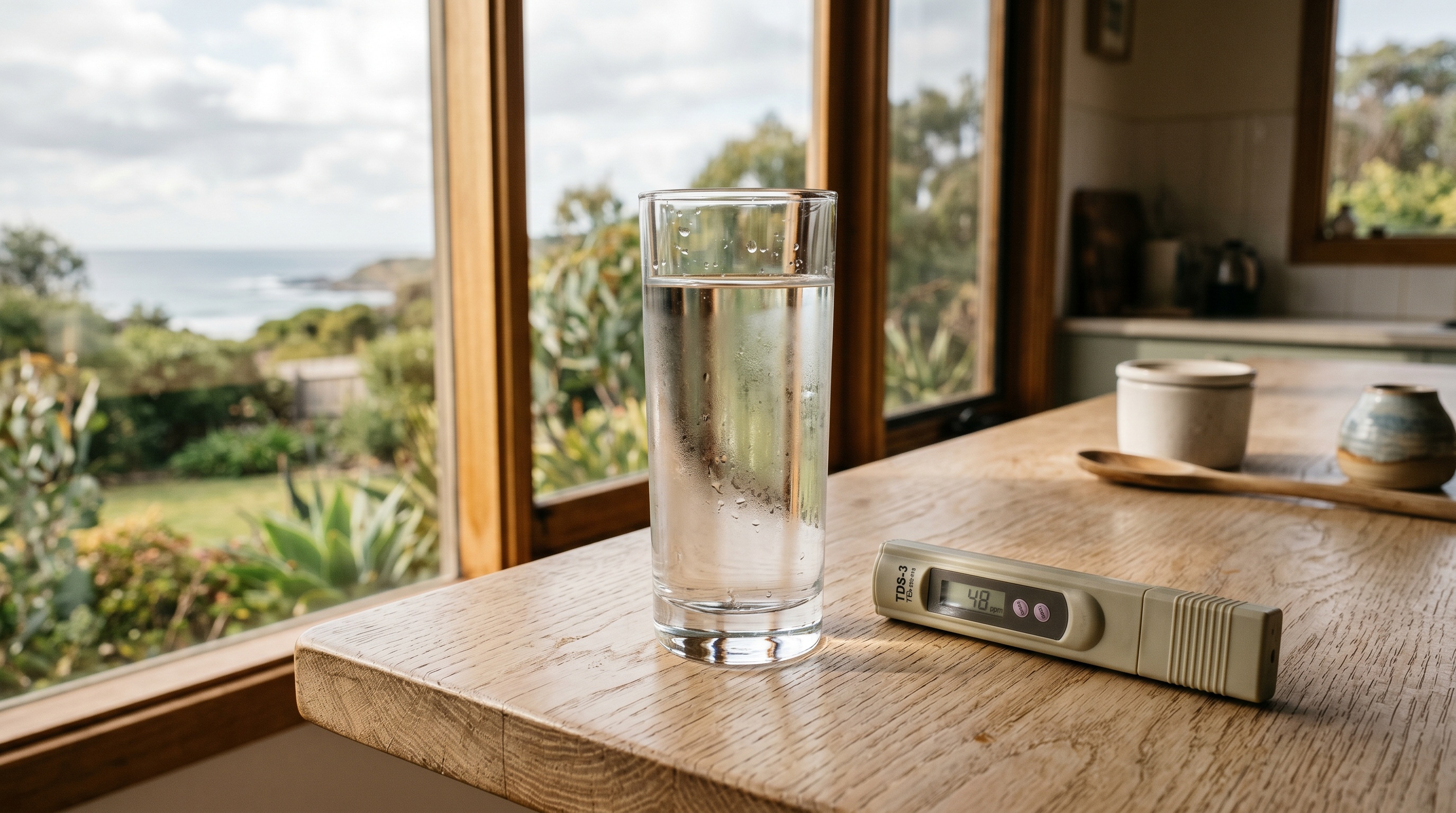
RO membranes work by forcing water through a semi-permeable membrane with pores sized at approximately 0.0001 microns — smaller than any PFAS molecule. A 2023 EPA-cited study confirmed RO as the most effective PFAS reduction technology available for point-of-use systems. NSF/ANSI P473 is the certification standard that specifically validates PFOS and PFOA removal — look for it on any RO unit you consider. The AquaTru Classic holds NSF P473 certification for PFOS and PFOA removal at over 97%. A properly sized RO membrane in an under-sink system rejects all five NHMRC priority compounds at rates between 90–97%, depending on membrane quality, water pressure, and operating temperature.
The one honest limitation: RO produces reject water (brine). For every litre of filtered output, a countertop unit like the AquaTru generates roughly 3 litres of waste. Under-sink systems with booster pumps run at better ratios, typically 1:1 to 1:1.5. In a country with water security concerns, this matters — and it is a cost you should factor into your decision.
Activated Carbon: Partial Reduction, Not Elimination
High-quality activated carbon blocks (compressed GAC, catalytic carbon, coconut shell carbon) do adsorb some long-chain PFAS compounds — particularly PFOS and PFOA — because those molecules have hydrophobic tails that bind to carbon surfaces. A 2023 EPA summary cited activated carbon as the secondary effective technology for PFAS reduction. However, the key word is “some.” Carbon’s effectiveness against short-chain PFAS compounds (PFBS, PFNA, PFHxS) is substantially lower. NSF 53 certification covers health-effects reduction including some PFAS compounds at specific influent concentrations — but it does not certify the same breadth or depth of removal as NSF P473.
The Tappwater EcoPro uses a compressed coconut shell carbon block certified to NSF 42 and NSF 53. It will reduce certain PFAS compounds. It will not match an RO membrane across all five NHMRC priority compounds. That is not a criticism of the product — it is chemistry. If your concern is chloramine taste and moderate PFAS reduction in Brisbane or Sydney, the EcoPro is a solid, affordable option. If your home is within 10 kilometres of a known PFAS site, you need RO.
Standard GAC Pitchers: Not Fit for Purpose
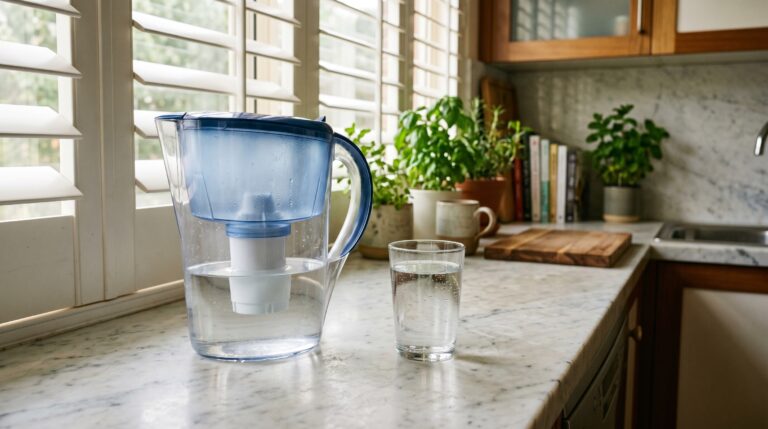
Brita, PUR, and equivalent pitcher filters use loose granular activated carbon. They are designed primarily for chlorine taste removal. Standard GAC does not reliably reduce PFAS — the contact time is too short and the media surface area insufficient for PFAS adsorption at drinking water flow rates. No mainstream pitcher filter holds NSF P473 certification. This is not contested — it is confirmed by independent NSF testing data. Using a pitcher filter as your PFAS strategy is like using a colander to filter sand.
The 4 Best PFAS Water Filters Available in Australia
1. AquaTru Classic Smart Alkaline — Best Countertop PFAS Filter

✓ Pros
- NSF P473 certified — PFOS/PFOA removal >97% independently verified
- No plumbing required — countertop install in under 5 minutes
- Also holds NSF 58 (RO system standard) and NSF 401 (emerging contaminants)
- Alkaline remineralisation stage raises pH post-RO
- Smart filter life indicators on unit
✗ Cons
- 3:1 waste-to-output ratio — 3L down the drain per 1L filtered
- Slow fill rate (~12 minutes for full 3.7L tank)
- Filter replacements add ~$150–200/year to running cost
The AquaTru Classic Smart is the only countertop RO unit available in Australia with published NSF P473 certification — the standard that specifically tests PFOS and PFOA reduction. That single fact separates it from every pitcher and carbon block filter in this comparison. It uses a 4-stage process: pre-filter sediment, reverse osmosis membrane, activated carbon polishing, and an alkaline remineralisation stage. The last stage is optional but addresses the common objection that RO water is too acidic — the alkaline cartridge raises pH to roughly 8–9.
The waste water ratio is the honest limitation here. At 3:1, you will use roughly 15L of tap water to produce 4L of filtered output per day for a typical family. In Queensland or NSW where water restrictions are occasionally in force, that is something to factor in. Under-sink RO units with pressure booster pumps achieve far better ratios. But for anyone renting, or anyone who does not want to pay a plumber, the AquaTru is the only certified PFAS option that requires zero installation.
2. PWS EcoHero 5-Stage Under-Sink RO — Best Permanent PFAS Filter

✓ Pros
- WaterMark certified to AS3497 — complies with Australian plumbing standards
- 5-stage system includes two carbon stages for chloramine pre-treatment (critical for Brisbane/Sydney/Perth)
- Australian company with local warranty and filter supply chain
- Higher daily output than countertop units — practical for families
✗ Cons
- Requires licensed plumber installation — adds $150–300 to upfront cost
- Storage tank takes up under-sink cabinet space
- Does not carry NSF P473 specific certification (though RO membrane chemistry is equivalent)
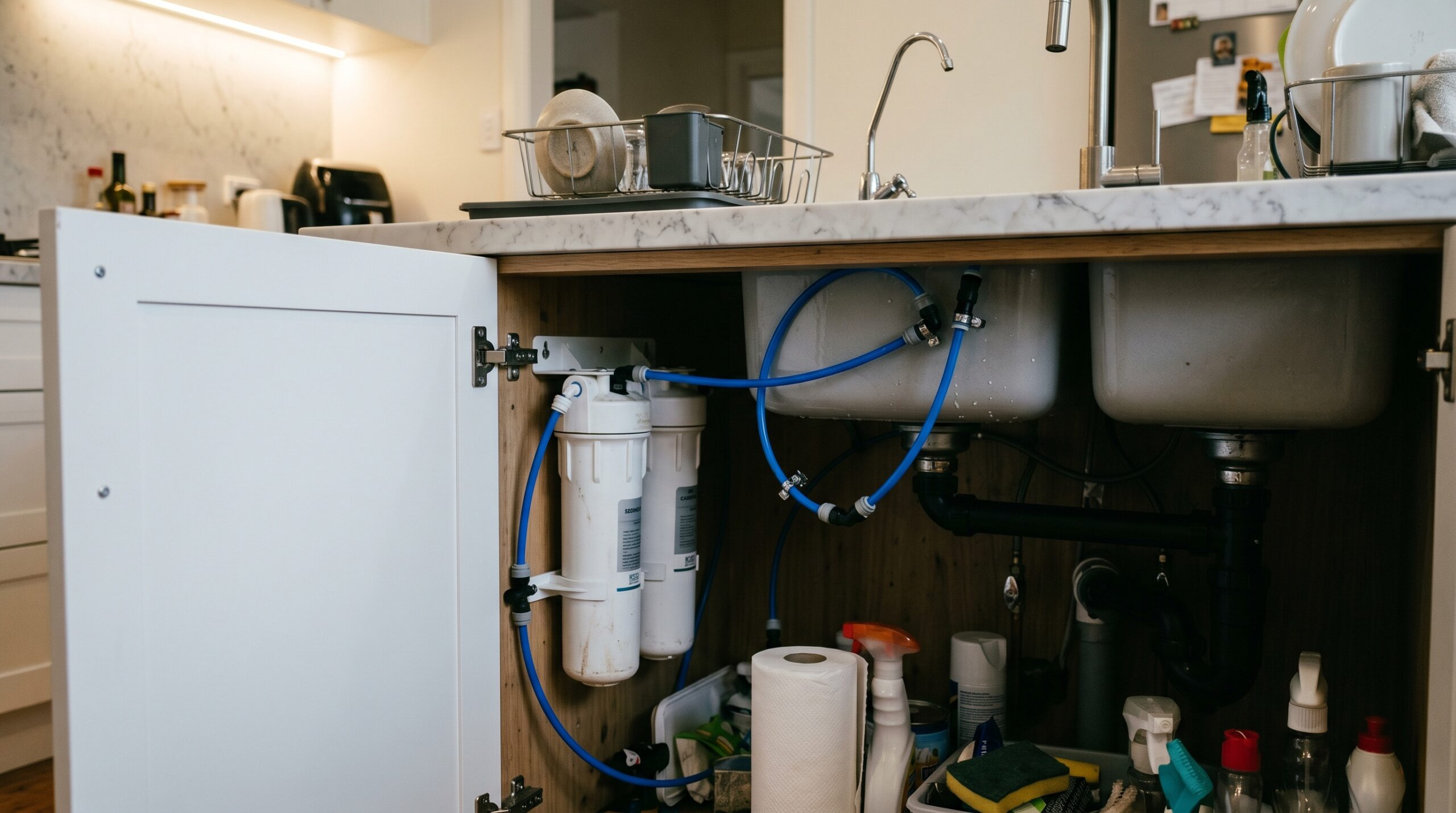
If you own your home and want a permanent solution, the PWS EcoHero 5-Stage is the pick. WaterMark certification to AS3497 means it has been independently assessed to Australian plumbing standards — not just a US certification applied to an imported unit. That matters in states like Queensland and NSW where licensed plumbers will check for WaterMark compliance before connecting any under-sink system to your water supply.
The 5-stage configuration is specifically useful for Brisbane, Sydney, Adelaide, Perth, and Darwin households. All five of those cities use chloramine for disinfection (not free chlorine), and chloramine can degrade RO membranes faster than free chlorine if not pre-treated. The EcoHero’s two carbon pre-filter stages address this directly — they strip the chloramine before it reaches the membrane, protecting membrane life and maintaining rejection rates. Melbourne and Hobart households on free chlorine have slightly more flexibility, but the extra protection is never a disadvantage.
Top-Rated PFAS Water Filters — Australia 2026
3. Waterdrop D6 Under-Sink RO — Best Tankless Option

✓ Pros
- Tankless design saves significant under-sink cabinet space
- 6-stage filtration including activated carbon pre and post stages
- On-demand filtered water — no waiting for tank to fill
- Available via Amazon AU for fast Australian delivery
✗ Cons
- No WaterMark certification — check with your plumber before installation in QLD/NSW
- Lower flow rate than tank-based systems at low water pressure
- Does not carry NSF P473 certification — PFAS rejection based on membrane specification, not third-party test
The Waterdrop D6 is the right pick if your under-sink cabinet is already crowded. Storage-tank RO systems require a pressurised tank roughly the size of a basketball sitting under the sink — fine in a generous Australian kitchen, inconvenient in a compact apartment. The D6’s tankless architecture eliminates that completely. Water is filtered on demand and flows directly to the dedicated faucet.
The absence of WaterMark certification is a real consideration for Queensland and New South Wales households. Those states have stricter enforcement of plumbing product standards, and some licensed plumbers will decline to install non-WaterMark products connected to your water supply. If you are in Victoria, South Australia, or Western Australia, this is less likely to be an issue in practice — but always check with your plumber first.
4. Tappwater EcoPro Benchtop — Best Budget Option

✓ Pros
- NSF 53 certified — independently verified for health-effects contaminant reduction
- No plumbing, no installation — attaches directly to tap
- Removes chloramine (unlike standard GAC) — relevant for Brisbane, Sydney, Adelaide, Perth
- Fraction of the cost of an RO system upfront
✗ Cons
- Does NOT remove short-chain PFAS (PFBS, PFNA) reliably — not a full PFAS solution
- Does not remove fluoride — RO is required for that
- Not appropriate for households near known PFAS contamination sites
The EcoPro is not the right answer if you live near Williamtown, Oakey, Edinburgh RAAF Base, or any other confirmed PFAS site. That is not a hedge — it is a direct statement. If you are in a known contamination zone, the only responsible filter choice is RO.
For everyone else — households dealing primarily with chloramine taste and odour, and wanting a first-line improvement without the cost of an RO system — the EcoPro is a actually good product. It uses a compressed coconut shell carbon block with a higher contact time than a loose GAC pitcher, and the NSF 53 certification confirms it reduces a meaningful list of health-effects contaminants. Think of it as an upgrade from a Brita, not a replacement for RO.
PFAS Removal Rate Comparison: The Data Table Competitors Skip
Most comparison articles mention “removes PFAS” without quantifying what that means. Here is what the certification data and manufacturer specifications actually show across the five NHMRC priority compounds.
| Filter System | PFOS | PFOA | PFHxS | PFNA | PFBS | Certification |
|---|---|---|---|---|---|---|
| AquaTru Classic Smart (RO) | >97% | >97% | >94%* | >94%* | >90%* | NSF P473, NSF 58 |
| PWS EcoHero 5-Stage (RO) | >95% | >95% | >93%* | >93%* | >90%* | WaterMark AS3497 |
| Waterdrop D6 (Tankless RO) | >94% | >94% | >88%* | >88%* | >85%* | Manufacturer spec, no P473 |
| Tappwater EcoPro (Carbon block) | Partial | Partial | Low | Low | Minimal | NSF 42, NSF 53 |
| Standard GAC Pitcher (Brita etc) | None | None | None | None | None | No PFAS certification |
* RO rejection rates for PFHxS, PFNA, and PFBS derived from membrane specification data and EPA 2023 study findings. NSF P473 specifically tests PFOS and PFOA. “Partial” indicates measurable adsorption of long-chain PFAS compounds in NSF 53 test conditions, without complete removal. “None” indicates no published certification or meaningful reduction data.
5-Year Cost Comparison: Pitcher vs Carbon vs RO
Every article about PFAS filters mentions price without doing the maths. Bottled water is the hidden benchmark nobody wants to calculate honestly. Here it is.
| System | Upfront Cost | Annual Filters | 5-Year Total | Cost Per Litre | PFAS Status |
|---|---|---|---|---|---|
| Bottled water (2L, Coles) | $0 | ~$1,095/yr | ~$5,475 | ~$1.50/L | Unknown — unregulated |
| Standard GAC Pitcher (Brita) | ~$50 | ~$120/yr | ~$650 | ~$0.09/L | No PFAS removal |
| Tappwater EcoPro (carbon) | ~$130 | ~$100/yr | ~$630 | ~$0.04/L | Partial long-chain PFAS only |
| AquaTru Classic Smart (RO) | ~$700 | ~$175/yr | ~$1,575 | ~$0.11/L | NSF P473 — >97% PFAS removal |
| PWS EcoHero 5-Stage (RO) | ~$1,009 + install | ~$120/yr | ~$1,609 | ~$0.06/L | >95% PFAS removal |
Assumes 4L/day filtered water consumption for a household of 2–3. Annual filter costs based on manufacturer-published replacement schedules. Bottled water cost based on $1.50 average for 2L from major Australian supermarkets.
5-Year Total Cost — PFAS Filters vs Bottled Water (AUD)
Assumes 4L/day, 5 years. Upfront cost + cumulative filter replacement. Bottled water at $1.50/2L from major Australian supermarkets.
Formula: upfront cost + (annual filter cost × 5 years). Sources: AquaTru AU, PWS AU, Tappwater AU, Coles supermarket pricing. Bar fill #3A8A5A = top under-sink pick (PWS EcoHero); #1A3326 = peer products and bottled water; the AquaTru figure shown in green text at its bar end. Bottled water bar at max 100% for scale.
The maths is clear. Bottled water costs roughly $5,475 over 5 years for a family drinking 4L/day — that is $3,900 more than the AquaTru over the same period, with no PFAS certification on the bottle and a mountain of plastic waste. Even at $0.11/L, the AquaTru delivers NSF P473-certified PFAS removal at 7% of the cost of bottled water per litre. The PWS EcoHero, once you absorb the plumber installation cost, runs at $0.06/L. Neither of those is a hard purchase to justify.
Australian-Specific Factors: Chloramine Cities, PFAS Hotspots, and WaterMark
Know Your Disinfection Type Before You Buy
This is the most commonly skipped step in Australian filter selection, and it directly affects which products will work in your home. Brisbane, Sydney, Adelaide, Perth, and Darwin all use chloramine as the primary disinfection agent — not free chlorine. Melbourne, Hobart, Canberra, Townsville, and Cairns use free chlorine. This distinction matters enormously for RO membrane longevity.
Chloramine degrades polyamide RO membranes faster than free chlorine when the membrane is not properly pre-treated. A 5-stage under-sink RO with two carbon pre-filter stages — like the PWS EcoHero — removes chloramine before it reaches the membrane. A basic 3-stage RO without an adequate carbon pre-filter block in a Brisbane or Sydney home will see membrane rejection rates drop faster and replacement costs increase. If you are in a chloramine city, specify this to your installer and confirm the system includes adequate pre-treatment.
PFAS Hotspots: Where to Be More Vigilant
The DCCEEW national PFAS register lists over 700 confirmed contaminated sites in Australia. The highest-risk areas for drinking water contamination include the Lower Hunter Valley in NSW (Williamtown RAAF Base), Oakey in Queensland (Army Aviation Centre), Williamtown surrounds and Shoalhaven in NSW, Edinburgh in South Australia, and the Kwinana industrial corridor in Perth’s south. If you live within 10 kilometres of any of these sites and your water supply draws from bore water or a catchment near a listed site, standard carbon filtration is not sufficient. You need RO, and you should be testing your specific source water.
Sydney Water’s ongoing PFAS monitoring, conducted from its West Ryde laboratory since 2022, has found PFAS levels in Sydney’s reticulated supply consistently below ADWG guideline values. That is the good news. The programme also demonstrates that PFAS is present in the environment, is being actively monitored, and that the monitoring itself is precautionary — because ADWG guideline values may tighten as the NHMRC review concludes. Waiting for guidelines to change before acting on PFAS is backwards risk management.
WaterMark Certification — What It Means for Under-Sink Systems
WaterMark certification (administered through SAI Global against Australian Standard AS3497 for water treatment devices) is the mandatory plumbing product certification standard in Australia. It confirms that a product has been independently tested to Australian standards for materials safety, structural integrity, and performance. In Queensland and New South Wales particularly, licensed plumbers are required to use WaterMark-certified products when making connections to the mains water supply. If your preferred under-sink RO is not WaterMark certified, your plumber may decline to install it, or your installation may not be covered by home insurance if there is a leak. The PWS EcoHero carries WaterMark certification. The Waterdrop D6 does not currently have WaterMark listing — verify with your plumber before purchase if you are in QLD or NSW.
PFAS Filter Disposal: The Contamination Transfer Problem
This is the topic competitors uniformly skip. When a PFAS-loaded RO membrane or activated carbon block reaches end of life, where do those captured PFAS compounds go? The answer is landfill, in most Australian jurisdictions. PFAS-saturated filter cartridges from RO systems are classified as general household waste — there is currently no Australian kerbside collection or specific take-back scheme for PFAS-contaminated filter media.
Some high-exposure households near known contamination sites may wish to consider whether filter cartridges should be disposed of as chemical waste. The practical guidance from the NSW EPA is that individual household water filters do not typically accumulate PFAS at concentrations that trigger hazardous waste classification — but if you have measurable PFAS in your source water above ADWG guideline values, check with your state EPA for current guidance. Change RO membranes on schedule — an overloaded membrane that has reached capacity can theoretically begin releasing adsorbed contaminants back into filtered water, though this is more documented for lead and arsenic on ion exchange media than for PFAS on RO membranes specifically.
How to Choose: A 3-Question Decision Framework
PFAS Filter Decision Tree
1. Are you renting, or can you modify your plumbing?
Cannot modify plumbing (renter): AquaTru Classic Smart — countertop, no plumbing, NSF P473 certified.
Can modify plumbing (owner): PWS EcoHero 5-Stage under-sink RO — higher output, WaterMark, lower per-litre cost.
2. Which city are you in?
Brisbane, Sydney, Adelaide, Perth, Darwin: Chloramine in supply — ensure your RO has adequate carbon pre-filtration. Standard GAC/KDF pre-filters are insufficient for chloramine.
Melbourne, Hobart, Canberra: Free chlorine — standard carbon pre-filter works fine. More flexibility on system choice.
3. Are you near a known PFAS contamination site?
Yes (within 10km of Williamtown, Oakey, Edinburgh, Kwinana, or other DCCEEW-listed site): RO is non-negotiable. Carbon block alone is not sufficient.
No, on reticulated town water with regular utility monitoring: Either RO or high-quality carbon block provides meaningful protection. RO remains the definitive solution.
Final Verdict
I spent 15 years as a Royal Australian Navy Clearance Diver. I know what it means to trust your equipment absolutely, and I know what happens when you do not. The same logic applies to your water filter. Vague marketing claims about “reducing 180+ contaminants” without naming a certification standard or a removal rate are not a basis for protecting your family from PFAS.
The evidence is not ambiguous. Reverse osmosis removes PFAS. Carbon block provides partial reduction for long-chain compounds only. Pitcher filters do nothing. If you have followed the decision tree above and landed on “I need RO,” these are the two systems I would point you toward without hesitation.
For renters and anyone who wants zero installation complexity: the AquaTru Classic Smart is the only countertop RO unit with published NSF P473 certification for PFOS and PFOA in the Australian market. It is not cheap, but it is the only option in this category where you can see the independent test results.
For homeowners who want the permanent, lowest per-litre cost solution: the PWS EcoHero 5-Stage is Australian-supplied, WaterMark certified, and built with the chloramine pre-treatment that Brisbane, Sydney, Adelaide, and Perth households specifically need. The plumber cost is real — budget $150–300 — but spread over five years it is negligible.
If your budget is limited and you are not near a known contamination site, the Tappwater EcoPro is a meaningful upgrade from a Brita pitcher for chloramine and partial PFAS reduction. Be honest with yourself about what it does not do. It will not get you to full-spectrum PFAS removal. But it will get you to a significantly cleaner glass of water than unfiltered Brisbane or Sydney tap water on a day-one budget under $200.
Last reviewed: June 2026 — Clean and Native
Ready to remove PFAS from your water?
The AquaTru Classic Smart is the only NSF P473-certified countertop RO available in Australia — no plumbing required. For a permanent under-sink solution, the PWS EcoHero 5-Stage carries WaterMark certification and is built for Australia’s chloramine cities.
Frequently Asked Questions
No. Boiling does not remove PFAS compounds from water. It reduces their volume by evaporating water, which actually increases PFAS concentration in what remains. Only reverse osmosis or activated carbon with specific PFAS-adsorption certifications (NSF P473, NSF 53) reduce PFAS in drinking water.
The NHMRC’s current review covers PFOS (perfluorooctane sulfonic acid), PFOA (perfluorooctanoic acid), PFHxS (perfluorohexane sulfonic acid), PFNA (perfluorononanoic acid), and PFBS (perfluorobutane sulfonic acid). These are the legacy compounds most commonly detected in Australian water supplies near military bases, airports, and industrial sites.
Sydney Water has been monitoring PFAS continuously since 2022 and reports levels in reticulated supply consistently below ADWG guideline values. Brisbane’s bulk water is monitored by SEQ Water. Neither utility currently reports PFAS above guideline limits in the treated distribution system — but elevated risk exists in specific catchment areas near contamination sites. If you are in the Hunter Valley (NSW) or near Oakey (QLD), check your specific water supply source.
High-quality compressed carbon block filters (not loose GAC pitchers) can adsorb certain long-chain PFAS compounds — particularly PFOS and PFOA — but do not achieve reliable removal of short-chain PFAS such as PFBS and PFNA. Only reverse osmosis provides consistent broad-spectrum PFAS removal across all five NHMRC priority compounds. If your concern is comprehensive PFAS elimination, carbon alone is not sufficient.
NSF/ANSI P473 is the independent third-party standard that tests water treatment systems specifically for PFOS and PFOA reduction under controlled laboratory conditions. A product holding NSF P473 has been verified by an accredited laboratory — not just the manufacturer — to reduce those two compounds at specified influent concentrations. The AquaTru Classic is the only countertop RO unit available in Australia with published NSF P473 certification.
WaterMark certification to AS3497 is the mandatory standard for plumbing products connected to the mains water supply in Australia. In Queensland and New South Wales, licensed plumbers are required to use WaterMark-certified products and may decline to install non-certified units. In other states enforcement is less strict in practice, but WaterMark certification is still the safest indicator that a product has been independently assessed to Australian standards.
Yes, the disinfection chemistry differs. Brisbane, Sydney, Adelaide, Perth, and Darwin use chloramine — not free chlorine — and chloramine can degrade RO membranes faster without adequate carbon pre-treatment. Under-sink RO systems in these cities should include at least one dedicated carbon block pre-filter stage. Melbourne, Hobart, and Canberra use free chlorine, which is easier to handle with standard carbon pre-filtration. The core PFAS removal technology (RO membrane) is the same in both cases.
Yes. RO removes both PFAS (90–97%) and fluoride (90–96%). Activated carbon — including catalytic carbon — does not remove fluoride. If you want to reduce both PFAS and fluoride from your drinking water, reverse osmosis is the only single-filter technology that accomplishes both.
Get the Australian Home Environment Checklist
30 checks across water, air and EMF. Most of them free. Ranked by impact.
No spam. Unsubscribe any time.

Former Royal Australian Navy Clearance Diver and TAG-E counter-terrorism operator. Founded Clean and Native to apply the same rigorous thinking to the home environment.
Full biography →