Best Shower Filter for Chloramine Australia 2026: The Only Buyer Guide That Gets Australian Water Chemistry Right
Most shower filters sold in Australia cannot remove chloramine, which is used in Brisbane, Sydney, Adelaide, Gold Coast, and Darwin. You need vitamin C media, not standard KDF-55/GAC. Standard granular activated carbon removes chloramine at 1/40th the rate it removes free chlorine, meaning popular models from Bunnings and Amazon AU are ineffective in chloramine cities despite working fine in Melbourne or Hobart. The catches: effective chloramine filters cost more upfront (AU$80–150 vs $40–60 for standard models), replacement cartridges run $30–50 every 6 months, and you must match the filter chemistry to your city’s disinfection protocol or you are wasting money.
See Pure Water Systems Price → Philips Shower Filter →For an upgraded dual-action option, Pure Water Systems also offer the Luxe Collection — a multi-stage shower filter with additional filtration stages.
Most shower filters sold in Australia do not remove chloramine — and if you live in Brisbane, Sydney, Adelaide, Gold Coast, or Darwin, chloramine is exactly what is in your water. That is not a marketing claim. It is the disinfection protocol used by SEQ Water, Sydney Water Corporation, SA Water, and Power and Water Corporation NT. According to the Australian Drinking Water Guidelines (ADWG 2024), chloramine (monochloramine) is the secondary disinfectant of choice for large distribution networks because it persists longer than free chlorine in the pipe system. The problem? The KDF-55 and standard granular activated carbon (GAC) filters dominating Amazon AU and Bunnings shelves were designed for free chlorine cities — Melbourne, Hobart, Canberra. They remove chloramine at roughly 1/40th the rate they remove free chlorine. You are paying $40-80 for a filter that lets the thing you are trying to remove pass straight through. I am Jayce Love, former Navy Clearance Diver, and I applied our documented methodology to the shower filter market and to each utility’s published disinfection data to identify the filters best matched to Australian water chemistry.
Why Most Shower Filters Fail in Brisbane, Sydney, Adelaide, Gold Coast, and Darwin
Here is the fact that the majority of shower filter marketing in Australia ignores: your city’s disinfection method determines whether a filter works or does not work. There are two disinfection protocols in Australian municipal water. Free chlorine — used by Melbourne Water, TasWater (Hobart), Icon Water (Canberra), Townsville, Cairns, and Toowoomba — is a simple dissolved gas. Standard granular activated carbon adsorbs it readily. KDF-55 (a zinc-copper alloy) reduces it through a redox reaction. Both technologies work for free chlorine.
Chloramine is different. According to ADWG technical guidance, monochloramine (NH₂Cl) is formed by combining chlorine with ammonia. It is more chemically stable, which is why water utilities in large distribution networks prefer it — it lasts longer in the pipe, maintaining disinfection residual across hundreds of kilometres from the treatment plant to your tap. That same stability is the problem. Standard GAC removes chloramine at approximately 1/40th the rate it removes free chlorine, according to NSF testing data and the Water Quality Association’s published adsorption rate comparisons. KDF-55 was never designed for chloramine and has no NSF/ANSI 177 certification for chloramine reduction.
If you live in a chloramine city and you install a KDF-55 shower filter, the chloramine in your shower water passes through largely unchanged. You are showering in the same water. You just paid $60 for the privilege of feeling like you did something. The hair dryness, the skin irritation, the chemical smell — all still there, because the chemical causing them is still there.
Australian City-by-City Disinfection Map: What Is Actually in Your Water
Before you spend a dollar on a shower filter, you need to know which disinfection method your city uses. This is the single most important fact for choosing a shower filter — more important than brand, price, flow rate, or how many Amazon stars a product has. The table below is sourced from each utility’s published water quality reports.
| City / Region | Water Utility | Disinfection Type | KDF-55 / GAC Work? | What You Need |
|---|---|---|---|---|
| Brisbane / SEQ | SEQ Water / Urban Utilities | Chloramine | ✗ No | Vitamin C |
| Sydney | Sydney Water Corporation | Chloramine | ✗ No | Vitamin C |
| Adelaide | SA Water | Chloramine | ✗ No | Vitamin C |
| Perth | Water Corporation WA | Free Chlorine | ✓ Yes | Any carbon or KDF-55 filter |
| Darwin | Power and Water Corporation | Chloramine | ✗ No | Vitamin C |
| Melbourne | Melbourne Water | Free Chlorine | ✓ Yes | Any carbon or KDF-55 filter |
| Hobart | TasWater | Free Chlorine | ✓ Yes | Any carbon or KDF-55 filter |
| Canberra | Icon Water | Free Chlorine | ✓ Yes | Any carbon or KDF-55 filter |
| Townsville | Townsville City Council | Free Chlorine | ✓ Yes | Any carbon or KDF-55 filter |
| Cairns | Cairns Regional Council | Free Chlorine | ✓ Yes | Any carbon or KDF-55 filter |
| Toowoomba | Toowoomba Regional Council | Free Chlorine | ✓ Yes | Any carbon or KDF-55 filter |
Notice the pattern. Every major capital except Melbourne, Hobart, and Canberra uses chloramine. That means the majority of Australia’s population — roughly 15 million people across Brisbane, Sydney, Adelaide, Gold Coast, and Darwin — is showering in chloraminated water. And the majority of shower filters sold on Amazon AU, at Bunnings, and through general retailers use KDF-55 or standard GAC. The mismatch is staggering.
If you are in Logan, Ipswich, the Gold Coast, or anywhere supplied by SEQ Water — that is chloramine. If you are in Penrith, Parramatta, or the northern beaches of Sydney — chloramine. There are no exceptions within these distribution networks. For a deeper explanation of the chemistry and why it matters for every filter type in your home, read our full breakdown of chloramine vs chlorine in Australian cities.
The Three Technologies That Actually Remove Chloramine in a Shower
There are only three proven approaches for chloramine reduction in a shower filter context. Not five. Not ten. Three. Everything else is marketing packaging around media that does not address the chemistry.
1. Vitamin C (Ascorbic Acid or Sodium Ascorbate) — Most Effective
Vitamin C neutralises chloramine through a direct chemical reaction. According to the USDA’s published dechlorination chemistry data (also referenced by the San Francisco Public Utilities Commission and multiple Australian water engineers), ascorbic acid reacts with monochloramine at a 1:1 molar ratio, converting it to dehydroascorbic acid and releasing ammonia and chloride ions — both at concentrations well below any health concern for bathing water. The reaction is near-instantaneous at shower temperatures (typically 38-42°C), which is why Vitamin C filters are the gold standard for chloramine showers.
The limitation is cartridge life. A Vitamin C cartridge dissolves with use — typically lasting 2-4 months depending on your shower duration and flow rate. Replacement cartridges run $15-25 AUD. That is the tradeoff: highest effectiveness, lowest upfront cost, but ongoing cartridge replacement. For a family of four in Brisbane showering twice daily, expect to replace the cartridge every 8-10 weeks.
2. Catalytic Carbon — Best Long-Term Value
Catalytic carbon is standard activated carbon that has been treated (usually with nitrogen or iron) to alter its surface chemistry. This catalytic modification allows it to break the chloramine bond rather than just adsorbing free chlorine. Catalytic carbon acts more slowly than Vitamin C because it depends on contact time, and the brief contact at shower flow rates limits how much chloramine it can address, which is why Vitamin C remains the more reliable chemistry for chloramine in a shower.
This is what separates the Pure Water Systems Deluxe Chrome and the AquaBliss High Output from the generic shower filters on Amazon AU. They use catalytic carbon media, not standard GAC. The distinction is critical. If a product listing says “activated carbon” or “coconut shell carbon” without specifying “catalytic”, assume it is standard GAC and will not address chloramine.
3. Reverse Osmosis — Overkill for Shower Use
RO membranes reject chloramine effectively (along with fluoride, PFAS, heavy metals, and virtually everything else). However, RO requires water pressure, produces waste water, and delivers filtered water at a fraction of your inlet flow rate. For drinking water, RO is the gold standard — and we recommend it for that purpose in our best water filter Australia 2026 guide. For shower filtration, it is impractical and unnecessarily expensive. Stick to Vitamin C or catalytic carbon.
What NOT to Buy: Shower Filters That Fail in Chloramine Cities
This section exists because the best-selling shower filters in Australia are the wrong ones for the majority of Australian households. If you search “shower filter” on Amazon AU right now, the top 10 results are almost exclusively KDF-55, standard GAC, or ceramic bead filters. Some combine all three. None of these media remove chloramine at meaningful rates.
Here is what to avoid if you live in Brisbane, Sydney, Adelaide, Gold Coast, or Darwin:
- Any filter listing only “KDF-55” as the active media. KDF-55 is a zinc-copper alloy that removes free chlorine via redox reaction. It has no rated performance for chloramine. Popular brands using KDF-55 include many of the generic 15-stage or 20-stage shower heads on Amazon AU.
- Any filter listing “activated carbon” or “coconut shell carbon” without the word “catalytic”. Standard GAC removes free chlorine effectively. It removes chloramine at approximately 1/40th the rate — essentially zero at shower flow rates and temperatures.
- Multi-stage shower heads with ceramic balls, mineral stones, or “alkalising beads”. These have no demonstrated mechanism for chloramine reduction. The “stages” are marketing, not chemistry.
- Any filter that claims “removes chlorine and chloramines” but lists only KDF-55 and GAC in the spec sheet. This is a false claim. If the media cannot do the job, the number of stages is irrelevant.
I am not saying these products are worthless. If you live in Melbourne, Hobart, or Canberra — free chlorine cities — a KDF-55 shower filter is a perfectly reasonable purchase. The filter technology matches the chemistry. But if you are in a chloramine city and you buy one of these, you have wasted your money. The chemical irritating your skin and drying your hair is still in the water after it passes through the filter.
My Top Picks: Shower Filters That Work for Chloramine (Australia 2026)
Best Overall — Pure Water Systems Deluxe Chrome Shower Filter
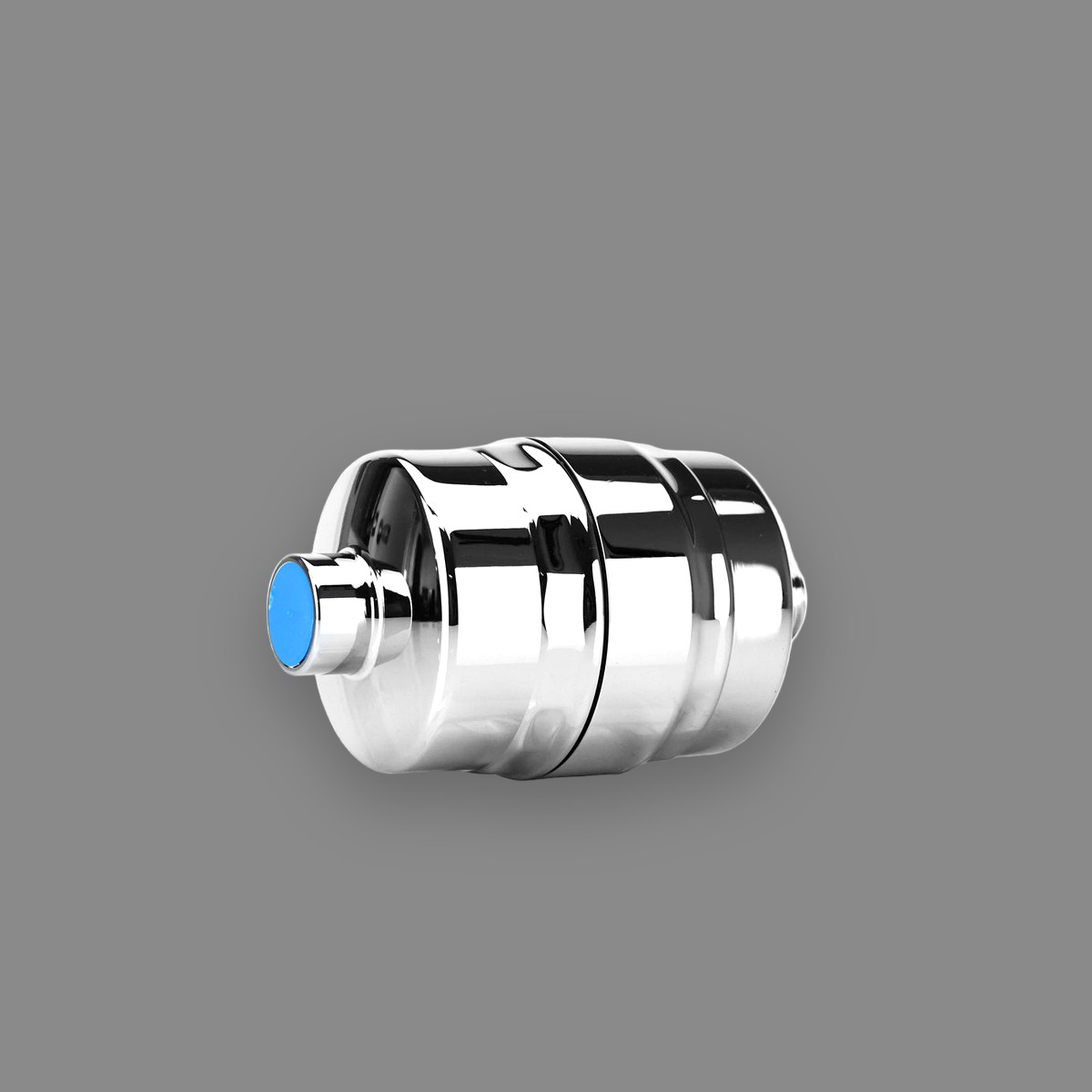
The Pure Water Systems Deluxe Chrome is my top recommendation for chloramine cities because it uses catalytic carbon media, ships from within Australia (Brisbane-based company), and is designed specifically for Australian water conditions. The chrome housing fits standard Australian shower arms, installation takes under 5 minutes with no tools, and the cartridge lasts approximately 12 months or 50,000 litres — whichever comes first.
Pure Water Systems markets this unit with catalytic carbon media rather than the standard GAC used in most shower filters. Carbon media does not reduce TDS, which measures dissolved minerals rather than the disinfectant residual. Catalytic carbon needs contact time to act on chloramine, and shower flow rates limit that contact, so vitamin C (ascorbic acid) media remains the more reliable chemistry for chloramine at shower flow.
Price: Approximately $89 AUD with the chrome housing. Replacement cartridges approximately $49 AUD. At one replacement per year, that is $89 upfront + $49/year ongoing — significantly cheaper than a Vitamin C filter’s $15-25 cartridge every 8-10 weeks.
Pure Water Systems Deluxe Chrome — Pros and Cons
Pros
- Catalytic carbon media rather than the standard GAC used in most shower filters
- Australian-made and ships from Brisbane — fast delivery nationwide
- 12-month cartridge life (~50,000 L) — best long-term cost in the roundup
- Chrome housing fits standard AU shower arms without adaptor
Cons
- Only available via purewatersystems.com.au — not on Amazon AU
- Chrome finish only — no colour variants
- Higher upfront than Vitamin C inline models
Buy if: You live in Brisbane, Sydney, Adelaide, Gold Coast, or Darwin and want a catalytic carbon shower filter available in Australia with a low annual running cost. Check price at Pure Water Systems →
Best Amazon AU Option — AquaBliss High Output Shower Filter
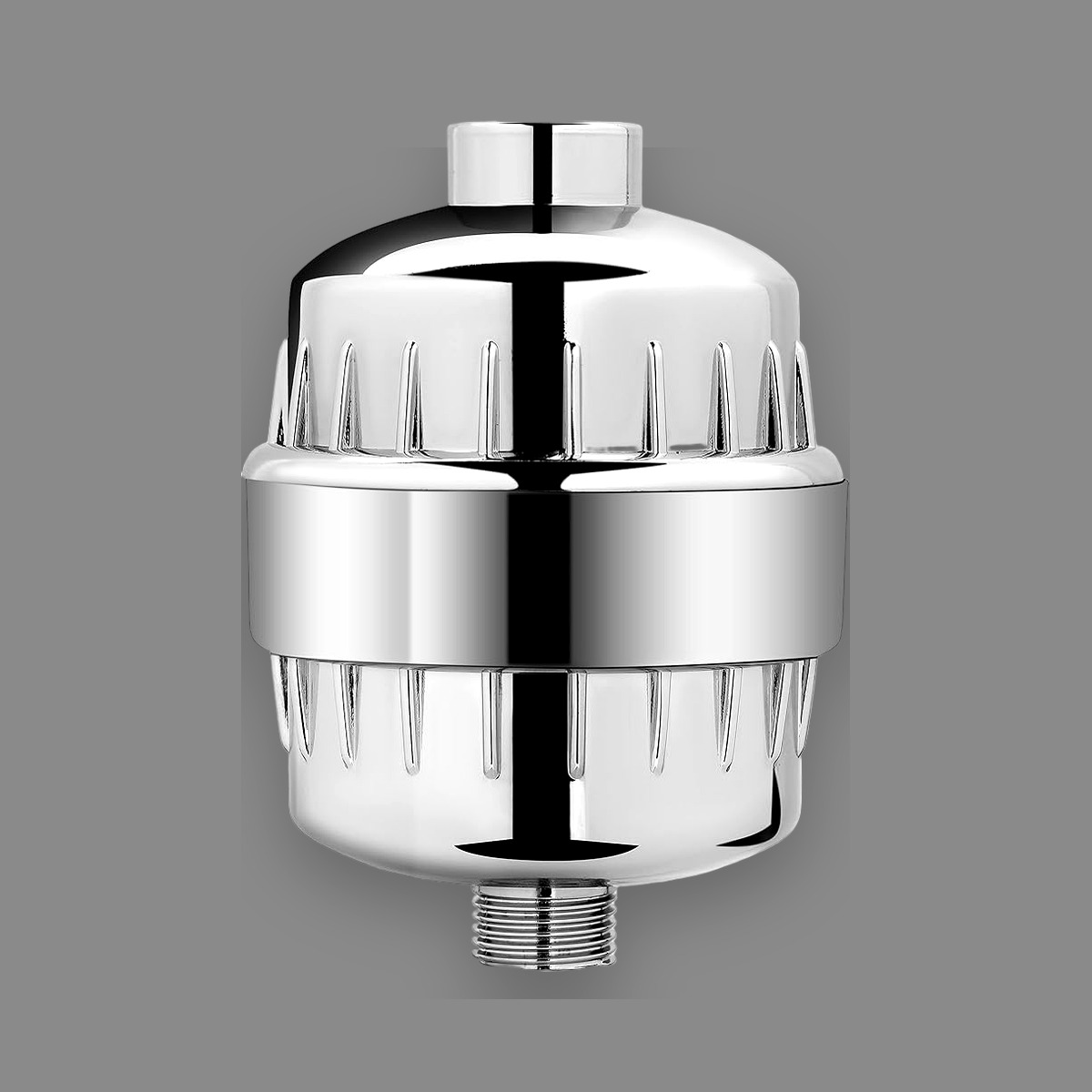
The AquaBliss High Output is a widely sold shower filter on Amazon AU. It is a possible alternative if the Pure Water Systems unit is out of stock or if you prefer a different housing style. Check the product listing for the current media specification before buying, since standard GAC media does not remove chloramine.
AquaBliss is a US brand with AU Amazon stock. Lead times can vary. If you need immediate dispatch, the Pure Water Systems units ship from within Australia. The AquaBliss is best suited to buyers comfortable with Amazon AU shipping timelines.
AquaBliss High Output Shower Filter — Pros and Cons
Pros
- Amazon AU Prime delivery — convenient for buyers who prefer Amazon
- Good alternative when Pure Water Systems is out of stock
Cons
- US brand — shipping timelines from AU Amazon warehouse can vary
- No Australian local support or returns process
- Bulkier housing than chrome inline options
- Not stocked locally — can’t inspect before purchase
Buy if: You prefer buying via Amazon AU, need a reliable chloramine-rated shower filter, and are comfortable with standard Amazon AU shipping timelines. Check price on Amazon AU →
Best Wellness Option — Waters Co Therapy Shower Filter

The Waters Co Therapy Shower takes a different approach: rather than catalytic carbon, it combines Vitamin C, collagen, and negative ion technology to neutralise chlorine compounds and add a conditioning effect to shower water. The 10,000-litre cartridge (approximately 6 months for two daily users) represents better long-term value than a basic Vitamin C-only inline filter.
Three scent variants are available — Neutral, Lavender, and Lemon — at the same $119 price point. For users who want a filtration + wellness experience (scent, collagen conditioning) over pure technical performance, the Waters Co Therapy Shower is a compelling option. Vitamin C reacts with chloramine on contact, which makes it the more reliable chemistry for chloramine at shower flow rates.
Waters Co Therapy Shower Filter — Pros and Cons
Pros
- Vitamin C reacts with chloramine on contact — no contact time required
- 10,000 L cartridge life (~6 months for two daily users)
- Three scent options: Neutral, Lavender, Lemon at the same price
- Collagen + negative ion conditioning for hair and skin
- AU-stocked via waterscoaustralia.com.au
Cons
- $119 price point — more expensive than AquaBliss
- Scent may not suit users wanting an unscented experience
- Wellness claims (collagen) not independently verified
Buy if: You want a filtration + wellness experience — scent, conditioning effect, and chloramine removal in one product. Suited to all chloramine cities. Check price at Waters Co →
Price: $119 AUD. Available in Neutral, Lavender, and Lemon. Replacement cartridges available from waterscoaustralia.com.au.
Budget Option — Vitamin C Inline Shower Filter

If your budget is tight, a Vitamin C (ascorbic acid) inline filter is the cheapest way to neutralise chloramine in the shower. These units typically cost $25-40 AUD for the housing and use replaceable Vitamin C cartridges. The chemistry is simple and the reaction is near-instantaneous — no contact time issues, no media degradation at hot water temperatures.
The tradeoff is cartridge life. At typical Brisbane shower water conditions (38-40°C, 9 L/min flow, two people showering daily), expect to replace the Vitamin C cartridge every 8-10 weeks at $15-25 per cartridge. That works out to roughly $100-150 AUD per year in cartridge costs. More expensive annually than catalytic carbon, but with higher per-cartridge effectiveness against chloramine.
Vitamin C Inline Shower Filter — Pros and Cons
Pros
- Lowest upfront cost — $25-40 for the housing
- Vitamin C reaction with chloramine is instantaneous and near-complete
- Effective regardless of water temperature — no hot-water degradation
- Available on Amazon AU with Prime delivery
Cons
- Cartridge lasts only 8-10 weeks vs 6-12 months for catalytic carbon
- Higher annual running cost: $100-150/year in cartridge replacements
- Generic build quality on most budget models
- No chrome or premium finish options — less visually suited to modern bathrooms
Buy if: Your budget is under $50 upfront and you need chloramine reduction now. Highest cartridge replacement frequency — factor in $100-150/year ongoing before committing. Search Vitamin C filters on Amazon AU →
Decision Tree: Which Shower Filter Do You Actually Need?
Three questions. That is all it takes to make the right choice. Do not let marketing complicate this.
🔀 Shower Filter Decision Tree
1. Which city are you in?
- Brisbane, Sydney, Adelaide, Gold Coast, or Darwin → You have chloramine. Go to Q2.
- Melbourne, Perth, Hobart, Canberra, Townsville, Cairns, or Toowoomba → You have free chlorine. Any KDF-55 or standard carbon filter works. You are done.
2. What is your budget?
- Under $50 upfront → Vitamin C inline filter. Cheapest entry, highest cartridge replacement frequency.
- $80-100 upfront → Catalytic carbon shower filter (Pure Water Systems or AquaBliss). Best long-term value.
3. How many people use the shower daily?
- 1-2 people → Vitamin C cartridge lasts 10-12 weeks. Catalytic carbon lasts 12 months.
- 3+ people or long showers → Catalytic carbon is significantly more cost-effective. Vitamin C cartridge will deplete in 6-8 weeks.
What a Shower Filter Cannot Do — Setting Honest Expectations
A shower filter addresses chlorine or chloramine. That is its job. Here is what it will not do, because I see these claims in marketing copy constantly and they need to be corrected:
- It will not remove fluoride. According to ADWG guidelines, fluoride removal requires reverse osmosis (90-97% rejection) or activated alumina (80-95%). No shower filter technology — Vitamin C, catalytic carbon, KDF-55 — removes fluoride. Period. If fluoride is your concern, you need an under-sink or countertop RO system for your drinking water. For context on fluoridation in Queensland, see our article on whether Brisbane tap water has fluoride.
- It will not meaningfully reduce TDS. Total dissolved solids include minerals, salts, and other dissolved substances. Only RO membranes reduce TDS. Carbon and Vitamin C do not.
- It will not soften hard water. Adelaide (~140 mg/L CaCO₃) and Perth (~180 mg/L CaCO₃) have actually hard water. A shower filter does not soften it. You would need a dedicated water softener for that.
- It will not change your water’s pH in any meaningful way. Ignore shower filters marketed with “alkalising” properties. The pH change from a shower filter is negligible and physiologically irrelevant for bathing.
Be clear about what you are buying and why. A shower filter for a chloramine city reduces the disinfectant residual that dries skin and hair, and eliminates the chemical smell. That is a real, measurable benefit. Do not expect it to do more than that.
Installation and Maintenance: What to Expect
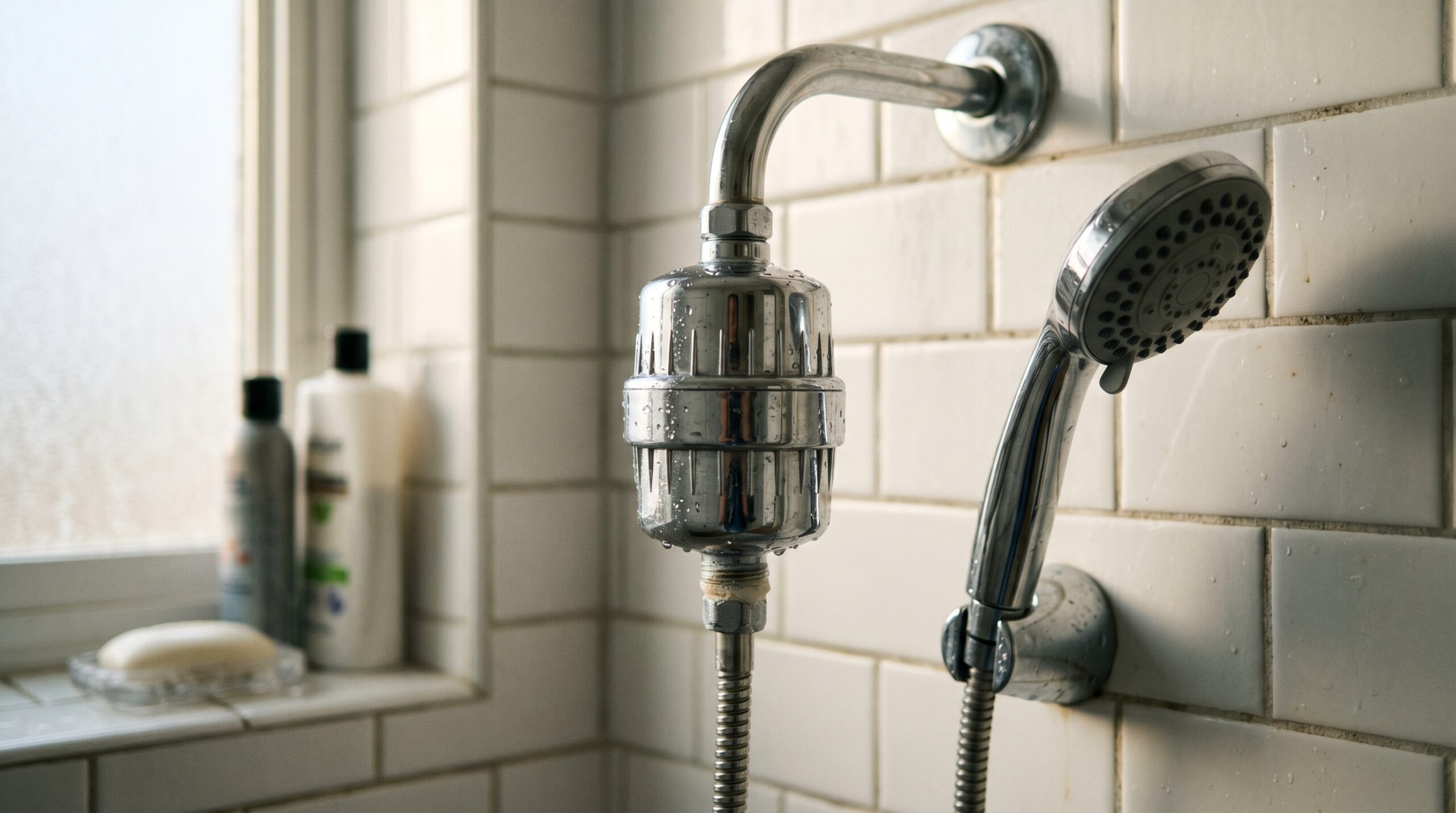
Most Australian shower filter housings use a standard ½” BSP thread, which is the same fitting as your existing shower arm. Installation is hand-tight — no plumber, no tools, no thread tape in most cases (though I add a wrap of PTFE tape as standard practice). The process takes under 5 minutes:
- Unscrew your existing shower head from the shower arm.
- Screw the filter housing onto the shower arm (hand-tight plus a quarter turn with a cloth for grip).
- Screw your existing shower head onto the filter housing’s outlet.
- Run the shower on cold for 30 seconds to flush carbon fines (if catalytic carbon) or to wet the Vitamin C cartridge.
Flow rate impact: Expect a 5-15% reduction in flow rate through the filter housing. At standard Australian shower pressure (200-500 kPa), this is barely noticeable. If you are in a low-pressure system (gravity-fed tank), check that the filter housing has a wide-bore design to minimise restriction.
Cartridge replacement schedule: Catalytic carbon cartridges (PWS Deluxe) last approximately 12 months or 50,000 litres. Vitamin C cartridges last 8-12 weeks depending on usage. Mark your calendar on the day you install. Do not wait until you can smell chloramine again — by then the cartridge has been depleted for weeks.
Final Verdict
The Australian shower filter market has a fundamental problem: the best-selling products use media that does not address the disinfectant used by the majority of the country’s population. If you are in Brisbane, Sydney, Adelaide, Gold Coast, or Darwin — which collectively represent roughly 15 million Australians according to ABS 2024 population estimates — you need a shower filter with Vitamin C media. Not KDF-55. Not standard GAC. Not a 15-stage unit packed with ceramic beads and mineral stones.
For most households in chloramine cities, the Pure Water Systems Deluxe Chrome shower filter is the best combination of effectiveness, longevity, and value. The cartridge lasts approximately 12 months and it ships from Brisbane. Note that catalytic carbon needs contact time, so vitamin C media remains the more reliable chemistry for chloramine at shower flow. If budget is the primary concern or if you want the highest single-cartridge effectiveness, a Vitamin C inline filter is the alternative — just budget for more frequent cartridge replacement.
Whatever you choose, check the disinfection method for your city first. That single fact determines whether a $60 shower filter works or wastes your money. This is not complicated. It just requires knowing the one thing most shower filter marketers do not tell you.
Ready to fix your shower water?
The Pure Water Systems Deluxe Chrome uses catalytic carbon media. Chloramine is the disinfectant used in Brisbane, Sydney, Adelaide, Gold Coast, and Darwin. Australian-made, $89 upfront, $49/year cartridges.
Last reviewed: June 2026 — Clean and Native
Frequently Asked Questions
Does Brisbane tap water have chloramine or chlorine?
Brisbane and all SEQ Water-supplied areas use chloramine (monochloramine) as the primary disinfectant. According to SEQ Water’s published water quality data, chloramine is used because it persists longer in the extensive pipe network serving Brisbane, Logan, Ipswich, Gold Coast, and surrounding regions. Standard carbon and KDF-55 filters do not effectively remove chloramine.
Can a KDF-55 shower filter remove chloramine?
No. KDF-55 is a zinc-copper alloy designed to reduce free chlorine through a redox reaction. It has no published or certified performance data for chloramine removal. If you live in a chloramine city (Brisbane, Sydney, Adelaide, Gold Coast, or Darwin), a KDF-55 shower filter will not address the disinfectant in your water.
What is the difference between chlorine and chloramine in Australian water?
Free chlorine is a dissolved gas that evaporates readily and is easily removed by standard carbon filters. Chloramine (monochloramine) is formed by combining chlorine with ammonia, creating a more stable compound. Standard GAC removes chloramine at approximately 1/40th the rate of free chlorine. Most large Australian cities — Brisbane, Sydney, Adelaide, Gold Coast, Darwin — use chloramine because it persists longer in distribution networks. See our full guide: chloramine vs chlorine in Australian cities.
Does a shower filter remove fluoride from water?
No. No shower filter technology — Vitamin C, catalytic carbon, KDF-55, or ceramic — removes fluoride. According to the ADWG, fluoride removal requires reverse osmosis (90-97% removal) or activated alumina (80-95%). For fluoride reduction, you need an under-sink or countertop RO system for your drinking water.
How long does a catalytic carbon shower filter cartridge last?
Catalytic carbon shower filter cartridges typically last 12 months or 50,000 litres, whichever comes first. For a 4-person household with standard shower usage (7-minute showers at 9 L/min), that works out to approximately 12 months. Set a calendar reminder on your installation date.
Is Vitamin C effective for removing chloramine in shower water?
Yes. Vitamin C (ascorbic acid or sodium ascorbate) neutralises chloramine through a direct chemical reaction at a 1:1 molar ratio. The reaction is near-instantaneous at typical shower temperatures of 38-42°C. Vitamin C is the most effective single-cartridge media for chloramine in a shower context, though cartridges need replacement every 8-12 weeks.
Do I need a shower filter in Melbourne?
Melbourne Water uses free chlorine, not chloramine. Standard KDF-55 or GAC shower filters work effectively for free chlorine removal. Melbourne also has very soft water (~25 mg/L CaCO₃, TDS ~60 mg/L), so scaling and hardness issues are minimal. A basic KDF-55 shower filter is sufficient for Melbourne households.
How do I know if my city uses chloramine or chlorine?
Check your water utility’s annual water quality report, available on their website. In Australia: Brisbane/SEQ Water, Sydney Water Corporation, SA Water (Adelaide), and Power and Water Corporation (Darwin) all confirm chloramine use. Water Corporation (Perth), Melbourne Water, TasWater (Hobart), Icon Water (Canberra), and regional QLD councils (Townsville, Cairns, Toowoomba) use free chlorine. When in doubt, contact your water utility directly.
Get the Australian Home Environment Checklist
30 checks across water, air and EMF. Most of them free. Ranked by impact.
No spam. Unsubscribe any time.

Former Royal Australian Navy Clearance Diver and TAG-E counter-terrorism operator. Founded Clean and Native to apply the same rigorous thinking to the home environment.
Full biography →