Best Water Filter for Eczema Australia 2026
If you or your child has eczema, you’ve probably already looked at diet, detergent and skincare. But one exposure most Australians overlook is the water they bathe in — and increasingly, the water they drink. This guide covers the drinking water angle: how disinfection by-products, hard water minerals and the emerging gut-skin axis connect to eczema, which filters actually help, and how to build a complete water strategy for your home.
For a deep-dive on the shower and bath contact exposure — which is the primary route for water-triggered eczema flares — read our companion guide: Best Shower Filter for Eczema and Sensitive Skin in Australia. This article focuses on the drinking water piece and brings both angles together into a practical, city-specific action plan.
QUICK VERDICT
QUICK VERDICT
- Best overall shower filter (primary exposure): Philips Premium Shower Filter
- Best RO for drinking water: AquaTru Classic Smart RO
- Best benchtop for renters: Tappwater EcoPro Catalytic Carbon
- Perth/Adelaide hard water: PWS Whole-House Water Softener + shower filter
- Baby eczema bath water: Vitamin C ball bath dechlorinator + dedicated bath filter
Who This Guide Is For — And Who It Isn’t
- You or your child has diagnosed atopic eczema or eczema-prone skin
- You live in Perth, Adelaide, Brisbane or Sydney (harder or chloraminated water)
- You want to reduce environmental triggers alongside medical treatment
- You’re renting and can’t install whole-house filtration
- You’re curious about the gut-skin axis and water quality
- You expect a water filter to replace prescribed eczema treatment
- You have contact dermatitis (a separate condition — see a dermatologist)
- You want a definitive cure claim — water filters are a supportive optimisation only
- You’re looking for a shower filter guide (see our shower filter article)
The Evidence: Water Quality and Eczema
Hard Water and Skin Barrier Disruption
The strongest published evidence connecting water quality and eczema comes from a 2021 study in the British Journal of Dermatology, which confirmed that hard water significantly increases skin barrier disruption — particularly in individuals carrying filaggrin gene mutations (the genetic variant most strongly associated with atopic eczema). The study found that calcium and magnesium deposits from hard water damage the skin’s natural lipid barrier, making it easier for irritants to penetrate and triggering inflammatory responses.
Perth and Adelaide consistently record the highest water hardness levels of any Australian capital city, typically ranging from 150–200 mg/L as CaCO₃ in many metropolitan areas. That’s classified as “hard” to “very hard” by Australian water quality standards, and it means residents in these cities are bathing and showering in water with significantly elevated mineral loads. Brisbane and Sydney also have moderately hard water in many council areas, compounded by the use of chloramines as a disinfectant.
It’s worth being precise about the mechanism: the hard water damage primarily occurs through contact exposure — skin absorbing mineral-laden water during bathing and showering. This is why a shower filter and, for Perth and Adelaide households, a water softener, address the most direct exposure pathway. Read more in our detailed explainer on hard water and eczema in Australia.
Chloramines, Disinfection By-Products and the Gut-Skin Axis
Most Australian cities using surface water as their primary source now use chloramine as their primary disinfectant. This includes Brisbane, Sydney, and Adelaide (confirmed by respective utility annual water quality reports). Melbourne, Hobart, Canberra, and Perth use free chlorine. (Darwin: verify current method with Power and Water Corp.) Perth uses free chlorine confirmed by Water Corporation WA — this is an important distinction for filter selection, as standard activated carbon works effectively for free chlorine removal.
Why does this matter? Two reasons:
1. Standard activated carbon (pitcher filters, GAC cartridges) does not reliably remove chloramine. It takes much longer contact time and surface area — which is why catalytic carbon or reverse osmosis is required for chloramine removal in drinking water. A standard Brita-style pitcher will not do the job if you’re in Brisbane, Sydney or Adelaide.
2. Chloramine reactions in pipes produce disinfection by-products (DBPs) including trihalomethanes (THMs) and haloacetic acids (HAAs). These compounds form when chlorine or chloramine reacts with naturally occurring organic matter in the water supply. At Australian tap water concentrations, DBPs meet the Australian Drinking Water Guidelines safety standards — meaning they are not considered an acute health risk. However, emerging research is examining whether long-term, lower-level exposure to DBPs may influence the gut microbiome, which in turn has implications for systemic inflammation and skin health.
The gut-skin axis is an area of active research. A growing body of work shows that gut microbiome diversity and composition influences systemic immune regulation, and that disrupted gut microbial balance correlates with eczema severity in some populations. Whether filtered drinking water (with reduced DBP load) meaningfully supports gut microbiome health is not yet proven in clinical trials — it remains a plausible mechanism worthy of investigation rather than a confirmed therapeutic intervention. We present it here as a reasonable, low-risk optimisation, not a treatment claim. For a full breakdown of how chloramine specifically damages the skin barrier and which filter media remove it, see our chloramine, skin and hair guide.
For drinking water, the case for filtration in eczema households rests on:
- Reducing THMs and HAAs from the daily fluid intake
- Removing residual chloramine that may affect gut lining permeability
- Improving overall drinking water palatability, encouraging adequate hydration (itself beneficial for skin barrier function)
See our full guide on the best water filters for chloramine removal in Australia for a technical breakdown of filter media performance.
Shower vs Drinking Water: Putting the Evidence in Perspective
To be clear about the relative weight of evidence: the shower and bath contact exposure pathway is the better-supported primary route for water-triggered eczema flares. When you shower, your skin is in direct prolonged contact with water containing chloramine, potential DBPs and hardness minerals. The transdermal absorption and surface disruption from this exposure is far greater than what occurs through drinking water.
Drinking water’s contribution is through the secondary gut-skin pathway — you ingest water, gut bacteria are potentially influenced by water chemistry, and downstream immune signalling may affect skin inflammation. This is real but less direct, and less well-evidenced at current writing.
The practical implication: start with a shower filter. It’s the highest-ROI intervention for most eczema households. Then layer in drinking water filtration as a complementary measure. Our shower filter guide at Best Shower Filter for Eczema and Sensitive Skin covers that in detail.
The Three-Layer Approach to Water and Eczema
For an eczema household wanting a comprehensive water strategy, we recommend thinking in three layers:
Layer 1: Shower Filter (Highest Priority)
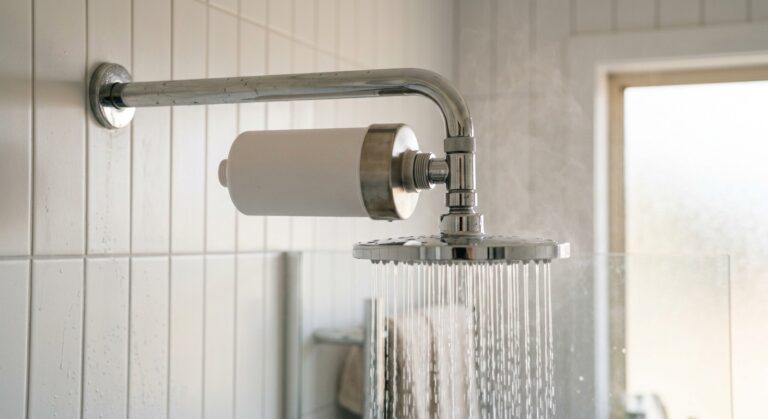
Removes chloramine and DBPs at the point of skin contact. In Perth and Adelaide, pair with a water softener for hardness minerals. Note: Perth uses free chlorine — any KDF or carbon shower filter works for the disinfectant. For eczema households this is the single most impactful intervention. Uses: catalytic carbon or KDF media in shower filter.
Addresses: direct skin contact exposure during showering — the primary water-eczema pathway.
Layer 2: Drinking Water Filter (Supporting Role)
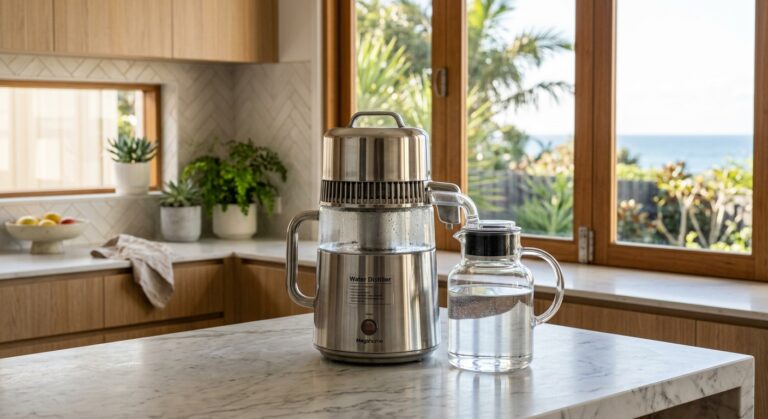
Removes chloramine, THMs and HAAs from ingested water. Best options: reverse osmosis (complete removal) or catalytic carbon benchtop (good removal without the cost or installation of RO). Supports the gut-skin axis rationale.
Addresses: ingested DBP load — the secondary gut-skin axis pathway.
Layer 3: Bath Water Treatment (Baby and Child Eczema)
For babies and young children with eczema who soak in bath water for extended periods, the prolonged contact time amplifies hard water and disinfectant exposure. A vitamin C dechlorinator ball reduces chloramine for Brisbane/Sydney/Adelaide/Darwin; a standard carbon ball works for Perth (free chlorine). For Perth and Adelaide, a whole-house water softener is the most comprehensive solution for hardness.
Addresses: extended contact exposure in bath — particularly important for baby eczema.
The Best Water Filters for Eczema in Australia 2026
For a full breakdown of shower filter options, media types and installation guidance see: Best Shower Filter for Eczema and Sensitive Skin in Australia and Best Shower Filters Australia 2026.
#2 AquaTru Classic Smart RO — Best Drinking Water Filter for Eczema
BEST FOR ECZEMA — COUNTERTOP REVERSE OSMOSIS
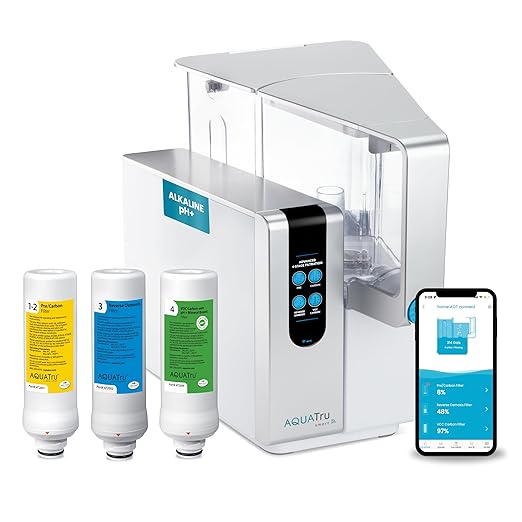
AquaTru Classic Smart Reverse Osmosis
Countertop four-stage reverse osmosis system that removes chloramine, DBPs, heavy metals and hardness minerals from drinking water — no installation required.
Reverse osmosis is the gold standard for comprehensive drinking water filtration. The AquaTru Classic Smart uses a four-stage process: sediment pre-filter, activated carbon pre-filter, RO membrane, and activated carbon post-filter (for taste). This sequence removes well over 95% of chloramine, eliminates THMs and HAAs almost entirely, and strips the water of hardness minerals (calcium and magnesium).
Why does this matter for the eczema-gut-skin axis rationale? You’re removing the full suite of compounds that might plausibly affect gut microbiome health: chloramine, trihalomethanes, haloacetic acids and other chlorination by-products. The result is water that’s as close to mineral-free as you can get from a countertop system.
The AquaTru’s key advantage over under-sink RO units is that it requires zero plumbing. You fill the reservoir, it filters, and you draw from the clean tank. This makes it ideal for renters, apartment dwellers or anyone who wants RO-quality water without a plumber’s visit. It produces roughly 2–3 litres per hour, which is adequate for a household’s drinking and cooking needs.
One important note: RO water is low in minerals, including beneficial ones. If you’re using it as your sole water source, consider a trace mineral supplement or a remineralisation filter stage to restore some calcium and magnesium. Some eczema practitioners recommend maintaining adequate dietary magnesium separately — this filter removes it from water.
- Removes 95%+ of chloramine, THMs, HAAs and hardness minerals
- No plumbing required — countertop installation
- Ideal for Sydney, Brisbane, Adelaide (chloramine cities); Perth uses free chlorine (standard carbon works)
- Smart filter life monitoring
- NSF/ANSI certified filtration
- Higher upfront cost than pitcher or benchtop carbon filters
- Produces some wastewater (typical of RO systems)
- Removes beneficial minerals — consider remineralisation
- Countertop footprint may be large for small kitchens
#3 Tappwater EcoPro Catalytic Carbon — Best Benchtop Filter for Renters
BEST FOR ECZEMA — BENCHTOP / RENTERS
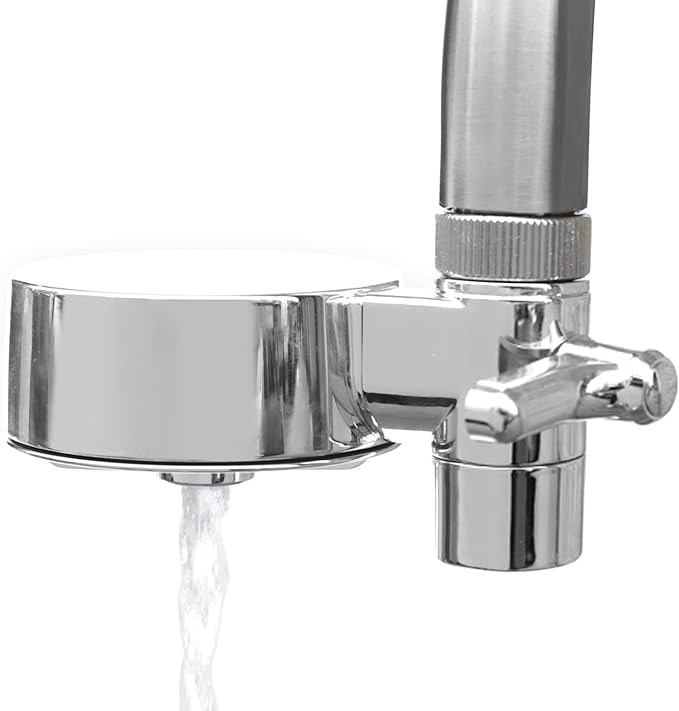
Tappwater EcoPro Catalytic Carbon Benchtop Filter
Catalytic carbon block benchtop filter that removes chloramine and DBPs from tap water without RO cost or complexity — the accessible option for renters and budget-conscious households.
The critical distinction for Australian chloramine cities (Brisbane, Sydney, Adelaide, Darwin) is filter media type. Perth uses free chlorine (Water Corporation WA) — standard activated carbon is sufficient for Perth’s disinfectant. Standard granular activated carbon (GAC) pitchers — the classic Brita or BRITA-style jugs — are not effective at chloramine removal. Chloramine requires either catalytic carbon (which has a modified surface structure that breaks the chloramine bond) or reverse osmosis.
The Tappwater EcoPro uses catalytic carbon block media, which means it does the one thing a standard pitcher cannot: it reliably removes chloramine from drinking water. It connects to your standard kitchen tap via an adaptor and filters water on demand, giving you clean water at mains pressure without the wait of a pitcher system.
For eczema households that can’t justify the cost of RO, or who are renting and want a portable solution they can take when they move, this is the practical middle ground. It won’t remove hardness minerals (that requires RO or a softener), but it addresses the chloramine and DBP load in ingested water effectively.
As a benchtop unit it also avoids any landlord permissions issue — it attaches and detaches from the tap with no permanent modification.
- Catalytic carbon removes chloramine — unlike standard GAC pitchers
- Benchtop / tap-mount — no plumbing, renter-friendly
- On-demand filtered water at mains pressure
- Lower cost than RO systems
- Portable — take it when you move
- Does not remove hardness minerals (not RO)
- Tap adaptor may not fit some specialty taps
- Replacement cartridges are an ongoing cost
- Less comprehensive than RO across the full contaminant spectrum
#4 HolyH2O Shower Filter — Alternative Shower Filter Option
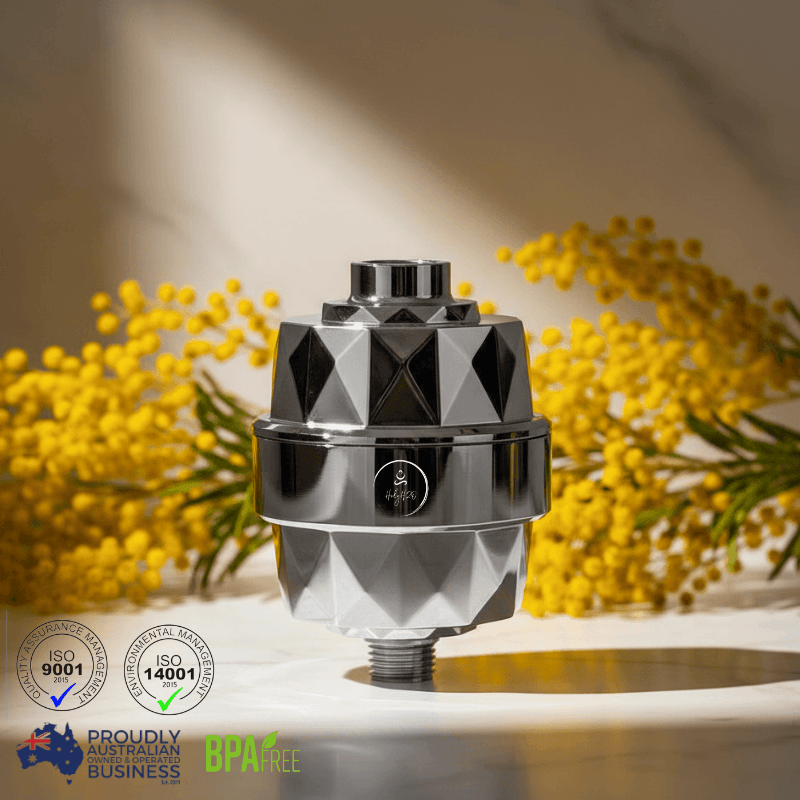
BEST FOR ECZEMA — SHOWER FILTER ALTERNATIVE
HolyH2O Shower Filter
Multi-stage shower filter with chloramine and chlorine removal — a strong alternative shower filter option for eczema-prone skin. Use coupon HOLYJAYCELOVE10 for 15% off.
HolyH2O is an Australian-focused brand offering shower filtration specifically marketed for sensitive skin and eczema applications. Their shower filter uses a multi-stage approach combining KDF media with activated carbon designed to reduce chloramine levels in shower water, alongside sediment reduction.
For households where the HolyH2O form factor or aesthetic is preferred, this is a solid alternative that targets the same primary exposure pathway. The 15% discount with code HOLYJAYCELOVE10 makes it an accessible entry point for households wanting to trial shower filtration before committing to a whole-house approach.
As with all shower filters, the critical question for Australian users is whether the filter media specifically handles chloramine (not just free chlorine). HolyH2O’s KDF media does work against chloramine, making it suitable for Sydney, Brisbane, Adelaide, Perth and Darwin users.
- KDF media handles chloramine for Australian city water
- Australian-focused brand with local support
- 15% off with code HOLYJAYCELOVE10
- Clean aesthetic suitable for modern bathrooms
- Easy installation on standard AU shower fittings
- Does not address water hardness (Perth/Adelaide will still want a softener)
- Cartridge replacement frequency depends on household usage
#5 PWS Whole-House Water Softener — For Perth and Adelaide Hard Water Eczema
BEST FOR ECZEMA — HARD WATER (PERTH / ADELAIDE)
PWS Whole-House Water Softener
Ion-exchange whole-house water softener — the definitive solution for Perth and Adelaide households where water hardness is the primary eczema trigger.
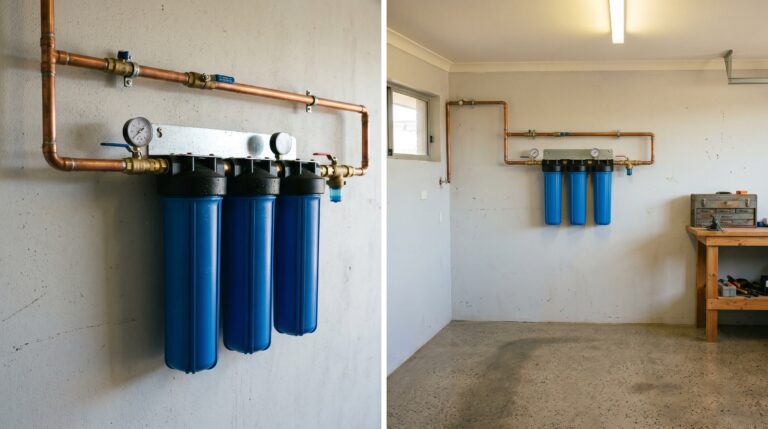
For Perth and Adelaide households — where water hardness consistently ranks highest among Australian capital cities — a whole-house water softener is the most comprehensive eczema intervention available. The 2021 British Journal of Dermatology research confirms that it’s the calcium and magnesium ions in hard water that drive skin barrier disruption, particularly in filaggrin-mutation carriers. A water softener using ion-exchange technology addresses this at every tap: shower, bath, laundry and kitchen.
The PWS system uses proven salt-based ion exchange, replacing calcium and magnesium ions with sodium ions. The result is softened water throughout the home — showers don’t leave limescale on skin, baths are gentler on eczema-prone skin, and laundry detergent works more effectively (meaning you can use less, reducing another potential irritant). Use our discount code for 10% off the purchase price.
A water softener is a significant investment — both in cost and installation (it requires a plumber for the mains connection). For Perth and Adelaide eczema households, however, it’s the single most targeted intervention matched to the local water chemistry. Pair it with a shower filter for chloramine removal (softeners don’t remove chloramine) for comprehensive protection.
For a full guide to water softener options in Australia see: Best Water Softeners Australia 2026.
- Removes hardness minerals throughout the entire home
- Addresses the primary eczema trigger in Perth and Adelaide water
- Eliminates limescale on skin, hair, appliances and pipes
- Improves laundry results — less detergent needed, reduced irritant exposure
- 10% off with code via purewatersystems.com.au
- Higher upfront investment — professional installation required
- Requires ongoing salt replenishment
- Does not remove chloramine — still need a shower filter
- Not suitable for renters or apartments
- Softened water has slightly elevated sodium content — separate drinking water filter recommended
Which Filter Do You Need? A City-by-City Guide
Water chemistry varies significantly by city across Australia. Here’s how to apply the above recommendations to your location:
| City | Disinfectant | Hardness | Priority Eczema Action |
|---|---|---|---|
| Perth | Chloramine | Very Hard (150–220 mg/L) | Water softener + shower filter (KDF) + catalytic carbon drinking filter |
| Adelaide | Chloramine | Hard (120–200 mg/L, seasonal variation) | Water softener + shower filter (KDF) + catalytic carbon or RO for drinking |
| Brisbane | Chloramine | Moderate (50–120 mg/L) | Shower filter (KDF) + catalytic carbon benchtop for drinking |
| Sydney | Chloramine | Soft–Moderate (varies by council) | Shower filter (KDF) + catalytic carbon benchtop for drinking |
| Melbourne | Free Chlorine | Very Soft (10–30 mg/L) | Shower filter (standard carbon) + standard carbon pitcher for drinking |
| Hobart | Free Chlorine | Very Soft | Shower filter (standard carbon) + standard carbon pitcher |
| Canberra | Free Chlorine | Soft–Moderate | Shower filter (standard carbon) + standard carbon benchtop |
| Darwin | Chloramine | Moderate–Hard (varies) | Shower filter (KDF) + catalytic carbon drinking filter |
Perth and Adelaide: The Hard Water Priority Case
Perth and Adelaide residents with eczema have the most compelling case for comprehensive water treatment. Perth water routinely exceeds 150 mg/L hardness — classified as “hard” by Australian standards — with some areas approaching 220 mg/L. Adelaide’s water hardness fluctuates seasonally but regularly exceeds 120 mg/L.
Both cities also use chloramine, meaning a standard carbon pitcher won’t address the disinfectant load. The recommended stack for a Perth or Adelaide eczema household is:
- Whole-house water softener (PWS or equivalent) — addresses hardness minerals at every tap
- Shower filter with KDF media (HolyH2O) — addresses chloramine in shower water specifically (softeners don’t remove chloramine)
- Catalytic carbon benchtop or RO for drinking water — addresses ingested DBP load
Yes, this is a more involved setup. But for a Perth or Adelaide household where eczema is significantly impacting quality of life, the combination directly targets the key water chemistry factors that clinical evidence links to eczema aggravation. For Perth: hardness (free chlorine is handled by standard filters). For Adelaide: both hardness and chloramine.
Brisbane and Sydney: Chloramine Priority
Brisbane and Sydney have less acute hardness concerns but are firmly in the chloramine zone. The priority here is ensuring any filter you use — shower or drinking — can actually handle chloramine. That means:
- Shower filter: KDF or catalytic carbon media (not basic carbon only)
- Drinking filter: catalytic carbon block (Tappwater EcoPro or similar) or RO (AquaTru) — not a standard GAC pitcher
Melbourne users have the simplest situation: free chlorine (not chloramine) means standard activated carbon works in both shower and drinking applications, and water is very soft so hardness minerals aren’t a significant concern. A basic shower filter with activated carbon and a carbon pitcher is a perfectly adequate starting point.
Australian Water Quality and Eczema: City-by-City Data
Water quality varies more dramatically across Australian cities than most eczema sufferers realise. The table below maps each major city’s two key variables — disinfectant type and hardness — against the eczema risk each creates, and links to city-specific guidance where available.
| City | Disinfectant | Hardness (mg/L CaCO₃) | Eczema risk factors | Guide |
|---|---|---|---|---|
| Perth | Free chlorine (Water Corporation WA) | Up to 226 (very hard) | Hard water primary trigger; standard dechlorinators work for disinfectant | Perth guide |
| Adelaide | Chloramine | 134–148 (hard) | Chloramine + hard water — both triggers active simultaneously | Adelaide guide |
| Brisbane | Chloramine | 50–120 (moderate) | Chloramine primary trigger; hardness secondary | Brisbane guide |
| Sydney | Chloramine | 40–80 (soft–moderate) | Chloramine primary trigger; hardness low | Sydney guide |
| Darwin | Verify with Power and Water Corp | ~150 (hard) | Hardness + disinfectant (verify type with utility) | — |
| Melbourne | Free chlorine | ~25 (very soft) | Temperature is the primary shower trigger; water chemistry low risk | Guide coming |
| Hobart / Canberra | Free chlorine | <50 (soft) | Temperature primary; standard carbon filters sufficient | — |
Sources: Water Corporation WA, SA Water, SEQ Water, Sydney Water, Melbourne Water, Power and Water Corp NT. Hardness figures are typical supply-zone ranges; values vary by suburb. See utility annual water quality reports for your specific supply zone.
Decision Tree: Which Water Filter Do You Need?
Work through this in order:
Step 1: Do you live in Perth or Adelaide?
→ YES: Water hardness is your primary concern. Start with a whole-house water softener (PWS). Then add a shower filter with KDF media and a catalytic carbon drinking filter. See PWS softener →
→ NO: Continue to Step 2.
Step 2: Are you renting or unable to install whole-house systems?
→ YES: Focus on a shower filter (no installation needed) + benchtop drinking filter. Go to Step 3.
→ NO: Consider a whole-house approach if budget allows. Go to Step 3 for individual filters.
Step 3: Do you live in Brisbane, Sydney, Adelaide, Gold Coast or Darwin?
→ YES: You’re on chloramine. Standard carbon pitchers won’t work. You need KDF shower filter + catalytic carbon or RO for drinking.
→ NO (Melbourne, Hobart, Canberra): Standard activated carbon works for both shower and drinking filters.
Step 4: Is baby or child eczema a concern?
→ YES: Add a bath dechlorinator (vitamin C ball or dedicated bath filter) to treat bath water. Extended contact time in baths amplifies exposure — especially important for Perth/Adelaide hard water.
→ NO: Shower filter + drinking filter is sufficient.
Step 5: What’s your budget?
→ Limited budget: Shower filter first (highest ROI) — HolyH2O. Add drinking filter when budget allows.
→ Medium budget: Shower filter + Tappwater EcoPro benchtop catalytic carbon.
→ Comprehensive: Shower filter + AquaTru RO for drinking. Perth/Adelaide: add water softener.
Baby Eczema and Bath Water: Special Considerations
Infant and toddler eczema deserves specific attention when it comes to bath water. Babies typically spend 10–20 minutes in bath water — far longer proportional skin contact than an adult shower. In hard water cities, that sustained exposure to calcium-rich, chloramine-treated water on barrier-compromised baby skin is a meaningful concern.
Options for improving bath water quality for baby eczema:
- Vitamin C dechlorinator bath balls: A sachet or ball of ascorbic acid (vitamin C) placed in the bath neutralises chloramine almost instantly. Low cost, available at most health food stores or online, and completely safe for babies. This handles the disinfectant issue effectively.
- Dedicated bath filter unit: Whole-bath filter housings that connect to the bath tap treat the entire bath fill. More expensive but more comprehensive — handles both chloramine and some hardness minerals depending on media type.
- Whole-house water softener (Perth/Adelaide): Addresses hardness minerals at every tap including the bath. For Adelaide, combine with a vitamin C dechlorinator for chloramine. For Perth (free chlorine), a standard carbon dechlorinator is sufficient for the disinfectant — the whole-house softener addresses hardness, which is Perth’s primary bath eczema trigger.
Paediatricians and dermatologists generally recommend lukewarm (not hot) baths of 10–15 minutes maximum for eczema-prone babies, followed by immediate application of emollient while skin is still slightly damp. Improved bath water quality is a complementary measure alongside this established clinical advice.
What About Drinking Water and Baby Eczema?
For formula-fed infants, the quality of water used for formula preparation is worth considering. RO or catalytic carbon filtered water for formula preparation removes DBPs that might otherwise be ingested by infants. This is a precautionary measure — Australian tap water meets safety standards for infant use — but for families where eczema is a concern and filtration is already in place for drinking water, using filtered water for formula is a sensible extension of the same principle.
Breastfeeding mothers’ dietary and hydration choices also pass through breast milk to varying degrees, though the evidence base for water quality specifically affecting breast milk composition and infant eczema is limited. Adequate maternal hydration and a varied diet remain the well-supported priorities.
The Gut-Skin Axis: What the Research Actually Says
Because the drinking water angle for eczema rests substantially on the gut-skin axis, it’s worth being precise about the state of the evidence — and what it doesn’t yet prove.
The gut-skin axis refers to the bidirectional communication between the gut microbiome and skin health via immune, hormonal and neural pathways. Research published over the past decade has established several relevant findings:
- Children with eczema show measurable differences in gut microbiome composition compared to non-atopic controls, including lower diversity and altered relative abundance of key bacterial families
- Probiotic supplementation in some trials has shown modest reductions in eczema severity scores, suggesting gut microbiome manipulation can influence eczema outcomes
- Gut barrier permeability (“leaky gut”) has been associated with systemic immune activation patterns seen in atopic disease
What has not been demonstrated in published research is a direct causal link between drinking water DBP content and gut microbiome disruption leading to worsened eczema. The chain of reasoning is plausible — chloramine and THMs can affect gut bacterial communities in vitro, gut microbiome health influences eczema — but the specific clinical benefit of filtering drinking water for eczema management has not been tested in randomised controlled trials at the time of writing.
Our recommendation rests on the following: the intervention (filtering drinking water to remove chloramine and DBPs) is low-risk, has independent health rationale, is affordable and practical, and is consistent with a precautionary approach to reducing chemical exposures. It is not a treatment and should not substitute for prescribed medical management of eczema.
Filters That Won’t Work for Australian Eczema Households (And Why)
A brief note on filter types that are commonly marketed but may not address Australian eczema households’ specific water chemistry concerns:
- Standard GAC (granular activated carbon) pitcher filters (Brita, BRITA, Aldi etc.): Do not reliably remove chloramine. In Brisbane, Sydney, and Adelaide — chloramine cities — a standard pitcher filter is largely ineffective for the disinfectant. Perth uses free chlorine (Water Corporation WA); standard carbon pitchers do handle free chlorine, though they won’t address hardness or PFAS. The carbon granules simply don’t have sufficient contact time to break the chloramine bond. If you’re in Melbourne or Hobart (free chlorine), they work fine.
- Magnetic / ceramic / infrared “alkaline” filters: No credible published evidence for chloramine, THM or hardness mineral removal. Often marketed with vague health claims. Not recommended.
- UV filters: Excellent for biological contamination (bacteria, viruses) but do not remove chemicals. Municipal water is already treated for biological safety — UV adds no value for eczema-relevant water chemistry.
- Water ionisers/alkalising units: Alter pH but do not address chloramine, DBPs or hardness minerals. No clinical evidence for eczema benefit.
Final Verdict
For eczema households in Australia, a water filtration strategy makes most sense as a layered approach — and the evidence strongly suggests starting with shower contact exposure before drinking water.
The Philips Premium Shower Filter is our top recommendation because it directly addresses the mechanism best supported by published research: daily skin contact with chloramine-treated, mineral-laden water. It’s the highest-ROI single intervention for any Australian eczema household regardless of city.
For drinking water, the AquaTru Classic Smart RO gives the most comprehensive contaminant removal — chloramine, THMs, HAAs, hardness minerals all addressed in one countertop unit. For renters or households on a tighter budget, the Tappwater EcoPro’s catalytic carbon is the correct choice for chloramine cities, unlike the standard pitchers that won’t do the job.
Perth and Adelaide households with moderate to severe eczema have the clearest case for a whole-house water softener (PWS) given the local water hardness levels documented in the 2021 British Journal of Dermatology research context. Pair that with a shower filter and a drinking water filter for comprehensive coverage.
None of these interventions are a cure for eczema. They’re environmental optimisations — reducing likely triggers in the water you contact every day. Combine with your prescribed emollient and medical management protocol for best outcomes.
Build Your Eczema Water Strategy
Start with the shower — then layer in drinking water filtration for the comprehensive approach.
Frequently Asked Questions
Can drinking filtered water actually help eczema?
Drinking filtered water is not a proven treatment for eczema. However, there is a plausible rationale via the gut-skin axis: filtering out chloramine, trihalomethanes (THMs) and haloacetic acids (HAAs) from drinking water may support gut microbiome health, which emerging research links to eczema severity. This is a low-risk, supportive optimisation — not a substitute for prescribed eczema management. The contact exposure from showering and bathing has far stronger evidence as a water-related eczema trigger.
Does hard water cause eczema?
Clinical research — including a 2021 study published in the British Journal of Dermatology — has confirmed that hard water increases skin barrier disruption, particularly in individuals carrying filaggrin gene mutations (the main genetic risk factor for atopic eczema). The calcium and magnesium ions in hard water physically disrupt the skin’s lipid barrier on contact. This is a contact exposure effect (showering and bathing), not a drinking water effect. Perth and Adelaide have the hardest tap water among Australian capital cities, making water softeners particularly relevant there.
Will a standard Brita pitcher filter help with eczema in Brisbane or Sydney?
No — not for the chloramine concern. Brisbane and Sydney both use chloramine as a primary water disinfectant. Standard granular activated carbon (GAC) pitcher filters, including well-known brands, do not reliably remove chloramine — the contact time and surface area are insufficient to break the chloramine bond. You need either catalytic carbon (such as the Tappwater EcoPro) or reverse osmosis (such as the AquaTru) for effective chloramine removal from drinking water. Melbourne, Hobart and Canberra use free chlorine, where standard activated carbon does work effectively.
Is a shower filter or a drinking filter more important for eczema?
A shower filter should be your first priority. The primary water-related eczema exposure pathway is contact: skin directly touching chloramine-treated, mineral-rich water for extended periods during showering or bathing. This has far stronger clinical support than the secondary gut-skin axis pathway from drinking water. If budget only allows one intervention, choose a quality shower filter with KDF or catalytic carbon media. Add a drinking water filter once you have the shower filter in place.
What’s the best water filter for baby eczema in Australia?
For baby eczema, bath water treatment is a priority given the longer contact time. A vitamin C dechlorinator ball works for chloramine cities (Brisbane, Sydney, Adelaide, Darwin); standard carbon works for Perth (free chlorine, Water Corporation WA). For Perth and Adelaide (hardest water cities), a whole-house water softener addresses hardness minerals at every tap including the bath. For drinking or formula water, a catalytic carbon benchtop filter or RO system gives clean water for formula preparation.
Can I use a water softener instead of a shower filter?
A water softener and a shower filter address different things and both are ideally used together in hard water, chloramine cities. A water softener removes hardness minerals (calcium and magnesium) via ion exchange, which addresses the skin barrier disruption mechanism from hard water. However, a water softener does not remove chloramine. A shower filter with KDF or catalytic carbon media removes chloramine but typically doesn’t address hardness minerals. For Perth eczema households: a whole-house water softener for hardness, plus any standard shower filter for the free chlorine. For Adelaide: whole-house water softener plus a catalytic carbon or vitamin C shower filter for chloramine.
Does reverse osmosis water remove too many minerals to be good for eczema?
Reverse osmosis removes the vast majority of dissolved minerals including beneficial ones like calcium and magnesium. For drinking water, this isn’t harmful for most healthy adults — dietary intake of minerals is far larger than what water provides. However, if RO is your sole water source and you have concerns about mineral balance, a remineralisation stage (a small cartridge that adds trace minerals back) is worth considering. Some practitioners recommend ensuring adequate dietary magnesium intake separately when using RO water. The DBP removal benefit of RO for the gut-skin axis rationale is not negated by mineral removal.
How long does it take to see results from a water filter for eczema?
For shower and bath contact exposure — where the evidence is strongest — some eczema-prone individuals report skin improvement within a few weeks of consistent filtered water use. The skin barrier takes time to rebuild, so expecting rapid dramatic changes is unrealistic. For the gut-skin axis pathway via drinking water, any microbiome changes occur over weeks to months. Eczema management is multi-factorial: if you’ve installed a water filter and aren’t seeing improvement, the water quality may not be the dominant trigger in your case. Work with your dermatologist or GP to identify your individual trigger pattern.
Get the Australian Home Environment Checklist
30 checks across water, air and EMF. Most of them free. Ranked by impact.
No spam. Unsubscribe any time.

Former Royal Australian Navy Clearance Diver and TAG-E counter-terrorism operator. Founded Clean and Native to apply the same rigorous thinking to the home environment.
Full biography →