Best Water Filter for Babies Australia 2026
Quick Verdict — Best Water Filters for Babies Australia 2026
For formula-fed infants in chloramine cities, the AquaTru Classic is the only NSF 58-certified countertop RO available in Australia without any plumbing. For breastfeeding families or renters, the Tappwater EcoPro removes chloramine and lead at a fraction of the cost.
| Which water filter is best for formula-fed infants in chloramine cities? | AquaTru Classic — NSF 58 certified. Removes fluoride, chloramine, nitrates, lead, and PFAS. No plumbing required. ~$449. |
| What water filter do breastfeeding families or renters need? | Tappwater EcoPro — Carbon block, plug-in benchtop install, removes chloramine and lead. Budget pick. ~$199. |
| What is the best permanent water filter for a family with young children? | Waterdrop D6 Under-Sink RO — Tankless, unlimited on-demand filtered water for homeowners. ~$499–699 installed. |
Every parent wants the absolute best for their newborn, and when it comes to what goes into that tiny body, water is the foundation — it makes up the formula they drink, the purees you introduce at four months, and eventually the water they sip straight from a cup. Choosing the right water filter for your baby is not about fear; Australian tap water is genuinely safe and meets the Australian Drinking Water Guidelines (ADWG 2022). This guide is about optimisation — understanding which contaminants matter most at each stage of your baby’s development, and which filters actually address them.
Who Is This Article For?
This article is for you if…
- You are formula-feeding a newborn and want to understand the risks of tap water in your city
- Your baby has eczema or sensitive skin and you suspect bath water may be a trigger
- You want city-specific guidance — Brisbane, Sydney, Melbourne, Perth, Adelaide and beyond
- You are introducing solids at 4–6 months and want to know which water to use for purees
- Your family is on tank or bore water and you need to understand nitrate risk
Looking for something more specific?
- If you only want formula-preparation recommendations with a deep dive into each RO system, see our dedicated guide: Best Water Filter for Baby Formula Australia 2026
- If you want a whole-family overview across all use cases, the Best Water Filter Australia 2026 roundup covers it all
Is Australian Tap Water Safe for Babies?
The short answer is yes — Australian tap water meets the Australian Drinking Water Guidelines (ADWG) 2022, which are aligned with World Health Organization (WHO) standards and are designed to protect human health across the general population. The vast majority of Australians drink tap water every day without consequence, and there is no evidence that unfiltered Australian tap water poses a significant health risk to healthy infants in normal circumstances.
That said, infants are not miniature adults. Their risk profile differs from adults in several important ways: their body weight is far lower (meaning the same concentration of a contaminant represents a proportionally higher dose per kilogram), their kidneys are still developing and less efficient at excreting certain substances, and their gut flora and immune systems are not yet fully established. For these reasons, the question is not whether tap water is “unsafe” — it isn’t — but whether certain contaminants warrant additional precaution for babies, particularly newborns and formula-fed infants.
Here are the key contaminants Australian parents need to understand:
Fluoride
Australian mains water is fluoridated at 0.6–1.0 mg/L, a concentration the NHMRC and WHO consider safe and beneficial for dental health across all age groups. At this level, there is no evidence of harm to infants from fluoride exposure.
However, a nuance worth knowing: the American Dental Association (ADA) recommends that parents mixing infant formula use low-fluoride or fluoride-free water for infants under 6 months, as a precautionary measure to reduce the theoretical risk of dental fluorosis — a cosmetic condition that causes faint white spots or streaking on developing teeth. The key word is precautionary. This is not an alarm; dental fluorosis is a minor cosmetic issue, not a health risk. Australia’s NHMRC does not currently issue a specific recommendation to avoid fluoride in formula preparation, and Australian paediatric guidelines do not flag fluoride in tap water as a concern for formula-fed infants.
The practical takeaway: if you are formula-feeding a newborn under 6 months and want to follow the ADA’s precautionary guidance, a reverse osmosis (RO) filter will remove greater than 95% of fluoride. If you are breastfeeding, this is a non-issue — breast milk contains negligible fluoride regardless of the mother’s intake. Once your baby is over 6 months and eating a varied diet, fluoride in drinking water is genuinely not a concern.
Chloramine
This is the single most important water quality issue for formula parents in major Australian cities. Chloramine — a compound of chlorine and ammonia — is used as a disinfectant in Brisbane, Sydney, Adelaide, Gold Coast, and Darwin water supplies. Unlike free chlorine, chloramine does not evaporate when you leave water out overnight, and it is not adequately removed by standard granular activated carbon (GAC) pitchers such as Brita or similar jug filters.
For formula preparation, this matters because formula dissolved in chloramine-containing water exposes infants to a disinfection byproduct that standard filtration misses. Catalytic carbon (a specially activated form of carbon) or reverse osmosis is required to adequately remove chloramine. We cover this in depth in our guide to the best water filters for chloramine in Australia.
If you live in Melbourne, Hobart, or Canberra, your water uses free chlorine, which does boil off and is removed by standard carbon filters. The chloramine issue is specific to the cities listed above.
Lead
Lead is not an issue with Australian water treatment — mains water leaves treatment plants essentially lead-free. The risk comes from household plumbing. Homes built before the 1980s — particularly in inner-city Sydney and Melbourne — may have lead solder joints in their copper pipes. While lead levels in these homes are typically still within ADWG guidelines, infants are especially sensitive to lead exposure at any level, given its effects on developing neurological systems.
If you live in an older home, the precautionary steps are simple: run the cold tap for 30 seconds before using water (this flushes standing water from the pipes), and use only cold water for formula (hot water dissolves lead faster). If you want certainty, a reverse osmosis filter removes effectively 100% of lead.
Nitrates
Nitrates in drinking water are a genuine risk for infants under 6 months — a condition called methaemoglobinaemia (colloquially “blue baby syndrome”) occurs when nitrate levels are high and infants cannot metabolise the byproducts. In Australian city mains water, nitrate levels are consistently well within ADWG limits and this is not a concern. The risk is almost entirely specific to rural properties on tank water, bore water, or private wells in farming areas where fertiliser runoff can raise nitrate concentrations. If you are on tank or bore water and have a formula-fed infant, nitrate testing and RO filtration are essential — not optional.
Age Stages and Filtration Needs
Not all stages of infancy carry the same filtration considerations. Here is a practical framework:
- Newborn–6 months (formula-fed): Highest filtration need. Formula constitutes 100% of nutrition; any contaminant in the water is concentrated in every feed. RO is the gold standard for chloramine cities. At minimum, use catalytic carbon for chloramine removal.
- Newborn–6 months (breastfed): The mother’s body acts as a filter; breast milk contaminant levels are extremely low. Focus on the mother drinking clean, well-hydrated water. A mid-range catalytic carbon filter is appropriate for household drinking water.
- 4–6 months (starting solids): Water used for purees and porridge should be filtered, particularly in chloramine cities. Same filter recommendations as formula stage.
- 6–12 months (transitioning to water): Australian tap water is considered safe for babies at this age. A household filter is a reasonable quality-of-life choice but not a medical necessity for city-dwelling families on mains water.
- 12+ months: Tap water is safe for toddlers. Filtration is about taste, preference, and general contaminant reduction for the whole family.
Best for Formula-Fed Infants: AquaTru Classic Smart Countertop RO
#1 PICK — BEST FOR FORMULA-FED INFANTS
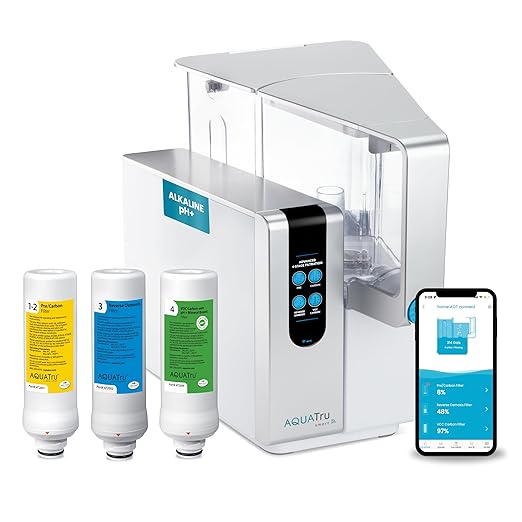
AquaTru Classic Smart Countertop Reverse Osmosis Filter
4-stage RO · NSF 58 Certified · No plumbing required · WiFi-enabled filter tracking · ~2L/hour production
Who This Is For
- Mixing infant formula in Brisbane, Sydney, Adelaide, Gold Coast, or Darwin (chloramine cities)
- You need NSF 58-certified fluoride, chloramine, nitrate, and lead removal in one unit
- Renters with no plumbing access — benchtop setup, no installation required
Who This Is Not For
- Breastfeeding families with no fluoride concern — Tappwater EcoPro is sufficient and cheaper
- Very tight bench space — unit requires approximately 340×330mm footprint
- Budget under $400 — AquaTru Classic costs ~$449 upfront
For parents mixing infant formula in Brisbane, Sydney, Adelaide, Gold Coast, or Darwin, the AquaTru Classic Smart is the clearest recommendation available. Its four-stage reverse osmosis process removes greater than 99% of fluoride, chloramine, chlorine, nitrates, lead, PFAS, arsenic, and over 80 other contaminants that are NSF 58 certified. Critically, it does this without requiring any plumbing — it sits on your benchtop, connects to your existing tap, and produces purified water into an integrated 1.9-litre tank.
The Smart version adds WiFi connectivity, which means you get real-time filter life tracking via an app rather than having to guess when filters need replacement. For time-pressed parents, this small convenience matters — a depleted filter that isn’t replaced quietly stops doing its job, and you won’t know unless something tells you. The AquaTru app sends you a notification before that happens.
Production rate is approximately 2 litres per hour, and the storage tank holds around 1.9 litres. For formula preparation — which typically requires 150–200ml of water per feed — this is more than adequate. You fill the tank in the evening; it’s ready for overnight feeds. The countertop footprint is roughly the size of a coffee machine, which is a real-world consideration for galley-style Australian kitchens.
At approximately $449 AUD, the AquaTru is not the cheapest option, and ongoing filter costs (pre-filter, carbon filter, and RO membrane require periodic replacement) add to the total cost of ownership. These are genuine cons — but for formula-fed infants in the first six months of life, this system removes every contaminant on the infant risk list in a single unit, with third-party certification to back the claims. No other benchtop filter category does that.
✓ Pros
- NSF 58 certified — third-party verified claims
- Removes fluoride, chloramine, nitrates, lead, PFAS and more
- No plumbing required — benchtop installation
- WiFi filter life tracking via app
- Large enough storage tank for overnight formula feeds
✕ Cons
- Higher upfront cost (~$449 AUD)
- Ongoing filter replacement costs
- Slower flow than direct tap (2L/hr production)
- Wastes some water (though better ratio than most RO systems)
- Countertop footprint requires bench space
Buy This If…
You’re mixing infant formula in a chloramine city and need certified fluoride, nitrate, chloramine, and lead removal in a no-plumbing benchtop unit.
Best for Breastfeeding Families: Tappwater EcoPro Benchtop Filter
#2 PICK — BEST FOR BREASTFEEDING FAMILIES
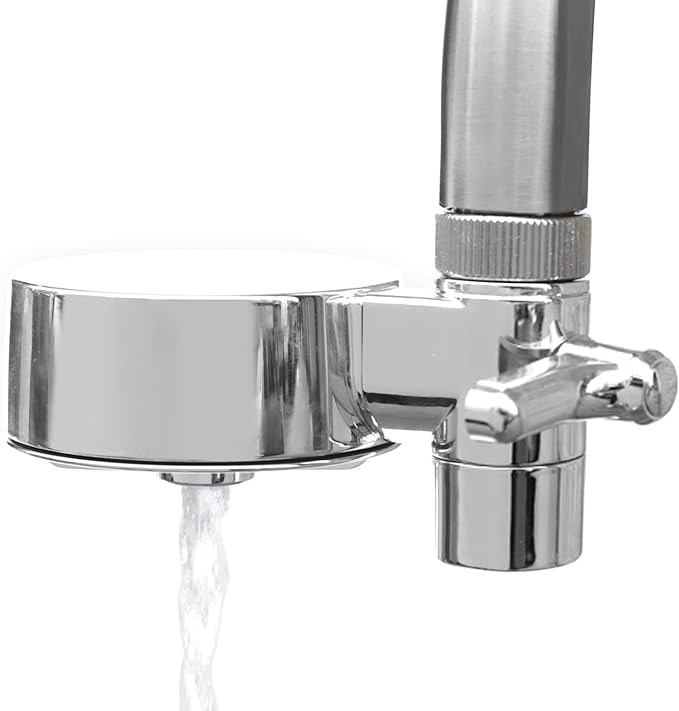
Tappwater EcoPro Benchtop Water Filter
Catalytic carbon block + hollow fibre · NSF 42 & 53 certified · Removes chloramine, lead, microplastics · No plumbing
Who This Is For
- Breastfeeding families who want chloramine and lead removed from drinking water
- Renters — plug-in benchtop install, no plumbing, no landlord approval needed
- Budget-conscious households who don’t need fluoride removal
Who This Is Not For
- Formula-fed infants — carbon block alone won’t remove fluoride or nitrate
- Bore water or tank water with nitrate risk — needs full RO instead
- Anyone needing PFAS or fluoride removal — an NSF 58-certified RO unit is required
If you are breastfeeding rather than formula-feeding, the risk calculus changes significantly. Breast milk has remarkably low contaminant levels regardless of the mother’s water source — the body is an effective filter, and contaminants that could theoretically concentrate in formula are not concentrated in breast milk to the same degree. For breastfeeding families, the priority is the mother’s own hydration and the quality of household drinking water more broadly, rather than the surgical-grade filtration needed for formula preparation.
The Tappwater EcoPro is the most practical answer for this use case. Its catalytic carbon block is specifically designed to reduce chloramine — the key limitation of standard GAC pitcher filters — alongside removing free chlorine, lead, microplastics, cysts, and sediment. It carries NSF 42 and NSF 53 certification, meaning its claims for chloramine and lead reduction are independently verified. For a Brisbane or Sydney family where the mother is breastfeeding, this filter meaningfully improves the quality of everyday drinking water without the cost or complexity of RO.
The EcoPro also grows with your family. As your baby transitions to solids and then to drinking water directly, the EcoPro remains the appropriate filter — it handles the contaminants that matter most for the 6–18 month stage without over-engineering. For families in Melbourne, Hobart, or Canberra (free chlorine rather than chloramine), the EcoPro is genuinely overkill — a standard pitcher filter would serve the household adequately — but it is not a harmful choice.
What the EcoPro does not do: it does not remove fluoride, and it does not remove nitrates. If you transition to formula feeding or have a rural water supply with elevated nitrates, step up to the AquaTru or Waterdrop D6.
✓ Pros
- Removes chloramine — unlike standard pitcher filters
- NSF 42 & 53 certified
- Removes lead, microplastics, and cysts
- No plumbing required
- More affordable than RO systems
✕ Cons
- Does not remove fluoride
- Does not remove nitrates
- Higher upfront cost than basic pitcher filters
- Filter replacement ongoing cost
Buy This If…
You’re breastfeeding or on a budget, rent your home, and want chloramine and lead removed without the price of full reverse osmosis.
Best Permanent Solution: Waterdrop D6 Under-Sink RO
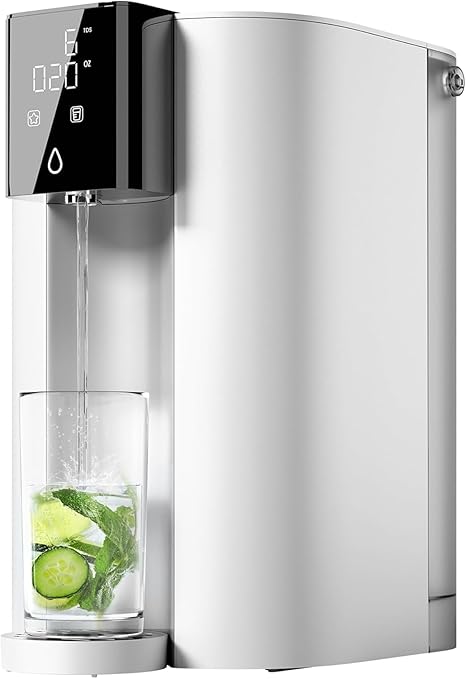
#3 PICK — BEST PERMANENT FAMILY SOLUTION
Waterdrop D6 Under-Sink Reverse Osmosis System
6-stage RO with remineralisation · 400GPD flow · Smart filter display · Dedicated faucet · Requires plumbing installation
Who This Is For
- Homeowners wanting permanent under-sink RO filtration for the whole family
- Multiple children or planning another pregnancy — high daily water demand
- You want RO quality with instant flow (400 GPD, no tank refill wait)
Who This Is Not For
- Renters — requires landlord approval and a licensed plumber to install
- Single-infant households with low demand — AquaTru Classic is simpler and cheaper
- Tight budgets — installation adds $150–$300 on top of unit cost
For families who want a permanent, hands-off solution — particularly those planning more children, managing multiple kids at different stages, or simply wanting RO-quality water available on demand from any tap — the Waterdrop D6 is the definitive choice. It installs under the sink and supplies filtered water through a dedicated faucet, so there is no benchtop unit occupying counter space and no waiting for a tank to refill.
The D6 runs through six stages: sediment pre-filter, pre-carbon block, RO membrane, post-carbon filter, and a remineralisation stage that adds back beneficial minerals (primarily calcium and magnesium) that the RO membrane removes. This last stage is genuinely valuable for infant formula, since formula relies on water having a near-neutral mineral balance — pure RO water is slightly acidic and very low in minerals, which the remineralisation cartridge corrects. The result is water that has had everything harmful removed and a healthy mineral balance restored.
At 400 gallons per day (GPD), this system produces filtered water essentially on demand — there is no waiting, no tank management, no remembering to check filter life on an app (though the smart display on the unit handles that automatically). For a busy household with a baby, the frictionless nature of the D6 is a significant practical advantage over benchtop systems.
The trade-off is installation. The D6 requires connection to your under-sink plumbing — a one-time job that a competent DIYer can manage in under an hour, or a plumber in 30 minutes. If you rent, check your lease before installation. The upfront cost is higher than the AquaTru, and like all RO systems it wastes some water in the filtration process, though the D6’s ratio is better than older-generation RO systems.
✓ Pros
- 6-stage RO with remineralisation — complete contaminant removal plus mineral balance
- 400GPD — effectively instant filtered water, no waiting
- Smart filter life display
- No counter space required
- Removes fluoride, chloramine, nitrates, lead, PFAS, heavy metals
✕ Cons
- Requires plumbing installation
- Higher upfront cost than benchtop options
- Still wastes some water (improved ratio vs older RO systems)
- Not suitable for renters without landlord approval
Buy This If…
You own your home, have multiple children, and want permanent unlimited RO-quality water on demand without ever refilling a tank.
Which Filter Do You Need? City-by-City Guide
Not all Australian cities treat their water the same way. The type of disinfectant used in your city’s water supply is the single most important variable when choosing a filter for formula preparation. Here is a quick reference table, followed by city-specific context.
| City | Disinfectant | Formula Filter Needed | Drinking Water Priority |
|---|---|---|---|
| Brisbane | Chloramine | Catalytic carbon or RO | High — chloramine not removed by standard pitchers |
| Sydney | Chloramine | Catalytic carbon or RO | High — plus lead risk in pre-1980s homes |
| Melbourne | Free chlorine | Standard GAC carbon sufficient for disinfectant | Medium — standard pitcher works; RO for fluoride removal |
| Perth | Chloramine + hard water | RO recommended | High — also removes hardness minerals |
| Adelaide | Chloramine | Catalytic carbon or RO | High — also known for taste issues from chloramine |
| Hobart | Free chlorine | Standard carbon sufficient | Low — cleanest mains water in Australia |
| Canberra | Free chlorine | Standard carbon sufficient | Medium — standard pitcher works fine |
| Darwin | Chloramine | Catalytic carbon or RO | High — tropical water quality varies seasonally |
Brisbane and Sydney
Both cities switched to chloramine as their primary disinfectant years ago, and both cities retain it throughout the distribution network at levels that are safe for adults but challenging for standard pitcher-style filters. If you are formula-feeding in Brisbane or Sydney, a standard Brita-style jug filter will not adequately remove chloramine — this is not a matter of opinion but a chemical fact. You need either catalytic carbon (the Tappwater EcoPro uses this) or RO (AquaTru, Waterdrop D6). For more on why this matters and which filters genuinely address it, see our guide to the best water filters for chloramine in Australia. Sydney residents in older inner-city suburbs (Newtown, Glebe, Paddington, Marrickville) should additionally consider lead pipe risk and treat RO as the more complete solution.
Melbourne
Melbourne’s water supply uses free chlorine rather than chloramine, which significantly changes the filter requirements. Free chlorine does dissipate naturally when water is left to stand, and it is adequately removed by standard granular activated carbon filters — meaning a quality pitcher filter (not just a basic Brita, but a good-quality GAC pitcher) is sufficient for chlorine removal. For Melbourne formula parents who want to address fluoride as well, an RO system remains the only complete answer. For breastfeeding families in Melbourne, the Tappwater EcoPro is excellent but arguably more filter than you strictly need — a quality pitcher would serve you well.
Perth
Perth faces the most challenging water quality combination in Australia for formula parents: chloramine disinfection plus naturally hard water (high calcium and magnesium concentrations). While hardness is not a health risk for adults, the combination of chloramine and high mineral content makes RO the most sensible choice for formula preparation in Perth. The AquaTru or Waterdrop D6 both address all three — chloramine, fluoride, and hardness — in a single system. Perth parents using benchtop-only catalytic carbon filters (like the Tappwater EcoPro) will handle the chloramine but won’t address hardness or fluoride.
Adelaide
Adelaide uses chloramine and is one of the Australian cities most commonly cited for water taste complaints. The chloramine concentration, combined with mineral content from the Murray-Darling system, gives Adelaide tap water a distinctive taste that many residents notice. For formula parents, the same rule applies as Brisbane and Sydney: catalytic carbon at minimum, RO for complete filtration. Adelaide families who invest in an RO system frequently report that formula-prepared water tastes noticeably cleaner and that their babies take feeds more readily — though this is anecdotal and formula brand is a much bigger variable in palatability.
Which Filter Is Right for Your Baby’s Age and Needs?
Baby Water Filter Decision Tree
Step 1: What is your baby’s age and feeding method?
- Newborn–6 months, formula-fed in a chloramine city (Brisbane, Sydney, Gold Coast, Adelaide, Darwin):
→ RO filter is the gold standard. The AquaTru Classic Smart (benchtop, no plumbing) or Waterdrop D6 (under-sink, permanent). Removes the full contaminant matrix: fluoride, chloramine, nitrates, lead. - Newborn–6 months, formula-fed in a free-chlorine city (Melbourne, Hobart, Canberra):
→ Catalytic carbon minimum; RO for fluoride removal. The Tappwater EcoPro handles chloramine and lead. Upgrade to RO if you also want fluoride reduction. - Newborn–6 months, breastfed (any city):
→ Focus on the mother’s drinking water. The Tappwater EcoPro is appropriate for household drinking water in chloramine cities. Mother’s milk contaminant levels are very low regardless of water source. Hydration is the priority. - 4–6 months, starting solids:
→ Use filtered water for purees and porridge. Same filter recommendation as formula stage for your city. Any water used for cooking infant food should be filtered to the same standard as formula water. - 6–12 months, transitioning to drinking water:
→ Australian tap water is safe at this age. A household filter (Tappwater EcoPro or equivalent) is a reasonable precaution for chloramine cities, but not a medical necessity for healthy babies on mains water. - 12+ months:
→ Tap water is safe for toddlers. A whole-family filter is a quality-of-life and long-term wellbeing choice, not a safety imperative. - Baby with eczema (any age):
→ Add bath dechlorination alongside drinking water filtration. For bath water specifically, a vitamin C bath tablet is a low-cost add-on that neutralises chloramine at point of bathing. - Rural household — tank, bore, or private well water:
→ RO is essential, not optional. Nitrate levels, bacterial contamination, and other agricultural contaminants are genuine risks in rural water supplies. Test your water first (many councils offer free testing); treat with RO as a baseline.
How We Assess These Filters
Every filter in this guide was assessed against its manufacturer specifications and independent NSF/ANSI certification data, with a focus on the contaminants that matter most for infants: fluoride, chloramine, nitrates, and lead.
Where NSF/ANSI independent certification exists (NSF 42, 53, or 58), that data is the primary performance reference, representing controlled lab testing across a wider contaminant matrix than any single at-home measurement can assess. Where independent certification is absent, we say so. For full methodology, see how we test.
Our Verdict
Australian tap water is safe. Let’s start there, and end there. This guide is not about fear — it is about informed optimisation for one of the most consequential moments in your family’s life.
For formula-fed infants in the major chloramine cities — Brisbane, Sydney, Gold Coast, Adelaide, and Darwin — reverse osmosis represents the gold standard because it is the only filter category that addresses the full contaminant list that matters for infants: chloramine, fluoride, nitrates, and lead in a single certified system. The AquaTru Classic Smart is the clearest recommendation for parents who want a benchtop solution without plumbing. The Waterdrop D6 is the answer for families who want a permanent, under-sink system that delivers RO-quality water on demand — particularly appropriate for families with multiple children or those planning another pregnancy.
For breastfeeding families, or for families with babies over six months transitioning to a wider diet, the Tappwater EcoPro is the most practical choice: it removes chloramine and lead, carries independent NSF certification, and does so without the complexity and cost of RO.
For a deeper dive into formula-specific filtration, see our companion article: Best Water Filter for Baby Formula Australia 2026. For the full household water filter picture, our Best Water Filter Australia 2026 roundup covers every category and use case.
Last reviewed: June 2026 — Clean & Native. Sources: NHMRC ADWG 2022, Australian Dental Association infant formula guidance, state utility annual water quality reports.
Affiliate links — we may earn a commission at no extra cost to you.
Frequently Asked Questions
Is Australian tap water safe for babies?
Yes. Australian tap water meets the Australian Drinking Water Guidelines (ADWG) 2022, which are aligned with WHO standards and are designed to protect human health across the whole population. For healthy babies over six months, tap water is safe to drink. For newborns and formula-fed infants under six months, the considerations around fluoride and chloramine (in certain cities) make additional filtration a sensible precautionary choice — but this is about optimisation, not because tap water poses a significant risk. Parents should always use the cold tap and run it briefly before drawing formula water, particularly in older homes.
What water filter do I need for baby formula in Australia?
The answer depends on your city. If you live in Brisbane, Sydney, Adelaide, Gold Coast, or Darwin — all of which use chloramine as a disinfectant — you need either a catalytic carbon filter or a reverse osmosis (RO) system. Standard GAC carbon pitcher filters (such as Brita) do not adequately remove chloramine. If you also want to address fluoride, RO is the only filter type that removes it effectively. The AquaTru Classic Smart is our top benchtop RO pick; the Waterdrop D6 is the best permanent under-sink option. For a detailed comparison, see our guide: Best Water Filter for Baby Formula Australia 2026.
Does fluoride in tap water affect babies?
At Australian tap water concentrations (0.6–1.0 mg/L), fluoride is considered safe by the NHMRC and WHO for all age groups. The nuance is specific to formula-fed infants under six months: the American Dental Association (ADA) recommends using low-fluoride water for formula preparation as a precaution to reduce the theoretical risk of dental fluorosis — a minor cosmetic condition that can cause faint white spots on developing teeth. Australia’s NHMRC does not currently issue this specific recommendation. If you want to follow the precautionary ADA guidance, use an RO filter for formula preparation. For breastfed infants, fluoride in the mother’s water is not a concern — breast milk contains negligible fluoride regardless of intake.
What is chloramine and why does it matter for baby formula?
Chloramine is a disinfectant used in the water supplies of Brisbane, Sydney, Adelaide, Gold Coast, and Darwin — chosen because it is more stable than free chlorine and provides residual disinfection protection throughout the distribution network. Unlike free chlorine, chloramine does not boil off when you leave water to stand, and it is not adequately removed by standard granular activated carbon (GAC) filters like Brita. For formula preparation, this means that unless you use a catalytic carbon filter or reverse osmosis system, your formula water contains chloramine at the concentrations present in the mains supply. This is the most important water filtration consideration for formula parents in the cities listed above.
Can I use a Brita filter for baby formula?
For families in Melbourne, Hobart, or Canberra — which use free chlorine rather than chloramine — a quality Brita-style pitcher filter will remove the disinfectant from tap water adequately. However, for families in Brisbane, Sydney, Adelaide, Gold Coast, or Darwin, a standard Brita filter is not sufficient for formula preparation because it uses granular activated carbon (GAC), which does not adequately remove chloramine. Chloramine requires either catalytic carbon or reverse osmosis. If you are in a chloramine city and using a Brita for formula, you are not removing the main water quality concern for formula-fed infants in your city.
At what age can babies drink unfiltered tap water?
Australian guidelines do not specify a minimum age for unfiltered tap water, and tap water is considered safe for the general population including children. In practice, most paediatric and maternal health guidance suggests that for healthy, term-born babies on mains water in Australian cities, tap water is safe to drink from around six months of age — the age at which babies typically start taking sips of water alongside solid food introduction. The main consideration for younger infants (under six months) is formula preparation, where the concentrations involved and the undeveloped state of the infant gut and kidneys make additional filtration a sensible precaution. On tank or bore water, additional testing and filtration is recommended regardless of age.
Is filtered water safe for mixing baby formula?
Yes — filtered water from a certified filter is safe and appropriate for mixing infant formula. If using reverse osmosis water, the water is essentially mineral-free; most formula brands account for this and contain the necessary minerals in the powder itself, so pure RO water does not create a mineral deficit. If you are using an RO system with a remineralisation stage (such as the Waterdrop D6), this is even more ideal as it restores a natural mineral balance. Always follow the formula manufacturer’s preparation instructions for water temperature, as the temperature recommendation (typically boiling then cooling, or using water at 70°C) is about bacterial safety in the powder, not about the filter type.
Should I filter bath water for a baby with eczema?
If your baby has eczema and you live in a chloramine city (Brisbane, Sydney, Adelaide, Gold Coast, Darwin), filtering bath water is worth trialling. Chloramine and residual chlorine are recognised as skin irritants that can compromise the skin barrier, and several studies and dermatological guidelines note the potential link between chlorinated bathing water and eczema aggravation. For bath water specifically, vitamin C bath tablets are a low-cost option to neutralise chloramine at the point of bathing. The evidence linking bath water chloramine to eczema is not conclusive, but trialling both is a low-risk first step. Combine with fragrance-free bath products, lukewarm water temperature, and emollient application immediately after bathing for a comprehensive approach.
Get the Australian Home Environment Checklist
30 checks across water, air and EMF. Most of them free. Ranked by impact.
No spam. Unsubscribe any time.

Former Royal Australian Navy Clearance Diver and TAG-E counter-terrorism operator. Founded Clean and Native to apply the same rigorous thinking to the home environment.
Full biography →