Rockhampton Tap Water Quality 2026: What’s In It
Drafted with AI assistance and checked against published specifications and certifications. First-hand measurements appear only where stated. How we make content
How this assessment was made. I have not personally tested this unit. This assessment is based on manufacturer specifications, independent certification records (NSF/ANSI, WaterMark AS3497) and Australian supply and pricing data current at the time of writing. Where I have personally measured a product in my own home, the article says so explicitly and gives the readings. Clean and Native earns affiliate commission on some links. That does not affect which products are assessed or what the specifications say.
Rockhampton’s tap water is drawn from the Fitzroy River, treated with chlorine (free chlorine, not chloramine), and meets the Australian Drinking Water Guidelines (ADWG 2024) for regulated parameters — but it contains documented traces of PFAS compounds (PFOA, PFOS, PFHxS) and elevated sodium that most residents have never been told about. If you live in Rockhampton, Gracemere, or surrounding CQ communities, your standard carbon jug handles chlorine taste just fine, but it does nothing for PFAS or sodium — only reverse osmosis removes those.
Rockhampton tap water uses free chlorine disinfection, meaning standard carbon filters work for taste and odour — but PFAS contamination documented in the 2022/23 Drinking Water Quality Management Plan means reverse osmosis is the only responsible recommendation for families wanting full protection. The Fitzroy River source is vulnerable to flood turbidity events that spike sediment and require heavy treatment intervention. Sodium levels run higher than coastal SEQ averages. For drinking and cooking water, a countertop or under-sink RO system removes PFAS (>98%), sodium, and residual chlorine in one unit.
| Concern | Filter Technology | Verdict |
|---|---|---|
| Chlorine taste/odour | Standard GAC or carbon block | Works fine — free chlorine city |
| PFAS (PFOA, PFOS, PFHxS) | Reverse osmosis (NSF/ANSI P473) | Recommended — RO removes >98% |
| Sodium / elevated TDS | Reverse osmosis | Recommended — carbon cannot reduce sodium |
Key catches
- Rockhampton uses free chlorine, not chloramine — standard carbon filters remove it effectively (unlike Brisbane, Sydney, Adelaide, and Perth which use chloramine)
- PFAS compounds (PFOA, PFOS, PFHxS) were documented in Rockhampton drinking water in the 2022/23 Quality Management Plan — carbon jugs do not remove these
- Fitzroy River flood events spike turbidity dramatically, increasing treatment chemical dosing and post-flood taste/odour issues
- No carbon filter removes sodium — if sodium is a concern (dietary restriction, infant formula), RO is the only option
Where Rockhampton’s Water Comes From and How It’s Treated
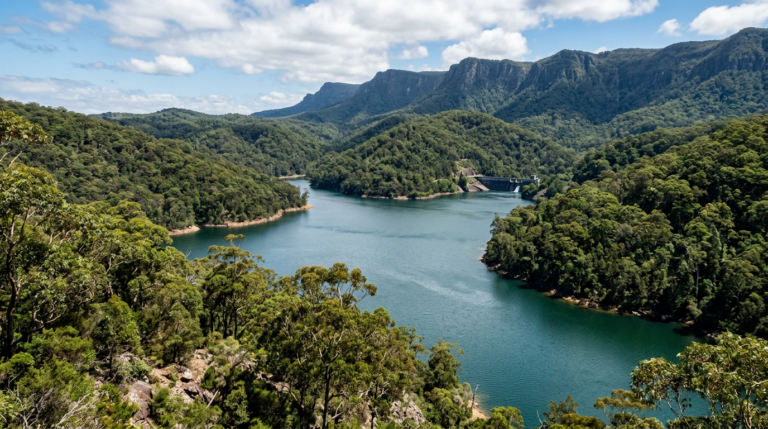
Every drop of Rockhampton’s reticulated water originates from the Fitzroy River — the largest river system draining into the Great Barrier Reef lagoon. The Fitzroy River Water (FRW) division of Rockhampton Regional Council operates the Glenmore Water Treatment Plant, which services Rockhampton, Gracemere, and surrounding communities across the Capricorn Coast hinterland. The raw water intake sits on the lower Fitzroy, downstream of the Fitzroy Barrage (also called the Rockhampton Weir), which acts as the primary raw water storage impoundment.
Treatment at Glenmore follows a conventional surface water process: coagulation with aluminium-based coagulants, flocculation, sedimentation, rapid sand filtration, and disinfection. The critical fact for filter selection: Rockhampton uses free chlorine for disinfection, not chloramine. This makes Rockhampton one of the few Queensland population centres outside south-east QLD that uses free chlorine — putting it in the same category as Toowoomba, Cairns, and Townsville rather than Brisbane, which uses chloramine.
Why does this matter? A standard granular activated carbon (GAC) filter — your Brita jug, a basic benchtop carbon unit — removes free chlorine effectively. In chloramine cities (Brisbane/SEQ, Sydney, Adelaide, Perth, Darwin), standard GAC removes chloramine at roughly 1/40th the rate, making those filters functionally useless for disinfection by-product reduction. In Rockhampton, a basic carbon filter actually works for chlorine taste and odour. That is the good news.
The less-good news is that chlorine taste is the least of Rockhampton’s water quality concerns.
What’s Actually in Rockhampton Tap Water: The Numbers
The ADWG sets guideline values for aesthetic and health-related parameters. Rockhampton’s water meets all regulated ADWG limits — this is not disputed. The issue is what sits below those limits but above zero, and whether the ADWG thresholds themselves are conservative enough for long-chain PFAS compounds that were not even measured when most Australian guidelines were written.
PFAS Contamination: The Issue Nobody Mentions
According to the Australian PFAS Contamination Map compiled from state and federal reporting data, PFAS compounds — specifically PFOA, PFOS, and PFHxS — were documented in Rockhampton drinking water samples as reported in the 2022/23 Drinking Water Quality Management Plan. These are perfluorinated “forever chemicals” that do not break down in the environment, accumulate in the body, and have been linked by the US EPA to kidney cancer, thyroid disease, and developmental effects in infants.
The ADWG health guideline value for PFOS + PFHxS combined is 70 nanograms per litre (ng/L). For PFOA, the guideline is 560 ng/L. Rockhampton’s detected levels sit below these thresholds. But here is the problem: Australia’s PFAS drinking water guidelines are among the least protective in the developed world. The US EPA’s final enforceable standard (April 2024) sets individual PFAS limits at 4 ng/L for PFOA and PFOS — roughly 17 times lower than the Australian PFOS guideline and 140 times lower than the PFOA guideline.
Whether you regard the Australian or US standard as more appropriate is your call. What is not debatable is that no carbon filter — GAC, catalytic carbon, or carbon block — reliably removes PFAS from drinking water. Only reverse osmosis (certified to NSF/ANSI P473) achieves >98% PFAS reduction. If PFAS in your family’s drinking water concerns you, RO is the only verified solution.
Sodium and TDS
The Fitzroy River catchment drains extensive pastoral and agricultural land across central Queensland. During low-flow periods, dissolved mineral content concentrates. Rockhampton’s total dissolved solids (TDS) typically sit between 150 and 350 mg/L depending on season and river flow — higher than Brisbane (~80-115 mg/L) and significantly higher than Melbourne (~60 mg/L). Sodium levels track with TDS and can be elevated compared to coastal SEQ supplies.
The ADWG aesthetic guideline for sodium is 180 mg/L (taste threshold), and the health guideline is “no health-based guideline value” — the ADWG defers to dietary guidance. For most healthy adults, sodium in tap water is a rounding error compared to dietary sodium. For people on sodium-restricted diets, parents preparing infant formula, or anyone with kidney disease, the elevated sodium is worth noting — and again, carbon filtration cannot reduce sodium. Only RO membrane rejection removes dissolved sodium from water.
Flood Turbidity Events
The Fitzroy River is notorious for flood events. Major floods hit Rockhampton in 2011, 2013, 2015, and 2024. During and after these events, raw water turbidity at the Glenmore intake can spike from normal levels of 5-20 NTU to well above 1,000 NTU. The treatment plant copes — it is designed for these events — but the chemical dosing required (coagulant and chlorine) increases substantially, and post-flood taste and odour complaints are common across Rockhampton suburbs from Wandal to Norman Gardens and Parkhurst.
Sediment, organic matter, and agricultural runoff (herbicides, pesticides, nutrients) all spike during flood events. According to Rockhampton Regional Council and the River Health Partnership, the South Rockhampton STP achieved approximately a 90% ammonia reduction, equating to roughly 1,000 kg of nitrogen no longer reaching the estuary annually. This is a wastewater improvement, not a drinking water metric — but it illustrates the nutrient load that the Fitzroy system carries and the treatment challenges Glenmore faces during high-flow events.
| Parameter | Rockhampton Typical | ADWG Guideline | Notes |
|---|---|---|---|
| Disinfection type | Free chlorine | ≤5 mg/L | Standard carbon filters work |
| TDS | 150–350 mg/L | 600 mg/L (aesthetic) | Higher than Brisbane/Melbourne |
| Hardness | ~100–200 mg/L CaCO₃ | 200 mg/L (aesthetic) | Moderate to hard; varies with river flow |
| Fluoride | ~0.7 mg/L (added) | 1.5 mg/L | Only RO or activated alumina removes fluoride |
| PFAS (PFOS + PFHxS) | Detected (below ADWG) | 70 ng/L combined | US EPA limit is 4 ng/L individually |
| PFOA | Detected (below ADWG) | 560 ng/L | US EPA limit is 4 ng/L |
| Sodium | Elevated (seasonal) | 180 mg/L (aesthetic) | Carbon filters cannot reduce sodium |
| Turbidity (normal) | 5–20 NTU (raw) | ≤1 NTU (treated) | Spikes >1,000 NTU during Fitzroy floods |
Why Standard Carbon Filters Are Not Enough for Rockhampton
If you are reading this and thinking “I have a Brita jug, I’m covered” — you are covered for chlorine taste. That is it. Here is what a standard GAC jug filter does not remove from Rockhampton tap water:
- PFAS (PFOA, PFOS, PFHxS): Standard GAC has negligible PFAS removal capacity. Even high-quality carbon block filters are not certified to NSF/ANSI P473 for PFAS unless specifically designed and tested for it. RO membranes reject PFAS at >98%.
- Fluoride (0.7 mg/L added): Carbon filters — including catalytic carbon — cannot remove fluoride. Only reverse osmosis (90-97% removal per NSF/ANSI 58) or activated alumina (80-95%) are effective. If you want fluoride removed, you need RO.
- Sodium: Carbon filters pass dissolved sodium straight through. They are adsorption media, not rejection membranes. Sodium ions are too small and too soluble for carbon to capture. RO membranes reject 85-95% of sodium depending on feed water concentration and membrane condition.
- Hardness (calcium/magnesium): At ~100-200 mg/L CaCO₃, Rockhampton’s water is moderate to hard. Carbon does nothing for hardness. RO reduces it substantially. If you see scale buildup on your kettle element or shower screen in suburbs like Berserker, The Range, or Allenstown, that is calcium carbonate — and carbon will not change it.
The Fitzroy River source adds another layer. During and after flood events, treatment chemical dosing increases. Residual aluminium from coagulation can temporarily rise (the ADWG aesthetic guideline is 0.2 mg/L). Disinfection by-products — trihalomethanes (THMs) and haloacetic acids (HAAs) — form when chlorine reacts with organic matter. Higher organic loads during floods mean higher DBP formation potential. Carbon filters do reduce THMs effectively, which is one genuine point in their favour. But for the full contaminant profile Rockhampton faces, carbon alone is a half-measure.
If your only concern is chlorine taste after a flood event, a $30 carbon jug is adequate. If you want PFAS, fluoride, sodium, and hardness addressed, you need reverse osmosis. There is no middle ground on that chemistry.
Recommended Filtration for Rockhampton Households
Based on Rockhampton’s documented water chemistry — free chlorine disinfection, PFAS detections, elevated sodium and TDS, moderate-to-hard water, and flood turbidity events — here are the two tiers of filtration that actually match the threat profile.
Tier 1: Reverse Osmosis (Full Protection — PFAS, Fluoride, Sodium, Hardness)
If you want everything addressed in one system, RO is the answer. Two options depending on whether you can modify plumbing:
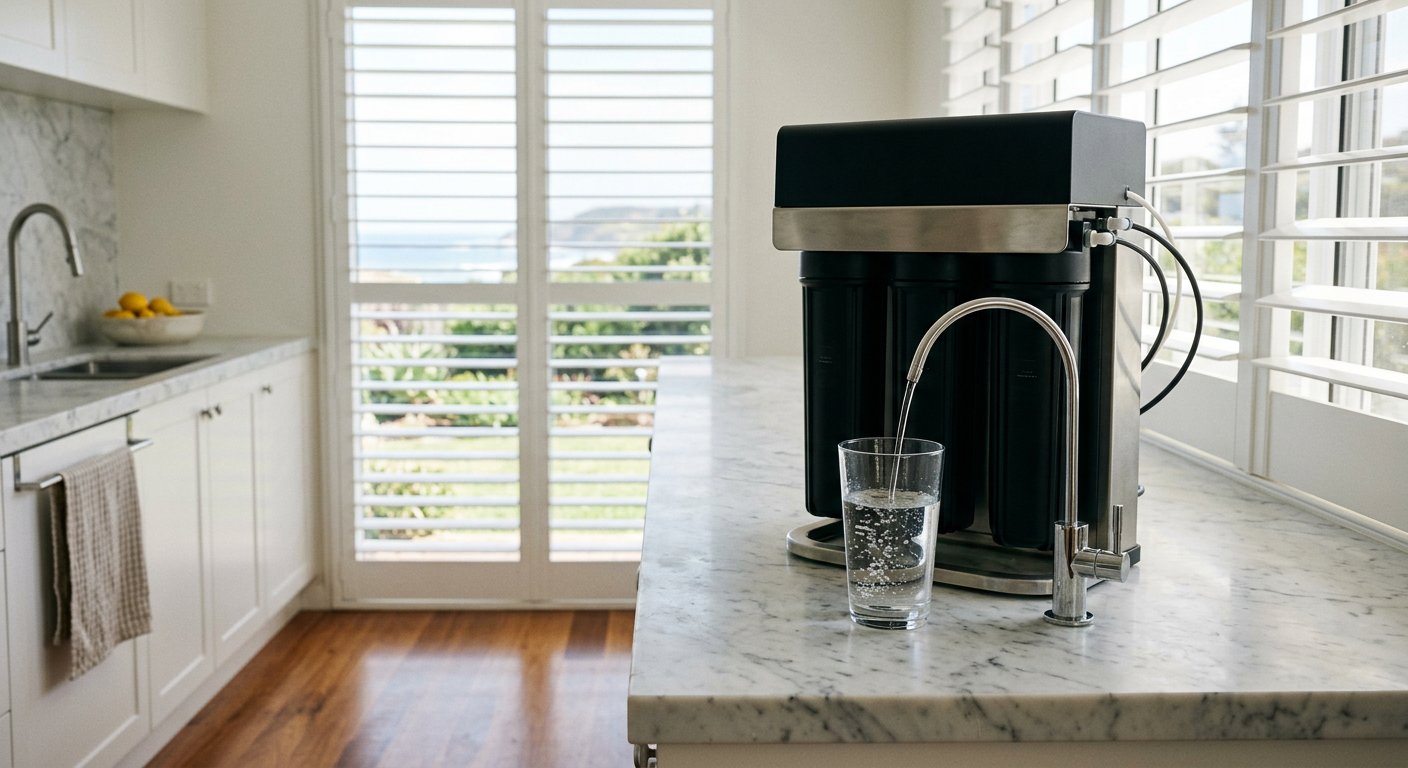
Can’t modify plumbing (renters, units, or preference): The AquaTru Classic Smart Alkaline is a countertop RO unit that requires zero installation. Fill the tank, press a button. It is certified to NSF/ANSI 58 (RO performance), 42 (chlorine taste/odour), 53 (lead, VOCs), and 401 (emerging contaminants). It removes >98% of PFAS, 90-97% of fluoride, and rejects sodium effectively. At roughly $699 for the unit and approximately $120-150/year in replacement filters, the 5-year cost works out to around $0.04 per litre — compared to $2-5 per litre for bottled water.
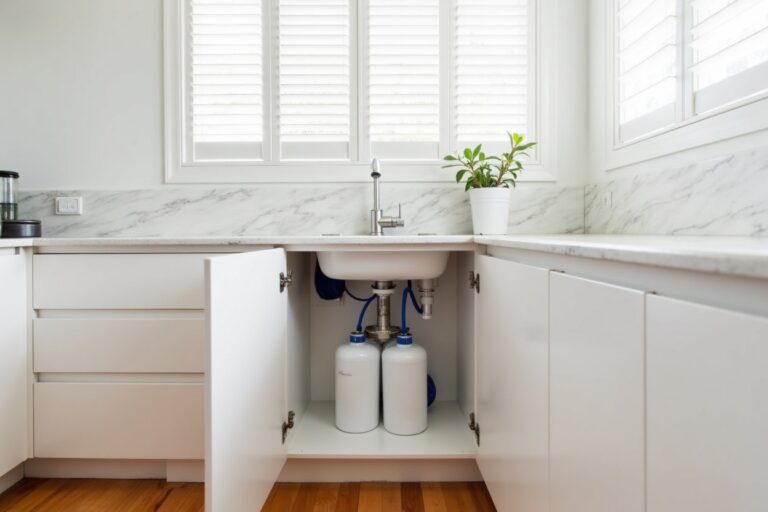
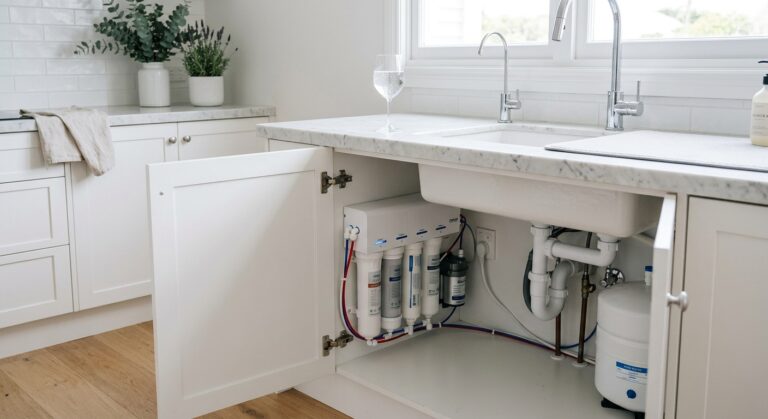
Own your home and want permanent under-sink installation: The Waterdrop D6 under-sink RO is a tankless system that delivers filtered water on demand through a dedicated tap. NSF/ANSI 58 certified. Higher upfront cost but lower per-litre running cost over time due to larger membrane capacity. A licensed plumber can install it in under an hour.
Tier 2: Carbon Block (Chlorine Taste Only — Budget Option)
If your only concern is chlorine taste and post-flood odour, a quality carbon block filter is sufficient. Rockhampton’s free chlorine disinfection means standard carbon works at full efficiency. The Tappwater EcoPro is a benchtop unit that attaches to your kitchen tap with no plumbing modification. It removes free chlorine, THMs, and improves taste. It does not remove PFAS, fluoride, or sodium. If those contaminants are not a concern for you, this is a valid budget option at around $80-100.
Be honest with yourself about what you are trying to achieve. If you are filtering for taste, carbon is fine and significantly cheaper. If you are filtering for health — PFAS, fluoride, sodium — carbon is the wrong tool. You would not use a screwdriver as a hammer. Same principle.
5-Year Cost Comparison: RO vs Bottled Water vs Carbon
| Option | Upfront | Annual Filter Cost | 5-Year Total | Cost/Litre |
|---|---|---|---|---|
| AquaTru Classic RO | ~$699 | ~$130 | ~$1,349 | $0.18 |
| Waterdrop D6 RO | ~$599 | ~$100 | ~$1,099 | $0.15 |
| Tappwater EcoPro (carbon) | ~$90 | ~$60 | ~$390 | $0.05 |
| Bottled water (600mL) | $0 | ~$2,920 | ~$14,600 | $2.00 |
Assumes 4L/day household consumption (1,460L/year). Bottled water priced at $2/L (Woolworths/Coles average). Filter replacement costs are manufacturer estimates converted to AUD.
The AquaTru at $0.18/litre is roughly 11 times cheaper than bottled water per litre — and the Waterdrop D6 is cheaper again. Over five years, you save more than $13,000 compared to buying bottled water for a family of four. That is the maths. Next step: decide whether you need RO or carbon, and choose accordingly.
Rockhampton vs Other Queensland Cities: Water Quality Comparison
Context matters. Here is how Rockhampton’s water stacks up against other Queensland and Australian cities you might compare to.
| City | Disinfection | TDS (mg/L) | Hardness (mg/L CaCO₃) | PFAS Detected | Carbon Filter Works? |
|---|---|---|---|---|---|
| Rockhampton | Free chlorine | 150–350 | 100–200 | Yes (2022/23) | For chlorine only |
| Brisbane / SEQ | Chloramine | 80–115 | 80–120 | Various sites | No — chloramine |
| Townsville | Free chlorine | ~50–100 | ~30–80 | Lavarack Barracks | For chlorine only |
| Toowoomba | Free chlorine | ~100–200 | ~80–150 | Oakey area | For chlorine only |
| Melbourne | Free chlorine | ~60 | ~25 | Fiskville CFA | Yes — free Cl₂ |
| Adelaide | Chloramine | ~400 | ~140 | Edinburg RAAF | No — chloramine |
Rockhampton’s advantage: free chlorine means cheaper, simpler filtration works for taste. Rockhampton’s disadvantage: higher TDS and hardness than Brisbane or Townsville, documented PFAS in the drinking water supply (not just groundwater near a defence site), and a river source system that is inherently more vulnerable to flood contamination than dam-based supplies like SEQ’s Wivenhoe or Melbourne’s Thomson Reservoir.
If you have moved to Rockhampton from Brisbane or Sydney, your old Brita jug actually works better here for chlorine — those cities use chloramine, and your jug was barely touching it. But if you had an RO system in your previous home, keep using it. The PFAS and sodium profile in Rocky makes RO just as justified here. For a full breakdown of water filters matched to Brisbane’s chloramine-treated water, see our best water filter for Brisbane guide.
Decision Tree: Which Filter Does a Rockhampton Household Need?
Three questions. That is all it takes.
1. What are you trying to remove?
- Chlorine taste/odour only → Carbon block filter (Tappwater EcoPro or similar). Job done.
- PFAS, fluoride, sodium, or hardness → Reverse osmosis. No other technology covers all four. Move to question 2.
2. Can you modify your plumbing?
- No (renter, unit, body corporate restrictions) → AquaTru Classic countertop RO. Zero installation. Sits on the bench. Plug in and fill.
- Yes (homeowner, house) → Waterdrop D6 under-sink RO. Permanent, out of sight, higher daily capacity.
3. Budget priority?
- Lowest upfront cost → Carbon filter (~$90). Accepts the PFAS/fluoride/sodium tradeoff.
- Lowest 5-year cost per litre → Under-sink RO (~$0.15/L). Higher upfront, lower running cost.
- No plumbing + full protection → Countertop RO (~$0.18/L). Middle ground.
There is no wrong answer here — only an honest assessment of what you are trying to achieve. If PFAS does not concern you, carbon is cheaper and simpler. If it does, the RO path is clear. Either way, you are ahead of the 85% of Rockhampton households drinking unfiltered tap water without knowing what is in it.
Ready to filter your water?
For Rockhampton households dealing with PFAS, elevated sodium, and flood-related turbidity, the AquaTru Classic countertop RO is the simplest path to NSF/ANSI 58-certified filtration — no plumber, no plumbing modification, removes >98% of PFAS.
Last reviewed: August 2026 – Clean and Native
Frequently Asked Questions
Does Rockhampton use chlorine or chloramine in its tap water?
Rockhampton uses free chlorine for disinfection. This means standard carbon filters (including Brita jugs and benchtop carbon units) effectively remove chlorine taste and odour. Unlike Brisbane, Sydney, Adelaide, Perth, and Darwin, which use chloramine, Rockhampton does not require catalytic carbon or RO specifically for disinfection removal.
Is there PFAS in Rockhampton drinking water?
Yes. According to the Australian PFAS Contamination Map, PFAS compounds (PFOA, PFOS, PFHxS) were documented in Rockhampton drinking water as reported in the 2022/23 Drinking Water Quality Management Plan. Levels were below ADWG guideline values but above the stricter US EPA limits of 4 ng/L per compound.
Can a Brita jug remove PFAS from Rockhampton water?
No. Standard granular activated carbon (GAC) filters like Brita jugs have negligible PFAS removal capacity. Only reverse osmosis systems certified to NSF/ANSI P473 reliably remove >98% of PFAS compounds from drinking water.
How hard is Rockhampton’s tap water?
Rockhampton’s water hardness typically ranges from 100 to 200 mg/L CaCO₃, classified as moderate to hard. This is higher than Brisbane (~80-120 mg/L) and significantly harder than Melbourne (~25 mg/L). You will likely see scale buildup on kettle elements and shower screens. Carbon filters do not reduce hardness — RO does.
Where does Rockhampton’s drinking water come from?
Rockhampton’s reticulated water supply comes from the Fitzroy River, drawn at the intake upstream of the Fitzroy Barrage. It is treated at the Glenmore Water Treatment Plant operated by Fitzroy River Water, a division of Rockhampton Regional Council.
Does Rockhampton water have fluoride?
Yes. Fluoride is added to Rockhampton’s water supply at approximately 0.7 mg/L, within the ADWG guideline range. Carbon filters — including catalytic carbon — cannot remove fluoride. Only reverse osmosis (90-97% removal per NSF/ANSI 58) or activated alumina (80-95%) are effective at fluoride reduction.
Does flooding affect Rockhampton’s tap water quality?
Yes, significantly. During Fitzroy River flood events, raw water turbidity can spike from normal levels of 5-20 NTU to over 1,000 NTU. The Glenmore treatment plant manages this with increased chemical dosing, but post-flood taste and odour changes are commonly reported across suburbs including Wandal, Norman Gardens, Berserker, and Parkhurst.
What is the best water filter for Rockhampton homes?
For full contaminant protection (PFAS, fluoride, sodium, hardness), a reverse osmosis system is the only verified solution. The AquaTru Classic countertop RO requires no installation and is NSF/ANSI 58 certified. The Waterdrop D6 is a permanent under-sink option. For chlorine taste only, a carbon block filter like the Tappwater EcoPro is sufficient and significantly cheaper.
Is Rockhampton tap water safe to drink without a filter?
Rockhampton tap water meets all current ADWG health guideline values and is considered safe by Australian regulatory standards. However, documented PFAS detections and the gap between Australian and US EPA PFAS limits mean “meets guidelines” and “zero risk” are not the same thing. Whether to filter is a personal risk assessment, not a yes/no compliance question.
Get the Australian Home Environment Checklist
30 checks across water, air and EMF. Most of them free. Ranked by impact.
No spam. Unsubscribe any time.

Former Royal Australian Navy Clearance Diver and TAG-E counter-terrorism operator. Founded Clean and Native to apply the same rigorous thinking to the home environment.
Full biography →