Desalination vs Home Filtration: Perth and Gold Coast Tap Water
Drafted with AI assistance and checked against published specifications and certifications. First-hand measurements appear only where stated. How we make content
How this assessment was made. I have not personally tested these units. This assessment is based on manufacturer specifications, independent certification records (NSF/ANSI, WaterMark AS3497) and Australian supply and pricing data current at the time of writing. Where I have personally measured a product in my own home, the article says so explicitly and gives the readings. Clean and Native earns affiliate commission on some links. That does not affect which products are assessed or what the specifications say.
Desalinated water makes up a significant portion of Perth’s drinking supply and sits on standby for the Gold Coast — and it tastes different from dam-sourced water because the mineral profile is fundamentally altered by reverse osmosis at industrial scale. The good news: you do not need different filtration technology. The same chloramine, fluoride, and PFAS concerns that apply to conventional Australian tap water apply to desalination-blended supply, and the same home RO and catalytic carbon solutions address them.
| Factor | Desalination Plant | Home RO Filtration |
|---|---|---|
| What it does | Converts seawater to potable supply at city scale | Removes residual chloramine, fluoride, PFAS from tap water at point of use |
| Addresses taste? | Produces low-mineral base water; taste varies after blending and re-chloramination | Removes chloramine taste/odour and adjusts TDS at tap |
| Verdict | Essential infrastructure — not a substitute for home filtration | Best point-of-use solution for taste + contaminant removal in desal-blended supply |
Desalination does not eliminate the need for home filtration. Perth’s Water Corporation re-chloraminates desalinated water before it reaches your tap. Gold Coast’s Tugun plant output goes through the same SEQ Water treatment process. The contaminants you care about — chloramine, fluoride (dosed post-treatment), and trace PFAS — are added or present after desalination, not before it. A countertop or under-sink RO system is the correct final barrier for drinking water quality in both cities.
Key catches
- Perth uses chloramine disinfection — standard GAC/Brita jugs remove chloramine at ~1/40th the rate of free chlorine. You need catalytic carbon or RO.
- Gold Coast (SEQ Water) also uses chloramine. Same rule applies.
- Fluoride is dosed after desalination in both cities — carbon filters cannot remove it. Only RO (90-97%) or activated alumina (80-95%) works.
- Desal-blended water has lower baseline TDS than dam water, but this does not mean it is “pure” at your tap — pipe infrastructure adds minerals and contaminants on the way.
How Desalinated Water Differs from Dam and River Supply
Every drop of water that comes out of a desalination plant starts as seawater — roughly 35,000 mg/L total dissolved solids (TDS). Industrial reverse osmosis membranes strip that down to approximately 50-150 mg/L TDS, depending on the plant’s post-treatment remineralisation process. For context, Perth dam water typically sits around 170 mg/L TDS and 180 mg/L CaCO₃ hardness, according to Water Corporation annual water quality data. Desalinated water, before blending, is significantly softer and lower in mineral content than what Perth residents are used to.
This matters for two reasons. First, taste. Minerals like calcium, magnesium, and bicarbonate contribute to what most people perceive as “good-tasting” water. Strip them out, and water can taste flat, slightly metallic, or just “different.” Water authorities partially address this by remineralising — adding lime (calcium hydroxide) and sometimes carbon dioxide to raise the pH and reintroduce some mineral content. But the resulting mineral profile is simpler and less varied than naturally filtered catchment water that has percolated through rock and soil for months.
Second, pipe compatibility. Very soft, low-TDS water is more aggressive to pipe infrastructure. It can leach copper and lead from older plumbing at higher rates than harder water. The ADWG sets a guideline value of 0.01 mg/L for lead in drinking water, and homes with older copper or brass fittings connected to a desalination-heavy supply may see elevated readings at the tap — particularly first thing in the morning after water has sat in pipes overnight. This is not a desalination failure; it is a pipe-infrastructure reality that makes point-of-use filtration more relevant, not less.
Perth’s Desalination Infrastructure: Kwinana, Southern Seawater, and Alkimos
Perth is Australia’s most desalination-dependent capital city — and that dependence is growing. Two operational plants currently supply the Perth Integrated Water Supply Scheme (IWSS), with a third under construction.
Perth Seawater Desalination Plant (Kwinana): Operational since 2006. Capacity of approximately 145 megalitres per day (ML/day), or around 53 billion litres per year. Located in the Kwinana industrial corridor, south of Perth. This was Australia’s first large-scale desalination plant and fundamentally changed Perth’s water supply mix.
Southern Seawater Desalination Plant (Binningup): Operational since 2011. Capacity of approximately 300 ML/day at full output. Located near Binningup, roughly 150 km south of Perth. Together with Kwinana, these two plants can supply a substantial share of Perth’s total demand.
Alkimos Seawater Desalination Plant: Under construction as of 2026, with a major pipeline milestone reported by Water Corporation in June 2026. This $2.8 billion project, located north of Perth, will add further desalination capacity to the IWSS. Water Corporation describes it as critical to meeting Perth’s growing population demand as rainfall-dependent dam inflows continue declining.
Water Corporation blends desalinated output with groundwater and dam supply before distributing it across the Perth network. The exact blend ratio varies by season, dam levels, and demand — Water Corporation does not publish a fixed percentage split, because it changes week to week. What is consistent: all water entering the distribution network is chloraminated (not free chlorine) and fluoridated to approximately 0.7 mg/L, per WA Health Department requirements.
For residents in suburbs like Rockingham, Mandurah, and the Kwinana corridor itself, the proportion of desalinated water in the blend tends to be higher due to proximity to the southern plants. Northern suburbs near Alkimos will see increased desal contribution once that plant is commissioned. The practical implication for filtration is identical regardless of blend ratio: chloramine is the disinfectant, fluoride is dosed, and standard GAC jugs are inadequate.
Gold Coast’s Tugun Desalination Plant: Standby Mode and What That Means for Your Water
The Gold Coast Desalination Plant at Tugun operates under a fundamentally different model to Perth’s infrastructure. Built as a drought-response measure and commissioned in 2009 with a capacity of approximately 133 ML/day, the Tugun plant is managed by Seqwater and maintained in what they describe as a “high state of readiness” — meaning it can ramp up to full production within a defined timeframe when dam levels drop below trigger points.
As of 2026, South East Queensland dam levels have generally been sufficient to keep Tugun in standby or low-production mode. According to Seqwater’s published water security data, the SEQ Water Grid draws primarily from Wivenhoe, Somerset, and North Pine dams, supplemented by the Western Corridor Recycled Water Scheme and Tugun desalination as needed. When Tugun does produce, its output is blended into the broader SEQ grid and treated identically to other sources — including chloramination and fluoridation.
For Gold Coast residents in suburbs like Tugun itself, Burleigh Heads, Coolangatta, and Palm Beach, the practical reality is this: whether your tap water on any given day contains 0% or 30% desalinated water, it has been chloraminated by SEQ Water before reaching your home. The disinfection chemistry does not change based on the source water origin. And the ADWG-compliant fluoridation dosing (typically 0.6-0.8 mg/L in SEQ) is applied post-treatment regardless.
The taste variation Gold Coast residents sometimes notice — particularly during drought periods when Tugun production increases — comes from the shifting mineral profile of the blend, not from any new contaminant. Desalinated water contributes a lower-mineral base to the mix, which changes the overall hardness and TDS. SEQ Water reports typical TDS of 80-115 mg/L and hardness of 80-120 mg/L CaCO₃ for Brisbane/Gold Coast supply. During heavy desal blending, TDS can sit at the lower end of that range.
Why Some Residents Notice a Taste Difference After Desal Blending
If your water tastes “flat”, “chemical”, or just “off” compared to what you remember from five or ten years ago, you are not imagining it. Three factors converge in desalination-blended supply to change how tap water tastes.
1. Reduced mineral complexity. Natural catchment water picks up a wide range of trace minerals as it moves through soil, rock, and aquifer systems. This creates what water scientists call a “mineral fingerprint” — a unique combination of calcium, magnesium, sodium, potassium, bicarbonate, silica, and trace elements that varies by catchment. Desalinated water, even after remineralisation, has a simpler mineral profile. Most plants add calcium hydroxide and CO₂ to stabilise pH and hardness, but this does not replicate the full mineral diversity of catchment water. The result: water that meets every ADWG guideline but tastes less “full” or “round” to many palates.
2. Chloramine persistence. Chloramine (chlorine bonded to ammonia) is more stable than free chlorine — that is precisely why water utilities in Perth, Brisbane/SEQ, Sydney, Adelaide, and Darwin use it. It persists longer through the distribution network, ensuring disinfection all the way to your tap. But persistence means you taste it. Chloramine has a subtler chemical taste than free chlorine, but it lingers. And because desalinated water has fewer competing mineral flavours to mask the chloramine, the chemical taste can be more noticeable in desal-heavy blends.
3. Seasonal blend variation. Your palate adapts to whatever your baseline water tastes like. When the blend ratio shifts — more desal during dry periods, more dam water during wet — the taste changes, and your adapted palate notices. Perth residents experience this more acutely than Gold Coast residents because Perth’s desal plants run continuously, and the blend varies with seasonal demand. Gold Coast experiences sharper shifts when Tugun ramps up from standby to production during drought triggers.
None of these taste factors indicate a safety issue. Desalination-blended water meets ADWG standards. But “safe to drink” and “pleasant to drink” are different standards. If your goal is water that tastes clean, neutral, and free of chemical flavour, point-of-use filtration is the answer — specifically, filtration that addresses chloramine, which is the dominant taste driver.
Does Desalinated Tap Water Need Different Filtration?
No. This is the most important practical conclusion of this article. The contaminants of concern in desalination-blended tap water are identical to those in conventional Australian tap water — because the contaminants are introduced during treatment and distribution, not from the source water itself.
Here is what the desalination process removes and what it does not remove from your final tap water:
| Contaminant | Removed by Desal Plant? | Present at Your Tap? | Home Filter Required |
|---|---|---|---|
| Chloramine | N/A — added after desal | Yes (Perth + Gold Coast) | Catalytic carbon or RO |
| Fluoride | N/A — dosed after desal | Yes (~0.7 mg/L Perth, ~0.6-0.8 mg/L Gold Coast) | RO (90-97%) or activated alumina (80-95%) |
| PFAS | Yes — industrial RO membranes reject PFAS | Possible trace — from pipe infrastructure and blended non-desal sources | RO (>98% per NSF P473) |
| Lead | Yes — but leaches from pipes after desal | Possible — especially in older homes with brass/copper fittings | RO (>95%) or NSF 53-rated carbon block |
| Hardness minerals | Yes — partially re-added via remineralisation | Yes — lower than dam-source water | Not a contaminant — RO removes if desired |
The pattern is clear: desalination handles the heavy lifting of converting seawater to potable water, but the contaminants you actually taste and worry about are introduced downstream of the desal plant. Chloramine is added as a disinfectant. Fluoride is dosed per state health regulations. Lead can leach from aging pipe infrastructure — and the softer, more aggressive water from desalination can increase that leaching rate compared to harder dam water.
This means your home filtration decision tree is identical whether you live in a suburb with high desal blend (Rockingham, Kwinana in Perth; Tugun, Coolangatta on the Gold Coast) or one with a lower desal contribution. The deciding factor is your city’s disinfection type and what you want to remove.
The Right Filtration for Perth and Gold Coast Desal-Blended Water
If you want to address chloramine taste, fluoride, and potential PFAS in a single system, reverse osmosis is the only technology that covers all three. Here is how the decision breaks down based on your living situation.
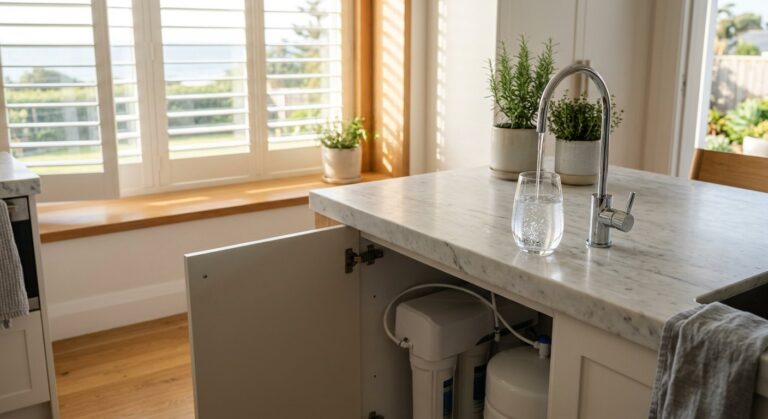
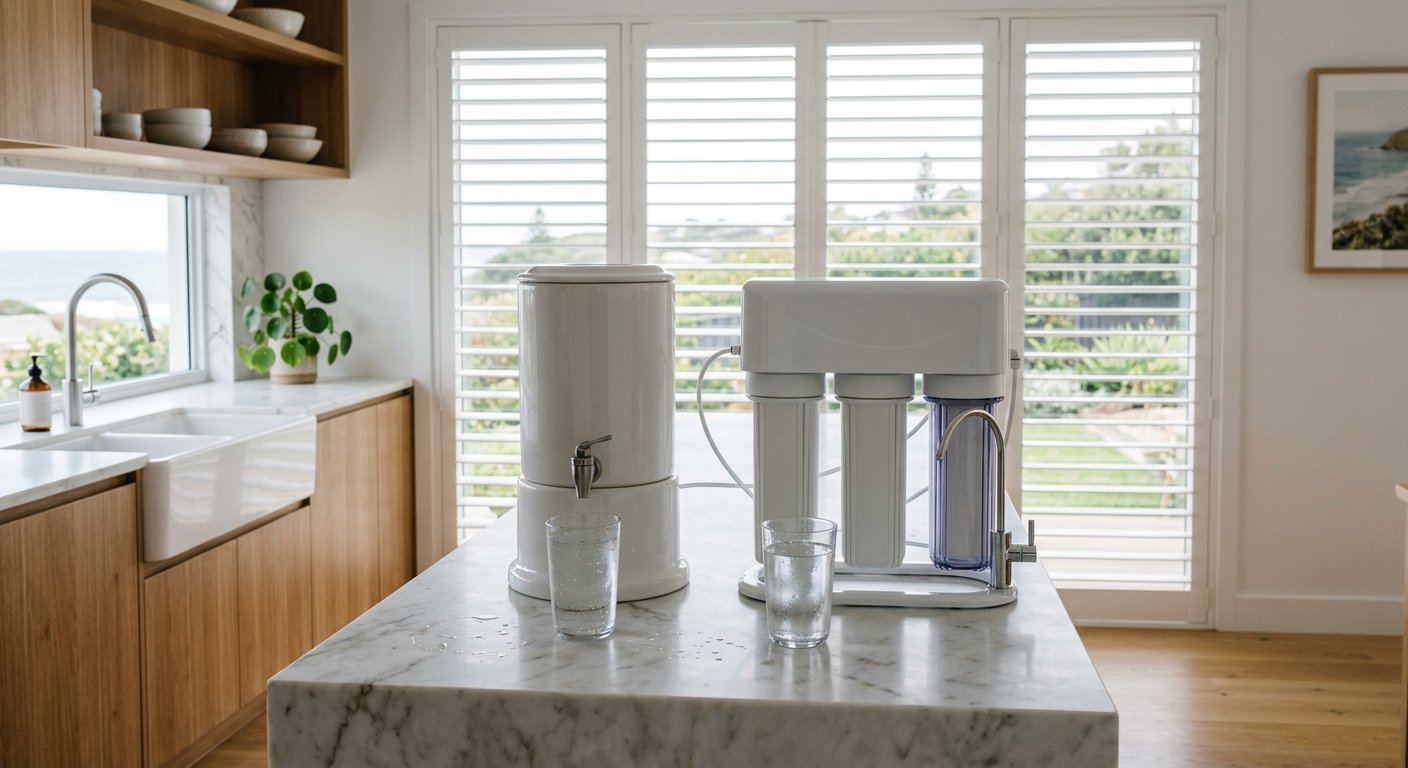
Can you modify your plumbing? If yes, an under-sink RO system like the Waterdrop X8 installs under your kitchen sink and provides filtered water through a dedicated tap. This is the cleanest installation for homeowners — no bench space required, no refilling tanks. The Waterdrop X8 is certified by IAPMO R&T to NSF/ANSI 42, 58 and 372, and Waterdrop lists TDS, fluoride, lead, PFOA and PFOS among the contaminants it reduces. It needs a power point under the sink.
If you rent or cannot modify plumbing, a countertop RO system like the Philips RO Water Station sits on your bench, connects to no plumbing, and produces RO water from a 4 L tank you fill manually. Philips lists chlorine, lead, PFOA and PFOS among the substances it reduces, but not fluoride or chloramine, and it names no independent certification, so test the output if a specific contaminant is your concern.
If your only concern is chloramine taste and you are not concerned about fluoride or PFAS, a catalytic carbon block filter is a more affordable option. The Tappwater EcoPro is a benchtop unit that uses compressed activated carbon to address chloramine and improve taste. It will not remove fluoride — carbon filters of any type cannot do this — but for pure taste improvement in a chloramine city, it is effective and costs less upfront than RO.
| Product | Type | Chloramine | Fluoride | PFAS | Best For |
|---|---|---|---|---|---|
| Philips RO Water Station | Countertop RO | Not listed | Not listed | ✓ PFOA, PFOS listed | Renters, no-plumbing installs |
| Waterdrop X8 | Under-sink RO | Chlorine (NSF 42); chloramine not listed | ✓ Listed (NSF 58 system) | ✓ PFOA, PFOS listed | Homeowners wanting permanent install |
| Tappwater EcoPro | Benchtop carbon block | ✓ | ✗ No | ✗ No | Taste-only improvement, lower budget |
If you want to remove fluoride, PFAS, chloramine, and lead in one system, there is no substitute for RO. Carbon block handles chloramine taste effectively but cannot touch fluoride. That is a hard physical limitation — not a brand or quality issue.
Desalination vs Home RO: What Each System Actually Does
There is a common misconception that because desalination plants use reverse osmosis, and home water filters also use reverse osmosis, the two systems do the same job. They do not. Understanding the distinction clarifies why home filtration remains necessary even when your water starts at a desal plant.
Industrial desalination RO operates at pressures of 55-80 bar (800-1,160 psi) and pushes seawater through spiral-wound polyamide membranes. The goal is converting saline water to potable water — reducing TDS from ~35,000 mg/L to ~50-150 mg/L. The output is then remineralised, pH-adjusted, disinfected with chloramine, fluoridated, and pumped into the distribution network. By the time it reaches your suburb, it has travelled through kilometres of pipe infrastructure — picking up trace metals, biofilm residues, and potentially sediment along the way.
Home RO systems operate at 3-6 bar (45-90 psi) using household water pressure. Their job is fundamentally different: they remove the treatment chemicals (chloramine, fluoride) and distribution contaminants (lead, copper, sediment, PFAS) that the desal plant never intended to address — because those contaminants are added or introduced after the plant. A home RO membrane certified to NSF/ANSI 58 removes approximately 90-97% of fluoride, >95% of lead, and >98% of PFAS (per NSF P473 testing protocols). It also strips chloramine completely.
Think of it this way: the desal plant makes seawater drinkable. Your home filter makes drinkable water clean. They are sequential, not redundant. Without home filtration, you are drinking water that has been treated to regulatory compliance — but “compliant” means meeting the ADWG guideline values, not the absence of contaminants. The ADWG itself states that guideline values “do not represent concentrations below which there is no risk” — they represent concentrations considered acceptable based on a balance of health risk, technical feasibility, and cost.
Perth vs Gold Coast: A Side-by-Side Water Quality Comparison
| Parameter | Perth (Water Corporation) | Gold Coast (SEQ Water) | ADWG Guideline |
|---|---|---|---|
| Disinfection type | Chloramine | Chloramine | — |
| TDS (mg/L) | ~170 | ~80-115 | <600 (aesthetic) |
| Hardness (mg/L CaCO₃) | ~180 (hard) | ~80-120 (moderate) | 200 (aesthetic) |
| Fluoride (mg/L) | ~0.7 | ~0.6-0.8 | 1.5 |
| Desal contribution | Significant (continuous operation, variable blend) | Low-to-nil in normal conditions (standby mode) | — |
| Primary filtration need | Chloramine + fluoride + lead (softer desal water = higher leaching risk) | Chloramine + fluoride | — |
Perth faces the harder water challenge overall at ~180 mg/L CaCO₃, but the desalination blend actually brings that number down in suburbs with high desal contribution. Gold Coast water is moderately hard at 80-120 mg/L and relatively stable in composition when Tugun is in standby. Both cities share the same filtration requirement: catalytic carbon or RO for chloramine, and RO for fluoride. If you want the full analysis for your city, read our dedicated guides for Perth tap water quality and Gold Coast water quality.
Your Three-Question Filtration Decision Tree
Whether your tap water comes from a dam, a bore, or a desalination plant, the decision logic is the same for Perth and Gold Coast residents:
1. Can you modify your plumbing?
- Yes → Under-sink RO (Waterdrop X8) is the cleanest permanent installation.
- No (renter or preference) → Countertop RO (Philips RO Water Station) sits on your bench, no plumbing needed.
2. What do you want to remove?
- Chloramine + fluoride + PFAS + lead → RO is the only option that covers all four.
- Chloramine taste/odour only → Catalytic carbon block (Tappwater EcoPro) works at lower cost. But understand: it will not touch fluoride.
3. Are you concerned about lead from older pipes?
- Yes (pre-1990 home, brass fittings, or copper pipes) → RO or an NSF 53-certified carbon block rated for lead reduction. Desalinated water’s lower hardness makes this concern more relevant, not less — softer water leaches more lead from pipes.
- No → Any of the above options based on your other priorities.
Final Verdict
Desalination is critical infrastructure for water security in Perth and climate resilience on the Gold Coast. It solves the supply problem — converting unlimited seawater into drinkable water when dams run low. What it does not solve is the last-mile quality problem. Chloramine is added after desalination. Fluoride is dosed after desalination. Lead leaches from pipes after desalination. These are the contaminants that affect what comes out of your kitchen tap, and they require point-of-use filtration.
For Perth residents in the Kwinana corridor, Rockingham, Mandurah, or northern suburbs near the future Alkimos plant: your water has a significant desalination component, and your filtration needs are identical to any other Perth suburb. For Gold Coast residents in Tugun, Burleigh, Coolangatta, or Palm Beach: your water is chloraminated whether or not the Tugun desal plant is running.
If you want one system that handles chloramine, fluoride, PFAS, and lead — regardless of source — reverse osmosis is the correct technology. The Waterdrop X8 for under-sink (certified to NSF/ANSI 58) and the Philips RO Water Station for the benchtop are the two options we rate highest; test the Philips output if fluoride is your concern. Stop buying bottled water. Filter at the tap.
Last reviewed: August 2026 – Clean and Native
Ready to filter your water?
The Philips RO Water Station is our countertop RO pick for Australian renters who cannot modify plumbing: no installation, and Philips lists PFOA, PFOS and lead reduction, though not fluoride. Homeowners should choose the certified Waterdrop X8 under-sink RO.
Frequently Asked Questions
Does desalinated water taste different from dam water?
Yes. Desalinated water has a simpler mineral profile than dam or river water, even after remineralisation. Many Perth residents describe it as “flat” or “thin.” The chloramine added after desalination also contributes a subtle chemical taste that is more noticeable when there are fewer competing mineral flavours in the water.
Does Perth tap water contain desalinated water?
Yes. Perth has two operational desalination plants (Kwinana and Southern Seawater at Binningup) with a third (Alkimos) under construction as of 2026. Desalinated water is blended with dam and groundwater supply, and the blend ratio varies by season, demand, and dam levels. Water Corporation does not publish a fixed percentage split.
Is the Gold Coast Desalination Plant currently operating?
The Tugun desalination plant is maintained by Seqwater in a “high state of readiness” as a climate-resilient backup. As of 2026, South East Queensland dam levels have generally kept the plant in standby or low-production mode. It can ramp up to approximately 133 ML/day when dam levels trigger activation.
Do I need a different water filter if my water comes from a desalination plant?
No. The contaminants you need to filter — chloramine, fluoride, lead, and PFAS — are added or introduced after desalination during treatment and distribution. The same filtration technology (catalytic carbon for chloramine, RO for fluoride and PFAS) applies whether your water originated from a dam, bore, or desal plant.
Can a Brita jug filter chloramine from Perth tap water?
No, not effectively. Perth uses chloramine disinfection. Standard GAC (granular activated carbon) filters like Brita remove chloramine at approximately 1/40th the rate of free chlorine. You need catalytic carbon, compressed carbon block, or reverse osmosis to address chloramine in Perth tap water.
Does desalinated water leach more lead from pipes?
It can. Desalinated water, even after remineralisation, tends to be softer and more chemically aggressive than harder dam or groundwater supply. This can increase the rate at which lead and copper leach from older plumbing fittings. The ADWG guideline for lead is 0.01 mg/L. Homes with pre-1990 brass or copper fittings should consider RO filtration or flushing pipes for 30 seconds before drinking.
Can a carbon filter remove fluoride from desalinated tap water?
No. Carbon filters — including standard GAC, catalytic carbon, and compressed carbon block — cannot remove fluoride. Fluoride removal requires reverse osmosis (90-97% rejection) or activated alumina (80-95% removal). This applies regardless of whether the water source includes desalinated water or not, because fluoride is dosed after desalination as part of standard treatment.
What is the TDS of Perth tap water compared to Gold Coast tap water?
Perth tap water typically measures approximately 170 mg/L TDS with hardness around 180 mg/L CaCO₃, per Water Corporation data. Gold Coast (SEQ Water) typically ranges from 80-115 mg/L TDS with hardness of 80-120 mg/L CaCO₃. Perth’s higher figures reflect its harder groundwater sources, though desalination blending can lower TDS in suburbs near the Kwinana and Binningup plants.
Is desalinated water safe to drink without filtering?
Yes, desalinated tap water in Perth and on the Gold Coast meets Australian Drinking Water Guidelines (ADWG 2024) and is safe to drink without additional filtration. However, the ADWG states that guideline values “do not represent concentrations below which there is no risk.” Home filtration reduces chloramine, fluoride, and trace contaminants to levels below ADWG guidelines — which is a different standard than “safe.”
Get the Australian Home Environment Checklist
30 checks across water, air and EMF. Most of them free. Ranked by impact.
No spam. Unsubscribe any time.

Former Royal Australian Navy Clearance Diver and TAG-E counter-terrorism operator. Founded Clean and Native to apply the same rigorous thinking to the home environment.
Full biography →