Best Water Filter for Eczema Perth 2026
Perth has the hardest tap water of any Australian capital city — up to 226 mg/L CaCO₃ according to the Water Corporation WA annual report — and that mineral hardness is the primary skin barrier threat for eczema sufferers. A 2020 meta-analysis by Jabbar-Lopez ZK et al. (PubMed 33259122) found an odds ratio of 1.28 for eczema prevalence in hard water areas. Perth also uses free chlorine for disinfection (Water Corporation WA), not chloramine, which means a standard activated carbon shower filter handles the disinfectant effectively. The harder problem — and the one most Perth households miss — is the calcium and magnesium that no shower filter removes.
| Solution | What It Removes | Verdict for Perth Eczema |
|---|---|---|
| Carbon shower filter | Free chlorine ✓ Hardness ✗ | Good first step — addresses chlorine irritation only |
| Water softener | Calcium & magnesium ✓ Chlorine ✗ | Addresses the primary Perth trigger — hardness |
| Both combined | Free chlorine ✓ Hardness ✓ | Full Perth eczema solution stack |
For Perth eczema sufferers, the correct approach is a two-stage solution: a standard activated carbon or KDF shower filter (~$100-200) for free chlorine removal, plus a whole-house water softener ($2,000-4,000 installed) if mineral hardness is driving persistent flares. Perth uses free chlorine, not chloramine (Water Corporation WA), so catalytic carbon and vitamin C shower filters are unnecessary for the disinfectant — standard carbon or KDF-55 works. The real problem is 180-226 mg/L CaCO₃ hardness that no shower cartridge can touch. Without addressing the minerals, you are solving the smaller half of the equation.
Key catches
- No shower filter removes hardness minerals — calcium and magnesium pass through carbon, KDF, and vitamin C media
- Perth does NOT use chloramine — catalytic carbon is overkill for the disinfectant here (save that spend for Brisbane, Sydney, or Adelaide)
- A water softener requires plumbing modification — renters need landlord approval or a portable exchange unit
Perth Water Chemistry: Why Your Skin Is Under Siege
If you live in Perth and your eczema flares after every shower, you are not imagining it. Perth’s tap water presents two distinct skin stressors — but one of them is far more damaging than the other, and most people address the wrong one first.
Hardness: the primary threat. According to the Water Corporation WA annual water quality data, Perth’s groundwater-dominated supply delivers hardness levels of 140-226 mg/L CaCO₃ depending on the source bore and suburb. The ADWG classifies anything above 200 mg/L as “hard” and above 300 mg/L as “very hard.” Perth sits right at the threshold — hard enough to leave scale on shower screens, calcify heating elements, and, critically, disrupt the skin’s acid mantle. Suburbs drawing from the Gnangara Mound (Joondalup, Wanneroo, Alkimos) and Jandakot bore fields (Cockburn, Rockingham) tend to report the highest hardness values.
Free chlorine: the secondary irritant. The Water Corporation WA disinfects Perth’s supply with free chlorine — not chloramine. This is a significant distinction. Free chlorine is a strong oxidant that strips skin oils on contact, but it is also easily removed by standard activated carbon filtration and KDF-55 shower media. Cities like Brisbane, Sydney, Adelaide, and Darwin use chloramine, which is far harder to filter (requiring catalytic carbon or reverse osmosis). Perth does not have that problem. A $100-200 shower filter handles Perth’s disinfectant chemistry with off-the-shelf media.
How Hard Water Damages Eczema-Prone Skin
You already know hard water leaves white scale on your shower glass. The same calcium carbonate deposits are forming on your skin — and the research confirms the damage is measurable.
The mechanism. Jabbar-Lopez ZK et al. published a systematic review and meta-analysis in 2020 (PubMed 33259122) examining the association between domestic water hardness and eczema. The finding: an odds ratio of 1.28 (95% CI 1.17-1.40) for eczema prevalence in areas with hard water. That is a 28% increased risk — not dramatic in isolation, but consistent across multiple study populations and geographies. The proposed mechanisms include:
- Skin surface pH elevation. Calcium and magnesium ions raise the skin’s surface pH from its optimal acidic range (~4.5-5.5) toward neutral. The acid mantle is the skin’s primary antimicrobial and moisture-retention layer. When pH rises, the barrier weakens.
- Surfactant interaction. Hard water minerals react with soap to form calcium stearate (soap scum). This insoluble film deposits on skin, blocks pores, and triggers inflammatory responses in atopic skin. According to the Jabbar-Lopez meta-analysis, the combination of hard water plus soap is more damaging than either alone.
- Increased trans-epidermal water loss (TEWL). Compromised barrier function from mineral deposits leads to higher TEWL — your skin dries out faster, and the itch-scratch cycle begins.
Free chlorine compounds the problem. While hardness is the primary driver, free chlorine in Perth’s supply acts as a secondary irritant. Chlorine oxidises skin lipids, accelerating the barrier disruption already initiated by mineral deposits. For eczema-prone skin, this is a one-two combination: minerals weaken the barrier, chlorine strips the oils trying to repair it.
If you are showering in Perth tap water without any filtration, you are exposing compromised skin to both triggers simultaneously — up to 226 mg/L of hardness minerals and residual free chlorine — at water temperatures that open pores and maximise absorption. That is not a recipe for skin recovery. It is a recipe for persistent flares.
What a Shower Filter Actually Does for Perth Water
Here is where most Perth households get it wrong: they buy a shower filter expecting it to solve their eczema, and when flares continue, they conclude filtration does not work. The problem is not the filter. The problem is expecting it to do something it physically cannot.
What a shower filter removes in Perth. A standard activated carbon or KDF-55 shower filter is designed to remove dissolved chlorine and chlorinated byproducts from water passing through at shower flow rates (typically 8-12 L/min). Because Perth uses free chlorine — not chloramine — standard shower filter media works. KDF-55 (copper-zinc alloy) performs well even in hot water, making it suitable for shower applications where carbon media can lose effectiveness at elevated temperatures. A carbon or KDF shower filter in Perth will reduce free chlorine by 90-99% at rated flow, depending on the cartridge and water temperature.
What a shower filter does NOT remove in Perth. No shower filter — carbon, KDF, vitamin C, or any other media — removes dissolved calcium and magnesium. These are dissolved ionic minerals, not particles or gases. They pass straight through any cartridge-based shower filter. After filtration, your shower water still contains 180-226 mg/L of hardness minerals. The scale still forms. The soap scum still coats your skin. The pH elevation still occurs.
This does not mean a shower filter is worthless for Perth eczema sufferers. Removing free chlorine eliminates one of the two irritants and provides meaningful relief for some people. But if mineral hardness is driving your flares — and in Perth, statistically, it probably is — the shower filter is stage one of a two-stage solution.
What a Water Softener Does for Perth Eczema
A water softener addresses the problem a shower filter cannot: dissolved calcium and magnesium. Ion-exchange softeners swap calcium (Ca²⁺) and magnesium (Mg²⁺) ions for sodium (Na⁺) ions as water passes through a resin bed. The result is water with dramatically reduced hardness — typically below 17 mg/L CaCO₃ from an input of 180-226 mg/L. That is a reduction of over 90%.
What changes for your skin. Softened water means no calcium stearate (soap scum) forming on your skin. Soap lathers and rinses cleanly. Your skin surface pH returns closer to its natural acidic range. Trans-epidermal water loss decreases. For eczema sufferers in Perth, this addresses the primary trigger that the Jabbar-Lopez meta-analysis identified — the 28% increased risk associated with hard water exposure.
The cost reality. A whole-house water softener in Perth runs $2,000-4,000 installed, including the unit, plumbing modifications, and drain connection for regeneration waste. Annual salt costs run $150-300 depending on household size and water usage. Over five years, total cost of ownership is approximately $2,750-5,500. That is not trivial — but compare it to years of dermatologist visits, prescription emollients, and topical corticosteroids that treat symptoms without addressing the environmental trigger.
Limitations. A water softener does not remove free chlorine. The sodium-ion exchange process has no effect on dissolved chlorine. In Perth, this is a solvable problem — a standard carbon pre-filter or post-filter addresses free chlorine for minimal additional cost. But if you install a softener without a carbon stage, your water will be soft but still chlorinated.
For renters who cannot modify plumbing, a portable exchange softener is an option — these are rented from water treatment companies who swap out exhausted resin tanks on a regular schedule. No plumbing modification required beyond a hose connection. Cost is typically $30-50/month in the Perth metro area.
The Perth Eczema Solution Stack: Two Stages
Stop thinking about this as a single product purchase. Perth’s water chemistry requires a staged approach, and the stage you start with depends on your budget and housing situation.
Stage 1: Standard Carbon or KDF Shower Filter (~$100-200)
This is the immediate, low-cost intervention. A shower filter removes free chlorine from Perth tap water at the point of use. It does not fix hardness, but it eliminates the oxidative irritant that compounds mineral damage. For mild eczema, this alone may provide noticeable relief within 2-4 weeks.
Recommended products for Perth:
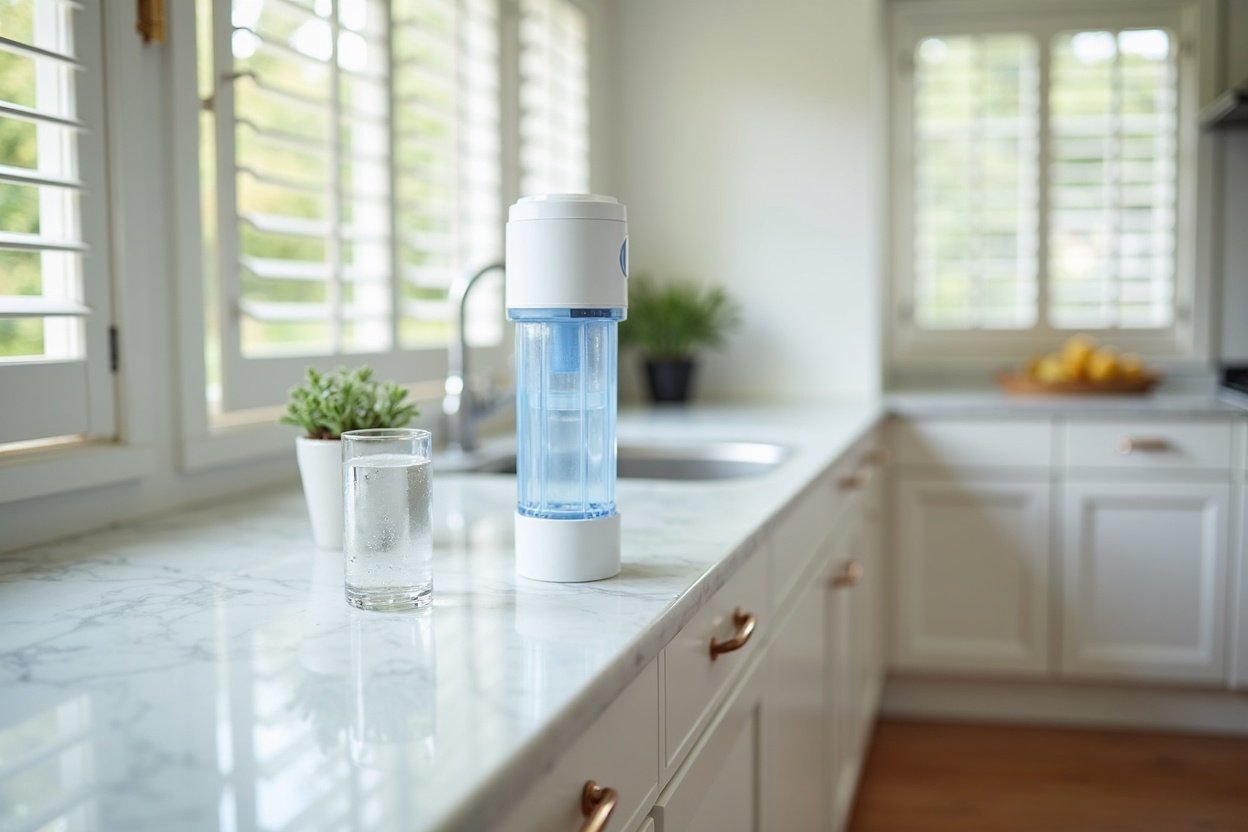
The Pure Water Systems (PWS) shower filter uses a multi-stage carbon and KDF media configuration and is an Australian-stocked alternative with local warranty support.
The PWS filter uses standard activated carbon media, which is the correct choice for Perth’s free chlorine chemistry. You do not need catalytic carbon (designed for chloramine cities) or vitamin C (also overkill for free chlorine). Standard carbon or KDF-55 at Perth’s free chlorine levels is sufficient and costs less.
Stage 2: Whole-House Water Softener ($2,000-4,000 Installed)
If shower filtration alone does not resolve flares within 4-6 weeks, mineral hardness is the dominant trigger. A whole-house ion-exchange water softener is the only technology that removes dissolved calcium and magnesium at the concentrations present in Perth’s supply.
For detailed product recommendations, sizing guidance, and installation considerations specific to Perth’s bore-water-heavy supply, see our best water softener for Perth 2026 guide.
Why the order matters. Start with the shower filter. It costs 5-10% of a softener, installs in ten minutes, and eliminates one confirmed irritant. If your eczema improves meaningfully, you may not need the softener at all. If flares persist despite chlorine removal, you have your answer: hardness is the driver, and the softener is the next investment. This staged approach avoids spending $3,000+ before confirming which trigger is primary for your skin.
5-Year Cost Comparison: Shower Filter vs Water Softener vs Both
| Solution | Upfront Cost | Annual Running | 5-Year Total | Removes |
|---|---|---|---|---|
| Carbon/KDF shower filter | $100-200 | $60-100 (cartridges) | $400-700 | Free chlorine only |
| Whole-house softener | $2,000-4,000 | $150-300 (salt) | $2,750-5,500 | Ca²⁺ & Mg²⁺ only |
| Both combined | $2,100-4,200 | $210-400 | $3,150-6,200 | Free chlorine + hardness |
| Portable exchange softener (renters) | $0 | $360-600 (rental) | $1,800-3,000 | Ca²⁺ & Mg²⁺ only |
Compare those figures to the cost of not acting. According to the Australasian College of Dermatologists, moderate-to-severe eczema management costs Australian households $1,000-5,000+ annually in GP visits, specialist consultations, prescription emollients, topical corticosteroids, and lost productivity from sleep disruption. A shower filter at $400-700 over five years is one of the cheapest interventions available — and if it resolves the chlorine component of your flares, the ROI is immediate.
Decision Tree: Which Solution Do You Need?
Three questions. That is all it takes to determine the right setup for your Perth home.
1. Can you modify plumbing?
No → Start with a shower filter (PWS). If eczema persists after 4-6 weeks, investigate a portable exchange softener (no plumbing modification, monthly tank swap).
Yes → Move to question 2.
2. How severe is your eczema?
Mild (occasional dry patches, minor itch) → A shower filter alone may be sufficient. Free chlorine removal addresses the oxidative irritant.
Moderate to severe (daily itch, cracked skin, topical steroid use, sleep disruption) → Move to question 3.
3. Has your dermatologist identified hard water as a trigger?
Yes or suspected → Install both: shower filter for chlorine + whole-house softener for hardness. This is the full Perth eczema solution stack.
Unsure → Start with the shower filter. Track symptoms for 4-6 weeks. If no improvement, hardness minerals are the likely driver — proceed to whole-house softener installation.
Perth Suburb Water Quality Variation
Not all Perth suburbs receive the same water. The Water Corporation WA blends multiple sources — desalination, groundwater, and surface water from dams — and the ratio varies by zone. This directly affects hardness levels at your tap.
Highest hardness suburbs. Areas supplied primarily by Gnangara Mound groundwater — including Joondalup, Wanneroo, Alkimos, Yanchep, and Two Rocks in the northern corridor — consistently report hardness values at the upper end (200-226 mg/L CaCO₃). Similarly, southern suburbs drawing from Jandakot bore fields (Cockburn, Rockingham, Baldivis, Mandurah) report elevated hardness.
Lower hardness suburbs. Areas receiving a higher proportion of desalinated water from the Perth Seawater Desalination Plant (Kwinana) or the Southern Seawater Desalination Plant (Binningup) tend to have lower hardness — desalinated water is typically remineralised to around 60-80 mg/L CaCO₃. Inner Perth suburbs (Subiaco, Nedlands, Claremont) may receive more blended water with moderate hardness around 140-160 mg/L.
If you are unsure about your suburb’s specific hardness level, request a water quality report from the Water Corporation WA for your supply zone, or test at home with a TDS meter and hardness test strips (available for under $20 at hardware stores or online). A reading above 120 mg/L CaCO₃ is in the zone where the Jabbar-Lopez meta-analysis data begins to show elevated eczema risk.
Why Perth Is Different from Other Australian Capitals
Perth’s eczema challenge is unique because the primary trigger (hardness) requires different technology from the primary trigger in other capitals (disinfectant chemistry).
| City | Disinfectant | Hardness (mg/L CaCO₃) | Primary Eczema Trigger | Shower Filter Media Needed |
|---|---|---|---|---|
| Perth | Free chlorine | ~180 (up to 226) | Mineral hardness | Standard carbon / KDF-55 |
| Brisbane | Chloramine | ~80-120 | Disinfectant chemistry | Vitamin C or catalytic carbon |
| Sydney | Chloramine | ~50 | Disinfectant chemistry | Vitamin C or catalytic carbon |
| Adelaide | Chloramine | ~140 | Both (hard + chloramine) | Vitamin C or catalytic carbon |
| Melbourne | Free chlorine | ~25 | Disinfectant only (very soft water) | Standard carbon / KDF-55 |
Notice the pattern. Melbourne has the softest water in Australia (~25 mg/L CaCO₃) and uses free chlorine — eczema sufferers there solve the problem with a shower filter alone. Perth has the hardest water and uses free chlorine — the shower filter handles the disinfectant, but the minerals remain. Adelaide has hard water AND chloramine — arguably the toughest combination in the country for eczema-prone skin. For a deeper look at the best water filter for eczema across all Australian cities, see our national guide.
Final Verdict
The Perth Eczema Water Strategy
Start with a standard activated carbon or KDF shower filter (~$100-200). Perth uses free chlorine (Water Corporation WA) — not chloramine — so standard filter media works. No need for catalytic carbon or vitamin C at Perth’s disinfectant chemistry. This removes one confirmed skin irritant at minimal cost.
If eczema persists after 4-6 weeks of shower filtration, mineral hardness is the driver. Perth’s water reaches 226 mg/L CaCO₃ (Water Corporation WA) — the hardest of any Australian capital. Only a water softener removes dissolved calcium and magnesium. Budget $2,000-4,000 installed for a whole-house ion-exchange unit, or $30-50/month for a portable exchange tank if you are renting.
The science is clear: Jabbar-Lopez et al. (2020) found a 28% increase in eczema prevalence in hard water areas (OR 1.28, PubMed 33259122). Perth’s hardness levels exceed the thresholds in that meta-analysis. Every shower without treatment is another exposure event for compromised skin.
Ready to address Perth’s water?
Start with a shower filter to remove free chlorine — the fastest, cheapest first step for eczema-prone skin in Perth. If hardness is the driver, escalate to a whole-house softener.
Last reviewed: July 2026 – Clean and Native
Frequently Asked Questions
Does Perth use chloramine or free chlorine?
Perth uses free chlorine for disinfection, according to the Water Corporation WA. This means standard activated carbon and KDF-55 shower filters effectively remove the disinfectant. Catalytic carbon and vitamin C media — designed for chloramine — are unnecessary for Perth’s water chemistry.
How hard is Perth tap water?
Perth’s water hardness ranges from 140 to 226 mg/L CaCO₃ depending on suburb and water source, according to Water Corporation WA data. This is the hardest tap water of any Australian capital city. The ADWG classifies water above 200 mg/L as hard.
Can a shower filter remove hard water minerals?
No. No shower filter — carbon, KDF, vitamin C, or any other cartridge media — removes dissolved calcium and magnesium. These are dissolved ionic minerals that pass through all shower-grade filter media. Only an ion-exchange water softener removes hardness minerals.
Does hard water cause eczema?
A 2020 meta-analysis by Jabbar-Lopez ZK et al. (PubMed 33259122) found an odds ratio of 1.28 for eczema prevalence in hard water areas — a 28% increased risk. The proposed mechanisms include elevated skin surface pH, increased soap scum deposition, and higher trans-epidermal water loss from compromised barrier function.
What type of shower filter is best for Perth?
A standard activated carbon or KDF-55 shower filter is the correct choice for Perth. Because Perth uses free chlorine (not chloramine), expensive catalytic carbon or vitamin C filters offer no additional benefit for disinfectant removal. KDF-55 has the advantage of maintaining effectiveness in hot water.
How much does a water softener cost in Perth?
A whole-house water softener in Perth typically costs $2,000-4,000 installed, including the unit, plumbing, and drain connection. Annual salt costs run $150-300. Renters can use portable exchange softeners at $30-50 per month with no plumbing modification required.
Which Perth suburbs have the hardest water?
Suburbs supplied by Gnangara Mound groundwater (Joondalup, Wanneroo, Alkimos, Yanchep) and Jandakot bore fields (Cockburn, Rockingham, Baldivis) tend to report the highest hardness values, up to 226 mg/L CaCO₃. Suburbs receiving more desalinated water (inner Perth, Kwinana corridor) tend to have lower hardness around 60-80 mg/L.
Should I get a shower filter or a water softener for eczema in Perth?
Start with a shower filter ($100-200) to remove free chlorine. If eczema persists after 4-6 weeks, mineral hardness is likely the dominant trigger, and a water softener ($2,000-4,000 installed) is the next step. The staged approach avoids over-investing before confirming which trigger drives your flares.
Do I need a catalytic carbon shower filter in Perth?
No. Catalytic carbon is designed for chloramine removal, and Perth does not use chloramine — it uses free chlorine (Water Corporation WA). Standard activated carbon or KDF-55 removes free chlorine effectively at lower cost. Save catalytic carbon for Brisbane, Sydney, Adelaide, Gold Coast, or Darwin households.
Can I test my Perth water hardness at home?
Yes. Water hardness test strips are available for under $20 on Amazon AU. A TDS meter gives a general dissolved solids reading (Perth averages ~170 mg/L TDS) but does not isolate hardness specifically. For a precise CaCO₃ reading, use a dedicated hardness test kit or request your suburb’s water quality data from the Water Corporation WA.
Get the Australian Home Environment Checklist
30 checks across water, air and EMF. Most of them free. Ranked by impact.
No spam. Unsubscribe any time.

Former Royal Australian Navy Clearance Diver and TAG-E counter-terrorism operator. Founded Clean and Native to apply the same rigorous thinking to the home environment.
Full biography →