Best Alkaline Water Pitcher & Jug Australia 2026: Glass vs Plastic, Tested
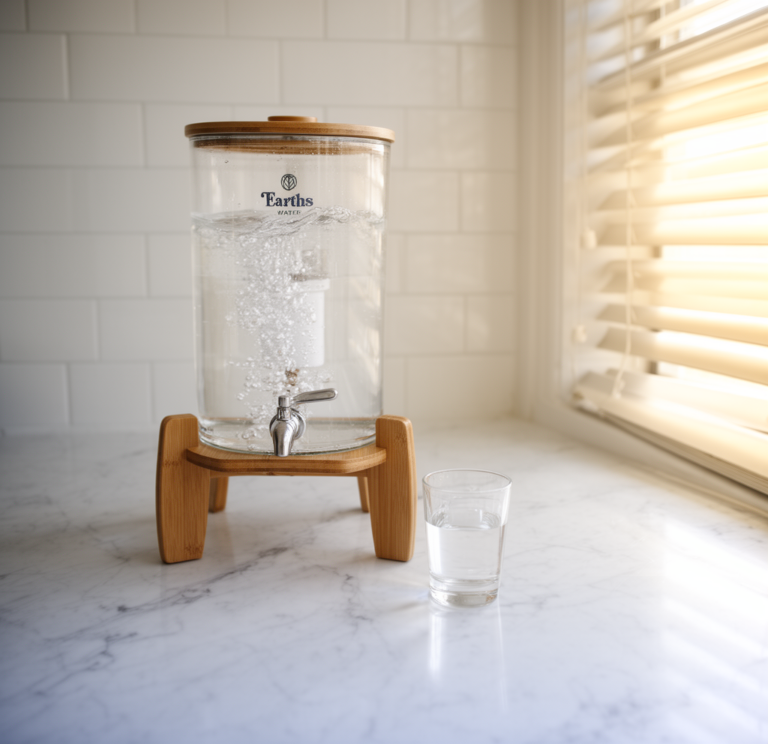
Independently Tested
Jayce Love tests every recommended product personally — with calibrated instruments, no gifted units, and no brand payments. See our testing process →
The best alkaline water pitcher for Australian households in 2026 is the Earth’s Water 3.5L Glass Carafe — it raises tap water pH to 8.5-9.5 using mineral stones and activated carbon, and does it in a glass body that does not leach BPA under alkaline conditions.
Quick Verdict — Best Alkaline Water Pitcher Australia 2026
Glass beats plastic every time for alkaline water. At pH 8.5-9.5, BPA leaching from polycarbonate and lower-grade plastics accelerates — a documented problem that most roundup sites ignore. The Earth’s Water 3.5L Glass Carafe is the only pitcher in this category that solves the problem at the design level. The 2.4L plastic jug is a legitimate budget entry for renters and singles. Brita is included as an honest comparison — it does not alkalise water.
| Product | Best For | Verdict |
|---|---|---|
| Earth’s Water 3.5L Glass Carafe | Families, glass-preferred | Top Pick |
| Earth’s Water 2.4L Jug | Singles, fridge storage | Best Budget |
| Brita Marella XL | Chlorine taste only | Not alkaline — honest comparison |
Why Glass Matters for Alkaline Water — and Why Most Pitcher Reviews Miss It
Here is the problem with most alkaline pitcher roundups: they test pH output, list filter life, and move on. None of them mention that raising water pH to 8.5-10 changes the chemistry of what your filter body is doing to the water inside it.
BPA (bisphenol-A) leaching from polycarbonate plastics is pH-dependent. A 2021 study published in Environmental Science and Technology confirmed that alkaline conditions accelerate the hydrolysis of polycarbonate polymers, releasing BPA at measurably higher rates than neutral-pH water. You buy an alkaline pitcher specifically to improve water quality. If the jug body then leaches endocrine-disrupting compounds into that alkalised water, you have created the problem you were trying to solve.
Manufacturers have largely shifted to Tritan or food-grade AS resin to address BPA concerns. Tritan is actually BPA-free. But the chemical stability of any plastic under continuous alkaline exposure is still less certain than glass, which is chemically inert at any pH. Full stop.
Glass does not leach. It does not off-gas under UV. It does not absorb odours or flavour compounds over time. For an alkaline pitcher specifically — where the output pH is elevated by design — glass is the correct material choice. The Earth’s Water 3.5L Glass Carafe is the only product in the Australian market at this price point that defaults to glass. That alone makes it worth the $110 premium over a plastic equivalent.
Do Alkaline Pitcher Jugs Remove Fluoride? The Honest Answer
No. Not one alkaline pitcher jug on the Australian market removes fluoride to any meaningful extent. This needs to be stated plainly because the marketing language around these products often implies comprehensive filtration — and fluoride is specifically what many Australians are trying to reduce.
Australian tap water is fluoridated under the Australian Drinking Water Guidelines (ADWG 2022) at a target concentration of 0.6-1.1 mg/L depending on the state. That fluoride is dissolved ionic fluoride. Alkaline mineral stones, activated carbon, and ion exchange resin — the three media inside virtually every alkaline pitcher — do not remove dissolved fluoride ions to any documented degree.
The only filter technologies that actually reduce fluoride are reverse osmosis (90-97% removal, per NSF/ANSI 58 certification data) and activated alumina (80-95% removal under controlled pH conditions). If fluoride removal is your primary concern, an alkaline pitcher is the wrong product. You want an RO system — either the AquaTru countertop RO or an under-sink RO unit from our fluoride and PFAS water filter guide.
What alkaline pitchers do well: they raise pH using mineralisation (adding calcium, magnesium, and potassium ions), they reduce chlorine taste and odour via activated carbon, and they improve the subjective taste of tap water. For Brisbane, Sydney, Adelaide, Perth, and Darwin households — where the disinfectant is chloramine, not free chlorine — the carbon in these pitchers removes chloramine at roughly 1/40th the rate of free chlorine. Taste improvement will be partial, not complete.
How to Test Your Water pH at Home
Before you spend $79 or $199 on a pitcher, know your starting point. Palm Beach QLD tap water sits at approximately pH 7.2-7.4, which is typical for SEQ treated water. Most Australian capital city tap water falls in the 7.0-7.8 range per state utility reports.
To measure pH at home, use a digital pH pen — not colour-changing test strips, which are imprecise above pH 9. The Apera Instruments PH20 or similar food-grade pH meters are available on Amazon AU for around $50-70 and are accurate to ±0.01 pH. Calibrate with pH 7.0 and pH 10.0 buffer solution before testing. Test your tap water first, then fill your pitcher and test again after the filter bed has conditioned (run three full cycles before trusting the readings).
TDS (total dissolved solids) measurement is a complementary check. A TDS-3 pen costs around $15 on Amazon AU. Note that alkaline mineral stone filters typically increase TDS slightly — they are adding mineral ions, not removing dissolved solids. A reading that goes from 80 mg/L to 120 mg/L after filtering is normal and expected for an alkaline mineralisation pitcher. It is not contamination.
Brisbane tap water TDS sits around 80-115 mg/L depending on the treatment blend from the Mt Crosby and Molendinar facilities. Melbourne’s Yarra Valley supply runs exceptionally soft at roughly 60 mg/L TDS. Adelaide’s supply is the hardest of the capitals at around 400 mg/L TDS — if you are in Adelaide and your alkaline pitcher is starting from that baseline, your mineral output will differ from what you see in online reviews conducted with Melbourne or Sydney water.
Products Reviewed
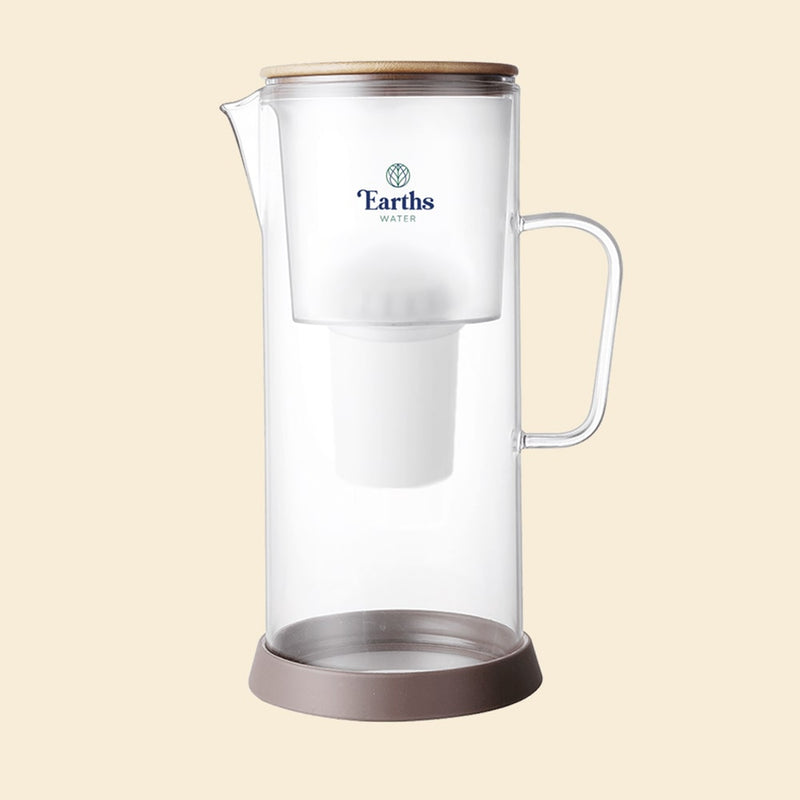
1. Earth’s Water 3.5L Glass Carafe — Top Pick
✓ Pros
- Borosilicate glass body — chemically inert, no BPA risk at any pH
- Raises pH to 8.5-9.5 via mineral stone mineralisation
- 3-month / 1,500L filter life — lowest per-litre cost in category
- Bamboo lid and reservoir — sustainable, no plastic contact with water
✗ Cons
- Glass is heavier — 3.5L filled weighs approximately 4.5 kg
- Does not remove fluoride
- Partial chloramine reduction only (relevant for Brisbane, Sydney, Perth users)
Filter media and pH output
The filter cartridge combines alkaline mineral stones (typically tourmaline, maifan stone, and calcium carbonate-based media) with activated carbon and an ion exchange resin layer. This three-stage approach raises pH by adding calcium and magnesium ions to the water rather than using an electrical charge like a bench-top ioniser. Output pH of 8.5-9.5 is achievable from typical Australian municipal water. Results vary with starting TDS — Adelaide’s high-TDS supply (around 400 mg/L) may produce slightly different pH outputs than Melbourne’s very soft water (TDS around 60 mg/L).
Filter life and running cost
At 3 months or 1,500 litres, the Earth’s Water filter lasts three times longer than a Brita cartridge (approximately 150L per month standard Brita claim). For a household consuming 4 litres per day of filtered water, a single cartridge covers approximately 375 days — well beyond the 3-month manufacturer recommendation. Following the time-based recommendation of 3 months is the safer approach regardless of volume consumed.
Glass construction — what it means in practice
The carafe body is borosilicate glass — the same material used in laboratory glassware and quality kitchen storage. Borosilicate is rated for thermal shock resistance and is chemically stable across the full pH range. It does not absorb flavour compounds from previous fills. It does not yellow or cloud with age the way plastic does. The bamboo reservoir (where unfiltered water sits before passing through the cartridge) means there is no plastic contact with water at the alkaline output stage. For daily use, this is the correct design.
Who it suits in Australia
Families in Melbourne or Canberra — free chlorine cities — will get the most from the carbon filtration component. Brisbane, Sydney, Adelaide, Perth, and Darwin households (all chloramine cities) will still see pH improvement and some taste change, but chloramine reduction will be partial. If shower water is your concern, the Earth’s Water shower filter is the relevant product there.
2. Earth’s Water 2.4L Alkaline Water Filter Jug — Budget Pick
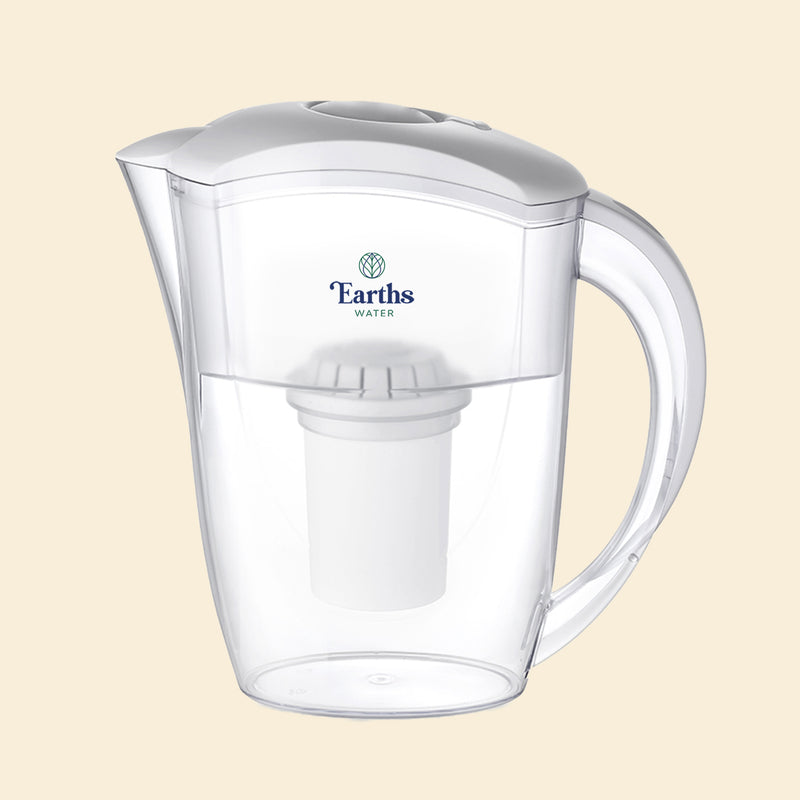
✓ Pros
- Fridge-friendly 2.4L size fits standard door shelves
- Raises pH to 8.5-9 — same mineralisation technology as the glass carafe
- Low entry cost (from $69) with replacement filters available
- Lightweight — practical for renters or shared households
✗ Cons
- Plastic body — greater BPA/chemical leaching risk under alkaline conditions than glass
- 2.4L total capacity (about 1.6L filtered reservoir) — not enough for a family of 4
- Does not remove fluoride
The plastic body trade-off
Earth’s Water states their plastic components are BPA-free. That is a meaningful claim — BPA-free Tritan or AS resin is actually safer than older polycarbonate. But “BPA-free” does not mean all chemical leaching is eliminated under alkaline conditions. For occasional use or short-term storage in the fridge, the risk is low. For someone drinking four litres of alkaline water per day from this pitcher for years, the glass carafe is the more defensible choice.
Capacity for real-world use
The 2.4L total volume includes the reservoir (unfiltered water sitting above the cartridge) and the jug body. The actual filtered water available at any point is closer to 1.4-1.6L. For one or two people, that works. For a household of three or four, you will be refilling multiple times daily. At that usage rate, the 3.5L glass carafe is a more practical tool.
Running cost per litre
If replacement cartridges cost approximately $25-35 per filter and each filter covers 1,500L, the cost per litre of filtered alkaline water sits around $0.02-0.03 per litre — ignoring the sunk cost of the pitcher itself. Spread the $89 purchase price over two years of use and add filter costs, and you are looking at roughly $0.04-0.06 per litre total. Compare that to commercially bottled alkaline water at $2-5 per litre, and the economics of any pitcher — glass or plastic — are decisive.
Earth’s Water Alkaline Pitchers — Buy Direct
Full Earth’s Water 9L benchtop review →3. Brita Marella XL — Honest Comparison (Not an Alkaline Filter)
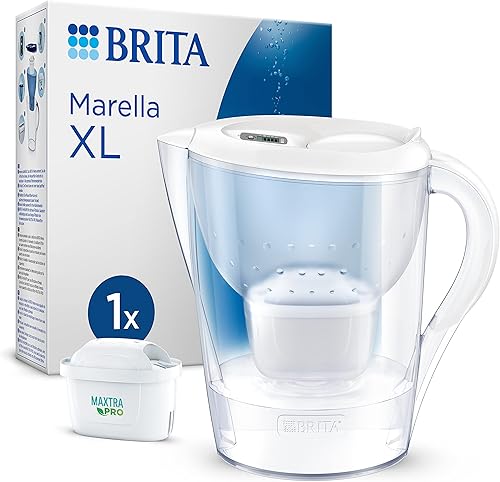
✓ Pros
- Widely available in Australian supermarkets and hardware stores
- Low upfront cost (~$49)
- Reduces chlorine taste and odour in free-chlorine cities (Melbourne, Hobart, Canberra)
✗ Cons
- Does NOT alkalise water — pH remains neutral (7.0-7.5)
- Standard GAC filter fails on chloramine — ineffective in Brisbane, Sydney, Perth, Adelaide
- Short 150L filter life means cartridges every 4-5 weeks for a family
- Does not remove fluoride
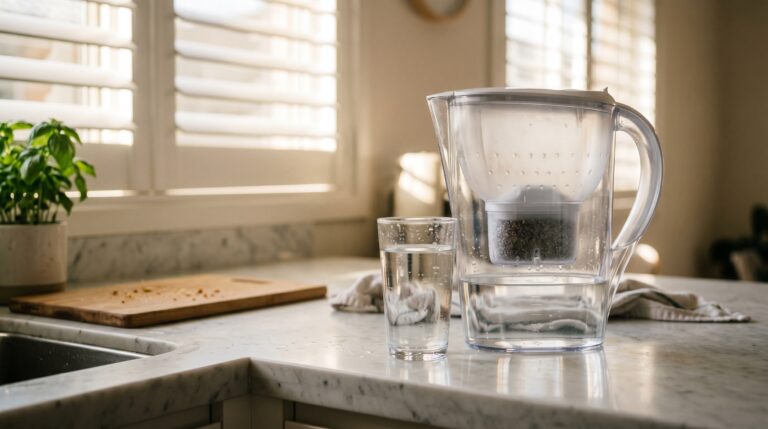
The Brita Marella XL is not a bad product — it is simply not an alkaline filter. If you are in Melbourne, Hobart, or Canberra (free chlorine cities), a Brita removes chlorine taste effectively. If you are in Brisbane, Sydney, Adelaide, Perth, or Darwin (chloramine cities), the standard GAC cartridge removes chloramine at approximately 1/40th the rate of free chlorine — meaning taste improvement will be minimal. And it will not touch your water’s pH. Buy it for what it is. Do not buy it expecting alkaline mineralisation.
Full Comparison Table
Cost Per Litre Comparison: Pitcher vs Bottled Alkaline Water
Cost Per Litre — Alkaline Water Options, Australia 2026
Assumes 4L/day household. Pitcher costs amortised over 2-year lifespan including filter replacements. Bottled water at typical Australian retail.
The numbers make the case without commentary. Bottled alkaline water at $3.50 per litre versus $0.04 per litre from the glass carafe. At four litres per day, that is $5,110 per year in bottled water versus approximately $58 per year in filter costs. The glass carafe pays for itself in the first eleven days of use compared to bottled water.
Who Should Buy an Alkaline Pitcher — and Who Should Not
✓ Who This Is For
- Households replacing bottled alkaline water — the cost difference is enormous
- Anyone who prefers slightly alkaline drinking water for taste
- Melbourne, Hobart, and Canberra households who also want chlorine taste reduction
- Renters who cannot install under-sink systems
- Minimalist households wanting a single benchtop appliance
× Who It Is Not For
- Anyone whose primary concern is fluoride removal — you need RO. See our fluoride filter guide
- PFAS-contaminated areas (Oakey QLD, Katherine NT, Williamtown NSW) — only RO removes PFAS
- Brisbane, Sydney, Perth, Adelaide households wanting significant chloramine reduction — need catalytic carbon or RO
- Households needing bacteria or pathogen removal — pitchers do not disinfect
Final Verdict
Buy the Earth’s Water 3.5L Glass Carafe if you want an alkaline pitcher for daily household use. Glass body, 3-month filter life, pH 8.5-9.5 output, and the only product in this category that solves the BPA-under-alkaline-conditions problem at the design level. At $0.04 per litre, it undercuts bottled alkaline water by 98%. The $199 purchase price returns to zero in under two weeks of use if you are currently buying bottled water.
Buy the Earth’s Water 2.4L Jug if you are a single person, renting, or want a fridge-sized pitcher to test alkaline water before committing to the glass carafe. The plastic body is a real trade-off at alkaline pH — go in eyes open — but the filter technology is identical and the cost per litre is still excellent.
Do not buy a Brita expecting alkaline water. It does not produce it. For a comprehensive review of what a Brita does and does not do in the Australian context, our full water filter guide for fluoride and PFAS covers the distinction in detail.
One last point: neither of these pitchers removes fluoride. If that is the health priority driving your search, you need an RO system. The AquaTru countertop RO is the closest no-plumbing alternative to a pitcher-style solution that actually addresses fluoride, PFAS, and chloramine in one unit.
Last reviewed: June 2026 — Clean and Native
Ready to switch to alkaline water?
The Earth’s Water 3.5L Glass Carafe is the only glass-bodied alkaline pitcher in Australia at this volume. No BPA risk. pH 8.5-9.5. Filter replacement every 3 months. Under $0.05 per litre.
Frequently Asked Questions
No. Alkaline pitchers use mineral stones, activated carbon, and ion exchange resin. None of these remove dissolved fluoride ions. Only reverse osmosis (90-97% removal) or activated alumina (80-95%) remove fluoride to meaningful levels. If fluoride reduction is your goal, you need an RO system.
Yes, for daily alkaline water use. At pH 8.5-10, alkaline conditions accelerate chemical leaching from plastic polymers. Glass is chemically inert at all pH levels and does not leach compounds regardless of how long water sits in it. For a product specifically designed to raise water pH, a glass body is the more chemically sound design choice.
Partially. Brisbane, Sydney, Adelaide, Perth, and Darwin all use chloramine as the primary disinfectant. Standard activated carbon (used in most alkaline pitchers) removes chloramine at roughly 1/40th the rate it removes free chlorine. You will get pH improvement and some taste change, but significant chloramine reduction requires catalytic carbon or reverse osmosis — not a pitcher filter.
The Earth’s Water filters (both the 3.5L glass carafe and the 2.4L jug) are rated for 3 months or 1,500 litres, whichever comes first. For a household using 4 litres per day of filtered water, the 3-month time limit will trigger first at most usage levels. Replace based on time if you are uncertain about volume.
Most Australian capital city tap water falls between pH 7.0 and 7.8. Brisbane’s SEQ supply typically runs around pH 7.2-7.5. Melbourne’s Yarra Valley supply is similar. Adelaide’s supply can sit slightly higher due to its harder mineral content. All of these are within the ADWG 2022 acceptable range of 6.5-8.5.
Use a digital pH pen calibrated with pH 7.0 and pH 10.0 buffer solutions — not colour-strip test kits, which are unreliable above pH 9. Test your tap water first, then test filtered water after running three complete fill-and-filter cycles to allow the mineral bed to condition. Expected output from Earth’s Water filters is pH 8.5-9.5 from typical Australian municipal water.
The clinical evidence for health benefits of alkaline drinking water is limited. Most peer-reviewed studies on alkaline water have small sample sizes or are industry-funded. The ADWG and NHMRC do not specifically recommend alkaline water over neutral-pH tap water. What is clear is that alkaline pitchers can improve the taste of chlorinated tap water, and at $0.04 per litre, they are far cheaper than bottled water whether alkaline or not.
An alkaline pitcher raises pH through passive mineralisation — mineral stones add calcium, magnesium, and potassium ions over time as water passes through. A bench-top ioniser uses electrolysis (an electric current) to split water into alkaline and acidic streams, typically achieving higher pH (up to 11+) with more precise control. Ionisers cost $1,500-4,000+ and require bench space and power. A pitcher at $79-199 produces a meaningful pH lift with no electricity, no installation, and no ongoing commitment beyond a quarterly filter replacement.
Get the Australian Home Environment Checklist
30 checks across water, air and EMF. Most of them free. Ranked by impact.
No spam. Unsubscribe any time.

Former Royal Australian Navy Clearance Diver and TAG-E counter-terrorism operator. Founded Clean and Native to apply the same rigorous thinking to the home environment.
Full biography →