Legionella Risk in Australian Rainwater Tanks
Drafted with AI assistance and checked against published specifications and certifications. First-hand measurements appear only where stated. How we make content
How this assessment was made. I have not tested rainwater tanks for Legionella myself. This guide is built from the Australian Drinking Water Guidelines (NHMRC), enHealth’s guidance on rainwater tanks, Queensland and South Australian health department advice, the CDNA national Legionellosis guidelines, peer-reviewed Australian tank studies and manufacturer certification records. Where a figure is an estimate or a rule of thumb, the article says so. Clean and Native earns affiliate commission on some links. That does not change the advice or what the sources say.
Legionella bacteria multiply in warm, stagnant water between 20°C and 45°C, and enHealth notes that above-ground rainwater tanks in an Australian summer are likely to hold water between 25°C and 50°C. If you rely on rainwater for drinking, showering, or garden irrigation, Legionella is a genuine health hazard that carbon filters alone cannot solve. It requires temperature control, tank maintenance, and in many cases UV or chlorine disinfection at the point of use.
| Control Method | What It Does | Verdict |
|---|---|---|
| Hot water system ≥60°C | Kills Legionella at the storage tank and in distribution pipes | Primary defence: non-negotiable |
| UV disinfection (point of use) | Inactivates Legionella in drinking water before consumption | Recommended for drinking supply |
| Carbon filter alone | Removes taste, odour, some chemicals; does NOT kill bacteria | Insufficient as sole Legionella control |
Legionella is a system and temperature problem, not a filtration problem. Queensland researchers using qPCR found Legionella pneumophila DNA in 26% of tank samples in one study and 5.6% of 214 samples in a larger follow-up. Your first line of defence is maintaining hot water systems at 60°C or above and preventing stagnation, backed by tank hygiene and a first-flush diverter. Treatment (UV, then RO) is an important second layer for drinking water, but without correct temperature control, no filter protects you from aerosolised Legionella in your shower.
Key catches
- Carbon filters (GAC, catalytic carbon, carbon block) do not kill Legionella and are not rated to remove it
- Legionella multiplies between 20°C and 45°C, fastest at about 37°C, and summer tank water commonly sits in that range
- Australia has a high share of cases from L. longbeachae, a species linked to potting mix and soil rather than water
- Inhalation (shower mist, sprinkler spray) is the infection route, not drinking
What Is Legionella and Why Rainwater Tanks Are the Perfect Host
Legionella is a genus of gram-negative bacteria found naturally in freshwater environments: rivers, creeks, groundwater. In the wild, concentrations stay low. The problem starts when Legionella enters a man-made water system that provides exactly what it needs: warmth, stagnation, biofilm, and a food source (other microorganisms, particularly amoebae).
A rainwater tank can tick every box. In south-east Queensland, researchers using quantitative PCR (qPCR) found Legionella pneumophila DNA in 7 of 27 tank samples (26%) in a 2008 study and in 5.6% of 214 samples in a 2010 study, both in Applied and Environmental Microbiology. enHealth’s rainwater tank guidance notes Legionella has been found in tanks by culture and PCR, and that sludge in tanks is where it survives and grows. Roof runoff carrying dust, soil, leaf matter and droppings is the usual way organisms reach the tank.
Once inside, the growth curve depends almost entirely on temperature. Queensland Health puts the growth range at 20°C to 45°C, with optimal multiplication at about 37°C. Below 20°C, it survives but does not multiply meaningfully. Heat kills it, but not instantly: Queensland Health gives about 6 hours at 55°C, 32 minutes at 60°C and 2 minutes at 65°C, with immediate disinfection at 70°C. enHealth notes above-ground tanks in Australian summers are likely to hold water between 25°C and 50°C, which overlaps most of that growth range.
The bacteria does not grow freely in open water. It replicates inside free-living amoebae, single-celled organisms that graze on biofilm inside tanks, pipes, and hot water systems. According to the WHO’s guidelines on Legionella and prevention of legionellosis, this intracellular replication inside amoebae is what makes Legionella so persistent. The amoebae act as both a host and a shield, protecting the bacteria from disinfectants and temperature fluctuations that would otherwise kill free-floating cells.
Australia’s Unique Risk Factors: Climate, Tank Design, and L. longbeachae
Australia has two Legionella problems, not one. Most international guidance focuses on Legionella pneumophila, the species responsible for the majority of Legionnaires’ disease outbreaks in cooling towers and large building water systems globally. But Australia carries a disproportionate burden of Legionella longbeachae, a species associated with soil and potting mix rather than water systems. Australia’s national surveillance guidelines (CDNA) state that L. longbeachae and L. pneumophila are notified in almost equal numbers here, and in 2008 L. longbeachae made up 58% of cases with species data. New Zealand shows a similar pattern: a 2019 University of Otago study attributed 63% of cases to L. longbeachae.
This may matter for rainwater tank owners because your roof collects soil dust, decomposing organic matter, and windblown potting mix particles, all possible carriers of L. longbeachae. If you live in a semi-rural or peri-urban area with gardens, compost, or mulched beds near your roof catchment, the risk is compounded. The proven exposure route for L. longbeachae is handling potting mix and compost, so the standard potting mix precautions (gloves, a mask, damp mix) matter more for this species than your tank does.
Climate Zone Risk Assessment
Not all Australian rainwater tanks carry the same Legionella risk. Temperature is the dominant variable, and Australia’s climate zones create a clear risk gradient. The tank temperatures below are indicative estimates based on climate, not measurements; enHealth’s general figure for above-ground tanks in summer is 25°C to 50°C.
| Climate Zone | Regions | Indicative Peak Tank Temp | Legionella Risk | High-Risk Months |
|---|---|---|---|---|
| Tropical | Cairns, Darwin, Townsville, FNQ | 30-38°C | Very High | Year-round |
| Subtropical | Brisbane/SEQ, Gold Coast, Coffs Harbour | 25-35°C | High | October to April |
| Temperate | Sydney (western suburbs), Adelaide, Perth | 22-32°C | Moderate-High | November to March |
| Cool Temperate | Melbourne, Hobart, Canberra, Blue Mountains | 15-25°C | Moderate | December to February |
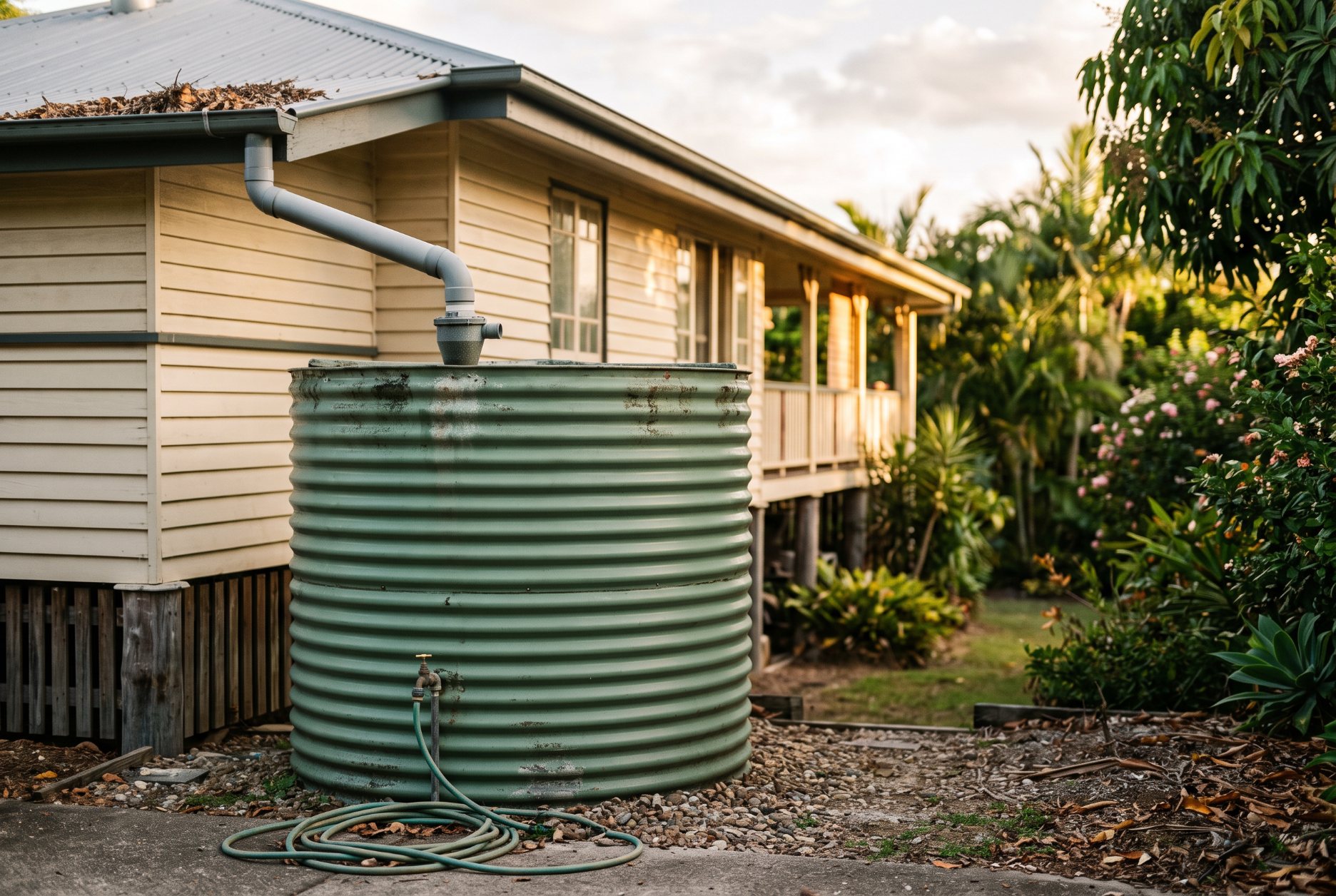
Dark-coloured tanks (green, black, dark grey) absorb more solar radiation and reach higher internal temperatures than pale or light-coloured tanks. A black poly tank in full sun in Cairns or Townsville is likely to sit close to Legionella’s optimal growth temperature of about 37°C. Tank placement in shade, use of light-coloured tanks, and insulation are free or low-cost risk reduction measures.
Roof Material and Catchment Contamination
A 2011 study in Water Research compared roof materials and found metal roofs produced the lowest faecal indicator bacteria, with concrete tile roofs producing similar water quality. It also found every roof type needed treatment, at minimum first-flush diversion, filtration and disinfection, to meet drinking water guidelines. Whatever your roof, the initial runoff carries the highest microbial load, which is why the first-flush diverter matters.
Overhanging trees are a compounding factor. Leaf litter provides organic nutrients for biofilm growth inside the tank, and possum, bird, and insect access to the roof increases faecal contamination. Dead animals in gutters or tanks, a common discovery during tank cleaning, create concentrated bacterial blooms.
Specific Risk Scenarios Every Tank Owner Should Audit
Legionella does not become dangerous just by being present in your tank. The infection pathway requires aerosolisation: the bacteria must be inhaled as fine water droplets (less than 5 microns) that penetrate deep into the lungs. The Australian Drinking Water Guidelines state Legionella is not known to cause disease by drinking water. This distinction shapes which parts of your water system need the most attention.
1. Hot Water Systems Set Below 60°C
This is the single highest-risk factor in any Australian home using rainwater. The Australian Building Codes Board and the Australian/New Zealand Standard AS/NZS 3500.4 require hot water storage systems to store water at a minimum of 60°C to prevent Legionella growth. Many homeowners, especially those with solar hot water systems, heat pumps, or older electric storage units, inadvertently set their thermostat lower to save energy. At 50°C, Legionella survives. At 40-45°C, it multiplies rapidly.
Check your hot water system thermostat. If it is set below 60°C, have a licensed plumber reset it and confirm a tempering valve is fitted, so you do not swap a Legionella hazard for a scald hazard. Yes, this increases energy use. The alternative is a water system incubating a bacterium behind a disease where ten per cent or more of cases are fatal, according to the Australian Drinking Water Guidelines. Tempering valves (or thermostatic mixing valves) bring the delivered water temperature down to a maximum of 50°C for scald prevention, while the storage temperature stays at 60°C or above.
2. Unused or Seasonally Vacant Properties
Holiday homes, weekenders, rental properties between tenants, and rural sheds with rainwater supply are high-risk environments. When water sits stagnant in pipes and tanks for weeks or months, biofilm establishes and Legionella populations build. The first shower after a period of vacancy delivers the highest bacterial load directly as an aerosol into your lungs.
Queensland Health advises heating the hot water system to 60°C for at least half an hour before use after a prolonged absence, and flushing outlets to clear stagnant water (at least 15 seconds at full flow for outlets that sit unused, and longer after an extended absence). Our rule of thumb after any absence longer than a week: two minutes per outlet (taps, showers, hoses), standing back from the spray. For properties vacant for extended periods, consider draining and cleaning the hot water system before reoccupation.
3. Header Tanks and Roof-Mounted Storage
Gravity-fed header tanks, common in rural and off-grid Australian properties, sit on elevated platforms or roof structures where they absorb maximum solar heat. A small header tank in direct sun has little water mass to buffer that heat, so expect it to run warmer than a ground-level tank on a hot day. These tanks are often uninsulated and infrequently cleaned. If you have a header tank feeding showers, it is the highest-priority system to address.
4. Garden Irrigation Systems: Sprinklers and Misters
Any device that creates a fine mist or aerosol from rainwater is a Legionella transmission vector. Sprinkler systems, evaporative coolers, misters on outdoor entertaining areas, and pressure washers all aerosolise water. If these systems draw from an untreated rainwater tank, you are creating a direct inhalation pathway. Drip irrigation is a safer alternative for gardens: it delivers water to the root zone without aerosolisation.
Who Is Most at Risk, and Why This Is Not Just an “Old People” Problem
Legionnaires’ disease is a severe form of pneumonia. It is not a mild cold. The Australian Drinking Water Guidelines state that ten per cent or more of cases are fatal, and outcomes are worse in hospital patients and people with weakened immune systems. Even healthy people can contract Legionnaires’ disease, but the risk is sharply elevated for specific groups.
High-risk individuals include:
- Adults over 50 years of age
- Current smokers (smoking damages the lung epithelium, making it easier for Legionella to establish)
- People with chronic lung disease (COPD, emphysema, asthma)
- Immunocompromised individuals: organ transplant recipients, people on immunosuppressive medication, those undergoing chemotherapy
- People with diabetes or chronic kidney disease
- Heavy alcohol users
But here is the part most guides skip: Pontiac fever is a milder, non-pneumonic form of Legionella infection that affects otherwise healthy adults. It presents as flu-like symptoms (fever, muscle aches, headache) and usually resolves on its own within a week. Many people who get Pontiac fever from a contaminated shower are never diagnosed. They assume they had the flu. The infection goes unreported, the contaminated water system goes unaddressed, and the next person who showers, who might be older, a smoker, or immunocompromised, could get Legionnaires’ disease.
If several people in a household develop flu-like symptoms within a few days of moving back into a property that has been vacant, consider Legionella and tell your GP. Pontiac fever usually appears 4 hours to 3 days after exposure; Legionnaires’ disease usually appears 2 to 10 days after. A urine antigen test gives a result within hours, but most kits detect only L. pneumophila serogroup 1, so a negative result does not rule out L. longbeachae.
Prevention: The Four-Layer Defence for Australian Rainwater Tank Owners
Legionella control is not a single product purchase. It is a system approach. Here are the four layers, in order of priority.
Layer 1: Tank Maintenance and Catchment Hygiene
First-flush diverters. Install a first-flush diverter on every downpipe feeding your tank. This device diverts the initial slug of roof runoff, the most contaminated portion, away from the tank. The Australian Government’s Guidance on use of rainwater tanks (enHealth, 2010) supports first-flush diverters as an additional barrier, suggesting the first 20 to 25 litres from an average roof could be diverted, but stresses they do not replace normal maintenance.
Gutter guards and leaf screens. Prevent organic matter from entering the tank. Clean gutters at least twice per year (before and after the main leaf-fall season for your region). Inspect and clean the tank inlet screen annually.
Tank inspection and cleaning. Every 2-3 years, or sooner if sediment shows up in the water, inspect the tank interior for sediment buildup, dead animals, and biofilm. Professional tank cleaning services are available in most regions. Sediment on the tank floor is a biofilm habitat and nutrient source for Legionella’s amoeba hosts.
Light-coloured tanks in shade. If you are installing a new tank, choose a light colour (beige, pale grey, mist green) and position it in shade. A black poly tank in full sun in Rockhampton or Mackay is an incubator.
Layer 2: Hot Water System Temperature Control
Store at 60°C minimum, deliver at 50°C maximum. This is the non-negotiable rule. AS/NZS 3500.4 mandates hot water storage at 60°C to prevent Legionella colonisation. Water delivered to bathroom outlets is capped at 50°C (45°C in aged care, childcare and healthcare settings), usually by a tempering valve or thermostatic mixing valve (TMV), to prevent scalding. A licensed plumber can verify your hot water temperature and fit or service the valve; get a quote, as cost depends on your layout.
Solar hot water and heat pump systems deserve special attention. Many solar systems only reach 60°C on high-insolation days, falling below the threshold in overcast or winter conditions. Ensure your solar system has an electric or gas boost element that maintains 60°C when solar input is insufficient. With heat pumps, check the storage setpoint on the controller rather than assuming it is 60°C.
Instantaneous (continuous flow) hot water systems present lower Legionella risk because they do not store water. However, the pipes between the unit and the outlet still contain standing water. In a system with long pipe runs (common in large houses or houses with the hot water unit located externally), the standing water in pipes can colonise. Flush hot taps for 15-30 seconds before showering if the outlet has not been used for more than 24 hours.
Layer 3: Disinfection Before Aerosolisation Points
UV disinfection is the most practical point-of-entry disinfection for residential rainwater systems. A UV-C unit installed on the main supply line exposes water to ultraviolet light at 254 nm, inactivating Legionella and most other bacteria and protozoa without chemicals (enHealth notes typical UV doses give only limited inactivation of viruses). UV requires pre-filtration to remove turbidity: the water must be clear (most manufacturers specify below 1 NTU) for UV to be effective. A 5-micron sediment pre-filter upstream of the UV unit is standard practice. enHealth recommends a sensor that shows the unit is working and notes lamps usually need replacing every 9 to 12 months.
Chlorination is an alternative, but it has complications for rainwater systems. Chlorine reacts with organic matter in tank water to form disinfection byproducts (trihalomethanes, haloacetic acids). The ADWG (Australian Drinking Water Guidelines 2011, as updated) sets guideline values for these byproducts, for example 0.25 mg/L for total trihalomethanes. If you chlorinate, use a dosing system calibrated to your flow rate and test regularly: over-chlorination creates its own health issues, and under-chlorination provides a false sense of security. enHealth’s target is a free chlorine residual of at least 0.5 mg/L after 30 minutes. To disinfect a contaminated tank, enHealth gives 40 mL of 12.5% liquid sodium hypochlorite, or 7 g of 75% granular calcium hypochlorite, per 1,000 L (about 5 mg/L). Never use stabilised (cyanurate) pool chlorine in a tank.
Critical point: UV and chlorination address water on its way to the tap. They do not eliminate Legionella already established in the hot water system or pipe biofilm. That is why Layer 2 (temperature control) must come first.
Layer 4: Point-of-Use Filtration for Drinking Water
For drinking water specifically, a reverse osmosis system provides the most comprehensive barrier. RO membranes with a nominal pore size of 0.0001 microns should physically exclude Legionella cells (which are 0.3-0.9 microns wide and 2-20 microns long). But home RO units are not certified for bacteria removal, and their performance data sheets warn against use on water that is microbiologically unsafe or of unknown quality without adequate disinfection before or after the system. On tank water, that means UV first, then RO: a germicidal treatment followed by a physical polish.
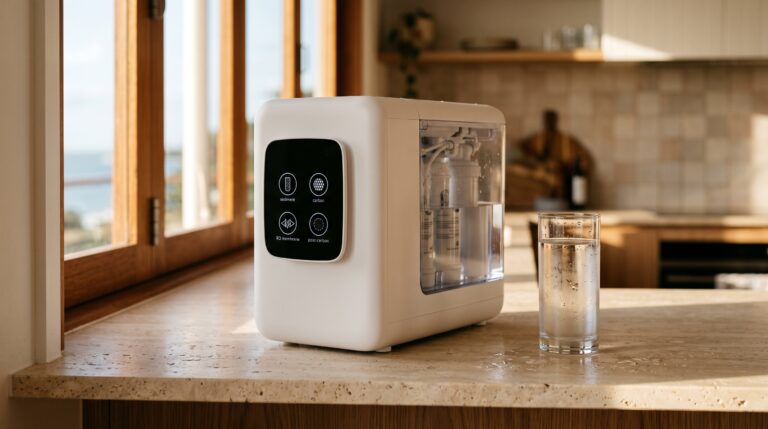
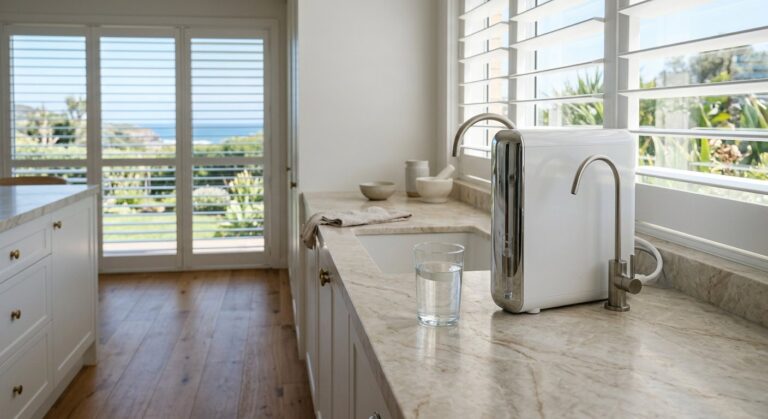
 Under-sink RONSF 58Tankless · 800 GPD
9-stage | 0.0001 µm RO membrane | 800 GPD | 2:1 pure-to-drain | IAPMO-certified to NSF/ANSI 42, 58 and 372
See Waterdrop X8 Price →✓ Pros
- Independently certified to NSF/ANSI 58, the reverse osmosis performance standard
- Tankless design saves cupboard space compared with tank RO units
- Tap shows TDS in real time and flags when filters are due
× Cons
- Not certified for bacteria removal: on tank water it must sit after UV disinfection
- Needs a power point under the sink and a plumber or confident DIY install
Buy this if…
you already have UV disinfection on your tank supply and want a permanent RO polish at the kitchen tap.
But here is the critical distinction: a carbon filter, whether standard GAC, catalytic carbon, or a carbon block, does not kill or reliably remove Legionella. Carbon filters are designed for chemical adsorption (chlorine, chloramine, VOCs, taste, and odour). They are not microbiological barriers. A Brita jug, a benchtop carbon filter, or even a high-end catalytic carbon block will not protect you from Legionella in rainwater. If your only treatment is a carbon filter on a rainwater supply, you have a false sense of security for bacterial contaminants.
Similarly, if you are on town mains water, Legionella in the supply is not your primary concern: utilities keep a chlorine or chloramine residual through the network, and the ADWG notes chlorine or chloramines will eliminate these organisms. On mains water, your Legionella risk sits in your own hot water system and rarely used pipes. For rainwater tank owners, the problem is the opposite: you have no disinfectant residual at all, and Legionella fills that gap.
When Filtration Helps, and When It Creates a False Sense of Security
You cannot buy your way out of a Legionella problem with a filter. That is the uncomfortable truth. Filtration is one component of a multi-barrier approach, and it is the last component, not the first. Here is where each technology sits in the Legionella control hierarchy.
| Technology | Legionella Effective? | Mechanism | Limitation |
|---|---|---|---|
| Reverse Osmosis (RO) | Yes | Physical barrier: 0.0001 µm pores should exclude 0.3-0.9 µm bacteria | Drinking water only; not certified for bacteria, so use after UV; does not protect shower aerosolisation |
| UV-C Disinfection | Yes | DNA damage at 254 nm inactivates bacteria | Requires pre-filtered clear water (<1 NTU); no residual disinfection downstream |
| 0.2 µm Absolute Ceramic/Membrane | Yes | Physical exclusion of bacteria (0.3+ µm) | Slow flow rate; requires regular cleaning/replacement |
| Carbon Block (1 µm) | Partial only | May physically trap some cells but not rated for bacteria removal | Not a microbiological barrier; biofilm can colonise the filter itself |
| GAC (Granular Activated Carbon) | No | Chemical adsorption only; no physical barrier | Can harbour and amplify bacterial growth in the carbon bed |
| KDF-55 | No | Redox reaction; targets chlorine and heavy metals | No bactericidal or physical exclusion effect on Legionella |
One of the most dangerous misconceptions is that a GAC filter “cleans” rainwater. It removes some taste and odour compounds. It may reduce certain pesticides and VOCs. But GAC media, warm, damp, and rich in organic carbon, is itself a potential growth medium for bacteria, including Legionella. An old, overdue-for-replacement GAC cartridge on a rainwater line can actually increase your bacterial exposure compared to unfiltered water. If you use GAC on rainwater, change cartridges at the manufacturer’s recommended interval, never beyond it.
For rainwater drinking water, the recommended treatment chain is: sediment pre-filter (5 µm) → UV-C disinfection → RO membrane → carbon post-filter (taste polish). This gives you particulate removal, germicidal treatment, physical bacterial exclusion, and taste improvement, in the correct order. The Waterdrop X8 under-sink RO can fill the RO stage of that chain. It is not certified for bacteria removal, so it belongs after UV disinfection, and it does not replace the need for hot water temperature control and tank maintenance upstream.
A Practical Legionella Risk Assessment Checklist for Your Property
As a former Royal Australian Navy Clearance Diver, I approach risk assessment the same way we approached dive planning: systematically, checklist-driven, and with the understanding that the thing you do not check is the thing that gets you. Here is a practical checklist you can walk through on your own property.
| Check | Risk Factor | Action If Yes |
|---|---|---|
| Hot water system below 60°C? | Critical | Plumber to reset storage to 60°C and confirm a tempering valve is fitted |
| Tank in full sun, dark colour? | High | Shade the tank or paint/replace with light colour |
| No first-flush diverter? | High | Install on every downpipe feeding tank |
| Tank not cleaned in 3+ years? | High | Schedule professional tank cleaning |
| Overhanging trees on roof? | Moderate | Trim branches; install gutter guards |
| Property vacant >7 days? | Moderate | Flush all outlets 2+ min before use; run HWS to 60°C |
| Sprinklers or misters on tank supply? | Moderate | Switch to drip irrigation or install UV upstream |
| Only treatment is a carbon filter? | Critical | Add UV or RO for drinking; address HWS temperature for shower |
| Elderly or immunocompromised residents? | Critical | Implement all four layers; consider annual water testing |
You can get your rainwater tested for Legionella through NATA-accredited laboratories. Ask the lab for a quote; culture results take around a week or more because Legionella grows slowly. qPCR testing is faster but detects both live and dead cells: a positive qPCR result does not necessarily mean live Legionella is present, but it does confirm the organism has been in your system. If you get a positive result, implement all four layers above before retesting.
For a complete guide to making rainwater safe for drinking, covering sediment, heavy metals, PFAS, pesticides, and microbiological contaminants beyond Legionella, read our detailed guide: Rainwater Drinking Safety Australia 2026.
Last reviewed: October 2026, Clean and Native
Ready to protect your rainwater drinking supply?
For rainwater tank owners, RO is the final polishing layer for drinking water, reducing PFAS and heavy metals. Put UV disinfection ahead of it, because home RO units are not certified for bacteria removal and are meant for disinfected water. Hot water temperature control must be addressed in parallel.
Frequently Asked Questions
Can you get Legionella from drinking rainwater?
The infection route for Legionella is inhalation of contaminated aerosols from showers, sprinklers, or misters, not drinking. The Australian Drinking Water Guidelines state Legionella is not known to cause disease by drinking water. Aspiration (water entering the airway during swallowing) is a possible route in some vulnerable patients, such as people with swallowing difficulties or on tube feeding.
What temperature kills Legionella in a hot water system?
Queensland Health gives kill times of about 6 hours at 55°C, 32 minutes at 60°C and 2 minutes at 65°C, with immediate disinfection at 70°C. AS/NZS 3500.4 requires hot water to be stored at 60°C minimum. Tempering or thermostatic mixing valves reduce the delivered temperature to 50°C maximum (45°C in aged care, childcare and healthcare settings) to prevent scalding.
Does a carbon water filter remove Legionella?
No. Carbon filters (GAC, catalytic carbon, carbon block) are chemical adsorption media designed for chlorine, chloramine, and VOC removal. They are not microbiological barriers and do not kill or reliably exclude Legionella bacteria. GAC media can actually harbour bacterial growth if not replaced on schedule. For Legionella, you need UV disinfection, RO membrane filtration, or a certified 0.2-micron absolute filter.
How common is Legionella in Australian rainwater tanks?
South-east Queensland studies using qPCR found Legionella pneumophila DNA in 26% of 27 tank samples (2008) and 5.6% of 214 samples (2010). Detection does not always mean disease-causing concentrations are present, and enHealth notes there is little evidence that rainwater tank supplies are associated with increased public health risk. Keep the tank clean and the hot water system at 60°C.
What is the difference between Legionella pneumophila and Legionella longbeachae?
L. pneumophila is transmitted primarily through contaminated water aerosols (cooling towers, showers, hot tubs). L. longbeachae is linked mainly to potting mix, compost, and soil. In Australia the two species are notified in almost equal numbers, according to the national CDNA guidelines. Both species cause Legionnaires’ disease.
Should I flush my rainwater pipes after a holiday?
Yes. Queensland Health advises heating the hot water system to 60°C for at least half an hour before use after a prolonged absence, and flushing outlets to clear stagnant water from the pipes. Our rule of thumb after any absence longer than a week is two minutes per outlet (taps, showers, hoses), standing back from the spray.
Does reverse osmosis remove Legionella from rainwater?
In principle, but do not rely on it alone. RO membranes have a nominal pore size of 0.0001 microns, which should physically exclude Legionella cells (0.3-0.9 microns wide), but home RO units are not certified for bacteria removal and manufacturers warn against using them on microbiologically unsafe water without disinfection. On tank water, put UV ahead of the RO. RO also protects the drinking water tap only; it does not protect your shower, which is the primary Legionella inhalation risk. Hot water temperature control (60°C minimum storage) remains essential for shower safety.
Can I test my rainwater tank for Legionella myself?
Home test kits for Legionella are not widely available or reliable in Australia. Laboratory testing through a NATA-accredited laboratory is the standard. Ask the lab for a quote; culture results take around a week or more. qPCR testing is faster but detects both live and dead cells. Contact your state health department for a list of accredited testing labs in your area.
Does UV disinfection work against Legionella in rainwater?
Yes. UV-C light at 254 nm is effective at inactivating Legionella bacteria. However, UV requires clear water (turbidity below 1 NTU) to work, because particles in the water can shield bacteria from the UV light. Install a 5-micron sediment pre-filter upstream of any UV unit. UV provides no residual disinfection, meaning bacteria can recolonise downstream pipes. UV works best as part of a multi-barrier system, not as a standalone treatment.
Is Legionella a risk on mains water in Australian cities?
Legionella risk in reticulated mains water is very low because water utilities maintain disinfectant residuals (chlorine, chloramine, or both, depending on the system) throughout the distribution network. The ADWG notes chlorine or chloramines will eliminate these organisms. The primary Legionella risk in mains-connected homes is in the domestic hot water system if stored below 60°C, or in rarely used dead-leg pipe sections.
Get the Australian Home Environment Checklist
30 checks across water, air and EMF. Most of them free. Ranked by impact.
No spam. Unsubscribe any time.

Former Royal Australian Navy Clearance Diver and TAG-E counter-terrorism operator. Founded Clean and Native to apply the same rigorous thinking to the home environment.
Full biography →