Best Water Filter for Gold Coast 2026: Chloramine, Fluoride and What Actually Works
Drafted with AI assistance and checked against published specifications and certifications. First-hand measurements appear only where stated. How we make content
Gold Coast tap water uses chloramine disinfection — not free chlorine — which means standard Brita pitchers and basic tap-mount carbon filters provide almost no protection. The Waterdrop D6 under-sink reverse osmosis system is the best filter for Gold Coast homes; for renters or apartments, the AquaTru Classic countertop RO handles chloramine and fluoride with no plumbing required. Both remove the fluoride (0.6-0.8 mg/L), trace PFAS, and seasonal desalination mineral shifts that characterise Gold Coast mains. The catch: RO removes everything including beneficial minerals — you may want a remineralisation stage if you drink large volumes daily.
| Filter | Best For | Verdict |
|---|---|---|
| Waterdrop D6 | Homeowners, permanent install, families | Best Overall |
| AquaTru Classic | Renters, apartments, no-plumbing households | Best for Renters |
| PWS 5-Stage RO | Homeowners wanting Australian-brand value | Best Value |
Gold Coast tap water is safe to drink. Seqwater meets every Australian Drinking Water Guideline requirement at the point of supply. But safe and optimal are not the same thing, and Gold Coast water has one chemistry feature that invalidates most generic filter advice: it uses chloramine as its primary disinfectant, not free chlorine. That single fact means the Brita pitcher in your fridge, the basic carbon tap-mount from the hardware store, and the gravity jug your neighbour swears by are doing almost nothing for the two contaminants Gold Coast residents should actually care about — chloramine and fluoride.
Gold Coast mains also sits at 33.9 mg/L total hardness, making it the softest water in South East Queensland. That softness sounds like a bonus until you realise it accelerates corrosion in copper plumbing — a common feature in older Surfers Paradise, Broadbeach, and Palm Beach units built before 2000. If you live in a pre-2000 apartment, trace copper from your building’s pipes is a more immediate concern than what Seqwater puts in. See our full Gold Coast water quality breakdown for the complete chemistry profile.
Who Should Buy a Water Filter for Gold Coast
- ✓You drink Gold Coast tap water daily and want chloramine removed. Chloramine is not removed by boiling, basic carbon pitchers, or standard activated carbon filters. Only catalytic carbon or reverse osmosis removes it reliably.
- ✓You want fluoride removed. Gold Coast fluoridates at 0.6-0.8 mg/L. Only reverse osmosis and activated alumina filters remove fluoride — carbon alone does not.
- ✓You live in a pre-2000 apartment in Surfers Paradise, Broadbeach, or Southport. Soft Gold Coast water at 33.9 mg/L hardness is aggressive on copper pipes. An under-sink point-of-use filter addresses what happens between the mains and your tap.
- ✓You are pregnant, immunocompromised, or have young children. The precautionary case for removing disinfection by-products from drinking water is strongest for these groups, and Gold Coast’s chloramine chemistry produces different DBP profiles than chlorinated systems.
- ✓You are currently buying bottled water. A Waterdrop D6 pays for itself versus 2L bottles within 12-18 months for a household of three.
Who Does NOT Need a Water Filter for Gold Coast
- ✗You only want improved taste from chlorine. Gold Coast uses chloramine, not free chlorine — taste complaints about chloramine are milder. If taste is your only concern, a standard carbon filter still reduces it somewhat. RO is overkill for taste alone.
- ✗You want to address whole-house filtration for showers and laundry. This guide covers drinking water point-of-use filters only. Whole-house systems are a separate category with different products and installation requirements.
- ✗You are concerned about hardness scale on your appliances. At 33.9 mg/L Gold Coast water is already extremely soft — there is no scale problem to solve. A water softener would be counterproductive.
Best Water Filter for Gold Coast Overall: Waterdrop D6 Under-Sink RO
Key Takeaway: The Waterdrop D6 is a sub-$650 under-sink RO whose catalytic carbon stage and NSF/ANSI 58 certified membrane are rated to remove chloramine from SEQ mains. Its tankless design suits the smaller under-sink spaces common in Gold Coast apartments and townhouses.
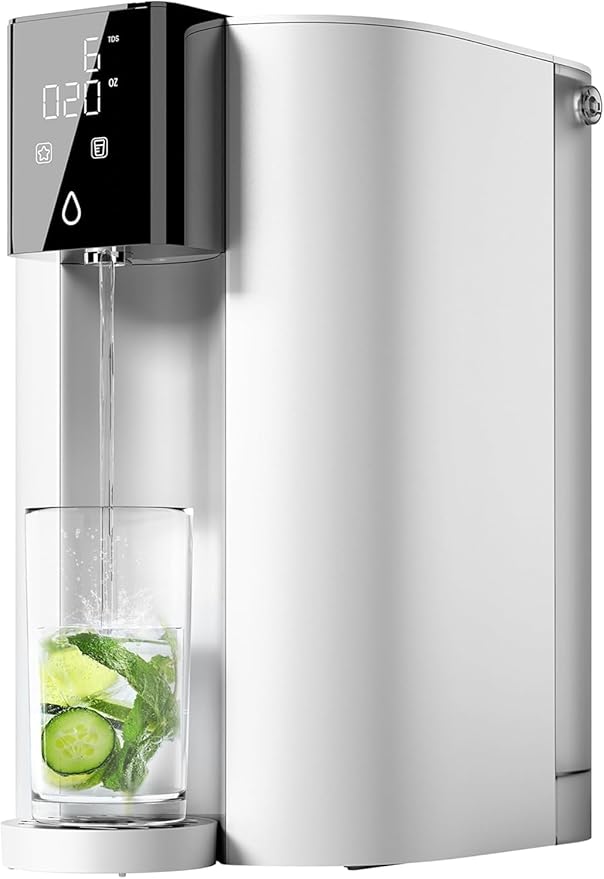
The Waterdrop D6 is a strong fit for SEQ-supply water quality. What matters for SEQ households is the catalytic carbon pre-filter stage combined with the RO membrane — this two-stage approach is why the D6 removes chloramine where most filter pitchers fail. Standard activated carbon in a Brita or PUR filter adsorbs free chlorine effectively but has almost no effect on the chloramine-ammonia bond. Catalytic carbon breaks that bond first; the RO membrane then removes everything that passes through.
Reverse osmosis membranes of this type typically reduce TDS by more than 95%, taking SEQ mains water from the 55-70 ppm range down to single digits, and the D6’s RO membrane carries NSF/ANSI 58 certification for that performance. Gold Coast mains sit at roughly 55-70 ppm TDS depending on season (desalination blending during drought events pushes it slightly higher), within the range the D6 is rated to handle.
The tankless design is relevant for Gold Coast specifically because a large proportion of residences are apartments, townhouses, and smaller homes with compact under-sink cavities. Traditional 5-stage RO systems with pressurised storage tanks typically need 35-45cm of vertical clearance and 30-40cm of horizontal depth. The D6 needs roughly 25cm vertical clearance and mounts directly to the cold supply line and drain, leaving the rest of the cabinet usable.
One honest limitation: the D6 does not include a remineralisation stage in its base configuration. At 3 ppm output, the water is essentially deionised — some people find this tastes flat compared to mineral water. If you drink primarily filtered water and notice this, the D6 has a compatible remineralisation filter (sold separately) that adds calcium and magnesium back to roughly 50-80 ppm, which most people find more palatable for drinking.
Best Water Filter for Gold Coast Renters and Apartments: AquaTru Classic
Key Takeaway: The AquaTru Classic is the only countertop RO system that meaningfully addresses Gold Coast chloramine without any plumbing modification — critical for the large share of Gold Coast households in short-term or strata-restricted rentals where drilling or tap connections are not permitted.
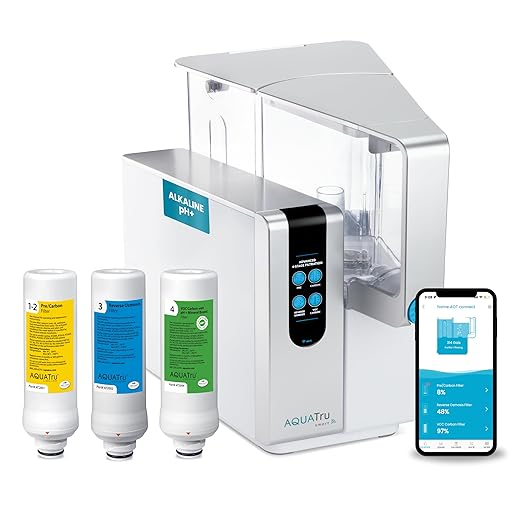
The Gold Coast rental market is one of the most constrained in Queensland — vacancy rates have sat below 1% for extended periods, and renters routinely accept properties with restrictive lease terms that prohibit any plumbing modifications. The AquaTru Classic is the answer for this cohort: it sits on the bench, connects to any standard tap via an adapter (included), fills its internal reservoir, and delivers 4-stage RO filtration without touching your plumbing.
The 4-stage sequence is: pre-filter (sediment and large particle removal), activated carbon (taste, VOCs, some chloramine pre-treatment), RO membrane (primary chloramine, fluoride, PFAS, heavy metal removal), and post-carbon polish. The NSF/ANSI 58 certification on the RO membrane is the critical credential — it means the chloramine and fluoride removal has been third-party verified, not just claimed.
For Gold Coast specifically, the 3.8L reservoir suits a household of 2-3 people well. At roughly 33.9 mg/L TDS input (soft Gold Coast water), the AquaTru produces at a slightly faster rate than it would in harder water cities — less mineral load on the membrane means less resistance. You will typically get 10-12 litres per day out of the Classic under Gold Coast conditions, which is ample for drinking and cooking in a small household.
The honest trade-off: at ~$120/yr running costs versus the D6’s ~$80/yr, the AquaTru costs more to operate long-term. Over five years that difference is $200 — meaningful but not prohibitive given the renter’s alternative is buying bottled water at $2-3 per 600ml. If you are comparing AquaTru to bottled water, the Classic pays for itself within 6-8 months for a household of two.
Best Value Under-Sink Water Filter for Gold Coast Homeowners: Pure Water Systems 5-Stage RO
Key Takeaway: Pure Water Systems is an Australian brand that ships from within Australia, offers local phone support, and sells replacement cartridges at significantly lower per-litre cost than the imported alternatives. For Gold Coast homeowners who want a permanent install without premium pricing, it is the value pick.
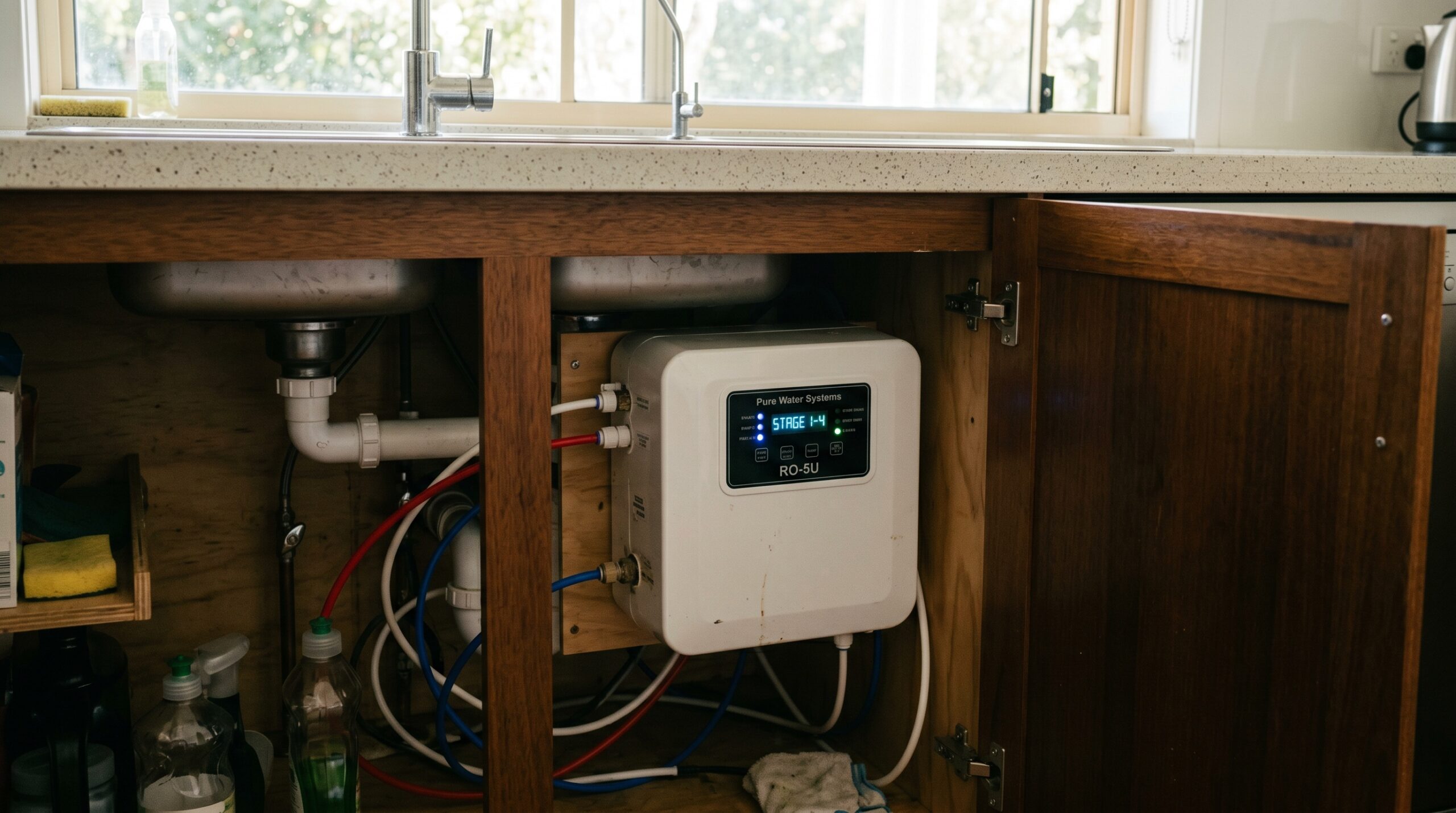
Pure Water Systems operates out of Australia and supplies replacement cartridges locally — two factors that matter more than they might seem. When your Waterdrop D6 pre-filter needs replacing, you are waiting on international shipping or paying a premium for express. With PWS, cartridges arrive within 2-3 business days from their Australian warehouse, and their support line is staffed by people who know the Gold Coast water supply chemistry rather than reading from a generic script.
The 5-stage configuration covers: sediment pre-filter (removes particulates common during Gold Coast storm events when Hinze Dam turbidity spikes), carbon block (pre-treats chloramine for the membrane), RO membrane (primary removal stage), post-carbon, and a standard 12L storage tank. For Gold Coast’s soft water at 33.9 mg/L hardness, the membrane experiences minimal scaling pressure — expect to run 18-24 months between membrane replacements rather than the 12-month interval typical in harder water cities like Perth or Adelaide.
The running cost advantage is real: generic-compatible cartridges for the 5-stage format cost around $60/yr at standard replacement intervals. That is $20/yr less than the D6’s proprietary filters and $60/yr less than the AquaTru kit. Over five years, the PWS saves $300 in running costs versus the AquaTru — money that more than offsets any premium in upfront price.
at checkout at purewatersystems.com.au. This applies to the filter unit and to replacement cartridges on subsequent orders.
What NOT to Buy for Gold Coast Water
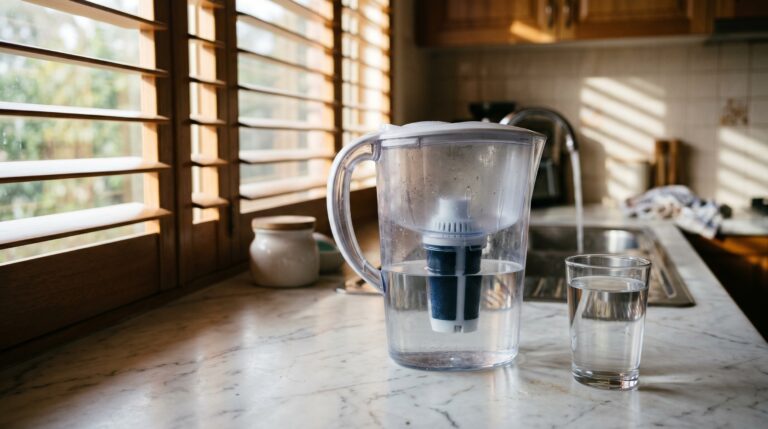
Brita and standard carbon pitcher filters: These are the most commonly purchased water filters in Australia and among the least effective for Gold Coast water. Standard activated carbon removes free chlorine well but has almost zero effect on chloramine. Brita’s own performance data does not claim chloramine removal. If you have a Brita in your Gold Coast home, it is improving taste slightly and removing some sediment — nothing more.
Basic tap-mount carbon filters (Pur, Aquatap, generic hardware store units): Same limitation as Brita pitchers. The carbon block stage in a low-cost tap mount does not have the contact time or catalytic carbon formulation needed for chloramine removal. These are fine for chlorinated cities (Melbourne, Hobart) but wrong for Gold Coast.
Gravity ceramic filters (Big Berkey, Doulton): Gravity filters are excellent for sediment, bacteria, and chlorine — but not chloramine. The Big Berkey’s Black Berkey elements are not rated for chloramine removal. For a chloramine-disinfected supply like Gold Coast, you need catalytic carbon specifically or reverse osmosis. Gravity filters at $400-600+ are expensive for what they actually achieve in this water chemistry.
Alkaline water jugs: Adding alkalinity to Gold Coast water via mineral stones or pH-raising cartridges does not address any of the actual contaminants. These are marketing products with no relevant performance claim for chloramine or fluoride removal.
5-Year Running Cost Comparison
Annual Filter Running Cost (Gold Coast)
Running costs only. Does not include upfront unit cost. Filter replacement at manufacturer-recommended intervals for Gold Coast water conditions.
| Filter | Upfront | Annual Cost | 5-Year Total | vs Bottled Water |
|---|---|---|---|---|
| Waterdrop D6 | ~$599 | ~$80 | ~$999 | Save ~$3,500 |
| AquaTru Classic | ~$449 | ~$120 | ~$1,049 | Save ~$3,450 |
| PWS 5-Stage RO | ~$449 | ~$60 | ~$749 | Save ~$3,750 |
| Bottled water (2L/day household of 3) | $0 | ~$900 | ~$4,500 | Baseline |
Which Gold Coast Water Filter Should You Buy?
Use this decision guide to match your situation to the right filter:
Waterdrop D6 — permanent install, lowest 5-year running cost among the under-sink options, tankless design suits any under-sink cavity size.
AquaTru Classic — no plumbing, no drilling, moves with you when you leave. The only benchtop unit that genuinely handles Gold Coast chloramine chemistry.
PWS 5-Stage RO — Australian brand, local cartridge supply, lowest annual running cost at ~$60/yr.
Neither the D6 nor AquaTru is a budget product. If budget is the constraint, the TAPP EcoPro (catalytic carbon tap-mount) removes chloramine at a lower upfront cost — but it will not remove fluoride or PFAS. Acknowledge that trade-off before purchasing.
How We Evaluate These Picks
Our recommendations for Gold Coast draw on each system’s NSF/ANSI certifications, manufacturer performance specifications, and published water chemistry data for the SEQ chloramine supply. Contaminant-removal claims reflect third-party certification and manufacturer ratings rather than in-house measurement of every unit. See our full testing methodology.
Gold Coast water is representative of the broader SEQ chloramine supply, including Brisbane northern suburbs, Ipswich, and the Sunshine Coast, so the same filtration approach applies to these areas with minor variation. The seasonal desalination contribution (typically October-March during drought drawdown from Hinze Dam) shifts TDS by approximately 5-12 ppm depending on blend ratio, within the range reverse osmosis systems are rated to handle at more than 95% TDS reduction.
Last reviewed: May 2026. Prices are approximate and subject to change. Verify current pricing on Amazon AU and purewatersystems.com.au before purchasing.
Frequently Asked Questions
Does Gold Coast tap water contain chloramine?
Yes. Seqwater uses chloramine (a combination of chlorine and ammonia) as the primary disinfectant for Gold Coast mains water. Chloramine is more stable than free chlorine, which means it persists further through the distribution network — useful for a geographically spread supply area like the Gold Coast, but problematic for standard carbon filters that are designed to remove free chlorine only.
Can a Brita filter remove chloramine from Gold Coast water?
No. Standard activated carbon in Brita pitchers and similar products adsorbs free chlorine effectively but has almost no effect on the chloramine bond. Brita’s own product specifications do not include chloramine as a removed contaminant. For Gold Coast water, you need either catalytic carbon (specific filter formulation) or reverse osmosis.
Does Gold Coast tap water have fluoride?
Yes. Queensland Water Supply (Safety and Reliability) Act mandates fluoridation, and Gold Coast mains is fluoridated at 0.6-0.8 mg/L. Only reverse osmosis (at greater than 90-95% removal efficiency) or activated alumina reduces fluoride to below 0.1 mg/L. Standard carbon filters do not remove fluoride.
What is the TDS of Gold Coast tap water?
Gold Coast tap water typically sits at 45-70 mg/L TDS depending on season and location. Hardness is 33.9 mg/L — the softest of any SEQ major supply. During drought periods when Seqwater blends in desalination supply, TDS can rise to 75-90 mg/L, but this is temporary. All three recommended filters reduce TDS by greater than 95% regardless of seasonal variation.
Does Gold Coast water have PFAS contamination?
PFAS testing by Seqwater has returned results below the Australian Drinking Water Guidelines limits at point of supply. However, the ADWG limits are based on 2022 guidance — the US EPA has since set health advisories at concentrations far lower than the ADWG. If you want to apply the stricter standard, reverse osmosis (Waterdrop D6 or AquaTru) removes PFAS to below detectable levels at the point of use.
What is the best water filter for Gold Coast renters?
The AquaTru Classic is the best option for Gold Coast renters because it requires no plumbing modifications — it sits on the bench, fills from any tap, and moves with you when the lease ends. It is one of the few countertop units that has been tested and certified to remove chloramine, which is the primary filtration challenge in Gold Coast mains water.
How often do water filter cartridges need replacing for Gold Coast water?
Gold Coast’s soft water (33.9 mg/L hardness) is significantly gentler on RO membranes than the hard water found in Perth, Adelaide, or Melbourne. At this hardness level, RO membranes typically last 18-24 months rather than the 12-month standard interval. Pre-filter cartridges (sediment and carbon) should still be replaced at 6-12 month intervals since they handle the chloramine pre-treatment load regardless of hardness.
Is Gold Coast tap water safe to drink without filtering?
Yes. Gold Coast tap water meets all Australian Drinking Water Guidelines and is safe to drink unfiltered. Filtering is about optimising beyond the safety baseline — specifically removing chloramine disinfection by-products, fluoride, and trace PFAS to below detection. These are personal health choices, not emergency safety measures.
Does the Gold Coast desalination plant change the water quality?
Yes, seasonally. The Gold Coast Desalination Plant at Tugun supplements Hinze Dam supply during low-rainfall periods. Desalinated water has a different mineral profile to dam-sourced water — typically higher sodium and slightly different trace mineral content. All three filters recommended here handle the blended supply across seasonal variation without performance change.
Will a water filter remove the chloramine taste from Gold Coast tap water?
Chloramine has a milder taste impact than free chlorine — most Gold Coast residents do not notice a strong chemical taste. A reverse osmosis filter (Waterdrop D6, AquaTru, or PWS) will completely eliminate any chloramine taste by removing the compound itself. If taste is your only concern and chloramine taste is barely noticeable, the ROI case for an RO filter is harder to make purely on taste grounds — consider the broader health and contaminant removal rationale as well.
Get the Australian Home Environment Checklist
30 checks across water, air and EMF. Most of them free. Ranked by impact.
No spam. Unsubscribe any time.

Former Royal Australian Navy Clearance Diver and TAG-E counter-terrorism operator. Founded Clean and Native to apply the same rigorous thinking to the home environment.
Full biography →