
Toowoomba Tap Water Quality 2026: Free Chlorine (Not Chloramine), 47 Bores, and the Cressbrook Dam Project
Affiliate disclosure: Clean and Native earns a commission if you purchase through links on this page. This does not affect our editorial position — products are recommended based on performance data and certification only.
Toowoomba uses free chlorine for disinfection — meaning standard activated carbon filters work, unlike Brisbane/Gold Coast/Ipswich which require catalytic carbon for chloramine removal. The city draws from Cressbrook, Cooby, and Perseverance Dams, plus 47 groundwater bores contributing 20–30% of supply seasonally — the highest bore component of any major QLD city. Fluoride is added at 0.6–0.9 mg/L per state legislation. The catches: Cressbrook Dam is currently lowered as part of a $270M safety project (completion 2026), and bore reliance means total dissolved solids can spike during drought periods when groundwater contribution increases.
| Filter Type | Effectiveness | Verdict |
|---|---|---|
| Reverse Osmosis | Removes chlorine, fluoride, TDS, bore minerals | Recommended |
| Standard Carbon | Removes chlorine; fluoride remains | Works (unlike SEQ cities) |
| Catalytic Carbon | Unnecessary — no chloramine used | Overkill for Toowoomba |
Quick answer
The three products we own are measured first-hand by Jayce Love, former Royal Australian Navy Clearance Diver; every other product is assessed on published manufacturer specifications and independent certification using our documented methodology — no gifted units, no brand payments.
Toowoomba’s water supply is managed by Toowoomba Regional Council — not Seqwater. This distinction matters: unlike Brisbane, Gold Coast, and Ipswich which use chloramine, Toowoomba uses free chlorine for disinfection. Standard carbon filters work. Primary sources are Cressbrook, Cooby, and Perseverance Dams, supplemented by 47 groundwater bores that contribute 20-30% of supply — a bore component higher than any SEQ city. Cressbrook Dam is currently being lowered as part of a $270 million safety improvement project, with Perseverance Dam providing supplementary supply during this period. Fluoride is added per QLD legislation.
NOT chloramine
Seasonal contribution
Safety project
Active supply
Toowoomba has one of the most unusual water supply profiles of any Queensland city. It is the only major QLD city not on the SEQ Water Grid, manages its own dams independently, draws 20-30% of its supply from 47 groundwater bores, and uses free chlorine rather than chloramine for disinfection. It is also the city that staged Australia’s most famous water referendum — the 2006 vote that rejected adding treated recycled sewage water to Cooby Dam by a decisive margin. Understanding Toowoomba’s supply means understanding why its water is fundamentally different to any coastal Queensland city.
Where Toowoomba’s water comes from
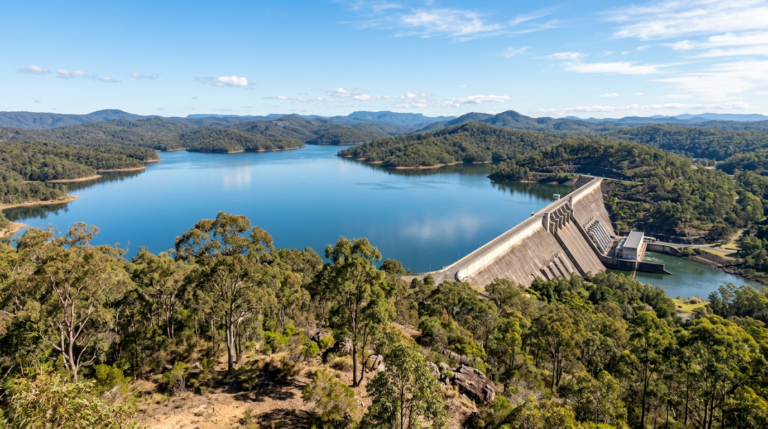
Toowoomba Regional Council manages the Bulk Water Supply Scheme, which serves the city of Toowoomba and surrounding towns across the Darling Downs. The primary surface water sources are three dams in the ranges northeast of the city: Cressbrook Dam (81,800 ML, the largest), Perseverance Dam (26,800 ML), and Cooby Dam (23,100 ML). These are supplemented by 47 groundwater bore stations that access subsurface aquifers and contribute approximately 20-30% of total supply — a groundwater reliance significantly higher than Brisbane, Sydney, or any coastal Australian capital.
Treatment occurs primarily at the Mt Kynoch Water Treatment Plant, with additional treatment at smaller plants at Pechey, Cressbrook, and Perseverance. A 38-kilometre pipeline from Wivenhoe Dam (operational since 2010) provides a backup source for the Cressbrook system, providing drought security when local dam levels fall critically low. Water is delivered via more than 370 km of pipelines, 18 reservoirs, and 17 pump stations.
The groundwater contribution is significant for water quality. Bore water typically has higher mineral content than surface water from dam catchments — the minerals accumulate as water moves through soil and rock. This means Toowoomba’s water hardness is typically higher and more variable than coastal QLD cities, with the specific characteristics depending on seasonal mix of dam water versus bore water in the distribution system.
The Cressbrook Dam safety project — 2024-2026
Since July 2024, Toowoomba Regional Council has been deliberately drawing primarily from Cressbrook Dam to lower its water level to approximately 70% before commencing a $270 million safety improvement project — Queensland’s largest local government-led dam safety project. The works involve widening the spillway and raising the dam crest to handle larger flood flows, as required by the Water Supply (Safety and Reliability) Act 2008. The project does not affect water supply to Toowoomba residents — treatment continues at Mt Kynoch WTP — but Perseverance Dam has been pumped to supplement supply during the Cressbrook drawdown period. Water quality is not impacted by the construction work, as the treatment plant sits downstream of the construction zone.
The 2006 recycled water referendum
Toowoomba holds a unique place in Australian water history. During the severe drought of the mid-2000s, Cooby Dam reached 8% capacity. Facing critical water shortage, the council proposed the “Toowoomba Water Futures” project: piping treated recycled wastewater (processed to drinking water standards) into Cooby Dam as a drought-resilient supply. On 29 July 2006, residents voted 62% to 38% against the proposal in a referendum that drew national attention.
The “no” vote became influential in Australian water policy debates. The technology proposed was not fundamentally different from what is now used in Singapore, parts of the US, and in Queensland’s Western Corridor Recycled Water Scheme (which indirectly supplements SEQ supplies during drought). Toowoomba’s water security instead came via the Wivenhoe pipeline, completed in 2010. The recycled water debate is historically relevant and recurs periodically in discussions about Queensland’s long-term water security.
Our Top-Rated Water Filters
Reverse osmosis is the only residential technology that reliably removes PFAS, fluoride, chloramine, and heavy metals — the four contaminants most Australians are most exposed to.
Toowoomba water quality and what it means for filtration
| Parameter | Toowoomba | Filtration relevance |
|---|---|---|
| Disinfection | Free chlorine (NOT chloramine) | Standard activated carbon filters work effectively — unlike Brisbane, Gold Coast, Ipswich. |
| Hardness | Variable — higher with bore contribution | Harder than coastal QLD cities. Scale on appliances. RO removes effectively. |
| Fluoride | Added per QLD legislation | ~0.6-0.8 mg/L. RO is the only consumer method for removal. |
| Seasonal variation | Higher in dry periods (more bore water) | Mineral content and hardness increase when bore contribution rises. RO output remains consistent. |
Chlorine taste and odour — standard carbon works
Unlike Brisbane and Gold Coast, Toowoomba uses free chlorine. Standard NSF 42-certified activated carbon filters remove free chlorine effectively. Any carbon block tap filter or under-sink carbon unit will address the taste and odour of Toowoomba’s disinfectant.
Recommended: TAPP EcoPro — NSF 42 + 53, no catalytic carbon required
See the TAPP EcoPro on Amazon AU →Comprehensive — hardness, fluoride, all dissolved
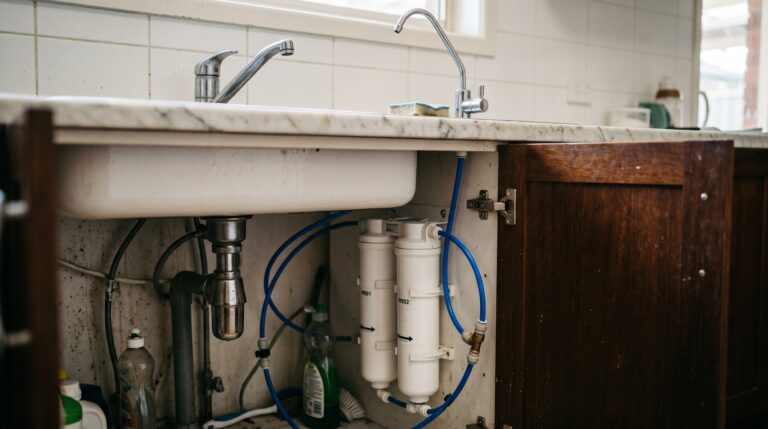
If bore water hardness, fluoride removal, or comprehensive filtration is the goal, RO is the appropriate technology. Toowoomba’s higher and more variable hardness from bore contribution makes RO more impactful than in soft coastal cities.
Recommended: EcoHero 5-Stage RO — WaterMark + NSF 58
See the EcoHero RO System →For a personalised filter recommendation based on your specific concerns, see the water filter quiz. For all filter options across every price point, see the best water filters Australia guide.
Frequently asked questions
What water filter works for Toowoomba tap water?
Because Toowoomba uses free chlorine (not chloramine), a standard NSF 42-certified activated carbon block filter such as the TAPP EcoPro works effectively. For fluoride removal or comprehensive filtration including TDS reduction, an RO system such as the EcoHero 5-stage is the appropriate choice.
Is Toowoomba water hard or soft?
Toowoomba water hardness varies depending on the current blend of dam and bore water. Bore contributions (20–30% of supply) add more minerals. Hardness typically ranges from 80–180 mg/L as CaCO3 depending on season — moderate by Australian standards.
What is the TDS of Toowoomba tap water?
Toowoomba TDS varies seasonally due to groundwater bore contributions. During high bore use periods, TDS can reach 200–300 mg/L. During high dam supply periods, TDS is typically lower, around 80–120 mg/L. Toowoomba Regional Council publishes annual water quality data.
Does Toowoomba tap water have fluoride?
Yes. Fluoride is added to Toowoomba water per Queensland Health’s Water Fluoridation Policy, targeting 0.7–1.0 mg/L. This is consistent with NHMRC recommendations for dental health.
Can I drink Toowoomba tap water without filtering?
Yes. Toowoomba Regional Council operates the supply to ADWG standards and all health parameters are met. Filtration is a personal preference choice for taste or to address bore-water mineral content — not a health requirement.
Is Toowoomba tap water safe to drink?
Yes. Toowoomba Regional Council manages the water supply from Cressbrook, Cooby, and Perseverance Dams plus 47 groundwater bores, treated at Mt Kynoch Water Treatment Plant. The supply meets Australian Drinking Water Guidelines and is safe to drink without filtration.
Does Toowoomba water have chloramine?
No. Unlike Brisbane, Gold Coast, and Ipswich which all use chloramine on the SEQ Water Grid, Toowoomba uses free chlorine for disinfection. This means standard activated carbon filters are effective — you do not need catalytic carbon. Toowoomba is the only major QLD city with free chlorine disinfection.
What was the Toowoomba recycled water referendum?
On 29 July 2006, during severe drought conditions with Cooby Dam at 8% capacity, Toowoomba residents voted 62% to 38% against a council proposal to add treated recycled wastewater (purified to drinking water standard) into Cooby Dam. The referendum attracted national attention and influenced Australian water policy debates. Water security was instead achieved via the Wivenhoe pipeline, completed in 2010.
Get the Australian Home Environment Checklist
30 checks across water, air and EMF. Most of them free. Ranked by impact.
No spam. Unsubscribe any time.

Former Royal Australian Navy Clearance Diver and TAG-E counter-terrorism operator. Founded Clean and Native to apply the same rigorous thinking to the home environment.
Full biography →