EMF Protection for Bedrooms Australia: 5 Actions Ranked by Impact
Drafted with AI assistance and checked against published specifications and certifications. First-hand measurements appear only where stated. How we make content
The most effective EMF protection for Australian bedrooms is removing or switching off internal sources — router on a timer, phone in another room, and power points off at the bed head — not buying shielding products. These three free actions reduce measurable bedroom EMF by 70–95% in typical homes, far more than any canopy or paint applied over active sources. The catches: you need to actually implement the boring steps (timer switches, habit changes), and external RF shielding only makes sense after you’ve eliminated all controllable internal sources first.
| Action Type | Cost | Verdict |
|---|---|---|
| Router timer + phone out | Free–$15 | Start here — 70%+ impact |
| Hardwiring + demand switch | $20–150 | High value after basics |
| Shielding (canopy/paint) | $150–600 | Only after steps 1–7 done |
EMF Bedroom Protection: Ranked Action List
| 1 | Router out of bedroom or on $15 timer | Free–$15 — highest impact |
| 2 | Phone in another room or airplane mode | Free |
| 3 | Switch off power points at bed head | Free |
| 4 | Hardwire nearby devices, disable their Wi-Fi | ~$20 ethernet cable |
| 5 | Move bed away from smart meter wall (if applicable) | Free |
| 6 | Replace DECT cordless phone in/near bedroom | ~$30 corded alternative |
| 7 | Install demand switch on bedroom circuit | ~$100–150 electrician |
| 8 | Shield residual external RF (only after steps 1–7) | $150–600 (last resort) |
Most bedroom EMF reduction advice starts in the wrong place — with products. Shielding paint, EMF-blocking canopies, and “protective” phone cases make for compelling product listings, but they address the wrong problem for most Australian bedrooms. The primary EMF sources in a typical Australian bedroom are inside the room: a router in or near the bedroom, a smartphone on the bedside table, smart home devices, and plugged-in appliances creating AC electric fields. Shielding these internal sources doesn’t work — it reflects them.
The three products we own are measured first-hand by Jayce Love, former Royal Australian Navy Clearance Diver; every other product is assessed on published manufacturer specifications and independent certification using our documented methodology — no gifted units, no brand payments.
The correct sequence is: measure → remove or reduce sources → shield only external residual RF if still elevated. Following this order costs almost nothing for most people and achieves more than any shielding product.
This guide covers every meaningful bedroom protection action available in Australia, ranked by impact and cost. It’s a companion to the EMF bedroom audit guide — if you haven’t measured yet, start there first. If you have measurement data and want to act on it, you’re in the right place.
Why the Bedroom Is the Priority Room
The case for prioritising the bedroom over other rooms comes down to biology, not EMF paranoia. Sleep is the body’s primary recovery window — the period when growth hormone is secreted, cellular repair occurs, and the brain clears metabolic waste through the glymphatic system. You spend approximately 7–9 hours per night in this state, largely stationary, within metres of whatever you’ve placed on your bedside table.
Two specific biological mechanisms are relevant to EMF exposure during sleep:
Melatonin and light sensitivity: The pineal gland produces melatonin in response to darkness, signalling the circadian system to initiate sleep. Research has examined whether RF and ELF-MF exposure at sufficient intensities affects pineal function. The evidence is not conclusive, but the precautionary rationale for reducing unnecessary exposures during sleep — when the body is in repair mode — is reasonable regardless of the specific mechanism.
Proximity and duration: The inverse square law means that EMF intensity drops rapidly with distance. A phone on your bedside table at 30 cm delivers substantially more RF to your head than the same phone at 2 metres. Eight hours of this exposure nightly accumulates differently than the same device used actively during waking hours. The free reduction strategies (moving the phone, removing the router) exploit this physics directly.
Step 0: Measure Before You Act
The single biggest waste in bedroom EMF management is buying products based on what should be present rather than what is actually present. The Palm Beach audit found that the router in the living room — three rooms away from the bedroom — was the primary RF source affecting the bed position, while the bedside clock radio contributed almost nothing. Without measurement, interventions would have targeted the wrong things.
The EMF bedroom audit guide covers the full step-by-step measurement protocol using the TriField TF2. For this guide, the relevant baselines are:
- RF target (building biology sleeping area): <0.1 mW/m² (precautionary); <1 mW/m² (standard)
- Magnetic field target: <0.2 µT (precautionary); <1 µT (standard)
- Electric field target: <5 V/m (precautionary at sleep position)
The TriField TF2 is the recommended meter for Australian bedrooms — it measures all three field types (RF, magnetic, electric) on a single device with a frequency range of 1 MHz to 8 GHz, covering Wi-Fi (2.4/5 GHz), 4G/5G (700 MHz – 3.5 GHz), smart meter (900 MHz), Bluetooth (2.4 GHz), and all mains-frequency ELF fields (50 Hz Australia).
Measure First. Act Second.
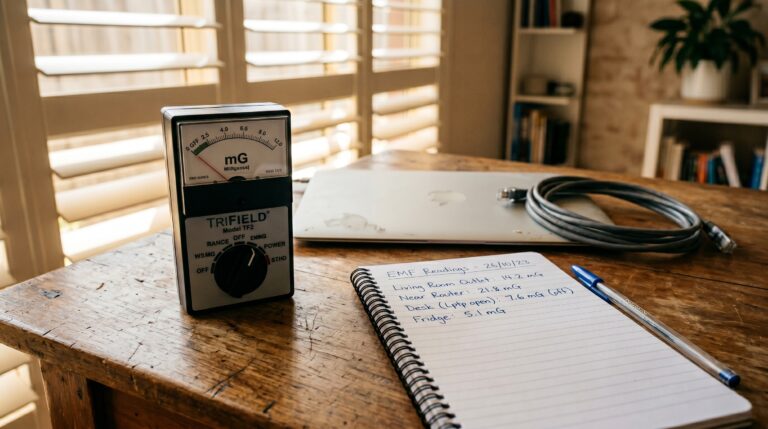
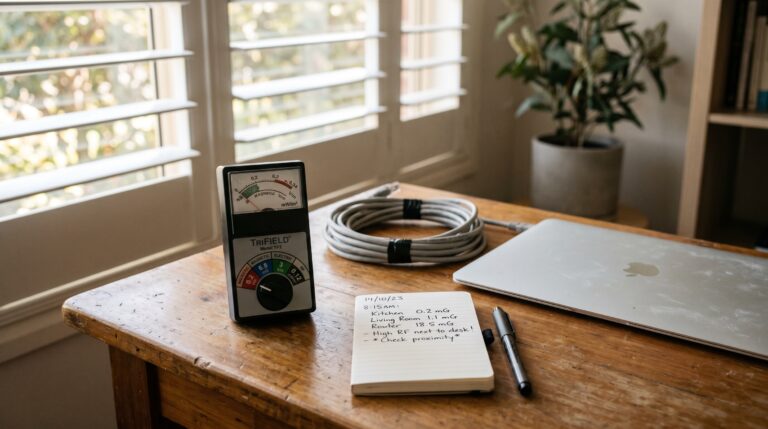
The TriField TF2 measures AC magnetic, AC electric, and RF fields in one meter. Without real readings, every EMF decision is a guess. Every room audit starts here.
Action 1: Router Management (Free — $15)
The Wi-Fi router is the highest-intensity continuous RF source in most Australian homes. A typical 802.11n/ac/ax router operating at full power transmits at 100–200 mW EIRP — far more than a smartphone at standby. If the router is in or adjacent to the bedroom, it’s the primary target for reduction.
Option A: Move the router to a different room
The most effective router intervention. Moving a router from the bedroom to a hallway or living room reduces bed-position RF by 90–99% in most home layouts, purely through distance and wall attenuation. This costs nothing and doesn’t affect connectivity for the rest of the home.
Practical consideration: if the router is in the bedroom due to NBN connection box placement, note that the NBN connection box itself (NTD — Network Termination Device) doesn’t transmit RF. Only the attached Wi-Fi router does. The NBN NTD can be in the bedroom connected via ethernet to a router in another room. An electrician or NBN technician can relocate the connection point if the cable run allows it.
Option B: Outlet timer for overnight scheduling
If router relocation isn’t possible, a digital outlet timer (available from Bunnings, Woolworths, or Amazon, ~$15) schedules the router off at your set bedtime and on again at your wake time. This eliminates 7–9 hours of nightly continuous RF exposure with no impact on daytime connectivity.
The simple mechanical timer works fine; a digital programmable timer allows multiple on/off periods and is more reliable long-term. The router resumes exactly where it left off when power is restored — no reconfiguration needed.
Option C: Reduce router transmit power
Many modern routers (including common Australian ISP models from Telstra, Optus, and TPG) have transmit power settings accessible through their admin interface (typically 192.168.0.1 or 192.168.1.1). Reducing transmit power from 100% to 50% reduces RF intensity by ~50% (3 dB reduction) while typically maintaining adequate coverage throughout a standard Australian home. This is a useful supplement to other measures but less impactful than relocation or scheduling.
Option D: Use ethernet and disable Wi-Fi
The ultimate router solution: connect all devices that support it via ethernet cable and disable the Wi-Fi radio entirely. This reduces the router to a wired switch/gateway — zero RF output. Most modern routers allow Wi-Fi to be disabled per band (2.4 GHz and 5 GHz separately) or entirely through the admin interface. This approach requires ethernet cables to each device but eliminates the RF source completely.
Action 2: Phone Management (Free)
A smartphone on standby is a multi-frequency RF transmitter. While the phone is sitting on your bedside table it’s:
- Maintaining a connection to 4G/5G cellular network (transmitting periodically to update location/time)
- Maintaining Wi-Fi connection (periodic data exchange)
- Scanning for Bluetooth devices
- Running background app updates if connected
At 30 cm from your head during 8 hours of sleep, this is a significant and unnecessary exposure that’s trivially reduced.
Airplane mode: the free solution
Enabling airplane mode disables all radio transmitters — cellular, Wi-Fi, Bluetooth, GPS. The alarm function continues to work normally in airplane mode. If you use your phone as an alarm, this is the simplest reduction available: set alarm, enable airplane mode, place phone across the room (further from the sleep position) or in another room entirely.
Distance matters even with airplane mode disabled: at 2 metres, the inverse square law means RF exposure is 1/4 the level at 1 metre. Placing the phone on the opposite side of the room rather than the bedside table reduces exposure substantially even without airplane mode.
The $10 alarm clock: eliminating the tradeoff
Many people resist moving their phone out of the bedroom because they use it as an alarm. A basic digital alarm clock from Kmart, Target, or the Reject Shop ($10–25) eliminates this dependency entirely. The phone goes to another room to charge; the alarm wakes you reliably. Simple.
For those who wake and immediately check devices: this change also has documented benefits for sleep quality independent of EMF concerns — the absence of the temptation to check notifications is itself sleep-improving.
Action 3: Switch Off Power Points at Bed Head (Free)
AC electric fields radiate from power cables as long as they’re connected to a live (powered) outlet — even when the plugged-in device is switched off. This is different from magnetic fields (which only appear when current flows) and RF (which requires an actively transmitting device). Electric fields are present whenever a conductor is energised, whether or not current is flowing.
In a typical bedroom, the bed head often has:
- Bedside lamp power cord
- Phone/device charger
- Extension cord under the bed with multiple devices
- Clock radio or smart speaker power cable
Each of these radiates an AC electric field at 50 Hz. At typical household wiring voltages (240V Australian), the field from a power cord is detectable at distances of 0.5–1 metre and falls off rapidly with distance.
The free fix: Switch off the power points at the wall before bed (Australian power points have individual switches, which is a significant advantage over US/European outlets). If the power point is switched off, no electric field radiates from that circuit segment. Switching off a power board turns off all cables connected to it simultaneously.
For bedside lamps you want to switch on quickly: a battery-powered LED touch lamp eliminates the need for a bedside power point entirely.
Action 4: Hardwire Devices and Disable Their Wireless (Free — ~$20)
Every wireless device in or adjacent to the bedroom that can be connected via ethernet cable is a potential RF reduction. Smart TVs, game consoles, streaming boxes (Apple TV, Chromecast, Fetch), desktop computers, and NBN modems all support wired ethernet connections.
A wired device with its Wi-Fi disabled transmits zero RF. The ethernet cable from an adjacent room or from a wall ethernet port costs $15–30 from JB Hi-Fi, Bunnings, or Officeworks. Most devices allow Wi-Fi to be disabled in their network settings once a wired connection is established.
This is particularly impactful if a smart TV or streaming device is on the bedroom wall or nearby — these devices regularly transmit data for software updates, streaming recommendations, and smart home integration even when the screen appears off.
Action 5: Smart Meter Wall Assessment (Free — if action needed)
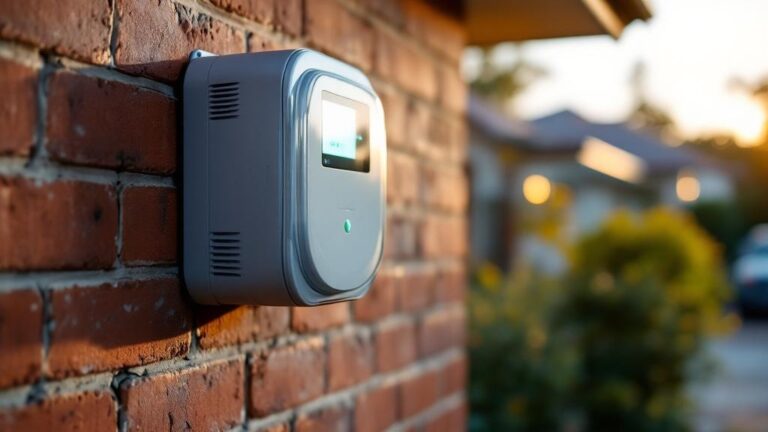
Australian smart meters (deployed across Victoria, NSW, QLD, and SA) transmit via 900 MHz mesh radio networks. The transmission pattern is different from a continuously transmitting Wi-Fi router — smart meters typically transmit in short bursts at intervals (every few minutes for data relay, with periodic synchronisation bursts at higher power).
The critical behaviour for bedroom protection: peak hold mode on your meter shows substantially higher readings than time-average mode during smart meter transmissions. Ausgrid (NSW) and Energex (QLD) meters can produce peak readings 100–1,000 times higher than the time-average during transmission events. This means a bedroom wall adjacent to an external smart meter may appear to have low RF on a time-averaged reading but experience significant peak bursts throughout the night.
How to assess: use the TriField TF2 in RF peak hold mode. Stand at the bedroom wall closest to where the smart meter is mounted externally. If you observe periodic peak spikes (you’ll see the display jump and hold a peak value, then jump again some minutes later), the smart meter is contributing meaningfully to bedroom RF.
Free action first: Move the bed to an interior wall — away from the exterior wall where the smart meter is mounted. Distance and the wall itself provide significant attenuation. In most Australian homes, this repositioning alone reduces smart meter RF contribution to negligible levels at the sleep position.
If repositioning isn’t possible: A section of RF-blocking paint or a shield panel on the interior surface of the smart meter wall can reduce transmission into the room. This is a legitimate use of shielding — targeting a confirmed external source with measurement verification before and after.
Action 6: Replace the DECT Cordless Phone (~$30)
DECT (Digital Enhanced Cordless Telecommunications) cordless phones — the standard cordless home phones sold in Australia — transmit continuously at ~1.9 GHz, even when not in use. The base station is an always-on RF transmitter. If a DECT phone base station is in the bedroom or adjacent room, it’s a significant source that’s often overlooked because it appears inactive.
The simple solution: move the base station out of the bedroom (if you must keep DECT), or replace with a corded phone for the bedroom location ($30–60 for a basic corded handset). For households who’ve moved to mobile-only communication, the DECT base station can simply be removed.
Note: “Eco mode” or “ECO DECT” features available on some modern DECT phones reduce transmit power when not in use. These are a partial improvement if full replacement isn’t practical.
Action 7: Demand Switch for Electric Field Elimination (~$100–150)
A demand switch (also called a demand controller or field disconnector) is a device installed by a licensed electrician on the bedroom circuit. It detects the residual electric field from wiring and automatically cuts power to the circuit when no loads are present — eliminating AC electric fields from all bedroom wiring during sleep without requiring you to manually switch off every outlet.
When you turn on a bedside lamp or phone charger, the demand switch detects the current draw and restores power instantly. When you turn the lamp off again, the demand switch cuts power once the circuit is inactive.
The result: during sleep with no devices running, the bedroom circuit is de-energised. No AC electric fields radiate from the wall wiring, ceiling light cables, or outlet boxes. This is the most effective electric field reduction available short of rewiring in shielded conduit.
Australian installation notes: Demand switches are installed in the meter board/switchboard, not at the wall. A licensed electrician is required. The typical cost in Australia is $80–150 for the device plus $50–100 for installation. The Geofield demand switch is available from specialist EMF retailers in Australia. A single demand switch can serve the bedroom circuit plus any adjacent circuits (e.g., connecting bedroom and ensuite on the same breaker).
The Shielding Guide: When to Shield, When Not To
Shielding is a last resort — not a first step. The reason is fundamental physics: shielding works by blocking electromagnetic fields, but it works indiscriminately. If the primary source is inside the shielded area, the shield reflects and can increase the internal field density.
RF-blocking paint
RF-blocking paint (typically containing graphite or carbonyl iron) can attenuate RF by 30–50 dB (1,000–100,000× reduction) when applied to walls, ceiling, and floor. It’s most appropriate for walls facing a mobile phone tower or a neighbour’s router that you can’t control.
Important technical notes:
- The paint must be grounded (earthed) to be effective — an ungrounded RF paint can act as an antenna and worsen the situation
- It must cover all surfaces completely — gaps at window frames, power points, and around door frames break the Faraday cage effect
- A separate earthed topcoat is typically required for aesthetic finish
- Professional application is strongly recommended for effectiveness
Products available in Australia: Yshield HSF54 and similar paints are available from EMF-specialist retailers. Verify technical specifications and ensure the installer understands earthing requirements. Budget $400–1,200 for a standard bedroom including materials and professional installation.
RF-blocking canopy / bed net
An RF-blocking bed canopy (silver-thread or stainless steel mesh fabric) can provide significant attenuation of external RF — 30–50 dB when well-made and properly deployed. However, the shielding trap applies fully here: all internal sources (phone, router, smart devices) must be removed before or the canopy amplifies rather than reduces exposure.
Legitimate use cases for an RF canopy:
- Bedroom directly facing a 5G small cell or mobile tower at close range, confirmed by measurement
- After all internal source management is complete and a residual external RF source is confirmed by measurement to exceed your target level
- Temporary use during unusual circumstances (e.g., a construction-site RF transmitter adjacent to the building)
Quality canopies: Naturalmat, Swiss Shield, and Stralskydd fabrics provide manufacturer-verified attenuation data. Australian retailers include EMF-specialist online stores. Budget $200–600 for a quality single-bed canopy with measured attenuation specifications. Avoid cheap imports with no technical specifications — a non-shielding “canopy” is simply a decorative item.
EMF-blocking phone cases: useful but limited
RF-blocking phone cases (Faraday pouches, cases with shielded back panels) reduce RF from the phone in the direction of the shield — typically toward your body. The limitation: your phone needs to receive signal to function. A fully shielded case blocks signal, causing the phone to increase transmit power searching for the network. A shielded phone in a Faraday bag in airplane mode transmits nothing and needs no shielding.
The most useful application: a Faraday pouch for daytime carry — with the phone in a bag pocket against your body, a quality pouch reduces RF toward your torso while maintaining adequate signal. At night, if the phone is in the bedroom at all, it should be in airplane mode — at which point shielding adds nothing.
What Not to Buy: Products That Don’t Work
The EMF protection market contains a substantial proportion of products that have no credible mechanism of action. Being clear about this protects your budget for actions that make a measurable difference.
Products with no plausible mechanism:
- Anti-EMF crystals (shungite, black tourmaline, orgonite devices) — no physical mechanism by which these materials attenuate electromagnetic fields. Shungite can be weakly conductive but has no shielding properties relevant to household EMF frequencies at household intensities.
- Phone sticker “shields” — a small adhesive patch cannot create meaningful shielding. Any attenuation would require complete enclosure of the source. These are demonstrably ineffective at any frequency.
- EMF “harmonising” devices — products claiming to neutralise, harmonise, or transform EMF without any frequency-specific attenuation mechanism. Waveform alteration, scalar wave generators, and similar claims have no basis in electromagnetic physics.
- Pendant and wearable “protection” — small wearables cannot meaningfully shield the body from ambient electromagnetic fields. Legitimate wearable shielding would require complete body coverage in a grounded conductive enclosure — impractical by definition.
A simple test: does the product’s claimed mechanism involve physical attenuation, reflection, or absorption of electromagnetic waves? If not — if it involves “harmonising,” “neutralising,” or “transforming” EMF — there is no plausible physics behind it.
Australian-Specific Sources: What to Check in Your Bedroom
Beyond the universal sources (router, phone, devices), Australia has some specific EMF sources that are more common or configured differently than in other countries:
Smart meters: Victoria mandated smart meter rollout from 2009; NSW, QLD, and SA followed. The meters operate on 900 MHz mesh radio networks (Landis+Gyr, Itron, and similar). Unlike the US where meters often use Zigbee at 2.4 GHz, Australian meters typically use sub-GHz radio which penetrates walls more effectively. If your bedroom shares an external wall with a smart meter mounting location, this is a priority check item.
NBN connection boxes: The NBN NTD (Network Termination Device) itself doesn’t transmit RF — it’s the attached Wi-Fi router that does. Many NBN installations place the NTD and router in a combined unit, often mounted near the front door or in a study/bedroom for cable access convenience. If your NBN Wi-Fi router is in or adjacent to the bedroom, it’s the highest-priority RF source to address.
Reverse-cycle air conditioning: Split-system reverse-cycle air conditioners are standard in Australian bedrooms. The indoor unit (head unit) contains a transformer and induction motor that generate AC magnetic fields when running — typically 0.1–2 µT at 0.5 metres. At typical installation heights of 2–2.5 metres above floor level, the field at sleeping position (roughly 1.5–2 metres horizontal distance) is usually below precautionary thresholds. Verify with a measurement if the unit is directly above the bed position.
5G small cells: Telstra, Optus, and TPG have been deploying 5G small cells (street-level infrastructure) in metropolitan areas. These typically mount on power poles or building fascias at 3–6 metres height, transmitting at 3.5 GHz or 28 GHz with maximum EIRP of 50–200 W. If your bedroom faces a recently installed small cell at close range (<20 metres), measurement at the window is warranted. Building walls provide 10–30 dB attenuation at these frequencies.
Action Plan by Measurement Reading
| TF2 Reading (RF) | Likely Source | First Action | If Still Elevated |
|---|---|---|---|
| >1 mW/m² uniform across room | Router in room or adjacent room | Relocate router or add timer | Confirm relocation achieved target; check other devices |
| 0.1–1 mW/m² near bed only | Phone on bedside table | Phone to airplane mode or other room | Check for other devices (smart speaker, tablet) |
| Periodic peaks on one exterior wall | Smart meter | Move bed to interior wall | RF paint or shield panel on that wall |
| High reading near window facing street | External tower or small cell | Move bed away from window; use heavy curtains | RF-blocking curtain lining or window film |
| ELF magnetic >0.2 µT near bed | Appliance within 1m, or wiring in wall behind bed | Move bed away from that wall; remove appliances | Electrician assessment; mu-metal shielding for confirmed wiring source |
| ELF electric >10 V/m at bed | Extension cord under bed or live cables in wall | Switch off power points at wall before sleep | Demand switch installation; cable rerouting by electrician |
Building Biology Guidelines vs ARPANSA: Which Standard to Use
This question comes up frequently: do you use the ARPANSA (Australian Radiation Protection and Nuclear Safety Agency) exposure limits or the building biology guidelines?
ARPANSA limits are thermal protection standards — they set thresholds below which tissue heating from RF absorption doesn’t occur. For RF, the ARPANSA general public limit at 2.4 GHz is 1,000 µW/cm² (10 W/m²). This is a safety standard, not a comfort or precautionary standard. Virtually no household RF exposure comes close to these limits.
Building biology guidelines (BauBiologie / SBM-2015) are precautionary recommendations developed for long-term chronic exposure in sleeping areas specifically. They’re not regulatory limits — they’re practitioner guidelines derived from the precautionary principle. For RF in sleeping areas, the SBM-2015 “no anomaly” level is <0.001 mW/m², with “slight anomaly” at 0.001–0.01 mW/m².
| Standard | RF Limit (mW/m²) | Basis | Application |
|---|---|---|---|
| ARPANSA (Australia) | 10,000,000 (10 W/m²) | Thermal — tissue heating | Regulatory safety limit |
| ICNIRP (international) | 10,000,000 (10 W/m²) | Thermal | WHO-recommended |
| Switzerland NISV | 95,000 | Precautionary regulatory | Sensitive-use zones (schools, homes) |
| Salzburg Resolution 2000 | 1,000 | Precautionary | Indoor recommendation |
| Building Biology SBM-2015 | <0.1 (no anomaly) | Precautionary sleeping area | Practitioner guideline |
For practical bedroom management, the building biology guideline (<0.1 mW/m² as a target) is useful as a working benchmark — not because it’s scientifically established as a harm threshold, but because it’s achievable in most Australian bedrooms through the free and low-cost actions in this guide. It provides a concrete measurement target.
Frequently Asked Questions
What is the most effective EMF reduction for the bedroom?
Moving the Wi-Fi router out of the bedroom or putting it on a nightly timer. The router is typically the highest-intensity continuous RF source in Australian bedrooms — operating at 100–200 mW EIRP continuously. A $15 outlet timer from Bunnings schedules it off during sleep hours, eliminating the largest single source with zero impact on daytime connectivity. This one change typically reduces bedroom RF by 90% or more in most Australian home layouts.
Should I put my phone in airplane mode at night?
Yes, if reducing bedroom RF is a goal. A standby smartphone continuously transmits cellular, Wi-Fi, and Bluetooth radio. Airplane mode stops all of this — the alarm function still works. If you can’t move the phone to another room, airplane mode plus placing it across the room (further from your head) provides meaningful reduction at zero cost.
Do EMF shielding products for the bedroom work?
Some do, with critical conditions. RF-blocking paint and quality metallic canopy fabrics can attenuate external RF effectively — but only if the primary sources are external, all internal sources have been removed, and the shielding is properly installed and grounded. If you install a canopy over a bed in a room with a router, phone, or smart speaker, you may increase rather than decrease exposure by trapping internal RF. Measure first, address internal sources, then shield residual external sources only if measurement confirms they’re still elevated.
What EMF does a Wi-Fi router emit?
Wi-Fi routers emit RF (radiofrequency) electromagnetic radiation at 2.4 GHz and/or 5 GHz (standard Wi-Fi) or 6 GHz (Wi-Fi 6E). Modern 802.11ax routers typically transmit at 100–200 mW EIRP continuously when active. At 1 metre, a router can produce 0.5–5 mW/m² — substantially above building biology precautionary guidelines of 0.1 mW/m² for sleeping areas.
How do I reduce EMF from a smart meter in my bedroom?
First, measure using the TriField TF2 in peak hold mode at the wall closest to the smart meter. If confirmed elevated, move the bed to an interior wall — distance and wall attenuation typically resolve the issue without any additional products. If the bedroom layout cannot accommodate repositioning, an RF-blocking paint section on the smart meter wall (applied to the interior surface, properly grounded) is the targeted solution.
What is a demand switch and do I need one?
A demand switch (demand controller) is installed by a licensed electrician on your bedroom circuit. It cuts power to the circuit when no loads are drawing current — eliminating AC electric fields from all bedroom wiring during sleep. When you turn on a device, it restores power instantly. Cost: approximately $100–150 including installation. Worth considering if you have measured AC electric fields above building biology guidelines at your sleep position and switching off all power points still leaves elevated readings from wall wiring.
Are EMF crystals and orgonite effective for bedroom protection?
No. There is no credible physical mechanism by which crystals, orgonite, or similar products attenuate electromagnetic fields. Legitimate EMF shielding works through specific physical mechanisms: conductive materials reflect RF (Faraday cage effect), certain materials absorb RF and convert it to heat, and ferromagnetic materials redirect magnetic fields. None of these mechanisms operate in crystals or orgonite devices.
What is the ARPANSA limit for bedroom EMF exposure in Australia?
ARPANSA’s reference level for general public RF exposure at 2.4 GHz is 10 W/m² (10,000,000 µW/m²). This is a thermal safety standard designed to prevent tissue heating — not a precautionary comfort standard. Virtually no residential RF source approaches this level. Building biology practitioners use much lower precautionary targets (0.1 mW/m² for sleeping areas) as a working guideline based on the principle of minimising unnecessary chronic exposure.
Should I buy an EMF-blocking phone case?
Only for daytime carry applications. An RF-blocking case (Faraday pouch) against your body during the day, when carrying the phone in a pocket, reduces RF exposure toward your torso. At night, if the phone is in the bedroom, it should be in airplane mode — which stops all transmission, making shielding unnecessary. If the phone is in another room, no case is needed. The highest-impact phone change remains: out of the bedroom, or airplane mode.
How far should a router be from where you sleep?
The building biology sleeping area guideline is <0.1 mW/m² RF. Most Wi-Fi routers reach this level at 5–15 metres distance or through multiple walls. In a typical Australian home, placing the router in a living area or hallway on the opposite side of the home from the bedroom typically achieves this. If the home is small, a router timer (off during sleep hours) is a more practical solution than distance alone.
What does the TriField TF2 measure?
The TriField TF2 measures all three types of EMF relevant to bedroom assessment: AC magnetic fields (from appliances, wiring, transformers), AC electric fields (from energised cables and wiring), and RF/microwave (from Wi-Fi, 5G, smart meters, Bluetooth, DECT phones). It covers the frequency range 1 MHz to 8 GHz for RF, and 40 Hz to 100 kHz for magnetic/electric fields. This makes it the most practical all-in-one meter for a household bedroom audit in Australia. The palm beach audit referenced in this guide used a calibrated TF2 for all measurements.
Get the Australian Home Environment Checklist
30 checks across water, air and EMF. Most of them free. Ranked by impact.
No spam. Unsubscribe any time.

Former Royal Australian Navy Clearance Diver and TAG-E counter-terrorism operator. Founded Clean and Native to apply the same rigorous thinking to the home environment.
Full biography →