Fluoride in Drinking Water: What the Research Actually Shows
Drafted with AI assistance and checked against published specifications and certifications. First-hand measurements appear only where stated. How we make content
Affiliate disclosure: Clean and Native earns a commission if you purchase through links on this page. This does not affect our editorial position — products are recommended based on research and testing only.
Australian research (UQ 2024) found no IQ harm at 0.7 mg/L fluoridation levels, but global meta-analyses show inverse associations at higher exposures — reverse osmosis removes 93.6% of fluoride plus contaminants like PFAS and heavy metals, making it the only filtration method that addresses both sides of the uncertainty. The dental benefit is established, the neurological risk remains contested at Australian doses. The catches: most carbon/gravity filters don’t touch fluoride, and RO requires under-sink installation or bench space for countertop units.
| Filter type | Fluoride removal | Verdict |
|---|---|---|
| Reverse osmosis (RO) | 93.6% (NSF 58 certified) | Recommended |
| Activated carbon (Brita, Tappwater) | 0-15% (ineffective) | Avoid for fluoride |
| Gravity filters (Berkey) | 40-60% with add-on media | Partial solution only |
Quick answer
The three products we own are measured first-hand by Jayce Love, former Royal Australian Navy Clearance Diver; every other product is assessed on published manufacturer specifications and independent certification using our documented methodology — no gifted units, no brand payments.
The fluoride-IQ research has produced contradictory findings in Australian-relevant contexts. A 2025 JAMA Pediatrics meta-analysis of 74 studies found an inverse association between fluoride and IQ, but the effect was strongest at exposures above Australian levels. A December 2024 University of Queensland study — the most directly relevant Australian research — found no negative effect: children drinking fluoridated water scored 1.07 IQ points higher on average. Both findings deserve examination. Reverse osmosis removes fluoride at 93.6% efficiency regardless of where the science lands, alongside PFAS, lead, chloramine, and heavy metals.
Fluoride in drinking water sits at the intersection of established public health benefit (tooth decay reduction) and emerging research uncertainty (potential neurological effects at higher exposures). Most articles on this topic either dismiss the concerns entirely or amplify them without context. This article presents the primary evidence on both sides, what it means for Australian households specifically, and what filtration options exist for those who choose to act on the precautionary principle.
The key studies — what each actually shows
| Study | Finding | Australian relevance |
|---|---|---|
| JAMA Pediatrics 2025 74-study meta-analysis |
Inverse association between fluoride and IQ. -1.63 IQ points per 1 mg/L urinary fluoride in low-bias studies. Association held in analyses restricted to less than 1.5 mg/L. | Moderate. Most studies from China, India, Iran at higher exposure levels. Few high-quality studies at Australian concentrations (0.7 mg/L). |
| University of Queensland 2024 357 Australian participants, ages 16-26 |
No negative effect found. Children who consistently drank fluoridated water scored 1.07 IQ points higher on average. Dental fluorosis also associated with marginally higher IQ. Socioeconomic status controlled. | High. Australian participants, fluoridation levels consistent with national program, NHMRC-funded. |
| NTP Monograph 2024 US National Toxicology Program |
“Moderate confidence” association between fluoride above 1.5 mg/L and lower IQ. Note: failed peer review by National Academies of Sciences in earlier drafts due to methodological limitations. | Low-moderate. Australian fluoridation at 0.7 mg/L is below the 1.5 mg/L threshold where effects are most consistent. |
| Systematic review of low-fluoride studies 2023 Non-endemic fluorosis areas only |
No statistically significant IQ difference between recommended and lower fluoride levels (SMD = 0.07, non-significant). Studies from countries with controlled water systems (Canada, New Zealand, Taiwan) showed no negative effect. | High. Directly relevant to fluoridated water at 0.7-1.0 mg/L as used in Australia. |
Australian fluoridation levels in context
Australian drinking water is fluoridated at a target of 0.7 mg/L in most states. The ADWG health-based guideline is 1.5 mg/L — twice the fluoridation target. The NHMRC’s current position, reaffirmed following the NTP review, is that fluoridation at Australian levels does not cause adverse neurological effects. The University of Queensland study — the only large-scale Australian-specific research directly measuring cognitive outcomes — found no evidence of harm at Australian fluoridation concentrations.
The key methodological limitation of the international studies showing harm: the majority were conducted in regions of China, India, and Iran with naturally occurring fluoride levels of 1.5-4 mg/L or higher, in populations simultaneously exposed to other environmental contaminants including lead, mercury, and arsenic. Isolating fluoride’s contribution in these contexts is methodologically difficult. Studies from countries with controlled water systems at 0.7-1.0 mg/L show a consistently different pattern.
The case for filtration regardless
There is a separate argument for RO filtration that does not depend on resolving the fluoride debate: RO removes fluoride, PFAS, lead, heavy metals, chloramine, nitrates, and virtually everything else dissolved in water as a consequence of the same membrane technology. If you choose to install RO for PFAS removal (the health case for which is substantially stronger and better established), fluoride removal happens as part of the same system at no additional cost or complexity.
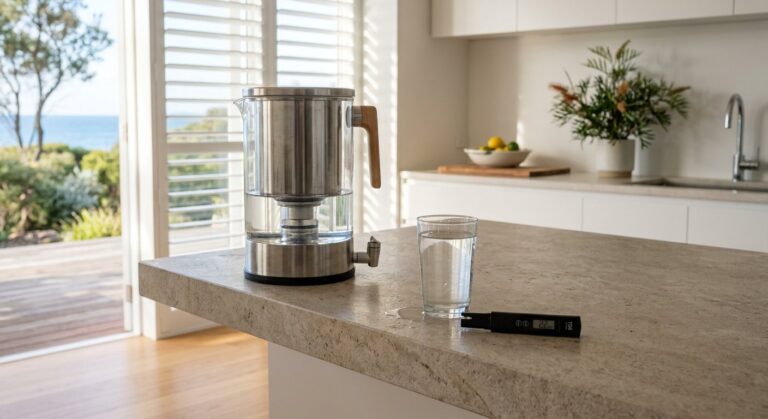
The EcoHero 5-stage system tested in this house reduced TDS from 69 ppm (Palm Beach tap) to 3 ppm post-filter — a 95.7% reduction confirmed by measurement. NSF 58 certified fluoride removal is 93.6%. These are instrument-verified figures, not marketing claims.
What RO removes — NSF 58 certified EcoHero figures
Frequently asked questions
Is Australian tap water fluoride safe?
Based on the most directly relevant Australian research (UQ 2024, 357 participants), yes. The international studies showing harm are primarily from higher exposure levels in developing countries. NHMRC maintains its safety position.
What did the JAMA 2025 study find?
Inverse association across 74 studies, strongest at exposures above Australian levels. Studies from countries with controlled water at Australian concentrations showed no effect.
Does RO remove fluoride?
Yes — 90-98% removal. NSF 58 certified. Standard carbon filters do not.
How to reduce fluoride in your drinking water
Regardless of where the fluoride research lands for your household, reverse osmosis is the only independently certified household technology that reliably removes fluoride from Australian tap water. The mechanism is physical — Donnan exclusion at the RO membrane rejects fluoride ions (F⁻) into the drain stream. NSF 58 certification independently verifies removal rates greater than 96%.
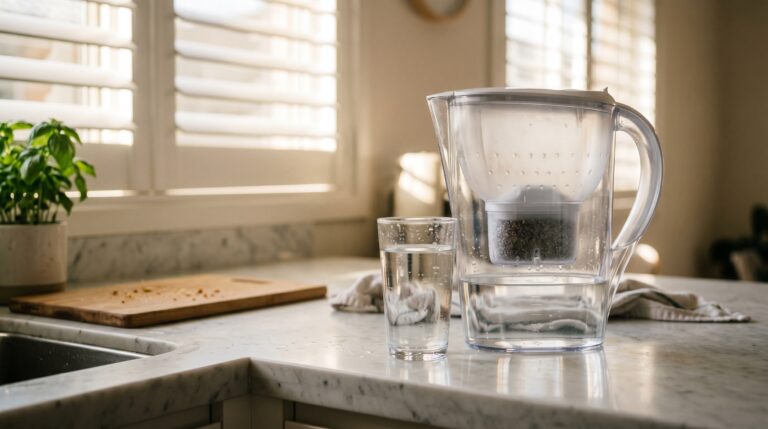
Carbon block filters, Brita pitchers, and ceramic filters do not remove fluoride. For the full explanation of why, see our guide: does reverse osmosis remove fluoride.
No-plumbing: AquaTru Classic
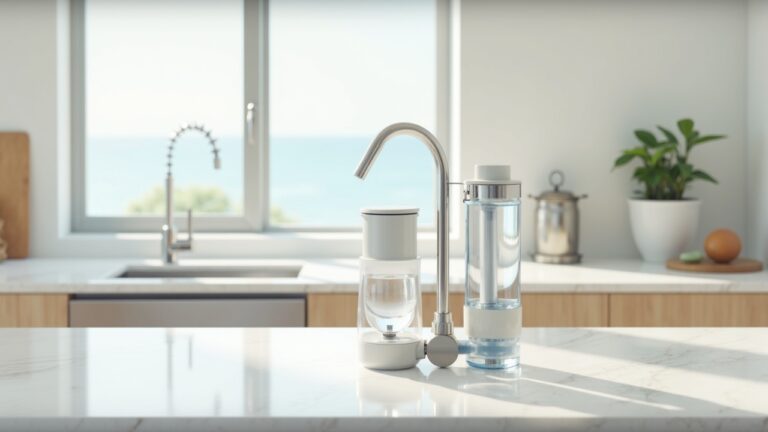
4-stage countertop RO. NSF 58 + 401 certified. Removes fluoride (>96%), PFAS (>99%), lead, chloramine. No plumbing modification — suitable for renters. Tank holds 3.3L. Available on Amazon AU with Prime delivery.
AquaTru Classic — best for renters and homeowners
Under-sink: EcoHero 5-Stage RO
WaterMark certified under-sink RO. 190L/day production. Permanent installation with dedicated tap. Removes fluoride alongside PFAS, lead, chloramine, and microplastics. Suitable for larger households wanting on-demand RO water.
EcoHero 5-Stage — for homeowners wanting permanent install
For a full comparison of fluoride levels across Australian cities, see our fluoride removal guide. For city-specific water quality data: Brisbane, Sydney, Melbourne, Perth, Adelaide.
Get the Australian Home Environment Checklist
30 checks across water, air and EMF. Most of them free. Ranked by impact.
No spam. Unsubscribe any time.

Former Royal Australian Navy Clearance Diver and TAG-E counter-terrorism operator. Founded Clean and Native to apply the same rigorous thinking to the home environment.
Full biography →