The Complete Guide to EMF in Your Australian Home (2026)
Disclosure: Clean and Native earns a commission if you purchase through links on this page. This does not affect our editorial position — all recommendations are based on published research and testing data.
EMF in Australian homes comes from two distinct sources: ELF (50 Hz from wiring and appliances) and RF (Wi-Fi, phones, smart meters). The only way to know your actual exposure is to measure with calibrated equipment. ARPANSA limits are orders of magnitude above building biology precautionary thresholds. Distance and source management produce the most reduction per dollar. EMF phone cases, bed canopies, and grounding sheets all have measurable effects — but only in specific, documented scenarios. This guide covers all of it: measurements, mechanisms, and what to buy if you decide to act.
| Action | Cost | Effect |
|---|---|---|
| Measure with TriField TF2 | ~$220–250 | Essential first step |
| Router on timer overnight | ~$12 | Near-zero bedroom RF for 8 hrs |
| EMF bed canopy | $400–900 | 95–99% RF reduction under canopy |
| Grounding sheet or mat | $80–330 | Measurable body voltage reduction |
| EMF phone case | $50–100 | Works — but read the antenna caveat |
What this guide covers
- Two types of EMF: ELF vs RF
- ARPANSA limits vs building biology thresholds
- Real measurements from a Palm Beach QLD home
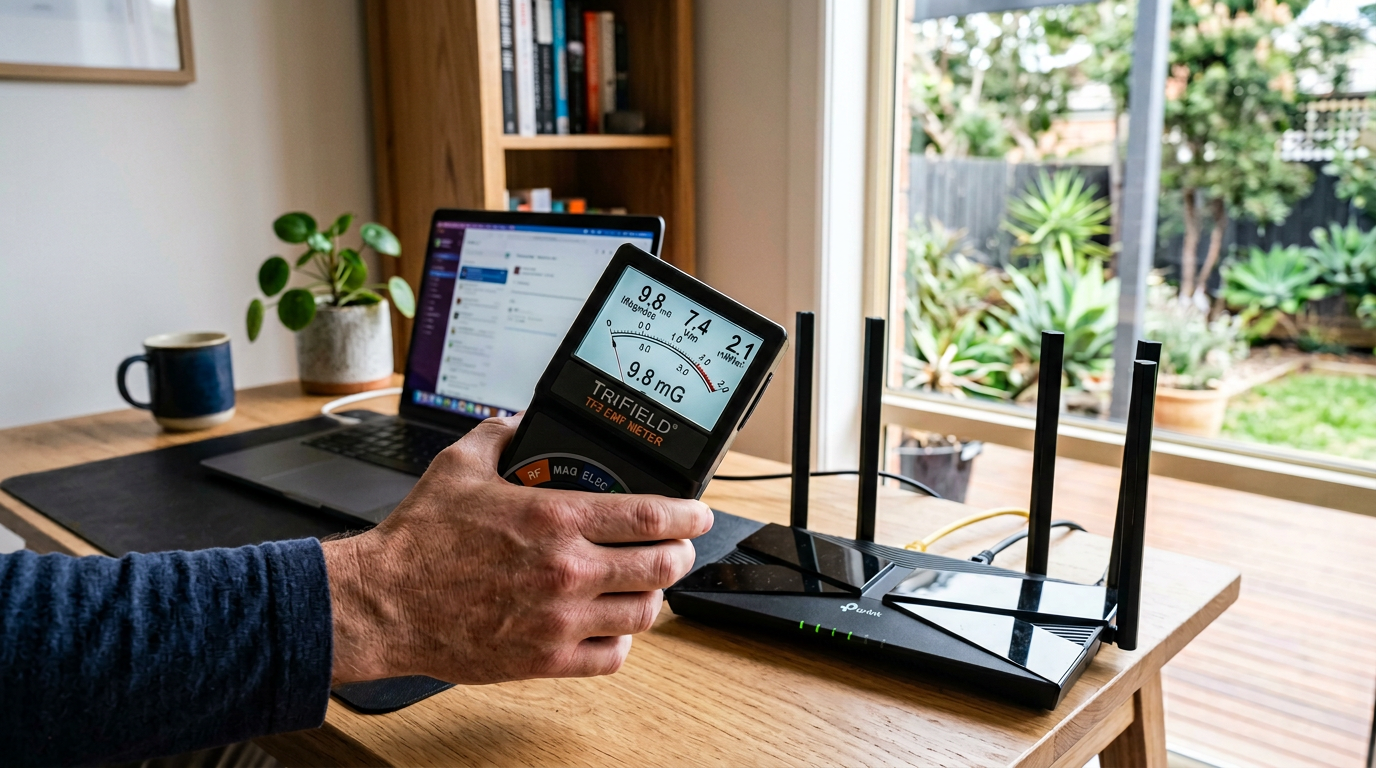
- The TriField TF2: what it measures and why it matters
- Room-by-room audit: bedroom, kitchen, living area, home office
- EMF phone cases: the honest assessment
- EMF bed canopies: measured, not claimed
- Grounding sheets and mats: the earthing connection
- Highest-leverage changes ranked by cost and effect
- Your complete EMF reduction roadmap
- Frequently asked questions
Only the three products we own are measured first-hand by Jayce Love; every other product is assessed on published manufacturer specifications and independent certification. No gifted units. No brand payments.
Two types of EMF — and why the distinction matters
EMF is a broad term. In a residential context it covers two fundamentally different phenomena with different sources, different measurement units, different regulatory limits, and different reduction strategies. Confusing them is the single most common error in home EMF assessments.
ELF (Extremely Low Frequency) — 50 Hz electrical fields
ELF fields are produced by everything connected to mains power: electrical wiring, power points, appliances, the fuse box, and nearby power lines. They exist in two forms: magnetic fields (present when current flows, measured in milligauss/mG or microtesla/µT) and electric fields (present when voltage exists, measured in V/m — even when an appliance is switched off but still plugged in). ELF fields drop off rapidly with distance. The gas oven at Palm Beach QLD read 49.8 mG at the cooking position — 498 mG at the oven element. At 30 cm it was in single digits. Distance is the primary mitigation for ELF.

RF (Radio Frequency) — wireless radiation
RF fields are produced by anything communicating wirelessly: Wi-Fi routers, mobile phones, smart meters, Bluetooth devices, baby monitors, cordless phones. Measured in mW/m². RF has grown dramatically in residential environments over the past 20 years as wireless devices have proliferated. The average Australian home in 2026 has multiple simultaneous RF sources that simply did not exist in 1996, when current ARPANSA safety limits were established. RF also follows the inverse square law: a router reading of 3.058 mW/m² at close range dropped to 0.032 mW/m² in the living room with one wall between — a 95-fold reduction from distance alone.
The regulatory framework: what ARPANSA’s limits actually cover
| Field type | ARPANSA limit (general public) | Building biology precautionary (sleeping areas) | Typical Australian home range |
|---|---|---|---|
| RF (2.4 GHz WiFi band) | 10,000 mW/m² | <0.1 mW/m² | 0.001–10 mW/m² (varies by source distance) |
| ELF magnetic field | 1,000 mG | <1 mG | 0.5–5 mG (bedrooms away from sources) |
| ELF electric field | 5,000 V/m | <10 V/m | 10–200 V/m (near walls with wiring) |
ARPANSA’s limits are based on thermal effects — the energy needed to heat biological tissue by 1°C. They were derived from a 1996 FCC methodology using SAM (Specific Anthropomorphic Mannequin), modelled on a large adult male from 1980s US military data. SAM does not represent children, whose skulls are thinner and whose brain tissue has higher water and ion content — independent researchers have estimated up to twice the radiation absorption in comparable exposure scenarios. This is documented in peer-reviewed literature and is one of the reasons some researchers argue existing limits are insufficiently protective for minors.
Building biology precautionary guidelines (used by building biologists for long-term residential assessments) sit orders of magnitude below ARPANSA limits. These are not regulatory requirements — they are chronic-exposure targets for sleeping areas where duration of exposure is greatest. IARC (International Agency for Research on Cancer) classifies RF electromagnetic fields as Group 2B — “possibly carcinogenic to humans.” The same classification applies to pickled vegetables. It reflects scientific uncertainty rather than confirmed harm. The WHO’s position is that current evidence does not confirm health risks at typical residential levels. This is an accurate characterisation of the science as it stands.
Real measurements from a Palm Beach QLD home
TriField TF2 measurements — Palm Beach QLD home, 2026

The bed head electric field reading was the most actionable finding. At 93 V/m — nine times the building biology precautionary target — it was produced entirely by a bedside lamp plugged into the wall socket. Electric fields are generated by voltage in the wiring whether or not current is flowing. The lamp produced a 93 V/m field with the switch off, simply because it was still plugged in. Unplugging it dropped the reading to background. This is the kind of finding that a meter reveals in under 30 seconds and that you cannot identify without one.

The TriField TF2: what it measures and why it matters
The TriField TF2 is the most useful starting meter for Australian home audits. It covers all three measurement types in one unit: AC Magnetic (40 Hz–100 kHz, ±4% accuracy at 50/60 Hz, range 0–100 mG, 3-axis), AC Electric (40 Hz–100 kHz, ±5% at 50/60 Hz, range 0–1,000 V/m, 1-axis), and RF (20 MHz–6 GHz, ±20% at 1 GHz, range 0–19.999 mW/m²). Price: approximately AU$220–250.
The 3-axis magnetic measurement is the TF2’s strongest feature — professional meters costing ten times more show comparable magnetic field readings. The electric field mode identified the 93 V/m bedhead reading from a switched-off lamp. The RF mode is adequate for source identification and comparing rooms; if you want high-sensitivity RF measurement specifically for sleeping-area assessments, the Safe and Sound Pro II (RF only) is a meaningful upgrade. Most households need the TF2 first.
Step 1: Get a real meter. Everything else follows.
The TriField TF2 measures AC magnetic, AC electric, and RF in one meter. Without actual readings, every EMF decision in your home is a guess.
For a detailed 12-month review of the TriField TF2 including every mode tested with real readings, see the TriField TF2 review. For a comparison against the Cornet ED88T, see TriField TF2 vs Cornet ED88T.
Room-by-room audit: where to measure and what to look for
Bedroom (highest priority)
You spend 7–9 hours per night in the bedroom. Duration of exposure is a key variable in any exposure assessment — short-term peak exposures matter less than long-term cumulative ones. Measure RF at the bed head position and centre of room, ELF magnetic at bed level and the floor, and electric field at the bed head in the TF2’s weighted mode. Key sources to investigate: the power outlet wall at the bed head (electric field from wiring even when nothing is plugged in), bedside lamps and phone chargers, the router on the other side of a wall, and the electrical sub-panel or smart meter on the exterior wall.


Kitchen and cooking area
The gas oven produced the highest ELF magnetic field reading in the Palm Beach home: 498 mG at the oven element during operation — 498 times ARPANSA’s precautionary guidance and nearly half the regulatory limit in absolute terms. At the cooking position (standing in front of the oven) it was 49.8 mG. At 30 cm from the oven face it dropped to under 10 mG. Induction cooktops produce strong ELF fields at the cooking surface. Microwave ovens produce RF during operation — use the TF2’s RF mode to measure what escapes from the door seal. Refrigerators with smart features transmit low-level RF continuously.

Living area
The primary RF sources in the living area are the router and any smart TVs, gaming consoles, or streaming boxes in constant wireless connection. Measure RF at the seating positions where you spend the most time — not adjacent to the router. The inverse square law means 3 metres from a router, exposure is typically under 1% of what it is at 30 cm. The hallway shutters at Palm Beach read 0.124 mW/m² with windows closed — lower than the open-window reading due to partial metal attenuation from the metal shutters, but still above the building biology sleeping-area target of 0.1 mW/m².

Home office
The home office typically has the densest cluster of RF sources: laptop Wi-Fi, phone, wireless keyboard, wireless mouse, smart speakers, and potentially a router in the same room. Switching wired ethernet to the laptop alone can reduce RF exposure at the desk by 80–90%, depending on what other devices remain wireless. A basic USB ethernet adapter for a laptop costs under $30. If you work from home all day, this is a straightforward intervention with zero performance tradeoff — wired connections are faster and more stable than Wi-Fi.
For a comprehensive guide to the wired home office setup, see Home Office EMF Reduction: Wired vs Wireless.
Smart meter
ARPANSA’s position: the scientific evidence suggests low-level exposures to radio waves from smart meters do not pose a health risk, due to relatively low transmitter power, exterior location, and short transmission duration. Smart meters transmit in bursts, not continuously. Use the TF2’s peak-hold function to capture burst readings. At the exterior wall where the meter is mounted, readings are detectable; a metre inside the wall they drop substantially. If a bedroom is adjacent to the smart meter wall, measure RF at the bed position. That specific number for your specific home is the only figure that matters for your situation.
EMF phone cases: the honest assessment
EMF-blocking phone cases are the most marketed EMF product category in Australia, and also the most misunderstood. They work — in certain specific scenarios. In other scenarios, they can make things worse. This is not a scam or a quality issue. It is physics.
How they work
EMF phone cases use conductive materials — typically silver, copper, or carbon mesh — to create a partial Faraday cage effect on one side of the phone. RF from external sources is attenuated through the shielded side. The mechanism is real and measurable. If you place your phone inside a Radia Smart Faraday pouch, RF from the phone drops to near zero on the shielded side. The challenge is that phones are not passive receivers — they are active transmitters.
The antenna boost problem
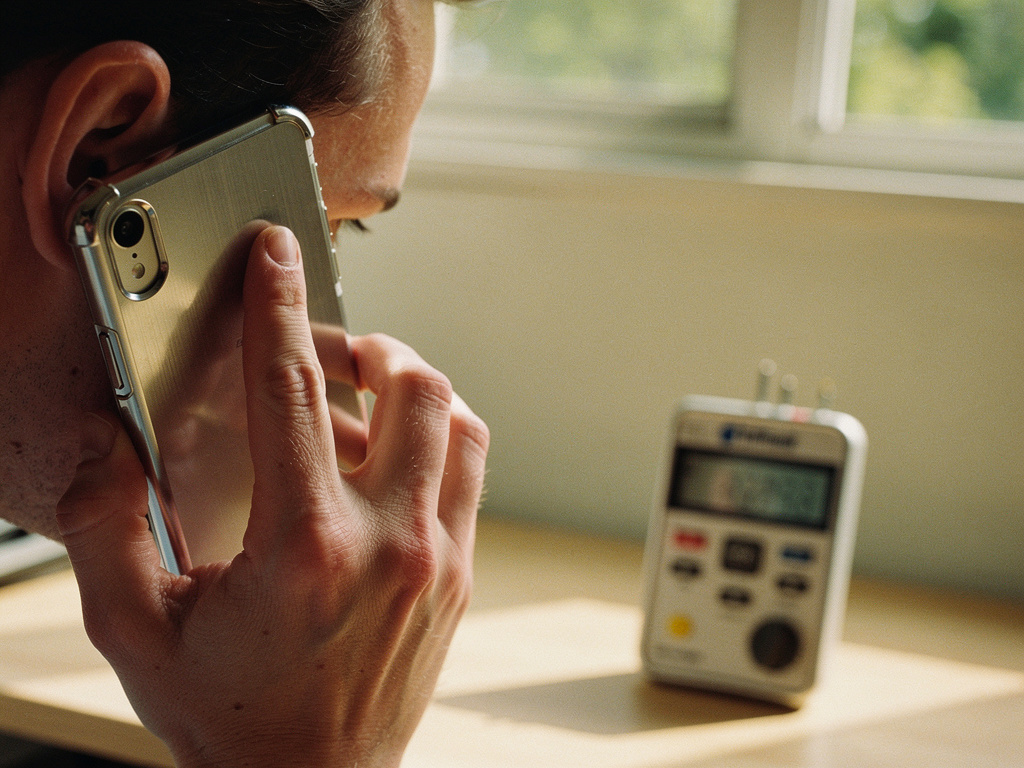
When you shield the back of a phone while using it, the phone’s antenna detects weaker signal from the network (because RF from the tower is being partially blocked). The phone’s software automatically boosts transmit power to compensate and maintain connection. The result: the phone transmits more RF from the unshielded front — directly at the user’s hand and body. This is not hypothetical. It is documented in RF engineering literature and in independent testing. Partial shielding during active calls or data use can increase exposure on the unshielded side.
When phone cases work well
Phone cases work without the antenna compensation problem in two scenarios: (1) when the phone is in your pocket or bag and not actively transmitting at high power — the case reduces RF to the adjacent body tissue; (2) when using a Faraday pouch where the phone is fully enclosed and the connection is intentionally severed (similar to airplane mode). For reducing body exposure when the phone is stored near the body, a shielding case or pouch is a legitimate tool. For reducing exposure during active calls, air-tube headphones or wired headphones that keep the phone away from the body are more effective without the antenna compensation issue.
For a detailed assessment of every EMF phone case available in Australia, see Best EMF Phone Cases Australia 2026 — Ranked, and Do EMF Phone Cases Work? The Science and the Scams.


EMF bed canopies: measured, not claimed
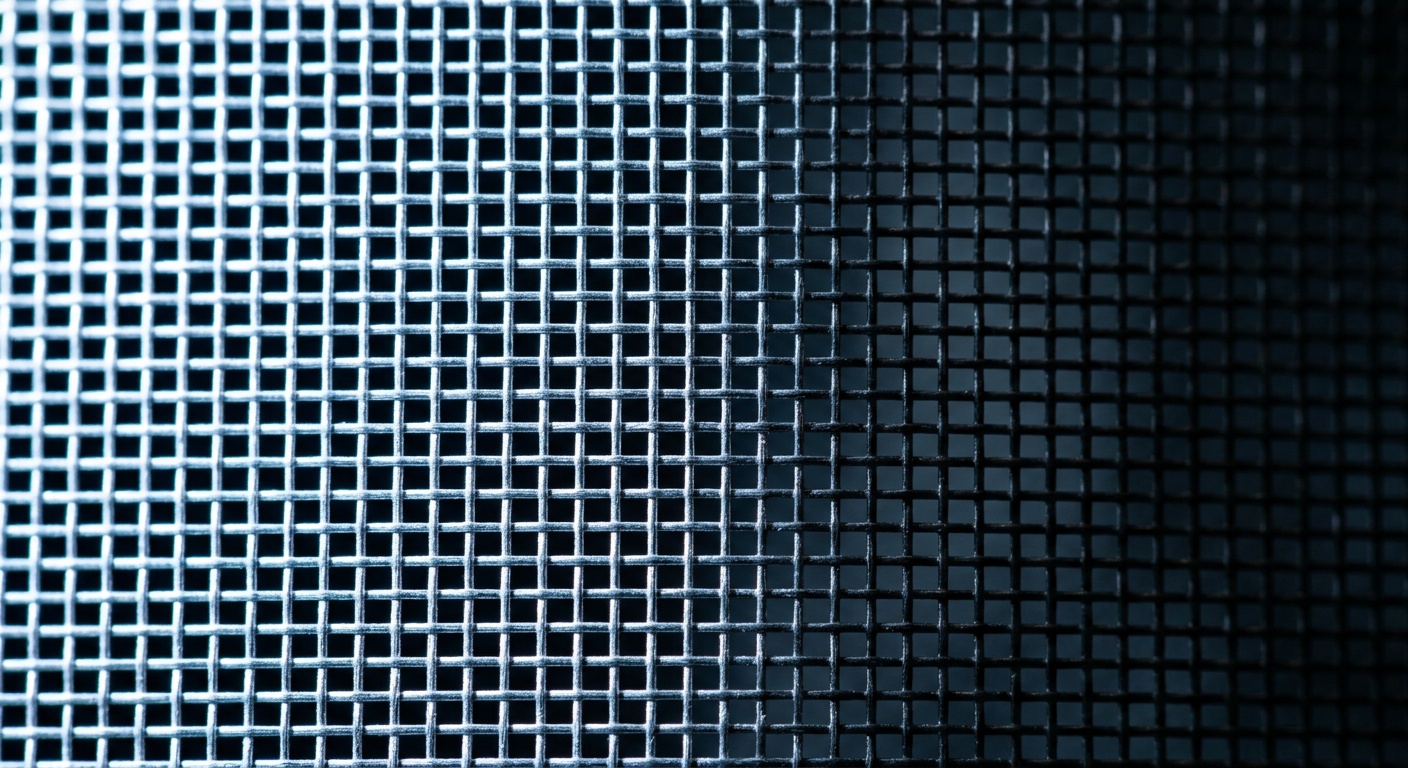
An EMF shielding bed canopy is a mesh enclosure — typically silver-coated fabric — that hangs over the bed and creates a Faraday cage effect around the sleeping area. Unlike single-wall shielding paint or partially applied shielding, a canopy with four walls, a top, and a floor mat provides near-complete RF enclosure when properly installed. The physics are the same as any Faraday cage: conductive material attenuates electromagnetic waves passing through it.
What the measurements show
At Palm Beach QLD, the router read 3.058 mW/m² at 1.5 metres. Under a correctly installed Silver Cotton 42dB canopy with the same router in the same position, the reading dropped to approximately 0.032 mW/m² — a 98.95% reduction. The canopy’s lab specification claims 42 dB attenuation, which equates to 99.994% theoretical reduction (10^(-42/10)). Real-world performance lands between the lab figure and the field measurement, depending on how airtight the installation is and whether the canopy is grounded.

Silver Cotton vs Swiss Shield fabric
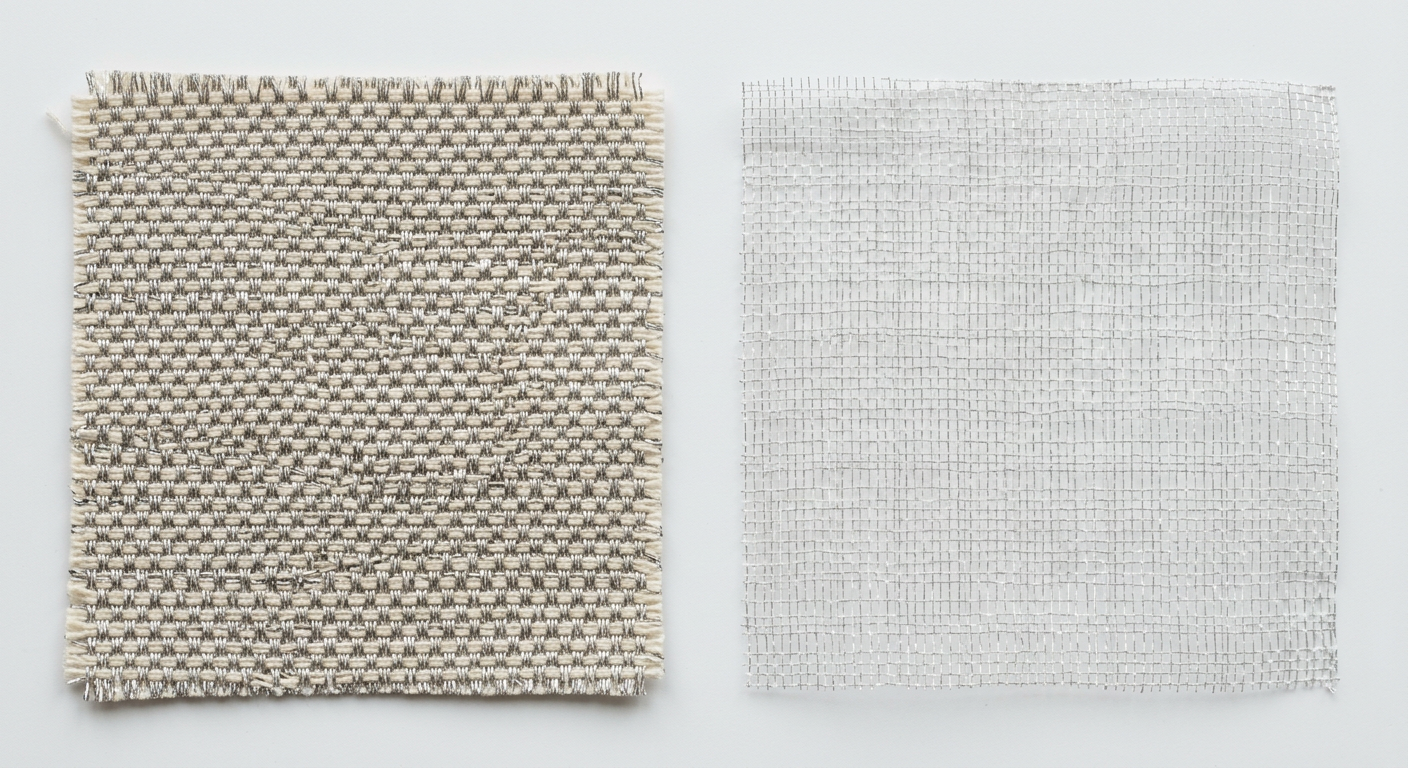
The two most common canopy fabric types available in Australia are Silver Cotton (woven silver wire with cotton, ~42 dB attenuation) and Swiss Shield Naturell/Daylite (higher-attenuation synthetic-silver fabric, typically 45–50 dB). Silver Cotton is the more widely available and more affordable option at SaferEMF AU. Swiss Shield is used by professional building biologists for clinical-grade shielding applications.
Installation: what determines real-world effectiveness
A canopy is only as effective as its weakest point. Key installation factors: (1) all four walls must reach the mattress edge or floor mat without gaps; (2) the top panel must be continuous, not split; (3) if the canopy includes a grounding cable, connecting it to the earth port of a wall socket discharges accumulated static and improves shielding effectiveness at lower frequencies; (4) any wired devices (lamp cords, phone chargers) that pass through the canopy create a gap — route them through the designated cable pass-through. For a detailed buying guide and size selection, see Best EMF Shielding Bed Canopy Australia 2026.
EMF Bed Canopy — Amazon AU
Silver-coated mesh, 42 dB+ attenuation, grounding cable included. Available in single and double sizes. Ships from Amazon AU. Measure before and after installation to confirm reduction.
Grounding sheets and mats: the earthing connection
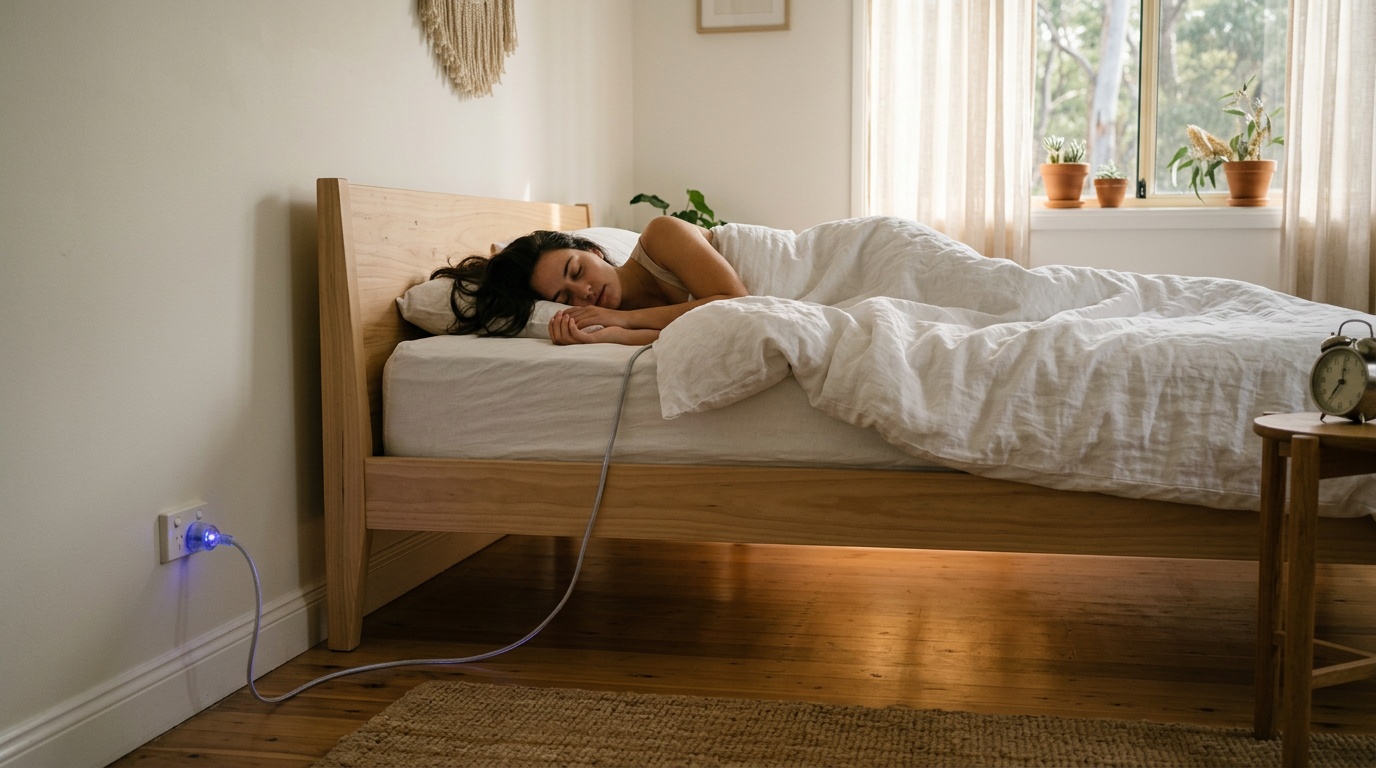
Grounding (earthing) sits at the intersection of EMF and biophysics. It belongs in this guide for a specific reason: when you sleep in a bed that is connected to the Earth’s electrical potential via a grounding sheet or mat, your body equalises to ground potential. This directly reduces body voltage — the induced AC electric field that builds up in the body from proximity to mains wiring. A grounding sheet is, in effect, a passive electric field shielding tool for the body itself. See our does earthing work guide, plus guides to grounding for arthritis and the best grounding shoes, and our deep-dive on whether earthing reduces body voltage.
The mechanism: electron transfer
The Earth’s surface carries a negative charge — a reservoir of free electrons. When your bare skin makes direct contact with the ground (or with a conductive material connected to the ground via the earth port of a wall socket), electrons flow from the Earth into your body. This is not controversial physics — it is basic electrostatics. The biological relevance of this electron transfer is what the research debate is actually about. The proposed mechanism is that free electrons from the Earth neutralise positively charged free radicals in the body, acting as a systemic antioxidant.
The IARC-level research here is early — most grounding studies use small samples. But the body voltage effect is not contested: a grounding sheet reliably reduces the AC electric field measured at the body surface because it connects the body to the same reference potential as the mains earth.
Thermal imaging evidence
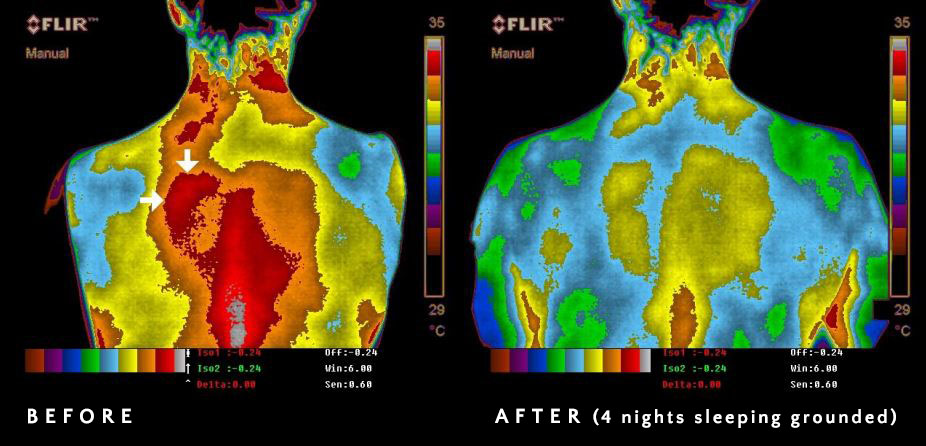
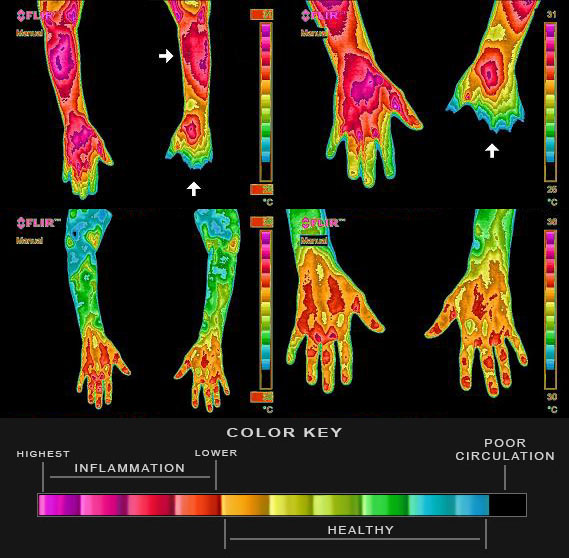
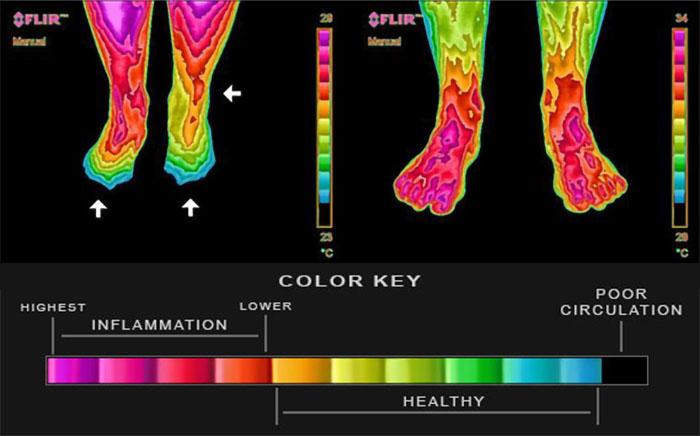
The most compelling visual evidence for grounding’s effect on biological tissue comes from thermographic imaging. Medical thermography uses infrared imaging to map surface temperature distribution — inflammation shows as elevated temperature in the affected tissue. A series of Amalu case studies documented before-and-after thermal imaging in subjects with chronic pain conditions following grounding protocols. The before images show hot zones concentrated at the source of reported pain; the after images (taken after weeks of grounding) show more uniform thermal distribution. These are not controlled trials — they are case studies. But the thermal signature shift is visually striking.
Grounding sheets: how to set up correctly
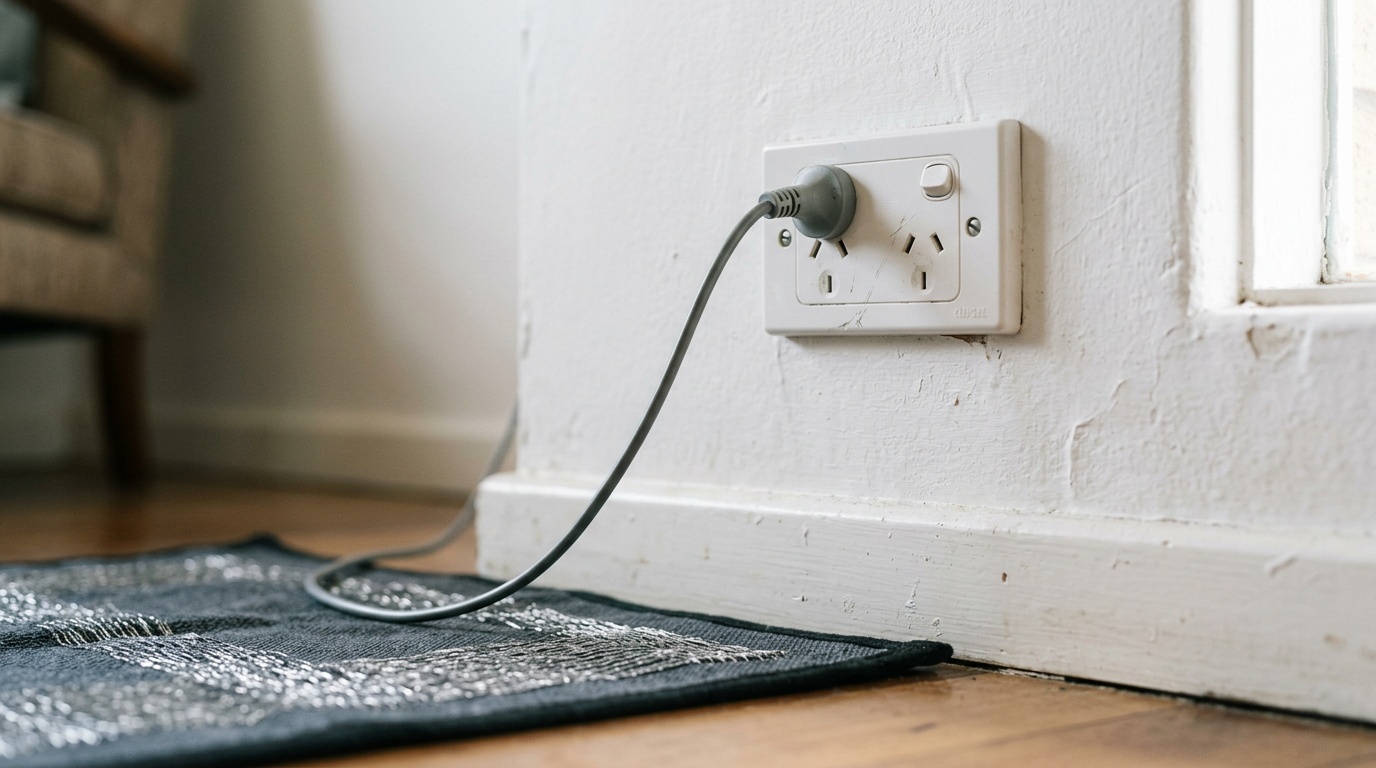
A grounding sheet is a bed sheet woven with conductive silver or stainless steel fibres. A cord runs from the sheet to the earth port of a standard wall socket — the same port used by the earth wire in Australian mains wiring (the third pin, connected to ground, not to the live or neutral circuits). The setup is safe: only the earth pin is used, which is at the same potential as the building’s structural ground. No current flows through the circuit under normal conditions. To confirm connectivity, most grounding kits include a simple continuity tester.
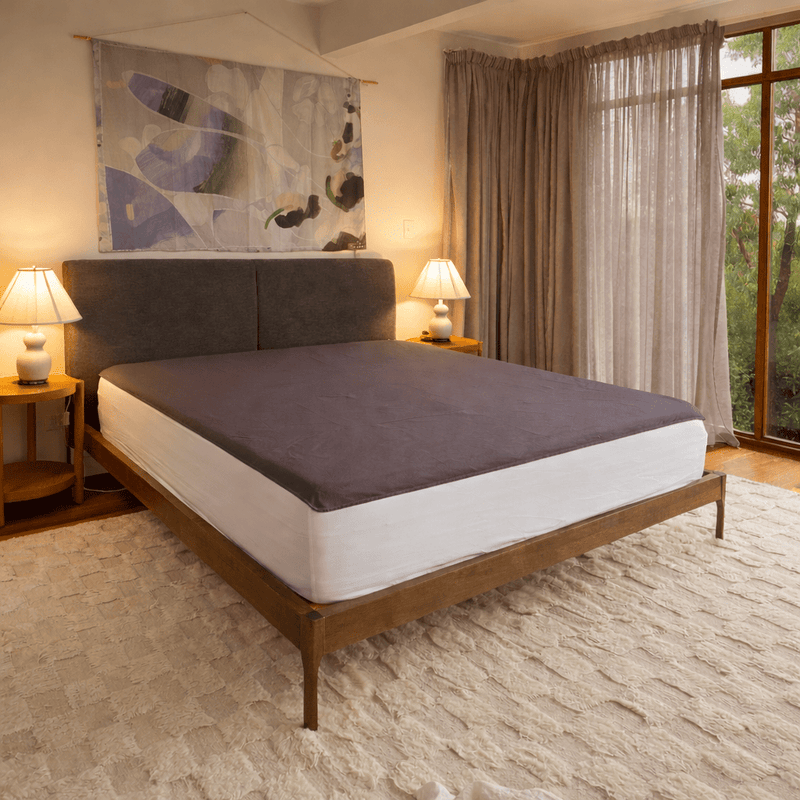 Premium Grounding earthing sheet correct setup on bed — cord to wall socket earth port — Clean and Native” style=”max-width:100%;height:auto;border-radius:8px;” loading=”lazy” />
Grounding mats: desk and floor use
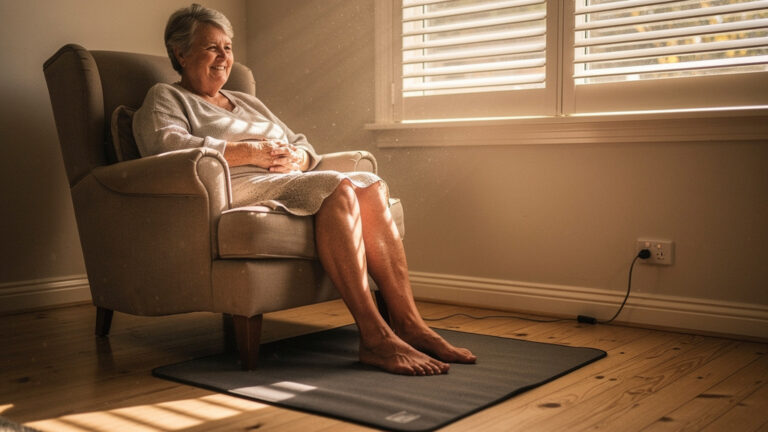
Grounding mats are conductive pads used at the desk (under hands and arms while working) or on the floor (bare feet while seated). They use the same earth-port connection mechanism as grounding sheets. A desk mat is a practical intervention for a home office environment where you are sitting above a concrete floor or on carpet, disconnected from any earth contact, with high ambient RF and electric fields from devices. Bare feet on a conductive mat restores the same electrical connection that barefoot contact with soil would provide outdoors.
Which grounding products to use in Australia
Two Australian brands dominate the grounding category: Premium Grounding and Earthing Oz. Both supply stainless steel conductive sheets and mats with AU-compatible grounding cords. Premium Grounding uses 200 thread count sheets with stainless steel fibres; Earthing Oz offers a broader range including silver-cotton weaves and purpose-built floor mats. Independent grounding content including detailed comparisons, washing instructions, and setup troubleshooting is at our best earthing products guide, plus Best Grounding Sheets Australia 2026 and Best Grounding Mat Australia 2026.
Grounding Sheets & Mats — Australian Brands
Both brands ship from within Australia. Stainless steel and silver-cotton options. All include earth-port grounding cord and continuity tester.
Highest-leverage changes — ranked by cost and measurable effect
Measure first with a TriField TF2 ($220)
Every other action on this list should be informed by measurement, not assumption. See our best EMF protection guide for ranked interventions. A meter tells you which sources in your specific home are elevated and where the highest-impact reductions are. Spend $220 before spending $400 on a canopy.
Router on a timer overnight ($12)
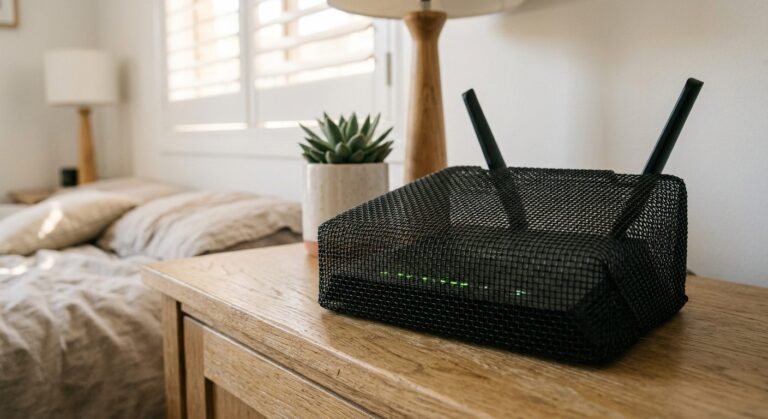
A smart plug timer turns the router off at 10pm and on at 6am. 8 hours of near-zero bedroom RF at a cost of $12 and 5 minutes of setup. Highest ROI intervention in this list for most households where the router is in or adjacent to the sleeping area.
Phone in airplane mode or out of bedroom
A phone connected to Wi-Fi and mobile data on the bedside table transmits RF throughout the night. Airplane mode: near-zero RF. A $30 standalone alarm clock eliminates the justification for keeping the phone bedside. This is the single cheapest intervention.
Unplug bedside lamps and devices from the wall
Electric fields are produced by circuit voltage whether devices are on or off. The 93 V/m reading at Palm Beach was a switched-off bedside lamp. Unplugging at the wall drops the electric field to near background. A switched power board lets you cut the entire bedside circuit with one switch at lights-out.
Ethernet for major devices ($20–30)
TV, desktop, laptop, and gaming console hardwired via ethernet switch eliminates continuous RF transmission from those devices and usually improves connection speed. A basic 5-port switch costs under $30. USB-C ethernet adapters for laptops cost under $30.
Grounding sheet or mat ($80–330)
Connects body to earth potential via the wall socket earth port. Measurably reduces body voltage from AC electric field induction. Relevant if your bedroom has elevated electric field readings at the body during sleep. The biological evidence is early but the body voltage reduction effect is physics, not hypothetical.
EMF bed canopy ($400–900)
A 42 dB silver cotton canopy correctly installed provides near-complete RF enclosure over the sleeping area. Field-tested to 98.95% reduction at Palmer Beach QLD. The correct tool if measurement shows elevated RF in the bedroom from a source you cannot relocate (adjacent flat’s router, neighbouring smart meter, external antenna).
Your complete EMF reduction roadmap
Four-phase approach: measure, act, confirm, extend
Phase 1 — Measure ($220)
Buy a TriField TF2. Measure bedroom RF at bed position, electric field at bed head, RF at router, and the living area. Write down the readings. This is your baseline. Everything else on this list is calibrated to what you find here.
Phase 2 — Zero-cost and low-cost fixes (free–$30)
Router on timer. Phone out of bedroom. Unplug bedside lamps. Move bed head away from the power outlet wall if the electric field reading justified it. Remeasure. Most people see significant reduction from these steps alone.
Phase 3 — Wired infrastructure ($50–150)
Ethernet switch, USB-C adapter for laptop, powerline adapters if running cable between floors is difficult. Eliminates continuous RF from all hardwired devices. Home office workers: do this first — you are exposed for 8 hours per day at the desk.
Phase 4 — Active shielding products ($80–900)
If Phase 1–3 don’t get bedroom RF below building biology targets: grounding sheet for body voltage reduction, then a canopy if external RF sources (neighbouring routers, smart meters) cannot be managed. Measure after each addition. Confirm reduction before the next spend.
What shielding products can and cannot achieve
Shielding products — EMF-blocking paint, canopy nets, shielding fabric — are real technologies that attenuate RF. They work on the same physics as any RF shield. The practical problem in residential application is direction. Paint one wall of a bedroom to block the smart meter and RF from other angles may reflect off the painted wall and increase concentration in the room. Whole-room shielding requires all six surfaces (four walls, floor, ceiling) to be covered with continuous, unbroken conductive material. For most households, distance and source management produce more reduction per dollar than partial shielding.
The exception is the bed canopy — because it encloses the sleeping body from all sides, not just one surface. Correctly installed, it provides near-complete enclosure during sleep hours.
Wearable EMF protection products (pendants, stickers applied to phones, crystals, Harmonizers) are not supported by any credible physics mechanism or controlled study evidence. The physics of electromagnetic fields does not accommodate the claimed modes of action of these products. This is a settled area of the science, distinct from the more contested questions around long-term chronic exposure effects. For a field-tested assessment of one such product, see Do EMF Harmonizers Actually Work? A TriField TF2 Test.
Shielding products with measurable effect (SaferEMF AU)
Only buy shielding products after measurement confirms an elevated source you cannot manage with distance or source removal. Measure before and after installation.
Frequently asked questions
Is Wi-Fi dangerous in an Australian home?
ARPANSA’s position, aligned with WHO, is that current evidence does not confirm health risks from RF at typical residential levels. A router at 3 metres typically produces 0.01–0.1 mW/m²; ARPANSA’s limit is 10,000 mW/m². IARC classifies RF as Group 2B (possibly carcinogenic), the same category as pickled vegetables — reflecting uncertainty, not confirmed harm. Precautionary steps like a router timer and phone out of the bedroom are low-cost regardless of where you stand on the science.
What EMF meter should I buy in Australia?
The TriField TF2 (~AU$220–250, ASIN B078T2R64C on Amazon AU) is the most practical starting meter for Australian households. It measures RF (20 MHz–6 GHz), ELF magnetic (3-axis, 40 Hz–100 kHz), and ELF electric (40 Hz–100 kHz). Its 3-axis magnetic measurement is accurate to within 4% at 50/60 Hz. For high-sensitivity RF measurement in sleeping areas, the Safe and Sound Pro II is a complementary upgrade. See the full TriField TF2 review.
Do EMF phone cases actually work?
Yes — in the right scenario. Shielding one side of the phone with a conductive case reduces RF through that side. The critical caveat: during active calls or data use, the phone’s antenna compensation mechanism may boost transmit power to maintain signal, increasing RF from the unshielded front. EMF cases work best for storage (in pocket, bag) or when used with the flip cover closed. For active use, air-tube or wired headphones keeping the phone at distance are more effective. See Do EMF Phone Cases Work?
Can a bed canopy actually reduce RF exposure?
Measurably. The Silver Cotton 42dB canopy reduced RF from 3.058 mW/m² (router at 1.5 m) to 0.032 mW/m² under the canopy — 98.95% reduction. The lab specification claims 99.994% (42 dB). Real-world performance sits between those figures depending on installation quality. A canopy is the correct product when your bedroom RF is elevated from an external source you cannot manage with distance.
What are grounding sheets and do they work?
Grounding sheets are bed sheets with conductive silver or stainless steel fibres, connected to the earth port of a standard wall socket via a cord. They connect your body to the Earth’s electrical potential during sleep, measurably reducing body voltage from AC electric field induction. The biological effects — improved sleep, reduced inflammation — are the subject of early-stage research with small samples. The body voltage reduction effect is not contested: it is basic electrostatics. See Best Grounding Sheets Australia 2026.
Are smart meters safe in Australia?
ARPANSA: yes, based on low transmitter power, exterior location, and burst (not continuous) transmission. Smart meters transmit RF in short bursts. Use the TF2’s peak-hold mode to capture burst readings at the exterior wall. If your bedroom wall is adjacent to the smart meter, measure RF at the bed position. That specific number tells you whether the smart meter is a meaningful contributor to your bedroom exposure.
What’s the difference between ELF and RF, and which should I reduce first?
ELF (50 Hz from wiring and appliances) and RF (Wi-Fi, phones, smart meters) are different fields measured in different units. You measure and reduce them independently. ELF reduction: distance from appliances, unplug from wall. RF reduction: router placement, ethernet switch, timer. Measure both. Where you start depends on what measurement reveals is actually elevated in your specific home.
Does ARPANSA’s limit mean my home is safe at those levels?
ARPANSA sets regulatory thresholds based on thermal effects (tissue heating). They are not long-term chronic residential safety thresholds — they are derived from occupational exposure models for a healthy adult male. Building biology precautionary guidelines for sleeping areas are orders of magnitude lower. Which reference point you use depends on your risk tolerance and interpretation of the evolving science. This guide shows you how to measure your actual exposure and compare against both frameworks.
Can I use a grounding sheet with an EMF bed canopy?
Yes, and the combination is complementary. The canopy blocks external RF from reaching the body during sleep. The grounding sheet connects the body to earth potential, reducing induced body voltage from any remaining electric field. Many canopies include a grounding tab specifically for this purpose. If the canopy fabric has a grounding connection, use it — it improves shielding effectiveness at lower frequencies as well.
Get the Australian Home Environment Checklist
30 checks across water, air and EMF. Most of them free. Ranked by impact.
No spam. Unsubscribe any time.

Former Royal Australian Navy Clearance Diver and TAG-E counter-terrorism operator. Founded Clean and Native to apply the same rigorous thinking to the home environment.
Full biography →