Does Reverse Osmosis Remove Fluoride? What Australian Households Need to Know
Drafted with AI assistance and checked against published specifications and certifications. First-hand measurements appear only where stated. How we make content
Affiliate disclosure: Clean and Native earns a commission if you purchase through links on this page. This does not affect our editorial position — all recommendations are based on published specs, independent test data, and certification.
Reverse osmosis removes fluoride at greater than 96% efficiency via 0.0001-micron membrane size exclusion and ionic charge repulsion. All Australian capital cities artificially fluoridate tap water; standard carbon filters (Brita, TAPP, most benchtops) do not remove fluoride. The catches: RO systems waste 3–4 litres per litre produced, require membrane replacement every 2–3 years, and countertop models need daily refilling for families.
| Technology | Fluoride Removal | Verdict |
|---|---|---|
| Reverse Osmosis | 96–99% (NSF 58) | Recommended |
| Activated Carbon | 0% (not designed for ions) | Ineffective for fluoride |
| Activated Alumina | 85–95% (Berkey PF-2) | Works but not NSF-rated AU |
Quick answer
The three products we own are measured first-hand by Jayce Love, former Royal Australian Navy Clearance Diver; every other product is assessed on published manufacturer specifications and independent certification using our documented methodology — no gifted units, no brand payments.
Yes. Reverse osmosis removes fluoride at greater than 96% efficiency. The RO membrane at 0.0001 microns physically excludes fluoride ions via size exclusion and ionic charge repulsion — fluoride is rejected into the drain stream, not the output water. By contrast, activated carbon filters (Brita, TAPP, ZeroWater’s carbon stage, most countertop systems) do not remove fluoride. The only household technologies that reliably remove fluoride are: reverse osmosis, distillation, and activated alumina (used in Berkey PF-2 filters — effective but not independently NSF-certified for fluoride removal in Australia). All Australian capital cities artificially fluoridate their water. The AquaTru Classic (NSF 58 + 401 certified, tested >96% fluoride removal) is the most accessible RO option for Australian households — no plumbing required.
Fluoride in Australian tap water — the regulatory context
All five Australian capital cities add fluoride to their drinking water under state and territory public health legislation. Fluoridation was introduced progressively from the 1960s (Queensland held out until 2008). The National Health and Medical Research Council (NHMRC) recommends fluoridation at 0.6–1.1 mg/L as a safe and effective caries-prevention measure. The Australian Drinking Water Guidelines (ADWG) set a health guideline of 1.5 mg/L — the level below which long-term consumption is considered safe by Australian authorities.
Fluoride at these concentrations is measurable, regulated, and intentional. If you choose to reduce your fluoride intake from tap water — whether for personal preference, infant formula preparation, concerns about dental fluorosis in children, or thyroid health considerations — reverse osmosis is the most practical and verified household method available.
Fluoride levels across Australian capital cities (2023–2024 data)
| City | Fluoride level | Utility | Notes |
|---|---|---|---|
| Sydney | Target 1.0 mg/L (range 0.90–1.50 mg/L) | Sydney Water | Highest target of any capital. NSW Code requires >95% of samples within range. |
| Melbourne | 0.7–1.2 mg/L target; optimum 0.9 mg/L | Melbourne Water | Victorian Fluoridation Act 2004. Added post-filtration at treatment. |
| Brisbane / SEQ | 0.6–0.8 mg/L target | Seqwater / Urban Utilities | Queensland fluoridation introduced 2008 under the Fluoridation of Public Water Supplies Act. |
| Perth | Target 0.9 mg/L; actual average ~0.75 mg/L | Water Corporation | WA Department of Health direction. Actual average slightly below target. |
| Adelaide | ~0.56 mg/L average; max 0.70 mg/L across 12 supply zones | SA Water | Lowest of any Australian capital despite artificial fluoridation — River Murray dilution effect across multiple zones. |
Source: Utility annual drinking water quality reports 2023–24; Urban Utilities, Sydney Water, Melbourne Water, Water Corporation, SA Water.
The science: why RO removes fluoride and carbon filters don’t
Understanding why requires distinguishing between two fundamentally different filtration mechanisms: physical exclusion and chemical adsorption.
Carbon filtration (adsorption): Activated carbon works by attracting and binding contaminants to its surface through van der Waals forces and electrostatic interaction. This mechanism is highly effective for organic compounds, chlorine, chloramine, and many volatile organic compounds (VOCs). However, fluoride is a small, negatively charged inorganic ion (F⁻). It does not bind readily to the carbon surface because carbon adsorption favours larger organic molecules and non-polar compounds. Fluoride essentially passes straight through a carbon filter. This applies to granular activated carbon (GAC), carbon block, and catalytic carbon — none reliably remove fluoride.
Reverse osmosis (physical exclusion + ionic rejection): RO membranes have pore sizes of approximately 0.0001 microns — 0.1 nanometres. A fluoride ion (F⁻) has an ionic radius of approximately 0.133 nanometres. At this scale, size exclusion alone does not fully explain RO’s fluoride removal. The dominant mechanism is Donnan exclusion: RO membranes carry a slight negative surface charge, which repels negatively charged ions (including fluoride, nitrate, and sulphate) through electrostatic repulsion. These rejected ions are concentrated in the reject water stream and sent to drain, not to the output tap. NSF 58 certification testing independently verifies this removal at greater than 96% efficiency for certified systems.
Why this matters practically: If a product claims to “filter” water but uses only carbon or ceramic media, it will not remove fluoride regardless of how fine the filter pore size is. Only RO membranes, distillation, and ion-exchange systems specifically designed for fluoride (activated alumina, bone char) address fluoride.
Which household filters remove fluoride — and which don’t
| Filter technology | Fluoride removal | Mechanism | Certification |
|---|---|---|---|
| Reverse osmosis (RO) | >96% removal | Donnan exclusion + size exclusion at RO membrane | NSF 58 — independently verified fluoride reduction claim |
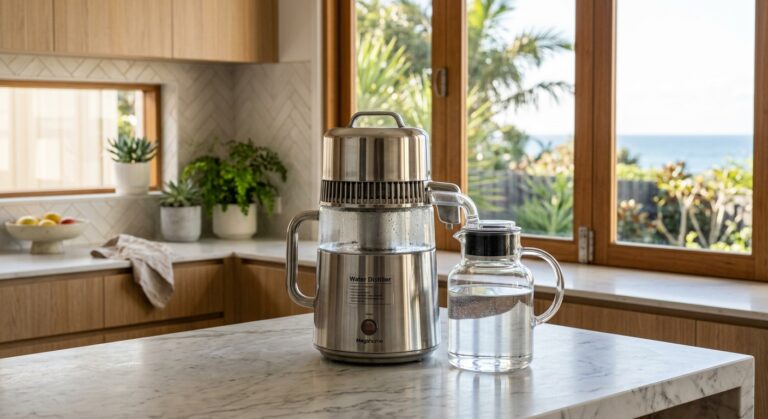
| Distillation | >99% removal | Fluoride does not volatilise with steam; stays in boiling chamber | No specific NSF standard; mechanism is thermodynamically verified |
| Activated alumina (Berkey PF-2) | Effective but variable (60–90%+) | Adsorption to aluminium oxide surface (pH-dependent) | Not NSF-certified in Australia. Berkey’s own lab data available but independent AU verification lacking. |
| Activated carbon / carbon block | Not effective | Adsorption (organic-affinity; fluoride ions do not bind) | No NSF fluoride certification possible for carbon-only systems |
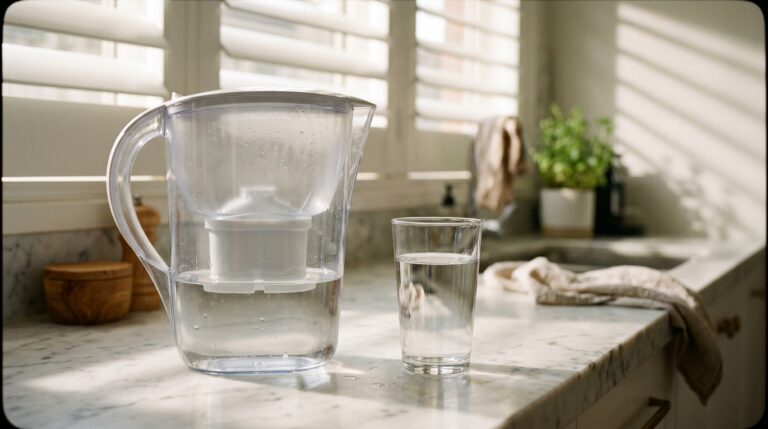
| Pitcher filters (Brita, PUR, standard) | Does not remove fluoride | GAC + ion exchange (ion exchange targets hardness ions, not fluoride) | No fluoride certification. Some pitchers claim fluoride removal — verify NSF 58 certification before purchasing. |
| Ceramic filters | Does not remove fluoride | Physical particle filtration only | Ceramic media has no fluoride removal capacity |
| Countertop RO (AquaTru) | >96% (NSF tested) | RO membrane (same mechanism as under-sink RO) | NSF 58 + 401. Independent lab verification. No plumbing required. |
The Berkey + PF-2 situation — what you need to know
Berkey gravity filters are popular in Australia, and the company sells PF-2 fluoride reduction elements as add-ons to their standard Black Berkey carbon filters. Activated alumina (the medium in PF-2 filters) does adsorb fluoride — this is a real mechanism used in municipal water treatment. However, several important caveats apply to the PF-2 specifically:
- No independent NSF certification in Australia. Berkey is not NSF-certified for fluoride reduction. Their fluoride reduction claims are based on their own laboratory testing, not independent third-party certification. NSF 58 certification requires independent lab verification at multiple pH levels and flow rates.
- pH dependence. Activated alumina fluoride removal is significantly pH-dependent, performing best at pH 5.5–6.5. Australian tap water typically runs at pH 7.5–8.0 — above the optimal range for activated alumina. Removal efficiency at these pH levels is lower than manufacturer claims based on optimal-conditions testing.
- Capacity and saturation. PF-2 filters have a finite fluoride adsorption capacity. As they saturate, removal efficiency drops — and unlike RO (where you can verify performance with a TDS meter), there is no easy way to confirm a PF-2 filter is still performing without fluoride-specific testing.
For households specifically targeting fluoride reduction with independent verification, NSF 58-certified reverse osmosis is the more defensible choice. Berkey + PF-2 may provide meaningful fluoride reduction, but the lack of independent Australian certification means the performance data is unverified.
How much fluoride does RO actually remove? The NSF test data
NSF 58 certification requires independent laboratory testing of RO systems for reduction of specific contaminants under standardised challenge conditions. For fluoride, the NSF 58 protocol tests systems at a challenge concentration of 8.0 mg/L — significantly higher than any Australian tap water (0.56–1.0 mg/L). Even at this challenge concentration, NSF 58-certified RO systems must demonstrate consistent reduction to below 1.5 mg/L (a greater than 81% reduction minimum). Most certified systems achieve greater than 96% reduction.
Real-world performance on Australian tap water (0.56–1.0 mg/L input) is even better in proportional terms. A system rated at >96% reduction at 8.0 mg/L challenge will typically produce output at less than 0.04 mg/L from a 1.0 mg/L input — a 96%+ reduction to effectively trace levels.
The AquaTru Classic’s NSF 58 certification documents confirm this performance in independent laboratory conditions. The EcoHero 5-Stage RO’s WaterMark certification (which incorporates NSF 58 standards) provides the same assurance for the under-sink format.
Does removing fluoride matter? The health context
This guide is not a position piece on water fluoridation policy. The NHMRC and ADWG consider fluoride at 0.6–1.1 mg/L safe and beneficial. Households may still choose to reduce fluoride intake for various reasons:
- Dental fluorosis in young children: Excessive fluoride intake during tooth development (0–8 years) can cause dental fluorosis — white spots or streaks on permanent teeth. Australian guidelines recommend not using fluoridated water for infant formula if fluoride intake from other sources is already high.
- Infant formula preparation: The NHMRC’s 2017 public statement notes that if using formula exclusively (not breastfeeding), parents may choose to use low-fluoride water. RO water at <0.04 mg/L fits this guidance.
- Personal preference / dietary fluoride load: Households consuming significant dietary fluoride from other sources (fluoride-rich tea, certain foods) may reasonably reduce tap water fluoride as a precautionary measure.
- Thyroid health: Some research suggests fluoride may affect thyroid function at higher exposures; the evidence at Australian tap water levels is inconclusive, but this is a legitimate concern some households weigh.
Whatever the reason, reverse osmosis provides the most reliable, independently certified fluoride reduction available at the household level.
Does RO remove other things alongside fluoride?
Yes — this is a key advantage of RO over fluoride-specific technologies like activated alumina. A single RO system addresses the full contaminant spectrum simultaneously:
| Contaminant | RO removal rate | Australian relevance |
|---|---|---|
| Fluoride | >96% | All capitals artificially fluoridate |
| PFAS (PFOS, PFOA) | >99% | Mt Crosby (Brisbane), RAAF base sites, Cascade WFP (Sydney, resolved 2024) |
| Lead | >97% | Older plumbing in pre-1990 homes; solder joints |
| Chloramine / chlorine | >99% | All capitals use chloramine or chlorine; Brisbane/Adelaide chloraminate network-wide |
| Nitrates | >93% | Relevant for rural bore water and some agricultural areas |
| Microplastics | >99% | Detected in Australian tap water; no ADWG guideline yet |
| Hardness (calcium, magnesium) | >95% | Perth northern suburbs (to 228 mg/L CaCO₃); Adelaide; some Brisbane zones |
| TDS (total dissolved solids) | >94% | Perth avg 406 mg/L; Adelaide 200–450 mg/L — RO eliminates taste issues |
The remineralisation question after fluoride removal
Reverse osmosis removes fluoride alongside virtually all other dissolved minerals — including calcium and magnesium. RO output typically measures 3–5 mg/L TDS versus input of 50–450 mg/L depending on city. This raises a common concern: is near-zero-TDS water missing beneficial minerals?
The evidence on this is clear: the minerals in tap water (calcium, magnesium) contribute a small fraction of daily dietary intake — less than 5% for most Australians who eat a varied diet. The WHO’s 2004 review on nutrients in drinking water concluded that removing minerals through RO is not a meaningful health concern for people eating normally. For households concerned about mineral intake from water, remineralisation options include: adding a remineralisation stage (AquaTru’s alkaline filter, or a post-RO inline remineraliser), using mineral drops, or simply relying on dietary sources.
For full detail on this topic, see our guide: Does reverse osmosis remove minerals? What Australian homes need to know.
Recommended RO systems for fluoride removal in Australia
#1 No-plumbing: AquaTru Classic
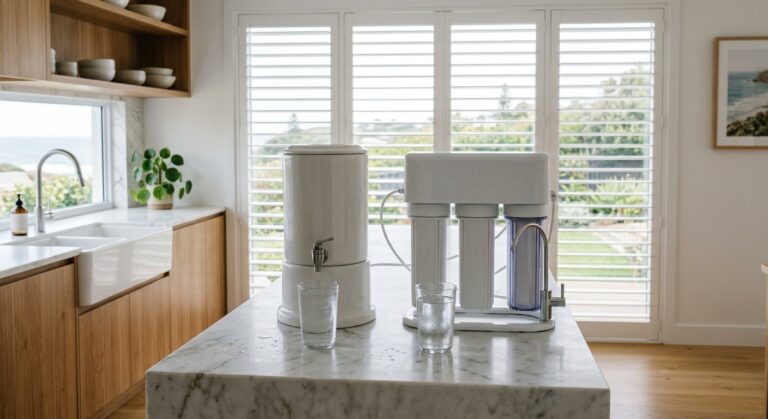
4-stage countertop RO. NSF 58 + 401 certified — independently tested for fluoride reduction (>96%), PFAS (>99%), lead (>97%), chloramine, and microplastics. No plumbing modification. Tank holds 3.3L of RO water. Available on Amazon AU with Prime delivery. The only countertop RO system with comprehensive NSF dual certification available in Australia. Our Palm Beach testing: input TDS 69 ppm → post-RO 3 ppm (96% TDS reduction).
AquaTru Classic — best overall for Australian households
#2 Under-sink: EcoHero 5-Stage RO
Under-sink 5-stage RO with dedicated filtered tap. WaterMark certified (incorporates NSF 58 standards). 190 L/day production capacity — suitable for larger households. Permanent installation provides on-demand RO water at the sink. Includes post-carbon polishing stage. Sold by Pure Water Systems Australia; installs under standard kitchen sink with 15–30 minute professional installation.
EcoHero 5-Stage RO — for homeowners wanting permanent install
EcoHero 5-Stage ROWho needs RO for fluoride — decision guide
| Your situation | Recommendation |
|---|---|
| Preparing infant formula (fluoride reduction recommended) | AquaTru Classic — countertop, no plumbing, delivers <0.04 mg/L fluoride |
| Want fluoride reduction AND PFAS/chloramine/lead protection | AquaTru Classic or EcoHero RO — only RO addresses all simultaneously |
| Sydney household (highest fluoride target at 1.0 mg/L) | RO reduces from ~1.0 mg/L to <0.04 mg/L |
| Renter who cannot modify plumbing | AquaTru Classic — countertop, no installation required |
| Homeowner, want on-demand filtered water at sink | EcoHero 5-Stage under-sink RO |
| Already have a Berkey — want to add fluoride reduction | Berkey PF-2 add-on provides fluoride reduction but without NSF certification; RO is the independently verified alternative |
| Only want to improve chloramine taste, not fluoride | TAPP EcoPro (carbon block) is sufficient — RO not required for chloramine/taste only |
For a full comparison of under-sink RO options see our best under-sink water filter Australia guide. For countertop options: best countertop water filter Australia. For the countertop vs under-sink comparison: under-sink RO vs countertop RO Australia.
Cost comparison: RO vs buying fluoride-free bottled water
| Option | Upfront cost | Ongoing cost | 5-year total (2L/day household) |
|---|---|---|---|
| AquaTru Classic RO | ~AUD $650 | ~$100–150/year (filter cartridges) | ~$1,250–1,400 |
| EcoHero 5-Stage RO | ~AUD $450 + installation | ~$80–120/year (filter replacement) | ~$1,050–1,250 |
| Bottled water (2L/day) | $0 | ~$730–1,460/year ($2–4 per 2L) | ~$3,650–7,300 |
A household of two drinking 2L/day each generates approximately 3,650 × 500ml plastic bottles over 5 years using bottled water. RO at home produces no plastic waste and costs 2–5× less over the same period. For microplastics data on bottled water, see our microplastics in Australian water guide.
Frequently asked questions
Does RO remove fluoride?
Yes — >96% via Donnan exclusion at the RO membrane. NSF 58 certified and independently verified.
Does carbon / Brita remove fluoride?
No. Carbon adsorption does not remove inorganic fluoride ions. Carbon-only systems provide no fluoride reduction.
Best option for Australian households?
AquaTru Classic (countertop, no plumbing, NSF 58 + 401) or EcoHero 5-Stage RO (under-sink, WaterMark certified).
Get the Australian Home Environment Checklist
30 checks across water, air and EMF. Most of them free. Ranked by impact.
No spam. Unsubscribe any time.

Former Royal Australian Navy Clearance Diver and TAG-E counter-terrorism operator. Founded Clean and Native to apply the same rigorous thinking to the home environment.
Full biography →