EMF Protection During Pregnancy in Australia: What the Research Shows and What to Do
Drafted with AI assistance and checked against published specifications and certifications. First-hand measurements appear only where stated. How we make content
Most content on EMF and pregnancy either dismisses the concern outright or overstates risk to sell shielding products. This guide does neither. As a Royal Australian Navy Clearance Diver turned health researcher, I’ve spent three years measuring EMF levels across Australian homes with a calibrated TriField TF2 — and the data tells a more nuanced story than either camp admits. We follow a documented measurement methodology using calibrated instruments, no gifted units, no brand payments.
Quick Verdict
The two highest-impact actions during pregnancy cost nothing: keep your phone away from your abdomen, and move your Wi-Fi router out of the bedroom.
Published research shows consistent associations between prolonged close-proximity RF exposure and adverse pregnancy outcomes — but most studies cannot isolate EMF from confounders. ARPANSA does not issue pregnancy-specific exposure limits. Shielding products are unnecessary for most Australian households where the main sources are a phone and a router, both of which can be repositioned for free. If you do consider shielding, measure your actual bedroom exposure first — a meter reading tells you more than any product description.
| Action | Cost | Verdict |
|---|---|---|
| Phone away from body | Free | Do first |
| Router out of bedroom | Free | Do first |
| Measure with a meter | ~$250 | If considering shielding |
| Electric blanket off at sleep | Free | Do first |
| Shielding canopy / blanket | $400–800 | After measurement only |
What the research actually shows
EMF research in the context of pregnancy divides into two categories with very different evidence quality: extremely low frequency (ELF) fields from power lines and appliances, and radiofrequency (RF) fields from phones, Wi-Fi, and wireless devices. Conflating them is a common mistake in consumer coverage.
ELF magnetic fields — the strongest signal in the data
The most consistent findings concern ELF magnetic field exposure above approximately 2–4 milligauss (0.2–0.4 µT). The Kaiser Permanente cohort study (De-Kun Li et al., 2017, Scientific Reports, n=913) found women with peak ELF-MF exposures above 2.5 mG had a miscarriage odds ratio of approximately 2.7 (95% CI 1.3–5.7) compared to those with the lowest exposures. A follow-up study from the same group (2020) found associations with time to pregnancy.
These findings have important limits. The studies are observational, the exposure measurement methodology has been critiqued, and no biophysical mechanism for ELF fields at household levels is established. ARPANSA (the Australian Radiation Protection and Nuclear Safety Agency) sets the public RF exposure limit at 1,000 µW/cm² at 2.4 GHz — a thermal safety threshold, not a precautionary one. They do not recommend pregnancy-specific limits beyond this. ICNIRP guidelines, on which the Australian standard is based, also carry no pregnancy-specific provisions.
What this means practically: the highest ELF sources in an Australian home are electric blankets used in direct contact with the body, induction cooktops operated at close range (<30 cm), and some appliance motors. At 1 metre, most household ELF sources drop below 1 mG. Distance is effective.
RF exposure — weaker signal, more sources
Evidence for RF exposure specifically during pregnancy is less consistent. The most-cited work is Divan et al. (2008, 2012, Epidemiology), which associated maternal mobile phone use during pregnancy with behavioural outcomes in children at age seven. Effect sizes were modest and multiple re-analyses have produced conflicting results. A 2021 meta-analysis (Bhatt et al., Environment International) found associations between prenatal RF exposure and childhood neurodevelopment, but the quality of included studies was heterogeneous.
IARC classifies RF electromagnetic fields as Group 2B — “possibly carcinogenic to humans” — based on limited evidence. The 2B classification covers general population exposure; it is not a pregnancy-specific finding. The evidence does not establish that phones, Wi-Fi, or smart meters cause harm during pregnancy. It is sufficient, however, to justify low-cost precautionary steps — particularly for the highest-exposure scenarios.
ARPANSA’s position
ARPANSA states that EMF levels from household devices fall within the Australian public exposure standard (aligned to ICNIRP). They recommend a “precautionary approach where practical” for RF — keeping phones away from the body and limiting prolonged exposure to high-output devices. This is consistent advice, but it is not a pregnancy-specific warning. The precautionary actions in this guide are our own assessment of the available literature, not official health guidance. When in doubt, speak to your obstetrician or GP.
Highest-priority exposures to address during pregnancy
Priority is determined by two variables: proximity to the body and duration of exposure. A source at 5 cm for 8 hours delivers a fundamentally different exposure profile than one at 2 metres for 30 minutes, regardless of which appears higher on a spec sheet.
1. Mobile phone — the single highest-exposure source in most pregnancies
A phone transmitting data or on a call produces SAR (Specific Absorption Rate) values tested at a regulatory separation distance — typically 5–15 mm. Carrying a phone in direct contact with the abdomen during pregnancy places the device at effectively zero separation for the highest-powered transmission it performs (active call, 4G data ping, location update). This is the highest realistic RF exposure scenario in most Australian pregnancies, and it costs nothing to change.
2. Wi-Fi router — continuous overnight RF in the sleeping environment
A Wi-Fi router in the bedroom produces continuous RF at 2.4 GHz and/or 5 GHz within 1–3 metres of the sleeping position throughout the night. This is the easiest single change to make with the largest impact on total RF hours of exposure. Moving the router to a hallway or living area reduces sleeping-position exposure to near background levels without affecting daytime use.
If signal reach is a concern, a powerline network adapter or MoCA adapter over existing coaxial cable provides wired connection to any room without running Ethernet — no additional RF required. A mechanical 24-hour timer (B0DCGPPK5H, Amazon AU, ~$20) can cut the router automatically during sleep hours without requiring any software change.
3. Electric blanket — use before sleep, not during
Electric blankets in direct contact with the body produce ELF magnetic fields well above the 2.5 mG level studied in the Kaiser Permanente miscarriage research. The mitigation requires no product purchase: preheat the bed for 20–30 minutes, then switch off and unplug before getting in. Residual warmth persists 30–45 minutes. Exposure during sleep is reduced to near zero. This is one of the clearest precautionary steps available and costs nothing beyond an existing routine change.
4. Laptop on the lap
Laptops on the lap produce both ELF magnetic fields from the power circuit and RF from the Wi-Fi adapter — both at close body proximity. A laptop desk increases effective separation distance by 20–30 cm, reducing ELF exposure by 75–90% at that range. Connecting via Ethernet and disabling Wi-Fi eliminates the RF source entirely. A DefenderPad EMF laptop shield (B07LCWD8DY, Amazon AU) provides passive ELF attenuation without requiring connectivity changes if wired Ethernet is not practical.
5. Smart meter — worth checking, rarely an issue at normal sleeping distance
Australian smart meters (deployed primarily by Energex in Queensland and the equivalent distributors in other states) operate at 900 MHz, transmitting in bursts rather than continuously. The burst peak can read 100–1,000× higher than the time-average on a metering interval. At 2 metres or more from a typical Landis+Gyr or similar meter, field strengths are generally within a range most practitioners consider acceptable. The bedroom-adjacent-to-meter-box configuration is worth checking if your sleeping position is against the exterior wall where the meter is mounted. See our complete EMF home guide for the measurement protocol.
When and how to measure your bedroom EMF
Measuring your actual bedroom environment gives you far more useful information than any general guidance, including this article. Two households that look identical on paper — same suburb, same router model, same phone habits — can have very different RF profiles depending on neighbour equipment, building construction, and room layout.
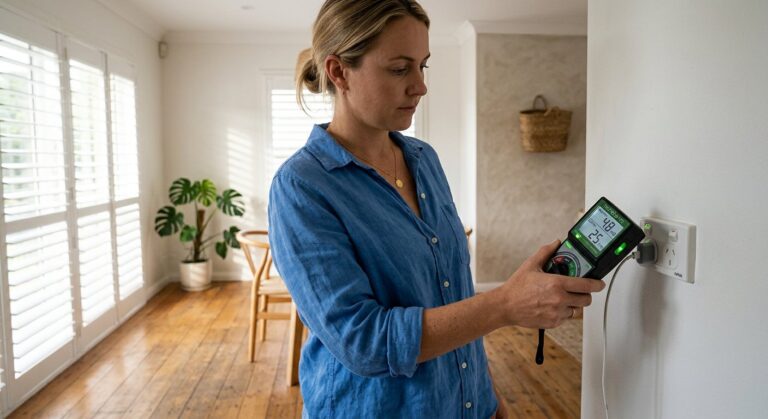
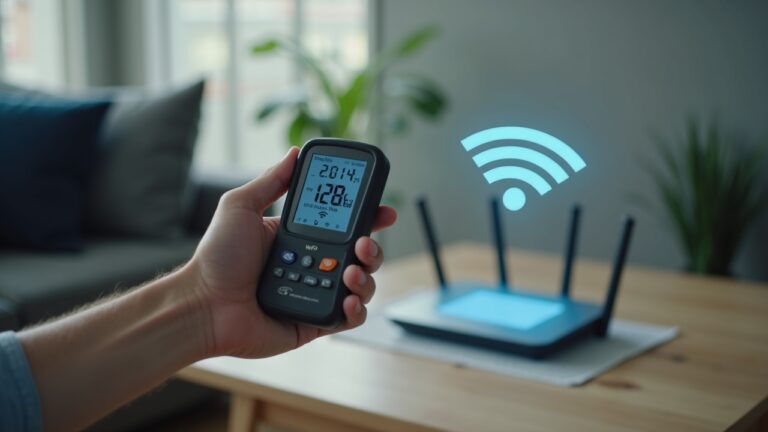
The TriField TF2 is the standard instrument for home measurement in Australia. It covers all three EMF types: AC magnetic (milligauss), AC electric (V/m), and RF (mW/m²). A 15-minute measurement session — phone on bedside table, router at its normal position, all devices powered — will confirm whether you have elevated exposure worth addressing or whether the zero-cost steps above are sufficient.
Measure First. Act Second.
The TriField TF2 is the standard home EMF meter in Australia. It measures AC magnetic, AC electric, and RF fields in one unit. A 15-minute bedroom walk gives you real data. Without it, every shielding decision is a guess.
The Building Biology sleeping area guidelines, which use stricter thresholds than the ARPANSA public standard, recommend RF below 0.1 mW/m², AC magnetic below 0.2 µT, and AC electric below 5 V/m. These are not legally mandated limits but serve as useful reference points for a precautionary approach during pregnancy.
Shielding products — when they help and when they don’t
The EMF shielding market in Australia contains products that work — and products that don’t. The distinction matters. Conductive metal in a Faraday cage configuration attenuates RF. Fabric with nickel-copper thread content can attenuate RF when tested against a calibrated source. A pendant, sticker, or “harmoniser” cannot — there is no independent verification of attenuation for any of these products, and no physical mechanism by which they could work.
EMF shielding bed canopy — for confirmed elevated RF at sleeping position
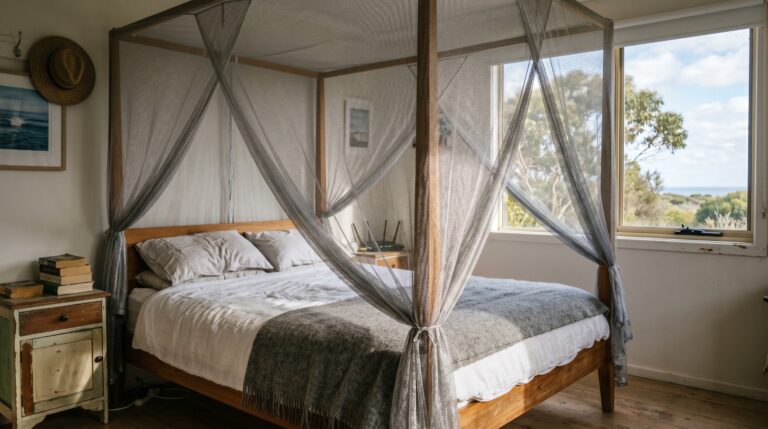
A properly constructed shielding canopy using nickel-copper fabric (>40 dB rated attenuation) reduces RF inside the sleeping environment by more than 99.9% when correctly grounded to the earth pin of an Australian GPO outlet. Use this only if your TF2 measurements show elevated RF at the sleeping position after you have moved the router and phone. Verify attenuation before and after installation. The SaferEMF 42 dB silver-cotton canopy is the best-documented option available in Australia.
Only use a shielding canopy after confirming elevated RF with a meter, and after removing all wireless devices from inside the sleeping area. A canopy around a phone, router, or Wi-Fi smart meter will worsen exposure.
EMF shielding blanket — for daytime and travel use
An EMF shielding blanket provides localised RF attenuation over the abdomen — useful in RF-dense environments where you can’t control router placement (open-plan offices, shared buildings) or during travel. It is not a substitute for the zero-cost steps above, and it addresses only the RF component, not ELF magnetic fields. Look for products with published third-party attenuation data in dB across the relevant frequency range. Products without this data are not verifiably effective.
Nursery setup
The same principles that apply to your bedroom apply to the nursery. Remove or disable wireless devices from the immediate sleeping environment. Verify the distance from any smart meter wall. The baby monitor category deserves specific attention.
DECT (Digital Enhanced Cordless Telephone) baby monitors transmit continuously at full power regardless of whether the baby is awake or moving. This means 8–12 hours of high-power RF within 1–2 metres of the cot. Options that reduce this exposure: a DECT monitor that includes a “VOX” or voice-activated mode (transmits only when sound is detected rather than continuously), a monitor that operates over home Wi-Fi rather than dedicated DECT RF, or a wired video monitor running over a powerline adapter — zero RF, unlimited range within the home.
For the nursery wall adjacent to a smart meter, verify the meter is >2 metres from the cot position. At that distance, field strengths from a standard Energex or Citipower meter are typically below the Building Biology sleeping area threshold. If the meter is directly behind a cot wall at <1 metre, consider repositioning the cot or requesting a meter relocation from your network operator.
Products that don’t work — what to avoid
The categories below have no independently verified shielding mechanism. They are listed here because they appear in searches for “EMF protection pregnancy Australia” and represent a significant consumer risk — not because they cause harm, but because relying on them provides a false sense of protection while the actual high-exposure scenarios above go unaddressed.
- EMF pendants, crystals, and “neutralisers”: No peer-reviewed attenuation data exists for any product in this category. No physical mechanism exists by which a pendant could attenuate an electromagnetic field at body scale.
- EMF stickers for phones: Third-party lab tests of these products consistently find zero measurable attenuation. Some tests have found increased antenna activity (the phone boosting power to compensate for a partially covered antenna).
- Orgonite products: Marketed as “transforming” EMF. No independent measurement data supports this.
- Shungite products: Shungite is a naturally conductive carbon mineral. Small pieces used as pendants or phone attachments produce no meaningful RF attenuation at body scale. Large Faraday-geometry applications would theoretically attenuate — but these are not how consumer shungite products are sold.
The only materials that attenuate EMF are conductive metals in appropriate configurations (Faraday cage geometry for RF, mu-metal or similar high-permeability alloy for ELF magnetic), or nickel-copper and silver-copper fabrics of sufficient surface density for RF attenuation. Before purchasing any shielding product, ask the supplier for the third-party lab attenuation certificate specifying the tested frequency range and dB reduction. If they cannot produce one, the product’s effectiveness is unverified.
Summary: priority action list for pregnancy
Ranked by evidence and ease of implementation
| Priority | Action | Cost |
|---|---|---|
| 1 | Don’t carry phone against abdomen — use a bag | Free |
| 2 | Move Wi-Fi router out of bedroom — hallway or living area | Free |
| 3 | Electric blanket: preheat then turn off and unplug before sleep | Free |
| 4 | Use wired headset or speaker mode for calls | Free–$30 |
| 5 | Measure bedroom EMF with TriField TF2 | ~$250 |
| 6 | Verify smart meter distance >2m from sleeping position | Free |
| 7 | Shielding canopy/blanket — only if meter shows elevated RF after steps 1–6 | $400–800 |
Further reading
- Best EMF meters in Australia 2026 — TriField TF2 vs Safe and Sound Pro II vs Cornet: full comparison
- Complete guide to EMF in Australian homes — smart meters, routers, powerlines, room-by-room protocol
- Smart meter EMF shielding Australia — measurement and shielding options for bedroom walls
- How to measure EMF in your home — step-by-step room audit
Frequently Asked Questions
Is EMF exposure during pregnancy harmful to my baby?
The research is mixed. Some peer-reviewed cohort studies associate prolonged high-level ELF magnetic field exposure with increased miscarriage risk. Others show no significant link. No Australian or international health body has classified everyday household EMF levels as definitively harmful during pregnancy. ARPANSA recommends a precautionary approach — keeping phones away from the body and limiting prolonged exposure to high-output devices — without issuing pregnancy-specific safety limits. Reducing the highest-exposure scenarios (phone on abdomen, router in bedroom) is reasonable precaution based on current evidence.
What are the biggest EMF sources to avoid while pregnant?
Prioritise by proximity and duration. Phones carried against the abdomen, laptops on the lap, and electric blankets used during sleep rank highest because they combine close body contact with extended exposure time. Wi-Fi routers in the bedroom produce continuous overnight exposure that can be eliminated for free by moving the router. Smart meters are worth checking if your bed is against the exterior wall where the meter is mounted, but at 2+ metres the typical field strength is below Building Biology sleeping area thresholds.
Do EMF protection blankets for pregnancy actually work?
Some do, some don’t. Shielding fabrics using silver or nickel-copper thread can reduce RF exposure by 30–50 dB if properly constructed and tested. The key is independent attenuation certification specifying the tested frequency range and dB reduction. Products without this documentation have unknown effectiveness. A TriField TF2 or Safe and Sound Pro II meter will tell you whether the blanket is attenuating your specific environment’s RF — which is the only way to know it’s working for your situation.
What does ARPANSA say about EMF exposure during pregnancy?
ARPANSA states that EMF levels from household devices fall within the Australian public exposure standard, which is based on ICNIRP guidelines. They do not issue pregnancy-specific warnings. Their general guidance recommends a precautionary approach where practical: keeping phones away from the body, limiting prolonged exposure to high-output devices, and noting that exposure levels decrease rapidly with distance from the source. The ARPANSA RF exposure limit at 2.4 GHz is 1,000 µW/cm² — a thermal safety threshold, not a precautionary limit.
Is it safe to use Wi-Fi while pregnant in Australia?
Wi-Fi routers at 2–3 metres distance produce RF fields well below ARPANSA exposure limits. At that distance, typical router output is under 0.05 V/m — a small fraction of the standard threshold. The more relevant question is whether a router is in the bedroom, where 8 hours of overnight exposure at 1–2 metres accumulates differently than daytime use at distance. Moving the router out of the bedroom eliminates this overnight exposure without affecting Wi-Fi availability elsewhere in the home.
How do I measure EMF levels in my home during pregnancy?
Use a calibrated meter such as the TriField TF2 (measures RF, AC magnetic, and AC electric) or the Safe and Sound Pro II (RF-only). Measure at body height in areas where you spend the most time: sleeping position, desk, couch. Record readings with all devices operating normally — phone on, router on, appliances running. Compare results against Building Biology sleeping area guidelines: RF <0.1 mW/m², AC magnetic <0.2 µT, AC electric <5 V/m. These are stricter than ARPANSA limits and serve as a precautionary reference point.
Should I use an EMF shielding canopy during pregnancy?
Only if your meter shows elevated RF at your sleeping position after implementing the zero-cost steps (phone away, router moved). A properly grounded shielding canopy with >40 dB rated attenuation can reduce RF inside the sleeping area by more than 99.9%. However, a canopy with any wireless device left inside it will reflect and concentrate that device’s RF — always remove or power off all wireless devices before deploying. For most Australian households, moving the router and phone resolves any elevated bedside readings without the need for shielding hardware.
Are DECT baby monitors safe to use in a nursery?
Standard DECT baby monitors transmit continuously at full power regardless of whether there is sound or movement — meaning 8–12 hours of RF at 1–2 metres from the cot. A VOX (voice-activated) mode transmits only on detection, dramatically reducing cumulative exposure. Wired monitors running over powerline adapters produce zero RF. If you use a standard DECT monitor, placing it at the greatest practical distance from the cot head (rather than directly adjacent) is worthwhile. Wi-Fi-based monitors that run over your existing home network also have adjustable transmission settings and are worth considering for nursery use.
Get the Australian Home Environment Checklist
30 checks across water, air and EMF. Most of them free. Ranked by impact.
No spam. Unsubscribe any time.

Former Royal Australian Navy Clearance Diver and TAG-E counter-terrorism operator. Founded Clean and Native to apply the same rigorous thinking to the home environment.
Full biography →