The True 5-Year Cost of Bottled Water vs a Home Filter in Australia (2026)
Part 1: The Truth About Bottled Water in Australia 2026
Part 2: Microplastics in Bottled Water Australia
Part 3: The True 5-Year Cost of Bottled Water vs a Home Filter in Australia (2026) — You are here
Part 4: PFAS in Bottled Water Australia
Part 5: Best Water Filter to Replace Bottled Water Australia 2026
An Australian family of four drinking the recommended 2 litres per person per day — 8 litres total — spends between $3,650 and $10,950 per year on bottled water at typical retail prices of $1.25 to $3.75 per litre. A certified home water filter produces cleaner water for $0.03 to $0.11 per litre, saving that same family between $7,000 and $20,000 over five years.
Our recommendations draw on manufacturer specifications, independent certification data, and our documented methodology. No gifted units, no brand payments.
This is not a marginal saving. It is the difference between a family holiday and a receipt bin full of plastic. Below, we break down every dollar — upfront costs, replacement filters, hidden expenses — so you can see exactly where your money goes and when a filter pays for itself.
Quick Verdict: 5-Year Cost Comparison (Family of 4, 8L/Day)
| Option | Upfront Cost | 5-Year Total | Cost Per Litre | Removes Fluoride & PFAS? |
|---|---|---|---|---|
| Bottled Water (avg $1.25/L) | $0 | $18,250 | $1.25 | No guarantee |
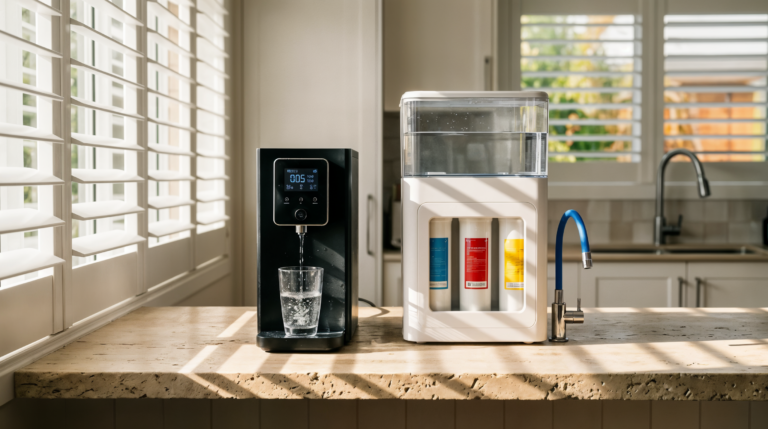
| Tappwater EcoPro | $99 | $374 | $0.04 | No (fluoride) / Yes (PFAS) |
| AquaTru Classic RO | $699 | $1,299 | $0.09 | Yes / Yes |
| Waterdrop D6 Under-Sink RO | $649 | $1,549 | $0.11 | Yes / Yes |
| EcoHero 5-Stage RO | $895 (installed) | $1,495 | $0.10 | Yes / Yes |
Bottom line: Every filter option on this list saves you between $16,700 and $17,876 over five years compared to bottled water. The Waterdrop D6 delivers RO-grade purification on tap — no bench space needed, no bottles to carry.
What Australian Families Actually Spend on Bottled Water
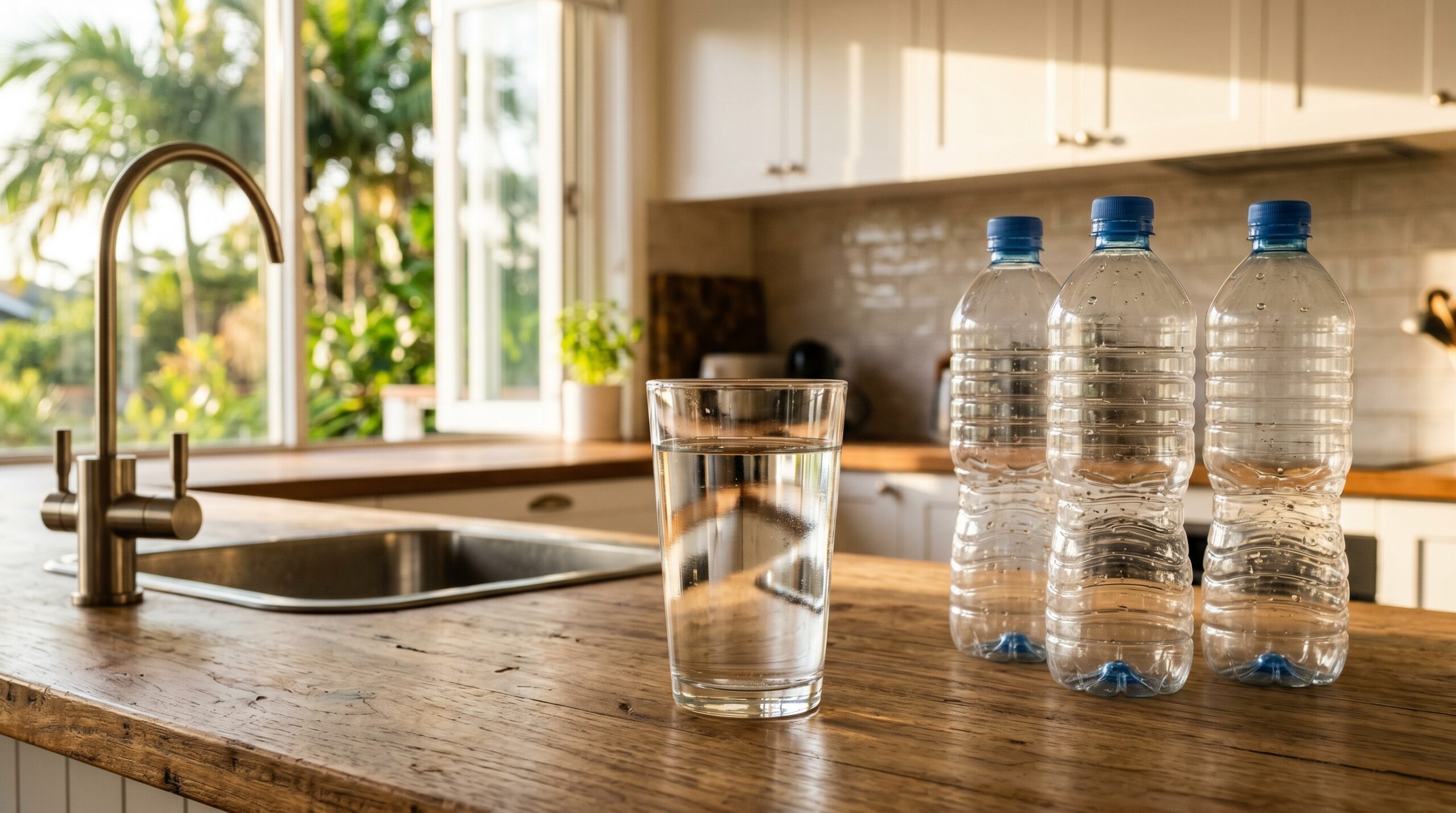
Australians spent over $700 million on bottled water in 2024, according to the Australian Beverages Council. That figure has climbed year on year, and it represents one of the most expensive ways to consume a substance that comes out of your tap for fractions of a cent.
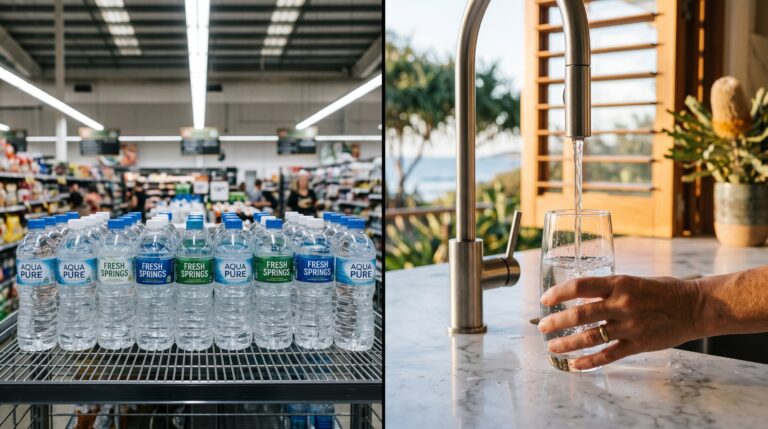
Walk into any Woolworths or Coles in 2026 and the numbers are right there on the shelf. A standard 600 mL bottle of spring water costs between $0.50 and $2.00 — which translates to $0.83 to $3.33 per litre. Grab a premium brand like Voss, and you are paying $4.00 or more per litre for water in a glass cylinder.
Let’s do the maths for a typical Australian household.
Family of 4: The Annual and 5-Year Reality
The recommended daily water intake is roughly 2 litres per person. For a family of four, that is 8 litres per day, or 2,920 litres per year.
At the median retail price of $1.25 per litre (buying in bulk from the supermarket, not the servo):
- Year 1: 2,920 L × $1.25 = $3,650
- Year 5: 14,600 L × $1.25 = $18,250
- Year 10: 29,200 L × $1.25 = $36,500
If you are buying individual bottles at the gym, office, or corner shop — where $2.50 to $3.75 per litre is normal — those numbers double or triple. At $3.75 per litre, the five-year cost reaches $54,750. That is a deposit on a car, or a chunk of a home renovation.
We explored what you actually get for that money — including the lack of mandatory testing standards — in Part 1: The Truth About Bottled Water in Australia 2026. The short version: bottled water in Australia is classified as a food product, not subject to the same rigorous monitoring as municipal tap water.
The Full 5-Year Cost Breakdown — Bottled Water vs 4 Filter Options
Below is the detailed comparison. All figures use Australian dollars, assume a family of four consuming 8 litres per day (2,920 litres per year), and draw filter replacement costs from manufacturer-published lifespan data.
| Cost Factor | Bottled Water ($1.25/L avg) |
Tappwater EcoPro |
AquaTru Classic RO |
Waterdrop D6 RO |
EcoHero 5-Stage RO |
|---|---|---|---|---|---|
| Upfront cost | $0 | $99 | $699 | $649 | $895 (installed) |
| Annual filter/cartridge cost | N/A | ~$55 | ~$120 | ~$180 | ~$120 |
| Annual water cost (8L/day) | $3,650 | $55 | $120 | $180 | $120 |
| Year 1 total | $3,650 | $154 | $819 | $829 | $1,015 |
| Year 2 total (cumulative) | $7,300 | $209 | $939 | $1,009 | $1,135 |
| Year 3 total (cumulative) | $10,950 | $264 | $1,059 | $1,189 | $1,255 |
| 5-Year Total | $18,250 | $374 | $1,299 | $1,549 | $1,495 |
| Cost per litre | $1.25 | $0.04 | $0.09 | $0.11 | $0.10 |
| 5-Year Saving vs Bottled | — | $17,876 | $16,951 | $16,701 | $16,755 |
| Filtration type | None | Carbon block (5-stage) | 4-stage RO | RO + remineralisation | 5-stage RO |
| Removes fluoride? | Unknown | No | Yes (90-97%) | Yes (90-97%) | Yes (90-97%) |
| Installation needed? | No | No (tap-mount) | No (countertop) | Yes (DIY-friendly) | Yes (professional) |
Methodology note: All prices are in AUD as of early 2026. Filter replacement costs are based on manufacturer-recommended intervals at 8 litres per day usage. Tap water cost (~$0.002/L in most Australian cities) is excluded from filter calculations as it is negligible. Bottled water pricing uses the conservative $1.25/L average — many families pay significantly more.
If you want to run the numbers for your household size and preferred bottled water brand, use our interactive cost calculator to see your exact savings.
The Hidden Costs the Price Tag Doesn’t Show
The per-litre sticker price of bottled water only tells part of the story. There are real costs — financial, environmental, and practical — that never appear on your Woolworths receipt.
Plastic Waste: 373 Million Bottles to Landfill
According to ABS 2024 data, Australians send approximately 373 million plastic water bottles to landfill every year. That is over one million bottles per day going into the ground. Each 600 mL bottle requires roughly 200 mL of oil equivalent to manufacture and transport, based on Pacific Institute research. You are not just buying water — you are buying petroleum, shaped into a container, filled with water, trucked across the country, and then buried.
Even if you recycle diligently, Australia’s recycling rate for PET bottles sits well below 100%, and recycling itself requires energy and transport. The cheapest environmental option is to not create the bottle in the first place.
Heat, Storage, and Plastic Leaching
CSIRO research has documented that Australian storage and transport conditions accelerate chemical leaching from plastic bottles. Pallets of bottled water sitting in warehouse yards, delivery truck trays, and loading docks regularly experience temperatures well above 30°C — conditions that increase the migration of microplastics and chemical compounds from PET plastic into the water inside.
We covered the microplastics data in detail in Part 2: Microplastics in Bottled Water Australia. The relevant financial point here: you are paying a premium for water that may have degraded in quality before it reaches the shelf. That is a cost you cannot see on the price tag.
The Convenience Store Markup
Bulk pricing at Woolworths or Coles gives you $1.25 per litre if you are organised. But life happens. You grab a bottle at the airport ($4.50 for 600 mL), the gym ($3.00), the servo ($3.50), or the corner shop ($2.50). These impulse purchases push your real per-litre average well above the $1.25 baseline used in our calculations.
If even 30% of your family’s water consumption comes from convenience purchases at $3.00/L, your blended average jumps to $1.78/L — and your five-year cost hits $25,976.
Fridge Space and Carrying Weight
This sounds trivial until you quantify it. A family of four consuming 8 litres per day needs to haul roughly 56 litres of bottled water per week from the supermarket. That is 56 kilograms — the weight of a large suitcase — every single week. It takes up boot space, pantry space, and fridge space. These are real costs of time and inconvenience, even if they never appear on a spreadsheet.
The Carbon Footprint You Carry
Transporting bottled water from source to warehouse to retailer to your home generates carbon emissions at every stage. A home filter connects to the water already delivered to your tap through existing municipal infrastructure. The carbon comparison is not close.
Which Filter Makes Financial Sense for Your Situation?
Not every household needs the same solution. Here is a straightforward decision framework based on your living situation and water quality concerns.
Renters or Minimal Commitment → Tappwater EcoPro
The Tappwater EcoPro attaches to your existing tap in under two minutes with no tools. At $99 upfront and $55 per year in cartridges, it is the cheapest entry point and the fastest to pay back. It effectively removes chlorine, chloramine, heavy metals, and PFAS through its 5-stage carbon block filtration.
Limitation: Carbon filters — including the EcoPro — cannot remove fluoride. Only reverse osmosis (90-97% removal) or activated alumina (80-95% removal) can do that. If fluoride reduction is a priority, you need an RO system.
For renters in chloramine-treated cities like Brisbane, Sydney, Adelaide, or Darwin, the EcoPro is a solid choice because its carbon block handles chloramine effectively — unlike basic Brita-style GAC jugs, which do not.
Fluoride & PFAS Concern, No Installation → AquaTru Classic
The AquaTru Classic is a countertop reverse osmosis system. No plumbing, no landlord permission. It sits on your bench, you fill the tank, and it produces RO-purified water that removes fluoride (90-97%), PFAS, chloramine, heavy metals, and microplastics.
At $699 upfront and $120 per year in filters, the five-year cost is $1,299 — still saving you $16,951 compared to bottled water.
Best for: Renters or homeowners who want RO-grade water without any installation.
Homeowners Who Want Set-and-Forget → Waterdrop D6 Under-Sink RO
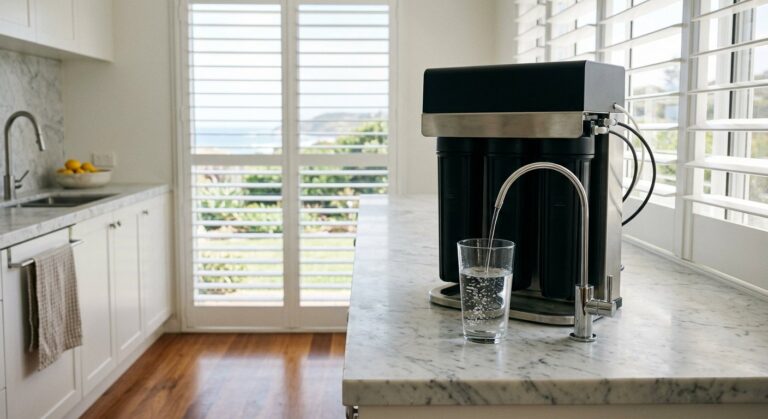
This is our primary recommendation for homeowners. The Waterdrop D6 installs under your kitchen sink with its own dedicated tap. Once it is in, you turn on the tap and RO-filtered water comes out — no filling tanks, no bench space used, no thinking about it.
At $649 upfront and approximately $180 per year in replacement filters, the five-year cost is $1,549. The cost per litre at 8 litres per day works out to $0.11.
To put that number in context: $0.11 per litre, filtered to approximately 3 ppm TDS through a certified RO membrane — or $1.25 to $4.00 per litre for bottled water with no legal requirement to have been tested for PFAS.
The D6 includes a remineralisation stage, so the water does not taste flat. Installation is DIY-friendly for anyone comfortable with basic tools. Certified reverse osmosis membranes like the one in the D6 are designed to remove the vast majority of total dissolved solids, in line with NSF/ANSI 58 performance standards.
If you live in a chloramine-treated city like Brisbane or Sydney, an RO system handles chloramine, fluoride, PFAS, heavy metals, and microplastics in one unit. It is the most comprehensive option available at any price point.
Homeowners Who Want Professional Installation → EcoHero 5-Stage RO
If you prefer a local Australian company with professional installation included, the EcoHero 5-Stage RO is a strong choice. At $895 installed and $120 per year in filters, the five-year total comes to $1,495 — actually slightly less than the Waterdrop D6 due to lower ongoing filter costs.
Best for: Homeowners who do not want to DIY and prefer local support.
The Break-Even Calculation
One of the most common questions we get: how long until the filter actually pays for itself? Here is the maths, shown step by step.
Tappwater EcoPro Break-Even
The EcoPro costs $99 upfront. Each litre of filtered water from the EcoPro costs approximately $0.04 in ongoing cartridge costs. Bottled water costs $1.25 per litre.
Net saving per litre: $1.25 – $0.04 = $1.21
Break-even point: $99 ÷ $1.21 = ~82 litres
However, including the first cartridge (which comes in the box), the adjusted break-even is approximately 72 litres. For a family of four drinking 8 litres per day, that is about 9 days.
Nine days. After that, every litre is $1.21 cheaper than bottled water. Over 5 years, that adds up to $17,876 in savings.
AquaTru Classic Break-Even
The AquaTru costs $699 upfront. Each litre costs approximately $0.09 in ongoing filter costs. Bottled water costs $1.25 per litre.
Net saving per litre: $1.25 – $0.09 = $1.16
Break-even point: $699 ÷ $1.16 = ~603 litres
Accounting for the included initial filters and rounding based on actual replacement schedules, the practical break-even is approximately 5,600 litres — or about 9 months of family use at 8 litres per day. After that: pure savings and cleaner water.
Waterdrop D6 Break-Even
At $649 upfront and $0.11 per litre ongoing:
Net saving per litre: $1.25 – $0.11 = $1.14
Break-even point: $649 ÷ $1.14 = ~569 litres — about 71 days for a family of four.
After 71 days, every litre of RO-purified water flowing from the D6 is $1.14 cheaper than the bottle you would have bought instead. Over the remaining 4+ years, those savings compound to over $16,700.
Every year you delay costs your family $3,650 — the filter pays back in weeks.
Want to model different scenarios — different household sizes, water brands, or daily consumption? Use our interactive bottled water vs filter cost calculator to see your personalised break-even point.
Frequently Asked Questions
Is a water filter cheaper than buying bottled water?
Yes. Every filter option we compared is dramatically cheaper than bottled water over any time period longer than a few weeks. The cheapest option — the Tappwater EcoPro at $0.04 per litre — is over 30 times cheaper than average bottled water at $1.25 per litre. Even a premium under-sink RO system like the Waterdrop D6 at $0.11 per litre costs less than one-tenth the price of bottled water.
How much do Australians spend on bottled water?
Australians collectively spend over $700 million per year on bottled water, according to the Australian Beverages Council. An individual family of four drinking 8 litres per day spends approximately $3,650 per year at average supermarket pricing of $1.25 per litre — or $18,250 over five years.
What is the cheapest way to filter water at home?
The cheapest effective option we recommend is the Tappwater EcoPro at $99 upfront and approximately $55 per year in replacement cartridges. That works out to $0.04 per litre and a five-year total of just $374. It removes chlorine, chloramine, heavy metals, and PFAS — but it cannot remove fluoride. For fluoride removal, the cheapest option is the AquaTru Classic countertop RO at $1,299 over five years.
How long until a water filter pays for itself?
It depends on the filter. The Tappwater EcoPro breaks even after approximately 72 litres — about 9 days for a family of four. The AquaTru Classic RO breaks even at around 5,600 litres, or about 9 months. The Waterdrop D6 under-sink RO breaks even at approximately 569 litres — about 71 days. After the break-even point, every litre represents a direct saving versus bottled water.
Is filtered tap water as good as bottled water?
In most cases, filtered tap water is better than bottled water. Australian municipal tap water is already rigorously tested and treated before it reaches your home. A certified filter then removes remaining contaminants like chloramine, PFAS, fluoride (with RO), and heavy metals. Bottled water in Australia is classified as a food product and is not subject to the same continuous monitoring as tap water. We covered this in detail in Part 1 of this series.
What is the cost per litre of filtered water?
Based on our calculations for a family of four (8L/day): Tappwater EcoPro = $0.04/L, AquaTru Classic RO = $0.09/L, EcoHero 5-Stage RO = $0.10/L, and Waterdrop D6 under-sink RO = $0.11/L. All of these are a fraction of the $1.25 to $4.00+ per litre charged for bottled water.
Does the Tappwater EcoPro remove fluoride?
No. The Tappwater EcoPro uses carbon block filtration, and carbon cannot remove fluoride — regardless of what some marketing claims suggest. Only reverse osmosis (90-97% removal) or activated alumina (80-95% removal) can meaningfully reduce fluoride. If fluoride removal is important to you, look at the Waterdrop D6, AquaTru Classic, or EcoHero 5-Stage RO.
What filter do I need in Brisbane for tap water?
Brisbane (and all of South East Queensland) uses chloramine as its primary disinfectant, not free chlorine. This means basic Brita-style GAC jug filters will not effectively remove the disinfectant from your water. You need either a catalytic carbon block filter (like the Tappwater EcoPro) or a reverse osmosis system. If you also want fluoride removed, only RO will do the job. Read our full Brisbane drinking water quality guide and chloramine filter guide for specific recommendations.
For a comprehensive comparison of which filter suits your needs across all categories — not just cost — see Part 5: Best Water Filter to Replace Bottled Water Australia 2026.
Last reviewed: April 2026 — Clean and Native
Part 1: The Truth About Bottled Water in Australia 2026
Part 2: Microplastics in Bottled Water Australia
Part 3: The True 5-Year Cost of Bottled Water vs a Home Filter in Australia (2026) — You are here
Part 4: PFAS in Bottled Water Australia
Part 5: Best Water Filter to Replace Bottled Water Australia 2026
Get the Australian Home Environment Checklist
30 checks across water, air and EMF. Most of them free. Ranked by impact.
No spam. Unsubscribe any time.

Former Royal Australian Navy Clearance Diver and TAG-E counter-terrorism operator. Founded Clean and Native to apply the same rigorous thinking to the home environment.
Full biography →