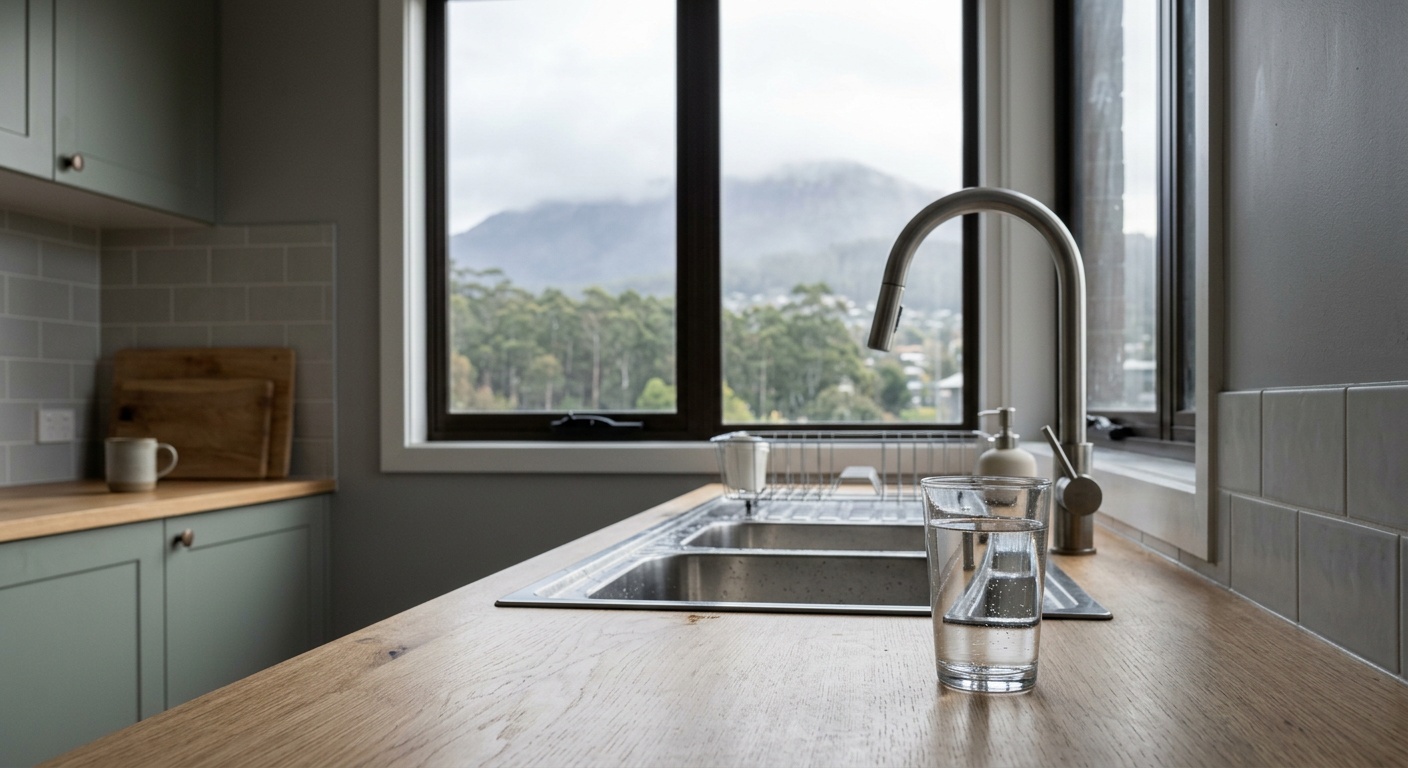
Hobart Tap Water Quality 2026: What’s Actually In It?
Hobart’s tap water comes from the Derwent River and kunanyi/Mount Wellington catchments, is treated with ozone, biological activated carbon, UV light, and chlorine at the Bryn Estyn plant, and has recorded zero PFAS detections across every raw water catchment in Tasmania. This is a fact-checked breakdown of what’s actually in it, sourced directly from TasWater’s own published data — tested using our documented methodology.
QUICK VERDICT
Hobart’s Greater Hobart supply (serving 216,435 people via Bryn Estyn) uses free chlorine, not chloramine, is fluoridated to 0.8-1.1 mg/L, and tested zero for PFAS across all Tasmanian catchments in TasWater’s 2023-24 report. Fern Tree on kunanyi/Mt Wellington was rated Australia’s best-tasting tap water in the same reporting year. The catch: TasWater logged 1,267 water quality complaints in 2023-24, mostly discoloured water from ageing mains — 16.5km of corroded pipe is being replaced in response.
A filter is worth considering if:
- You dislike the taste of chlorine specifically, even at Hobart’s relatively low free-chlorine levels
- Your home has older galvanised plumbing and you notice discoloured water — one of TasWater’s most common complaint categories
- You want a taste upgrade rather than a safety fix — Hobart’s water already meets every ADWG health parameter
- You are renovating and want to future-proof against ageing council-side infrastructure, not your own pipes
You can skip filtration if:
- You live in the Greater Hobart supply zone and have no taste complaints — the water is already compliant on every measured health parameter
- You are chasing chloramine removal — Hobart does not use chloramine, so chloramine-specific vitamin C filters are unnecessary here
- You are chasing PFAS removal — TasWater’s raw catchment testing found zero detections; there is nothing to filter out on this front
- Budget is tight — unlike Brisbane, Sydney, Adelaide, or Perth, Hobart residents aren’t fighting an inherently harder water chemistry problem
Where Hobart’s Water Actually Comes From
Most of Hobart’s water — an average of 60% of the needs of more than 200,000 Hobartians — runs through the Bryn Estyn Water Treatment Plant, a $243.9 million upgraded facility that draws from the River Derwent upstream of New Norfolk. TasWater’s own 2023-24 Annual Drinking Water Quality Report lists the “Greater Hobart” supply system as drawing from three sources: Lake Fenton, the Derwent River, and multiple offtakes on kunanyi/Mount Wellington. The Greater Hobart system serves 83,952 connections and 216,435 people — by far TasWater’s largest single system, out of 59 across the state.
The Mount Wellington offtakes matter for more than trivia value. In the same reporting year, Fern Tree — a small locality on the slopes of kunanyi/Mount Wellington, part of the same water network — was awarded “Best Tasting Tap Water in Australia.” That’s not a marketing claim from TasWater’s own materials being taken at face value uncritically; it reflects genuinely low-turbidity, low-organic-load source water coming off a forested mountain catchment rather than a heavily developed river system.
Key takeaway
Greater Hobart draws from the Derwent River, Lake Fenton, and kunanyi/Mount Wellington offtakes via the Bryn Estyn plant, serving 216,435 people. This is the same catchment network that produced Australia’s best-tasting tap water in TasWater’s most recent reporting year.
How Hobart’s Water Is Treated
Bryn Estyn runs what TasWater describes as multi-barrier treatment, and the sequence is publicly documented in their 2023-24 report:
- Clarification and flocculation — removes sediment from the raw Derwent River intake
- Ozone oxidation — breaks down organic material in the water
- Biological Activated Carbon (BAC) filtration — removes particulate matter through adsorption, using the ozone-treated water as feed
- UV disinfection — a final microbial-inactivation layer that doesn’t affect taste, colour, or odour
- Chlorination — the last disinfection step before the water leaves the plant
- Fluoridation — added at the end of the treatment train
The important detail for anyone comparing Hobart to a chloramine city: Hobart uses free chlorine, not chloramine. TasWater’s process description names chlorination specifically, with no mention of ammonia dosing to form chloramine. That distinction matters if you’re shopping for a shower filter or drinking water filter — see our best shower filter comparison for why chloramine cities need different filter media (vitamin C/ascorbic acid) than free-chlorine cities like Hobart, which standard KDF or carbon filters handle fine.
TasWater is also mid-rollout on a statewide UV disinfection program — 27 water treatment plants had UV online as of the 2023-24 report, with five more scheduled, at a program cost of $8.2 million for that year alone. Bryn Estyn (and therefore Greater Hobart) already has UV as part of its standard treatment train.
Key takeaway
Hobart’s water goes through six treatment stages — clarification, ozone, biological activated carbon, UV, chlorination, and fluoridation. It is disinfected with free chlorine, not chloramine, which means standard carbon or KDF shower and drinking filters work without needing chloramine-specific vitamin C media.
Fluoride Levels in Hobart Tap Water
Fluoride is added under the Fluoridation Act 1968 and the Tasmanian Code of Practice for the Fluoridation of Drinking Water Supplies, which apply to any system serving more than 500 customers — Greater Hobart is fluoridated. TasWater’s compliance standard requires the annual average concentration to sit between 0.8 and 1.1 mg/L, with a hard ADWG health-based ceiling of 1.5 mg/L.
For 2023-24, TasWater reported zero fluoride exceedances and stated this was the second consecutive year every fluoridated system in the state maintained its required average concentration, crediting increased monitoring and fluoride dosing system upgrades. If you specifically want fluoride-free water, standard carbon filtration will not remove it — reverse osmosis (90-97% removal) or activated alumina is required. See our under-sink RO comparison if fluoride removal specifically is your goal.
PFAS Testing: What TasWater Found
PFAS (per- and poly-fluoroalkyl substances) contamination is a live concern in several Australian water catchments, so it’s worth being specific here. TasWater’s 2023-24 report states plainly: “we have undertaken testing for the presence of Per- and Poly-Fluoroalkyl Substances (PFAS) in all raw water catchments across Tasmania and recorded no detections.” That’s a statewide claim covering all 73 catchments feeding the 59 potable systems TasWater manages — not a Hobart-specific test, but Greater Hobart’s Derwent/Mount Wellington/Lake Fenton catchments are included in that statewide sweep.
This is worth separating from a different, unrelated Tasmanian PFAS story: PFOS has been detected in effluent discharge from the Cambridge Sewage Treatment Plant near Hobart Airport. That is a wastewater/environmental monitoring issue at a treatment plant that processes sewage, not drinking water — TasWater has stated it has no drinking water catchments near that site. Don’t conflate the two when researching Hobart’s water quality; they are separate systems entirely.
Key takeaway
TasWater tested all raw water catchments across Tasmania for PFAS and recorded zero detections. A separate PFOS detection at the Cambridge Sewage Treatment Plant near Hobart Airport is a wastewater issue unconnected to any drinking water catchment.
Microbiological Safety and Recent Compliance Record
TasWater conducted approximately 280,000 water quality tests statewide in 2023-24 — roughly one every two minutes, year-round — all analysed by NATA-accredited laboratories. For that reporting year:
- 100% of TasWater’s 59 systems met microbiological compliance
- 100% of the serviced population (471,727 people) received microbiologically compliant water
- This was the sixth consecutive year of full microbiological compliance statewide
- All samples across all systems were compliant with ADWG health limits for metals — the third year running
Two documented events during 2023-24 are worth naming honestly, though neither occurred in the Greater Hobart system: Coles Bay and Lady Barron (both small regional systems, nowhere near Hobart) recorded total trihalomethane readings above the 250 µg/L ADWG limit on several occasions, traced to a bromide increase affecting carbon replacement frequency; and a single E. coli detection in the Launceston North Esk system (also not Hobart) on 26 June 2024, with the Department of Health notified immediately and the follow-up sample clear. No compliance events were logged against the Greater Hobart system in the reporting year.
The Real Complaint: Discoloured Water From Ageing Mains
TasWater’s report is transparent about where its actual customer friction lies, and it isn’t chemistry — it’s infrastructure. The utility recorded 1,267 water quality complaints statewide in 2023-24, and states the majority related to discoloured water, typically caused by sediment disturbance in corroding water mains (usually during main breaks, repairs, or high-demand periods). In direct response, TasWater has projects underway to replace 16.5km of corroded water mains in 2024-25 alongside targeted flushing programs, and separately invested $10.9 million replacing 7.5km of mains statewide in 2023-24 (Coles Bay and Granton specifically named).
This is the practical reason a basic sediment or carbon filter can still be worth running in an older Hobart property, even though the water leaving Bryn Estyn is compliant on every measured parameter: ageing galvanised or cast-iron mains between the treatment plant and your tap can introduce rust and sediment that TasWater’s plant-level testing doesn’t capture, because the contamination happens downstream of where they sample.
How Hobart Compares to Other Australian Capitals
Context matters. Here’s how Hobart’s water chemistry stacks up against the mainland capitals, using each utility’s own published disinfection method:
| City | Disinfection | PFAS Status | What You Need |
|---|---|---|---|
| Hobart | Free chlorine | Zero detections (statewide catchment testing) | Standard carbon filter optional, not necessary |
| Brisbane / SEQ | Chloramine | Varies by catchment | Vitamin C (ascorbic acid) media for chloramine |
| Sydney | Chloramine | Varies by catchment | Vitamin C (ascorbic acid) media for chloramine |
| Adelaide | Chloramine | Non-detect across 6 metro reservoirs (2024-25) | Vitamin C (ascorbic acid) media for chloramine |
| Perth | Free chlorine | Varies by borefield | Standard carbon filter; hardest water of any capital |
| Melbourne | Free chlorine | Non-detect across major reservoirs | Standard carbon filter optional, not necessary |
Hobart sits in the same “already low-maintenance” bracket as Melbourne — free chlorine disinfection, clean PFAS testing, and no chloramine-specific filtration requirement. That’s a genuinely different starting point than Brisbane, Sydney, or Adelaide residents, where chloramine drives a real, chemistry-based reason to filter.
Do You Need a Filter in Hobart? A Straight Answer
Based entirely on TasWater’s own published compliance data: no, not for safety. Hobart’s Greater Hobart supply meets every ADWG health-regulated parameter — microbiological, chemical/metals, and fluoride — and has done so for at least six consecutive years running. PFAS testing across the catchment came back clean. There is no chloramine to neutralise.
Where a filter still earns its keep is taste preference and downstream infrastructure, not upstream water chemistry:
- Chlorine taste sensitivity — even compliant, low-level free chlorine has a taste some people notice. A basic activated carbon jug or inline filter removes this without needing anything chloramine-specific.
- Older properties with galvanised or cast-iron plumbing — given TasWater’s own admission that discoloured water from corroding mains is its top complaint category, a sediment pre-filter stage is a reasonable precaution regardless of what leaves the treatment plant.
- Fluoride-free preference — if you specifically want fluoride out, that requires reverse osmosis or activated alumina, not a basic carbon filter.
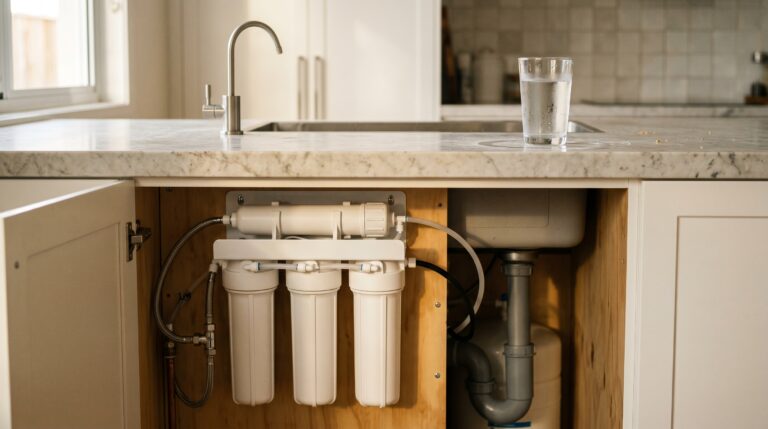
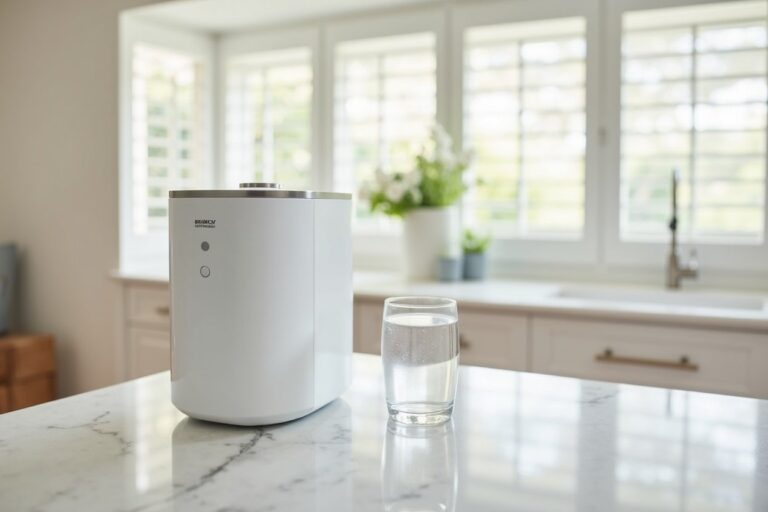
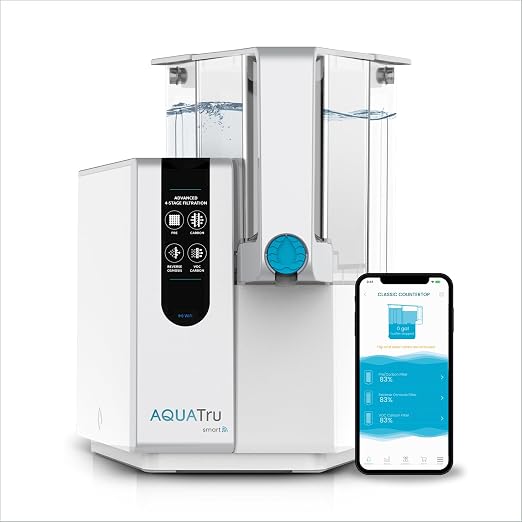
If you fall into any of those categories, a countertop reverse osmosis system handles all three at once — sediment, chlorine taste, and fluoride, if you want it removed. Our countertop water filter comparison covers the current options in detail.
Frequently Asked Questions
Does Hobart use chloramine or chlorine?
Hobart’s Greater Hobart supply uses free chlorine, not chloramine, according to TasWater’s published treatment process for the Bryn Estyn Water Treatment Plant. This means standard carbon or KDF filters work effectively — chloramine-specific vitamin C (ascorbic acid) filters, needed in Brisbane, Sydney, and Adelaide, are unnecessary in Hobart.
Is there PFAS in Hobart’s water?
TasWater tested all raw water catchments across Tasmania for PFAS in its most recent reporting period and recorded zero detections. This is separate from an unrelated PFOS detection in wastewater discharge from the Cambridge Sewage Treatment Plant near Hobart Airport, which is not connected to any drinking water catchment.
How much fluoride is in Hobart tap water?
TasWater’s compliance standard requires an annual average fluoride concentration between 0.8 and 1.1 mg/L for the Greater Hobart system, with a hard ADWG health limit of 1.5 mg/L. The utility reported zero fluoride exceedances and full compliance with the required average for the second consecutive year in its most recent report.
Where does Hobart’s tap water come from?
Greater Hobart’s water is sourced from the Derwent River, Lake Fenton, and multiple offtakes on kunanyi/Mount Wellington, treated at the Bryn Estyn Water Treatment Plant, which supplies an average of 60% of the water needs of more than 200,000 Hobartians.
Is Hobart’s tap water safe to drink without a filter?
Yes. TasWater reported 100% microbiological compliance across all 59 of its water systems for the sixth consecutive year, and full compliance with ADWG chemical/metals limits for the third consecutive year. No compliance events were recorded against the Greater Hobart system in the most recent reporting year.
Why does my water sometimes look discoloured in Hobart?
TasWater’s own reporting names discoloured water as the leading cause of customer complaints statewide (1,267 complaints in 2023-24), typically caused by sediment disturbance in ageing, corroding water mains rather than an issue with the treated water itself. TasWater has active projects replacing 16.5km of corroded mains in response.
Does Hobart have the best-tasting tap water in Australia?
Fern Tree, a locality on kunanyi/Mount Wellington within the Greater Hobart supply network, was awarded “Best Tasting Tap Water in Australia” in TasWater’s most recent reporting year — a result of low-turbidity source water from the forested mountain catchment.
How is Hobart’s water treated?
The Bryn Estyn plant uses multi-barrier treatment: clarification and flocculation to remove sediment, ozone oxidation to break down organics, biological activated carbon filtration, UV disinfection, chlorination, and fluoridation — in that order, per TasWater’s published process description.
Should I filter Hobart tap water for chlorine taste?
If you notice a chlorine taste, a basic activated carbon jug or inline filter removes it effectively, since Hobart uses free chlorine rather than chloramine. This is a taste preference, not a response to a documented safety issue — TasWater’s own compliance data shows the water meets every ADWG health parameter without filtration.
Data source: TasWater Annual Drinking Water Quality Report 2023-24. Last reviewed: August 2026 — Clean and Native.
Get the Australian Home Environment Checklist
30 checks across water, air and EMF. Most of them free. Ranked by impact.
No spam. Unsubscribe any time.

Former Royal Australian Navy Clearance Diver and TAG-E counter-terrorism operator. Founded Clean and Native to apply the same rigorous thinking to the home environment.
Full biography →