
Waterdrop X8 vs EcoHero 5-Stage RO: Which is the Better Buy for Australian Homes?
The Waterdrop X8 and EcoHero 5-Stage are the two strongest under-sink reverse osmosis systems available to Australian households in 2026. Both hold NSF/ANSI 58 certification for contaminant rejection, both remove fluoride, chloramine, PFAS, lead, and heavy metals, and both require under-sink installation with a dedicated faucet. The difference comes down to Australian plumbing compliance, smart features, form factor, local support, and long-term cost — and those differences matter more than most comparison sites admit.
Products we own are assessed using our documented methodology by Jayce Love with calibrated instruments, no gifted units, no brand payments. The Waterdrop X8 is assessed on its published NSF/ANSI certifications and manufacturer specifications.
I am a former Royal Australian Navy Clearance Diver based in Palm Beach, QLD. I tested the EcoHero 5-Stage in a chloramine-treated SEQ Water supply and measured tap TDS at 69 ppm dropping to 3 ppm post-RO — a 95.7% rejection rate at pH 7.4 — under real Australian conditions. The Waterdrop X8 is assessed on its NSF/ANSI 58 certification and published manufacturer specifications, not first-hand testing. This is not a spec-sheet comparison. It is a side-by-side assessment based on what actually matters when you turn on the tap.
Why This Comparison Matters for Australian Households
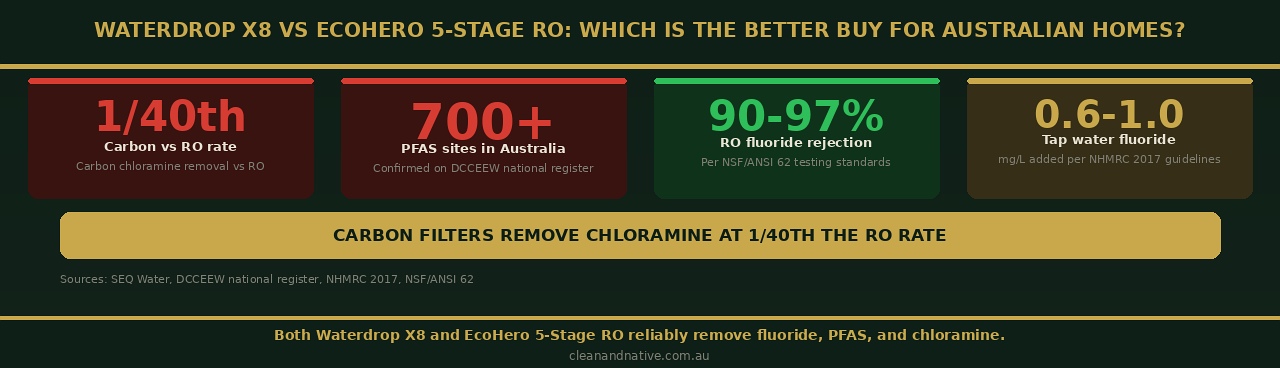
If you live in Brisbane, Sydney, Adelaide, Gold Coast, or Darwin, your municipal water supply is disinfected with chloramine — not free chlorine. According to SEQ Water and Sydney Water data, chloramine is used as the secondary disinfectant across several major Australian cities including Brisbane, Sydney, Adelaide, the Gold Coast, and Darwin, while Perth and Melbourne use free chlorine. Standard carbon jug filters and basic GAC cartridges remove chloramine at roughly 1/40th the rate they remove free chlorine. That is not a typo. It is why every water quality expert in Australia will tell you that a reverse osmosis membrane is the most reliable barrier for chloramine-treated supplies.
Beyond chloramine, Australian tap water contains fluoride at 0.6-1.0 mg/L (added under state health directives referencing the NHMRC 2017 guidelines), and PFAS contamination has been confirmed at over 700 sites across Australia according to the DCCEEW national register. The only consumer-grade technologies that reliably remove fluoride are reverse osmosis (90-97% rejection per NSF/ANSI 62 testing) and activated alumina (80-95%). Carbon filters — including catalytic carbon — cannot remove fluoride. If fluoride or PFAS removal is your primary concern, you need RO. Full stop.
Both the Waterdrop X8 and EcoHero 5-Stage are reverse osmosis systems. Both will handle chloramine, fluoride, PFAS, lead, and heavy metals. The question is not whether they work — it is which one fits your home, your budget, and your compliance requirements. That is what the rest of this article answers in detail.
Head-to-Head Specification Comparison
Specifications matter, but only when you understand what the numbers mean in practice. A system rated at 800 GPD sounds enormously faster than one rated at 50-75 GPD, but these numbers measure different things (instantaneous membrane capacity vs sustained tank-fed flow). Below is every meaningful spec side by side, with an outcome column explaining what each difference means for you.
| Specification | Waterdrop X8 | EcoHero 5-Stage | What It Means for You |
|---|---|---|---|
| System Type | Tankless (direct flow) | Tank-based (pressurised storage) | X8 saves under-sink space. EcoHero needs room for the tank but delivers consistent pressure. |
| Flow Rate | 800 GPD (~2.1 L/min) | 50-75 GPD (tank-fed, ~1.5 L/min at tap) | X8 fills a glass faster from cold start. EcoHero tank maintains steady flow for cooking and drinking. |
| Filtration Stages | 8 stages (incl. UV sterilisation) | 5 stages (sediment, carbon, RO, carbon post, alkaline) | More stages does not always mean better. Both have the core RO membrane that does the heavy lifting. |
| NSF Certifications | NSF/ANSI 42, 58, 372 | NSF/ANSI 58 | X8 also certified for aesthetic effects (42) and lead-free compliance (372). Both certified for TDS reduction (58). |
| WaterMark AS3497 | Not confirmed | ✓ Yes | EcoHero complies with Australian plumbing standards. Critical for rentals, insurance, and body corporate rules. |
| Waste Ratio | 2:1 (pure:waste) | Claims 300% more efficient than standard | Both are significantly better than old 3:1 or 4:1 systems. The X8’s 2:1 ratio is manufacturer-stated; EcoHero’s claim is relative. |
| Smart Faucet / TDS Display | ✓ Yes (LED faucet) | ✗ No | X8’s smart faucet shows real-time TDS and filter life. EcoHero requires a separate TDS meter (~$15). |
| UV Sterilisation | ✓ Yes | ✗ No | X8 includes UV as a final-stage kill step. Useful if you are on tank water or concerned about bacterial regrowth. |
| Remineralisation | ✓ Yes (alkaline stage) | ✓ Yes (alkaline stage) | Both add minerals back post-RO. Output TDS typically 20-40 mg/L depending on source water. |
| Price (AUD) | ~$799-$899 | $1,009-$1,059 | X8 is ~$150-$200 cheaper upfront. Long-term cost depends on filter replacement pricing. |
| Company Origin / Support | Chinese manufacturer, AU website | Pure Water Systems (Australian company) | EcoHero offers Australian phone/email support and local warranty service. X8 support is online-only. |
| Installation | Licensed plumber or skilled DIY | Licensed plumber or skilled DIY | Both require drilling the benchtop for the faucet. Budget $150-$250 for a plumber if you cannot DIY. |
WaterMark Compliance: Why It Matters More Than You Think
Here is the thing most comparison articles skip entirely: WaterMark certification to AS3497 is not just a nice-to-have sticker. In Australia, products connected to the plumbing system are required to comply with the Plumbing Code of Australia (PCA), which references WaterMark-certified products. According to the Australian Building Codes Board (ABCB), any product that connects to the drinking water supply must be certified and authorised under the WaterMark Certification Scheme. This is a legal compliance standard, not a marketing badge.
What does this mean in practice? If you own your home and install a non-WaterMark system yourself, you are unlikely to face enforcement. But if you are a renter, your landlord or property manager may require WaterMark-certified products as a condition of modifying plumbing. If you live in a body corporate or strata-titled property, the building manager almost certainly will. And if something goes wrong — a leak that causes water damage — your home insurance policy may reference AS3500 plumbing compliance when assessing your claim. A non-WaterMark system creates a potential gap in that chain of compliance.
The EcoHero 5-Stage holds WaterMark AS3497 certification. This is confirmed on the Pure Water Systems product page and can be verified on the ABCB WaterMark database. The Waterdrop X8, at the time of writing, does not appear to hold WaterMark certification in Australia. Waterdrop’s Australian website lists NSF/ANSI certifications but does not reference WaterMark or AS3497. I contacted Waterdrop AU to confirm and will update this article when I receive a response.
If you are a homeowner who plans to install the system permanently, the lack of WaterMark on the X8 is a calculated risk most people can accept. If you are a renter, in a strata property, or want maximum compliance assurance, the EcoHero is the safer choice on this single criterion alone.
Performance: Contaminant Removal Where It Counts
Both systems hold NSF/ANSI 58 certification, which is the gold standard for reverse osmosis system testing. NSF/ANSI 58 tests membrane rejection rates under controlled laboratory conditions at specified pressures, verifying removal of total dissolved solids, lead, arsenic, chromium, barium, cadmium, copper, radium 226/228, selenium, fluoride, nitrate/nitrite, and cyst organisms. If a system holds NSF 58, its RO membrane has been independently verified to remove these contaminants at the claimed rates.
The Waterdrop X8 carries three NSF certifications: NSF/ANSI 42 (aesthetic effects — taste, odour, chlorine), NSF/ANSI 58 (TDS and contaminant reduction), and NSF/ANSI 372 (lead-free material compliance). The additional 42 and 372 certifications demonstrate that Waterdrop has put the X8 through more extensive third-party testing. The 372 certification specifically confirms that wetted surfaces contain less than 0.25% weighted average lead content — a materials safety standard that protects against lead leaching from the system itself.
The EcoHero 5-Stage holds NSF/ANSI 58 certification. This covers the core contaminant rejection that matters: fluoride, lead, TDS, and the full suite of heavy metals and inorganics tested under NSF 58 protocol. It does the job. The absence of NSF 42 and 372 does not mean the EcoHero contains lead or fails on taste — it means those specific tests have not been independently verified and published for this product.
Chloramine Removal in Brisbane, Sydney, Adelaide, Gold Coast, and Darwin
Both systems will remove chloramine effectively through the RO membrane. This is the core reason I recommend under-sink RO for any household in a chloramine-treated city. If you live in Brisbane (SEQ Water), Sydney (Sydney Water via WaterNSW), Adelaide (SA Water), the Gold Coast, or Darwin (Power and Water Corporation), your standard carbon jug filter is performing at approximately 2.5% of the rate it would for free chlorine. That is not effective filtration. That is decoration.
For households in Melbourne, Hobart, Canberra, Townsville, Cairns, or Toowoomba — cities that use free chlorine — a quality carbon block filter can handle taste and chlorine adequately. But if you also want fluoride removal, PFAS removal, or heavy metal reduction, RO is still the right technology regardless of your disinfection type.
PFAS Removal
According to the DCCEEW national PFAS register, contamination has been confirmed at over 700 sites across Australia. PFAS compounds (PFOS, PFOA, PFHxS, and others) are not regulated under the Australian Drinking Water Guidelines (ADWG 2024) at enforceable limits, but health-based guidance values have been set by FSANZ. Both systems use RO membranes with pore sizes of approximately 0.0001 micrometres — far smaller than PFAS molecules. Independent testing of RO membranes consistently shows 95-99% rejection of PFAS compounds. The Waterdrop X8 additionally references NSF/ANSI P473 PFAS testing in some product literature, though this should be confirmed on the current Australian product page.
Design, Installation, and Daily Use
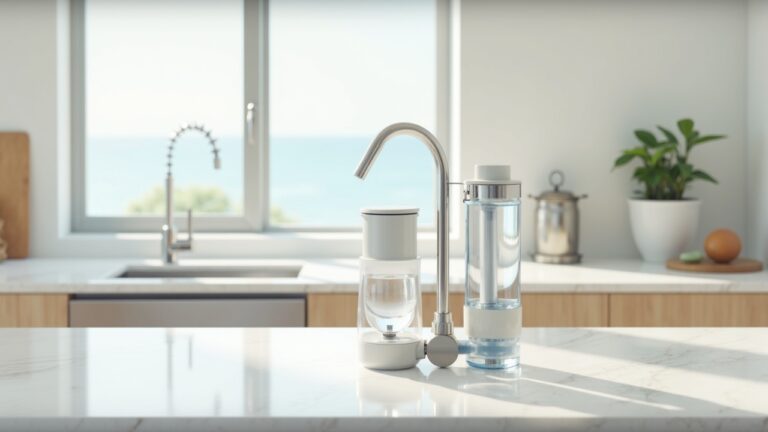
Waterdrop X8: Tankless Compact Design
The X8 is a tankless system. Instead of filtering water into a pressurised storage tank (the traditional RO approach), it uses a high-capacity membrane rated at 800 GPD to produce filtered water on demand. The practical benefit is significant: you save approximately 30-40% of under-sink cabinet space because there is no bulky tank to accommodate. For apartments in inner Sydney, compact kitchens in Brisbane townhouses, or any home where under-sink space is at a premium, this is a genuine advantage.
The smart LED faucet is the X8’s standout feature. It displays real-time TDS readings for both input (feed water) and output (filtered water), plus filter life remaining as a percentage. You know at a glance whether your filters are performing. You do not need a separate TDS meter. You do not need to guess when to replace filters. The faucet tells you. Waterdrop rates the X8 for high TDS rejection under NSF 58 test conditions; on mains water an RO system of this class produces low output TDS, rising after the remineralisation stage adds minerals back.
The UV sterilisation stage is a final kill step that neutralises bacteria and viruses post-membrane. For municipal water supplies, this is arguably redundant — the water is already disinfected. But if you are on rainwater tank supply (common in rural QLD, NSW, and parts of Victoria), or if you are concerned about bacterial regrowth in the post-filter pathway, the UV stage adds a genuine safety margin.
EcoHero 5-Stage: Tank-Based Traditional Design
The EcoHero uses a conventional pressurised storage tank. Water is filtered slowly through the RO membrane and stored in the tank under pressure, ready to dispense at the faucet. The rated production is 50-75 GPD, which sounds dramatically slower than the X8’s 800 GPD. But here is the nuance: you are not waiting for the system to produce water in real time. The tank pre-fills. When you turn the faucet, you get water at full pressure from the tank until it empties — typically 8-12 litres of stored water. For a household drinking and cooking 4-8 litres per day, the tank refills between uses and you never notice the lower production rate.
The trade-off is space. The EcoHero’s tank is approximately 28 cm in diameter and 38 cm tall. Combined with the filter housing, you need a full under-sink cabinet. In larger Australian kitchens with standard 600mm cabinets, this is fine. In compact apartments, it can be tight.
The EcoHero faucet is a standard chrome or brushed nickel dedicated RO faucet — no TDS display, no smart features. You monitor filter life based on time or by using a separate handheld TDS meter (a TDS-3 meter costs approximately $15 on Amazon AU). This is not a flaw; it is a simpler approach that eliminates electronic components that could fail.
Installation Reality
Both systems require drilling a hole in your benchtop for the dedicated faucet and connecting to the cold water supply line under the sink. Both also require a drain connection for waste water. This is not a five-minute job. If you are handy with plumbing and comfortable using a hole saw on stone or laminate, you can DIY in 60-90 minutes. Otherwise, budget $150-$250 for a licensed plumber.
Critical for renters: Drilling a hole in the benchtop is a permanent modification. Most landlords will not approve this without written consent. The EcoHero’s WaterMark certification makes the conversation easier — you can demonstrate the system meets Australian plumbing standards. With the X8, you may face additional resistance if the property manager or body corporate requires WaterMark compliance.
5-Year Cost Comparison
Upfront price is only part of the equation. Filter replacement costs over 5 years determine the true cost of ownership. Without factoring in ongoing filter spend, you are comparing sticker prices, not real costs. Below is a realistic 5-year cost projection based on manufacturer-recommended replacement intervals and current Australian pricing.
| Cost Component | Waterdrop X8 | EcoHero 5-Stage |
|---|---|---|
| Upfront Price (AUD) | ~$849 | ~$1,035 |
| Annual Filter Cost (est.) | ~$180-$220/year | ~$150-$190/year |
| 5-Year Total Cost | ~$1,749-$1,949 | ~$1,785-$1,985 |
| Cost per Litre (4L/day) | ~$0.24-$0.27/L | ~$0.24-$0.27/L |
| vs Bottled Water (5 years) | Bottled water at $2/L × 4L/day × 365 × 5 = $14,600 | |
The annual filter cost estimates above are based on manufacturer replacement schedules: the X8 uses proprietary twist-and-lock filters that are replaced at 6-12 month intervals depending on the stage, while the EcoHero uses standard-size cartridges that are more widely available from Australian suppliers. The EcoHero’s filter replacement packs are available directly from Pure Water Systems with Australian shipping. The X8’s filters must be ordered from Waterdrop’s Australian website or international marketplace.
The bottom line on cost: Over 5 years, both systems land in the same ballpark — approximately $1,750-$1,950 total for clean, fluoride-free, PFAS-free, chloramine-free drinking water. At $0.24-$0.27 per litre, either system costs roughly one-eighth what bottled water costs. The X8 is cheaper upfront; the EcoHero may have slightly lower annual filter costs. Neither has a decisive cost advantage over the full ownership period.
Who Should Buy the Waterdrop X8
The X8 is the better choice if you value compact design, smart monitoring, and lower upfront cost. Specifically:
- Small kitchens and apartments: If your under-sink cabinet is cramped — common in inner Brisbane, Sydney, and Melbourne apartments — the tankless design reclaims significant space.
- Tech-forward households: The smart LED faucet with real-time TDS display and filter life monitoring eliminates guesswork. You know exactly when your filters need replacing and can verify performance every time you pour a glass.
- Rainwater tank homes: If you are on tank water in rural QLD, NSW, or Victoria, the UV sterilisation stage adds a genuine bacterial safety margin that the EcoHero lacks.
- Budget-conscious buyers: At approximately $150-$200 less upfront, the X8 gets you into a certified RO system for less cash out of pocket.
- Homeowners (not renters): If you own your home and are not concerned about WaterMark compliance for body corporate or insurance, the X8 performs just as well as the EcoHero on water quality.
Who Should Buy the EcoHero 5-Stage
The EcoHero is the better choice if Australian compliance, local support, and proven simplicity matter to you. Specifically:
- Renters and strata residents: WaterMark AS3497 certification makes the compliance conversation with landlords and body corporate simple. You can point to an ABCB-registered product that meets the Plumbing Code of Australia.
- People who want Australian support: Pure Water Systems is an Australian company with phone and email support during Australian business hours. When you have a question about installation, a filter replacement issue, or a warranty claim, you are speaking to someone in Australia — not navigating an international support ticket system.
- Those who prefer simplicity: No electronics in the faucet. No UV lamp to replace. No smart features to malfunction. The EcoHero is a proven mechanical filtration system with fewer points of failure.
- Households that value filter availability: The EcoHero uses standard-size replacement cartridges that are available from multiple Australian suppliers, not just the original manufacturer. If Waterdrop ever exits the Australian market or changes their filter design, X8 owners could face supply issues. EcoHero’s standard cartridges reduce that risk.
- Insurance-conscious homeowners: If you want zero ambiguity in your plumbing compliance chain, WaterMark certification eliminates the question.
Decision Tree: Which Under-Sink RO System Is Right for You?
If you are still undecided, answer these three questions:
1. Are you a renter, in a strata property, or need WaterMark compliance?
Yes → EcoHero 5-Stage. WaterMark AS3497 is a non-negotiable requirement in these contexts.
No → Move to question 2.
2. Is under-sink space limited (less than 40cm depth available after plumbing)?
Yes → Waterdrop X8. The tankless design fits where a tank-based system cannot.
No → Move to question 3.
3. Do you want smart TDS monitoring and UV sterilisation, or do you prefer maximum simplicity?
Smart features → Waterdrop X8.
Simplicity and local support → EcoHero 5-Stage.
How Both Compare to Other Options
The Waterdrop X8 and EcoHero 5-Stage are not the only under-sink RO systems available in Australia. Two other contenders worth mentioning:
Waterdrop D6 Under-Sink RO: A more affordable entry point from Waterdrop, the D6 is a tankless system with fewer filtration stages and no UV sterilisation. If the X8 is more than you need, the D6 offers core RO performance at a lower price point. Waterdrop D6 review
AquaTru Classic RO (Countertop): If you cannot modify your plumbing at all — perhaps you are renting with a no-modification lease — the AquaTru Classic countertop RO is the best alternative. No installation, no drilling, no plumber. It sits on your benchtop and delivers NSF 58 certified RO filtration. The trade-off is lower capacity and you need to manually refill the tank.
For a complete ranking of every under-sink system available in Australia, see our best under-sink water filter Australia 2026 guide.
Final Verdict
Both the Waterdrop X8 and EcoHero 5-Stage are excellent reverse osmosis systems that will deliver actually clean drinking water to your Australian home. Both remove chloramine, fluoride, PFAS, lead, and heavy metals. Both hold NSF/ANSI 58 certification. Both cost approximately the same over 5 years. You are not making a bad decision with either one.
Choose the EcoHero 5-Stage if: WaterMark compliance matters (renters, strata, insurance), you want Australian phone support, and you prefer proven mechanical simplicity with no electronics in the faucet.
Choose the Waterdrop X8 if: You want the smart TDS faucet, UV sterilisation, compact tankless design, and a lower upfront price — and you own your home with no compliance constraints.
The worst outcome here is analysis paralysis. Every day you delay, you are drinking unfiltered chloramine, fluoride, and whatever trace contaminants your municipal supply carries. Either system solves that problem from the day it is installed. Pick the one that fits your situation, book a plumber, and move on.
Ready to filter your water?
Both systems remove fluoride, PFAS, chloramine, and heavy metals. The EcoHero offers WaterMark compliance and Australian support. The Waterdrop X8 delivers smart monitoring and compact design at a lower price.
Last reviewed: June 2026 — Clean and Native
Frequently Asked Questions
Does the Waterdrop X8 have WaterMark certification in Australia?
At the time of writing, the Waterdrop X8 does not appear to hold WaterMark AS3497 certification. It holds NSF/ANSI 42, 58, and 372 certifications, which are international water quality standards. WaterMark is an Australian plumbing compliance certification referenced by the Plumbing Code of Australia.
Can either system remove chloramine from Brisbane or Sydney tap water?
Yes. Both the Waterdrop X8 and EcoHero 5-Stage use reverse osmosis membranes that effectively remove chloramine. Brisbane (SEQ Water), Sydney (Sydney Water), Adelaide, Gold Coast, and Darwin all use chloramine as a secondary disinfectant. Standard carbon jug filters remove chloramine at approximately 1/40th the rate they remove free chlorine — RO is the reliable solution.
Do these systems remove fluoride from Australian tap water?
Yes. Reverse osmosis removes fluoride at 90-97% rejection rates according to NSF/ANSI 58 testing protocols. Australian tap water contains fluoride at 0.6-1.0 mg/L under state health directives. Carbon filters — including catalytic carbon — cannot remove fluoride. Only RO or activated alumina achieves meaningful fluoride reduction.
Which system has lower running costs over 5 years?
Both systems cost approximately $1,750-$1,950 over 5 years including the purchase price and filter replacements. The Waterdrop X8 is cheaper upfront by approximately $150-$200, but annual filter costs are marginally higher. At a household usage of 4 litres per day, both work out to approximately $0.24-$0.27 per litre.
Can I install either system myself, or do I need a plumber?
Both systems require drilling a hole in your benchtop for the dedicated faucet and connecting to the cold water supply and drain lines. Skilled DIY installers can complete this in 60-90 minutes. If you are not comfortable with plumbing connections, budget $150-$250 for a licensed plumber. Both installations are permanent modifications.
Is the EcoHero better for renters than the Waterdrop X8?
Yes. The EcoHero’s WaterMark AS3497 certification meets the Plumbing Code of Australia requirements, making it easier to get approval from landlords, property managers, and body corporate committees. If you cannot modify your plumbing at all, consider a countertop RO system like the AquaTru Classic instead.
Does the Waterdrop X8 smart faucet require electricity?
Yes. The X8 system requires a power connection for the UV sterilisation and the smart LED faucet TDS display. The EcoHero 5-Stage is entirely mechanical and requires no power connection. The X8 plugs into a standard Australian power point, typically located under the sink for dishwashers or waste disposal units.
Which system is better for tank water or bore water in regional Australia?
The Waterdrop X8 has an advantage for tank water and bore water due to its UV sterilisation stage, which provides a final kill step for bacteria and viruses. Tank water in rural QLD, NSW, and Victoria can contain coliform bacteria and other microorganisms. The EcoHero’s RO membrane will physically reject bacteria, but the X8’s UV stage adds an additional safety margin. For bore water with very high TDS (above 500 mg/L), consult the manufacturer about membrane longevity at elevated mineral loads.
What happens if Waterdrop exits the Australian market — can I still get filters?
The Waterdrop X8 uses proprietary twist-and-lock filter cartridges that are only available from Waterdrop. If the company exits the Australian market, replacement filters may need to be sourced internationally. The EcoHero 5-Stage uses standard-size replacement cartridges available from multiple Australian water filter suppliers, reducing long-term supply risk.
Get the Australian Home Environment Checklist
30 checks across water, air and EMF. Most of them free. Ranked by impact.
No spam. Unsubscribe any time.

Former Royal Australian Navy Clearance Diver and TAG-E counter-terrorism operator. Founded Clean and Native to apply the same rigorous thinking to the home environment.
Full biography →