Best EMF Phone Case for iPhone 16 Australia (2026)
The best EMF phone case for the iPhone 16 in Australia is a shielded wallet-style case that places a layer of RF-attenuating fabric between the phone’s antenna array and your body, reducing SAR exposure by up to 99% on the shielded side according to FCC-accredited lab testing. For Australian buyers, the two options worth considering are a fitted shielded wallet case for everyday carry and a faraday pouch for complete signal isolation during sleep or transit — and the choice depends on whether you want to keep using your phone while it is protected.
I am a former Royal Australian Navy Clearance Diver, and I approach EMF the same way I approach every other risk assessment: measure first, then act on data. Our testing methodology is documented here, and this review prioritises FCC-accredited lab data and manufacturer SAR specifications over marketing claims. This article covers the iPhone 16 lineup specifically — including the SAR values Apple reported to the FCC, the UWB chip consideration, and which cases actually fit the 6.9-inch iPhone 16 Pro Max. If you want the broader comparison across all phone brands, read our roundup of the best EMF phone cases in Australia.
Quick Verdict — Best EMF Phone Case for iPhone 16 (2026)
For daily iPhone 16 protection, a shielded wallet case with FCC-accredited lab-tested attenuation is the strongest verified option. For complete signal blocking during sleep or when you do not need your phone active, the Radia Smart Cell Phone Faraday Bag is the most practical faraday-style solution available to Australian buyers. Both approaches reduce RF exposure — the difference is whether you want your phone functional or fully isolated.
| Pick | Best For | Type | Fits iPhone 16 Pro Max? |
|---|---|---|---|
| SafeSleeve iPhone 16 Case | Everyday carry | Shielded wallet | Model-specific sizing |
| Radia Smart Faraday Pouch | Sleep / full isolation | Faraday pouch | Universal — fits all models |
iPhone 16 SAR Values Explained — What the FCC Numbers Actually Mean
Every phone sold in Australia must comply with ARPANSA‘s electromagnetic energy (EME) exposure limits, which align with the ICNIRP guidelines adopted internationally. The specific absorption rate (SAR) measures how much RF energy your body absorbs per kilogram of tissue when the phone transmits at maximum power. The FCC tests and publishes these values for every phone model, and Apple’s iPhone 16 (standard model) reports the following according to FCC ID filings:
| Measurement Position | SAR Value (W/kg, 1g tissue avg) | FCC Limit |
|---|---|---|
| Head | 1.17 W/kg | 1.6 W/kg |
| Body (5mm separation) | 0.95 W/kg | 1.6 W/kg |
| Hotspot / simultaneous transmission | 0.99 W/kg | 1.6 W/kg |
Those numbers sit within the FCC’s 1.6 W/kg limit (1g tissue average), and they are also within the ARPANSA reference level of 2.0 W/kg (10g tissue average, ICNIRP standard). The head SAR of 1.17 W/kg is not the lowest Apple has ever produced — the iPhone 15 reported a head SAR of approximately 1.14 W/kg — but the difference between models is marginal. What matters more is understanding that SAR is tested at maximum transmit power, a condition your phone hits when it has weak signal (one bar, rural areas, inside buildings with poor reception). In a strong 5G coverage area in Brisbane or Sydney CBD, actual exposure is a fraction of the SAR ceiling.
The iPhone 16 also includes Apple’s U2 Ultra Wideband (UWB) chip, which operates between 6 GHz and 8.5 GHz for Precision Finding and AirTag features. This is an additional RF source beyond the standard cellular, Wi-Fi, and Bluetooth bands. For shielded case selection, this means the shielding material must attenuate across a broader frequency range than older iPhones required. A case that blocks 2.4 GHz Wi-Fi but allows 6+ GHz UWB to pass through unimpeded is not providing complete protection. Look for cases that specify broadband RF attenuation across multiple frequency bands, not just a single test frequency.
Case Compatibility — Not All EMF Cases Fit the iPhone 16 Pro Max
This is the practical detail that most EMF case marketing glosses over, and it is the detail that leads to returns and frustration for Australian buyers. The iPhone 16 lineup spans four distinct physical dimensions:
| Model | Screen | Dimensions (mm) | Case Compatibility Note |
|---|---|---|---|
| iPhone 16 | 6.1″ | 147.6 x 71.6 x 7.80 | Standard size — most EMF cases available |
| iPhone 16 Plus | 6.7″ | 160.9 x 77.8 x 7.80 | Larger body — verify case listing says “Plus” |
| iPhone 16 Pro | 6.3″ | 149.6 x 71.5 x 8.25 | Different camera cutout from standard 16 |
| iPhone 16 Pro Max | 6.9″ | 163.0 x 77.6 x 8.25 | Largest iPhone ever — check Pro Max specific listing |
The iPhone 16 Pro Max at 163.0 mm tall is the largest iPhone Apple has ever made. If you order a case labelled “iPhone 16” without checking the exact model variant, it will not fit a Pro Max. Some shielded case manufacturers release model-specific SKUs weeks or months after the phone launch, so always confirm the listing specifies your exact model before purchasing. An ill-fitting case is worse than no case — gaps between the shielding material and your body reduce attenuation, and a case that does not properly close over the screen loses the shielded-side benefit entirely.
For universal faraday pouches like the Radia Smart, sizing is less of a concern because the pouch is designed to accommodate phones up to 6.9 inches. But for fitted wallet-style cases, you need the exact SKU for your iPhone 16 variant.
Best Shielded Wallet Case for iPhone 16 — SafeSleeve

DefenderShield EMF Phone Case for iPhone 16
FCC-accredited lab-tested RF attenuation on the body-facing side. Blocks cellular, Wi-Fi 2.4/5 GHz, and Bluetooth while your phone stays fully functional — the strongest verified everyday-carry option for iPhone 16.
Check Price at DefenderShield →The shielded wallet case category is the most practical option for everyday carry because it reduces body-side RF exposure while letting you use your phone normally. The shielding works only when the wallet flap is closed between the phone and your body — it does not block radiation from the screen side when you are holding the phone to your ear. This is a critical distinction that most marketing obscures. For a deeper explanation of the physics, read our guide on how EMF phone cases actually work.
SafeSleeve is the most established brand in this category, and they produce model-specific cases for the iPhone 16 lineup. Their cases use a multi-layer shielding fabric embedded in the wallet flap that they claim attenuates up to 99% of RF radiation on the shielded side, based on FCC-accredited lab testing across frequencies including cellular, Wi-Fi (2.4 GHz and 5 GHz), and Bluetooth bands. Key features for the iPhone 16 version:
- Model-specific fit: Separate SKUs for iPhone 16, 16 Plus, 16 Pro, and 16 Pro Max. Camera cutouts match each model’s triple-lens array.
- Wallet functionality: Card slots in the shielded flap, so the shielding material sits between the phone and your hip/thigh when in a pocket.
- MagSafe compatibility: Newer SafeSleeve models support MagSafe charging with the flap open. Verify the listing confirms iPhone 16 MagSafe compatibility before purchase.
- Drop protection: Military-grade drop tested (MIL-STD-810G), which adds practical value beyond EMF reduction.
The honest limitation: When you hold the phone to your ear for a call, the shielded flap is open and the screen side faces your head — the case provides zero head SAR reduction in that position. For head exposure reduction, you need to pair the case with a DefenderShield air-tube headset or use speakerphone. The case is a body-side solution, not a whole-device blocker.
Best Faraday Pouch for iPhone 16 — Radia Smart Cell Phone Faraday Bag

Radia Smart Cell Phone Faraday Bag
Universal-fit faraday pouch with multi-layer silver-woven fabric that blocks all RF signals — cellular, Wi-Fi, Bluetooth, NFC, and UWB. Fits every iPhone 16 model including Pro Max. No model-specific sizing needed.
Check Price on Amazon AU →If your goal is complete signal isolation — during sleep, during meetings, or whenever you want your phone to stop transmitting entirely — a faraday pouch is the correct tool. Unlike a shielded wallet case that blocks one side, a faraday pouch wraps the phone in conductive fabric on all sides, blocking all incoming and outgoing RF signals including cellular, Wi-Fi, Bluetooth, NFC, and UWB.
The Radia Smart Cell Phone Faraday Bag is a universal-fit faraday pouch that accommodates phones up to 6.9 inches, which means it fits every iPhone 16 model including the Pro Max. It uses a multi-layer silver-woven fabric lining that blocks RF signals across a broad frequency range. When your phone is inside with the pouch sealed, it cannot send or receive any wireless signal — calls go to voicemail, notifications stop, and location tracking ceases.
Practical considerations for Australian buyers:
- Availability: Available on Amazon AU.
- Universal fit: No model-specific sizing needed. Fits iPhone 16, 16 Plus, 16 Pro, and 16 Pro Max.
- Use case: Best for nightstand placement during sleep (eliminates all RF from the phone without needing airplane mode), carrying your phone when you do not need it active, or privacy-conscious situations.
- Trade-off: Your phone is unreachable while inside the pouch. No calls, no messages, no alarms. This is a feature, not a bug — but you need to understand it before buying.
A faraday pouch only blocks RF when it is fully sealed. Opening the pouch by even 1 cm at the top allows signal leakage, so proper closure is essential. A half-sealed pouch is a waste of money.
iPhone 16 EMF Protection — Top Picks
What to Avoid — Stickers, Shungite, and Unverified “EMF Protection”
The EMF phone case market is full of products that cannot demonstrate measurable RF attenuation. Before you spend money, here is what to avoid:
Anti-radiation stickers and stick-on chips: These small adhesive patches claim to “harmonise” or “neutralise” phone radiation. There is no peer-reviewed evidence or FCC-accredited lab test showing any RF attenuation from a sticker placed on the back of a phone. A sticker has no conductive shielding layer, no faraday cage properties, and no measurable effect on SAR. According to ARPANSA’s published guidance on EMF and health, products claiming to reduce phone radiation should be able to demonstrate attenuation through independent testing — stickers cannot.
Shungite phone plates: Shungite is a carbon-rich mineral marketed as an EMF absorber. While carbon materials can interact with electromagnetic fields at certain frequencies in laboratory conditions, a thin polished shungite plate stuck to a phone case has no demonstrated broadband RF attenuation at cellular frequencies (700 MHz to 3.5 GHz for 4G/5G). No FCC-accredited lab report supports shungite phone plates as effective SAR reduction devices.
Cases with no test data: If a case claims “EMF protection” but cannot point to an independent lab test showing RF attenuation in dB or percentage across specified frequencies, treat it as a marketing claim. Reputable shielded cases reference specific FCC-accredited laboratory testing (such as RF Exposure Lab or MiCOM Labs) with stated attenuation figures across cellular, Wi-Fi, and Bluetooth bands.
The simple test: Put your phone in the product, try to call it from another phone. If it rings, the product is not blocking RF. A genuine faraday pouch will send calls to voicemail. A genuine shielded case will not block calls (it shields one side only), but the manufacturer should be able to show lab data proving the shielded-side attenuation. If they cannot produce that data, keep your money.
How a Phone Case Fits Into a Complete EMF Reduction Strategy
A shielded case or faraday pouch addresses one source of RF exposure — your phone. But your phone is not the only RF emitter in your home. Your Wi-Fi router, smart meter (Australian smart meters transmit at 900 MHz in bursts, with peak readings 100-1,000x higher than time-averaged values), Bluetooth devices, and baby monitors all contribute to your total RF environment. A phone case without addressing the bedroom is like fitting one wheel to a car.
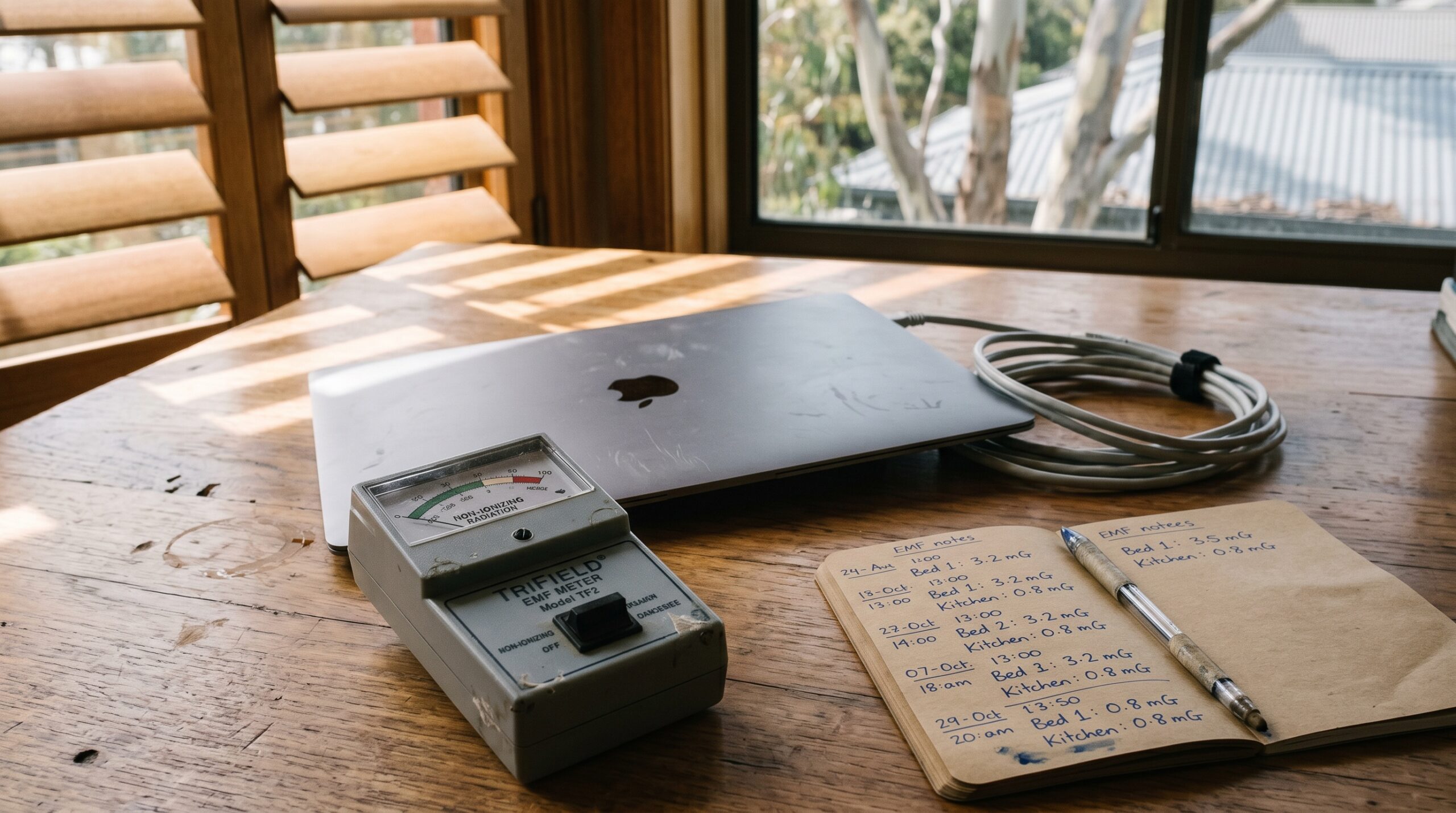
The highest-impact actions for your sleep environment cost almost nothing. A Jackson 24hr Mechanical Timer (~$20) on your Wi-Fi router kills RF during sleep hours automatically. Phone on airplane mode eliminates phone RF entirely — for free. If you want to verify what is actually reaching your bedroom, measure your bedroom RF levels with a TriField TF2 or Safe and Sound Pro II before spending money on any shielding product.
The correct sequence, based on Building Biology SBM-2015 principles, is always: measure, then remove sources, then shield external residual only. Do not buy a phone case and assume the job is done. Measure your bedroom, identify what is transmitting, eliminate what you can at the source, and use shielding products for what remains.
Final Verdict
For everyday iPhone 16 carry, a shielded wallet case with FCC-accredited lab attenuation data is the most practical choice — it reduces body-side SAR while keeping your phone functional. For sleep and complete signal isolation, the Radia Smart Cell Phone Faraday Bag fits all iPhone 16 models and eliminates all RF when properly sealed. Pair either with a DefenderShield air-tube headset for calls to address head SAR — the one exposure pathway no case solves.
Skip the stickers. Skip the shungite. Spend your money on products that can prove they work, and start with the free actions that deliver the biggest reduction: airplane mode at night and a timer on your router.
Start with measurement. The TriField TF2 is the only meter you need.
Measures AC magnetic, AC electric, and RF in one device. I use it for every room audit at the Palm Beach house. Without real readings, every EMF decision is a guess.
Last reviewed: June 2026 — Clean and Native
Frequently Asked Questions
The iPhone 16 has a head SAR of 1.17 W/kg and a body SAR of 0.95 W/kg (FCC, 1g tissue average). The hotspot/simultaneous transmission SAR is 0.99 W/kg. All three values are within the FCC limit of 1.6 W/kg and the ARPANSA/ICNIRP limit of 2.0 W/kg (10g average).
Yes. The iPhone 16 Pro Max measures 163.0 x 77.6 mm with a 6.9-inch screen — the largest iPhone ever made. A case designed for the standard iPhone 16 (147.6 x 71.6 mm, 6.1-inch screen) will not fit. Always order the model-specific SKU matching your exact iPhone 16 variant.
Shielded wallet cases do not affect Face ID because the shielding material is in the wallet flap, not over the screen or TrueDepth camera array. When you open the flap to use your phone, Face ID functions normally. Faraday pouches block all signals including Face ID, but you remove the phone from the pouch to use it.
Most shielded wallet cases allow MagSafe charging with the wallet flap open, because the shielding layer is in the flap, not the back of the case. Check the specific product listing to confirm MagSafe compatibility for your model, as some older designs interfere with the magnetic alignment.
The iPhone 16’s U2 Ultra Wideband chip transmits at 6-8.5 GHz, a higher frequency band than standard cellular or Wi-Fi. Shielding effectiveness varies by frequency, so a case tested only at 2.4 GHz may not attenuate UWB signals equally. Look for cases with broadband attenuation data across multiple frequency ranges.
No. Anti-radiation stickers have no conductive shielding layer and no peer-reviewed evidence or FCC-accredited lab testing showing measurable RF attenuation. ARPANSA guidance states that products claiming to reduce phone radiation should demonstrate attenuation through independent testing — stickers cannot.
Airplane mode is free and achieves the same result — eliminating all cellular, Wi-Fi, and Bluetooth transmissions. A faraday pouch is useful if you do not trust airplane mode to disable all radios (some phones maintain certain connections), or if you want a physical guarantee of signal isolation. For sleep, airplane mode is the simplest first step.
SafeSleeve cases are available through Amazon AU and their direct website, with shipping to Australia. The Radia Smart Cell Phone Faraday Bag ships from Amazon AU. DefenderShield air-tube headsets are available through SaferEMF Australia at saferemf.com.au. Local retail stock for shielded cases is limited in Australia — online purchase is the primary channel.
Get the Australian Home Environment Checklist
30 checks across water, air and EMF. Most of them free. Ranked by impact.
No spam. Unsubscribe any time.

Former Royal Australian Navy Clearance Diver and TAG-E counter-terrorism operator. Founded Clean and Native to apply the same rigorous thinking to the home environment.
Full biography →