Water Filter Cartridge Replacement Guide: When to Replace and How Much It Costs
A water filter cartridge that is past its service life does not just stop working — it becomes a breeding ground for bacteria and can release trapped contaminants back into your water. According to NSF International testing protocols, carbon block cartridges that exceed their rated capacity show measurable breakthrough of chlorine, VOCs, and in some cases lead. For Australian households, the stakes are higher than most realise: if you live in a chloramine city like Brisbane, Sydney, Adelaide, Gold Coast, or Darwin, a spent standard GAC cartridge was barely removing your disinfectant from day one — let alone after six months of use.
This guide is the definitive Australian resource for cartridge replacement. I am Jayce Love, former Royal Australian Navy Clearance Diver, and I built Clean & Native to cut through the vague advice that dominates this space. Below, you will find exact replacement schedules matched to Australian water chemistry by city, a transparent cost table with real AUD pricing, and a cartridge-type comparison that accounts for local hardness, chloramine, PFAS, and fluoride — contaminants addressed in the NHMRC’s updated Australian Drinking Water Guidelines (June 2025 PFAS guidance update).
Disclosure on testing: I have not personally tested the AquaTru, Waterdrop, Brita, Tappwater, or Berkey systems discussed in this guide; this assessment is based on published manufacturer specifications and independent certification (NSF/ANSI, WaterMark AS3497), not first-hand measurement. The only products I measure first-hand are the EcoHero 5-Stage RO, TriField TF2, and Coway Airmega 150.
Why Replacement Timing Is the Single Most Important Decision After Buying Your Filter
You spent $300, $500, maybe $900 on a quality water filtration system. You installed it. You felt good about it. Then you forgot about it for 14 months. Here is what happened inside that filter housing: the activated carbon became saturated, lost its adsorption capacity, and began channelling — water found the path of least resistance through the media, bypassing filtration entirely. According to NSF/ANSI 42 and 53 testing standards, every filter is rated for a specific volume of water (measured in litres) at a specific flow rate. Exceed that volume, and the manufacturer’s performance claims no longer apply.
That is the technical explanation. The practical consequence is worse. In warm Australian climates — particularly in Brisbane (SEQ), Darwin, and coastal Queensland — saturated carbon filters become ideal bacterial growth environments. Water sitting in a warm filter housing at 28-32°C ambient temperature accelerates biofilm development. Peer-reviewed research on point-of-use carbon filters has found that bacterial counts can exceed influent (tap) water levels when cartridges are used well beyond their rated life. You are not just getting unfiltered water — you are getting water that is potentially worse than what comes out of the tap.
The cost of not replacing your cartridge is not zero. It is negative. You are paying to make your water worse. That is the reality most filter companies do not advertise, because they would rather sell you a system and hope you forget about the ongoing cost.
Australian Cartridge Types Compared: Polyspun, Pleated, String-Wound, Carbon Block, Catalytic Carbon, and RO Membranes
If you have ever searched for a replacement cartridge on an Australian supplier’s website, you have been confronted with a wall of options — polyspun sediment, pleated washable, string-wound, granular activated carbon (GAC), carbon block, catalytic carbon, ceramic, and RO membranes. Most guides treat these as interchangeable “sediment filters” or “carbon filters.” They are not. Each type has a specific function, a specific weakness, and — critically for Australians — a specific interaction with your local water chemistry.
Sediment Pre-Filters (Stage 1 in Most Systems)
Polyspun (melt-blown polypropylene): The workhorse of Australian sediment filtration. Gradient density construction means the outer layers catch larger particles (50-20 microns) while the inner core catches fine sediment down to 1-5 microns. Non-washable, single-use. Ideal for Australian bore water and rural tank water where sediment loads are high. Typical lifespan: 6-12 months depending on source water turbidity. Cost: $8-15 per cartridge from Australian suppliers like Aquasafe or PSI Water Filters.
Pleated polyester: Washable and reusable — but this is a double-edged sword. The pleated surface area is roughly 5-6x that of a polyspun cartridge of the same physical size, meaning higher flow rates and longer service between cleans. However, washing cannot restore 100% of the original capacity. After 3-4 wash cycles, particle retention drops measurably. Best suited for pre-treated mains water in metropolitan areas (Melbourne, Sydney, Brisbane) where sediment loads are low but you want to protect a downstream carbon or RO stage. Cost: $15-25 per cartridge, with 3-6 months between washes and 12-18 months total life.
String-wound (wound cotton or polypropylene): The cheapest option at $5-10 per cartridge. Effective for large particulate, but inconsistent micron rating due to manufacturing variation. The wound channels can create preferential flow paths (channelling) faster than polyspun. I do not recommend these for drinking water systems — acceptable for a garden irrigation pre-filter or a first stage on a bore water system where you are discarding large debris.
| Cartridge Type | Micron Rating | Washable? | Typical Lifespan | Cost (AUD) | Best For | Removes Chloramine? |
|---|---|---|---|---|---|---|
| Polyspun PP | 1-50 µm | No | 6-12 months | $8-15 | Sediment pre-filtration | No |
| Pleated polyester | 1-20 µm | Yes (3-4 cycles) | 12-18 months | $15-25 | Low-sediment mains water | No |
| String-wound | 5-100 µm | No | 3-6 months | $5-10 | Bore/irrigation pre-filter | No |
| Standard GAC | 20-50 µm (nominal) | No | 6-12 months | $15-35 | Taste/odour, free chlorine only | No (~1/40th rate) |
| Carbon block (compressed) | 0.5-10 µm | No | 6-12 months | $25-55 | Chloramine, VOCs, cysts | Yes (slow flow) |
| Catalytic carbon | 0.5-10 µm | No | 6-12 months | $35-70 | Chloramine cities (Brisbane, Sydney, Gold Coast) | Yes |
| Ceramic | 0.2-0.9 µm | Yes (scrub/clean) | 6-12 months | $40-80 | Bacteria, sediment in tank/bore water | No |
| RO membrane | 0.0001 µm (0.1 nm) | No | 24-36 months | $60-150 | PFAS, fluoride, chloramine, heavy metals | Yes (90-97%) |
Carbon Filters: The Critical Distinction for Australian Households
This is where most Australians make the most expensive mistake. Standard granular activated carbon (GAC) removes free chlorine effectively but removes chloramine at approximately 1/40th the rate. That is not a typo. If you live in Brisbane, Sydney, Adelaide, Gold Coast, or Darwin — all chloramine-treated cities — a standard GAC cartridge like the ones in Brita jugs and many fridge filters is doing almost nothing for your primary disinfectant.
Chloramine removal requires catalytic carbon, compressed carbon block with sufficient contact time, or reverse osmosis. This means your replacement cartridge choice must be matched to your city’s disinfection type. Melbourne, Hobart, Canberra, Townsville, Cairns, and Toowoomba use free chlorine — standard carbon works fine there. But if you are in south-east Queensland, greater Sydney, Adelaide, or Darwin, you need to verify your replacement cartridge is catalytic carbon or better.
And a critical fact that applies to every carbon type: no carbon filter — including catalytic carbon — removes fluoride. Only reverse osmosis (90-97% removal) or activated alumina (80-95% removal) addresses fluoride. If fluoride removal is your primary concern, carbon cartridge replacements are not the answer. You need an RO system.
When to Replace: Cartridge Lifespans Adjusted for Australian Water Quality by City
Every cartridge packet says “replace every 6 months” or “every 2,000 litres.” Those numbers are tested under laboratory conditions — typically with clean municipal water at moderate TDS and low sediment. Australian water varies dramatically by region, and your actual replacement interval depends on three factors: total dissolved solids (TDS), water hardness, and sediment load.
City-by-City Water Quality and Its Impact on Cartridge Life
Melbourne (Yarra Valley catchment): TDS approximately 60 mg/L, hardness approximately 25 mg/L CaCO₃ (very soft), free chlorine disinfection. This is some of the cleanest municipal water in Australia. Cartridge lifespans here generally meet or exceed manufacturer ratings. A carbon block rated for 12 months will likely last the full 12 months. Sediment pre-filters may last even longer due to minimal particulate from the forested catchment. Suburbs drawing from Greenvale reservoir may see slightly harder water.
Brisbane (SEQ Water via Mt Crosby and other treatment plants): TDS approximately 80-115 mg/L, hardness approximately 80-120 mg/L CaCO₃ (moderate), chloramine disinfection. The moderate hardness means scale buildup on sediment and carbon cartridges is a factor — expect to replace 10-20% earlier than manufacturer ratings. Logan and Ipswich suburbs may see seasonal variation in TDS during heavy rainfall events when dam turbidity increases. The chloramine means only catalytic carbon or carbon block cartridges are effective — and their catalytic surface degrades faster with higher TDS water. Replace catalytic carbon cartridges at 5,000-7,000 litres, not the 8,000-10,000 litres often advertised.
Sydney (Sydney Water, Warragamba Dam system): TDS approximately 80-120 mg/L, moderate hardness, chloramine disinfection. Similar to Brisbane in replacement timing. Western Sydney suburbs like Penrith and Blacktown typically see slightly higher TDS and harder water than inner-city areas supplied directly from Warragamba. Fluoride is added at approximately 1.0 mg/L across the network — reinforcing that carbon replacements will not address this contaminant.
Adelaide (SA Water): TDS approximately 400 mg/L, hardness approximately 140 mg/L CaCO₃ (hard), chloramine disinfection. This is the toughest municipal water on carbon cartridges in Australia. High TDS and hardness mean carbon adsorption sites fill faster — reduce manufacturer-rated cartridge life by 25-30% for Adelaide. A cartridge rated at 6 months should be replaced at 4-4.5 months. Sediment pre-filters will also clog faster. RO membranes in Adelaide face higher scaling risk and may need replacement at 18-24 months rather than the 24-36 months typical in softer water cities.
Perth (Water Corporation): TDS approximately 170 mg/L, hardness approximately 180 mg/L CaCO₃ (hard), free chlorine disinfection. The hardest metropolitan water in Australia. Scale is a serious concern for RO membranes and can reduce membrane life by 30% without a proper sediment and carbon pre-filter stage. Kwinana industrial corridor and Rockingham suburbs may have additional industrial contaminant concerns. Reduce all cartridge life estimates by 20-25% compared to manufacturer specs.
Darwin (Power and Water Corporation): TDS varies seasonally (60-150 mg/L), moderate hardness, chloramine disinfection. The tropical climate adds a complication: warm water temperatures (25-32°C year-round) accelerate bacterial growth in saturated carbon cartridges. Replace carbon cartridges at the earlier end of the manufacturer’s range — if they say 6-12 months, target 6 months in Darwin.
| City | Disinfection | TDS (mg/L) | Hardness (CaCO₃) | Cartridge Life Adjustment | Carbon Type Required |
|---|---|---|---|---|---|
| Melbourne | Free chlorine | ~60 | ~25 (very soft) | Use manufacturer rating | Standard GAC or carbon block |
| Brisbane (SEQ) | Chloramine | ~80-115 | ~80-120 (moderate) | Reduce by 10-20% | Catalytic carbon / carbon block / RO |
| Sydney | Chloramine | ~80-120 | ~60-120 (moderate) | Reduce by 10-20% | Catalytic carbon / carbon block / RO |
| Adelaide | Chloramine | ~400 | ~140 (hard) | Reduce by 25-30% | Catalytic carbon / carbon block / RO |
| Perth | Free chlorine | ~170 | ~180 (hard) | Reduce by 20-25% | Standard GAC or carbon block |
| Darwin | Chloramine | ~60-150 | ~60-100 (moderate) | Reduce by 15-20% (heat factor) | Catalytic carbon / carbon block / RO |
| Hobart | Free chlorine | ~30-50 | ~20-30 (very soft) | Use manufacturer rating | Standard GAC or carbon block |
| Canberra | Free chlorine | ~40-70 | ~20-40 (soft) | Use manufacturer rating | Standard GAC or carbon block |
The Three Signs Your Cartridge Needs Replacing Now
1. Reduced flow rate. If water from your filter tap is noticeably slower than when the cartridge was new, the filter media is clogged. For carbon block and sediment cartridges, a 50% reduction in flow rate means the cartridge is near capacity. Do not wait for it to stop completely.
2. Taste or odour returns. If you detect chlorine taste (metallic, swimming-pool flavour) after previously not tasting it, the carbon is exhausted. This is especially noticeable in free chlorine cities like Melbourne and Hobart. In chloramine cities, the taste signature is more subtle — a rubbery or chemical aftertaste — but the principle is the same.
3. TDS readings increase. If you own a TDS meter (a $15-20 investment I recommend for every household), test your filtered water monthly. When TDS starts trending upward toward your unfiltered tap reading, the cartridge is losing effectiveness. I use a calibrated TDS-3 meter here in Palm Beach QLD, and I test my filtered water every fortnight. The data does not lie.
5-Year Cost Comparison: Real AUD Numbers for Popular Australian Filter Systems
The upfront price of a filter system is a distraction. What matters is the total cost of ownership — and that is dominated by replacement cartridges. A $200 system with $150/year in cartridges costs more over 5 years than a $700 system with $90/year in cartridges. Every Australian household should evaluate filter systems on a per-litre basis, because that is the number you can compare directly against bottled water ($1.50-3.00/L) and jug filters ($0.15-0.30/L).
The table below assumes a 4-person household consuming approximately 4 litres of filtered drinking water per day (1,460 litres per year). All prices are in AUD and based on Australian retail pricing as of Q2 2026.
| System | Upfront Price | Annual Filter Cost | 5-Year Total | Cost Per Litre | Removes Chloramine + Fluoride? |
|---|---|---|---|---|---|
| AquaTru Classic RO | $699 | ~$140 | $1,399 | $0.19/L | Yes + Yes |
| Waterdrop D6 Under-Sink RO | $599 | ~$100 | $1,099 | $0.15/L | Yes + Yes |
| Tappwater EcoPro | $99 | ~$120 | $699 | $0.10/L | Partial (carbon block) + No |
| Brita Marella Jug (GAC) | $45 | ~$80 | $445 | $0.06/L | No + No |
| Bottled water (1.5L) | $0 | ~$2,190 | $10,950 | $1.50/L | N/A |
Look at those numbers. A Brita jug is the cheapest per litre — but it cannot remove chloramine, fluoride, PFAS, or heavy metals. If you are in Brisbane, Sydney, Adelaide, Gold Coast, or Darwin, the Brita is essentially a taste-improvement device for free chlorine residuals that barely exist in your water anyway, because your utility uses chloramine. You are paying $80 a year for a cartridge that addresses a contaminant your water does not contain in the form the cartridge can treat.
The Waterdrop D6 under-sink RO at $0.15 per litre over five years removes chloramine, fluoride, PFAS, lead, and heavy metals — and its 24-month membrane life keeps annual costs low. If you can modify your plumbing, it is the most cost-effective comprehensive solution for Australian water. If you rent or cannot modify plumbing, the AquaTru Classic countertop RO at $0.19 per litre delivers the same contaminant removal with zero installation.
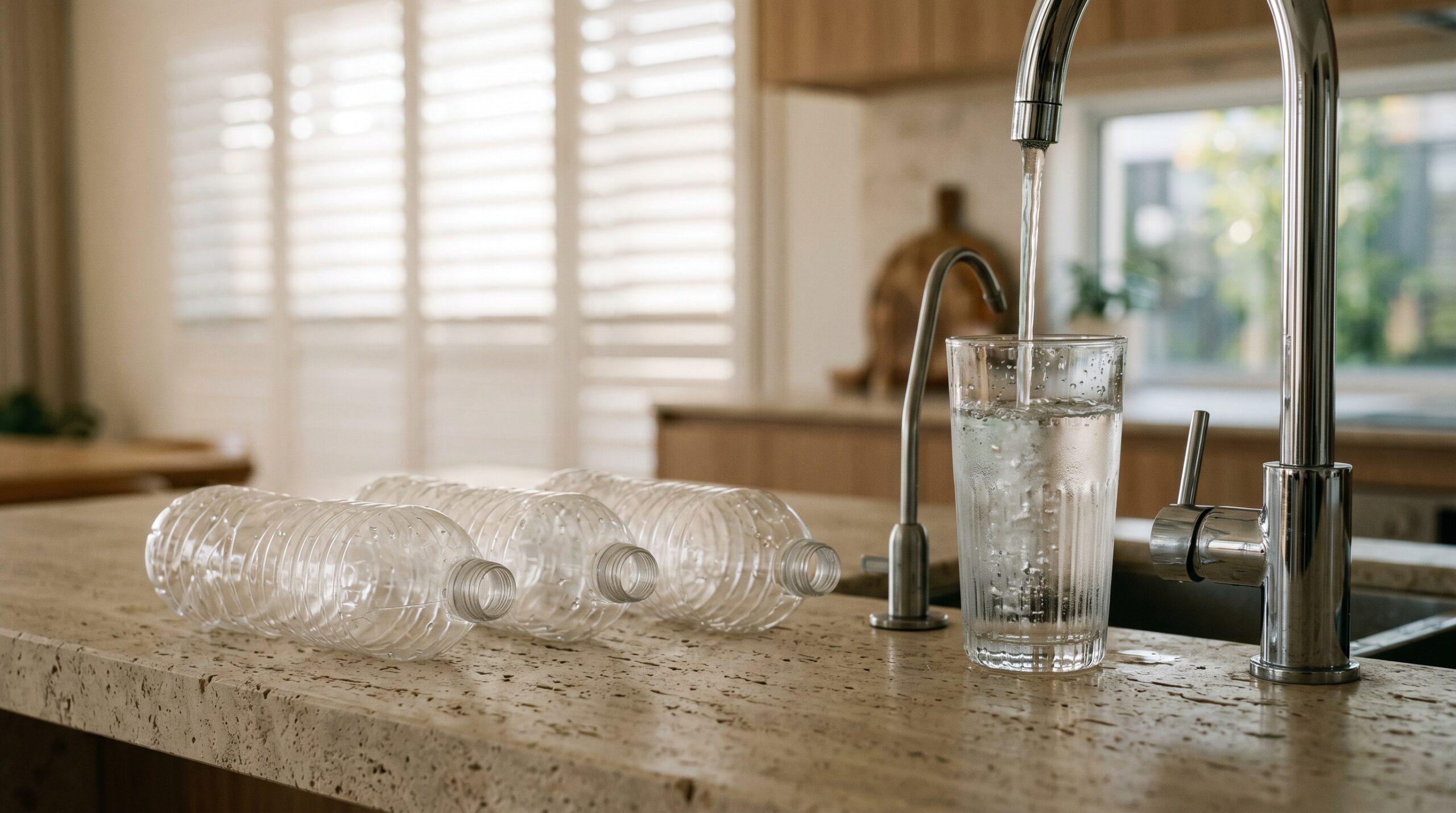
And bottled water? According to ABS waste data, Australians send hundreds of millions of plastic bottles to landfill annually. At $1.50 per litre, a family spending $2,190 per year on bottled water could buy the best RO system on the market, replace every cartridge on schedule for five years, and still save over $9,500.
Our Top-Rated Water Filters
PFAS, Fluoride, and the NHMRC 2025 Update: What Your Replacement Cartridge Must Handle
In June 2025, the NHMRC released updated chemical fact sheet reviews for the Australian Drinking Water Guidelines (ADWG), including revised PFAS guidance. According to the NHMRC administrative report, PFOS and PFOA health-based guideline values remain at 0.07 µg/L and 0.56 µg/L respectively, but the review expanded the scope to include additional PFAS compounds in the “sum of PFAS” calculation. This matters for your cartridge choice because PFAS contamination has been confirmed at 700+ sites across Australia according to the DCCEEW national register, with drinking water implications in areas near defence bases (Williamtown NSW, Oakey QLD, Edinburgh SA), airports, and industrial sites.
Standard carbon cartridges — GAC and carbon block — have limited and inconsistent PFAS removal. Some carbon block cartridges at 0.5 micron can reduce certain PFAS compounds, but removal rates vary widely (40-90%) depending on the specific PFAS compound, water flow rate, and carbon quality. Only reverse osmosis provides reliable, certified PFAS removal at 90-97% rejection rates, which is why NSF/ANSI P473 certification (the specific standard for PFAS reduction) is predominantly held by RO systems.
If you live near a known PFAS contamination site — Williamtown and Raymond Terrace in the Hunter Valley, Oakey in the Darling Downs, Kwinana and Rockingham in Perth, or Edinburgh in Adelaide — your replacement cartridge strategy should centre on RO membranes, not carbon. A carbon pre-filter protects the RO membrane from chlorine and sediment damage, but the membrane does the PFAS heavy lifting.
Fluoride: The Contaminant Carbon Cannot Touch
Most Australian capital cities add fluoride at 0.6-1.0 mg/L per NHMRC guidelines. If fluoride removal is a priority for your household, understand this clearly: no carbon filter of any type — standard GAC, catalytic carbon, or carbon block — removes fluoride. Only reverse osmosis (90-97% removal) or activated alumina (80-95% removal) is effective. When you are shopping for replacement cartridges, any carbon cartridge claiming fluoride removal should be treated with scepticism unless it contains an activated alumina stage in addition to the carbon.
For a deep dive into how different filtration technologies handle Australian contaminants, see our best water filter Australia 2026 guide, which assesses and ranks systems specifically against ADWG parameters.
How to Replace Your Water Filter Cartridge: Step-by-Step for Common Australian Systems
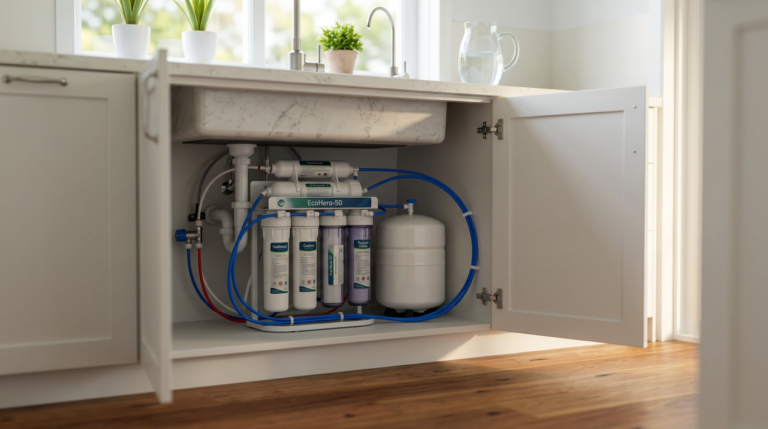
The actual replacement process is simple if you follow the sequence. Most Australian under-sink and benchtop filter systems use standard 10-inch or 20-inch cartridge housings (254mm or 508mm) that accept universal replacement cartridges. Here is the process, system by system.
Under-Sink Systems (2-5 Stage)
Step 1: Shut off the water supply. Turn the ball valve or isolation tap on the feed line to the filter. If your system does not have a dedicated isolation valve, turn off the mains at the meter. Do not skip this step — pressurised water in a housing you are opening will soak your under-sink cabinet.
Step 2: Release pressure. Open the filter tap (the dedicated filtered-water tap on your sink) and let it run until it stops dripping. This depressurises the housings.
Step 3: Place a bucket underneath. There will be residual water in each housing — typically 200-500mL per housing. A shallow baking tray works well in tight under-sink spaces.
Step 4: Remove housing using the filter wrench. Every system should come with a plastic spanner wrench. Turn counter-clockwise. If the housing is stuck (common in hard-water areas like Adelaide and Perth where mineral deposits seal the thread), wrap a rubber band or cloth around the housing for grip. Do not use pliers — they crack the housing.
Step 5: Remove the old cartridge and inspect the housing. Look for biofilm (slimy residue), sediment buildup, and any cracks in the housing. Rinse the housing with clean water. Do not use soap or detergent — residue will contaminate your filtered water.
Step 6: Install the new cartridge. Check the orientation — most carbon block cartridges have an arrow indicating flow direction, or a sealed end that faces upward. Incorrect installation bypasses filtration.
Step 7: Hand-tighten the housing. Do not use the wrench to tighten — hand-tight plus a quarter-turn is sufficient. Over-tightening cracks plastic housings and makes the next replacement harder.
Step 8: Flush the system. Open the feed valve, check for leaks at each housing, then run the filter tap for 5-10 minutes (or per manufacturer instructions) to flush carbon fines and manufacturing residue. The first litre or two will be dark grey or black — this is normal carbon dust.
Countertop RO Systems (AquaTru, Waterdrop, etc.)
Countertop systems are generally tool-free. The AquaTru Classic uses a twist-and-pull cartridge design — turn the cartridge 90 degrees and pull straight out. Insert the new cartridge, twist to lock, and run two full tank cycles to waste before drinking. The system’s electronic display tracks cartridge life automatically.
The Waterdrop D6 under-sink RO uses a quick-connect twist-lock system. No wrench, no housing disassembly. Turn off the water, twist the filter 90 degrees, pull out, push in the new one, twist to lock, turn the water back on, flush for 10 minutes. Total time: 5 minutes.
Benchtop Gravity Filters
Systems like the Berkey Royal gravity filter require no plumbing at all. Remove the upper chamber, unscrew the old filter elements from the mounting holes, screw in the new elements, prime them by running water through under tap pressure for 60 seconds each, reassemble. For a full breakdown of gravity filter maintenance, see our best water filter for renters guide.
Decision Tree: Which Cartridge Do You Actually Need?
Three questions. That is all it takes to identify the correct replacement cartridge for your situation. Most Australians are buying the wrong cartridge because they match the physical size without matching the media type to their water chemistry.
🔍 Water Filter Cartridge Decision Tree
Question 1: What is your primary concern?
- Taste and chlorine only → Go to Question 2
- PFAS or fluoride removal → You need an RO membrane. Carbon cannot address these. Full stop.
- Bacteria (bore water, tank water) → Ceramic cartridge (0.2-0.5 µm) or UV + RO system
Question 2: Which city do you live in?
- Brisbane, Sydney, Adelaide, Gold Coast, Darwin → Chloramine city. You need catalytic carbon, carbon block, or RO. Standard GAC is ineffective.
- Melbourne, Hobart, Canberra, Townsville, Cairns, Toowoomba → Free chlorine city. Standard GAC or carbon block both work.
Question 3: What housing size does your system use?
- Standard 10″ x 2.5″ (254mm x 63.5mm) → Most common Australian under-sink housing. Wide cartridge availability.
- Standard 20″ x 2.5″ → Whole-house systems. Same media options, double the capacity.
- Proprietary (twist-lock, quick-connect) → AquaTru, Waterdrop, Tappwater, etc. Must buy brand-specific replacements.
If you answered “chloramine city” and “PFAS or fluoride” to questions 1 and 2, the only cartridge that addresses all your concerns is an RO membrane as part of a multi-stage system. A reverse osmosis system is not a luxury for these households — it is a necessity if you want comprehensive contaminant removal compliant with ADWG health-based guideline values.
Common Cartridge Replacement Mistakes That Waste Your Money
Mistake 1: Buying generic GAC cartridges for a chloramine city. This is the most expensive mistake because it is invisible. The filter looks like it is working — water flows, the housing is not clogged — but the chloramine passes straight through. You have spent money on a cartridge and gained nothing. If you are in Brisbane, Sydney, Adelaide, Gold Coast, or Darwin, verify that “catalytic carbon” or “carbon block” (not “granular activated carbon”) is specified on the cartridge.
Mistake 2: Not replacing the sediment pre-filter. In multi-stage systems, the sediment pre-filter protects downstream carbon and RO stages. A clogged sediment cartridge forces higher pressure through the system, damaging RO membranes and reducing carbon contact time. In hard-water cities like Adelaide and Perth, the sediment cartridge clogs 20-30% faster than in soft-water cities. Many people replace the carbon stage and ignore the sediment stage. Replace both on schedule.
Mistake 3: Assuming “fits my housing” means “right for my water.” A 10-inch polyspun sediment cartridge and a 10-inch catalytic carbon cartridge are the same physical dimensions. They fit the same housing. They do completely different things. Physical compatibility is not chemical compatibility. Always match the media type to your contaminant concern.
Mistake 4: Extending cartridge life to “save money.” Running a carbon cartridge 50% past its rated life does not save you 50% of the cartridge cost. It gives you months of unfiltered water (the contaminants you bought the system to remove pass through), and in warm climates, it gives bacteria a colonisation opportunity. The $30-50 you “saved” by delaying replacement costs far more than the cartridge when you factor in what you are drinking.
Mistake 5: Not flushing new carbon cartridges. Fresh carbon cartridges contain fine carbon particles from manufacturing. If you do not flush 5-10 litres through a new cartridge before use, your first glasses of water will be grey-black. More importantly, unflushed carbon fines can clog downstream stages and reduce system pressure.
NHMRC Compliance Checklist: Does Your Cartridge Meet Australian Drinking Water Guidelines?
The Australian Drinking Water Guidelines (ADWG), maintained by the NHMRC, set health-based guideline values for contaminants in drinking water. Your water utility is responsible for meeting these at the treatment plant. But if you are filtering at the point of use — at your kitchen tap — your cartridge’s effectiveness determines whether your actual drinking water meets these values.
Here is what the ADWG 2025 update requires and which cartridge types can meet those requirements:
| Contaminant | ADWG Guideline Value | Standard GAC | Carbon Block | Catalytic Carbon | RO Membrane |
|---|---|---|---|---|---|
| Chlorine (free) | 5 mg/L (aesthetic: 0.6 mg/L) | ✓ Effective | ✓ Effective | ✓ Effective | ✓ 95-99% |
| Chloramine | 3 mg/L | ✗ ~1/40th rate | △ Moderate (slow flow) | ✓ Effective | ✓ 90-97% |
| Fluoride | 1.5 mg/L | ✗ None | ✗ None | ✗ None | ✓ 90-97% |
| PFOS | 0.07 µg/L | ✗ Inconsistent | △ Variable (40-80%) | △ Variable | ✓ 90-97% (NSF P473) |
| PFOA | 0.56 µg/L | ✗ Inconsistent | △ Variable (40-80%) | △ Variable | ✓ 90-97% (NSF P473) |
Ready to filter your water?The EcoHero 5-Stage RO is the top-rated under-sink filter for Australian homes — NSF 58 certified, WaterMark AS3497, removes fluoride, PFAS, lead, and chloramine. Get the Australian Home Environment Checklist30 checks across water, air and EMF. Most of them free. Ranked by impact. No spam. Unsubscribe any time. 
Written by Jayce Love
Former Royal Australian Navy Clearance Diver and TAG-E counter-terrorism operator. Founded Clean and Native to apply the same rigorous thinking to the home environment. Full biography →Similar Posts
|