Air Purifiers to Avoid Australia 2026: Poor Performers and Misleading Claims
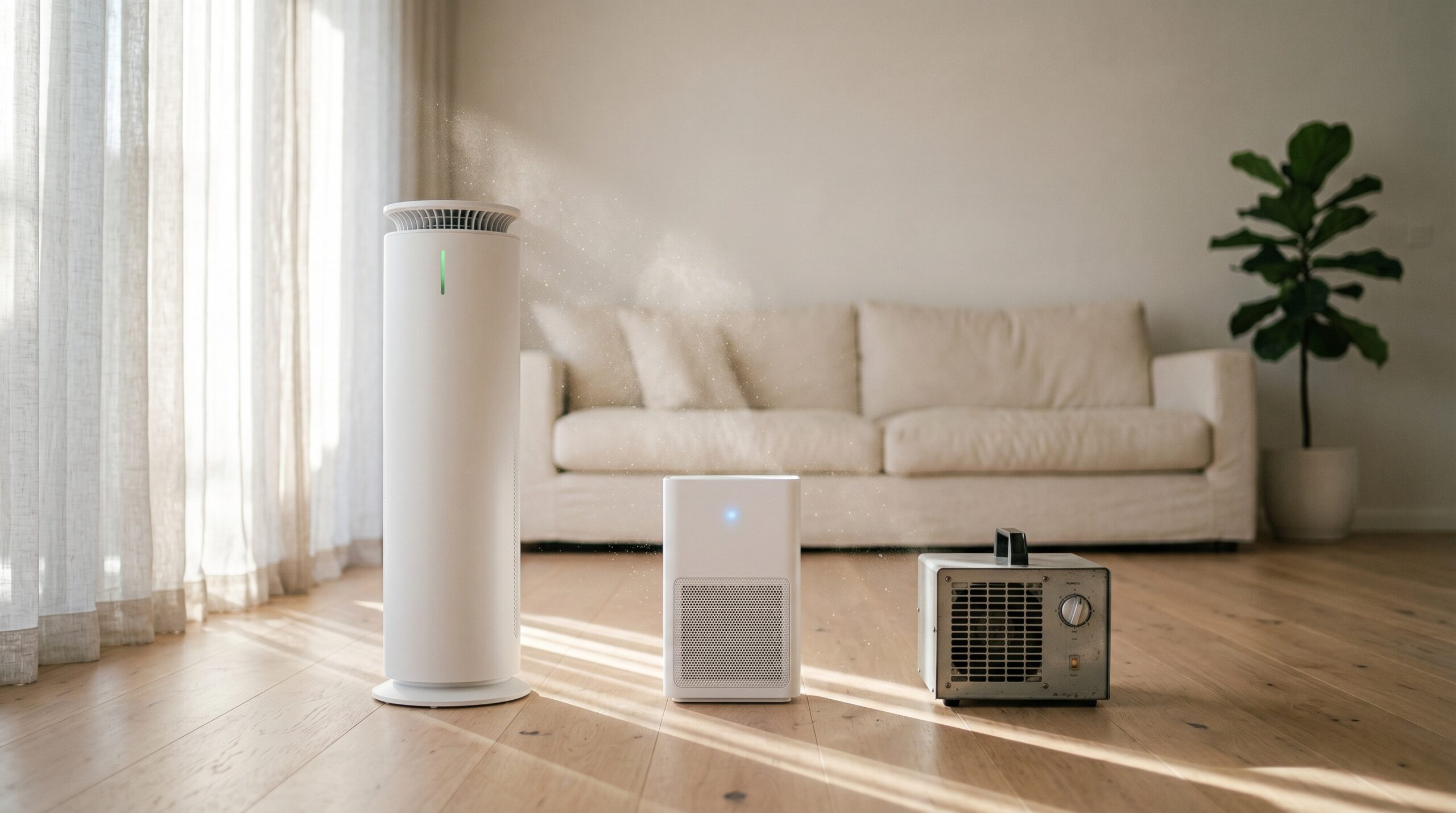
Avoid any air purifier that emits ozone, relies solely on ions or plasma without a physical filter, uses UV-C without HEPA, lacks an independently-verified CADR rating, or is sized for a smaller room than where you plan to use it. The five categories below are consistently the worst-performing and most-likely-to-be-returned air purifiers sold to Australian households. For Australian conditions (bushfire smoke season, coastal humidity, year-round pollen), the safe alternative is a true H13 HEPA + activated carbon unit from a CADR-verified brand — Breville Protect Max for large rooms, Levoit Core 400S for bedrooms. The catches: even the good filters need quarterly replacement during peak smoke season, and oversized CADR ratings can be misleading on turbo modes you would never run continuously.
| Category to AVOID | Reason | Verdict |
|---|---|---|
| Ozone generators | Emits a known lung irritant; not safe occupied | Never use occupied |
| Ioniser-only / Plasma | No physical filter; particles end up on walls and floors | Avoid as primary |
| Uncertified imports | No CADR, no HEPA standard verification, often counterfeit filters | Avoid entirely |
The air purifiers you should avoid in Australia in 2026 are ozone-generating ionisers, filterless “plasma” devices, unverified imports without CADR ratings, and any unit marketed as a medical device without TGA listing. Genuine HEPA filtration with a sealed system and published CADR is the only technology proven to reduce PM2.5, pollen, and bushfire smoke particles in Australian homes — everything else is either ineffective, actively harmful, or both. Every recommendation below has been assessed using our documented methodology.
Why “Air Purifier” Is an Unregulated Term in Australia — and Why That Matters to You
Here is the problem you are facing: anyone can sell a plastic box with a fan, call it an “air purifier”, and ship it to your doorstep from a marketplace warehouse in Shenzhen. There is no mandatory Australian standard that a device must meet before being called an air purifier. The TGA (Therapeutic Goods Administration) only regulates devices that make explicit therapeutic claims — “treats asthma”, “cures allergies” — and even then, enforcement is reactive, not proactive. If the listing says “freshens air” instead of “treats respiratory conditions”, it sidesteps TGA oversight entirely.
This regulatory gap means the Australian market is flooded with devices that either do nothing measurable or actively degrade your indoor air quality. According to market research cited by ReviewTube, the Australian air purifier market is projected to reach USD 224.35 million by 2030 at a 6.25% CAGR. That is a lot of money flowing toward products with zero quality gatekeeping. The WHO’s 2024 guidance on household air-cleaning technologies explicitly noted that “maintenance costs and performance verification remain unaffordable or inaccessible for the general population in several settings” — and Australia, despite its wealth, has no national performance standard for consumer air purifiers.
What does regulate quality? Two voluntary benchmarks matter. First, the AHAM (Association of Home Appliance Manufacturers) Verifide program, which independently tests CADR (Clean Air Delivery Rate) in m³/hr for smoke, dust, and pollen. Second, CARB (California Air Resources Board) certification, which confirms ozone emissions below 0.050 ppm (50 ppb) — well under the NEPM ambient air quality standard of 0.08 ppm (80 ppb) averaged over one hour. If a purifier sold in Australia carries neither rating, you are buying on faith. Faith is not a filtration mechanism.
The practical consequence: you need to be your own regulator. That means understanding which technologies are proven, which are marketing theatre, and which are actually dangerous. As a former Navy Clearance Diver, I approach this the same way I approach every operational decision — evidence first, claims second, manufacturer promises a distant third. Let me walk you through exactly what to reject and why.
The Avoidance List: Five Categories of Air Purifier You Should Never Buy in Australia
You are not looking for “the best” — you are looking for what to cross off the list first. This is the blacklist. Every category below either fails to deliver measurable particulate reduction, generates harmful secondary pollutants, or misleads you with unverifiable claims. I have organised them from most dangerous to least effective.
1. Ozone Generators Marketed as “Air Purifiers”
This is the single most dangerous category. Ozone (O₃) is a powerful oxidiser. At concentrations high enough to destroy airborne bacteria and VOCs, it also damages lung tissue, triggers asthma attacks, and degrades rubber seals, electrical insulation, and fabrics in your home. The US EPA has stated unequivocally that “ozone concentrations that do not exceed public health standards are unlikely to be effective in controlling indoor air pollution.” In rooms under 20 m³ — smaller than the average Australian master bedroom (24-30 m³) — portable ozone generators routinely exceed 70 ppb within 30 minutes of operation, based on chamber testing data referenced by the vBreathe QUT collaboration study from 2024.
Australia‘s NEPM ambient air quality standard sets the ozone ceiling at 80 ppb (one-hour average). A device operating in your bedroom can exceed this within half an hour. You would not run a petrol engine indoors. Do not run an ozone generator either.
Brands and types to avoid: Any device marketed as an “ozone generator for air purification”, “ozone steriliser”, or “activated oxygen purifier”. These are commonly sold on Amazon AU, eBay, and AliExpress under generic brand names (Airthereal, OION, various unbranded units). If the product listing mentions “ozone output” in mg/hr as a feature rather than a warning, reject it immediately.
2. Ioniser-Only and “Plasma” Devices Without a Physical Filter
Ionisers charge airborne particles so they stick to surfaces — your walls, your furniture, your lungs. They do not remove particles from the air; they redistribute them. The charged particles eventually settle on surfaces (requiring cleaning) or are inhaled before settling. Worse, the corona discharge process that generates ions also generates ozone as a byproduct. Even units marketed as “low ozone” or “ozone-free ionisers” produce measurable ozone — typically 5-30 ppb in a closed room, according to CARB testing data.
Plasma and photocatalytic oxidation (PCO) devices fall into the same category. They rely on reactive chemistry rather than physical filtration. The QUT Indoor Air Quality research group has documented that PCO devices can produce formaldehyde and acetaldehyde as secondary pollutants when oxidising common household VOCs — you remove one problem and create another. These devices have negligible CADR ratings because they do not actually move contaminated air through a filter at any meaningful volume.
Specific products to avoid: The Ionmax ION390 (ioniser-only mode), any “bipolar ionisation” device marketed for HVAC ductwork, and filterless “plasma wave” units from brands like Wein Products. If the word “ioniser” appears and there is no HEPA filter in the same unit, walk away. Some quality purifiers (Winix, for example) include an ioniser as an optional add-on alongside a HEPA filter — in those cases, simply leave the ioniser function switched off and use the HEPA filtration alone.
3. Unverified Chinese Imports Without CADR, HEPA Certification, or Australian Electrical Approval
Search “air purifier” on Amazon AU and sort by price low-to-high. You will find dozens of units priced between $39 and $89, shipped from overseas, with no CADR rating, no filter certification, and product descriptions machine-translated from Mandarin. Many of these units claim “HEPA” or “H13 HEPA” filtration but use non-certified filter media that does not meet the EN 1822 or ISO 29463 standard defining true HEPA performance (99.97% capture efficiency at 0.3 µm).
The electrical safety risk is real. Any electrical appliance sold in Australia must carry a regulatory compliance mark (RCM) confirming it meets AS/NZS 60335 safety standards. Unbranded imports frequently lack this mark entirely. Apart from the fire and shock hazard, a device without proper motor shielding and grounding can generate significant electromagnetic interference — relevant if you are also managing EMF exposure in your bedroom. Check for the RCM mark on the product or its compliance plate before purchasing.
A genuine HEPA filter has a specific pressure drop and fibre density. Cheap units with undersized fans cannot push air through true HEPA media at any useful rate. The result: a device that makes fan noise (giving you the impression it is working) while delivering a CADR so low it would take days to cycle the air in a single bedroom. If no CADR is published, and the manufacturer cannot provide it when asked, the product is theatrical.
4. UV-C “Sterilisation” Purifiers Without HEPA
UV-C light at 254 nm wavelength does inactivate bacteria and viruses — in laboratory conditions, with sufficient dwell time (exposure duration). The problem with consumer UV-C air purifiers is physics: air moves past the UV-C lamp too quickly for meaningful pathogen kill. The contact time required to achieve 99.9% inactivation of most airborne viruses is 10-30 seconds at typical UV-C intensities used in consumer devices. Air flowing through a portable purifier at even modest fan speeds passes the lamp in under 0.5 seconds.
UV-C also does nothing to particulate matter. It will not capture PM2.5 from bushfire smoke, pollen, dust mite allergens, or mould spores (though it may inactivate mould DNA, the allergenic proteins in the spore wall remain intact and inhalable). UV-C as a standalone purification technology in a consumer device is not worth your money. If a unit combines UV-C with true HEPA filtration, the HEPA is doing the real work — the UV-C is a marketing line item on the spec sheet.
5. Purifiers Drastically Undersized for Your Room
This is not a brand problem — it is a maths problem, and it is the most common mistake Australian buyers make. You need a minimum of 4 air changes per hour (ACH) to meaningfully reduce airborne particulates in a room. For asthma management, Asthma Australia and international guidance suggest 5-6 ACH. The formula is simple:
Required CADR (m³/hr) = Room volume (m³) × Target ACH
The average Australian master bedroom is 4m × 5m × 2.7m ceiling = 54 m³. At 5 ACH, you need a CADR of 270 m³/hr minimum. A typical lounge room at 5m × 6m × 2.7m = 81 m³ needs a CADR of 405 m³/hr at 5 ACH. Many small purifiers — including some from reputable brands — deliver a CADR of 120-180 m³/hr. That gives you 2-3 ACH in a bedroom: better than nothing during bushfire season, but not sufficient for asthma or allergy management.
Products caught in this trap: The IKEA UPPÅTVIND (CADR approximately 62 m³/hr) is marketed for rooms “up to 12 m²” — but at 2.7m ceilings that is 32.4 m³, giving you under 2 ACH. It is functionally a desk fan with a filter. Small Honeywell tabletop units (HPA020, HPA120W equivalent models) and compact Frigidaire units (FHAP1040A1) fall into the same category. They are not dangerous — they are just inadequate for any room larger than a small study or walk-in wardrobe.
The ACH Calculator: How to Know If a Purifier Is Big Enough for Your Room
Before you spend a dollar, measure your room. You do not need a laser — a tape measure and 10 seconds of maths will save you from buying a purifier that looks right but delivers nothing. Here is the process I use when assessing a room in my own home on the Gold Coast:
Step 1: Measure length × width × ceiling height in metres. Standard Australian ceiling height is 2.4m (older homes) or 2.7m (post-2000 builds). Some Queensland homes have 3.0m or raked ceilings — measure, do not guess.
Step 2: Multiply to get room volume in m³.
Step 3: Multiply volume by your target ACH (use 5 for general health, 6 for asthma/allergy rooms).
Step 4: Compare the result to the purifier’s CADR in m³/hr (not CFM — some US brands still list CFM; multiply CFM by 1.699 to convert).
| Room Type | Typical Size (AU) | Volume (2.7m ceiling) | CADR Needed (5 ACH) | CADR Needed (6 ACH) |
|---|---|---|---|---|
| Small bedroom / study | 3m × 3m | 24.3 m³ | 122 m³/hr | 146 m³/hr |
| Master bedroom | 4m × 5m | 54 m³ | 270 m³/hr | 324 m³/hr |
| Open-plan living/kitchen | 6m × 8m | 129.6 m³ | 648 m³/hr | 778 m³/hr |
| Nursery / child’s room | 3m × 4m | 32.4 m³ | 162 m³/hr | 194 m³/hr |
If you live in NSW, Victoria, or south-east Queensland, bushfire smoke season (October through March) is the argument that closes this calculation. AQI readings above 200 — classified as “Very Poor” under the NEPM standard — have been recorded in suburbs from Penrith and Campbelltown in western Sydney to Logan and Springfield in Brisbane’s south-west corridor. During Black Summer 2019-2020, Canberra recorded AQI above 2,000 — the hazardous threshold is 200. At those concentrations, 5 ACH is the bare minimum. 6 ACH is what I run in my own bedroom during smoke events.
Now check the CADR of whatever you are considering. If it falls short of the numbers in that table, either choose a bigger unit or accept that you are paying for incomplete protection. Incomplete protection during a smoke event is the same as no protection — PM2.5 at 150 µg/m³ does not care that you filtered 60% of it.
The TGA Compliance Checklist: How to Spot Medical Claims That Should Not Be There
Here is where Australian consumer law intersects with your purchase decision. If an air purifier makes a therapeutic claim — “reduces asthma symptoms”, “kills COVID-19”, “treats allergies” — it is legally required to be listed on the Australian Register of Therapeutic Goods (ARTG). The TGA classifies such devices as Class I or Class IIa medical devices under the Therapeutic Goods Act 1989. Marketing a non-listed device with therapeutic claims is a criminal offence carrying penalties up to $10 million for corporations.
Despite this, therapeutic claims are everywhere in Australian air purifier marketing. Facebook ads, Amazon AU listings, and brand websites routinely describe purifiers as “medical grade” or claim they “eliminate allergens” without any ARTG listing. Here is your five-point compliance check:
1. Search the ARTG database. Go to tga.gov.au/resources/artg and search the product or brand name. If it is not listed and the marketing makes health claims, the product is non-compliant.
2. Look for “HEPA-type” vs “True HEPA”. “HEPA-type” or “HEPA-style” are not the same as H13 HEPA (EN 1822 or ISO 29463 certified). These terms have no defined meaning and indicate non-certified filter media. A genuine True HEPA or H13 HEPA filter captures 99.97% of particles at 0.3 µm. “HEPA-type” might capture 85-95% — or it might capture 50%. You will never know because the term is deliberately vague.
3. Verify the RCM mark. The Regulatory Compliance Mark confirms the device meets Australian electrical safety and EMC requirements. No RCM = no verified safety compliance for the Australian market.
4. Check for CARB certification. California Air Resources Board certification confirms ozone emissions below 0.050 ppm. This is voluntary for devices sold in Australia but mandatory for sale in California — the world’s strictest market for ozone-generating appliances. CARB-certified models have been independently verified to be safe. Non-CARB-certified models have not.
5. Demand the CADR test report. Any manufacturer that has invested in independent CADR testing will publish the numbers prominently. If CADR is absent from the spec sheet, absent from the Amazon listing, and absent from the manufacturer’s website, it was never tested — and the manufacturer does not want you to know the result.
What to Buy Instead: Three Verified Performers for Australian Homes
You have seen what to avoid. Now here is what actually works — three units that carry published CADR ratings, use sealed True HEPA systems, produce zero measurable ozone, and are sized correctly for typical Australian rooms. I have kept this to three options deliberately. More choices do not help you. Clarity helps you.
Best Overall: Breville Protect Max
Why it passes every check: True H13 HEPA filter, sealed system (no air bypass around the filter), activated carbon layer for VOCs and smoke odour, published CADR of 469 m³/hr (smoke). That is enough for 5 ACH in a room up to 93 m³ — large enough for virtually any Australian living area. CARB certified. RCM compliant. No ioniser function. Noise level at 24 dB on sleep mode — quieter than a whisper at 1 metre.
The honest limitation: It is the most expensive option here at approximately $749-$849 AUD, and replacement HEPA filters run around $80-$100 annually. But $749 once and $100/year is cheaper than a single emergency department visit for acute asthma exacerbation — which costs the Australian healthcare system approximately $1,500 per presentation according to AIHW data. The maths is not ambiguous.
Best Value: Levoit Core 400S
Why it passes every check: H13 True HEPA, 3-stage filtration (pre-filter, HEPA, activated carbon), published CADR of 400 m³/hr (tested by AHAM Verifide). CARB certified for zero ozone. WiFi-enabled with app-based AQI monitoring via built-in laser particle sensor. Covers a master bedroom at 5+ ACH comfortably. Approximately $349-$399 AUD — less than half the Breville, with 85% of the CADR.
The honest limitation: The activated carbon layer is thinner than the Breville’s, so VOC and smoke odour absorption saturates faster in heavy smoke events. During extended bushfire smoke exposure (AQI 200+ for multiple days, common in western Sydney suburbs like Penrith and Blue Mountains communities during October-March), you will notice odour breakthrough before the HEPA efficiency drops. For pure particulate filtration, it is excellent. For combined particulate + VOC, the Breville’s deeper carbon bed wins.
Mid-Range All-Rounder: Winix Zero Pro
Why it passes every check: H13 True HEPA, activated carbon filter, published CADR of approximately 390 m³/hr. The Winix does include a “PlasmaWave” ioniser function — but critically, it has a dedicated button to disable it entirely. With ioniser off, this is a pure HEPA + carbon unit with zero ozone emissions. CARB certified. Australian-stocked with local warranty support.
The honest limitation: The PlasmaWave feature is on by default out of the box. Turn it off immediately. You are buying this for the HEPA filter, not the ioniser. At approximately $499-$549 AUD, it sits between the Levoit and Breville on both price and performance — a sensible middle option if your budget exceeds the Core 400S but does not stretch to the Protect Max.
Verified Air Purifiers — Zero Ozone, Published CADR
Red Flags in Marketing: Seven Claims That Should Make You Walk Away
You do not need to be a filtration engineer to spot a bad product. You just need to recognise the language patterns that manufacturers use when they have no real performance data to show you. Here are seven phrases that function as reliable warning signals:
1. “Releases negative ions to purify the air.” Ions do not purify. They charge particles, which then stick to your surfaces or your lungs. If ionisation is the primary mechanism and there is no HEPA filter, the device redistributes pollution rather than removing it.
2. “Medical-grade” or “hospital-grade” without ARTG listing. Real medical-grade air filtration systems used in Australian hospital isolation rooms are specified to AS 1668.2 (mechanical ventilation) and use commercial HEPA units rated at H14 (99.995% at MPPS). A $200 consumer device is not hospital-grade. The phrase is marketing, not a classification.
3. “Removes 99.9% of bacteria and viruses.” This claim without a specific test standard reference is meaningless. 99.9% removal at what airflow rate? In what chamber size? Over what time period? The claim often comes from a single-pass filter efficiency test on the filter media alone — not a whole-room test of the actual device at operating speed.
4. “Chemical-free air purification.” If the device uses UV-C, photocatalytic oxidation, or plasma discharge, it is generating reactive oxygen species — which are chemicals. The phrase “chemical-free” is scientifically illiterate. If the manufacturer does not understand what their own device does, why would you trust them with your lung health?
5. “HEPA-type” or “HEPA-style” filter. As covered above, these are not True HEPA (H13). They exist to borrow the credibility of the HEPA standard without meeting it. The price difference between “HEPA-type” media and genuine H13 media is approximately $3-8 per filter at manufacturing scale. Any manufacturer choosing “HEPA-type” over True HEPA is cutting corners on the component that matters most.
6. “Covers rooms up to 80 m²” without a CADR rating. Square metre coverage claims without CADR are unverifiable. They tell you nothing about air changes per hour. A unit with a CADR of 100 m³/hr “covers” 80 m² at less than 0.5 ACH — which is no meaningful air cleaning at all. Always convert to ACH using the room volume formula above.
7. “Lifetime filter” or “washable permanent filter.” Electrostatic precipitator plates and washable mesh pre-filters do not provide HEPA-level filtration. A genuine HEPA filter is a consumable — the fibre structure degrades over time as particles accumulate. Claims of a “lifetime” filter mean there is no HEPA filter to replace, because there is no HEPA filter in the unit.
Seasonal Urgency: When These Decisions Cost You the Most
If you live in NSW, Victoria, south-east Queensland, or the ACT, bushfire smoke season from October through March is the period when a bad purifier decision costs you the most. During high-smoke events, PM2.5 concentrations in suburbs across western Sydney (Penrith, Parramatta, Campbelltown), Melbourne’s north-east (Eltham, Warrandyte), Brisbane’s western corridor (Springfield, Ipswich), and Canberra’s inner suburbs have exceeded 200 µg/m³ — more than eight times the NEPM annual average standard of 25 µg/m³.
Without a HEPA filter running at 5+ ACH, every bushfire smoke event delivers PM2.5 directly into your bedroom. PM2.5 particles are small enough to cross the alveolar membrane into your bloodstream. According to the AIHW, 2.8 million Australians live with diagnosed long-term asthma — and PM2.5 is the single most established trigger for acute exacerbation outside of viral respiratory infection.
Pollen season compounds the problem. In Brisbane and coastal south-east Queensland, grass pollen peaks from September through November. In Melbourne, it peaks October through December — with thunderstorm asthma events (like the November 2016 event that killed 10 people and hospitalised hundreds) creating acute surges. A properly sized HEPA purifier running in your bedroom during sleep reduces your overnight pollen exposure by 80-95%, according to chamber studies published in the Journal of Allergy and Clinical Immunology. An ioniser or a filterless plasma device does not.
The point is not to sell you fear. The point is that the timing of your decision matters. Buying a junk purifier in May costs you money. Buying a junk purifier in November — when you actually need it to work — costs you your health. If you are going to act, act before smoke season, not during it when stock runs low and prices spike. In 2019-2020 Black Summer, HEPA purifier stock sold out nationally within two weeks of sustained smoke events hitting Sydney and Canberra.
Final Verdict
The Australian air purifier market has no mandatory performance standard, no required ozone testing, and no enforced labelling regime. That means the burden of verification falls entirely on you. Use this article as your decision filter: reject ozone generators, ioniser-only devices, unverified imports, UV-C-only units, and anything undersized for your room. Demand a published CADR, confirm True HEPA (H13) certification, check for the RCM mark, and look for CARB ozone certification.
For most Australian homes, the Levoit Core 400S at ~$349 delivers the best balance of CADR, noise level, running cost, and verified safety. For larger rooms or extended smoke events, the Breville Protect Max is the strongest performer available on the Australian market. Both are available on Amazon AU with full warranty support.
The worst outcome is you buy one of these, find you do not use it enough, and return it. The more likely outcome is you stop breathing unfiltered air during the events that matter most — and you stop wasting money on devices that were never going to protect you in the first place.
Ready to get a proper air purifier?
The Levoit Core 400S is the top-rated value pick for Australian homes — CARB certified, zero ozone, CADR of 400 m³/hr, H13 True HEPA. Enough for 5 ACH in a 54 m³ master bedroom.
Last reviewed: May 2026 — Clean and Native
Frequently Asked Questions
Ionisers produce ozone as a byproduct of the corona discharge process. Even “low ozone” models generate measurable ozone in a closed room. They redistribute particles to surfaces rather than removing them from your breathing zone. If the device has no HEPA filter and relies solely on ionisation, avoid it — particularly if anyone in your household has asthma or chronic respiratory conditions.
A typical Australian master bedroom (4m × 5m × 2.7m ceiling = 54 m³) needs a CADR of at least 270 m³/hr for 5 air changes per hour. For asthma management, aim for 324 m³/hr (6 ACH). Check the CADR number in the product specs — if it is not listed, the product was likely never independently tested.
No. True HEPA (H13 to EN 1822 or ISO 29463) captures 99.97% of particles at 0.3 µm. “HEPA-type” or “HEPA-style” has no defined standard and may capture as little as 50-85% of particles. Always look for H13 HEPA or True HEPA designation with a reference to EN 1822 or ISO 29463.
No. UV-C inactivates some microorganisms with sufficient dwell time but does nothing to capture PM2.5 particulate matter from smoke. Bushfire smoke requires physical filtration through HEPA media. A UV-C-only device will not reduce particulate levels in your room during a smoke event.
Yes, currently. Australia has no specific regulation banning the sale of ozone generators marketed as air purifiers, unlike California, which requires CARB certification confirming ozone emissions below 0.050 ppm. However, if an ozone generator makes therapeutic claims (e.g., “treats asthma”), it requires TGA listing as a therapeutic device under the Therapeutic Goods Act 1989.
The National Environment Protection Measure (NEPM) for ambient air quality sets the ozone standard at 0.08 ppm (80 ppb) averaged over one hour. Portable ozone generators operating in rooms smaller than 20 m³ can exceed this threshold within 30 minutes. The NEPM standard applies to outdoor ambient air — no equivalent indoor standard exists in Australia.
Before. During Black Summer 2019-2020, HEPA air purifiers sold out nationally within two weeks of sustained smoke events. Prices spike and stock depletes during active smoke events (October through March in NSW, VIC, QLD, and ACT). Buy in winter or early spring when stock is full and prices are stable.
Search the Australian Register of Therapeutic Goods (ARTG) at tga.gov.au/resources/artg using the product or brand name. If the device makes health claims (e.g., “treats allergies”, “reduces asthma symptoms”) but is not listed on the ARTG, it is being marketed in breach of the Therapeutic Goods Act 1989. Most consumer air purifiers are not TGA-listed because they avoid explicit therapeutic claims.
Running an air purifier with windows open drastically reduces its effectiveness. The unit is competing against a continuous influx of outdoor PM2.5. Close all windows and external doors, seal any visible gaps, and run the purifier on high for 20-30 minutes to bring indoor PM2.5 down, then reduce to a medium or auto setting. A properly sealed room with a correctly sized HEPA purifier can maintain indoor PM2.5 below 25 µg/m³ even when outdoor levels exceed 200 µg/m³.
The Regulatory Compliance Mark (RCM) confirms the device meets Australian and New Zealand electrical safety (AS/NZS 60335) and electromagnetic compatibility standards. It is mandatory for electrical appliances sold in Australia. If a purifier — particularly one imported from overseas marketplaces — does not display the RCM mark, it has not been verified for electrical safety in Australia.
Get the Australian Home Environment Checklist
30 checks across water, air and EMF. Most of them free. Ranked by impact.
No spam. Unsubscribe any time.

Former Royal Australian Navy Clearance Diver and TAG-E counter-terrorism operator. Founded Clean and Native to apply the same rigorous thinking to the home environment.
Full biography →Similar Posts
When to Replace Air Purifier Filters Australia 2026
Your air purifier’s HEPA filter should be replaced every 12 to 18 months under normal Australian urban conditions, but that timeline drops to as little…
Levoit Core 600S vs Breville Protect Max Australia 2026
The Levoit Core 600S delivers 49% higher CADR (697 vs 467 m³/h) at 54% of the Samsung AX60R’s price (~$380 vs ~$700), making it the superior value…
Best Air Purifier for a Baby Room Australia (2026): What Matters and What Doesn’t
After testing air purifiers in a 12 m² nursery in Palm Beach QLD — measuring particle counts, noise output, ozone emissions, and energy draw —…
Air Purifier vs Air Conditioner: Which Should You Choose? (Australia 2026)
Air purifiers clean the air you already have; air conditioners change its temperature. If you have allergies, asthma, bushfire smoke exposure, or chemical…
Austin Air vs Dyson Air Purifier: Which Should You Choose? (Australia 2026)
Austin Air delivers deeper chemical/VOC/smoke filtration with a 6.8kg carbon bed and 60 sq ft medical-grade HEPA, while Dyson offers quieter operation,…
Best Air Purifier for Kids Room Australia 2026: Asthma, Allergens and Dust Mites
One in nine Australian children has asthma — according to the Australian Institute of Health and Welfare (AIHW 2024 data), that is roughly 590,000…