
Best Shower Filter Australia 2026: What They Actually Remove
Drafted with AI assistance and checked against published specifications and certifications. First-hand measurements appear only where stated. How we make content
How this assessment was made. I have tested one shower filter at home in Palm Beach, QLD (an Earth’s Water unit, not one of the picks below), using a TDS meter. The picks are assessed from their manufacturers’ specifications, their certifications, their Amazon Australia and retailer listings, every Australian utility water quality report I could verify for chlorine and chloramine, and the published research on chloramine chemistry, shower filtration and skin. Amazon prices on this page come from Amazon Australia and show the date and time they were fetched; other prices show the date I checked them. Clean and Native may earn a commission on some links.
The best shower filter in Australia for most homes is a simple inline KDF filter such as the Philips AWP1775 (sold by Amazon AU). Shower filters are built to reduce free chlorine, and most Australian supplies, including Melbourne, Perth, Canberra, the Gold Coast, Adelaide metro, Darwin and Newcastle, use free chlorine. If you want a filter tested to the shower filter standard, Sprite says its Slim-Line 2 is tested to NSF/ANSI 177 for free chlorine, though it is not on NSF’s certified list. The exception is most of Sydney and Brisbane, which use chloramine: no shower filter I found is certified to remove it, and a vitamin C bath or a whole house filter is the better tool there.
Shower filters are sold with bigger promises than almost any other water product: softer hair, clearer skin, less eczema. The useful questions are simple: what does it actually do, under what conditions, and who says so. The answer is narrower than the box suggests, but on a chlorinated supply it is a cheap upgrade that does what it says.
Check your area first. On chlorinated water, a $50 inline filter works and is worth having. On chloraminated water (most of Sydney, Brisbane, regional SA), skip the shower filter and use the bath method or a whole house filter.
| Pick | Best for | Price |
|---|---|---|
| Philips AWP1775 inline | Best overall; sold by Amazon AU | $60.33at Amazon AU · as of 22 Nov 2026, 5:43 am AEST Details |
| AquaBliss SF100 | Widely sold inline option | $61.15at Amazon AU · as of 21 Nov 2026, 11:29 pm AEST Details |
| Sprite Slim-Line 2 (SL2) | Tested to NSF/ANSI 177 (Sprite) | $48.62at Amazon AU · as of 22 Nov 2026, 5:43 am AEST Details |
| Sprite HF-CM hose filter | Best for handheld showers | $33.00at Amazon AU · as of 22 Nov 2026, 5:43 am AEST Details |
| HolyH2O Shower Mate | Australian seller and fittings | $90 ($76.50 with HOLYJAYCELOVE, 11 Nov 2026) |
Will a shower filter work on your water? Pick your area.
Data from each utility’s own water quality reports. Hobart is not listed because I could not confirm TasWater’s disinfectant from a primary source.
✓ A shower filter is worth it if
- Your supply uses free chlorine (most of Australia: check above)
- You notice a chlorine smell in a hot shower
- You want a cheap, tool-free upgrade
- You understand it is about comfort, not treatment
× Do not expect it to
- Remove chloramine (Sydney, Brisbane, regional SA)
- Remove fluoride, lead or PFAS
- Soften hard water or stop scale
- Treat eczema: no trial has shown that
What a shower filter can and cannot do
Most shower filters use KDF (a copper-zinc media), activated carbon, calcium sulfite, vitamin C or a mix. Their certified job is reducing free chlorine. KDF's own lab data shows strong free-chlorine reduction; its published work on chloramine used a different grade of media and more than 20 seconds of contact, far longer than water spends in a shower filter at full flow.
Heat is not the problem many guides claim. Carbon removes chlorine faster in warm water, and the NSF/ANSI 177 test uses water at about 40°C. The real limit in a shower is contact time, especially for chloramine: the Water Quality Association notes that traditional activated carbon can need a bed contact time of 10 minutes or more to break chloramine down completely.
| Contaminant | Typical shower filter | Evidence |
|---|---|---|
| Free chlorine | Reduces | NSF/ANSI 177 test method; KDF lab data |
| Chloramine | Unproven | No certified shower product found; long contact needed |
| Fluoride | No | Carbon, KDF and vitamin C are not fluoride technologies (ADA) |
| Hardness and scale | No meaningful change | Not an ion-exchange softener |
| Dissolved solids (TDS) | No | My own test below; no pick here claims to reduce TDS |
Chlorine or chloramine: every major supply
This is the single fact that decides whether a shower filter is worth buying, and most shower filter guides skip it. I went through each utility's own water quality reports. Most of Australia is on free chlorine. Chloramine is concentrated in most of Sydney, Brisbane and the central South East Queensland grid, regional South Australia and the Goldfields of WA.
| Area | Disinfectant | Typical level | Utility source |
|---|---|---|---|
| Sydney (most suburbs) | Chloramine | About 0.9 mg/L monochloramine at the tap (Potts Hill area, Jul to Sep 2025) | Sydney Water (Potts Hill report) |
| Wollongong and Illawarra | Chlorine | About 0.7 mg/L free chlorine at the tap (Jul to Sep 2025) | Sydney Water (Illawarra report) |
| Brisbane | Chloramine | About 3 mg/L total chlorine leaving Aspley Reservoir (Sept 2026) | Seqwater (Brisbane zone) |
| Gold Coast | Chlorine | About 1.5 mg/L free chlorine (Sept 2026) | Seqwater (Gold Coast zone) |
| Sunshine Coast | Chlorine or chloramine | About 0.8 mg/L free chlorine (Unitywater north, 2017 to 18) | Unitywater |
| Logan | Chlorine or chloramine | Kept between 0.2 and 2 mg/L | Logan Water |
| Melbourne | Chlorine | About 0.8 mg/L chlorine (South East Water, 2024 to 25) | South East Water; Yarra Valley Water |
| Geelong | Chlorine or chloramine | 0.4 to 0.9 mg/L total chlorine, depending on suburb (2024 to 25) | Barwon Water |
| Canberra | Chlorine | About 0.8 mg/L free chlorine at the tap (2018 to 19) | Icon Water |
| Adelaide metro | Chlorine | Level not published | SA Water (Happy Valley) |
| Regional SA | Chloramine | Level not published | SA Water |
| Perth metro | Chlorine | 0.5 to 1.5 mg/L is typical for WA schemes | Water Corporation; WA Health |
| Kalgoorlie and the Wheatbelt | Chloramine | Level not published | Water Corporation; WA Health |
| Darwin | Chlorine | At least 0.5 mg/L, dose usually under 1 mg/L | Power and Water |
| Newcastle and Hunter | Chlorine | 0 to about 1.5 mg/L | Hunter Water |
| Central Coast NSW | Chlorine | About 1.2 mg/L free chlorine (12-month mean, 2024) | Central Coast Council |
| Townsville | Chlorine | About 1.2 mg/L free chlorine (2022 to 23) | Townsville City Council |
| Cairns | Chlorine | Main scheme level not published | Cairns Regional Council |
| Toowoomba | Chlorine | Operating range 0.2 to 2.5 mg/L | Toowoomba Regional Council |
Australia's drinking water guidelines set 5 mg/L for chlorine (health), 0.6 mg/L as the level where many people notice the taste and smell, and 3 mg/L for monochloramine (measured as monochloramine; utility reports often quote total chlorine instead). If your area is mixed or not listed, your utility's latest quarterly or annual report will say which disinfectant you get, or you can test it yourself in five minutes (see below).
The chloramine problem, and what works
Chloramine is chlorine bound to ammonia. Utilities use it because it lasts longer in long pipe networks. That same stability is what makes it hard to strip out in the few seconds water spends inside a shower filter.
KDF and carbon: KDF's own chloramine study used KDF 85, not the KDF-55 that most KDF shower filters name, with 21.6 to 28.2 seconds of contact. For traditional activated carbon, the Water Quality Association says complete chloramine breakdown can take a bed contact time of 10 minutes or more. A shower cartridge at full flow gets a fraction of that. I found no shower filter certified for chloramine reduction.
Vitamin C: this is the right chemistry, but it is slower than the shower filter marketing implies. Vitamin C does neutralise chloramine: a 1978 dialysis study in Clinical Nephrology found that adding ascorbic acid neutralised chloramine in tap water. But the same study put the half-time of the reaction at about 4 minutes. Water leaves a shower head within seconds of entering the filter. So a vitamin C shower cartridge reacts fast with free chlorine, which the US Forest Service describes as "very fast", but has little time to work on chloramine before the water reaches you.
Contact time, seconds (log scale)
Chloramine needs minutes. A shower filter gives it about a second.
What does work on chloramine: giving the water time. That means either a bath treated with vitamin C (below), or a large whole house carbon filter whose maker names chloramine, where far more media sits in the water path. See the best whole house water filters in Australia.
The vitamin C bath method
If you are in Brisbane or most of Sydney and the person you are worried about is a child in the bath, this is the cheapest, most effective fix available, and it costs cents per bath.
How much: the US Forest Service uses 2.5 parts of vitamin C to neutralise 1 part chlorine. A 150-litre bath of Brisbane water at about 3 mg/L holds about 450 mg of disinfectant, so on that ratio it needs roughly 1.1 g of vitamin C. Half a level teaspoon of pure ascorbic acid powder is about 2.2 g on the NOW label, roughly double that. Sydney's typical level is less than a third of Brisbane's. How long: stir it in and wait 10 to 15 minutes before anyone gets in, so a 4-minute half-time has time to run. Vitamin C is not toxic at these amounts; it may lower the water's pH slightly.
 Bath dechlorination2.2 gper half teaspoon (NOW label)
100% ascorbic acid, no other ingredients | About 100 half-teaspoon doses per tub | Sold by iHerb AU
Check the NOW Vitamin C Price on Amazon →Amazon AU price: $38.00 · as of 22 Nov 2026, 5:43 am AEST DetailsMy test: what a TDS meter shows
I collected water from a filtered shower in my Palm Beach bathroom and measured it with the same TDS meter I use on my drinking water. It read 73 ppm. My kitchen tap reads around 69 ppm. The shower filter made no difference to dissolved solids, which is exactly right: it is not a reverse osmosis system.
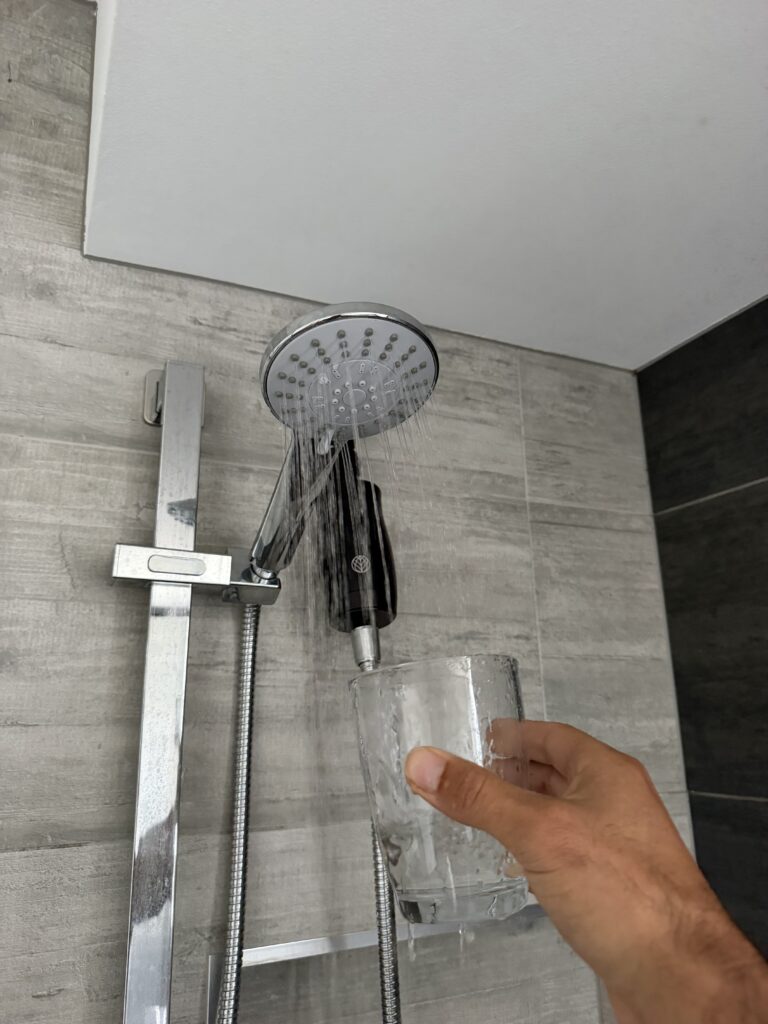
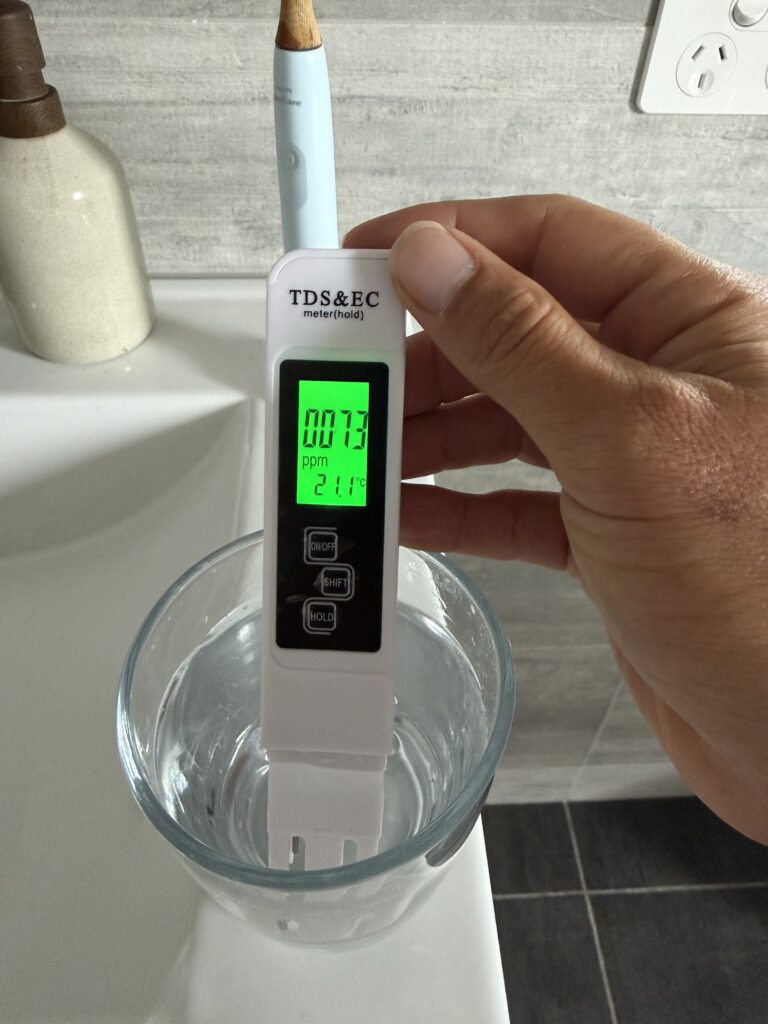
The useful lesson is what a TDS meter cannot tell you. It does not measure chlorine at all. Any shower filter review that uses a TDS reading as proof of chlorine removal is measuring the wrong thing.
Test your own water in 5 minutes
You do not need a lab. Pool test strips that read both free and total chlorine answer the two questions that matter: which disinfectant you have, and whether your filter is doing anything.
1. Which disinfectant? Dip a strip in cold tap water. If free and total chlorine read about the same, you are on chlorine. If total chlorine is high and free chlorine is near zero, you are on chloramine. 2. Is the filter working? Run the shower for 30 seconds, fill a glass from the filtered head, and dip a second strip. Compare it with the tap. On chlorinated water, a working filter should cut free chlorine clearly. When it stops doing that, the cartridge is spent, whatever the calendar says.
 Test your waterFree + totalchlorine on one strip
Reads pH, total chlorine and free chlorine | Pool strips: coarse colour steps, fine for 0.5 to 3 mg/L
Check the AquaChek Price on Amazon →Amazon AU price: $46.05 · as of 22 Nov 2026, 5:43 am AEST DetailsShower filters, eczema and hair: the evidence
The best evidence comes from the SWET trial, published in PLoS Medicine in 2011. Researchers randomised 336 children with eczema to an ion-exchange water softener or usual care for 12 weeks. Eczema scores improved by 20% with the softener and 22% with usual care; the softener gave no additional benefit. That trial tested softeners, which change water far more than a shower filter does.
I found no randomised controlled trial showing that a shower filter improves eczema. Plenty of listings claim it, and some people feel a difference, especially on chlorinated water. Treat that as comfort, not treatment, and talk to a GP or dermatologist about skin conditions. For more, see why shower water can make eczema feel worse.
The best shower filters in Australia
1. Philips AWP1775 Inline Shower Filter: best overall
 Inline shower50,000 Lper cartridge (Philips)
Fits between arm and head | KDF + double mesh | No TDS claim | Cartridge AWP175, 4 to 6 months
Check the Philips Shower Filter Price on Amazon →Amazon AU price: $60.33 · as of 22 Nov 2026, 5:43 am AEST DetailsThe AWP1775 screws in between your shower arm and head, so it works with the head you already have. It uses double mesh and KDF media; Philips says the KDF material is NSF certified, which refers to the media rather than the finished filter. Philips rates a cartridge at up to 50,000 litres, replaced every four to six months, and makes no claim to reduce dissolved solids. It is sold and shipped by Amazon AU ($60.33at Amazon AU · as of 22 Nov 2026, 5:43 am AEST Details), and replacement AWP175 cartridges are about $42.
✓ Pros
- Sold and shipped by Amazon AU
- Fits most shower arms and heads
- No inflated TDS or skin claims
× Cons
- Certification is for the media, not the product
- No chloramine claim
- Cartridge every four to six months
Buy this if…
you are on chlorinated water and want a simple, well-supported filter with local shipping.
2. AquaBliss SF100: most reviewed
 FitsArm
Fits between arm and head | Sediment, redox (KDF-type) media, calcium sulfite, carbon | SFC100 cartridge, every 3 to 6 months (AquaBliss) | No product certification stated | Imported by Amazon US
Check the AquaBliss Price on Amazon →Amazon AU price: $61.15 · as of 21 Nov 2026, 11:29 pm AEST DetailsThe SF100 is one of the most widely sold shower filters on Amazon Australia. It stacks sediment filters, a redox media of the KDF type, calcium sulfite and activated carbon in a chrome housing that fits between arm and head. AquaBliss tells owners to change the SFC100 cartridge every three to six months depending on water quality, and to watch for the chlorine smell coming back.
Where I part company with it is the listing copy. It promises to balance pH, infuse beneficial minerals into your skin and help eczema and dandruff. None of those claims is backed by a certification or a trial, and the listing states no product certification. Calcium sulfite and KDF-type media are sound choices for free chlorine. Buy it for that, and ignore the rest.
✓ Pros
- Huge, long review history
- Calcium sulfite plus KDF-type media for chlorine
- Clear cartridge change advice from the maker
× Cons
- No product certification stated
- Listing makes skin and pH claims it cannot support
- Imported via Amazon US
Buy this if…
you want the filter with the longest track record of real owners, and you accept that the certification gap is real.
3. Sprite Slim-Line 2: tested to the shower filter standard
 Inline showerNSF 177tested (Sprite)
Tested to NSF/ANSI 177 (Sprite; not NSF-listed) | Chlorgon media for free chlorine | SLC cartridge 6 months / about 38,000 L | Imported by Amazon US
Check the Sprite SL2 Price on Amazon →Amazon AU price: $48.62 · as of 22 Nov 2026, 5:43 am AEST DetailsSprite says the SL2 was tested according to NSF/ANSI 177, the standard for shower filtration, for free chlorine reduction. That is the maker's own claim: the SL2 does not appear on NSF's list of certified shower filters, so treat it as tested, not independently certified. It uses Sprite's Chlorgon media, has a slim housing and a dial-a-date reminder. Sprite rates the SLC cartridge at six months or 10,000 US gallons (about 38,000 L), and replacements are about $26. It is $48.62at Amazon AU · as of 22 Nov 2026, 5:43 am AEST Details, imported from the US. It is made for US shower fittings, so check the thread before you buy.
✓ Pros
- Maker says tested to NSF/ANSI 177
- Slim, low-profile housing
- Cheap cartridges
× Cons
- Imported via Amazon US
- US thread: check the fit
- Free chlorine only
Buy this if…
you want the cheapest filter here whose maker says it is tested to the shower filter standard.
4. Sprite HF-CM Hose Filter: best for handheld showers
 Handheld shower3 moHHC cartridge (Sprite)
Fits between handheld hose and wall | Chlorgon media | HHC cartridge about 3 months
Check the Sprite Hose Filter Price on Amazon →Amazon AU price: $33.00 · as of 22 Nov 2026, 5:43 am AEST DetailsIf you have a handheld shower on a rail, like the one in my own photos above, an inline filter at the arm may not suit. The HF-CM fits between the hose and the wall outlet, with a swivel so it sits at any angle. It uses Sprite's HHC cartridge, rated at about three months. It is sold by Amazon AU ($33.00at Amazon AU · as of 22 Nov 2026, 5:43 am AEST Details). The listing does not state a certification for this model.
✓ Pros
- Sold by Amazon AU
- Suits handheld and rail showers
- Cheap
× Cons
- Short three-month cartridge life
- No certification stated on the listing
- Free chlorine only
Buy this if…
you have a handheld shower and want a filter that does not hang off the head.
5. HolyH2O Shower Mate: best for Australian fittings
 Inline shower½ inchAustralian fittings (HolyH2O)
Fits between arm and head | Steel mesh, KDF-55, carbon, PP cotton, ceramic beads | Cartridge 3 to 6 months (HolyH2O) | NSF/ANSI 42 material safety test on the carbon only
See the Shower Mate at HolyH2O →The Shower Mate is the one pick here sold and shipped by an Australian company. It screws in by hand between your shower arm and head, and HolyH2O says it fits standard ½-inch Australian fittings, which takes away the thread question that comes with the US-made Sprite filters. Inside are a stainless steel mesh, KDF-55, carbon, PP cotton and silver and mineral ceramic beads. It is $90 in chrome and $95 in matte black (checked 11 November 2026). Our code HOLYJAYCELOVE takes 15% off orders over $50 and applies automatically through our link, which brings the chrome version to $76.50. Replacement cartridges are $55, and HolyH2O says to change them every three to six months.
Read the claims carefully. HolyH2O says the media reduces chlorine by up to 99%, and chloramine as well. The lab report on the product page is an NSF/ANSI 42 material safety test on the carbon media, which checks that nothing harmful leaches out, not how much chlorine comes out. That is not a chlorine performance test like the one Sprite cites for the SL2, and the contact-time problem I described above applies to its chloramine claim as much as to any other cartridge. To its credit, HolyH2O says plainly that it does not soften water or reduce fluoride. Set aside the skin and hair promises on the product page, for the reasons in the evidence section above. The lifetime guarantee only runs while a cartridge subscription is active, and the 100-day money-back guarantee covers unused products returned in their original packaging.
✓ Pros
- Australian seller, shipped from Sydney
- Made for ½-inch Australian fittings
- Keeps your existing head; no tools
× Cons
- No product certification for chlorine or chloramine
- Dearest cartridges here: $55 every 3 to 6 months
- Lifetime guarantee needs a subscription
Buy this if…
you are on chlorinated water and want an Australian seller and a filter made for Australian fittings, and you accept that its performance claims are not certified.
Check all seven rooms, not just this one
38 checks, 29 free, ranked by impact. Sent as a 32-page PDF.
We'll email you the audit and a short series of practical guides. Unsubscribe in one click, any time. Privacy.
Sent. Taking you to your download...
Comparison table
| Spec | Philips AWP1775 | AquaBliss SF100 | Sprite SL2 | Sprite HF-CM | HolyH2O Shower Mate |
|---|---|---|---|---|---|
| Fits | Arm to head | Arm to head | Arm to head | Hose to wall | Arm to head |
| Media | KDF + double mesh | Sediment, KDF-type, calcium sulfite, carbon | Chlorgon | Chlorgon | Steel mesh, KDF-55, carbon, PP cotton, ceramic beads |
| Certification | NSF-certified KDF media (Philips) | None stated | Tested to NSF/ANSI 177 (Sprite); not NSF-listed | Not stated | NSF/ANSI 42 material safety (carbon media only) |
| Cartridge life | 4 to 6 months / 50,000 L | 3 to 6 months (AquaBliss) | 6 months / about 38,000 L | About 3 months | 3 to 6 months (HolyH2O) |
| Seller | Amazon AU | Amazon US | Amazon US | Amazon AU | HolyH2O, shipped from Sydney |
| Price | $60.33at Amazon AU · as of 22 Nov 2026, 5:43 am AEST Details | $61.15at Amazon AU · as of 21 Nov 2026, 11:29 pm AEST Details | $48.62at Amazon AU · as of 22 Nov 2026, 5:43 am AEST Details | $33.00at Amazon AU · as of 22 Nov 2026, 5:43 am AEST Details | $90 (11 Nov 2026) |
NSF/ANSI 177 and other claims
NSF/ANSI 177 is the standard written for shower filters, and it covers free available chlorine reduction. It does not cover chloramine, fluoride, hardness or skin effects. NSF's own listing shows only a handful of shower products certified to NSF/ANSI 177, and none of the five picks here is among them. When a listing says "NSF certified", read the next few words: certification of a media such as KDF is not the same as certification of the finished filter.
Be sceptical of listings claiming 99% removal of hard water minerals or fluoride from a shower filter using KDF, carbon or calcium sulfite. Those media are not designed to remove calcium, magnesium or fluoride, and the American Dental Association says most carbon filters do not remove fluoride. Stage counts tell you little; what matters is which media is inside and whether the finished product is certified.
Hard water: what a shower filter will not fix
Hard water is calcium and magnesium, and it shows up as scale on glass and taps. Australia's drinking water guidelines describe under 60 mg/L (as calcium carbonate) as soft, 60 to 200 mg/L as good quality, 200 to 500 mg/L as increasing scaling problems and over 500 mg/L as severe scaling. Your utility's annual report lists your hardness.
A shower filter does not meaningfully change hardness, whatever the box says. The only household technology that does is an ion-exchange softener, plumbed in at the meter. If scale is your problem, see water softeners vs water filters. If chlorine is your problem, a shower filter is the right buy.
Cartridge costs
The filter is cheap; the cartridges are the ongoing cost. When I checked on 19 October 2026: the Philips AWP175 cartridge was about $42 (every four to six months), the AquaBliss SFC100 from about $47 (every three to six months) and the Sprite SLC about $26 (every six months). Over a year, that is roughly $50 (Sprite) to about $190 (AquaBliss on a three-month change) for one shower. The HolyH2O Shower Mate cartridge is $55 (checked 11 November 2026), every three to six months, which is $110 to $220 a year at list price. The vitamin C bath method costs well under 50 cents a bath: a tub holds about 100 half-teaspoon doses.
Which type fits your shower?
Fixed head on an arm: an inline filter such as the Philips AWP1775, AquaBliss SF100, Sprite SL2 or HolyH2O Shower Mate screws on between arm and head. Handheld on a rail: a hose filter such as the Sprite HF-CM fits at the wall outlet. Rain head or ceiling arm: check clearance; an inline filter adds length. All of these install by hand in a few minutes with thread tape, and none needs a plumber, because they are not connected to the drinking water supply. A cartridge adds some resistance, which you may notice on a low-flow head.
Which one should you buy?
Chlorinated supply (Melbourne, Perth, Canberra, Gold Coast, Adelaide metro, Darwin, Newcastle and most regional centres): the Philips AWP1775, or the Sprite SL2 if you want a filter its maker says is tested to the shower filter standard, or the AquaBliss SF100 if you trust a long review record, or the HolyH2O Shower Mate if you want an Australian seller and fittings. Handheld shower: Sprite HF-CM. Chloraminated supply (most of Sydney, Brisbane, regional SA, the WA Goldfields): do not buy a shower filter for chloramine. Use the vitamin C bath method for children, and look at a whole house carbon filter for the shower. Not sure: test free and total chlorine first. Hard water: a softener, not a filter. Drinking water: a different job; see the best water filters in Australia.
Final verdict
For most Australian showers, the Philips AWP1775 is the best shower filter: sold by Amazon AU, easy to fit, and modest in what it claims. The Sprite SL2 is the pick if you want the cheapest filter tested to NSF/ANSI 177 on its maker's word, and the AquaBliss SF100 has the longest record of real owners. The HolyH2O Shower Mate suits anyone who would rather buy from an Australian company with an Australian thread, though its claims are not certified. Keep expectations grounded: these reduce free chlorine, and nothing more is proven. I spent nine years as a Navy Clearance Diver, and I judge any kit by what it is rated to do. That is the test here too. If you are on chloramine, the money is better spent on a tub of vitamin C or a whole house filter.
Prices change. Check the retailer before buying.
Frequently asked questions
What is the best shower filter in Australia?
For most homes on chlorinated water, the Philips AWP1775 inline filter, sold by Amazon AU. For a filter its maker says is tested to NSF/ANSI 177, the shower filter standard, the Sprite Slim-Line 2.
Does my city use chlorine or chloramine?
Most of Australia uses free chlorine, including Melbourne, Perth, Canberra, the Gold Coast, Adelaide metro, Darwin and Newcastle. Most of Sydney, Brisbane, regional South Australia and the WA Goldfields use chloramine. Logan, Geelong and the Sunshine Coast are mixed. Your utility's water quality report will confirm it.
Do shower filters remove chloramine?
Not reliably. I found no shower filter certified for chloramine reduction. Chloramine needs far more contact time than a shower allows, and even vitamin C, which does neutralise it, had a reaction half-time of about 4 minutes in a 1978 clinical study.
Does a vitamin C shower filter work in Brisbane or Sydney?
Vitamin C reacts very fast with free chlorine but slowly with chloramine, so a vitamin C cartridge has little time to work in a shower. A bath treated with about half a teaspoon of pure vitamin C and left 10 to 15 minutes is the more reliable option on chloramine.
Do shower filters remove fluoride?
No. Shower filters use KDF, carbon, calcium sulfite or vitamin C, none of which is a fluoride technology. The American Dental Association says most carbon filters do not remove fluoride.
Do shower filters help eczema?
There is no trial evidence that they do. The SWET trial found water softeners gave no additional benefit for children's eczema over 12 weeks, and I found no randomised trial of shower filters. See a GP or dermatologist about eczema.
Do shower filters soften hard water?
No. They are not ion-exchange softeners and do not meaningfully remove calcium or magnesium. Australia's guidelines describe water over 200 mg/L hardness as causing increasing scaling; only a softener changes that.
How often should I change a shower filter cartridge?
Follow the maker's rating: four to six months for the Philips AWP175, three to six months for the AquaBliss SFC100, six months for the Sprite SLC and about three months for the Sprite HHC, and three to six months for the HolyH2O Shower Mate. A free chlorine test strip will tell you when a cartridge has stopped working.
Will a shower filter reduce water pressure?
It can, a little. The cartridge adds resistance, which you notice most on a low-flow head. A clogged cartridge reduces pressure further, which is another sign it is due for a change.
Can a TDS meter test my shower filter?
No. A TDS meter does not measure chlorine. Use test strips that read free and total chlorine, before and after the filter.
Do I need a plumber to fit a shower filter?
No. Inline and hose shower filters screw on by hand with thread tape and are not connected to the drinking water supply.
- NHMRC ADWG: Summary of guideline values (chlorine, monochloramine, hardness)
- American Dental Association: Fluoridation Facts (home treatment and fluoride)
- Sydney Water: Potts Hill quarterly water quality report, Q1 2025-26 (monochloramine)
- Sydney Water: Illawarra quarterly water quality report, Q1 2025-26 (free chlorine)
- Seqwater: Brisbane zone water quality report, September 2026
- Seqwater: water quality reports by zone (Gold Coast, September 2026)
- Unitywater: drinking water quality performance report 2017-18
- Logan City Council: drinking water quality common concerns
- South East Water: Annual Drinking Water Quality Report 2024-25
- Yarra Valley Water: how Melbourne's water is disinfected
- Barwon Water: Annual Drinking Water Quality Report 2024-25
- Icon Water: Annual Drinking Water Quality Report 2018-19
- SA Water: Happy Valley water treatment plant fact sheet
- SA Water: disinfecting your drinking water (chloramine areas)
- WA Health: chlorinated drinking water (Goldfields scheme chloramination)
- Power and Water: drinking water quality
- Hunter Water: what's in your water
- Central Coast Council: quarterly drinking water quality summary, Jul to Sep 2024
- Townsville City Council: DWQMP annual report 2022-23
- Cairns Regional Council: Drinking Water Report 2024-25
- Toowoomba Regional Council: DWQMP annual report 2024-25
- Neilan et al. 1978, Clinical Nephrology: ascorbic acid and chloramine (reaction half-time about 4 minutes)
- USDA Forest Service: using vitamin C to neutralise chlorine (2.5 to 1 ratio)
- KDF Fluid Treatment: KDF-55 free chlorine test data
- KDF: reductive dechloramination study (KDF 85, contact time)
- Water Quality Association: Technical Fact Sheet, Chloramine (carbon contact time)
- Water Conditioning & Purification: the NSF/ANSI 177 shower filter standard
- AquaBliss: when and how to change a filter cartridge
- NHMRC ADWG: Hardness (as calcium carbonate) fact sheet
- Thomas et al. 2011, PLoS Medicine: the SWET trial of water softeners for eczema

Former Royal Australian Navy Clearance Diver and TAG-E counter-terrorism operator. Founded Clean and Native to apply the same rigorous thinking to the home environment.
Full biography →The 7-Room Home Audit
Your tap water is one room. The audit covers all seven: 38 checks across water, air and EMF, 29 of them free, ranked by impact against Australian guidelines.
- Morning tap flush: the free lead fix most homes skip
- How to read your utility's water quality report
- Renting or owning: the two reverse osmosis filters I use at home
We'll email you the audit and a short series of practical guides. Unsubscribe in one click, any time. Privacy.
Sent. Taking you to your download...