Best Alkaline Water Filter Australia 2026: The Science-Honest Comparison
Drafted with AI assistance and checked against published specifications and certifications. First-hand measurements appear only where stated. How we make content
This article contains affiliate links. We may earn a commission at no extra cost to you.
Most “alkaline water” products are built on a marketing claim your stomach disproves in seconds — but behind the pH hype is a genuinely valuable product category. The best alkaline water filters in Australia combine reverse osmosis (removes 95-99% of contaminants including chloramines, heavy metals, and fluoride) with a remineraliser stage that adds calcium and magnesium back into the clean water. The result is filtered water that reads at pH 7.5-8.0 not because of marketing additives, but because calcium carbonate naturally raises pH slightly. In 2026, two systems stand out for Australian households: the for countertop simplicity, and the Pure Water Systems 5-Stage Portable ($988) for families who need higher daily output.
Quick Verdict — Best Alkaline Water Filter Australia 2026
| AquaTru Smart Alkaline | PWS 5-Stage Portable | PWS Under-Sink | |
|---|---|---|---|
| Price | $449 | $988 | $1,409 |
| Best for | Renters, countertop, 1-2 people | Families, 3+ people, portable | Permanent install, dedicated tap |
| Filtration stages | 4-stage (pre + RO + carbon + alkaline) | 5-stage (pre + RO + carbon + post + remineraliser) | 5-stage (pre + RO + carbon + post + remineraliser) |
| Removes chloramines | Yes | Yes | Yes |
| Remineralises | Yes | Yes | Yes |
| Install | No plumbing needed | No plumbing needed | Plumber required |
| 5-year total cost | ~$1,049 | ~$1,738 | ~$2,009 |
Bottled alkaline water costs ~$3,650 over 5 years per household (2L/day at $1/L supermarket price). Both RO systems pay for themselves well within 2 years.
Who This Guide Is For
This guide is for Australians who want genuinely clean, mineral-rich drinking water and are ready to look past pH marketing to understand what technology actually delivers it. It suits renters who cannot run plumbing (AquaTru requires no installation at all) and homeowners ready for a permanent high-output system. It is not for people seeking a $50 jug filter that “alkalises” water by passing it through limestone chips — those products cannot produce the filtration quality covered here, and the pH claim is a distraction from what actually matters.
The Alkaline Water Myth: Why pH Claims Are Pseudoscience
The alkaline water industry is worth billions globally, but the core claim — that drinking high-pH water changes your body’s pH — contradicts basic physiology. Your stomach produces hydrochloric acid at pH 1.5 to 3.5. A glass of pH 9 water is neutralised within seconds of hitting your stomach lining. Your blood pH is tightly regulated between 7.35 and 7.45 by your kidneys and respiratory system regardless of what you drink. Moving blood pH outside this window is a medical emergency — it does not happen from drinking an extra glass of alkaline water.
The scientific literature is clear on this. A 2016 study in the Journal of the International Society of Sports Nutrition found no performance or hydration benefit from alkaline water versus standard water in trained cyclists. A 2022 review of alkaline water interventions in Nutrients found no high-quality randomised controlled trial supporting alkaline water for any health outcome in healthy adults. Promotional language common on Australian alkaline water product pages — “boosts cellular hydration,” “detoxifies,” “improves metabolism” — has no peer-reviewed support at household doses.
Where does this leave us? The pH claim is a marketing hook layered onto a product category that does have genuine value: multi-stage water filtration. The machines that produce “alkaline water” typically use reverse osmosis (or at minimum carbon block plus mineral stages), and it is the filtration — not the pH — that makes the water genuinely better. Understanding this lets you choose a system based on actual filtration performance rather than a number on a pH strip.
What Actually Works: The Case for Remineralised RO Water
Reverse osmosis is the most thoroughly tested residential filtration technology available. An RO membrane has pores of approximately 0.0001 microns — small enough to block dissolved salts, heavy metals, nitrates, fluoride, PFAS compounds, and microplastics. The Australian Drinking Water Guidelines (ADWG 2022) identify chlorine byproducts (trihalomethanes), heavy metals, nitrates, and PFAS as compounds to monitor in Australian municipal supply. RO removes all of them to below ADWG limits, where carbon block filters — used in most jug filters and standard undersink units — leave measurable residues.
The trade-off: RO also removes calcium and magnesium, the dissolved minerals your body does absorb from water. A 2009 World Health Organization technical report on demineralised water found that prolonged consumption of very low-mineral water (below 30 mg/L total dissolved solids) may increase risk of cardiovascular and gastrointestinal effects compared to moderate-mineral water. Australian tap water typically contains 100-400 mg/L TDS depending on your city. Pure RO output sits at 5-20 mg/L — below the WHO caution threshold for long-term daily drinking use.
The solution is a remineraliser cartridge: a final filtration stage containing calcium carbonate and magnesium minerals. As water passes through, trace amounts dissolve back into the clean water, raising TDS to a healthy 50-150 mg/L range and incidentally raising pH to 7.5-8.0 — not because of a marketing claim, but because calcium carbonate is naturally alkaline. This is the honest version of “alkaline water.” Both products reviewed in this guide work this way.
Best Alkaline Water Filter Australia 2026: Full Reviews
The two systems below were selected because they meet the same criteria: genuine RO filtration (not just carbon block), an included remineraliser stage, and confirmed availability and support in Australia. Both are evaluated on their own merits. If you want a gravity or ceramic benchtop filter instead of RO — no plumbing, no waste water — see our separate best gravity water filter Australia guide, which covers those options in detail.
AquaTru Smart Alkaline — Full Review
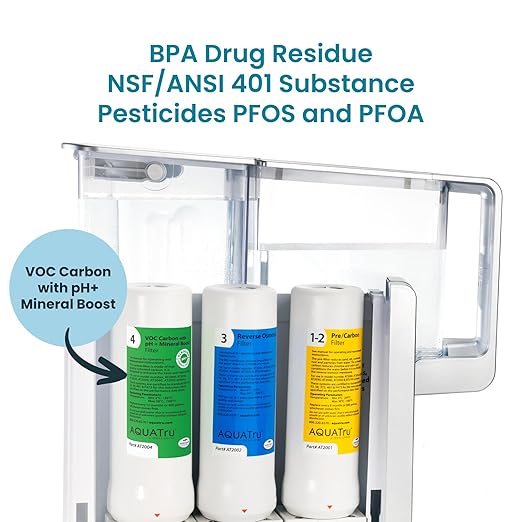
The AquaTru Smart Alkaline is the closest thing to a plug-and-play RO system for Australian renters. It sits on your benchtop, connects to no plumbing, and filters tap water through four stages: a pre-filter that removes sediment and chlorine taste, an NSF 58-certified reverse osmosis membrane that blocks dissolved contaminants, a carbon post-filter for polishing, and a final alkaline remineraliser cartridge. Filtered water collects in a 6-litre tank you can pour from like a jug. No installation. No plumber. No landlord approval required.
The RO membrane is the reason it earns the top spot. The NSF Standard 58 certification covers reduction of lead, arsenic, chromium 6, nitrates, fluoride, and chloramines — the full set of contaminants Australian households should care about. Brisbane, Sydney, Adelaide, and Gold Coast all use chloramine as a disinfectant, a compound that carbon filters alone cannot reliably remove but that RO membranes block effectively regardless of contact time. The alkaline stage then adds back calcium and magnesium, producing output at approximately pH 7.5-8.0 with TDS in the 50-150 mg/L range.
The 6-litre tank is a constraint worth understanding before you buy. For a household of two drinking 2-3 litres per day each, you will refill the unit once or twice daily. AquaTru produces filtered water at approximately 1 litre per 15-20 minutes, so the tank refills within an hour of being emptied. For a single person or couple this is a non-issue. For a family of four with higher daily water demand, the Pure Water Systems portable (reviewed below) is a better fit.
Filter cartridge costs run approximately $120-150 AUD per year: the pre-filter every 6 months, the RO membrane every 2 years, and the alkaline cartridge every 6-12 months. Five-year total including the upfront unit is approximately $1,049 — comparing favourably to bottled alkaline water at $3,650 over the same period for a household buying 10L boxes at supermarket prices.
AquaTru Smart Alkaline — Pros and Cons
Pros
- No plumbing — renter-friendly
- NSF 58-certified RO membrane
- Removes chloramines (critical for Brisbane, Sydney, Gold Coast, Adelaide)
- Dedicated remineraliser stage included
- Available on Amazon AU with local Prime delivery
- Lowest 5-year cost of any RO system in this guide
Cons
- 6L tank limits output for large families
- Slower filtration than plumbed systems
- Replacement filters must be sourced from AquaTru or Amazon
Buy if: You rent, move frequently, or have a 1-2 person household and want NSF-certified RO filtration with remineralisation at the lowest upfront cost.
Pure Water Systems 5-Stage Portable + Remineraliser — Full Review
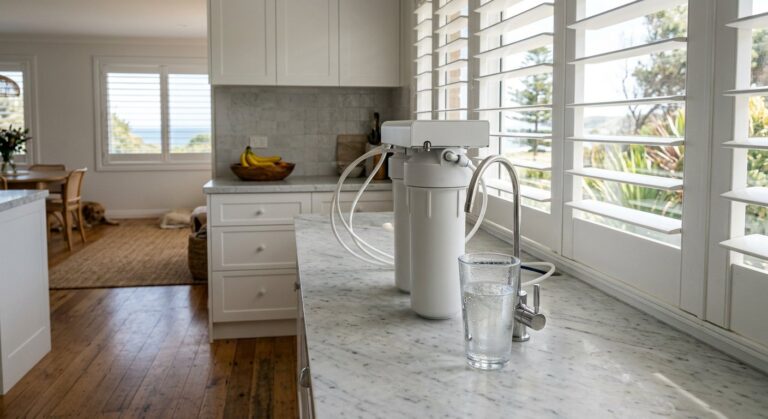
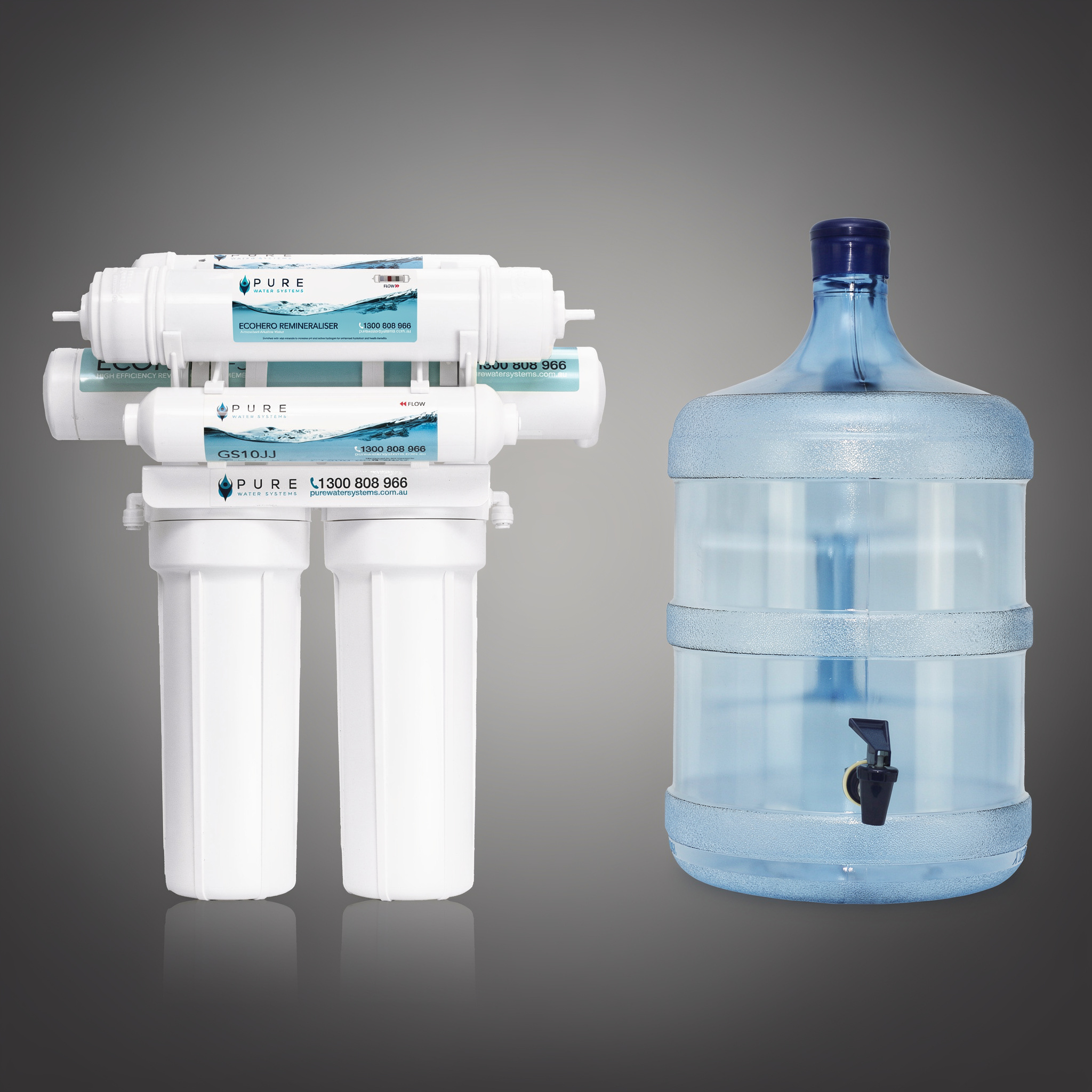
The Pure Water Systems 5-Stage Portable is an Australian-supported countertop RO system designed for households that need more daily filtered water than a tank-style unit can deliver. Where the AquaTru holds 6 litres, the PWS Portable operates as a higher-throughput flow system — viable for a family of four or a share house with higher daily drinking water demand. It requires no plumbing connection, sitting alongside your tap and connecting to it with the included fittings.
The five-stage filtration sequence covers sediment pre-filter, carbon block (removes chlorine taste and VOCs), the RO membrane (removes dissolved contaminants including chloramines, heavy metals, nitrates, and fluoride), post-carbon polishing, and the dedicated remineraliser cartridge. This five-stage sequence is more comprehensive than the AquaTru’s four stages, with the remineraliser as a distinct, independently replaceable cartridge rather than a combined stage. Output TDS lands in the 50-150 mg/L mineral-healthy range.
Pure Water Systems is an Australian company with local phone support — important when you need to troubleshoot or order replacement cartridges without navigating international shipping. Annual cartridge costs run approximately $130-150 per year. The upfront cost of $988 is higher than the AquaTru, but the 5-year total of approximately $1,738 still delivers substantial savings over bottled alkaline water and is the right choice when daily output volume is the deciding factor.
Under-sink upgrade path: Pure Water Systems also offers a 5-Stage Under-Sink with Remineraliser ($1,409) that uses the same filtration sequence routed to a dedicated filtered water tap mounted on your benchtop. This is the best permanent installation option for homeowners who want the countertop footprint eliminated entirely. It requires a licensed plumber for installation but delivers the highest daily output of any system in this guide. Visit purewatersystems.com.au to compare both configurations — at checkout on either.
Pure Water Systems 5-Stage Portable — Pros and Cons
Pros
- 5-stage with dedicated remineraliser cartridge
- Higher daily output than 6L tank-style units
- Australian company — local support and cartridge supply
- No plumbing required for portable model
- Under-sink upgrade path available ($1,409)
- = 10% off at checkout
Cons
- $988 upfront — higher than the AquaTru
- Larger countertop footprint
- Under-sink model requires licensed plumber install
Buy if: You have a family of 3+ people, need higher daily filtered water output, or want an Australian-supported system with a permanent install upgrade path. Shop Pure Water Systems — use for 10% off →
5-Year Cost Comparison: Bottled vs Filtered
The economics of home water filtration become compelling once you calculate bottled water costs honestly. A household drinking 2 litres per day of supermarket alkaline water (bulk 10L boxes at $1/L) spends $730 per year on water alone — $3,650 over five years, with no contaminant removal benefit beyond the brand claim. Both RO systems below pay for themselves in under two years at that baseline, and the AquaTru pays back in approximately 14 months.
5-Year Total Cost — Alkaline Water Options (2L/day household)
Costs: AquaTru $449 unit + ~$120/yr filters = $1,049. PWS Portable $988 + ~$150/yr = $1,738. PWS Under-Sink $1,409 + ~$120/yr = $2,009. Bottled: 2L/day at $1/L = $730/yr. Filter costs are approximate — replace on schedule for best performance.
Which City Water Are You Filtering? Chloramine vs Free Chlorine
Australian cities use two different disinfection methods in their water supply, and the difference matters for filter technology choice — although both RO systems reviewed here handle both.
Chloramine cities (Brisbane, SEQ, Sydney, Adelaide, Gold Coast, Darwin): These cities add chloramine — a combination of chlorine and ammonia — because it is more stable than free chlorine over long distribution networks. The downside: chloramine is significantly harder to remove than free chlorine. Activated carbon filters in jug filters and standard under-sink systems require very long contact times to reduce chloramine meaningfully. An RO membrane removes chloramine regardless of contact time, which is why RO is the appropriate technology for these cities.
Free chlorine cities (Melbourne, Hobart, Canberra, Townsville, Cairns): Free chlorine is easier to remove — standard activated carbon block filters handle it reliably. However, free chlorine reacts with organic matter in water to form trihalomethanes (THMs), disinfection byproducts the ADWG 2022 recommends keeping below 250 micrograms per litre. RO removes THMs along with the parent chlorine. In free chlorine cities, a quality carbon block filter is adequate for disinfectant removal — but RO remains the superior choice if you are also concerned about heavy metals, PFAS, fluoride, or nitrates.
What to Look For When Buying an Alkaline Water Filter in Australia
Most products marketed as “alkaline water filters” in Australia are activated carbon block systems with a mineral cartridge at the end — they raise pH without properly filtering the water first. Here is what separates a genuine filtration system from an expensive jug filter:
- RO membrane included: Non-negotiable. Without a reverse osmosis membrane, the system cannot remove chloramines, heavy metals, nitrates, fluoride, or PFAS. Look for NSF Standard 58 certification on the RO stage specifically.
- Separate remineraliser cartridge: The remineraliser should be a distinct cartridge, not mineral balls blended into a carbon filter. A dedicated stage gives you control over mineral output and lets you replace it independently when exhausted.
- Australian availability of replacement cartridges: A system requiring imported cartridges from the US adds ongoing cost and supply risk. Both products in this guide source cartridges locally.
- Honest marketing: If the product page leads with blood pH claims, cancer prevention, or “hydrogen-rich” water benefits, approach with scepticism. Reputable RO manufacturers lead with filtration data and certifications — not wellness claims.
- Realistic output numbers: RO systems reject approximately 2-4 litres of water for every litre filtered. Some manufacturers obscure this. Factor in wastewater when assessing running costs and water efficiency.
Frequently Asked Questions
Is alkaline water actually good for you?
The evidence for health benefits specific to alkaline pH is weak — no high-quality randomised controlled trial has demonstrated meaningful outcomes in healthy adults from drinking alkaline versus standard water. However, water from a quality RO plus remineraliser system is genuinely better in measurable ways: fewer contaminants (chloramines, heavy metals, PFAS removed) and appropriate mineral content restored. The benefit is filtration quality, not pH.
What is the difference between alkaline water and remineralised water?
Most “alkaline water” products raise pH by passing water through mineral beds or via electrolysis, without removing the contaminants already in the tap water. Remineralised water is RO-filtered water that has had specific minerals (calcium, magnesium) added back after filtration. Remineralised RO water is both clean and mineral-balanced. Alkaline-only water may have its pH raised without any meaningful contaminant removal.
Does reverse osmosis remove fluoride from drinking water?
Yes. RO membranes remove fluoride to approximately 94-96% efficiency, well below the ADWG 2022 guideline of 1.5 mg/L. Australian tap water is typically fluoridated at 0.6-1.1 mg/L, so RO output fluoride is generally below 0.05 mg/L. If fluoride removal is your primary concern, RO is the only residential technology that reliably achieves it — activated carbon filters do not remove fluoride.
Does reverse osmosis remove chloramines?
Yes. An RO membrane physically blocks chloramine molecules regardless of water contact time. This is why RO is the recommended technology for households in chloramine-dosed cities (Brisbane, Sydney, Adelaide, Gold Coast, Darwin). Activated carbon filters require extended contact times to reduce chloramine and standard jug or under-sink carbon filters typically do not achieve meaningful chloramine reduction in normal use.
What TDS level should my filtered water be?
Aim for 50-150 mg/L TDS in the output from an RO plus remineraliser system. Pure RO without remineralisation produces 5-20 mg/L TDS, which falls below the WHO threshold for appropriate mineral content. A properly functioning remineraliser stage raises TDS to the 50-150 range, providing adequate calcium and magnesium while remaining very clean. You can verify this with an inexpensive TDS meter available from most aquarium or hydroponic suppliers for under $20.
Is the AquaTru Smart Alkaline available in Australia?
Yes. The AquaTru Smart Alkaline (Amazon ASIN B0F9C7G3VD) is available on Amazon AU with local warehouse shipping. As of May 2026, it is listed at $449 AUD with Prime delivery available. Replacement filter cartridges are also stocked on Amazon AU. The unit operates on standard Australian tap water pressure and does not require a voltage converter.
How much do water filter cartridges cost per year in Australia?
For the systems in this guide, annual cartridge costs are approximately $120-150 AUD. This covers the pre-filter (every 6 months), RO membrane (every 2 years), carbon post-filter (every 12 months), and remineraliser cartridge (every 6-12 months depending on use and local water hardness). Hard water cities — Perth and Adelaide in particular — may require more frequent membrane replacement due to higher incoming dissolved solid loads.
Can I use a filter jug instead of a reverse osmosis system?
Jug filters (Brita, Aqua Optima, and similar) use activated carbon block technology that removes chlorine taste, some heavy metals, and improves flavour. They do not remove chloramines, nitrates, fluoride, PFAS, or most dissolved salts. For households in chloramine cities or concerned about heavy metals, PFAS, or fluoride, a jug filter is not adequate. For households in free chlorine cities whose only concern is taste, a quality carbon jug is a reasonable lower-cost option.
How long does it take a reverse osmosis system to pay for itself?
At a baseline of 2L per day of bulk supermarket alkaline water at $1/L ($730 per year), the AquaTru ($449 upfront plus ~$120/yr filters) pays for itself in approximately 14 months. The PWS Portable ($988 upfront plus ~$150/yr filters) pays for itself in approximately 21 months. If you buy premium bottled alkaline water at $2-3/L, payback for the AquaTru is under 10 months.
Does my city use chloramines or free chlorine?
Australian chloramine cities: Brisbane, Gold Coast, Sunshine Coast, Sydney, Newcastle, Wollongong, Adelaide, Perth, Darwin. Australian free chlorine cities: Melbourne, Hobart, Canberra, Townsville, Cairns. If you are outside a capital city, contact your local water authority or download your annual water quality report — most councils publish these online and list the disinfection method used.
Maintenance Schedule: Keeping Your RO System Performing
An RO system that is not maintained delivers progressively worse filtration without any obvious warning — the water still tastes clean because carbon post-filters mask any membrane degradation in flavour. The only reliable signal is TDS measurement. Check your post-filter TDS every 6 months with a $15 meter. If the reading is climbing toward 100-150 mg/L above your baseline, the RO membrane is reaching its service life.
For the AquaTru Smart Alkaline, AquaTru publishes a straightforward cartridge schedule: pre-filter at 6 months, post-carbon filter at 12 months, alkaline remineraliser at 6-12 months depending on use, and the RO membrane at 24 months under normal household use. Replacement cartridges are available on Amazon AU, so you are not dependent on a single local distributor. For the Pure Water Systems portable, PWS provides an equivalent schedule with Australian-stocked cartridges and local phone support if you have questions about replacement timing based on your city’s water hardness.
One practical note: both systems should be sanitised annually using a food-safe sanitiser solution to clear any biofilm that may develop in the storage tank (AquaTru) or the post-filter housing (PWS). Both manufacturers include sanitisation instructions in the product manual. Skipping sanitisation for more than 12 months in a warm climate like Queensland or Western Australia increases the risk of microbial growth in the clean water side of the system — which would be counterproductive given the reason you bought the filter in the first place.
How to Test Your Water Quality at Home
Before buying a filter, it is worth knowing what is actually in your tap water. Most Australian water utilities publish an annual water quality report for each local government area. These reports list measured concentrations of chloramine or free chlorine, lead, nitrates, fluoride, and TDS against the ADWG 2022 guideline limits. Search your water authority’s name plus “water quality report” to find yours — Sydney Water, Melbourne Water, South East Queensland Water, SA Water, and Water Corporation (Perth) all publish them.
For a faster at-home reading, a TDS meter costs under $20 from any aquarium supplier or online store. It measures total dissolved solids in milligrams per litre and gives you a baseline before filtering. After installing an RO system, test again — output from a functioning RO membrane should read 5-20 mg/L before the remineraliser stage and 50-150 mg/L after it. If your post-filter TDS is creeping back above 200 mg/L, the RO membrane needs replacing.
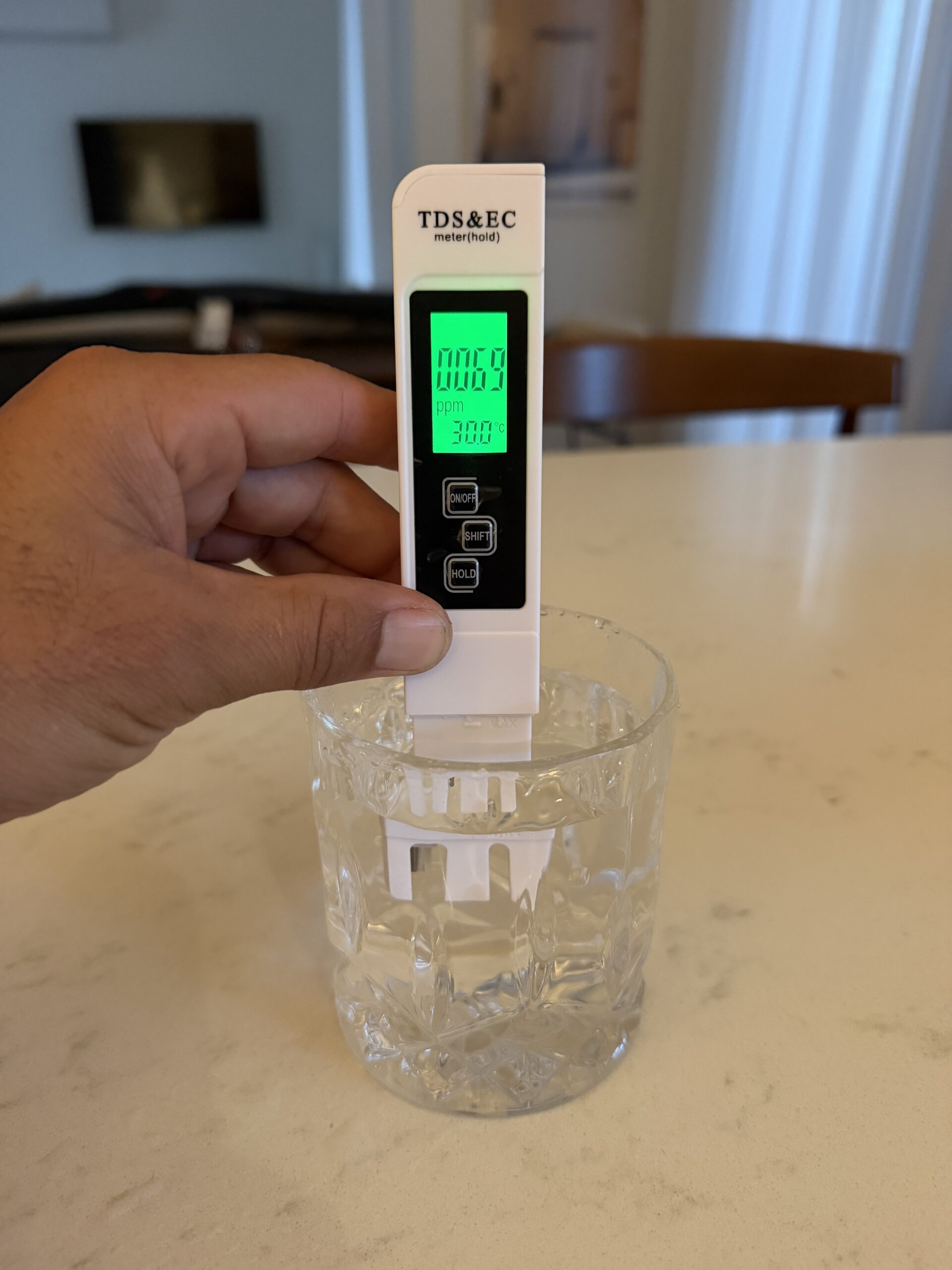
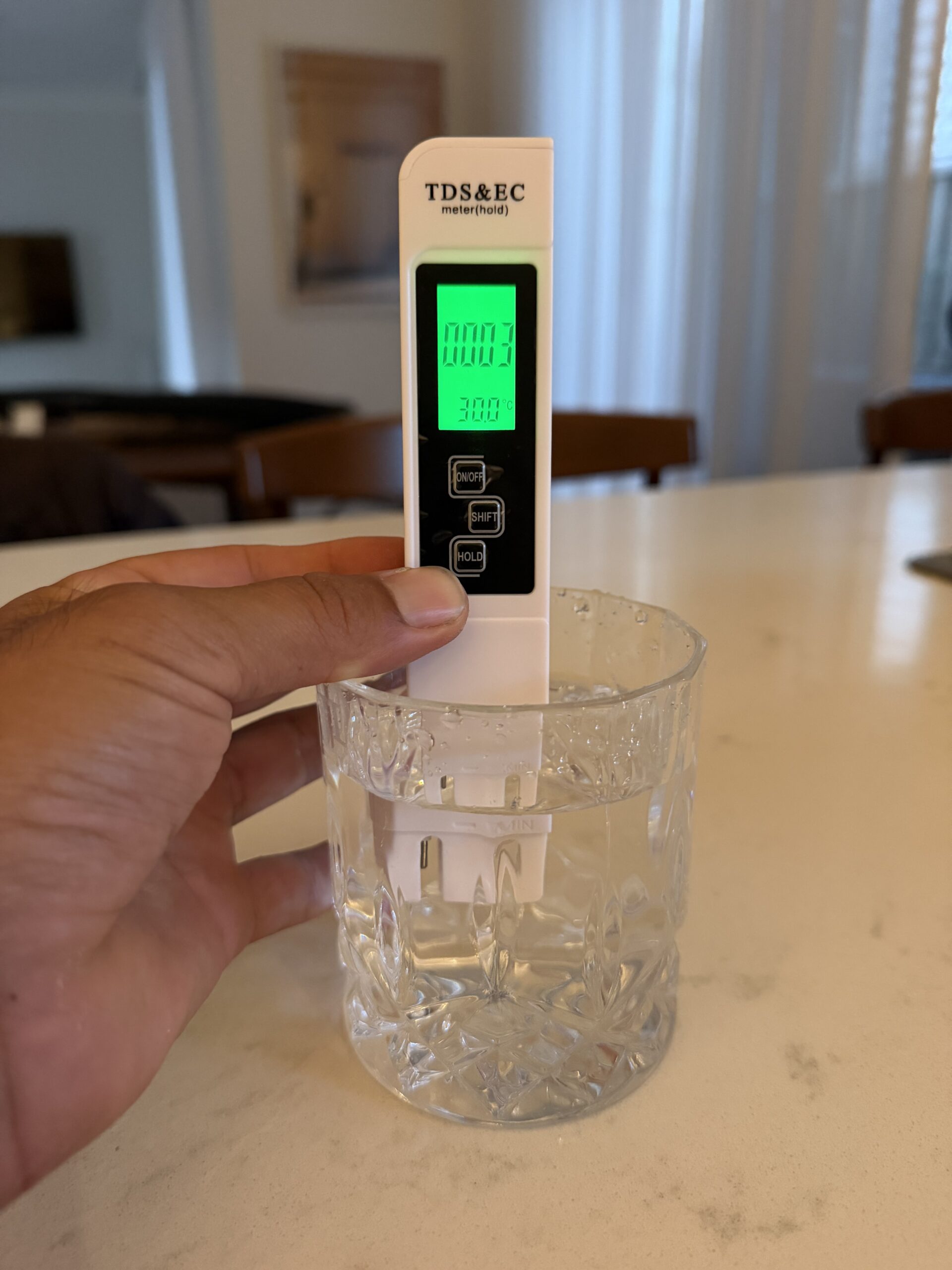
For chloramine specifically, a free residual chlorine test strip will read low (or near zero) even in high-chloramine water — because chloramine is a combined form of chlorine that standard free-chlorine test kits undercount. A total chlorine test (which measures both free and combined) is the correct test. If your total chlorine reading is elevated but your free chlorine reading is low, your city is using chloramine. Confirm with your water authority if in doubt — the annual report will state the disinfection method explicitly.
RO Water and Cooking: What Changes
Most Australians who install an RO system notice a change in the taste of hot beverages and cooked food almost immediately. The reason is chloramine. When chloramine-dosed water is used to make coffee or tea, heat accelerates the chemical reaction between chloramine residues and the organic compounds in the coffee or tea, producing off-notes that many people describe as “chemical,” “bleachy,” or “flat.” RO water, having no residual disinfectant, allows the natural aromatic compounds to express cleanly.
For cooking, RO water’s near-zero mineral content does change how some recipes behave. Bread made with very low-mineral water can have slightly different gluten development because calcium ions assist in gluten network formation. Pasta cooked in high-mineral water takes slightly longer than pasta cooked in pure RO water because the dissolved minerals raise the boiling point marginally. For most home cooks, these differences are negligible — but for sourdough bakers and specialty coffee enthusiasts, the shift to remineralised RO water (rather than pure RO water) is usually the ideal compromise: clean but not stripped.
The remineralised output from both systems in this guide — AquaTru Smart Alkaline and PWS 5-Stage Portable — targets the 50-150 mg/L TDS range that most baristas and home brewers consider the sweet spot for coffee extraction. The Specialty Coffee Association brewing water guidelines recommend 75-250 mg/L TDS with a target of 150 mg/L for optimal extraction. Remineralised RO water lands in that range without the chloramine interference that pushes flavour off in chloramine-dosed city water.
Understanding Water Waste in RO Systems
Every reverse osmosis system produces two outputs: filtered water and brine (reject water). The brine is the concentrated stream that carries all the removed contaminants away from the membrane. Most household RO systems produce 2-4 litres of brine for every litre of filtered water, though newer efficient membranes can achieve closer to 1:1 ratios.
In an Australian context, water efficiency is a legitimate consideration — particularly in states with ongoing restrictions, including South Australia, Western Australia, and parts of Queensland. For a household producing 4 litres of filtered water per day (sufficient for drinking and cooking for 2 people), a standard RO system at 3:1 brine ratio uses approximately 16 litres of tap water per day for filtered output. At Sydney Water’s current residential rate of approximately $2.25 per kilolitre, this adds roughly $13 per year to your water bill — a negligible cost compared to the savings over bottled water.
The brine output is not wasted in practice. Because it is still clean tap water (just concentrated with the minerals and dissolved solids that were removed), it is safe to use for watering plants, flushing toilets, or cleaning. Both the AquaTru and the PWS Portable produce brine that can be redirected to a separate container for this purpose. If water efficiency is a priority, check the membrane’s stated recovery rate — a 30-40% recovery rate is typical for standard residential membranes; premium membranes achieve 50-70%.
Get the Australian Home Environment Checklist
30 checks across water, air and EMF. Most of them free. Ranked by impact.
No spam. Unsubscribe any time.

Former Royal Australian Navy Clearance Diver and TAG-E counter-terrorism operator. Founded Clean and Native to apply the same rigorous thinking to the home environment.
Full biography →