Breville Smart Air Viral Protect Max Review Australia 2026: Specs Checked
Drafted with AI assistance and checked against published specifications and certifications. First-hand measurements appear only where stated. How we make content
How this assessment was made. I haven’t tested the Breville Smart Air Viral Protect Max; I own and run a Coway Airmega 150 in my bedroom. This review is built from Breville’s Australian and New Zealand instruction book and product pages, Australian retailer listings and the US EPA’s sizing guidance, and every room size is worked out from the clean air delivery rate rather than taken from the box. Prices and ratings were checked on Amazon Australia on 29 Oct 2026. An earlier version of this page made claims about CHOICE rankings and sensors that I couldn’t verify; they have been removed. Clean and Native may earn a commission on some links.
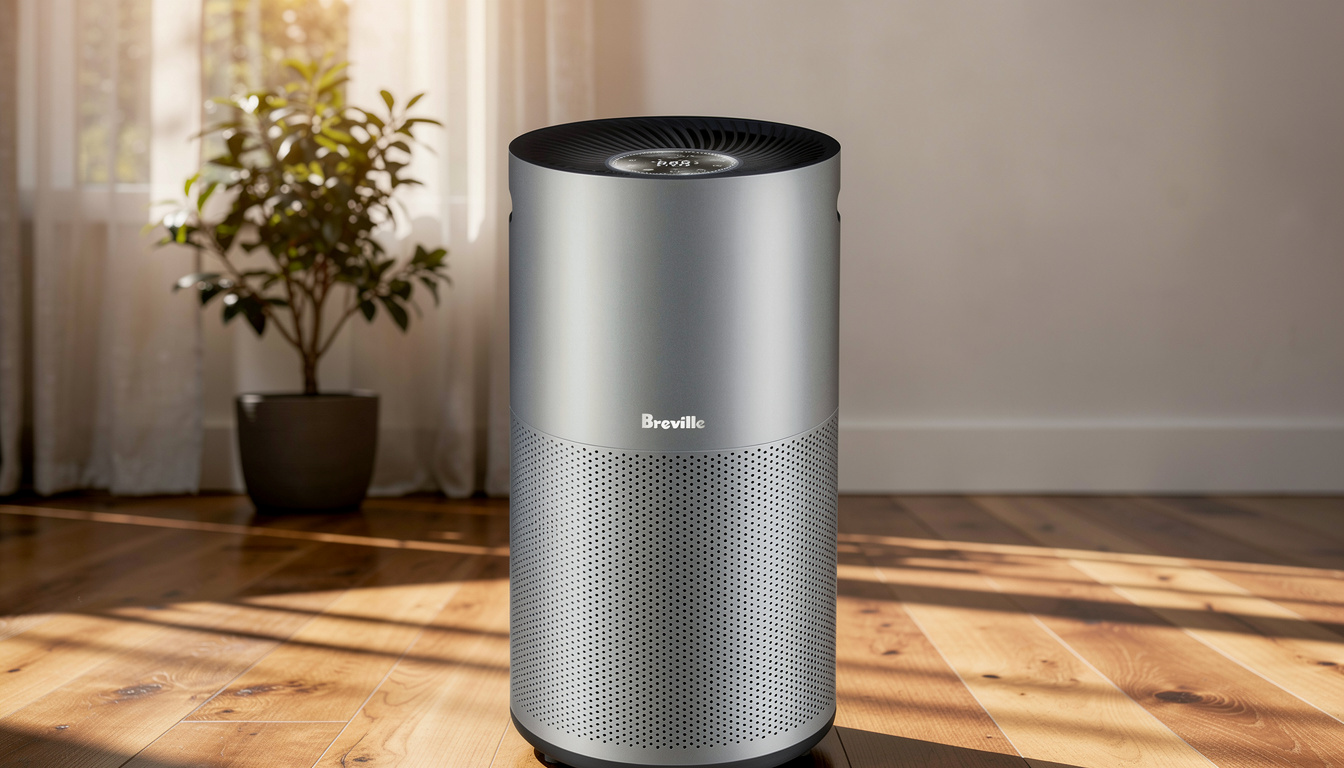
The Breville Smart Air Viral Protect Max (LAP608) is a large-room purifier: Breville rates it at a clean air delivery rate of up to 530 m³/h on the Chinese GB/T test, enough for an open-plan area of about 44 m² on the US EPA’s sizing rule, with a combined pre-filter, H13 HEPA and carbon filter, a PM2.5 sensor, Wi-Fi and a switchable UV-C lamp. It is a solid choice if you want an Australian brand with a three-year warranty. But at about $498 online, the Philips 3200 offers a similar rated airflow, no UV or ions, and lower running costs for about $382.
I wrote this review to answer the questions people actually search for: how big a room it really cleans, what the filters cost, whether the UV-C matters, what the app shows, and how it compares with the purifiers you’re likely weighing it against. As a former Navy Clearance Diver, I’d rather tell you what the spec sheet supports than repeat a marketing line, so every figure below has a source you can check.
A capable large-room HEPA purifier with good local support, but the Philips 3200 does a similar job for less. Buy the Breville for the warranty and brand, not because it out-cleans its rivals.
| Purifier | Best for | Price |
|---|---|---|
| Breville Protect Max | Open-plan areas to ~44 m²; Breville support, 3-year warranty | $470.81at Amazon AU · as of 19 Nov 2026, 11:29 pm AEST Details |
| Philips 3200 | Similar rated CADR, no UV or ions, lower power | $495.00at Amazon AU · as of 19 Nov 2026, 8:29 pm AEST Details |
| Coway Airmega 400 | Published smoke CADR in cfm, for big rooms | $629.00at Amazon AU · as of 19 Nov 2026, 8:29 pm AEST Details |
✓ The Breville Protect Max suits you if
- You need one purifier for an open-plan living area of roughly 30 to 45 m²
- You want an Australian brand with a three-year warranty and local service
- You like app control and a PM2.5 readout
- You’ll run it on Auto and let the sensor do the work
× Look elsewhere if
- The room is a bedroom under about 20 m²: a smaller purifier is cheaper to buy and run
- You’d rather avoid UV or ion features altogether
- You want a smoke CADR in cfm (the AHAM format) to size against
- Price matters more than brand: the Philips 3200 is about $116 cheaper
Specifications at a glance
 Assessed530 m³/hCADR, GB/T 18801 test (Breville)
Pre-filter + HEPA-13 + carbon in one LAP065 filter | PM2.5 sensor and Auto | Switchable UV-C | 50 W (manual) | 54 dB (manual) | 3-year warranty (retailers)
Check the Breville Protect Max Price on Amazon →Amazon AU price: $470.81 · as of 19 Nov 2026, 11:29 pm AEST Details| Spec | Breville Smart Air Viral Protect Max (LAP608) |
|---|---|
| CADR | Up to 530 m³/h, tested to GB/T 18801-2015 (Breville) |
| Breville room claim | Up to 138 m² |
| Room on the EPA 2/3 rule | About 44 m² (our calculation) |
| Filter | One LAP065 unit: pre-filter + AntiViral HEPA-13 + activated carbon |
| Sensors | PM2.5 laser sensor; ambient light sensor for the display |
| Extras | Switchable UV-C (Microbe Shield); Wi-Fi with the Breville app |
| Speeds | Low, Medium, High, Turbo, plus Auto and Night modes; 0 to 12 hour timer |
| Noise | 54 dB (the only figure in Breville’s manual; speed not stated) |
| Power | 50 W (Breville manual) |
| Size and weight | About 29 x 29 x 53.5 cm; 5.46 kg in Breville’s manual (retailers list up to 6.2 kg) |
| Warranty | 3 years (Appliances Online, CHOICE) |
| Price (29 Oct 2026) | ~$498 online; RRP $649 |
Two figures from older reviews, including an earlier version of this page, are worth correcting. The CADR is 530 m³/h, not 550. And the purifier is 53.5 cm tall and about 5.5 kg, not a 70 cm, 10 kg tower; it is a living-room purifier, but a manageable one.
CADR: how big a room it really cleans
Clean air delivery rate (CADR) is the volume of particle-free air a purifier delivers on its top setting. Breville’s manual says its 530 m³/h figure was tested to GB/T 18801-2015, the Chinese standard. That’s a legitimate test, but it isn’t the AHAM test most US brands publish, so it isn’t directly comparable to an AHAM smoke CADR in cubic feet per minute. Treat it as roughly comparable.
The US EPA’s sizing rule, which AHAM also publishes, says a purifier’s smoke CADR should be at least two-thirds of the room’s floor area in square feet. That works out to about five clean air changes an hour in a room with a 2.4 m ceiling. Applied to 530 m³/h, it gives a room of about 44 m². That’s a big open-plan kitchen and living area, which is exactly where this purifier belongs.
Breville’s figure of up to 138 m² is calculated under a Canadian method (NRCC-54013-2011, per the manual) that assumes far fewer air changes an hour. It isn’t wrong, it just isn’t the number to size with if you want the air in the room to stay clean while people are cooking, the doors are opening and smoke is drifting in.
| Room | Typical size | Air changes an hour at 530 m³/h (2.4 m ceiling) | Verdict |
|---|---|---|---|
| Main bedroom | 15 m² | ~14.7 | Oversized: buy a smaller purifier |
| Living room | 25 m² | ~8.8 | Plenty of headroom; runs quietly |
| Open-plan kitchen and living | 40 m² | ~5.5 | Right-sized |
| Large open-plan area | 60 m² | ~3.7 | Undersized for smoke events |
| Breville’s maximum | 138 m² | ~1.6 | Background filtering only |
Air changes an hour = CADR ÷ (floor area × 2.4 m). You can run your own room through our CADR calculator.
The filter and what it costs
The Protect Max uses one cylindrical filter, model LAP065, that combines a pre-filter, an AntiViral HEPA-13 layer and activated carbon. Breville’s New Zealand page says the filter material was tested for virus reduction to ISO 18184, a textile test. That tells you the media can inactivate virus on its surface; it doesn’t tell you how much it reduces infection risk in a room, which depends far more on airflow and ventilation.
H13 is a class in the European EN 1822 standard, which requires at least 99.95% efficiency at the most penetrating particle size. In practice, the difference between a good H13 filter and a well-sealed True HEPA filter is small; the CADR, which is how much air goes through the filter, matters more. See True HEPA vs H13 explained.
The replacement filter is $99.95 RRP on Breville’s Australian site. Breville says to replace it every 6 to 12 months; the manual rates it at 4,320 hours (about a year at 12 hours a day) but recommends a change every six months. So budget $100 to $200 a year for filters, depending on how hard you run it and how much smoke and dust it sees.
The UV-C lamp: what it does and doesn’t do
Breville’s manual states that the purifier contains a UV-C emitter, which Breville calls the Microbe Shield, and that it can be switched on and off. Retailer listings tend to describe it vaguely, so it’s worth knowing it’s there.
UV-C can inactivate microbes it shines on for long enough. Inside a purifier, it shines on the filter, where particles the HEPA layer has already caught are sitting. That’s why I treat filtration as the main event and UV as a possible extra, not a substitute; the US EPA’s guide to home air cleaners also notes that UV systems need high intensity and long exposure to kill many microbes. A HEPA filter removes particles from the air whether or not a UV lamp is on.
My approach is the one I’d take with any add-on in a purifier: you don’t need it to get clean air, so if you’d rather not run it, switch it off. If you do use it, never open the purifier with the lamp running; follow the manual. For more on why add-ons don’t replace filtration, see ozone, ionisers and HEPA compared.
Sensor, Auto mode and the app
The Protect Max has one air quality sensor: a laser PM2.5 sensor that Breville calls SensAir, which drives the Auto mode and the coloured purity light. The manual lists an ambient light sensor too, but that only dims the display. There is no VOC, carbon dioxide, humidity or temperature sensor. An earlier version of this page said there was; that was wrong.
Auto mode raises the fan speed when PM2.5 rises, which is what you want during cooking or a smoke event. Night mode runs the fan on Low and dims the display. The Breville app, over Wi-Fi, lets you change speed and modes remotely and see the PM2.5 reading. The unit itself has a 0 to 12 hour timer. If you want to track carbon dioxide or VOCs, you’ll need a separate monitor; see the best air quality monitors.
Noise and power
Breville’s manual gives a single noise figure of 54 dB without saying which speed it applies to. That’s almost certainly the top speed. I couldn’t find a published figure for Low or Night mode, so I can’t tell you how it compares at bedtime, and I’d be wary of any review that quotes one without a source. CHOICE does test noise, but its results are for members only.
Power is rated at 50 W in the manual. That’s a fair bit more than the Philips 3200 (36 W) for a similar rated airflow. Most of the time, on Auto in a normal home, it will run well below its maximum.
Check all seven rooms, not just this one
38 checks, 29 free, ranked by impact. Sent as a 32-page PDF.
We'll email you the audit and a short series of practical guides. Unsubscribe in one click, any time. Privacy.
Sent. Taking you to your download...
Running costs per year
| Cost | Breville Protect Max | Philips 3200 |
|---|---|---|
| Purchase (Amazon AU, 29 Oct 2026) | ~$498 | ~$382 |
| Max power | 50 W | 36 W |
| Electricity per year at max, 24/7, 30c/kWh | ~$131 | ~$95 |
| Electricity per year at max, 8 h a day | ~$44 | ~$32 |
| Filters | $99.95 every 6 to 12 months | About one a year (Philips) |
Electricity: watts × hours ÷ 1,000 = kWh, × $0.30. Real running costs will be lower on Auto. Check the current price of each brand’s genuine filter before you buy; filter prices change more often than purifier prices. For more models, see air purifier running costs in Australia.
How it compares
Breville Protect Max vs Philips 3200
 Living areas520 m³/hCADR, GB/T test (Philips)
CADR 520 m³/h (Philips, GB/T test) | HEPA NanoProtect + carbon | No ions or ozone emitted (Philips) | 15 to 47.5 dB(A) | 36 W | ECARF certified
Check the Philips 3200 Price on Amazon →Amazon AU price: $495.00 · as of 19 Nov 2026, 8:29 pm AEST DetailsThis is the comparison that matters. Philips rates the 3200 (AC3220) at 520 m³/h on the same Chinese GB/T standard (the 2022 edition, against Breville’s 2015), so on paper the two clean the same size room. The Philips has a HEPA NanoProtect and carbon filter, emits no ions or ozone according to Philips, draws 36 W, is ECARF certified, and was cheaper when I checked. What the Breville offers in return is an Australian brand’s three-year warranty and service network, and a filter you can buy at most Australian appliance retailers.
Breville Protect Max vs Coway Airmega 400
The Airmega 400 has a smoke CADR of 328 cfm (Coway’s figures, in the AHAM format), about 46 m² on the EPA rule, so it covers a similar room, but it costs about twice as much ($629.00at Amazon AU · as of 19 Nov 2026, 8:29 pm AEST Details). You’re paying for a smoke CADR published in the US format, two filter sets and Coway’s track record in big rooms. If your budget stretches and you want the most dependable figure to size against, it’s worth a look; see the best air purifiers for large rooms.
Breville Protect Max vs Winix Zero (5500-2)
The Winix Zero 4-Stage (sold on Amazon AU as the 5500-2) suits a smaller space: Winix’s Australian distributor quotes an optimum room of 38.2 m² for its AUS-1050AZBU Zero. It has a washable pre-filter, a separate carbon (deodorisation) filter and a PlasmaWave ion feature that can be switched off. For a living room under about 35 m², it is the cheaper choice; for a bigger open-plan area, the Breville has more airflow. See our Winix 5500-2 review.
Who should buy it
Buy the Breville Protect Max if you need one purifier for an open-plan area of about 30 to 45 m², you value a local brand’s three-year warranty and service, and you’ll use the app and Auto mode. Buy the Philips 3200 instead if you want the same rated airflow for less money and lower power, without UV. Buy something smaller for a bedroom; the best air purifiers for bedrooms and the best air purifiers under $200 cover that. For bushfire smoke in a large space, see the best air purifiers for bushfire smoke.
What about CHOICE?
Several Australian sites describe the Protect Max as CHOICE’s top-ranked purifier. CHOICE has tested it, but its scores, recommendations and test results are only available to paying members, and its public product page doesn’t rank it. I couldn’t verify any ranking claim, so I haven’t made one. If CHOICE’s verdict matters to you, a membership is the way to see it.
Final verdict
The Breville Smart Air Viral Protect Max is a good large-room HEPA purifier with honest strengths: a rated 530 m³/h on the GB/T test, enough for about 44 m² on the EPA rule; a combined H13 and carbon filter; a PM2.5 sensor and Auto mode; and a three-year warranty from a brand with Australian service. Its weaknesses are price and data. The Philips 3200 offers a near-identical rated airflow for about $116 less, with lower power and no UV, and Breville publishes only one noise figure. If you want Breville’s support, it’s a sound buy at the right price. If you’re buying on performance per dollar, the Philips is the better value.
Prices change. Check Amazon AU before buying.
Frequently asked questions
Is the Breville Smart Air Viral Protect Max worth it?
It’s worth it for an open-plan area of about 30 to 45 m² if you value Breville’s three-year warranty and local service. On rated airflow per dollar, the Philips 3200 (about $382 against about $498 online in late October 2026) is better value.
What is the CADR of the Breville Protect Max?
Up to 530 m³/h, tested to the Chinese GB/T 18801-2015 standard according to Breville’s manual. On the US EPA’s two-thirds rule, that suits a room of about 44 m².
What room size does the Breville Protect Max cover?
Breville says up to 138 m², a figure calculated for far fewer air changes an hour. To keep a room properly clean, size it for about 44 m² on the EPA rule.
Does the Breville Protect Max have a VOC or CO2 sensor?
No. Breville’s manual lists a PM2.5 laser sensor (SensAir) and an ambient light sensor that dims the display. There is no VOC, CO2, humidity or temperature sensor.
Does the Breville Protect Max have UV-C?
Yes. The manual says it contains a UV-C emitter, which Breville calls the Microbe Shield, and it can be switched off. The HEPA filter does the particle removal either way.
How often do you replace the Breville Protect Max filter?
Breville says every 6 to 12 months. The manual rates the LAP065 filter at 4,320 hours and recommends changing it every six months. It’s $99.95 RRP on Breville’s Australian site.
Is the Breville Protect Max CHOICE’s top pick?
CHOICE has tested it, but its results and recommendations are for members only, and I couldn’t verify any public ranking. This review doesn’t rely on one.
How noisy is the Breville Protect Max?
Breville’s manual gives one figure, 54 dB, without stating the speed; it’s almost certainly the top speed. No low-speed figure is published.
- Breville: the Smart Air Viral Protect Max (LAP608) ANZ instruction book (CADR test standard, speeds, sensors, UV-C, power, noise, filter life)
- Breville NZ: Smart Air Viral Protect Max product page (530 m³/h, 138 m², app, ISO 18184 filter test)
- Breville AU: the AntiViral HEPA-13 filter LAP065 (price, replacement interval)
- Appliances Online: Breville LAP608TTM (price, RRP, dimensions, weight, warranty)
- CHOICE: Breville LAP608TTM product page (test results for members only)
- Breville LAP608TTM: Amazon AU listing (price, seller, ratings)
- US EPA: how to create a cleaner air room (2/3 CADR rule)
- AHAM Verifide: air cleaner CADR and the 2/3 rule
- US EPA: guide to air cleaners in the home
- US EPA: guide to air cleaners in the home (UVGI section)
- Philips: PureProtect 3200 (AC3220) specifications
- Coway: Airmega 400 specifications
- Ausclimate: Winix Zero AUS-1050AZBU specification sheet
- MANN+HUMMEL: EN 1822 filter classes (H13, H14)

Former Royal Australian Navy Clearance Diver and TAG-E counter-terrorism operator. Founded Clean and Native to apply the same rigorous thinking to the home environment.
Full biography →The 7-Room Home Audit
Air is where most homes have their biggest free fix. The audit walks every room: 38 checks across air, water and EMF, ranked by impact against Australian guidelines.
- The rangehood habit that cuts gas cooking fumes
- Two-minute tests for exhaust fans, mould and stale bedrooms
- When a purifier helps, and the bedroom one I own
We'll email you the audit and a short series of practical guides. Unsubscribe in one click, any time. Privacy.
Sent. Taking you to your download...