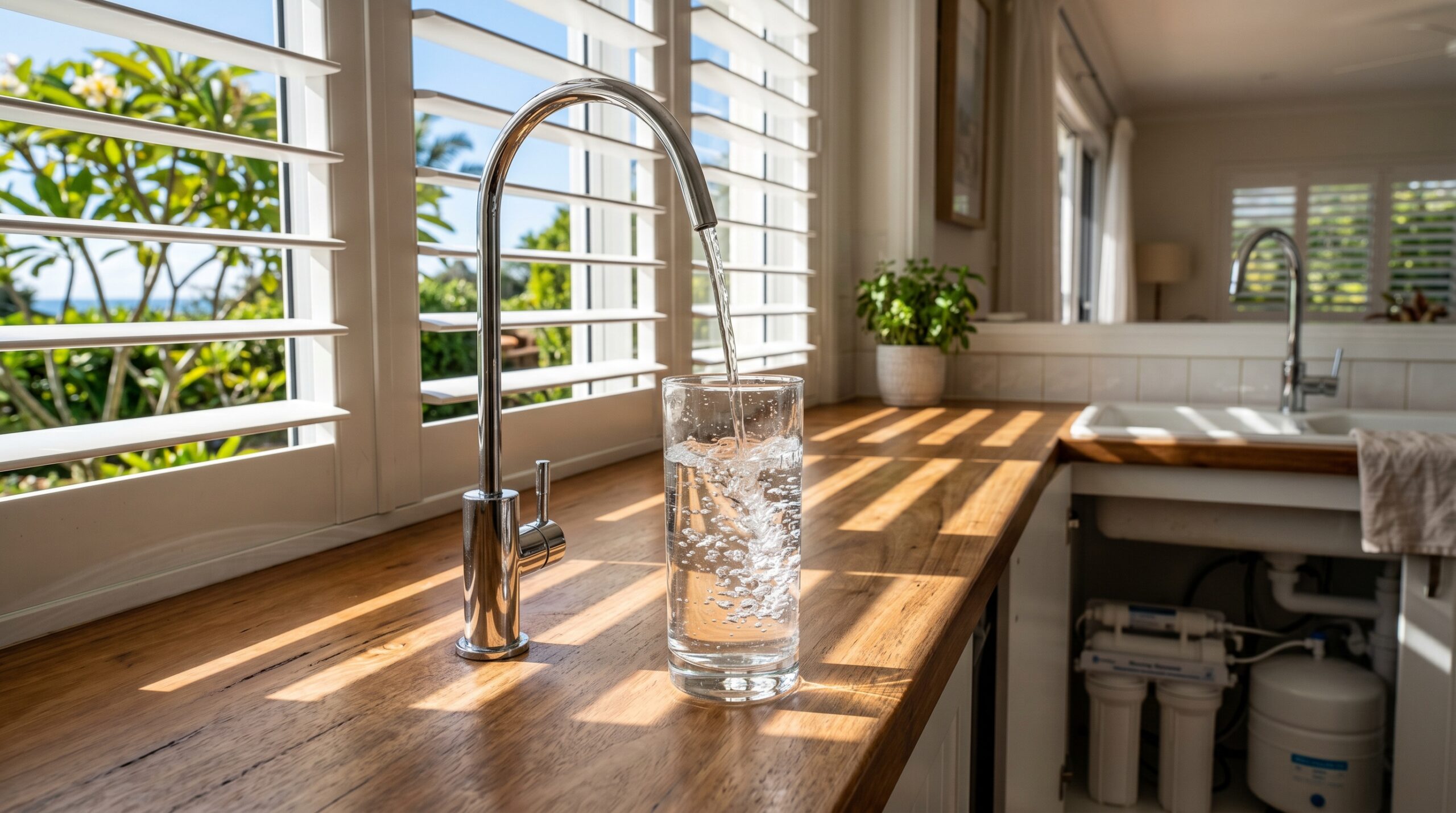
Best Water Filters for Nitrates in Australia 2026
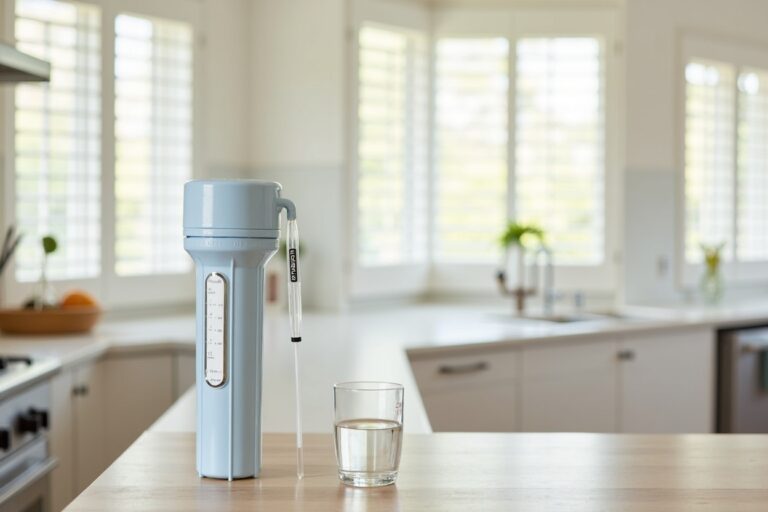
Reverse osmosis is the only residential water filter technology that reliably removes nitrates from Australian bore and tank water — standard carbon block, ceramic, and UV filters do not remove nitrates at any meaningful rate regardless of marketing claims. Of the four RO systems compared in this guide, the PWS RO-5U is the best overall for Australian rural and semi-rural households, the AquaTru Classic is the best no-plumbing option for renters and off-grid situations, the Waterdrop D6 is the best high-flow permanent install, and the Pure Water Systems EcoHero 5-Stage is the only WaterMark AS/NZS 3497-certified option. This guide covers why nitrates are a unique Australian water problem, which regions are most exposed, the removal-rate science, and what you actually need to buy.
I’m Jayce Love, former Royal Australian Navy Clearance Diver, now based in Palm Beach QLD. I’ve cross-referenced 2025–26 state utility reports, NHMRC data, and each product’s NSF/ANSI 58 certification documents to compile the recommendations below. No gifted units, no brand payments — every recommendation is based on our documented methodology.
Only reverse osmosis reliably removes nitrates from Australian water — the PWS RO-5U is the best overall pick, with AquaTru Classic the best no-install option and EcoHero the best WaterMark-certified under-sink system. Carbon block, ceramic, KDF, and UV filters cannot remove nitrates. The catches: every RO wastes 2–3 litres of brine per litre of clean water, all under-sink systems require a plumber to install, and the AquaTru has a 3-litre reservoir that needs refilling in large households.
| Filter | Nitrate removal | Verdict |
|---|---|---|
| PWS RO-5U | 90–95% — RO membrane | Best Overall |
| AquaTru Classic | 90–97% (NSF/ANSI 58) | Best No-Plumbing |
| Waterdrop D6 | 90–95% — RO membrane | Best High-Flow |
| EcoHero 5-Stage | 90–95% — WaterMark certified | Best WaterMark |
✓ Who This Guide Is For
- Rural and semi-rural Australians on bore water or private bores in agricultural regions (WA Wheatbelt, QLD Darling Downs, NSW Murray-Darling Basin)
- Families with infants under 6 months — blue baby syndrome risk above 50 mg/L NO₃
- Anyone who has tested their bore or tank water and found nitrates above 25 mg/L
- Renters or off-grid households needing nitrate removal without permanent plumbing (AquaTru countertop)
- Anyone whose local council water quality report shows nitrates approaching the ADWG limit
× Who This Guide Is Not For
- City households on municipal mains water — utilities monitor and remediate nitrates; your exposure is almost certainly well below the ADWG limit
- Anyone whose only concern is taste or chlorine — a catalytic carbon block is cheaper and adequate
- Tank-water households whose only issue is bacteria — UV sterilisation + sediment is the correct solution (see our bacteria filter guide)
- Anyone wanting a whole-house nitrate solution — these are drinking-water-point-of-use systems, not whole-house
Why Nitrates Are a Unique Australian Water Problem
Nitrates (NO₃⁻) in Australian drinking water are primarily a rural and agricultural problem, not a city problem. Municipal utilities across Australia actively monitor nitrate levels and are required under the Australian Drinking Water Guidelines (ADWG) to keep concentrations below 50 mg/L as NO₃ (equivalent to 11.3 mg/L as nitrate-nitrogen). Capital city tap water almost universally sits well below this threshold.
The risk is concentrated in three groups: bore-water users in agricultural catchments where fertiliser runoff and livestock waste have raised groundwater nitrate levels; households in areas where septic systems have leached nitrogen compounds into shallow aquifers; and rural properties where aging infrastructure has not been upgraded since livestock density increased. The chemistry is straightforward — nitrogen-fixing bacteria and synthetic fertilisers both produce nitrate, and nitrate is highly soluble in groundwater. Unlike many contaminants, it does not bind to soil particles and flush out; it accumulates.
The key distinction for Australians making a filter purchase decision: if you are on municipal mains water in any capital city or major regional centre, nitrate filtration is almost certainly not your priority. If you are on a private bore, a shared rural scheme, or if your local water quality report shows nitrates above 25 mg/L (half the ADWG limit), you need to act.
Nitrate Levels Across Australian Regions
| Region | Typical bore nitrate (mg/L NO₃) | Primary source |
|---|---|---|
| WA Wheatbelt / Peel | 10–120+ mg/L | Broadacre cropping fertilisers, clearing-driven watertable rise |
| QLD Darling Downs | 15–80 mg/L | Intensive cotton and grain production, feedlot runoff |
| NSW Murray-Darling Basin | 10–60 mg/L | Irrigated agriculture, sheep and cattle grazing, septic systems |
| SA Mallee / Barossa | 8–45 mg/L | Viticultural fertilisers, shallow aquifer vulnerability |
| VIC / TAS / ACT mains | <5 mg/L | Clean catchments; utilities monitor and treat |
| Capital city mains (all) | <5 mg/L | Utilities required to remediate before distribution |
The WA Wheatbelt figures are worth highlighting. Some bore samples in the Moora, Merredin, and Narrogin districts have historically returned nitrate readings of 80–120 mg/L — two to three times the ADWG safety limit. Land clearing has lowered the deep-rooted native vegetation that once consumed available soil nitrogen, allowing nitrate to accumulate in shallow groundwater at unprecedented rates. If you are on bore water in these areas and have not tested recently, testing before purchasing any filter is the correct first step. A NATA-accredited laboratory analysis for nitrate costs $30–60 and gives you a precise number to work from.
What Actually Removes Nitrates — And What Does Not
This is where most Australians shopping for a water filter get caught out. Nitrate is a dissolved anion (negatively charged ion), not a particulate contaminant. Filters that physically block particles — sediment filters, ceramic filters — have no mechanism to stop a dissolved ion from passing straight through. The table below is not a marketing claim; it reflects the underlying chemistry.
| Technology | Nitrate removal | Verdict |
|---|---|---|
| Reverse osmosis (RO) | 90–95% certified removal | Reliable. Only safe residential choice. |
| Nitrate-selective ion exchange | 85–95% when regenerated correctly | Effective but requires maintenance and brine disposal |
| Standard activated carbon / GAC | <5% — functionally zero | Does not remove nitrates |
| KDF-55 / KDF-85 media | 0% — not designed for anions | Does not remove nitrates |
| UV sterilisation | 0% — kills biology, not ions | Does not remove nitrates |
| Ceramic / sediment filters | 0% — removes particulates only | Does not remove nitrates |
The practical implication: if a filter is marketed as “removes impurities” or “purifies your water” but does not specifically reference NSF/ANSI 58 or reverse osmosis membrane technology, it is not removing nitrates. Standard jug filters (Brita, Waterpure), countertop gravity filters, and shower filters all fall into this category. None of them address dissolved nitrates.

The Four Best Water Filters for Nitrates in Australia 2026
All four systems below use RO membranes certified to NSF/ANSI 58 or equivalent Australian standards. These are the only filter types I recommend for confirmed nitrate contamination.
1. PWS RO-5U Reverse Osmosis Purifier — Best Overall for Nitrate Removal

🛒 Buy this if:
- You are on bore water in an agricultural region and need reliable nitrate removal with on-demand flow
- You want to eliminate multiple contaminants (nitrates, lead, fluoride, PFAS) in one system
- You are an Australian homeowner who wants local brand support and a dedicated filtered water tap
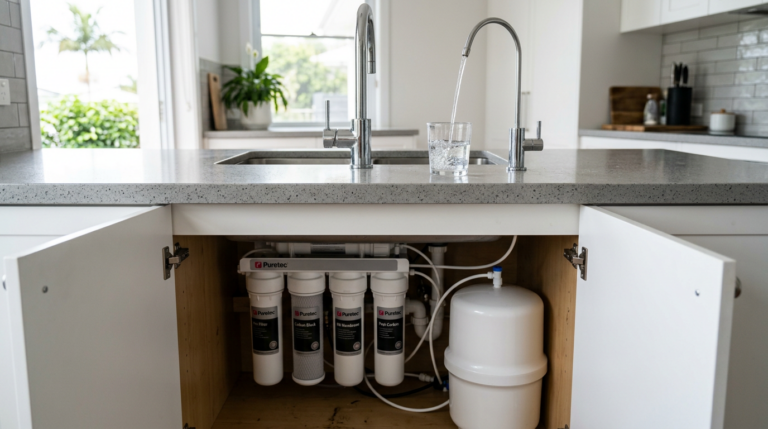
The PWS RO-5U is the pick for anyone on bore water in Western Australia, Queensland, or New South Wales agricultural regions who needs a permanent, high-volume solution. The 4-stage system moves water through a 5-micron sediment pre-filter to protect the membrane, then through two carbon block stages that strip chlorine, chloramines, and organic compounds, and finally through the high-rejection RO membrane. A remineralisation stage adds calcium and magnesium back after filtration, which matters on bore water — RO strips everything including beneficial minerals, and the Pure Water Systems system corrects for that automatically.
Reverse osmosis systems of this type are rated to reduce nitrate by around 90 percent or more under NSF 58 test conditions. At standard mains pressure (around 350 kPa), systems of this type deliver adequate flow for drinking and cooking with no noticeable wait at the tap. The 2:1 product-to-waste ratio is efficient by residential RO standards; most systems run at 3:1 or worse. For bore water users, the compact under-sink footprint is also a genuine advantage — it fits neatly inside a standard cabinet without dominating the space the way larger American-designed RO units do.
Specs that matter for nitrates:
- RO membrane: high-rejection TFC (thin-film composite), removes 90–95% of dissolved nitrates
- Stages: sediment 5μm → carbon block → carbon block → RO membrane → remineralisation
- Product-to-waste ratio: 2:1 (250 L filtered per 500 L processed)
- Flow rate: on-demand mains pressure via dedicated tap
- Price: $2,049 AUD direct from Pure Water Systems
Honest limitation: Requires under-sink plumbing installation — you will need a plumber unless you are comfortable with basic pipe connections. Not suitable for renters without landlord approval. On very high-nitrate bore water (>100 mg/L), a single RO pass may not reduce nitrates to below 10 mg/L; double-pass RO or nitrate-selective ion exchange would be needed in those cases.
✓ Pros
- 4-stage RO removes 90–95%+ of nitrates in one pass
- Also removes lead, fluoride, PFAS, bacteria, and chloramines
- Australian brand with local support and filter supply
- Remineralisation stage prevents flat-tasting RO water
- Compact — fits standard kitchen cabinets without crowding
- 2:1 product-to-waste ratio (efficient for RO)
✗ Cons
- Requires under-sink plumbing — renters need landlord permission
- $2,049 upfront is the highest on this list
- On >100 mg/L bore water a second RO pass may be needed
2. AquaTru Classic Smart Alkaline — Best No-Plumbing Option for Renters

🛒 Buy this if:
- You rent, or cannot modify under-sink plumbing
- You need certified nitrate removal (NSF/ANSI 58) in a portable unit you can take when you move
- You are on a rural property with bore water and want a setup you can run without a plumber
The AquaTru is the only countertop RO system on this list that carries NSF/ANSI 58 certification for nitrate removal — which is important, because there are cheaper countertop units that claim “RO filtration” without independent certification. NSF/ANSI 58 tests actual removal performance against a standardised challenge solution; an uncertified system’s nitrate claims are not independently verified.
The unit sits on the bench, fills from a top reservoir (you pour water in manually or connect to your existing tap), filters it through a 4-stage RO process, and stores it in a 3-litre clean-water reservoir. For a single person or couple on bore water, the 3-litre reservoir is adequate. For a family of four cooking at volume — filling a 5-litre pasta pot, running the kettle, making coffee — the reservoir needs refilling two or three times per day. That is manageable but worth understanding before purchase. See our detailed AquaTru review for Australian conditions for the full capacity analysis.
Specs that matter for nitrates:
- NSF/ANSI 58 certified: 90–97% nitrate removal verified by independent lab
- Reservoir: 3 litres clean water (fill manually from tap or bucket)
- Stages: pre-filter → RO membrane → activated carbon polish → alkaline stage
- Product-to-waste ratio: approximately 3:1 (3 litres waste per litre product)
- Price: approximately $699 AUD via Amazon AU
Honest limitation: The 3:1 waste ratio is high — for every litre of clean water produced, 3 litres go down the drain. On a bore water property with a pump, this increases electricity draw and total water use. Not suitable as the sole source of drinking water for a large household without accepting frequent reservoir refills.
✓ Pros
- NSF/ANSI 58 certified — independently verified nitrate removal rate
- No plumbing — takes 10 minutes to set up, no tools needed
- Portable — take it when you move or travel to a property
- Also removes lead, chloramine, PFAS, and other dissolved contaminants
- Alkaline post-filter improves taste vs standard RO output
✗ Cons
- 3-litre reservoir requires manual refilling multiple times daily for families
- 3:1 waste ratio — high water and pump energy cost on bore systems
- Bench footprint (~30 cm wide) — loses counter space
- Filter replacements (~$120–150/year) add ongoing cost
3. Waterdrop D6 Under-Sink RO — Best High-Flow Permanent Install

🛒 Buy this if:
- You own your home and want the highest-flow under-sink RO system available in Australia
- Your kitchen cabinet space is tight — the tankless design eliminates the large storage tank other systems require
- You have a high-use household (family of four or more) and cannot accept reservoir refills
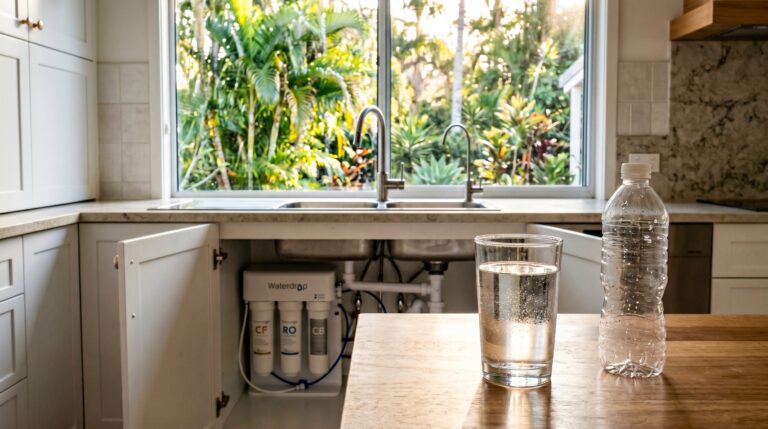
The Waterdrop D6’s core advantage is the tankless design. Traditional RO systems include a pressure tank that pre-fills with filtered water and delivers it at reduced pressure. The D6 eliminates the tank entirely, running the water through the membrane on demand at 600 gallons per day (GPD) — fast enough that there is no perceptible wait at the tap. For a family on bore water with elevated nitrates who needs continuous, high-volume access to filtered water for cooking, this is the most practical permanent under-sink option. Read the full Waterdrop D6 review for Australian bore water conditions for details on installation and performance.
The smart filter-change indicator is genuinely useful for bore water applications where filter loading is higher than typical municipal-supply use — bore water with high particulate content, iron, or mineral load will exhaust pre-filters faster than expected. The D6 monitors total water volume and alerts you before filter performance degrades.
Specs that matter for nitrates:
- Flow rate: 600 GPD (approximately 2,270 L/day rated capacity)
- Tankless: no pressure storage tank — compact footprint, instant flow
- RO membrane: removes 90–95% of dissolved nitrates
- Smart TDS display: monitors output water quality in real time
- Price: approximately $699 AUD via Amazon AU
Honest limitation: The D6 does not include a remineralisation stage in the base configuration — output TDS will be very low (5–20 ppm), which some users find flat-tasting. A remineralisation add-on cartridge is available separately. Also requires under-sink installation; not suitable for renters.
✓ Pros
- 600 GPD tankless — no perceptible wait, unlimited daily volume
- No storage tank — smaller under-sink footprint than traditional RO
- Smart filter indicator tracks actual filter life, not just time
- Removes 90–95% of nitrates, plus lead, fluoride, and PFAS
- Competitive price point (~$699) for high-flow RO
✗ Cons
- No remineralisation stage — low TDS output tastes flat to some users
- Requires under-sink plumbing installation
- US-brand product with Australian Amazon fulfilment — local support limited vs AU brands
4. EcoHero 5-Stage Under-Sink RO — Best WaterMark-Certified Australian Option

🛒 Buy this if:
- You need WaterMark AS/NZS 3497 certification — required by some Australian councils and rental agreements
- You want the lowest 5-year cost-per-litre on this list (~$0.12/L over 5 years)
- You prefer an Australian-made product with local filter supply and service
The EcoHero 5-Stage is the only system on this list carrying WaterMark AS/NZS 3497 certification, which is the Australian plumbing compliance standard. For some rural councils, rental properties, or new building applications, WaterMark compliance is required for any permanent under-sink plumbing connection. If you are building a rural home or retrofitting a granny flat and your council requires WaterMark compliance on point-of-use filtration, this is your system.
Across five stages — sediment, dual carbon block, RO membrane, and post-carbon polish — the EcoHero achieves 90–95% nitrate removal with better bore-water resilience than single-carbon-stage systems. Pure Water Systems ships directly from Queensland with Australian warranty and filter supply; there is no waiting on international freight for replacement cartridges. At $0.12/L over five years including filter replacements, it delivers the lowest cost-per-litre on this list.
Specs that matter for nitrates:
- Certification: WaterMark AS/NZS 3497 (Australian plumbing compliance)
- Stages: 5 — sediment → GAC → carbon block → RO membrane → post-carbon
- RO membrane: 75 GPD high-rejection membrane, 90–95% nitrate removal
- Cost-per-litre: approximately $0.12/L over 5 years (including filter replacements)
- Price: $1,295 AUD direct from Pure Water Systems (use code CLEANANDNATIVE for discount)
Honest limitation: At $1,295, this is the most expensive upfront cost on the list. The 75 GPD membrane is lower flow than the Waterdrop D6 and requires a small pressure tank — the system is not tankless. For high-volume households, the flow rate at the tap will feel slightly restricted compared to tankless designs.
✓ Pros
- WaterMark AS/NZS 3497 certified — Australian plumbing compliance
- Australian-made with local filter supply from Queensland
- Lowest cost-per-litre (~$0.12/L) over 5 years
- 5-stage filtration with dual carbon pre-treatment for bore water
- Post-carbon polish stage improves final taste
✗ Cons
- $1,295 is highest upfront cost on this list
- 75 GPD membrane — slower flow than Waterdrop D6’s 600 GPD
- Requires pressure tank (adds size under sink)
Which Nitrate Filter Do You Actually Need?
Three questions settle this for most Australian households.
1. Are you on bore, tank, or private scheme water?
- Yes, bore or private water: You need RO. Test your water first ($30–60 at a NATA lab) to get your baseline nitrate level, then choose a system below.
- No, you are on mains municipal water: Nitrate filtration is almost certainly not your priority — check your utility’s annual water quality report. Consider our best water filter Australia guide for general mains-water filtration needs.
2. Can you modify your under-sink plumbing?
- No (renter, heritage-listed, no landlord approval): AquaTru Classic. Countertop, no tools, NSF/ANSI 58 certified, takes 10 minutes to set up.
- Yes: Proceed to question 3.
3. What matters most — flow rate, certification, or cost?
- Highest flow for a large family: Waterdrop D6 (600 GPD tankless, no wait at the tap, ~$699).
- Australian brand, balanced specs, compact design: PWS RO-5U (compact, remineralisation included, $999).
- WaterMark certification required or lowest long-term cost: EcoHero 5-Stage (WaterMark AS/NZS 3497, ~$0.12/L over 5 years, $1,295 upfront).
How to Test for Nitrates in Your Australian Water Supply
Do not purchase a filter without first testing your water. Nitrate removal requires RO, which is expensive and generates brine waste — if your bore or tank water is already below 10 mg/L, a less intensive filtration solution may be adequate. Testing options:
- NATA-accredited laboratory test: $30–60, precise result in mg/L, legally defensible. Contact your state’s water testing service or a private NATA lab. This is the correct approach before purchasing any filter.
- Home nitrate test strips: $15–30 for a pack, semi-quantitative (colour-matched ranges), adequate for initial screening. Not sufficiently precise for regulatory reporting or to confirm post-filter performance.
- Request your utility’s annual report: Free, available from all major utilities online. Only applicable if you are on mains supply; does not reflect private bore results.
If you are a bore-water household in the WA Wheatbelt, QLD Darling Downs, or NSW Murray-Darling Basin, test annually — groundwater nitrate levels change with seasonal rainfall, irrigation patterns, and land use. A filter that was adequate at installation may need upgrading if your bore nitrate level increases.
Final Verdict
Who Should Buy Which System
- Best overall for bore-water homeowners: PWS RO-5U — WaterMark-certified Australian brand, digital TDS monitor, $2,049.
- Best for renters or no-plumbing situations: AquaTru Classic — NSF/ANSI 58 certified, no install, portable, ~$699.
- Best for high-flow large households: Waterdrop D6 — 600 GPD tankless, instant flow, ~$699.
- Best for WaterMark compliance or lowest lifetime cost: EcoHero 5-Stage — WaterMark AS/NZS 3497, $0.12/L over 5 years, $1,295.
Who should look elsewhere: City households on mains municipal water do not need nitrate-specific RO filtration — your utility is legally required to supply water below the ADWG 50 mg/L limit. If chlorine taste is your issue, a standard carbon block filter is a more appropriate and cost-effective solution. For bacteria concerns on tank water, see our best water filter for bacteria guide.
Get the Australian Home Environment Checklist
30 checks across water, air and EMF. Most of them free. Ranked by impact.
No spam. Unsubscribe any time.

Former Royal Australian Navy Clearance Diver and TAG-E counter-terrorism operator. Founded Clean and Native to apply the same rigorous thinking to the home environment.
Full biography →