PFAS Forever Chemicals in Australia’s Water 2026
Drafted with AI assistance and checked against published specifications and certifications. First-hand measurements appear only where stated. How we make content
PFAS (per- and polyfluoroalkyl substances) have contaminated drinking water at 700+ confirmed sites across Australia according to the DCCEEW national PFAS contamination register, with the International Agency for Research on Cancer (IARC) classifying PFOA and PFOS as Group 1 human carcinogens in 2023. Reverse osmosis filtration certified to NSF/ANSI P473 is the only proven household technology that removes PFAS to below Australian Drinking Water Guidelines (ADWG) health-based values of 0.07 µg/L for PFOS and PFOA combined.
What Are PFAS and Why Do They Never Break Down?
PFAS stands for per- and polyfluoroalkyl substances — a class of over 14,000 synthetic chemicals built around one of the strongest bonds in organic chemistry: the carbon-fluorine bond. That bond has a dissociation energy of approximately 536 kJ/mol, which is why these chemicals resist heat, water, oil, and biological degradation. They do not break down in soil. They do not break down in water. They do not break down in your body. The nickname “forever chemicals” is not hyperbole — it is chemistry.
The most studied PFAS are PFOS (perfluorooctane sulfonate) and PFOA (perfluorooctanoic acid). Both were widely used in firefighting foams (aqueous film-forming foam, or AFFF), non-stick cookware, food packaging, and textile treatments from the 1960s onward. In November 2023, the International Agency for Research on Cancer (IARC) classified PFOA as a Group 1 carcinogen (sufficient evidence of carcinogenicity in humans) and PFOS as a Group 1 carcinogen, citing links to kidney cancer, testicular cancer, and immunotoxicity.
What makes PFAS uniquely dangerous compared to other industrial contaminants is their persistence combined with bioaccumulation. According to research published in Environmental Science & Technology, the biological half-life of PFOS in the human body is approximately 5.4 years. That means if you stop all exposure today, it takes over five years for your body to eliminate just half of the PFOS already accumulated. Meanwhile, every glass of contaminated water adds more. This is not a toxin you flush out with a weekend detox. It accumulates silently for decades.
PFAS are also extraordinarily mobile in water. They are fully soluble, stable across a wide pH range, and pass through conventional water treatment processes — coagulation, flocculation, sand filtration, and even chlorination — with minimal reduction. This is why contaminated groundwater plumes near military bases and industrial sites have spread kilometres from the original source, entering bore water, municipal supply aquifers, and agricultural irrigation systems across Australia.
Australia’s PFAS Contamination Map: Where the Problem Is Worst
If you think PFAS contamination is an American problem, you are dangerously wrong. The Australian Government’s DCCEEW national PFAS contamination investigation has identified over 700 sites nationally where PFAS levels in soil or groundwater exceed investigation thresholds. The largest and most publicised sites are defence bases where AFFF firefighting foam was used for training exercises, often for decades, with foam runoff flowing directly into waterways and aquifers.
Defence Base Hotspots
The Department of Defence has confirmed PFAS contamination at the following key installations, among many others: RAAF Base Williamtown (NSW), where bore water within a 1.5 km radius was found to contain PFOS at levels exceeding 70 µg/L — that is 1,000 times the ADWG health-based guideline value of 0.07 µg/L combined PFOS+PFOA. RAAF Base Tindal (Katherine, NT) contaminated groundwater used by local Indigenous communities. RAAF Base Pearce (Bullsbrook, WA) with confirmed PFAS in the Gnangara Mound, Perth’s primary groundwater source. Army Aviation Centre Oakey (QLD) where PFAS migrated into local bore water supplies used by farming families.
And those are just the military sites. The contamination extends to civilian airports, firefighting training facilities, industrial manufacturing zones, and landfill sites across every state and territory.
The Blue Mountains Discovery
In 2025, researchers confirmed that PFAS contamination in the Blue Mountains UNESCO World Heritage Area west of Sydney had persisted for over three decades, originating from a now-closed industrial facility. According to research published in collaboration with environmental scientists, PFAS levels in local waterways exceeded safety thresholds that had been in place long before the contamination was publicly acknowledged. The contamination plume had migrated through sandstone aquifers into water sources used by communities in Springwood, Katoomba, and surrounding suburbs. If you live in the lower Blue Mountains and rely on bore water or untreated rainwater supplemented by local sources, you should have your water independently tested.
South-East Queensland
Residents of the Ipswich, Logan, and Beaudesert corridors in south-east Queensland face PFAS exposure from multiple vectors: defence base runoff, legacy industrial activity, and biosolid application on agricultural land. SEQ Water treats bulk water for the region, and while their treatment processes meet ADWG guidelines at the plant gate, PFAS concentrations in source water vary seasonally. Heavy rain events flush contaminated soil into catchments, creating spikes that may not be captured in quarterly monitoring reports. Brisbane, the Gold Coast, and Sunshine Coast households drawing from SEQ Water should note that this water is also chloraminated — meaning you need a filtration system that handles both chloramine AND PFAS. Standard GAC jug filters fail on both counts.
Other Key Contamination Zones
Perth’s Rockingham, Kwinana, and Bullsbrook suburbs sit atop or adjacent to confirmed PFAS plumes. Adelaide’s Edinburgh defence precinct has contaminated groundwater. Melbourne’s Fiskville CFA training facility site contaminated surrounding farmland. Townsville’s Lavarack Barracks and the Port of Townsville have confirmed detections. This is actually a national problem — not confined to one region or one type of community.
Australia’s $1.4 Billion Lawsuit Against 3M: What It Means for You
In May 2026, the Australian Government filed a $1.4 billion lawsuit against 3M — the manufacturer of AFFF firefighting foam used extensively at Australian Defence Force bases since the 1970s. According to Reuters reporting, this represents the nation’s largest environmental liability claim and signals that PFAS contamination is not a fringe concern but a systemic national failure that will cost taxpayers billions in remediation, health monitoring, and water treatment upgrades.
Here is what that lawsuit tells you as a homeowner: the government now acknowledges the contamination is serious, widespread, and directly linked to products it purchased and deployed for decades. But remediation of groundwater plumes takes 10-30 years using current pump-and-treat technologies. Some contamination scientists argue that full remediation of deep aquifer plumes may never be technically or economically feasible. The contamination is in the ground. It is in the water. And it is not going anywhere fast.
What does this mean practically? It means you cannot rely on government remediation timelines to protect your family’s drinking water today. The lawsuit is about accountability and funding — not about making your tap water safe next week. If you are in a contamination zone, the only defence you control is point-of-use filtration in your own kitchen.
The 3M lawsuit also creates a legal precedent that could open class actions for affected communities. Residents near Williamtown, Oakey, and other confirmed sites have already pursued separate legal action. But legal outcomes take years. Your water quality is a today problem, not a 2030 problem.
Australian Drinking Water Guidelines for PFAS: The Numbers
The Australian Drinking Water Guidelines (ADWG), maintained by the National Health and Medical Research Council (NHMRC), set health-based guideline values for PFAS. These were updated in 2024 following the accumulation of toxicological evidence. Here are the current limits you need to know:
| PFAS Compound | ADWG Health Value (µg/L) | IARC Classification | Primary Sources |
|---|---|---|---|
| PFOS + PFHxS (sum) | 0.07 µg/L | Group 1 carcinogen (PFOS) | AFFF foam, textiles, food packaging |
| PFOA | 0.56 µg/L | Group 1 carcinogen | Non-stick coatings, industrial processes |
| Total PFAS (all species) | No single guideline value | Varies by compound | Cumulative exposure from all sources |
Context matters here. The US EPA’s advisory level for PFOA and PFOS was set at 4 parts per trillion (0.004 µg/L) in 2024 — roughly 17 times stricter than Australia’s PFOS guideline and 140 times stricter than the PFOA guideline. The European Union has proposed similarly tight limits. Australia’s ADWG values are more permissive partly because they are based on tolerable daily intake calculations that assume lower per-capita water consumption in cooler climates. But if you live in tropical Queensland or outback Australia, you drink more water than the model assumes — and your actual exposure is higher than the guidelines predict.
Municipal water utilities in major cities generally meet ADWG PFAS guidelines at the tap. The risk is highest for people on bore water, tank water in contaminated catchments, or town water in smaller regional systems near contamination sites where treatment infrastructure has not been upgraded. If your water comes from a bore within 5 km of a known PFAS site, testing is not optional — it is essential.
How PFAS Gets Into Your Tap Water
Understanding the contamination pathway helps you assess your own risk. PFAS enters Australian drinking water through four primary routes, and your vulnerability depends on which one applies to your address.
Route 1 — Direct groundwater contamination. This is the highest-risk pathway. AFFF foam used at defence bases, airports, and firefighting training facilities soaks into soil, leaches through the vadose zone, and reaches the water table. Once in the aquifer, PFAS dissolves readily and travels with groundwater flow. At RAAF Williamtown, the plume extends over 4 km from the source. If you are on bore water downstream of a contamination site, your water may contain PFAS at levels far exceeding ADWG values. This affects communities in Bullsbrook (Perth), Salt Ash (Hunter Valley), Oakey (QLD), and Katherine (NT), among others.
Route 2 — Surface water contamination. Contaminated stormwater runoff carries PFAS into creeks, rivers, and dams that feed municipal water treatment plants. After heavy rain, PFAS levels in source water spike. Conventional treatment — coagulation, sedimentation, chlorination/chloramination — does not remove PFAS. Only plants with granular activated carbon (GAC) adsorption beds or membrane filtration stages can reduce PFAS in bulk supply. Not all Australian plants have these upgrades.
Route 3 — Biosolid application. Treated sewage sludge (biosolids) applied to agricultural land contains PFAS that originated from household products, industrial discharge, and landfill leachate. Rain washes PFAS from treated paddocks into waterways and groundwater. This pathway is particularly relevant in south-east Queensland’s Lockyer Valley and parts of regional Victoria where biosolid application is widespread.
Route 4 — Landfill leachate. Consumer products containing PFAS — non-stick pans, waterproof clothing, stain-resistant carpets, food packaging — end up in landfill. PFAS leaches from these products into landfill drainage, which can migrate into surrounding groundwater. This is a diffuse, low-level but persistent exposure source for communities near older, unlined landfill sites.
How to Test Your Water for PFAS in Australia
You cannot see, taste, or smell PFAS in water. A TDS meter will not detect it. A pH strip will not detect it. The only way to know your PFAS exposure is a laboratory analysis using liquid chromatography-tandem mass spectrometry (LC-MS/MS), which is the analytical method specified in NATA-accredited testing protocols for PFAS in water.
Here is the process. Contact a NATA-accredited laboratory — not a home test kit company. NATA (National Association of Testing Authorities) accreditation ensures the lab meets ISO 17025 quality standards for chemical analysis. Key laboratories offering PFAS water testing to Australian consumers include ALS Environmental, Eurofins, and SGS. Expect to pay $150-350 per sample for a standard PFAS suite (typically 28+ compounds including PFOS, PFOA, PFHxS, and short-chain PFAS).
Sample collection matters. Use the laboratory’s supplied bottles (typically HDPE, no glass). Do not rinse bottles with tap water before sampling. Run the tap for 30 seconds to clear stagnant line water, then fill the bottle without touching the inside. Keep the sample cold (esky with ice packs) and ship it within 24 hours. Contaminated samples from improper collection are a waste of $300.
If your results show PFOS+PFHxS above 0.07 µg/L or PFOA above 0.56 µg/L, you exceed ADWG health-based values and should install point-of-use reverse osmosis filtration immediately. If results are below guidelines but above the laboratory’s limit of reporting (typically 0.002-0.01 µg/L), you still have detectable PFAS — and given the bioaccumulative nature of these chemicals, filtration remains a prudent precaution, especially for households with young children or pregnant women.
For municipal water customers in major cities, your water utility publishes annual water quality reports. SEQ Water, Sydney Water, Melbourne Water, SA Water, and Water Corporation WA all report PFAS data. Request the latest report or check the utility’s website. But remember: these reports show average values at the treatment plant outlet. Your actual exposure may differ depending on distribution system conditions and supplementary bore water sources.
Which Filters Actually Remove PFAS? The Evidence
This is where most online advice fails you. Generic statements like “a good water filter removes contaminants” tell you nothing. PFAS are small molecules (typically 200-500 daltons molecular weight) that are fully dissolved in water. Removing them requires specific membrane pore sizes or specific adsorption media — and the performance varies enormously between filter types.
Here is what the evidence shows, technology by technology.
Reverse Osmosis — The Gold Standard
Reverse osmosis (RO) systems certified to NSF/ANSI P473 remove 90-97% of PFOS and PFOA. The RO membrane has a nominal pore size of approximately 0.0001 micrometres (0.1 nanometres), which physically excludes PFAS molecules through a combination of size exclusion, charge repulsion, and solution-diffusion mechanisms. NSF/ANSI P473 is the specific testing standard for PFAS removal — not NSF 42 (taste/odour), not NSF 53 (health contaminants). If a filter does not hold P473 certification, its PFAS removal claims are unverified marketing.
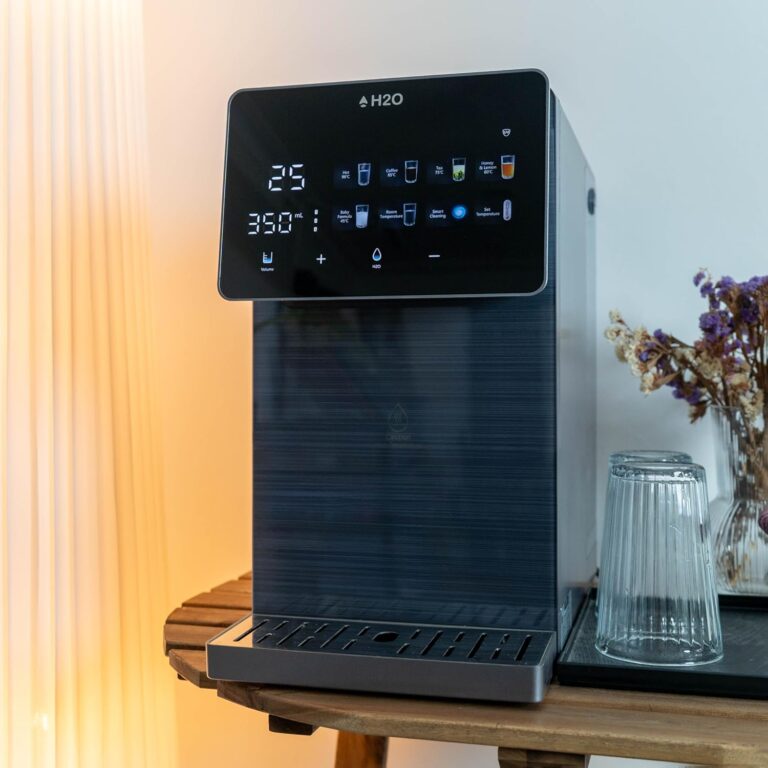
For Australian households, two RO options stand out. The AquaTru Classic is a countertop RO system that requires zero plumbing modification — you fill the upper tank, it filters into the lower tank, and you dispense from the tap. It holds NSF certifications and uses a 4-stage filtration process (sediment pre-filter, carbon pre-filter, RO membrane, carbon post-filter). It is the best option if you rent, live in an apartment, or simply do not want to modify your plumbing. The Waterdrop D6 is an under-sink tankless RO system that connects to your cold water line and delivers filtered water on demand through a dedicated faucet. It is the better option if you own your home and want the convenience of filtered water directly from the tap.
Both systems also remove fluoride (90-97%), chloramine, heavy metals, and microplastics — making them the single most comprehensive point-of-use filtration technology available.
Activated Carbon Block — Partial, Unreliable
High-quality compressed carbon block filters can adsorb some PFAS, particularly longer-chain compounds like PFOS and PFOA. Independent testing by Duke University and NC State University found that some activated carbon filters reduced PFAS by 50-70% when new. But performance degrades rapidly as the carbon becomes saturated with other contaminants. After 2-3 months of use, PFAS removal drops significantly — and in some cases, previously adsorbed PFAS can desorb back into the filtered water as the carbon bed reaches capacity. This is called “breakthrough” and it means your filter could be making your water worse without any visible indication.
Activated carbon is a valuable pre-filter stage (which is why RO systems include it), but it is not reliable as a standalone PFAS removal technology. If carbon is your only filtration, you are gambling with your family’s health.
Standard GAC and Jug Filters — Ineffective
Standard granular activated carbon (GAC) filters — including Brita and PUR jug filters, basic benchtop filters, and standard fridge filters — have minimal PFAS removal capability. The loose granular media has insufficient contact time and surface area to adsorb dissolved PFAS molecules at the concentrations found in Australian water. Multiple independent studies have confirmed removal rates below 30% for most PFAS species, and some jug filters showed zero measurable reduction.
If you are using a Brita jug and believe it is protecting you from PFAS, it is not. This is not a criticism of the product — jug filters are designed for taste improvement (chlorine, sediment) and were never engineered for PFAS removal. Using one for PFAS is like using a flyscreen to stop smoke.
Boiling — Completely Useless
Boiling water concentrates PFAS rather than removing it. PFAS are thermally stable to temperatures well above 100°C. Boiling evaporates pure water, leaving PFAS behind at a higher concentration. Never boil water as a PFAS mitigation strategy.
| Filter Technology | PFAS Removal | Also Removes Fluoride? | Also Removes Chloramine? | Verdict |
|---|---|---|---|---|
| Reverse Osmosis (NSF P473) | 90-97% | Yes (90-97%) | Yes | Gold standard |
| Activated Carbon Block | 50-70% (degrades) | No | Partial (catalytic only) | Insufficient alone |
| Granular Activated Carbon (GAC) | <30% | No | No (~1/40th rate of free chlorine) | Ineffective |
| Jug Filter (Brita/PUR) | Near zero | No | No | Ineffective |
| Boiling | Concentrates PFAS | No | No | Makes it worse |
5-Year Cost: RO Filtration vs Bottled Water vs Doing Nothing
The most common objection to reverse osmosis is cost. Let me reframe that. The question is not “can I afford a filter?” The question is “can I afford to keep drinking PFAS-contaminated water for the next five years while bioaccumulating Group 1 carcinogens in my bloodstream?”
Here is the maths, assuming a 4-person household consuming 4 litres of drinking water per day (1,460 litres per year).
| Option | Upfront Cost | Annual Filter/Ongoing | 5-Year Total | Cost Per Litre |
|---|---|---|---|---|
| AquaTru Classic RO | ~$699 | ~$160 | ~$1,499 | $0.21 |
| Waterdrop D6 Under-Sink RO | ~$599 | ~$140 | ~$1,299 | $0.18 |
| Bottled Water (1.5L) | $0 | ~$1,946 | ~$9,733 | $1.33 |
| Unfiltered Tap Water | $0 | ~$2 (water bill) | ~$10 | $0.001 |
Bottled water costs you 6-7 times more than reverse osmosis over five years. And here is the part that should concern you: a 2024 Columbia University study using Raman spectroscopy found an average of 240,000 detectable nanoplastic particles per litre in bottled water. You are paying $1.33 per litre to swap one contaminant for another, while generating plastic waste. According to ABS waste data, Australians send over 373 million plastic bottles to landfill annually.
An AquaTru at $699 upfront — that is $0.58 per day over the first year. Less than the price of a single bottled water from a servo. The Waterdrop D6 under-sink is even cheaper long-term at $0.18 per litre. If you are spending money on bottled water right now, you are already paying for RO-quality filtration — you are just getting worse results and more plastic.
Our Top-Rated PFAS Removal Filters
See full water filter rankings →Decision Tree: Which PFAS Filter Do You Need?
Three questions. That is all it takes to find the right system for your situation.
Question 1: Can you modify your plumbing?
No (renting, apartment, heritage restrictions) → Countertop RO. The AquaTru Classic sits on your bench, plugs into a power point, and needs zero plumbing. You fill the tank, it filters, you pour. Done.
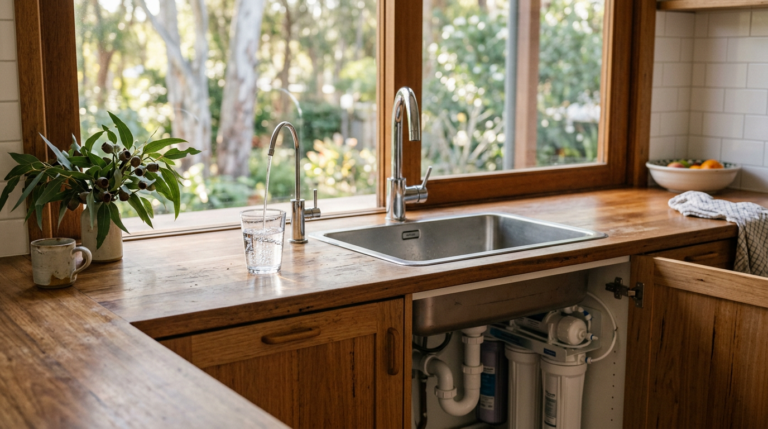
Yes (own your home, willing to install) → Under-sink RO. The Waterdrop D6 connects to your cold water line and delivers filtered water through a dedicated faucet. More convenient for daily use. Requires a WaterMark-compliant installation or a licensed plumber.
Question 2: Which city are you in?
Brisbane, Sydney, Adelaide, Gold Coast, or Darwin → Your water is chloraminated. Standard GAC filters remove chloramine at approximately 1/40th the rate of free chlorine. You need RO or catalytic carbon as a minimum for taste, and RO specifically for PFAS. A jug filter is useless here on both counts.
Melbourne, Canberra, or Hobart → Your water uses free chlorine, which standard carbon handles well for taste. But carbon does not remove PFAS. If PFAS is your concern (and given confirmed contamination sites near Melbourne), you still need RO.
Question 3: What is your primary concern?
PFAS and/or fluoride → RO is the only option. No carbon filter — standard, catalytic, or block — removes fluoride or reliably removes PFAS. Only reverse osmosis (90-97% rejection) or activated alumina (80-95% for fluoride only, not PFAS) can achieve this.
Taste and chlorine/chloramine only → A catalytic carbon block or benchtop filter like the Tappwater EcoPro handles taste. But it will not touch PFAS or fluoride.
PFAS Beyond Drinking Water: Other Exposure Routes
Filtering your drinking water is the highest-impact action you can take. But PFAS exposure is not limited to what you drink. Understanding the full picture helps you prioritise.
Food. PFAS accumulates in agricultural produce irrigated with contaminated water, in livestock raised on contaminated land, and in seafood from contaminated waterways. The NSW EPA issued “do not eat” advisories for fish and shellfish caught in Fullerton Cove and Tilligerry Creek near Williamtown. The FSANZ (Food Standards Australia New Zealand) has set maximum PFAS levels in some foods, but enforcement and monitoring remain patchy. You cannot filter your food — but you can choose food sourced from regions without confirmed PFAS contamination.
Dust. PFAS-treated carpets, upholstery, and clothing release PFAS-containing particles into household dust. Children ingest more dust than adults (hand-to-mouth behaviour), making this a significant paediatric exposure pathway. Wet mopping and HEPA vacuuming reduce dust-borne PFAS exposure. If you are looking at air purification, a HEPA air purifier captures the fine dust particles that carry PFAS compounds.
Personal care products. Some cosmetics, sunscreens, and dental flosses contain PFAS compounds. Check ingredient lists for terms containing “fluoro” or “perfluoro”. The TGA does not currently require PFAS-specific labelling on Australian personal care products, which makes ingredient vigilance your responsibility.
Occupational exposure. Firefighters, defence personnel, and industrial workers who handled AFFF foam have the highest PFAS blood serum levels in Australia. The Australian Defence Force has funded blood testing programs for current and former personnel who served at contaminated bases. If you served at Williamtown, Oakey, Tindal, Pearce, Edinburgh, or other confirmed sites, request blood serum PFAS testing through the Defence PFAS Health Assessment Program.
Final Verdict: What You Should Do Right Now
I spent years in the Royal Australian Navy as a Clearance Diver. I know what it looks like when a threat is invisible, persistent, and ignored until it is too late. PFAS contamination in Australian water is exactly that kind of threat.
Here is your action list, in order of priority:
1. Determine your risk. Check the DCCEEW PFAS contamination site map. If you live within 5 km of a confirmed site, or if your water comes from a bore, you are higher risk. Request your water utility’s latest PFAS monitoring data. If you are on bore water, commission a NATA-accredited PFAS test ($150-350).
2. Install reverse osmosis. If you rent or cannot modify plumbing, the AquaTru Classic is your best countertop option. If you own your home, the Waterdrop D6 under-sink RO offers superior convenience. Both remove PFAS, fluoride, chloramine, heavy metals, and microplastics. This is the single action that delivers the most measurable reduction in your family’s PFAS exposure.
3. Stop buying bottled water. It costs 6-7x more than RO-filtered water, contains microplastics, and is not tested for the full suite of PFAS compounds. It is the worst of every world.
4. Advocate locally. Push your water utility and local council for transparent PFAS monitoring data. Support community-level campaigns for treatment plant upgrades in areas near contamination sites. The government lawsuit against 3M may take years to resolve. Your family’s water quality cannot wait.
PFAS will be in Australian groundwater for generations. The carbon-fluorine bond guarantees it. But what enters your glass — that is something you can control today. For $699 and ten minutes of setup, or $599 and a plumber visit, you eliminate the single largest controllable PFAS exposure pathway in your household. That is not a purchase. That is a defence.
For a full breakdown of how each RO system performs, see our best under-sink water filter Australia rankings and our reverse osmosis filter guide for Australia.
Last reviewed: July 2026 — Clean and Native
Frequently Asked Questions
PFAS (per- and polyfluoroalkyl substances) are synthetic chemicals with carbon-fluorine bonds that resist all natural degradation. They entered Australian water supplies primarily through AFFF firefighting foam used at defence bases and airports, industrial discharge, and landfill leachate. Over 700 contamination sites have been confirmed nationally according to the DCCEEW register.
No. Boiling concentrates PFAS because the chemicals are thermally stable above 100°C. Pure water evaporates, leaving PFAS at a higher concentration. Never boil water as a PFAS mitigation strategy.
No. Standard jug filters like Brita use granular activated carbon (GAC) which has near-zero PFAS removal capability. Independent testing shows GAC jug filters remove less than 30% of most PFAS species. Only reverse osmosis certified to NSF/ANSI P473 reliably removes PFAS at 90-97%.
The ADWG sets a health-based guideline value of 0.07 µg/L for combined PFOS and PFHxS, and 0.56 µg/L for PFOA. These values are significantly less strict than the US EPA advisory level of 0.004 µg/L for PFOA and PFOS individually.
Contact a NATA-accredited laboratory such as ALS Environmental, Eurofins, or SGS. Request a PFAS suite analysis using LC-MS/MS methodology. Cost is typically $150-350 per sample. Home test kits and TDS meters cannot detect PFAS.
PFAS contamination has been confirmed near water sources in every Australian state and territory. Highest-risk areas include communities near RAAF Williamtown (NSW), Army Aviation Centre Oakey (QLD), RAAF Pearce Bullsbrook (WA), RAAF Tindal Katherine (NT), and Edinburgh (SA). Major city municipal supplies generally meet ADWG guidelines, but source water contamination varies seasonally.
Yes. Reverse osmosis systems certified to NSF/ANSI P473 remove 90-97% of PFOS and PFOA through a combination of size exclusion and charge repulsion at the RO membrane (nominal pore size ~0.0001 micrometres). RO is the most effective point-of-use PFAS removal technology available to Australian households.
The Australian Government filed a $1.4 billion lawsuit against 3M in May 2026 for contamination caused by AFFF firefighting foam at defence bases. This is a government claim for remediation costs, not a direct compensation program for individuals. Separate class actions have been pursued by affected communities near Williamtown and other sites.
High-quality compressed carbon block filters can partially reduce some PFAS compounds by 50-70% when new, but performance degrades rapidly as the carbon saturates. Granular activated carbon (GAC) is largely ineffective. Activated carbon should be viewed as a pre-filter stage within an RO system, not a standalone PFAS removal solution.
The biological half-life of PFOS in the human body is approximately 5.4 years according to research published in Environmental Science & Technology. This means it takes over five years for your body to eliminate just half of accumulated PFOS, even with zero new exposure. PFAS bioaccumulates with ongoing exposure from contaminated water, food, and dust.
Get the Australian Home Environment Checklist
30 checks across water, air and EMF. Most of them free. Ranked by impact.
No spam. Unsubscribe any time.

Former Royal Australian Navy Clearance Diver and TAG-E counter-terrorism operator. Founded Clean and Native to apply the same rigorous thinking to the home environment.
Full biography →