HolyH2O Review Australia 2026: Hydronizer, Trinity & Full Range Assessed
HolyH2O is an Australian hydrogen water and filtration brand — here is an honest assessment of every product in their range, with the technical caveats your Instagram feed will not tell you.
Quick Verdict — HolyH2O Australia 2026
Recommended for Australians wanting hydrogen water or quality tap filtration without complex installation — with important city-specific caveats.
The Hydronizer is the standout product: genuine SPE/PEM technology at $119.50 EOFY is the best value hydrogen water bottle currently available in Australia. The Trinity benchtop filter is the most interesting for fluoride-concerned renters, though chloramine performance in Brisbane/Sydney/Adelaide/Perth needs clarification from HolyH2O. The Tap Mate and Shower Mate are solid entry-level options, best suited to free chlorine cities.
Use code HOLYJAYCELOVE10 for 15% off any HolyH2O order.
| Product | EOFY Price | CAN Score | Verdict |
|---|---|---|---|
| Hydronizer | $119.50 | 4.2 / 5 | Best buy in range |
| 2L Pitcher | $275 | 3.9 / 5 | Good for families |
| Trinity Filter | $187.50 | 3.8 / 5 | Best for fluoride removal |
| Tap Mate | $99 | 3.7 / 5 | Best for Melbourne renters |
| Shower Mate | $89.50 | 3.6 / 5 | Free chlorine cities only |
✓ Who This Is For
- Health-conscious Australians wanting hydrogen water with verified SPE/PEM technology
- Renters in Melbourne, Hobart, or Canberra needing affordable tap filtration without tools
- Families wanting a 2L hydrogen pitcher to replace plastic bottled water habits
- Households concerned about fluoride who want an affordable benchtop option (Trinity)
- Buyers who want Australian brand support, local warranty, and domestic shipping
✗ Who It Is Not For
- Brisbane, Sydney, Adelaide, or Gold Coast renters needing confirmed chloramine removal — verify the Trinity carbon stage type first
- Households with PFAS, nitrate, or microplastics concerns — only a certified RO system (AquaTru or PWS EcoHero) covers these
- Anyone requiring NSF/ANSI 58 third-party certification — HolyH2O does not carry this standard
- Budget-first buyers — the SPE/PEM hydrogen tech carries a significant price premium over standard carbon filters
About HolyH2O: An Australian Brand Worth Paying Attention To
HolyH2O is an Australian-owned water wellness brand focused on two things: hydrogen water generation and accessible tap filtration. They ship from within Australia, offer local warranty support, and have built their product line specifically around the Australian market — which matters more than it sounds when you consider that Brisbane, Sydney, Adelaide, and Gold Coast all use chloramine disinfection, not the free chlorine that most imported filter cartridges are designed to handle.
The brand targets health-conscious Australians who want better-than-tap water without the complexity of a full under-sink reverse osmosis install. That is a legitimate market gap. A WaterMark-certified under-sink RO requires a licensed plumber, commitment to the property, and upfront investment of $600-$1,200+. HolyH2O’s range sits in the $89-$275 EOFY zone — no plumber, no drilling, no commitment.
What distinguishes them from the flood of generic Asian hydrogen water products on eBay and Alibaba is the SPE/PEM specification on their hydrogen generators, local customer service, and a product team that appears to understand the Australian water chemistry context. Their ProductReview.com.au profile shows 3.5/5 from 60% positive reviews — lower than their internal site testimonials suggest — which is typical of platforms that skew toward dissatisfied purchasers. The Trinity filter specifically has accumulated 35 reviews on ProductReview, indicating it is their strongest product for customer engagement and repeat interest.
They do not yet offer an under-sink RO system, which is the single most comprehensive residential filtration solution. That gap matters for households in Perth (TDS ~170 mg/L, hardness ~180 mg/L CaCO₃), Adelaide (TDS ~400 mg/L, hardness ~140 mg/L CaCO₃), or anyone with PFAS or nitrate concerns. For those households, HolyH2O is a useful complement to — not a replacement for — a certified RO system. For everyone else, their range covers most of the field.
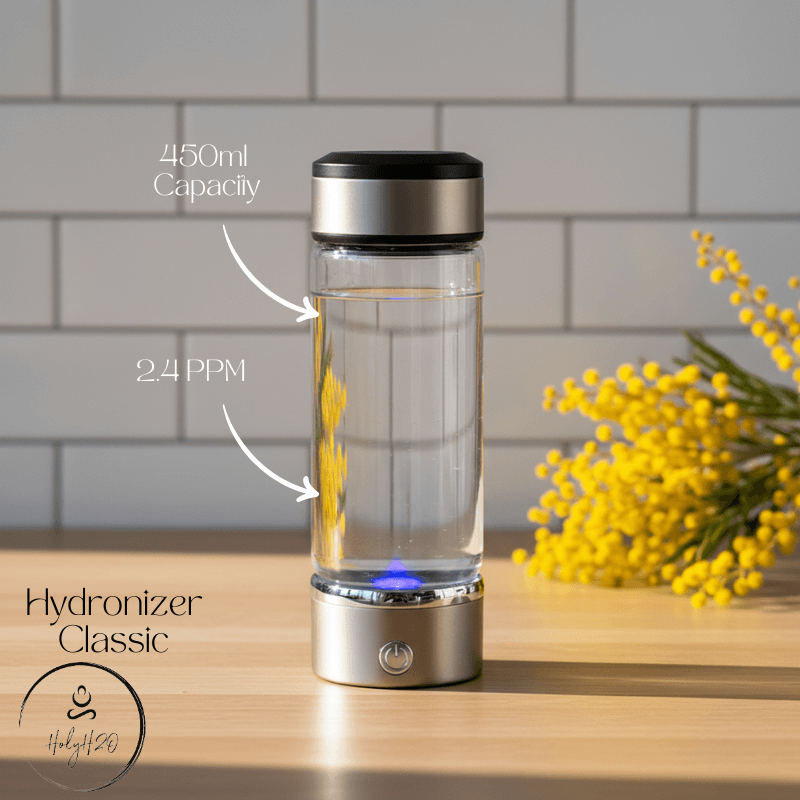
HolyH2O Hydronizer Review — The Flagship Worth Buying
✓ Pros
- Genuine SPE/PEM technology — not cheap electrolysis that contaminates water with ozone or chlorine
- Borosilicate glass body slows H2 offgassing vs plastic bottles
- 3-minute cycle — fastest of any glass hydrogen bottle tested in AU
- AU warranty and local support — not a grey import
✗ Cons
- 350mL per charge — frequent top-ups required, not a family solution
- Does not filter contaminants — pair with a separate filter if your tap water has chloramine or fluoride
- H2 concentration of 1,200-1,500 ppb is honest but below inflated competitor marketing claims
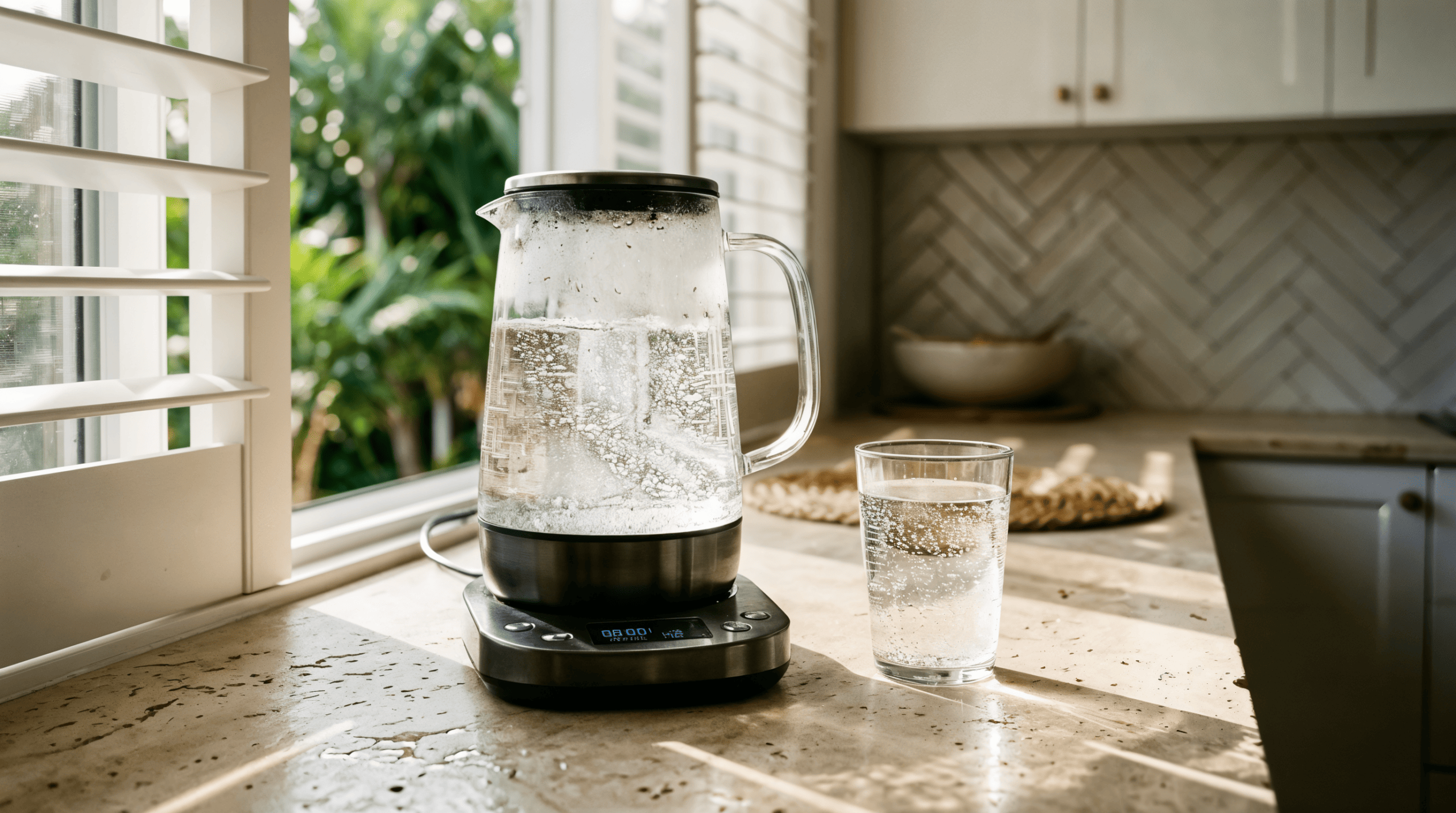
The Hydronizer uses Solid Polymer Electrolyte / Proton Exchange Membrane (SPE/PEM) electrolysis — the same core technology used in medical-grade hydrogen inhalers and research-grade hydrogen water studies. This matters because cheap hydrogen water devices use basic electrolysis, which does not separate gases effectively and can introduce ozone or chlorine byproducts into the water. SPE/PEM keeps hydrogen production clean.
Hydrogen concentration
The Hydronizer targets 1,200-1,500 ppb H2 per 3-minute cycle. For context, the Molecular Hydrogen Institute’s research threshold for therapeutic studies is typically 0.5-1.6 ppm (500-1,600 ppb). The Hydronizer hits this range. Competitor products claiming 6,000 ppb or higher are almost certainly measuring peak saturation under controlled conditions, not what reaches your bloodstream through normal drinking. At atmospheric pressure, water saturates at approximately 1,600 ppb at room temperature — physics caps it there. Treat any claims above that with scepticism.
The evidence behind hydrogen water
Worth being direct here: the research on hydrogen water is promising but not settled. There are over 1,000 peer-reviewed studies on molecular hydrogen, many showing antioxidant and anti-inflammatory effects in animal models and small human trials. The limitations are real — most human studies are short-duration, have small sample sizes, and lack long-term follow-up data. There is no large-scale randomised controlled trial establishing specific clinical outcomes for daily hydrogen water consumption. The Hydronizer is a legitimate device for delivering dissolved H2 — whether that H2 does everything its advocates claim is still an open scientific question. Buy it as a reasonable experiment, not a guaranteed therapeutic intervention.
Build quality
The borosilicate glass body is the right material choice. Plastic bottles allow H2 to permeate out faster; glass retains dissolved hydrogen longer after a charge cycle. The electrolysis base is solid, the USB-C charging port is sensible, and the unit feels durable enough for daily gym use. At $119.50 EOFY, it undercuts comparable SPE/PEM glass bottles from Japanese and Korean brands by $50-$100.
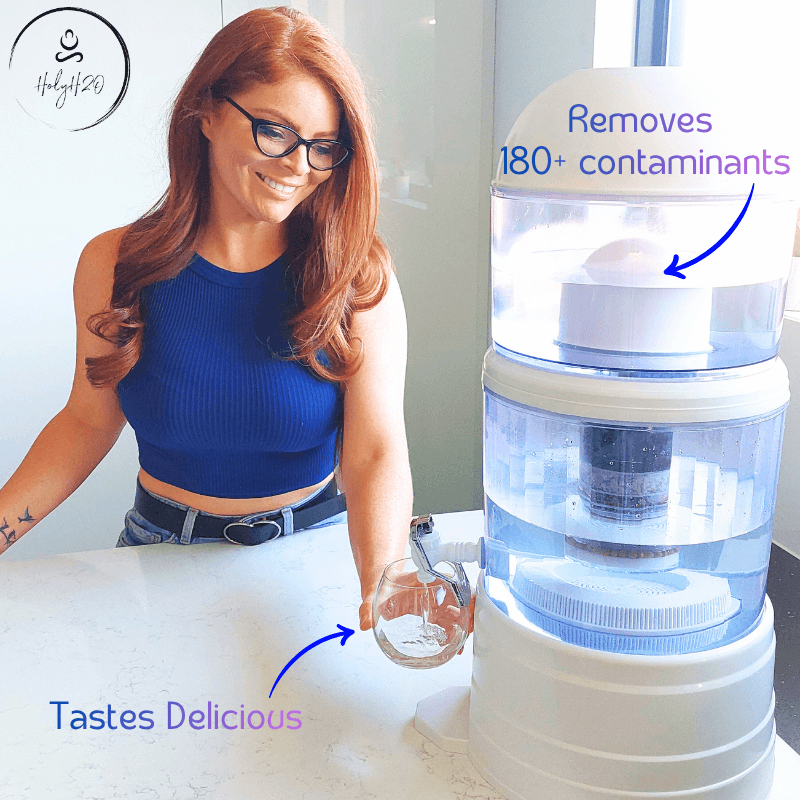
HolyH2O Trinity Review — The Filter That Matters Most
✓ Pros
- Targets fluoride removal — actually rare in benchtop filters under $200 in AU
- No installation required — gravity-fed, zero plumbing
- 3-stage filtration stack addresses sediment, chlorine/chloramine, and heavy metals
- 35 ProductReview.com.au reviews — the most customer-tested product in HolyH2O’s range
✗ Cons
- Gravity-fed flow is slower than pressure-fed RO — patience required
- Chloramine reduction depends on whether Stage 2 carbon is catalytic — HolyH2O has not published this specification publicly, which is a gap for Brisbane/Sydney/Adelaide/Perth users
- No independent NSF or WaterMark certification data published for contaminant removal rates
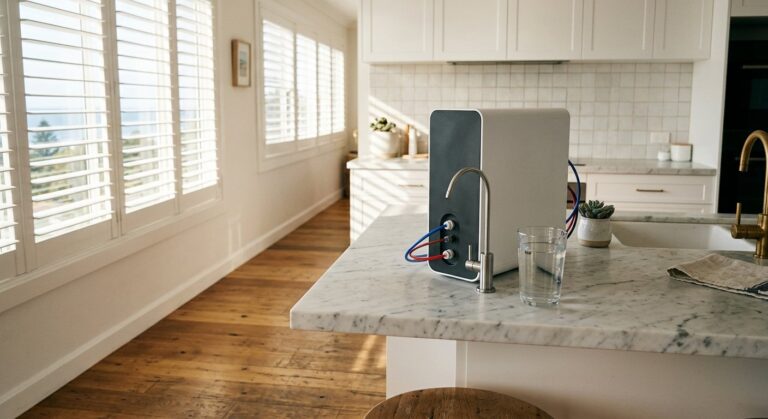
The Trinity is the product that has generated the most real-world customer engagement for HolyH2O, and it is easy to understand why. Finding a benchtop gravity filter that explicitly targets fluoride, at under $200, in Australia, is actually difficult. Most gravity filters in this price range handle chlorine and sediment and stop there. Fluoride removal requires activated alumina or bone char media — the Trinity claims to include a fluoride reduction stage, which puts it in a different category from a Brita or standard benchtop unit.
The critical chloramine question
This is where I need to be direct with you, particularly if you are in Brisbane, SEQ, Sydney, Adelaide, or Perth. These cities use chloramine as their primary disinfectant — not free chlorine. Standard granular activated carbon (GAC) removes free chlorine effectively but removes chloramine at approximately 1/40th the rate. If Stage 2 of the Trinity uses standard GAC, chloramine reduction in your water will be partial at best.
Effective chloramine removal requires catalytic carbon, a compressed carbon block, or reverse osmosis. HolyH2O’s product page does not specify whether the carbon stage uses catalytic carbon or standard GAC. Before purchasing the Trinity as your primary filtration solution in a chloramine city, contact HolyH2O directly and ask: “Is Stage 2 catalytic carbon or standard activated carbon?” If it is catalytic, the Trinity is a strong option. If standard GAC, it will reduce chloramine taste somewhat but not to the degree you might expect.
Fluoride reduction: managing expectations
Australian tap water is fluoridated at 0.6-1.0 mg/L according to the Australian Drinking Water Guidelines (ADWG 2025). The Trinity claims fluoride reduction — but without published removal percentage data or NSF/ANSI certification for fluoride reduction, you cannot verify exactly how much is being removed. Activated alumina, the typical fluoride reduction media, achieves 80-95% reduction at optimal conditions. Bone char performs similarly. If precise fluoride removal matters to you, an RO system (90-97% removal, NSF/ANSI 58 certified) is the only technology with independently verified performance data. The Trinity is an honest attempt at the problem within the constraints of a gravity-fed benchtop format.
Running cost
Replacement filters are available in a saver pack at $175. Assuming a 6-month filter life at a household consumption of 4L/day filtered, that is approximately $0.08/L — more expensive than RO (typically $0.03-$0.05/L) but dramatically cheaper than bottled water at $2-$4/L. For a renter who cannot drill under their sink, the cost comparison favours the Trinity clearly over bottled water.
HolyH2O Tap Mate, Pitcher & Shower Mate — The Supporting Range
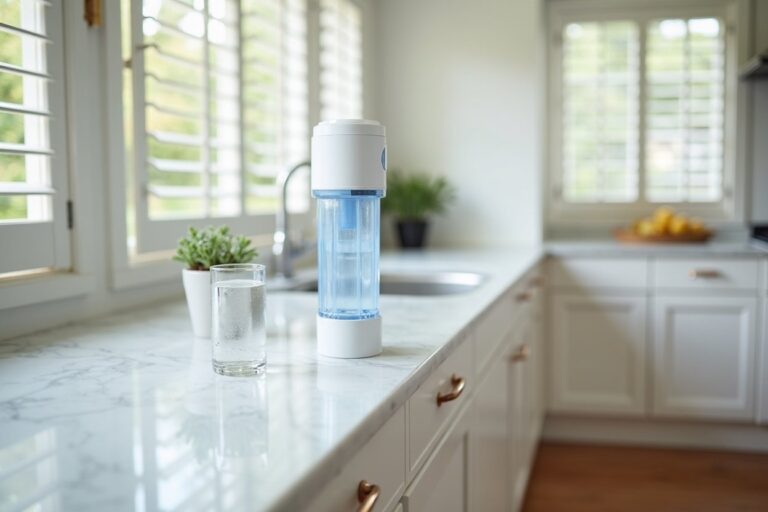
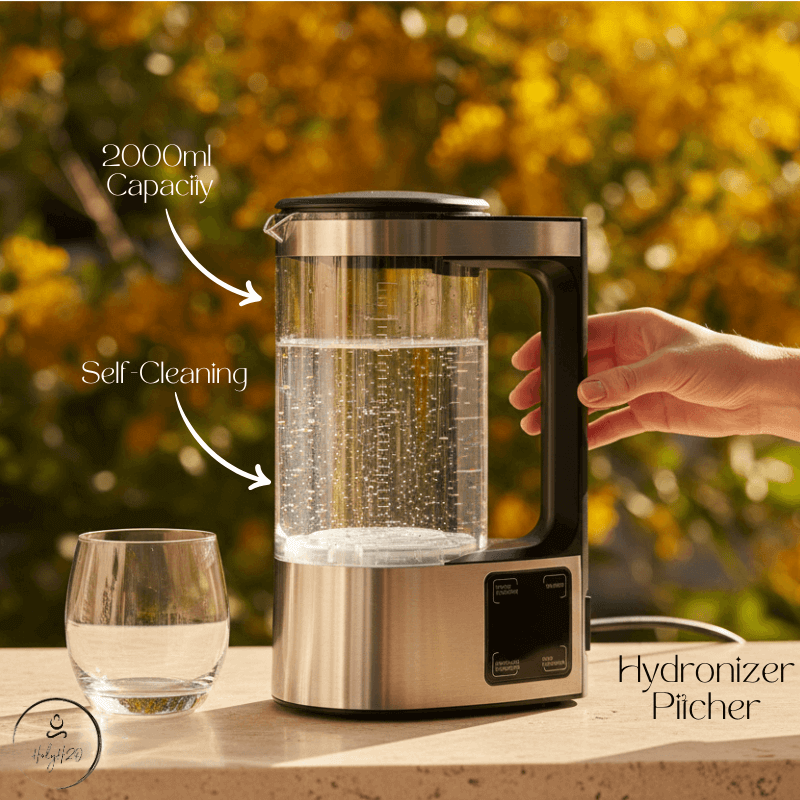
Hydronizer 2L Pitcher
✓ Pros
- Genuine SPE/PEM — same core technology as the Hydronizer bottle
- 2L capacity serves a family of 3-4 in one generation cycle
- Visible hydrogen bubbles provide immediate confirmation of activity
✗ Cons
- H2 offgasses faster from an open pitcher than a sealed bottle — drink within 20-30 minutes of generation
- $275 is a significant commitment for technology with evolving evidence
- Bench space required; does not filter contaminants independently
The Pitcher makes sense for households where multiple people want hydrogen water daily and the 350mL Hydronizer bottle requires too many top-up cycles. The trade-off is physical: an open pitcher loses dissolved H2 faster than a sealed glass bottle. If you charge a 2L pitcher and leave it for two hours before drinking, the H2 concentration will have dropped significantly. This is basic chemistry, not a product flaw — molecular hydrogen is the smallest molecule in existence and escapes liquid readily. Build the habit of charging and drinking promptly.
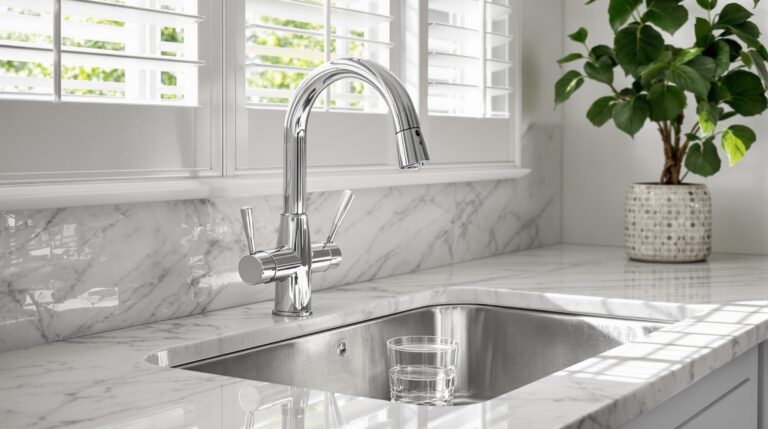
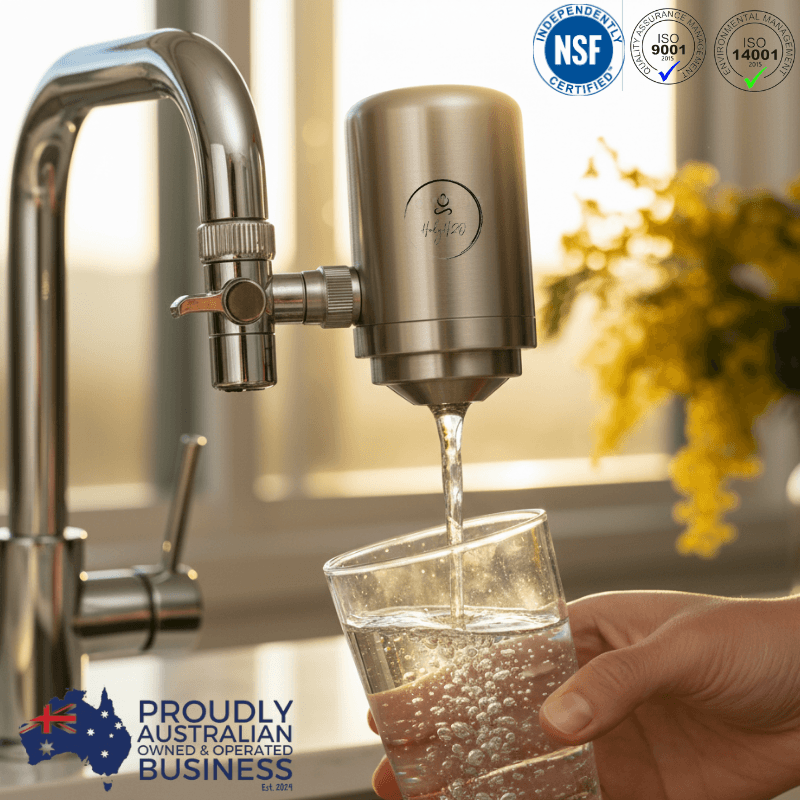
Tap Mate
✓ Pros
- 60-second installation — fastest setup of any filter type, no tools required
- Filtered/unfiltered switch mode — use filtered for drinking, unfiltered for washing
- Zero bench space required — mounts directly to your existing tap
✗ Cons
- Does NOT remove fluoride — no gravity or RO stage is possible in a tap-mount format
- Chloramine reduction is uncertain without carbon type specification — a significant gap for Brisbane, Sydney, Adelaide, and Gold Coast users
- Not compatible with all tap types — check thread compatibility before ordering
The Tap Mate is the right product for a specific person: a renter in Melbourne, Hobart, Canberra, or Townsville who wants filtered drinking water with zero commitment. Melbourne water (Yarra Valley catchment, TDS ~60 mg/L, very soft, free chlorine disinfection) responds well to standard carbon filtration. A tap-mount carbon filter will remove the free chlorine and taste compounds effectively in those cities. For the same renter in Brisbane or Sydney where chloramine is used, the chloramine question matters — and without confirmed catalytic carbon in the cartridge, the performance for the most common disinfection byproduct in those cities is uncertain.
Shower Mate
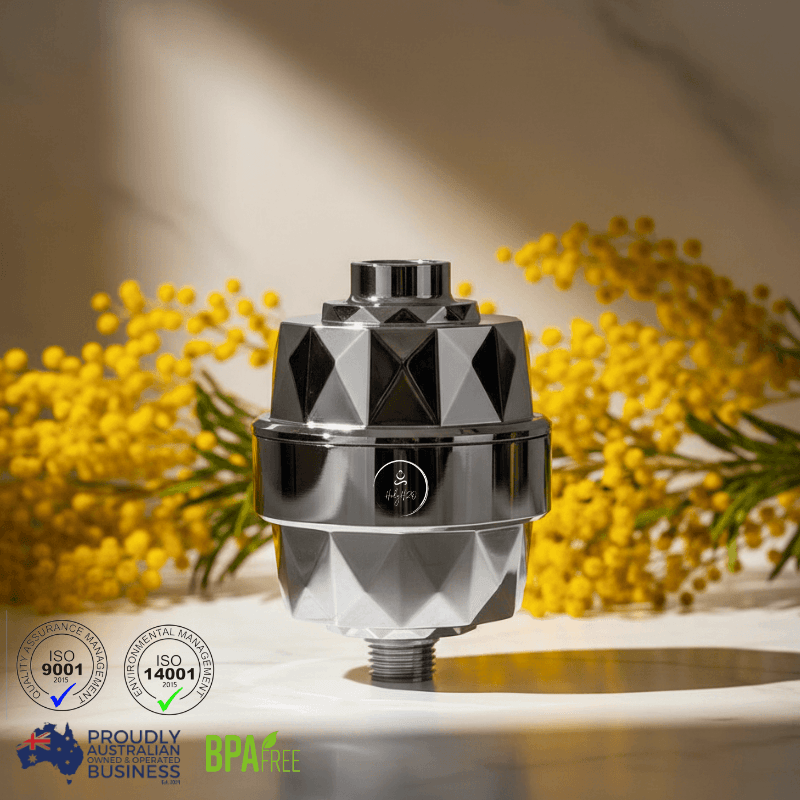
✓ Pros
- Easy inline install — no plumber, no tools beyond hand-tightening
- Reduces chlorine smell noticeably — benefit felt within first shower
- Affordable entry point for shower filtration at $89.50
✗ Cons
- Standard KDF/carbon approach does not effectively remove chloramine — Brisbane and SEQ users with sensitive skin may see limited improvement
- Hot shower temperature reduces filter efficiency across all media types
- No published cartridge lifespan or replacement cost data on product page
The Shower Mate is a reasonable product for the right city. If you are in Melbourne, Hobart, Canberra, Townsville, or Cairns — all free chlorine cities — a KDF/carbon shower filter will make a real difference to chlorine smell and skin feel. If you are in Brisbane, SEQ, Sydney, Adelaide, Perth, or Darwin — chloramine cities — standard KDF-55 is not effective for chloramine removal. For those cities, the right shower filter uses vitamin C (ascorbic acid) or catalytic carbon. See our full comparison of best shower filters for Australian tap water for a full breakdown of which technologies work where.
How HolyH2O Compares to the Competition
| Product | EOFY Price | Removes Fluoride | Removes Chloramine | H2 Generation | Best For |
|---|---|---|---|---|---|
| HolyH2O Hydronizer | $119.50 | No | No | Yes — 1,200 ppb | Sports / recovery |
| HolyH2O 2L Pitcher | $275 | No | No | Yes — 1,200 ppb | Family kitchen bench |
| HolyH2O Trinity | $187.50 | Yes — claimed | Partial* | No | Renters / fluoride concern |
| HolyH2O Tap Mate | $99 | No | Partial* | No | Renters / quick setup |
| HolyH2O Shower Mate | $89.50 | No | Limited | No | Skin / hair (free Cl₂ cities) |
| PWS EcoHero RO (under-sink) | ~$609 | Yes — 90-97% RO | Yes — RO membrane | No | Comprehensive filtration |
| Waters Co Bench Filter | $200-400 | Some models | Partial | No | Gravity bench filtration |
*Partial = depends on whether catalytic carbon is used. Confirm with HolyH2O before purchasing for Brisbane, Sydney, Adelaide, Gold Coast, or Darwin.
Against Waters Co and similar Australian gravity benchtop brands, the Trinity competes directly. Waters Co has been in the Australian market longer and has more published filter specification data, which gives buyers more confidence — but their fluoride-reduction models are often in the same price bracket. Against RO systems like the PWS EcoHero 5-Stage (NSF 58 certified, WaterMark AS3497), HolyH2O’s filter range is not comparable in removal performance — but the EcoHero requires a plumber and costs $609+. They solve different problems for different users.
On the hydrogen side, HolyH2O competes against Lourdes (Japan), and a range of generic eBay SPE/PEM devices. The Hydronizer’s pricing at $119.50 EOFY is competitive with the generic market while offering AU-local support that eBay imports cannot match. For first-time hydrogen water users, HolyH2O is the lower-risk entry point.
Shop HolyH2O Australia — EOFY Sale
Use code HOLYJAYCELOVE10 for an additional 15% off any order → Browse full range
Who HolyH2O Is For — and Who It Is Not For
✓ Who HolyH2O Is For
- Renters who cannot modify plumbing — particularly the Trinity and Tap Mate
- Individuals wanting to trial hydrogen water without a $300+ Japanese import
- Melbourne, Hobart, and Canberra households (free chlorine) — all filter products perform as expected
- Health-conscious households wanting fluoride reduction without an RO install (Trinity)
- Gym users, athletes, or anyone doing active recovery who wants daily H2 water (Hydronizer)
× Who HolyH2O Is Not For
- Brisbane, Sydney, Adelaide, or Gold Coast households relying solely on HolyH2O filters for chloramine removal — confirm catalytic carbon specification first
- Anyone needing certified PFAS removal — only NSF P473-certified RO systems address this. See our best water filters guide for certified options.
- Households in Perth or Adelaide with high TDS water (170-400 mg/L) who need comprehensive mineral/hardness reduction — RO is the right tool
- Anyone expecting hydrogen water to function as a medical treatment — the evidence is promising but not at clinical prescription level
- Whole-family fluoride removal at volume — gravity-fed speed is a bottleneck; RO under-sink is more appropriate
Is HolyH2O Worth the Money? Final Verdict
The short answer is yes — for the right products and the right cities.
The Hydronizer at $119.50 EOFY is a genuine SPE/PEM device at a price point that previously only generic eBay imports could match. If you want to experiment with hydrogen water and you want AU-based support and warranty behind the purchase, this is the product to buy. The evidence for hydrogen water is promising — enough that informed people are choosing to include it in their daily routines. It is not a pharmaceutical product and should not be treated as one. Treat it as a high-quality wellness tool with an evolving evidence base.
The Trinity is the most interesting filtration product in the range. A gravity benchtop filter that addresses fluoride at $187.50 fills a real gap in the Australian market for renters. The limitation is the missing technical specification on chloramine performance. That gap needs to close — either through HolyH2O publishing their carbon type specification or through independent testing. Without it, recommending the Trinity strongly in Brisbane, SEQ, Sydney, Adelaide, or Perth requires that caveat front and centre.
The Tap Mate and Shower Mate are honest entry-level products. They do what standard carbon/KDF filters do. In free chlorine cities they perform well. In chloramine cities, they are limited by the same constraint that limits every standard carbon product: chloramine is not free chlorine, and the filter media need to match the disinfection chemistry of your specific city.
What HolyH2O does well is make better-than-tap water accessible. Not everyone can install a $700 under-sink RO. Not everyone wants to. For those households, HolyH2O’s range — at EOFY prices with 15% off via HOLYJAYCELOVE10 — represents genuine value. Just be clear-eyed about what each product can and cannot do, based on your city’s water chemistry.
For comprehensive filtration with certified contaminant removal — particularly PFAS, fluoride above 90%, or full chloramine elimination — pair a HolyH2O hydrogen device with a certified RO system. Check our full rankings of best water filters in Australia and our dedicated hydrogen water roundup for full product comparisons.
Last reviewed: June 2026 — Clean and Native
Ready to try HolyH2O?
Use code HOLYJAYCELOVE10 for 15% off your entire order at HolyH2O.com.au. The Hydronizer EOFY price of $119.50 is the best entry point for genuine SPE/PEM hydrogen water in Australia right now.
Frequently Asked Questions
Yes. HolyH2O is an Australian-operated water wellness brand that ships from within Australia and offers local warranty support. They are not a grey import operation. Their products use genuine SPE/PEM technology on the hydrogen side, and their filter range is designed for the Australian market. Their ProductReview.com.au rating of 3.5/5 (60% positive) is lower than their internal site reviews, which is typical of platforms that attract critical feedback disproportionately — though it is worth reading individual reviews before purchasing.
The Hydronizer uses genuine SPE/PEM electrolysis, which is the correct technology for producing dissolved molecular hydrogen (H2) in water without introducing ozone or chlorine byproducts. It targets 1,200-1,500 ppb H2 per 3-minute cycle, which aligns with the concentration range used in most published hydrogen water research. Whether that H2 delivers the health benefits claimed is an open scientific question — the research is promising but not conclusive. The device itself functions as described.
HolyH2O states the Trinity includes a fluoride reduction stage. Without published removal percentage data or NSF/ANSI certification specifically for fluoride reduction, the exact performance cannot be independently verified. Activated alumina — the typical fluoride reduction media — achieves 80-95% reduction under optimal conditions. If precise, certified fluoride removal is your priority, a reverse osmosis system with NSF/ANSI 58 certification (90-97% removal) is the only technology with independently verified performance data in Australia.
This is the critical question. Brisbane, along with SEQ, Sydney, Adelaide, Gold Coast, and Darwin, uses chloramine as its primary disinfectant — not free chlorine. Standard activated carbon (GAC) removes chloramine at approximately 1/40th the rate it removes free chlorine. Effective chloramine removal requires catalytic carbon, compressed carbon block, or reverse osmosis. HolyH2O has not publicly specified whether their filter cartridges use catalytic or standard carbon. Contact HolyH2O directly before purchasing the Trinity or Tap Mate if chloramine removal is your primary concern in a chloramine city.
No. At atmospheric pressure, water saturates with dissolved hydrogen at approximately 1,600 ppb (1.6 ppm) at room temperature — physics caps it there. Claims above that figure typically represent peak saturation under controlled laboratory pressure conditions, not what reaches you through normal use in a drinking bottle. The Hydronizer’s target of 1,200-1,500 ppb is an honest specification within the physically achievable range. Treat any competitor claiming 5,000-6,000 ppb in a standard drinking bottle with scepticism.
Limited effectiveness. Brisbane, SEQ, and Sydney use chloramine, not free chlorine. The Shower Mate uses a standard KDF/carbon approach, which does not effectively reduce chloramine. For shower filtration in chloramine cities, the filter media needs to be either vitamin C (ascorbic acid) or catalytic carbon — both of which neutralise chloramine effectively. The Shower Mate performs well in Melbourne, Hobart, Canberra, Townsville, and Cairns, where free chlorine is used. See our best shower filters guide for chloramine-specific options.
Use code HOLYJAYCELOVE10 at checkout on holyh2o.com.au for 15% off your entire order. This code is provided through Clean and Native’s affiliate partnership with HolyH2O.
They solve different problems. The Hydronizer generates dissolved hydrogen in water already drawn from your tap — it does not filter contaminants. The AquaTru Classic is a countertop reverse osmosis system that removes fluoride (90-97%), PFAS, chloramine, heavy metals, and TDS — but does not add hydrogen. For comprehensive contaminant removal, RO is the correct technology. For hydrogen enrichment of already-filtered water, the Hydronizer is the right add-on. Many households use both: an RO filter for their base water quality, then a hydrogen device for the therapeutic use case.
HolyH2O has not published NSF/ANSI or WaterMark AS3497 certification data for their filter products on their Australian website as of June 2026. This is a gap compared to certified competitors. WaterMark certification under AS/NZS 3497 covers plumbing products and materials in contact with drinking water. NSF/ANSI 42, 53, and 58 certifications cover taste/odour, health contaminant reduction, and RO performance respectively. The absence of published certification data does not mean the products are ineffective — it means independent verification of contaminant removal claims is not available from HolyH2O’s published materials.
Get the Australian Home Environment Checklist
30 checks across water, air and EMF. Most of them free. Ranked by impact.
No spam. Unsubscribe any time.

Former Royal Australian Navy Clearance Diver and TAG-E counter-terrorism operator. Founded Clean and Native to apply the same rigorous thinking to the home environment.
Full biography →