British Berkefeld Gravity Filter Review Australia 2026
Drafted with AI assistance and checked against published specifications and certifications. First-hand measurements appear only where stated. How we make content
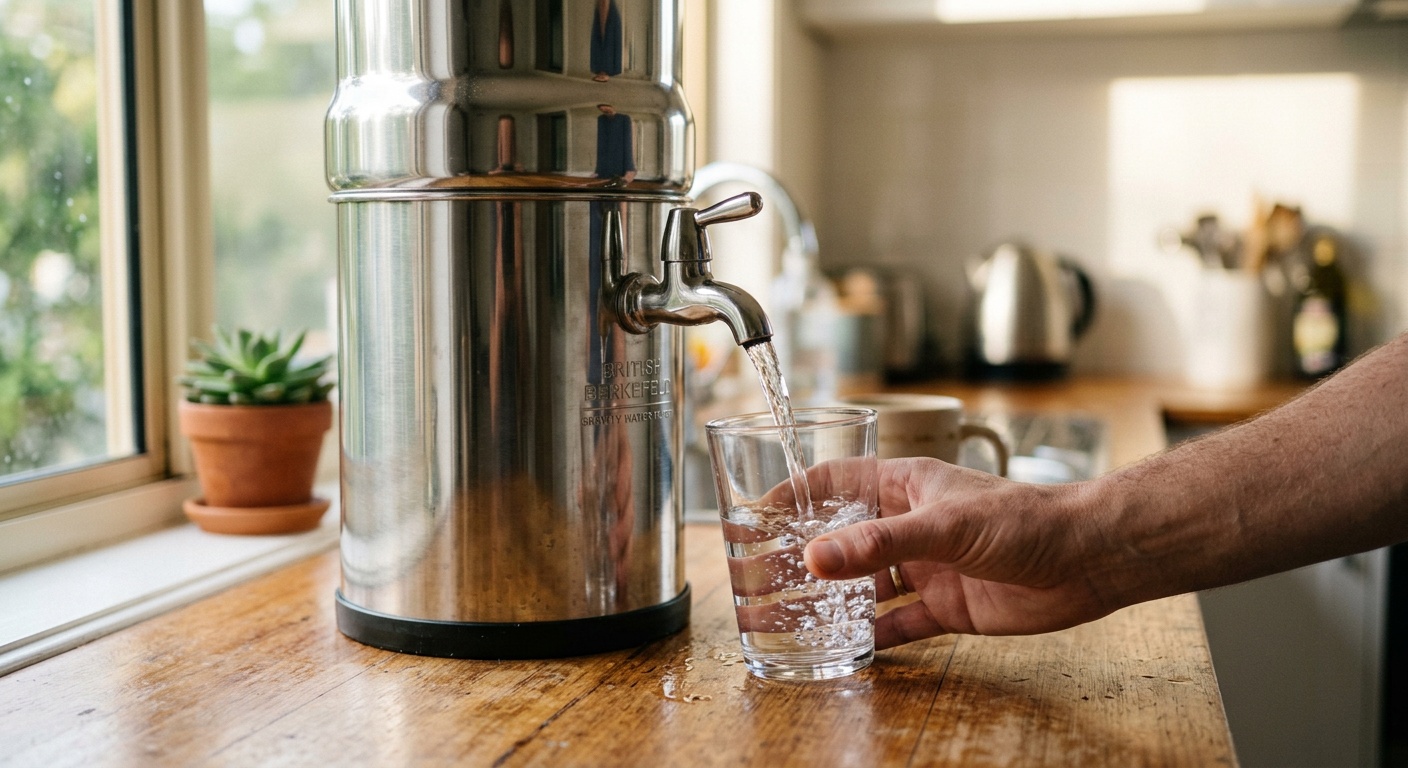
The British Berkefeld gravity filter is the only NSF-certified gravity-fed water purification system widely available in Australia — and it does not need electricity, plumbing, or mains pressure to work. For rural properties on tank water, off-grid setups, and emergency preparedness, that combination of certification and independence from infrastructure is actually hard to beat. This review covers what it removes, what it does not, how it compares to the confusingly-named Berkey, and whether it is the right choice for your situation — all based on manufacturer specifications, NSF certification data, and verified Australian distributor listings, assessed using our documented methodology.
The British Berkefeld gravity filter is the best non-electric water purification option available in Australia for tank water, off-grid properties, and emergency preparedness. Its NSF-tested ceramic candle elements remove >99.99% of bacteria and >99.9% of protozoa including Giardia and Cryptosporidium — the two pathogens most relevant to Australian rainwater tank users. It reduces free chlorine effectively through its activated carbon core. However, it cannot remove fluoride, does not meaningfully reduce TDS, and its standard carbon core is not rated for chloramine removal — which means it is not the right primary filter for mains water in Brisbane, Sydney, Adelaide, Gold Coast, or Darwin (all chloramine cities). For mains-connected homes wanting fluoride and PFAS removal, reverse osmosis remains the correct technology.
Key catches
- No fluoride removal — carbon ceramic cannot remove fluoride (only RO or activated alumina can)
- Standard carbon core removes free chlorine but is not rated for chloramine — ineffective for Brisbane, Sydney, Adelaide, Gold Coast, Darwin mains water
- Flow rate is slow: approximately 1-2 litres per hour per candle element — not instant like tap-connected filters
- Does not reduce TDS, hardness, or dissolved salts — not a softener or demineraliser
✓ Who This Is For
- Rural and regional Australians on tank water or bore water who need pathogen removal without electricity
- Off-grid homesteaders, caravan and camper trailer owners who need portable gravity filtration
- Emergency preparedness households wanting a filter that works during power outages and natural disasters
- Families in free chlorine cities (Melbourne, Hobart, Canberra) who want simple benchtop filtration without plumbing modifications
- Anyone philosophically opposed to wastewater production from RO systems
× Who It Is Not For
- Anyone in a chloramine city (Brisbane, Sydney, Adelaide, Gold Coast, Darwin) who needs chloramine removal from mains water — under-sink RO is the correct choice
- Households wanting fluoride or PFAS removal — only reverse osmosis (90-97%) or activated alumina handles fluoride
- Anyone who needs instant, high-flow filtered water for cooking and filling pots quickly
- Apartment renters with limited bench space — the stainless steel housing is tall (400-500mm+)
- People wanting TDS reduction or water softening — gravity ceramic does not reduce dissolved solids
What Gravity Ceramic Filters Actually Remove — And What They Do Not
This is where most gravity filter marketing gets vague, and where you need hard numbers. The British Berkefeld system uses ceramic candle filter elements — porous ceramic shells with an activated carbon core. The ceramic outer shell acts as a physical barrier: its nominal pore size of approximately 0.2 to 0.9 microns physically blocks bacteria, protozoa, cysts, and sediment. The activated carbon core inside adsorbs chlorine, some organic compounds, and improves taste and odour.
According to NSF International’s certified product listings (last confirmed active as of 29 March 2026 via NSF’s DWTU database), British Berkefeld elements carry certifications to NSF/ANSI standards. These are the numbers that matter:
| Contaminant | Removal Claimed | Mechanism | Relevant Standard |
|---|---|---|---|
| Bacteria (E. coli, cholera, etc.) | >99.99% | Ceramic pore exclusion | NSF/ANSI P231 |
| Protozoa (Giardia, Cryptosporidium) | >99.9% | Ceramic pore exclusion | NSF/ANSI P231 |
| Sediment / turbidity | Effective to sub-micron level | Ceramic physical barrier | NSF/ANSI 42 (aesthetic) |
| Free chlorine | Significant reduction | Activated carbon adsorption | NSF/ANSI 42 |
| Chloramine | NOT effectively removed | Standard carbon adsorbs chloramine at ~1/40th the rate of free chlorine | — |
| Fluoride | NOT removed | Carbon and ceramic cannot remove dissolved fluoride | — |
| PFAS | Not certified for PFAS removal | Would require NSF/ANSI P473 certification | — |
| TDS / dissolved minerals | NOT reduced | Requires reverse osmosis membrane | — |
| Lead | Partial reduction (some models) | Carbon adsorption | NSF/ANSI 53 (model-dependent) |
Here is the critical Australian-specific fact that most reviews skip entirely: if you are on mains water in Brisbane, Sydney, Adelaide, Gold Coast, or Darwin, your water supply uses chloramine as the disinfectant — not free chlorine. Standard activated carbon (the type inside British Berkefeld ceramic candles) removes free chlorine effectively but adsorbs chloramine at approximately 1/40th the rate, according to water treatment engineering literature. This means the British Berkefeld will taste-improve your water slightly in these cities, but it is not delivering meaningful chloramine reduction. For chloramine cities, you need catalytic carbon, a compressed carbon block rated for chloramine, or reverse osmosis.
In free chlorine cities — Melbourne, Hobart, Canberra, Townsville, Cairns, and Toowoomba — the carbon core works as intended for chlorine taste and odour reduction. But the real strength of this filter is not chlorine removal. It is pathogen removal from non-reticulated water sources.
British Berkefeld vs Berkey: Clearing Up the Confusion
If you have researched gravity water filters for more than 10 minutes, you have encountered two names that look almost identical: British Berkefeld and Berkey. They are not the same company, but the history connects them — and the distinction matters for what you are actually buying in Australia.
British Berkefeld is a British manufacturer (Doulton) that has been making ceramic water filter elements since 1827. The ceramic candle technology was originally developed for the British military and humanitarian water treatment. Doulton/British Berkefeld ceramic elements carry active NSF International certifications — confirmed as recently as March 2026 on NSF’s public DWTU listings database. The elements are manufactured in the UK.
Berkey (made by New Millennium Concepts, based in Texas, USA) originally licensed and resold British Berkefeld elements in stainless steel housings. They later developed their own proprietary “Black Berkey” purification elements. In 2023, the US EPA issued a stop-sale order against New Millennium Concepts, and the company subsequently filed for bankruptcy. While Berkey products are still circulated through some international resellers (including Amazon AU, where the Royal Berkey housing remains available), the regulatory situation around the Black Berkey elements specifically has created uncertainty.
Here is the practical comparison that matters for Australian buyers:
| Criterion | British Berkefeld (Doulton) | Berkey (Black Berkey Elements) |
|---|---|---|
| Manufacturer | Doulton (UK) — established 1827 | New Millennium Concepts (USA) |
| NSF certification | Active (confirmed March 2026) | No active NSF certification for Black Berkey elements |
| Regulatory status | No regulatory actions | EPA stop-sale (2023); company bankruptcy filed |
| Element material | Ceramic shell + activated carbon core | Proprietary compressed carbon block |
| Bacteria removal | >99.99% (NSF P231 tested) | >99.9999% (manufacturer claim — not independently certified) |
| Element lifespan | ~1,000-1,200L per candle (can be scrubbed to extend) | Claimed 11,000L per element pair |
| Australian availability | Doulton AU distributors, specialty water filter retailers | Amazon AU (housing only); Black Berkey elements availability inconsistent |
| Fluoride removal | No | Optional PF-2 fluoride elements (activated alumina add-on) |
The bottom line: British Berkefeld elements have the third-party certification to back their claims. Berkey Black elements do not. In Australia, where no TGA or NATA alignment exists specifically for point-of-use gravity water purifiers, NSF International certification is the most relevant independent validation available. The Australian Drinking Water Guidelines (ADWG 2024) reference NSF/ANSI standards as the benchmark for point-of-use treatment device performance claims.
One note on the Berkey housing: if you already own a Royal Berkey stainless steel housing (still available on Amazon AU), you can retrofit it with genuine British Berkefeld Super Sterasyl candle elements. The thread fittings are compatible. This gives you the certified element performance inside the Berkey’s high-capacity stainless housing — arguably the best-of-both-worlds option for existing Berkey owners.
Product Specifications: British Berkefeld System Overview
British Berkefeld gravity filter systems are available in several configurations depending on the housing type and the number of ceramic candle elements installed. The core technology across all models is the same: Doulton ceramic candle elements, typically the Super Sterasyl variant for pathogen-grade filtration.
| Specification | Detail |
|---|---|
| Filter element | Doulton Super Sterasyl ceramic candle (ceramic shell + activated carbon core + silver impregnation for bacteriostatic properties) |
| Nominal pore size | Sub-micron (absolute rating varies by element — typically 0.2-0.9 μm) |
| Flow rate (per candle) | ~1-2 litres per hour (gravity-fed — slower when filter is clogged, faster with new or freshly scrubbed candle) |
| Element lifespan | Manufacturer recommends replacement at 6-12 months or ~1,000-1,200L (can be extended by scrubbing ceramic exterior with Scotch-Brite pad to remove sediment buildup) |
| Housing material | 304 stainless steel (gravity housing models) or food-grade plastic depending on model |
| Capacity | Depends on housing — ranges from 5L (compact) to 12L+ (large stainless models) |
| Electricity required | None — operates on gravity alone |
| Plumbing required | None — fill upper chamber manually |
| NSF certifications | NSF/ANSI 42 (aesthetic effects), NSF/ANSI 53 (health effects — model-dependent), NSF P231 (microbiological purifiers) |
| Silver impregnation | Yes — prevents bacterial growth within the ceramic element itself (bacteriostatic, not bactericidal in the water) |
| Maintenance | Scrub ceramic exterior with clean Scotch-Brite pad under running water when flow rate drops. No tools required. |
The silver impregnation deserves explanation. Doulton’s ceramic elements include colloidal silver embedded within the ceramic matrix. This is not a silver ion release system and it does not “purify” the water with silver — it prevents bacterial colonisation on the ceramic surface itself. Without it, the wet ceramic would become a breeding ground for bacteria between uses. This is a well-established technique in ceramic water treatment and is part of the NSF P231 testing protocol.
On flow rate: expect to wait. At 1-2 litres per hour per candle, a two-candle system produces roughly 2-4 litres per hour. If you are filling a 12L lower chamber from empty with two candles, you are looking at 3-6 hours. This is not a complaint — it is physics. Gravity filtration through sub-micron ceramic pores is inherently slow. The solution is to keep the upper chamber topped up so the lower chamber always has filtered water available. Think of it as a batch process, not an on-demand tap.
Why It Makes Sense in Australia: Tank Water, Rural Properties, and Emergency Prep
Australia has approximately 2.3 million households relying wholly or partly on rainwater tanks, according to ABS data. In regional Queensland, New South Wales, Victoria, and Tasmania, tank water is the primary drinking water source for hundreds of thousands of homes. That water is not treated with chlorine or chloramine. It is not tested by a water utility. And it is potentially contaminated with Giardia, Cryptosporidium, E. coli, and Campylobacter from bird and animal faeces on roof catchments.
The Australian Drinking Water Guidelines (ADWG 2024) recommend that all household rainwater used for drinking be treated to remove microbial contamination. The recommended barrier is either UV disinfection, boiling, or point-of-use filtration that achieves >99.9% protozoa and >99.99% bacteria reduction. The British Berkefeld Super Sterasyl elements meet both of those thresholds under NSF P231 testing.
For tank water users specifically, here is why gravity ceramic makes more practical sense than alternatives:
- No electricity required — critical for off-grid properties, and during the cyclone, flood, and bushfire events that knock out power for days or weeks across regional Australia. Reverse osmosis systems require mains pressure or a pump. UV systems require electricity. Boiling requires fuel. Gravity ceramic works with nothing but water and gravity.
- No plumbing modifications — the system sits on a bench. No pipe cutting, no under-sink installation, no WaterMark compliance concerns for installation.
- Handles turbid water — tank water after heavy rain can carry significant sediment. The ceramic outer shell physically traps particulates and can be scrubbed clean when clogged. RO membranes can be permanently damaged by high-sediment water without adequate pre-filtration.
- Low ongoing cost — replacement ceramic candles cost approximately $30-$60 each from Australian distributors, and each candle can be scrubbed and reused multiple times before replacement. For a 2-candle system replaced annually, ongoing costs are roughly $60-$120/year.
For emergency preparedness, the British Berkefeld is arguably the single most practical water purification device you can stockpile. During the 2022 Lismore floods, the 2019-2020 Black Summer bushfires, and Cyclone Jasper in 2023, mains water supply was disrupted for days to weeks across affected communities. A gravity filter that works with creek water, rainwater, or any freshwater source — without power — is not a luxury item in those circumstances. It is critical infrastructure.
5-Year Cost Comparison: Gravity Ceramic vs RO vs Bottled Water
Cost analysis exposes the real economics behind water filtration choices. Most people underestimate how cheap gravity filtration is per litre — and how catastrophically expensive bottled water remains over any meaningful timeframe. The following comparison assumes a household consumption of 4 litres per day (1,460 litres per year), which is conservative for a family of two adults.
| Product | Upfront | Annual Filters | 5-Year Total | Cost/Litre |
|---|---|---|---|---|
| British Berkefeld gravity (2-candle system) | ~$250-$400 | ~$80-$120 | ~$650-$1,000 | $0.09-$0.14 |
| Philips RO Water Station (countertop RO) | ~$698-$779 | Not listed in Australia | n/a | n/a |
| Waterdrop X8 under-sink RO | ~$719 | ~$275 | ~$2,094 | ~$0.29 |
| Bottled water (600mL) | $0 | ~$3,504 (at $2.40/L supermarket) | ~$17,520 | $2.40 |
At $0.09-$0.14 per litre, the British Berkefeld is the cheapest filtration option on this list over five years — roughly 17 to 27 times cheaper per litre than bottled water. It is also cheaper than reverse osmosis because it has no pump, no membrane, no electricity draw, and no wastewater production. RO systems typically produce 2-4 litres of wastewater for every 1 litre of filtered water (newer tankless units do better: the Waterdrop X8 sends one litre to drain for every two it produces). Gravity ceramic produces zero wastewater.
The environmental maths are equally stark. According to ABS waste data, Australians use approximately 373 million plastic water bottles annually. At 4 litres per day, a single household switching from bottled to gravity-filtered water eliminates roughly 2,430 plastic bottles per year (based on 600mL bottles). Over five years, that is 12,150 fewer plastic bottles per household.
But — and this is the honest caveat — cost per litre is not the only metric that matters. The British Berkefeld is cheap because it does less. It does not remove fluoride. It does not remove PFAS. It does not reduce TDS. If you are on mains water and your concern is dissolved contaminants rather than pathogens, the RO systems on this table deliver a fundamentally different level of purification. You are not comparing like with like.
What the British Berkefeld Does Well
Pathogen removal is actually excellent. The >99.99% bacteria and >99.9% protozoa reduction under NSF P231 testing is not a marketing claim — it is a third-party-verified number produced under controlled laboratory conditions. For tank water in rural Queensland, NSW, Victoria, and Tasmania where Giardia and Crypto are real risks from animal contamination of roof catchments, this level of microbiological performance is exactly what is needed.
Zero infrastructure dependency is a legitimate advantage. No plumber, no electrician, no mains pressure, no pump, no power point. Unbox it, prime the candles, fill the top, and you have purified water. For caravan and camper trailer owners, for rural properties where the nearest plumber is an hour away, and for emergency kits — this matters. During Cyclone Jasper in far north Queensland (December 2023), communities around Cairns and the Daintree lost mains water for over a week. A gravity filter would have delivered safe drinking water from creek or tank sources throughout.
The ceramic candle is actually maintainable. When flow rate drops (which means the ceramic pores are clogging with sediment — exactly what they should do), you remove the candle, scrub the exterior lightly with a clean Scotch-Brite pad under running water, and reinstall. This can be done 20-30 times before the ceramic wears thin enough to require replacement. That means your effective per-candle lifespan is potentially 2-3x the manufacturer’s conservative rating, depending on source water quality.
Stainless steel construction (on the housing models) is durable. No BPA concerns, no plastic degradation, no UV sensitivity. The 304 stainless housing will outlast the owner. This is a buy-once proposition for the housing — only the candle elements are consumables.
What Could Be Better — Honest Limitations
Flow rate is slow, and there is no way around it. If you are a household of four and someone drains the lower chamber before bed, you are looking at 3-6 hours to refill with a 2-candle system. For families accustomed to on-demand filtered water from a tap-connected system, this requires a genuine adjustment in habit. You need to treat it like a kettle — keep it topped up.
No chloramine removal makes it unsuitable as a primary filter for most Australian capital cities. Brisbane, Sydney, Adelaide, Gold Coast, and Darwin all use chloramine. The standard activated carbon core in British Berkefeld candles adsorbs chloramine at approximately 1/40th the rate of free chlorine. If you are on reticulated mains water in any of these cities, this filter is not doing the job you probably bought it for. For chloramine cities, you need catalytic carbon, a compressed carbon block rated for chloramine, or reverse osmosis.
No fluoride removal is a hard limit of the technology. Carbon and ceramic cannot remove dissolved fluoride ions. Period. This is chemistry, not a design choice. Only reverse osmosis (90-97% removal) or activated alumina (80-95%) can reduce fluoride levels. If fluoride removal is your primary concern, a gravity ceramic filter is the wrong product category entirely. The Berkey brand offers optional PF-2 fluoride reduction elements (which use activated alumina), but those are Berkey-specific — not compatible with all British Berkefeld housings without modification.
No PFAS removal certification. PFAS contamination has been confirmed at 700+ sites across Australia according to the DCCEEW national register. For households near Defence bases, airports, or industrial sites in areas like Williamtown (NSW), Oakey (QLD), or Fiskville (VIC), PFAS removal requires NSF/ANSI P473 certification — which gravity ceramic does not carry. Only reverse osmosis consistently achieves >98% PFAS reduction.
Australian pricing and availability is fragmented. Unlike the Berkey (which has a clear Amazon AU listing), British Berkefeld systems are sold through specialist water filter retailers in Australia. PureWater4Life in Sydney is one known stockist. Pricing typically ranges from approximately $96 for entry-level plastic housing models up to $400+ for large stainless steel gravity systems. Replacement candle elements typically run $30-$60 each through Australian distributors. Availability can be inconsistent — check stock before planning a purchase.
Decision Tree: Is a Gravity Ceramic Filter Right for You?
Three questions. That is all it takes to determine whether the British Berkefeld is the right filter for your situation.
Decision Tree: Gravity Filter or Something Else?
1. What is your water source?
→ Tank water, bore water, creek water, or any non-reticulated source: British Berkefeld is an excellent choice — pathogen removal is the priority, and it excels at that.
→ Mains water (city supply): proceed to question 2.
2. Which city are you in?
→ Melbourne, Hobart, Canberra, Townsville, Cairns, Toowoomba (free chlorine): British Berkefeld handles chlorine taste/odour. But if you want fluoride or PFAS removal, skip to question 3.
→ Brisbane, Sydney, Adelaide, Gold Coast, Darwin (chloramine): British Berkefeld is not the right choice — standard carbon cannot handle chloramine. You need catalytic carbon or RO.
3. Do you need fluoride or PFAS removal?
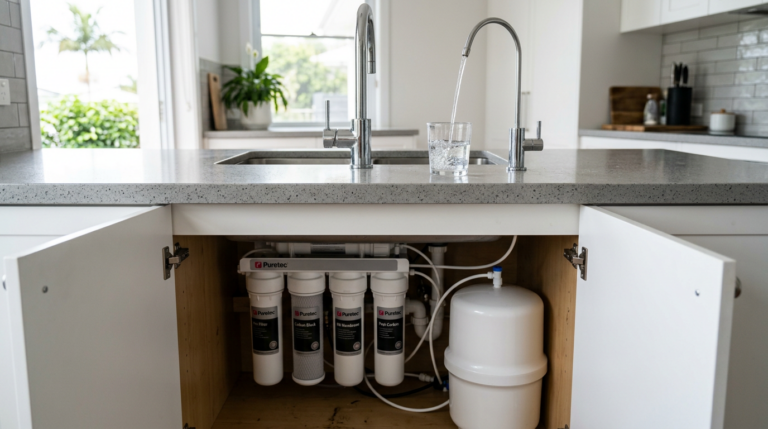
→ Yes: Gravity ceramic cannot do this. You need reverse osmosis — either countertop RO (the Philips RO Water Station lists PFOA and PFOS reduction but not fluoride) or certified under-sink RO (the Waterdrop X8 lists both).
→ No: British Berkefeld can work for taste/odour improvement in free chlorine cities, though it is overkill for treated mains water where pathogens are already eliminated by the utility.
How It Compares to RO: Gravity Ceramic vs Reverse Osmosis
This is not a “which is better” question. It is a “which is right for your situation” question. These are fundamentally different technologies solving different problems.
| Factor | British Berkefeld Gravity | Countertop/Under-Sink RO |
|---|---|---|
| Bacteria/protozoa | >99.99% / >99.9% | >99.9% (membrane exclusion) |
| Fluoride | 0% | 90-97% |
| PFAS | Not certified | >98% (NSF P473) |
| Chloramine | ~1/40th effective | >95% |
| Free chlorine | Effective | Effective |
| TDS reduction | No | 85-95% |
| Electricity | None | Required (pump) |
| Wastewater | Zero | 2-4L per 1L produced (typical) |
| Cost (upfront) | $200–$400 (unit only) | $350–$900 (unit only) |
| Installation | No plumber needed | May need plumber (under-sink) |
British Berkefeld is the best non-electric water filter in Australia — for the right water source
If your water comes from a rainwater tank, bore, creek, or any non-reticulated supply, the British Berkefeld earns its price outright. No other gravity filter available in Australia carries active NSF 231 and NSF 244 certification for bacteria and protozoa removal, and its ceramic candle elements are field-serviceable without full replacement — rinse and reinstall. For off-grid households, rural properties, and emergency preparedness, this is the definitive recommendation.
For mains-connected homes in chloramine cities — Brisbane, Sydney, Adelaide, Gold Coast, Darwin — or anyone needing fluoride or PFAS removal, reverse osmosis is the correct technology. The British Berkefeld does not compete in this space and should not be used as a primary filter for treated chloramine water.
Buy it if
- You are on rainwater tank, bore water, or any untreated supply
- You need a backup filter that works without power or water pressure
- You are off-grid, camping, or building an emergency water supply
- Your city uses free chlorine (Melbourne, Hobart, Canberra, Toowoomba, Cairns)
Look elsewhere if
- You are in Brisbane, Sydney, Adelaide, Gold Coast, or Darwin — chloramine cities where this filter underperforms
- You need fluoride or PFAS removal — only reverse osmosis handles this
- You want a wall-mounted, under-sink, or automatic refill system
- Counter space is limited — gravity filter vessels are large (8–12 litres)
Frequently Asked Questions
Does the British Berkefeld gravity filter remove fluoride?
No. Standard ceramic candle elements do not remove fluoride. Fluoride removal requires either an activated alumina post-filter (available as an add-on for some gravity filter brands) or a reverse osmosis membrane. If fluoride removal is your primary goal, RO is the correct technology.
Is the British Berkefeld suitable for Brisbane, Sydney, or Perth mains water?
Not as a primary filter. Brisbane, Sydney, Adelaide, Gold Coast, and Darwin all treat mains water with chloramine — a compound that standard activated carbon (used in British Berkefeld candles) cannot effectively remove. Chloramine requires catalytic carbon or reverse osmosis. Free-chlorine cities (Melbourne, Hobart, Canberra) are fine.
What is the difference between British Berkefeld and Berkey water filters?
They are different companies. British Berkefeld is a UK-origin brand (founded 1835) whose ceramic candle technology holds active NSF 231 and NSF 244 certification. Berkey is a US brand that has faced ongoing challenges with NSF certification. The similar names cause frequent confusion — they share no corporate relationship and use different filtration media.
How often do British Berkefeld ceramic candles need replacing?
Ceramic candles are cleanable and do not need replacing on a schedule — they are scrubbed with a clean brush under running water when flow rate drops. Manufacturer guidance suggests candles can last several years with regular cleaning. The activated carbon core inside the candle does exhaust over time; replacement timelines depend on water quality and use volume.
Where can I buy British Berkefeld in Australia?
British Berkefeld is available through Australian specialty water filter retailers including PureWater4Life (Sydney) and Waters Co Australia. Some models are also available through Amazon AU. Prices range from approximately $200 for smaller units to $400+ for larger household systems.
Does British Berkefeld remove Giardia and Cryptosporidium?
Yes. NSF 231 certification covers cyst removal at >99.9% including Giardia lamblia and Cryptosporidium parvum — the two protozoa most relevant to Australian rainwater tank users. This is the primary reason the British Berkefeld is recommended for tank water and untreated natural water sources.
Does the British Berkefeld need electricity or mains water pressure?
No. It is a gravity-fed system — water passes through ceramic candle elements by gravity alone. No pump, no electricity, and no mains pressure required. This makes it suitable for off-grid use, power outages, and locations without reliable water infrastructure.
Does the British Berkefeld reduce TDS (total dissolved solids)?
No. Ceramic filtration removes physical contaminants (bacteria, protozoa, sediment, some chlorine) but does not remove dissolved minerals or salts. TDS will remain approximately the same before and after filtration. If TDS reduction is required — for example, to remove nitrates, heavy metals, or dissolved fluoride — reverse osmosis is the correct technology.
Ready to filter your water?
The EcoHero 5-Stage RO is the top-rated under-sink filter for Australian homes — NSF 58 certified, WaterMark AS3497, removes fluoride, PFAS, lead, and chloramine.
Get the Australian Home Environment Checklist
30 checks across water, air and EMF. Most of them free. Ranked by impact.
No spam. Unsubscribe any time.

Former Royal Australian Navy Clearance Diver and TAG-E counter-terrorism operator. Founded Clean and Native to apply the same rigorous thinking to the home environment.
Full biography →