Water Filter for Eczema Melbourne 2026
Melbourne has the softest tap water of any Australian capital at approximately 25 mg/L CaCO₃, and uses free chlorine rather than chloramine for disinfection — meaning neither the hard-water skin barrier mechanism nor the chloramine irritation pathway applies here to a clinically significant degree. If you have eczema in Melbourne and are considering a water filter, the honest answer is that your tap water is probably not the primary trigger — house dust mites, fragrance-loaded detergents, and indoor mould are statistically more likely culprits.
| Factor | Melbourne | Verdict |
|---|---|---|
| Water hardness | ~25 mg/L CaCO₃ (very soft) | No filter needed |
| Disinfection | Free chlorine (not chloramine) | Standard carbon works if desired |
| Primary eczema triggers | Dust mites, mould, fragrance | Address these first |
Melbourne tap water is the least likely to aggravate eczema of any Australian capital. According to Melbourne Water’s published data, hardness sits at approximately 25 mg/L CaCO₃ — well below the 200+ mg/L threshold associated with increased atopic dermatitis prevalence in epidemiological studies (Jabbar-Lopez ZK et al., 2020, PubMed 33259122). The city uses free chlorine, not chloramine, so a standard carbon or KDF-55 shower filter removes residual chlorine effectively if skin sensitivity warrants it. However, most Melbourne eczema sufferers will get more relief from addressing indoor allergens, detergent fragrance, and shower temperature than from installing any filter.
Key catches
- Melbourne’s water hardness (~25 mg/L) is 5-7x lower than Adelaide or Perth — the hard-water eczema mechanism does not apply here
- Free chlorine is present but at ADWG-compliant levels (typically <1 mg/L) — a basic carbon filter handles it if chlorine smell bothers your skin
- No Cochrane or NHMRC-endorsed systematic review currently supports water filtration as a standalone eczema intervention
Melbourne Water Chemistry: Why Your Tap Water Is Already Gentle
Most Australians searching for eczema-related water filters live in hard-water cities — Adelaide (~140 mg/L CaCO₃), Perth (~180 mg/L), or Brisbane (~80-120 mg/L). The clinical concern is legitimate in those places: elevated calcium and magnesium ions interact with soap to form insoluble scum that disrupts the skin barrier, and a systematic review by Jabbar-Lopez ZK et al. (2020, British Journal of Dermatology, PubMed 33259122) found epidemiological associations between domestic water hardness above 200 mg/L CaCO₃ and increased atopic dermatitis prevalence in young children.
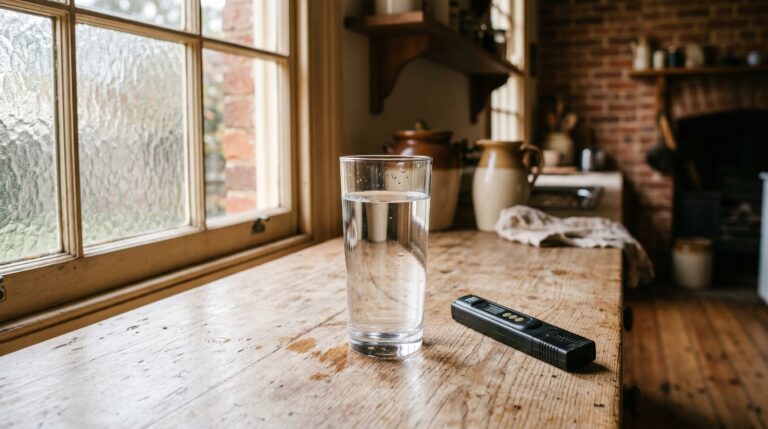
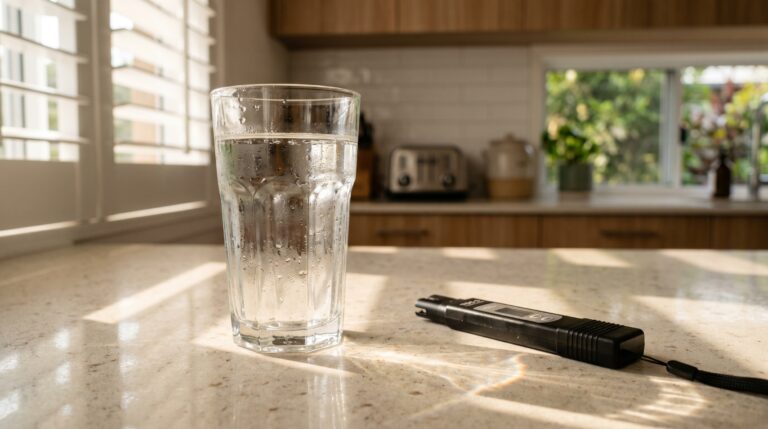
Melbourne is different. According to Melbourne Water’s published water quality data, the city’s supply — drawn primarily from the Yarra Ranges catchments (Upper Yarra, Thomson, and Maroondah reservoirs) — delivers water at approximately 25 mg/L CaCO₃. That is classified as “very soft” under the Australian Drinking Water Guidelines (ADWG 2024). It is roughly one-seventh the hardness of Perth tap water. The soap-scum mechanism that drives hard-water eczema research simply does not apply at this concentration.
The second factor is disinfection. Melbourne uses free chlorine — not chloramine. This distinction matters enormously for filter selection across Australia. Brisbane, Sydney, Adelaide, Gold Coast, and Darwin all use chloramine, which is far more persistent and requires catalytic carbon or reverse osmosis to remove (standard GAC filters remove chloramine at approximately 1/40th the rate of free chlorine). But in Melbourne, a standard activated carbon filter or KDF-55 shower head removes free chlorine effectively. The question is whether you need to remove it at all for eczema management.
Free chlorine in Melbourne’s supply typically sits below 1 mg/L at the tap, well within the ADWG health guideline value of 5 mg/L. At sub-1 mg/L concentrations, there is no robust clinical evidence that free chlorine in bathing water drives eczema flares in adults. Some dermatologists note that swimming pool chlorine (typically 1-3 mg/L, with prolonged immersion) can irritate compromised skin barriers — but a 10-minute shower at 0.5 mg/L is a materially different exposure.
The Hard-Water Eczema Evidence: What the Research Actually Shows
If you are reading about water filters and eczema, you have probably encountered claims that “hard water causes eczema.” The reality is more nuanced, and understanding the actual evidence helps you decide whether spending $40-$150 on a shower filter makes sense in Melbourne specifically.
The strongest evidence comes from the UK, where domestic water hardness varies dramatically by region (from ~20 mg/L in Scotland to 300+ mg/L in south-east England). The SOFTER trial (Thomas et al., 2011, PLOS Medicine) was a randomised controlled trial that installed ion-exchange water softeners in homes of children with established eczema. It found no statistically significant improvement in eczema severity compared to the control group — despite successfully reducing water hardness. This is the highest-quality interventional evidence available, and it did not support water softening as an eczema treatment.
Observational studies paint a more complex picture. The Jabbar-Lopez ZK et al. (2020) systematic review found that living in hard water areas was associated with higher eczema prevalence in some cross-sectional studies, but the authors explicitly noted the evidence was insufficient to establish causation. Confounders — socioeconomic status, climate, genetic FLG mutations, and indoor allergen exposure — were inadequately controlled across most included studies.
The bottom line: even in actually hard-water cities, the case for water filtration as an eczema intervention is observational and contested. In Melbourne, where hardness is 5-7 times lower than the thresholds studied, the case is essentially absent. No Australian clinical guideline — from the NHMRC, the Australasian College of Dermatologists, or any state health authority — recommends water filtration as a treatment for atopic dermatitis.
This does not mean water never interacts with eczema. It means the mechanism that matters is not hardness or disinfection chemistry — it is temperature and bathing behaviour. Hot water strips natural oils from the stratum corneum regardless of what city you live in. That applies in Melbourne just as much as Perth. We will cover what to do about it below.
When a Shower Filter Might Still Help in Melbourne
Honesty about the evidence does not mean a filter is never worthwhile. There are two specific scenarios where a Melbourne household with eczema-prone skin might benefit from a shower filter — just not for the reasons most filter marketing suggests.
Scenario 1: Chlorine Smell Bothers Sensitive Skin
Some people with compromised skin barriers report that the smell and sensation of chlorinated water is uncomfortable, even at Melbourne’s sub-1 mg/L concentrations. If this is you, a standard carbon or KDF-55 shower filter will reduce free chlorine effectively. Because Melbourne uses free chlorine (not chloramine), you do not need catalytic carbon or vitamin C filtration — any entry-level shower filter works here. A basic KDF-55 shower head costs $30-$60 and lasts 6-12 months before cartridge replacement.
This is a comfort intervention, not a clinical one. If removing chlorine from your shower makes the experience less irritating and you shower more willingly (rather than avoiding bathing, which worsens eczema), the filter has value — just not pharmacological value.
Scenario 2: Very Hot Showers in Winter
Melbourne winters are cold enough that long, hot showers become habit. This is the single most damaging bathing behaviour for eczema-prone skin, and it has nothing to do with water chemistry. Water above 37°C strips the lipid layer from the stratum corneum, increases transepidermal water loss (TEWL), and triggers itch-scratch cycles. A thermostatic mixing valve or simply turning the temperature down costs nothing and delivers more eczema benefit than any filter.
The evidence-based bathing protocol for eczema (endorsed by the Australasian College of Dermatologists) is: lukewarm water (32-37°C), shower duration under 10 minutes, pat dry (do not rub), and apply emollient within 3 minutes of drying. This protocol is free, city-independent, and supported by clinical evidence. A $50 shower filter is not.
What Melbourne Eczema Sufferers Should Address Before Buying a Filter
If you live in Melbourne and your eczema is flaring, the water is the least likely suspect. Here is what to investigate first — ranked by the strength of evidence and the likelihood of impact in Melbourne specifically.
1. House Dust Mites
Melbourne’s temperate climate with moderate humidity creates ideal conditions for Dermatophagoides pteronyssinus (the European house dust mite). According to the Australasian Society of Clinical Immunology and Allergy (ASCIA), house dust mite allergy is one of the most common triggers for atopic dermatitis in Australian children and adults. Encasing mattresses and pillows in mite-proof covers, washing bedding weekly at 60°C, and maintaining indoor humidity below 50% with a dehumidifier or adequate ventilation are evidence-supported interventions. These are free or low-cost and backed by randomised trial evidence.
2. Fragrance in Detergents and Personal Care Products
Fragrance chemicals (including limonene, linalool, and cinnamaldehyde) are among the most common contact allergens identified in patch testing by Australian dermatology clinics. Switching to fragrance-free laundry detergent, body wash, and moisturiser eliminates a significant irritant source. This costs nothing extra — fragrance-free products are widely available at Coles and Woolworths. The Australasian College of Dermatologists specifically recommends fragrance-free emollients as first-line eczema management.
3. Indoor Mould
Melbourne homes — particularly older weatherboard houses in suburbs like Northcote, Brunswick, and Fitzroy — are prone to mould growth during the cooler months (May-September). Mould spores are known respiratory allergens, and in sensitised individuals, mould exposure can exacerbate atopic dermatitis. Address visible mould with appropriate remediation, improve ventilation, and consider a HEPA air purifier rated for mould spore capture (particles typically 2-20 µm, well within HEPA’s 0.3 µm threshold).
4. Wool and Synthetic Fabrics
Melbourne’s cooler climate means more wool jumpers and synthetic thermal layers against the skin. Merino wool fibres above 18 µm diameter cause mechanical irritation that triggers itch-scratch cycles in eczema-prone individuals. Wear cotton or silk next to the skin. Ultrafine merino (<17.5 µm) is tolerated by most people with eczema, according to a 2019 randomised crossover trial by Su et al. (Dermatitis, PubMed 30570586), but coarser wools should be avoided.
Melbourne vs Other Australian Capitals: Why the City Matters
To understand why this article exists — and why most shower filter marketing is misleading for Melbourne residents — compare Melbourne’s water to other capitals where a filter actually makes more sense for eczema-prone skin.
| City | Hardness (mg/L CaCO₃) | Disinfection | Shower Filter Need for Eczema |
|---|---|---|---|
| Melbourne | ~25 (very soft) | Free chlorine | Low — comfort only |
| Brisbane / SEQ | ~80-120 (moderate) | Chloramine | Moderate — vitamin C or catalytic carbon |
| Sydney | ~50 (soft) | Chloramine | Moderate — chloramine is the concern |
| Adelaide | ~140 (hard) | Chloramine | High — hardness + chloramine |
| Perth | ~180 (hard) | Chloramine | Highest — hardest water + chloramine |
| Darwin | ~150 (hard) | Chloramine | High — hardness + chloramine |
The pattern is clear. The cities where water filters make the strongest case for eczema management — Perth, Adelaide, Darwin — are the ones with both hard water and chloramine disinfection. Melbourne sits at the opposite extreme: the softest water and the easiest-to-remove disinfectant. If you have moved to Melbourne from Perth or Adelaide and noticed your eczema improved, the water chemistry change is a plausible explanation. If you have always lived in Melbourne and your eczema is worsening, the water almost certainly is not the cause.
For Brisbane, Sydney, and other chloramine cities, our shower filter eczema guide covers the specific filtration requirements — KDF-55 fails for chloramine, so vitamin C or catalytic carbon is required. Melbourne residents do not face this complication.
If You Still Want a Filter: What Works in Melbourne
Some Melbourne residents will read all of the above and still want a filter. That is a perfectly reasonable comfort decision — removing chlorine from shower water can make hair and skin feel softer, even if the eczema benefit is not clinically supported. Here is what you need to know.
Standard carbon (GAC) or KDF-55 is sufficient. Because Melbourne uses free chlorine, you do not need catalytic carbon, vitamin C, or reverse osmosis. Any shower filter rated for free chlorine removal will work. This is the one Australian city where the cheapest, simplest shower filter technology is actually adequate.
Look for a shower filter that meets NSF/ANSI 177 (shower filtration devices) or at minimum states a free chlorine reduction percentage in its specifications. Replacement cartridges should be changed every 6-12 months depending on usage. For a household of two adults showering daily, expect cartridge life toward the lower end of that range.
Avoid spending more than $60-$80 on a shower filter for Melbourne use. You do not need multi-stage systems, vitamin C injection, or catalytic carbon — those technologies solve problems (chloramine, very hard water) that Melbourne does not have. Spending $150+ on a premium shower filter in Melbourne is spending money on a problem that does not exist.
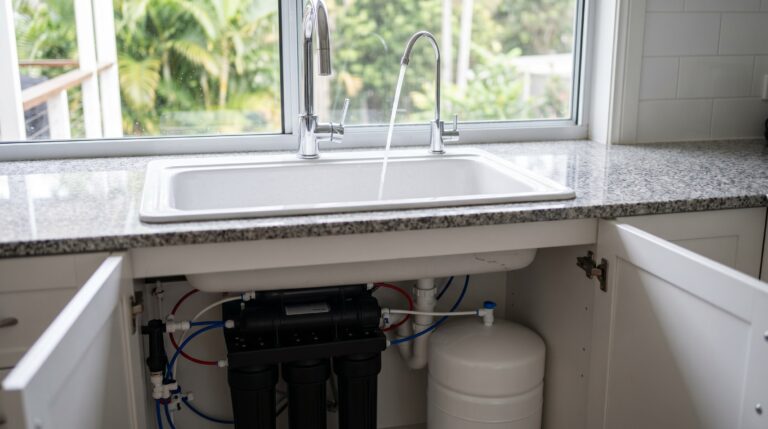
For drinking water — separate from shower water — Melbourne’s tap water is already among the cleanest in Australia. If you want to remove fluoride (Melbourne Water adds fluoride at approximately 1.0 mg/L, per ADWG compliance), only reverse osmosis (90-97% removal) or activated alumina (80-95%) will do the job. Carbon filters — including catalytic carbon — cannot remove fluoride. The Waterdrop D6 under-sink RO or AquaTru Classic countertop RO are the picks if fluoride removal is your goal.
The Evidence-Based Eczema Protocol for Melbourne
Rather than a product recommendation, here is the evidence-based sequence for managing eczema in Melbourne — ranked by clinical evidence strength and cost-effectiveness.
Step 1 (free): Reduce shower temperature to 32-37°C and limit duration to under 10 minutes. Apply emollient within 3 minutes of patting dry. This is the single most effective bathing intervention for eczema, endorsed by the Australasian College of Dermatologists and every major international eczema guideline.
Step 2 (free-$20): Switch to fragrance-free laundry detergent, body wash, and moisturiser. Fragrance chemicals are among the most common contact allergens identified in Australian patch testing.
Step 3 ($20-$80): Encase mattress and pillows in dust mite-proof covers. Wash bedding weekly at 60°C. Melbourne’s climate supports year-round dust mite populations — this is a high-impact, evidence-supported intervention.
Step 4 ($0-$50): Address indoor mould. Improve ventilation in bathrooms and bedrooms. Wipe visible mould with appropriate solutions. Consider a HEPA air purifier if mould is recurrent — particularly in older homes in inner Melbourne suburbs like Northcote, Collingwood, and Brunswick.
Step 5 ($30-$60, optional): Install a basic KDF-55 or carbon shower filter if chlorine sensation bothers your skin. This is a comfort measure, not a clinical intervention.
If you have worked through steps 1-4 and are still experiencing significant eczema flares, the next step is a dermatologist referral — not a more expensive water filter. Water filtration is not the answer to eczema that is unresponsive to evidence-based environmental and emollient interventions.
Last reviewed: July 2026 – Clean and Native
Want clean drinking water in Melbourne?
Melbourne’s tap water is already very soft and gentle. If you want to remove fluoride or PFAS from your drinking water, reverse osmosis is the only proven technology. The AquaTru Classic requires no plumbing and sits on your benchtop.
Frequently Asked Questions
Does Melbourne tap water cause eczema?
Melbourne tap water is very soft (~25 mg/L CaCO₃) and uses free chlorine, making it the least likely Australian capital water supply to aggravate eczema. No Australian health authority recommends water filtration as an eczema treatment, and the SOFTER randomised trial (Thomas et al., 2011) found no significant benefit from water softening even in hard-water areas.
Is Melbourne water hard or soft?
Melbourne water is classified as very soft at approximately 25 mg/L CaCO₃, according to Melbourne Water’s published quality data. This is roughly one-seventh the hardness of Perth (~180 mg/L) and one-fifth of Adelaide (~140 mg/L).
Does Melbourne use chloramine or chlorine?
Melbourne uses free chlorine for disinfection. This is significant because standard carbon and KDF-55 filters effectively remove free chlorine. Cities like Brisbane, Sydney, Adelaide, Gold Coast, and Darwin use chloramine, which requires catalytic carbon or vitamin C filtration and is harder to remove.
Do I need a shower filter for eczema in Melbourne?
For most Melbourne residents with eczema, a shower filter is not necessary. The water is already very soft, and free chlorine levels are typically below 1 mg/L. If chlorine smell bothers your sensitive skin, a basic KDF-55 or carbon shower filter ($30-$60) provides comfort — but it is not a clinical eczema treatment.
What type of shower filter works in Melbourne?
Standard KDF-55 and activated carbon (GAC) shower filters both work effectively in Melbourne because the city uses free chlorine. You do not need catalytic carbon, vitamin C, or multi-stage systems — those technologies address chloramine, which Melbourne does not use.
What triggers eczema in Melbourne if not the water?
The most common eczema triggers in Melbourne are house dust mites (Melbourne’s climate supports year-round populations), fragrance chemicals in detergents and personal care products, indoor mould (especially in older homes), wool and synthetic fabrics, and hot shower temperatures above 37°C.
Does Melbourne tap water contain fluoride?
Yes. Melbourne Water adds fluoride at approximately 1.0 mg/L, in line with ADWG guidelines. If you want to remove fluoride from drinking water, only reverse osmosis (90-97% removal) or activated alumina (80-95%) works. Carbon filters cannot remove fluoride.
Can a water filter cure eczema?
No. No water filter has been shown to cure eczema in any clinical trial. The highest-quality evidence (SOFTER trial, Thomas et al., 2011) found no significant improvement in eczema severity from water softening. Eczema management requires a dermatologist-guided approach including emollients, trigger avoidance, and sometimes topical treatments.
Is Melbourne water better for eczema than Brisbane or Perth water?
Yes, significantly. Melbourne’s water is very soft (25 mg/L CaCO₃ vs Perth’s 180 mg/L) and uses free chlorine instead of chloramine. Both factors make Melbourne tap water the gentlest on eczema-prone skin of any Australian capital. People who relocate from Perth or Adelaide to Melbourne often report skin improvement.
What water temperature should I shower at with eczema?
Between 32°C and 37°C (lukewarm), for under 10 minutes. Water above 37°C strips natural lipids from the skin barrier, increasing transepidermal water loss and triggering itch. This recommendation comes from the Australasian College of Dermatologists and applies regardless of which city you live in.
Get the Australian Home Environment Checklist
30 checks across water, air and EMF. Most of them free. Ranked by impact.
No spam. Unsubscribe any time.

Former Royal Australian Navy Clearance Diver and TAG-E counter-terrorism operator. Founded Clean and Native to apply the same rigorous thinking to the home environment.
Full biography →