Smart Meter EMF Opt Out in Every Australian State 2026
Australian smart meters transmit RF pulses at 900 MHz with peak power densities between 0.2 and 8.0 µW/cm² at one metre — well within ARPANSA’s thermal limit of 1,000 µW/cm² but substantially above the Building Biology SBM-2015 sleeping-area guideline of less than 0.1 mW/m². Opting out of a smart meter in Australia is a state-by-state process governed by your electricity distributor, not your retailer, and every state handles it differently — from Victoria’s established refusal pathway to Queensland’s limited non-transmitting alternatives.
| State | Opt-Out Path | Verdict |
|---|---|---|
| Victoria | Legislated refusal right — retain analog or request non-transmitting | Best pathway |
| NSW | Distributor-level negotiation — Ausgrid, Endeavour, Essential | Case-by-case |
| Queensland | Energex/Ergon — non-transmitting mode request | Limited |
| South Australia | SA Power Networks — analog retention request | Case-by-case |
| Western Australia | Western Power — limited deployment, delay option | Case-by-case |
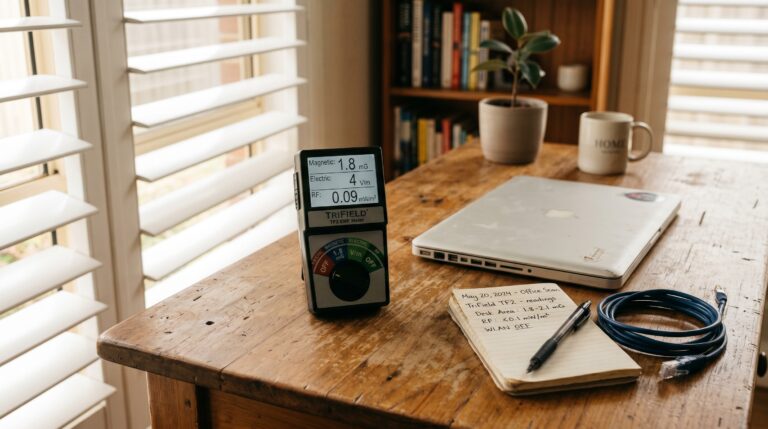
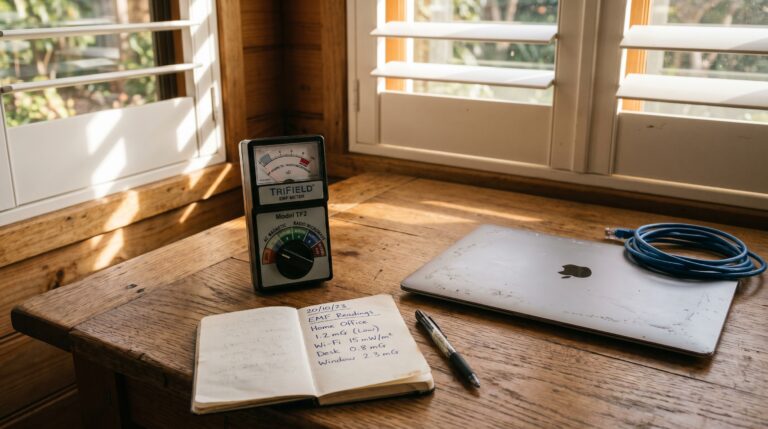
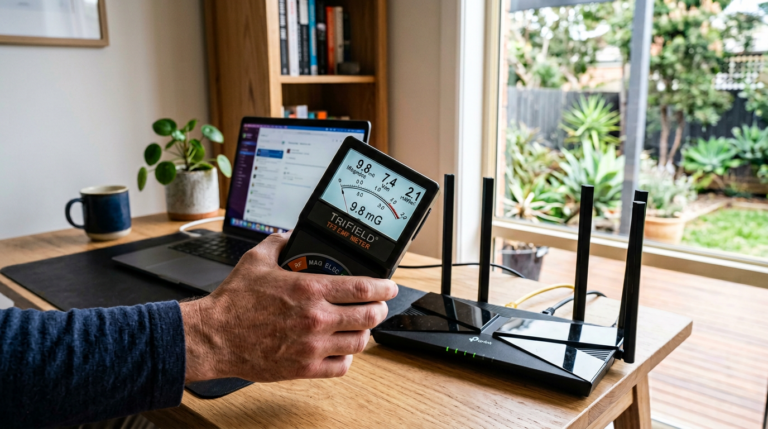
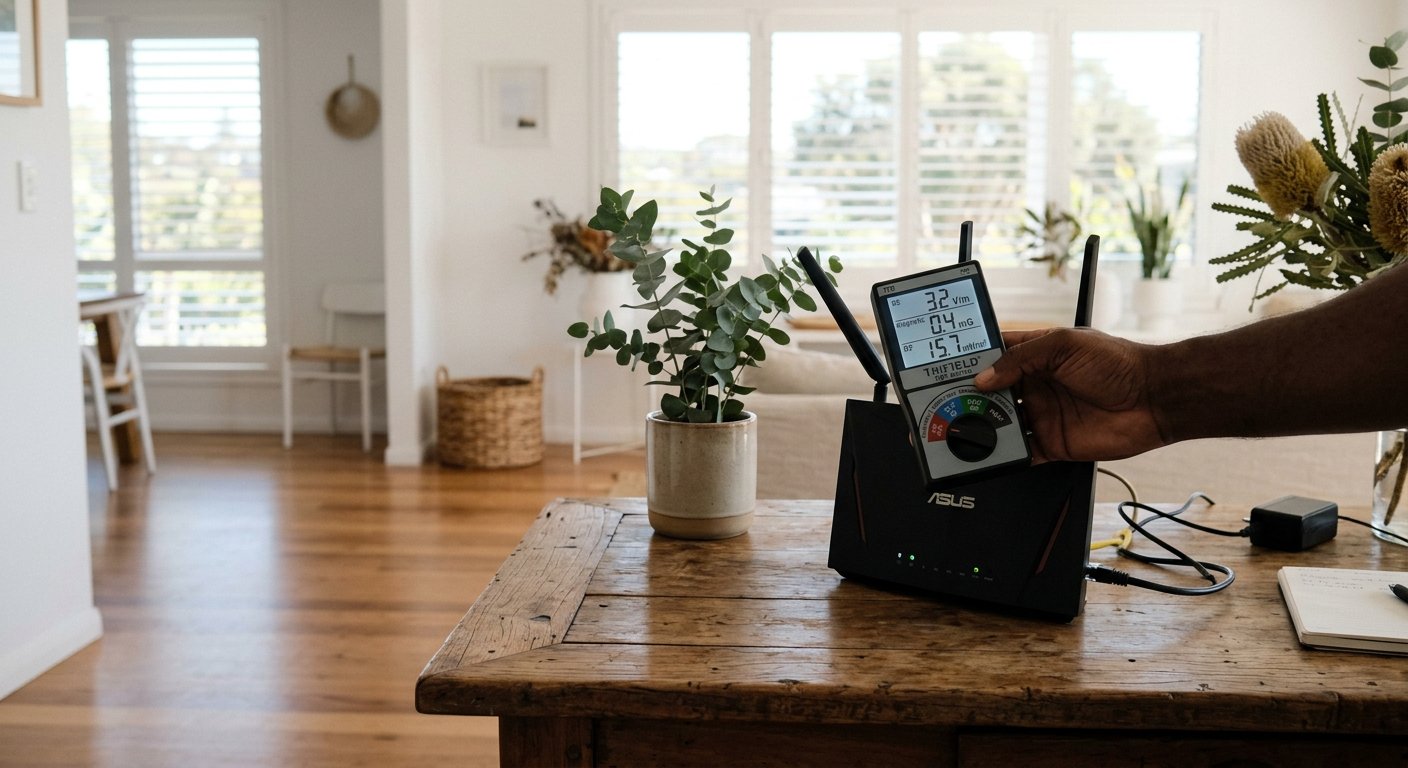
Victoria is the only Australian state with a legislated right to refuse a smart meter. Every other state requires direct negotiation with your electricity distributor — not your retailer. Before you begin the opt-out process, measure your actual exposure first: most bedrooms already exceed Building Biology sleeping-area RF guidelines from Wi-Fi routers and phones, which contribute far more RF than the meter on your exterior wall. The TriField TF2 is the most cost-effective way to identify what you are actually exposed to — and whether the smart meter is even your primary source.
Key catches
- Opt-out requests go to your distributor (Ausgrid, Energex, Powercor, etc.) — not your energy retailer (AGL, Origin, EnergyAustralia)
- Most states charge ongoing manual meter-reading fees if you retain an analog meter — typically $15-30/quarter
- A “non-transmitting” smart meter still contains RF hardware — its radio module is disabled, not removed
- Shielding the meter without first removing internal bedroom RF sources (Wi-Fi router, phone, DECT phone) can increase total exposure via reflection
What Your Smart Meter Actually Transmits — and Why Peak Matters More Than Average
Every Australian AMI (Advanced Metering Infrastructure) smart meter operates on the 900 MHz band regulated by ACMA. According to ARPANSA Radiation Protection Standard RPS 3, the general public RF exposure limit at 900 MHz is approximately 450 µW/cm² (4.5 W/m²). Smart meters sit well below that — but the number ARPANSA uses is a time-averaged figure, and that is where the problem starts for anyone sleeping one wall away from the meter box.
Smart meters do not broadcast continuously. They transmit usage data in short RF bursts — typically lasting 2-20 milliseconds — at intervals ranging from every 15 seconds to every 4 hours, depending on the distributor’s network configuration. Energex meters in south-east Queensland and Ausgrid meters in Sydney use a 900 MHz mesh network (Zigbee or proprietary protocols) that relays data between neighbouring meters before reaching a collector node.
The critical distinction is between time-averaged and peak exposure. ARPANSA’s compliance framework uses a 6-minute time average. During those 6 minutes, a meter might transmit for a cumulative total of 0.5 seconds. The time-averaged reading looks trivially low — often 0.001 µW/cm². But the peak power density during each burst can measure 0.2 to 8.0 µW/cm² at one metre from the meter, and substantially higher if the meter is a mesh relay handling data from multiple neighbouring properties.
For context, here is how smart meter RF compares to other common household sources:
| RF Source | Frequency | Peak at 1 m | Duty Cycle | Bedroom Impact |
|---|---|---|---|---|
| Smart meter (900 MHz) | 900 MHz | 0.2–8.0 µW/cm² | <1% typical | Wall attenuates 10–20 dB; lower indoors |
| Wi-Fi router (2.4 GHz) | 2.4 / 5 GHz | 10–100 µW/cm² | 10–90% (always pinging) | Typically highest bedroom source |
| Mobile phone (active call) | 700–2600 MHz | 100–1,000 µW/cm² | Near-continuous during call | Against head = max personal exposure |
| DECT cordless phone | 1.9 GHz | 10–50 µW/cm² | Continuous (even idle) | Constant emitter — remove from bedroom |
| Building Biology SBM-2015 limit | Any | <0.01 µW/cm² | N/A | Precautionary sleeping guideline |
The table makes the priority clear. Your Wi-Fi router and any phone left on the bedside table almost certainly contribute more RF to your sleeping environment than the smart meter on the exterior wall. That does not mean the smart meter is irrelevant — if your bedroom wall shares the exterior where the meter box is mounted, peak burst readings can still exceed Building Biology guidelines indoors. But before you spend time and money on an opt-out process, measure your actual exposure. The sequence matters: measure first, then address sources in order of contribution.
Why You Must Measure Before You Opt Out — the Correct Reduction Sequence
I am a former Navy Clearance Diver. In diving, we follow a strict sequence: assess the hazard, identify the source, mitigate the highest-risk item first. EMF reduction works the same way. If you skip measurement and go straight to an opt-out application, you might spend months navigating your distributor’s process while your Wi-Fi router broadcasts 50 µW/cm² into your pillow every night.
The correct sequence for reducing bedroom RF exposure is:
- Measure — take peak-hold RF readings at your bed position, at the smart meter wall, at the router, and at any other suspected source. Use a calibrated meter like the TriField TF2 or the Safe and Sound Pro II for dedicated RF measurement.
- Remove or disable internal sources — put your phone in airplane mode at night (free), put a mechanical timer on your Wi-Fi router ($20), remove DECT cordless phones from the bedroom entirely.
- Re-measure — confirm which sources remain. If the smart meter is now the dominant residual source, proceed to opt-out or shielding.
- Opt out or shield — apply for non-transmitting mode, analog retention, or (only after internal sources are gone) shield the meter wall externally.
The shielding trap is real. If you install a Faraday canopy or RF-shielding paint on an interior wall while your Wi-Fi router is still broadcasting inside the room, the shielding reflects that internal RF back toward you, increasing your exposure. Shielding is only appropriate once you have confirmed all significant internal sources are eliminated. This is documented in the Building Biology SBM-2015 guidelines for sleeping areas: shield external residual RF only, never internal sources.
After addressing internal sources, most households find their bedroom RF drops below Building Biology thresholds without touching the smart meter at all. For the remainder — particularly bedrooms where the bed headboard shares the exterior meter-box wall — the opt-out process is worth pursuing. Here is exactly how to do it in every Australian state.
State-by-State Smart Meter Opt-Out Process — Australia 2026
Every Australian state and territory manages electricity metering through different distributors under different regulatory frameworks. Your energy retailer (AGL, Origin, EnergyAustralia, etc.) does not own or manage the meter — the distributor does. You must contact the correct distributor directly. Here is the complete process for each state.
Victoria — Legislated Right to Refuse
Victoria completed its mandatory smart meter rollout between 2009 and 2013, making it the first and most contentious state in Australia for smart meter deployment. Following significant community opposition, the Victorian Government introduced an Order in Council under the Electricity Industry Act 2000 allowing customers to refuse installation of a smart meter or request a non-transmitting configuration.
Your options in Victoria:
- Refuse installation — if you still have an analog meter, you can formally refuse the replacement. Write to your distributor (Powercor, CitiPower, Jemena, AusNet Services, or United Energy) stating you do not consent to smart meter installation. Reference the Victorian Government’s 2014 Order in Council allowing customer refusal.
- Request non-transmitting mode — if a smart meter is already installed, you can request the wireless transmitter be disabled. The meter remains but functions as a manually-read digital meter. Contact your distributor in writing.
- Request meter removal — some distributors will remove an installed smart meter and replace it with an analog accumulation meter, though this is less commonly granted.
Costs: Victorian distributors typically charge a manual meter-reading fee for non-transmitting or analog meters. This has ranged from $15 to $30 per quarter depending on distributor. The fee covers the cost of sending a meter reader to your property instead of receiving data remotely.
Distributors:
| Distributor | Coverage Area | Contact Method |
|---|---|---|
| Powercor / CitiPower | Western VIC / Melbourne CBD | Written request to metering team |
| Jemena | North-west Melbourne suburbs | Written request to metering team |
| AusNet Services | Eastern VIC / Gippsland | Written request to metering team |
| United Energy | South-east Melbourne / Mornington | Written request to metering team |
Escalation: If your distributor refuses or delays, lodge a complaint with the Energy and Water Ombudsman Victoria (EWOV). Victorian consumers have the strongest regulatory backing for smart meter refusal of any Australian state. If you live in the eastern suburbs near AusNet’s coverage area, or in Mornington Peninsula under United Energy, the process is well established — these distributors have handled thousands of opt-out requests since 2014.
New South Wales — Distributor-Level Negotiation
NSW does not have a legislated right to refuse a smart meter in the same way Victoria does. However, the rollout in NSW is still ongoing and less advanced than Victoria’s. The three NSW distributors — Ausgrid (Sydney, Central Coast, Hunter), Endeavour Energy (western Sydney, Blue Mountains, Illawarra, southern highlands), and Essential Energy (regional NSW) — each handle requests independently.
Your approach in NSW:
- If your analog meter has not yet been replaced, write to your distributor requesting that the existing meter be retained. Cite health concerns and request a delay or exemption.
- If a smart meter is installed, request non-transmitting mode. Ausgrid’s AMI meters use a 900 MHz mesh network — the radio module can typically be disabled remotely by the distributor without a site visit.
- Reference the Australian Consumer Law (ACL) and your right to raise concerns about products and services installed at your property. While the ACL does not explicitly cover metering, it provides a framework for disputing unwanted installations.
Costs: NSW distributors may charge manual meter-reading fees similar to Victoria ($15-30/quarter). Some have waived these fees on a case-by-case basis, particularly where health grounds are cited with supporting documentation.
Escalation: Energy & Water Ombudsman NSW (EWON). For residents of western Sydney suburbs like Penrith, Parramatta, and Blacktown under Endeavour Energy’s network, the rollout timeline may provide additional time to negotiate before installation reaches your street.
Queensland — Limited Non-Transmitting Options
Queensland’s smart meter rollout is managed by Energex (south-east Queensland) and Ergon Energy (regional Queensland). SEQ’s rollout has been progressive rather than mandatory, with smart meters typically installed during new connections, meter upgrades, or solar installations.
Your approach in Queensland:
- Refuse at point of installation — if you receive notice that your meter is scheduled for replacement, write to Energex or Ergon requesting retention of your existing analog meter. This is most effective before installation occurs.
- Request non-transmitting mode — Energex’s AMI meters (predominantly Landis+Gyr models in SEQ) can have their 900 MHz radio module disabled. Request this in writing to the metering team at Energex.
- Solar complication — if you are installing solar PV, a smart meter is typically mandatory under Queensland’s feed-in tariff arrangements. You may still be able to request non-transmitting mode after installation, but the meter itself is required for bi-directional metering.
Costs: Energex may charge a manual meter-reading fee. For properties in Logan, Ipswich, and Brisbane’s western corridor, where Energex has been most active in meter replacement, early engagement with the metering team is critical.
Escalation: Energy and Water Ombudsman Queensland (EWOQ).
South Australia — SA Power Networks
South Australia has a single electricity distributor — SA Power Networks (SAPN). Their smart meter rollout has been progressive, with deployment concentrated in Adelaide’s metropolitan area before extending to regional SA.
Your approach in South Australia:
- Write to SA Power Networks’ metering department requesting analog meter retention or non-transmitting smart meter configuration.
- SA does not have legislated refusal rights equivalent to Victoria’s. Requests are handled on a case-by-case basis by SAPN.
- Cite health concerns with specific reference to sleeping proximity if your bedroom shares the meter-box wall.
Costs: Manual meter-reading fees apply — expect $15-30/quarter. Adelaide’s harder water (TDS ~400 mg/L, for context — though that is a water issue, not an EMF one) means many SA homeowners are already familiar with dealing with utility-specific technical requests.
Escalation: Energy and Water Ombudsman SA (EWOSA).
Western Australia — Limited Deployment, Delay Options
Western Australia’s smart meter rollout through Western Power is the least advanced of the mainland states. Many WA properties still operate with analog accumulation meters, particularly in Perth’s outer suburbs and regional areas.
Your approach in Western Australia:
- If you still have an analog meter, you are in the strongest position. Write to Western Power requesting that your existing meter be retained when the rollout reaches your area.
- If a smart meter has been installed, request non-transmitting mode in writing to Western Power’s metering department.
- WA’s regulatory framework through the Economic Regulation Authority (ERA) is less prescriptive on smart metering than Victoria’s framework, which can work in your favour — there is no mandate forcing replacement on an immediate timeline.
Costs: Manual meter-reading fees are likely if you retain an analog meter. For residents of Perth’s Kwinana industrial corridor, Rockingham, and Mandurah, where Western Power has focused early-stage deployment, proactive engagement now is the time to act.
Escalation: Energy and Water Ombudsman Western Australia (EWOWA).
ACT, Tasmania, and Northern Territory
The ACT (ActewAGL Distribution/Evoenergy), Tasmania (TasNetworks), and the Northern Territory (Power and Water Corporation) have smaller-scale or negligible smart meter rollouts as of 2026. If you are in these jurisdictions, the most effective action is to write to your distributor pre-emptively requesting analog meter retention before any future rollout is announced. Monitor your distributor’s published metering policies for changes.
How to Write an Effective Opt-Out Request Letter
Your opt-out request needs to be in writing — not a phone call. Written requests create a paper trail and trigger formal complaint-handling obligations under each state’s electricity distribution code. Here is what to include:
- Your NMI (National Metering Identifier) — found on your electricity bill. This identifies your specific meter, not your account.
- Specific request — state clearly whether you want analog meter retention, non-transmitting mode, or meter removal. Be specific. “I request that the wireless transmission function of smart meter NMI [number] be permanently disabled” is better than “I have concerns about smart meters.”
- Health grounds — reference the proximity of your sleeping area to the meter and cite the Building Biology SBM-2015 precautionary guidelines for sleeping areas (<0.1 mW/m² RF). You do not need a medical certificate, but one supporting your concerns strengthens the request.
- ARPANSA reference — note that ARPANSA Radiation Protection Standard RPS 3 is a thermal safety standard, not a precautionary health guideline, and that you are applying a precautionary approach as recommended by the Building Biology Institute.
- Ombudsman escalation statement — state that you will escalate to the relevant Energy and Water Ombudsman if a satisfactory resolution is not reached within 20 business days.
Send via email and registered post. Keep copies of everything. If the distributor acknowledges receipt but delays action, follow up at 10 business days and reference your escalation pathway. Distributors are required under their distribution licence conditions to respond to formal complaints within specified timeframes — the ombudsman reference signals you know this.
What to Do While You Wait — Immediate RF Reduction Steps
The opt-out process can take weeks to months. While you wait, these actions deliver measurable RF reduction in your sleeping environment tonight — most of them for free.
Step 1: Phone in airplane mode. Free. Your phone on the bedside table broadcasts at 700-2600 MHz and is almost certainly your highest personal RF source during sleep. Airplane mode eliminates it entirely. If you need an alarm, airplane mode still allows the alarm function.
Step 2: Router on a timer. A Jackson 24hr Mechanical Timer costs approximately $20 on Amazon AU. Set it to cut power to your router from 10 PM to 6 AM. Your Wi-Fi router broadcasts beacon frames every 100 milliseconds — even when no device is connected. Switching it off during sleep removes the single highest-duty-cycle RF source in most Australian homes.
Step 3: Remove DECT cordless phones. DECT phones transmit at 1.9 GHz continuously, even when not in use. The base station is a constant emitter. If you have one in or near your bedroom, unplug the base station at night or replace it with a corded phone.
Step 4: Move your bed. Free. If your bed headboard is against the wall that has the smart meter on the other side, move the bed to an interior wall. RF power density decreases with the square of distance — doubling your distance from the meter cuts exposure by 75%. An Australian brick veneer exterior wall provides approximately 10-20 dB of RF attenuation at 900 MHz, but moving the bed further from the wall provides additional reduction without any cost.
Step 5: Measure, then consider shielding. Only after steps 1-4 should you consider physical shielding. If the smart meter is confirmed as the dominant remaining source (via measurement with a TriField TF2 or Safe and Sound Pro II), you can apply aluminium foil tape to the interior of the wall behind the meter, or use EMF shielding paint on that wall section. Shielding on the exterior or meter box itself is not recommended — it can interfere with the mesh network and may prompt your distributor to replace the meter.
For a comprehensive walkthrough of the entire measurement and reduction process, see our complete guide to EMF in your Australian home.
Non-Transmitting Smart Meters vs Analog Meters — Which Is Better?
When you request an opt-out, your distributor will typically offer one of two options: disabling the wireless module on your existing smart meter (non-transmitting mode) or replacing the smart meter with an analog accumulation meter. These are different outcomes with different RF implications.
Non-transmitting smart meter: The RF radio module is disabled via firmware or physical disconnection. The meter retains its digital display, internal logging, and interval data recording — it just stops transmitting wirelessly. A meter reader visits periodically to download data via optical port or handheld device. RF emissions drop to effectively zero from the meter itself. However, the meter still contains RF hardware, and in some configurations, it may still receive (listen for) network signals without transmitting. If you are concerned about the receiving function, ask your distributor to confirm whether the radio is fully disabled in both transmit and receive modes.
Analog accumulation meter: A traditional electromechanical meter with a spinning disc. Zero RF emissions, zero digital components, zero wireless capability. It measures cumulative energy consumption only — no interval data, no time-of-use billing, no remote reading. This is the most complete elimination of meter-related RF. The trade-off is that you lose access to time-of-use tariffs (which can save money if you shift usage to off-peak periods) and detailed consumption data through distributor portals.
Which should you request? If your primary concern is RF exposure, either option eliminates smart meter RF. Non-transmitting mode is faster to implement (usually a remote firmware change, no site visit required) and preserves your access to time-of-use tariffs. Analog replacement is more definitive but requires a physical meter swap and may involve a longer wait and higher upfront cost.
For most households, requesting non-transmitting mode is the practical first step. If the distributor pushes back, escalate to analog retention as the alternative.
Demand Switches, Shielding, and the Smart Meter — Reducing What Remains
Even after addressing RF sources, your bedroom environment may still contain elevated AC electric fields from the house wiring itself. These are not related to the smart meter, but they are relevant to anyone taking a systematic approach to reducing electromagnetic exposure during sleep.
Demand switch: A licensed electrician installs a demand switch on your bedroom circuit for approximately $100-150. When no loads are drawing current (all lights off, nothing plugged in), the demand switch automatically cuts voltage to the circuit, eliminating AC electric fields from the wiring in your bedroom walls. According to Building Biology SBM-2015, AC electric fields in sleeping areas should be below 5 V/m — a demand switch achieves this by removing the field source entirely. This is the single most cost-effective intervention for AC electric field reduction and has nothing to do with your smart meter — but if you are already optimising your sleeping environment, it completes the picture.
Smart meter shielding (exterior wall only): If measurement confirms the smart meter as a significant residual RF source after internal sources are eliminated, you can apply shielding to the interior face of the wall behind the meter. Use EMF shielding paint (graphite-based, grounded to the building’s earth system) or multiple layers of aluminium foil tape behind the plasterboard. Both can achieve 20-40 dB of RF attenuation when properly grounded. Do not shield the meter box itself from the outside — this interferes with the mesh network and may prompt your distributor to investigate or replace the meter.
For a complete step-by-step guide to bedroom EMF measurement and reduction, including demand switches, router placement, and shielding techniques, read our complete EMF guide for Australian homes.
The ARPANSA Position vs Building Biology — Understanding the Gap
ARPANSA’s Radiation Protection Standard RPS 3 sets Australia’s general public RF exposure limit at approximately 450 µW/cm² at 900 MHz (derived from ICNIRP 2020 guidelines). According to ARPANSA’s published position, smart meters comply with this standard by a factor of more than 100. This is factually accurate — smart meter emissions are trivially small compared to ARPANSA’s thermal safety limit.
The Building Biology Institute’s SBM-2015 guidelines operate on a fundamentally different basis. They are precautionary practitioner guidelines for sleeping areas, not regulatory safety limits. The SBM-2015 RF guideline for sleeping areas is less than 0.1 mW/m² (approximately 0.01 µW/cm²) — roughly 45,000 times more conservative than ARPANSA’s limit at 900 MHz.
Neither standard is “wrong.” They answer different questions. ARPANSA’s limit answers: “At what level does RF cause measurable tissue heating in controlled conditions?” Building Biology’s guideline answers: “What RF level do we observe to be associated with undisturbed sleep in practitioner field experience?” These are not competing answers to the same question — they are answers to entirely different questions.
When you write to your distributor, reference both. ARPANSA compliance demonstrates the meter is legal. Building Biology guidelines demonstrate that precautionary action is not unreasonable. This framing prevents the distributor from dismissing your request as based on “debunked science” while making clear you are aware of the regulatory context.
For detailed guidance on how to interpret ARPANSA’s standards and Building Biology guidelines when measuring your own home, see our EMF measurement guide for Australian homes.
Last reviewed: August 2026 – Clean and Native
Final Verdict: Start With Measurement — the TriField TF2 Is the Only Meter You Need.
Measures AC magnetic, AC electric, and RF in one device. Without real readings, every EMF decision is a guess — including whether your smart meter is even your biggest source.
Frequently Asked Questions
Can I opt out of a smart meter in Australia?
Yes. Victoria has a legislated right to refuse or request non-transmitting mode. In NSW, QLD, SA, and WA, you must negotiate directly with your electricity distributor in writing. There is no national opt-out scheme — it is handled at the state and distributor level.
How much RF does an Australian smart meter emit?
Australian smart meters transmit at 900 MHz with peak power densities of 0.2 to 8.0 µW/cm² at one metre. The duty cycle is typically less than 1%, meaning they transmit for less than 1% of any given time period. Peak readings during bursts can be 100 to 1,000 times higher than the time-averaged figure.
Does a smart meter emit more RF than a Wi-Fi router?
No. A Wi-Fi router at 2.4 GHz typically produces 10-100 µW/cm² at one metre with a duty cycle of 10-90%, making it the dominant RF source in most Australian homes. A smart meter’s duty cycle is below 1%. Your router is almost always the higher-priority target for reduction.
What is the difference between a non-transmitting smart meter and an analog meter?
A non-transmitting smart meter has its wireless radio disabled but retains digital metering and interval data capabilities. An analog meter is a traditional electromechanical device with zero wireless hardware. Both eliminate RF emissions from the meter. Non-transmitting mode preserves time-of-use tariff access; analog does not.
Who do I contact to opt out — my energy retailer or my distributor?
Your distributor. Your energy retailer (AGL, Origin, EnergyAustralia) does not own or manage the meter. Contact your distributor directly — Ausgrid, Endeavour, Essential (NSW), Energex, Ergon (QLD), Powercor, Jemena, AusNet, United Energy (VIC), SA Power Networks (SA), or Western Power (WA).
How much does smart meter opt-out cost in Australia?
Most distributors charge a manual meter-reading fee of approximately $15 to $30 per quarter for analog or non-transmitting meters. Some distributors have waived these fees when health grounds are cited. There may also be a one-time fee for meter exchange if you request analog replacement. Exact costs vary by distributor and are not published uniformly.
Can I shield my smart meter instead of opting out?
You can shield the interior wall behind the meter using EMF shielding paint or aluminium foil tape, which provides 20-40 dB of RF attenuation when grounded. Do not shield the meter box from the outside — this interferes with the mesh network and may prompt the distributor to replace the meter. Always remove internal RF sources (Wi-Fi router, phones) before shielding any external source.
What is the best EMF meter for measuring smart meter emissions in Australia?
The TriField TF2 measures RF, AC magnetic, and AC electric fields in one device and covers the 900 MHz band used by Australian smart meters. For dedicated RF-only measurement with higher sensitivity, the Safe and Sound Pro II provides audio feedback and peak-hold readings. Always use peak-hold mode — time-averaged readings dramatically understate smart meter burst emissions.
Does ARPANSA say smart meters are safe?
According to ARPANSA Radiation Protection Standard RPS 3, smart meters comply with Australia’s RF exposure limits by a factor of more than 100. However, ARPANSA’s limits are thermal safety standards based on ICNIRP 2020 guidelines — they protect against tissue heating, not long-term low-level exposure. Building Biology SBM-2015 precautionary guidelines for sleeping areas are approximately 45,000 times more conservative than ARPANSA’s limits.
What is the fastest way to reduce bedroom EMF exposure tonight?
Put your phone in airplane mode (free, immediate), plug your Wi-Fi router into a mechanical timer set to cut power during sleep hours ($20), and remove any DECT cordless phone base stations from the bedroom (free). These three actions typically reduce bedroom RF more than a smart meter opt-out.
Get the Australian Home Environment Checklist
30 checks across water, air and EMF. Most of them free. Ranked by impact.
No spam. Unsubscribe any time.

Former Royal Australian Navy Clearance Diver and TAG-E counter-terrorism operator. Founded Clean and Native to apply the same rigorous thinking to the home environment.
Full biography →